Overview
Multiplying polynomials is a foundational algebraic skill that appears frequently throughout the SAT Math section, making it one of the most critical topics for test-takers to master. This operation involves combining two or more polynomial expressions through multiplication, applying the distributive property systematically to generate a new polynomial. Students encounter polynomial multiplication in various contexts on the SAT, from straightforward computational problems to complex word problems involving area, revenue functions, and geometric relationships.
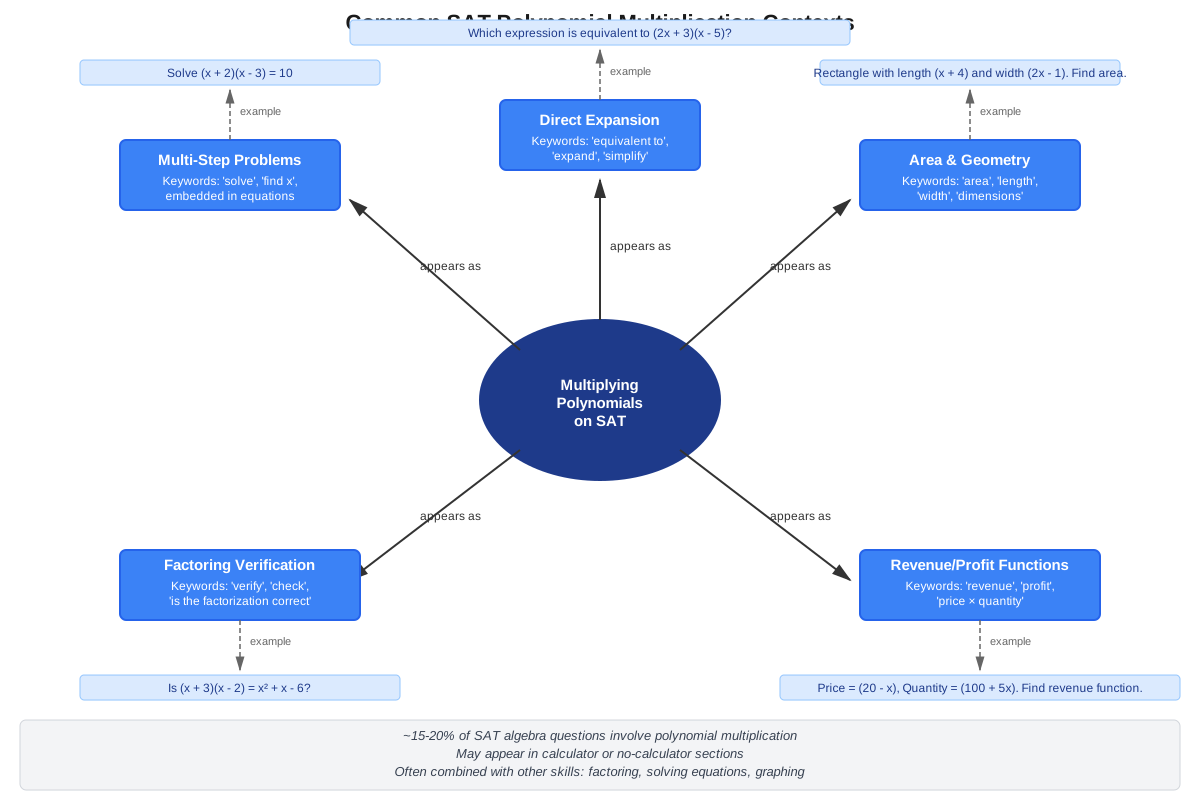
Understanding polynomial multiplication is essential because it serves as the gateway to more advanced algebraic manipulations tested on the SAT. Questions may directly ask students to expand expressions like (x + 3)(2x - 5), or they may embed polynomial multiplication within multi-step problems involving factoring, solving quadratic equations, or analyzing function behavior. The SAT frequently tests whether students can recognize when multiplication is needed, execute it accurately under time pressure, and apply the result to solve real-world scenarios.
This topic connects intimately with other core math concepts tested on the SAT, including factoring (the reverse operation), quadratic functions, systems of equations, and polynomial division. Mastery of sat multiplying polynomials enables students to tackle approximately 15-20% of algebra questions on the exam, making it a high-yield investment of study time. The techniques learned here—particularly the distributive property and combining like terms—form the computational backbone for success across multiple SAT math domains.
Learning Objectives
- [ ] Identify key features of multiplying polynomials, including terms, coefficients, and degree relationships
- [ ] Explain how multiplying polynomials appears on the SAT in both direct and applied contexts
- [ ] Apply multiplying polynomials to answer SAT-style questions accurately and efficiently
- [ ] Execute the FOIL method for binomial multiplication with 100% accuracy
- [ ] Multiply polynomials of any degree using the distributive property systematically
- [ ] Recognize when polynomial multiplication is required within multi-step SAT problems
- [ ] Simplify the product of polynomials by correctly combining like terms
Prerequisites
- Basic algebraic operations: Students must understand how to add, subtract, and multiply integers and variables, as polynomial multiplication builds directly on these fundamental operations
- The distributive property: The ability to apply a(b + c) = ab + ac is essential, since polynomial multiplication is repeated application of this property
- Combining like terms: Students need to recognize and combine terms with identical variable parts (e.g., 3x² + 5x² = 8x²) to simplify polynomial products
- Exponent rules: Understanding that x^m · x^n = x^(m+n) is critical for multiplying variable terms correctly
- Order of operations: Proper sequencing of mathematical operations ensures accurate calculation throughout the multiplication process
Why This Topic Matters
Polynomial multiplication represents one of the most practical algebraic skills with real-world applications spanning engineering, economics, physics, and computer science. Engineers use polynomial multiplication to model compound systems, economists apply it to calculate revenue functions (price × quantity, where both may be variable expressions), and physicists employ it when working with kinetic energy formulas and projectile motion equations. The ability to multiply polynomials enables professionals to combine multiple variable relationships into unified mathematical models.
On the SAT, polynomial multiplication appears in approximately 3-5 questions per test administration, representing roughly 5-8% of the total math section. These questions manifest in several formats: direct computational problems asking students to expand expressions, word problems requiring students to set up and multiply polynomial expressions, questions about the coefficients or degree of polynomial products, and multi-step problems where multiplication is an intermediate step toward finding a final answer. The College Board particularly favors questions that combine polynomial multiplication with other skills, such as finding specific coefficients in the expanded form or using the product to solve equations.
Common SAT question types include: finding the product of two binomials and identifying a specific coefficient; determining what expression, when multiplied by a given polynomial, yields a particular result; applying polynomial multiplication to geometric problems involving area or volume; and analyzing the degree or leading coefficient of a polynomial product. The test also frequently embeds polynomial multiplication within function notation, asking students to evaluate expressions like f(x) · g(x) where both functions are polynomials.
Core Concepts
The Distributive Property Foundation
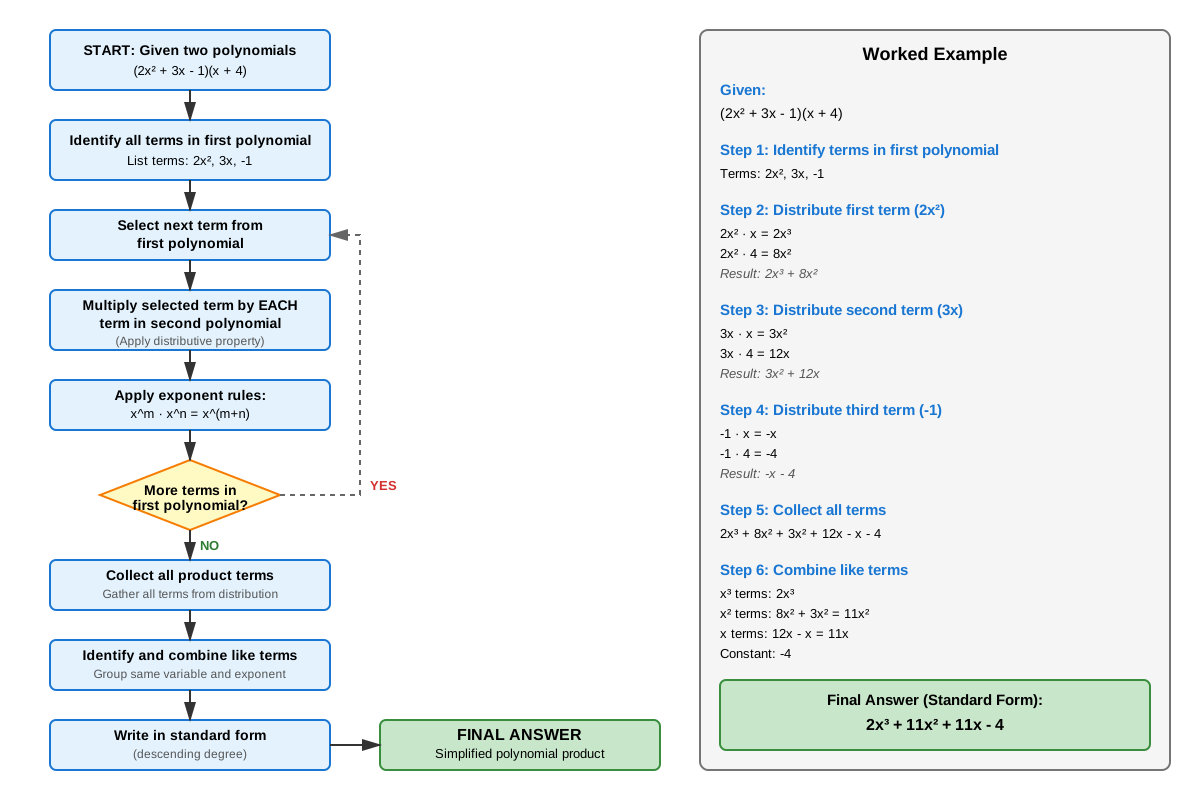
The fundamental principle underlying all polynomial multiplication is the distributive property, which states that a(b + c) = ab + ac. When multiplying polynomials, each term in the first polynomial must be multiplied by every term in the second polynomial. This systematic distribution ensures no terms are omitted and forms the conceptual foundation for all multiplication methods.
For example, when multiplying a monomial by a polynomial: 3x(2x² - 5x + 4), the monomial 3x must be distributed to each term inside the parentheses:
- 3x · 2x² = 6x³
- 3x · (-5x) = -15x²
- 3x · 4 = 12x
The final result is 6x³ - 15x² + 12x.
Multiplying Binomials: The FOIL Method
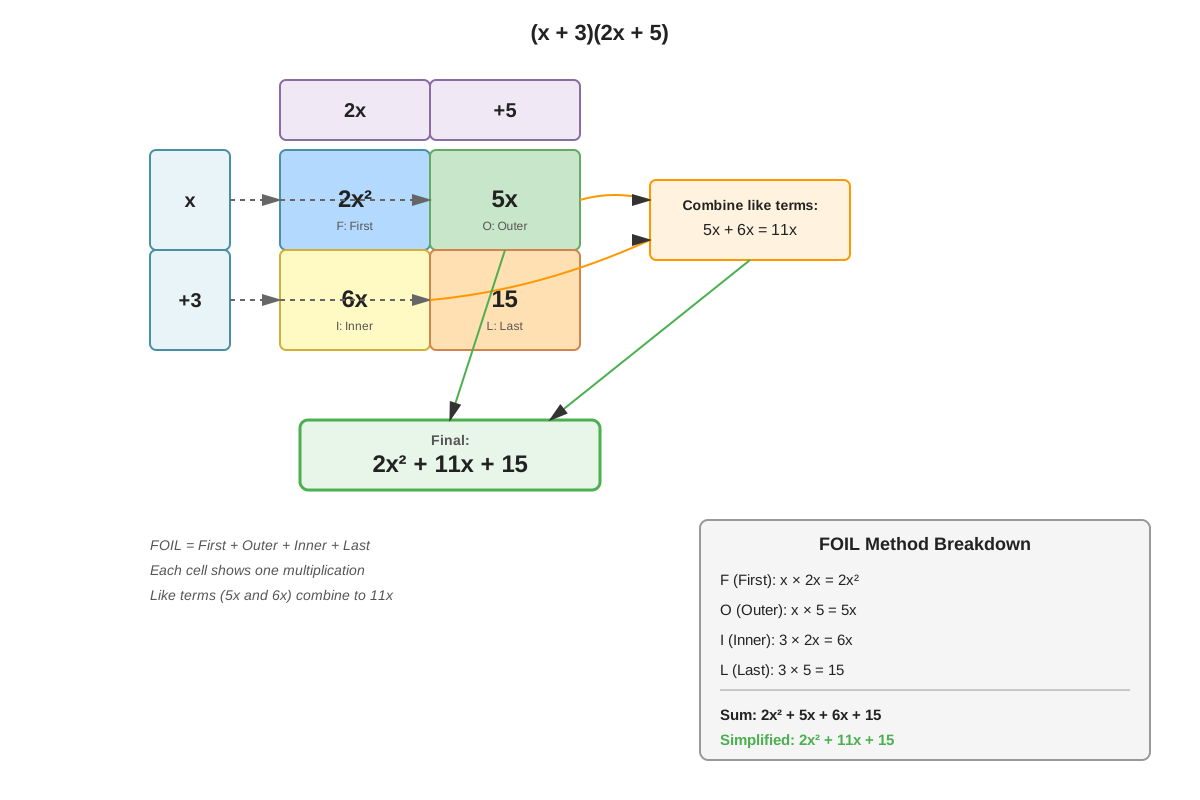
The FOIL method is a specialized technique for multiplying two binomials (polynomials with exactly two terms). FOIL is an acronym representing the four multiplication steps:
- First: Multiply the first terms of each binomial
- Outer: Multiply the outer terms (first term of the first binomial, second term of the second binomial)
- Inner: Multiply the inner terms (second term of the first binomial, first term of the second binomial)
- Last: Multiply the last terms of each binomial
Consider (2x + 3)(x - 4):
- First: 2x · x = 2x²
- Outer: 2x · (-4) = -8x
- Inner: 3 · x = 3x
- Last: 3 · (-4) = -12
Combining these products: 2x² - 8x + 3x - 12 = 2x² - 5x - 12
The FOIL method works exclusively for binomials but provides a quick, systematic approach that minimizes errors on timed exams.
The Box Method (Area Model)
The box method or area model provides a visual, organized approach to multiplying polynomials of any size. This method is particularly valuable for multiplying trinomials or larger polynomials where FOIL doesn't apply.
To use the box method:
- Draw a rectangle divided into a grid
- Write the terms of one polynomial along the top
- Write the terms of the other polynomial along the left side
- Fill each box by multiplying the corresponding row and column terms
- Add all the products in the boxes, combining like terms
For (x + 2)(x² - 3x + 5):
| x² | -3x | +5 | |
|---|---|---|---|
| x | x³ | -3x² | 5x |
| +2 | 2x² | -6x | +10 |
Collecting all terms: x³ - 3x² + 2x² + 5x - 6x + 10 = x³ - x² - x + 10
Vertical Multiplication Method
The vertical multiplication method mirrors the traditional algorithm for multiplying multi-digit numbers, making it familiar and systematic for students comfortable with arithmetic.
To multiply (3x² + 2x - 1)(x + 4):
    3x² + 2x - 1
    ×      x + 4
    _______________
   12x² + 8x - 4      (multiply by 4)
3x³ + 2x² - x         (multiply by x, shift left)
___________________
3x³ + 14x² + 7x - 4   (add columns)
This method excels when multiplying polynomials with many terms and helps prevent sign errors through organized alignment.
Degree and Leading Coefficient Rules
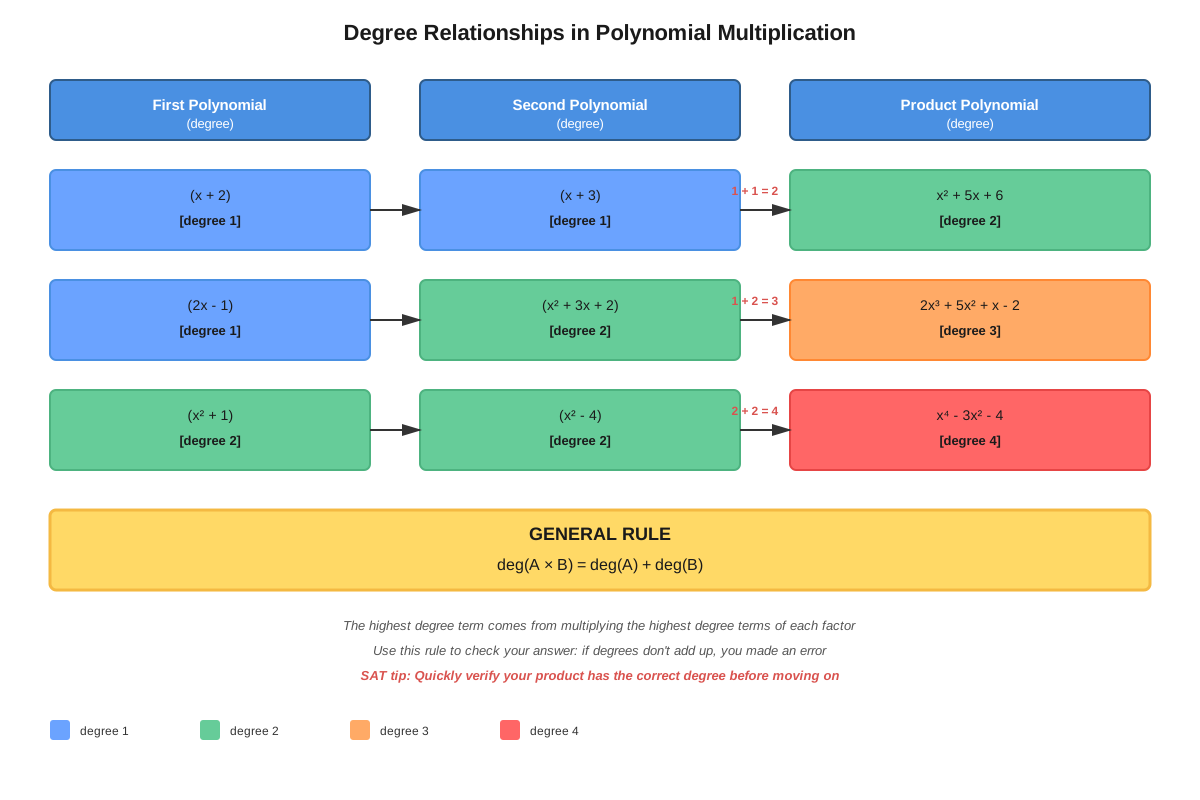
When multiplying polynomials, predictable patterns emerge regarding the degree (highest exponent) and leading coefficient (coefficient of the highest-degree term):
- Degree Rule: The degree of the product equals the sum of the degrees of the factors
- If polynomial A has degree m and polynomial B has degree n, then A · B has degree m + n
- Example: (degree 2) × (degree 3) = degree 5 product
- Leading Coefficient Rule: The leading coefficient of the product equals the product of the leading coefficients
- If A has leading coefficient a and B has leading coefficient b, then A · B has leading coefficient ab
- Example: (3x²)(5x³) yields leading term 15x⁵
These rules allow students to quickly verify answers or eliminate incorrect options on multiple-choice questions without fully expanding the product.
Special Products
Certain polynomial multiplication patterns occur so frequently on the SAT that recognizing them saves significant time:
| Pattern Name | Formula | Example |
|---|---|---|
| Square of a Sum | (a + b)² = a² + 2ab + b² | (x + 5)² = x² + 10x + 25 |
| Square of a Difference | (a - b)² = a² - 2ab + b² | (2x - 3)² = 4x² - 12x + 9 |
| Difference of Squares | (a + b)(a - b) = a² - b² | (x + 7)(x - 7) = x² - 49 |
| Sum and Difference Cubes | (a + b)(a² - ab + b²) = a³ + b³ | (x + 2)(x² - 2x + 4) = x³ + 8 |
Memorizing these special products enables instant recognition and application, particularly valuable for the no-calculator section of the SAT.
Combining Like Terms
After distributing all terms, the final critical step is combining like terms—adding or subtracting terms with identical variable parts. Terms are "like" only when they have exactly the same variables raised to exactly the same powers.
For example, in the expression 3x² - 5x + 2x² + 7x - 4:
- Combine x² terms: 3x² + 2x² = 5x²
- Combine x terms: -5x + 7x = 2x
- Constant term: -4
Final simplified form: 5x² + 2x - 4
Failure to combine like terms completely is one of the most common errors on SAT polynomial questions.
Concept Relationships
The concepts within polynomial multiplication form a hierarchical structure where simpler techniques build toward more complex applications. The distributive property serves as the foundational principle → which enables the FOIL method for binomials → which generalizes to the box method and vertical multiplication for larger polynomials → all of which require combining like terms as the final simplification step.
Understanding special products creates shortcuts that bypass the need for full distribution, connecting directly to pattern recognition skills. The degree and leading coefficient rules provide verification tools that connect polynomial multiplication to polynomial structure and properties.
Polynomial multiplication connects backward to prerequisite topics: it relies on exponent rules (when multiplying variable terms), integer operations (when multiplying coefficients), and the distributive property (as the core mechanism). It connects forward to advanced topics including factoring (the inverse operation), solving quadratic equations (which often requires expanding products), polynomial division, and function composition.
The relationship map: Distributive Property → Monomial × Polynomial → Binomial × Binomial (FOIL) → General Polynomial Multiplication → Special Products (shortcuts) → Applications (area, revenue, function operations) → Factoring (reverse process).
Quick check — test yourself on Multiplying polynomials so far.
Try Flashcards →High-Yield Facts
⭐ The degree of a polynomial product equals the sum of the degrees of the factors (degree 2 × degree 3 = degree 5 product)
⭐ FOIL only works for multiplying two binomials; use the distributive property or box method for larger polynomials
⭐ (a + b)² ≠ a² + b²; the correct expansion is a² + 2ab + b², including the middle term 2ab
⭐ The difference of squares pattern (a + b)(a - b) = a² - b² eliminates the middle term entirely
⭐ Every term in the first polynomial must multiply every term in the second polynomial; missing any combination produces an incorrect answer
- When multiplying binomials, the result is typically a trinomial (three terms) unless like terms cancel
- The leading coefficient of the product equals the product of the leading coefficients of the factors
- Sign errors most commonly occur with negative terms; carefully track negative signs through each multiplication step
- The constant term in the product of two polynomials equals the product of the constant terms from each factor
- Polynomial multiplication is commutative: (a)(b) = (b)(a), so the order of factors doesn't affect the final result
- On the SAT calculator section, expanding polynomials can be verified by substituting a test value (like x = 2) into both the original and expanded forms
- Questions asking for "the coefficient of x²" in a product require full expansion and careful combination of like terms
- Multiplying three or more polynomials requires working sequentially: multiply two factors first, then multiply that result by the third factor
Common Misconceptions
Misconception: (x + 3)² = x² + 9 → Correction: When squaring a binomial, the middle term cannot be omitted. The correct expansion is (x + 3)² = (x + 3)(x + 3) = x² + 3x + 3x + 9 = x² + 6x + 9. The middle term is always 2ab in the pattern (a + b)² = a² + 2ab + b².
Misconception: FOIL can be used to multiply any polynomials → Correction: FOIL is a specialized technique that only works for multiplying exactly two binomials. For polynomials with three or more terms, use the distributive property systematically, the box method, or vertical multiplication. Attempting to use FOIL with trinomials leads to missing terms.
Misconception: When multiplying (2x)(3x), the result is 5x² → Correction: Coefficients multiply and exponents add separately. The correct calculation is (2x)(3x) = (2 · 3)(x · x) = 6x². Students incorrectly add coefficients instead of multiplying them.
Misconception: The degree of (x² + 1)(x³ - 2) is 6 because 2 × 3 = 6 → Correction: While the degree calculation (2 + 3 = 5) might seem like multiplication, degrees actually add when polynomials multiply. The highest degree term comes from x² · x³ = x⁵, so the product has degree 5, not 6.
Misconception: Like terms can be combined before multiplication → Correction: Like terms can only be combined within a single polynomial before multiplication or after all distribution is complete. During multiplication, each term must be distributed individually. For example, in (x + 2x)(x + 3), simplify to (3x)(x + 3) first, but don't try to combine x and 2x with terms from the second polynomial before multiplying.
Misconception: (a - b)² = a² - b² → Correction: This confuses the square of a difference with the difference of squares. The correct expansion is (a - b)² = a² - 2ab + b², which includes a middle term. The pattern a² - b² comes from (a + b)(a - b), not from squaring.
Misconception: Negative signs only affect the term immediately following them → Correction: When distributing a negative term, the negative sign must be applied to every term it multiplies. For example, -2x(3x² - 5x + 1) = -6x³ + 10x² - 2x, where the negative affects all three products.
Worked Examples
Example 1: Binomial Multiplication with Application
Problem: A rectangular garden has length (2x + 5) feet and width (x - 3) feet. Write an expression for the area of the garden in square feet, fully simplified.
Solution:
Area = length × width = (2x + 5)(x - 3)
Using the FOIL method:
- First: (2x)(x) = 2x²
- Outer: (2x)(-3) = -6x
- Inner: (5)(x) = 5x
- Last: (5)(-3) = -15
Combining all products: 2x² - 6x + 5x - 15
Combining like terms: 2x² + (-6x + 5x) - 15 = 2x² - x - 15
Answer: The area is (2x² - x - 15) square feet
Connection to Learning Objectives: This problem demonstrates how polynomial multiplication appears in SAT word problems (geometric applications) and requires accurate execution of the FOIL method followed by combining like terms. It addresses the objective of applying polynomial multiplication to SAT-style questions.
Example 2: Finding a Specific Coefficient
Problem: When (3x - 2)(ax² + 5x - 1) is expanded and simplified, the coefficient of x² is 11. What is the value of a?
Solution:
We need to expand the product and identify which terms contribute to x²:
Using the distributive property:
(3x - 2)(ax² + 5x - 1) = 3x(ax² + 5x - 1) - 2(ax² + 5x - 1)
Distributing 3x: 3ax³ + 15x² - 3x
Distributing -2: -2ax² - 10x + 2
Combining all terms: 3ax³ + 15x² - 2ax² - 3x - 10x + 2
Combining like terms: 3ax³ + (15 - 2a)x² - 13x + 2
The coefficient of x² is (15 - 2a), and we're told this equals 11:
15 - 2a = 11
-2a = 11 - 15
-2a = -4
a = 2
Verification: If a = 2, the coefficient of x² is 15 - 2(2) = 15 - 4 = 11 ✓
Answer: a = 2
Connection to Learning Objectives: This problem exemplifies a high-difficulty SAT question type that requires systematic polynomial multiplication, careful tracking of like terms, and algebraic reasoning. It addresses the objectives of identifying key features of polynomial products and applying multiplication techniques to solve complex problems.
Exam Strategy
When approaching SAT questions involving polynomial multiplication, begin by identifying the question type: Does it ask for complete expansion, a specific coefficient, the degree of the product, or an application? This classification determines the most efficient solution path.
Trigger words and phrases that signal polynomial multiplication include: "expand," "simplify," "the product of," "when multiplied," "area of a rectangle with dimensions," "revenue function" (price × quantity), and "find the coefficient of [specific term]." Questions using function notation like "f(x) · g(x)" or "h(x) = f(x)g(x)" also require polynomial multiplication.
For complete expansion questions, choose your method based on the polynomial sizes: FOIL for two binomials, box method for visual organization with larger polynomials, or vertical multiplication for systematic calculation. Always finish by combining like terms completely—SAT answer choices often include partially simplified expressions as distractors.
For specific coefficient questions, you don't need to fully expand the product. Instead, identify which multiplication combinations produce the target term. For example, to find the x² coefficient in (2x + 3)(x² - 5x + 1), only calculate: (2x)(−5x) = −10x² and (3)(x²) = 3x², giving coefficient −10 + 3 = −7. This targeted approach saves significant time.
Process-of-elimination strategies specific to polynomial multiplication:
- Eliminate answers with incorrect degrees (remember: degrees add)
- Check the leading coefficient by multiplying the leading coefficients of the factors
- Verify the constant term by multiplying the constant terms from each factor
- Test answer choices by substituting a simple value like x = 1 or x = 0 into both the original expression and the proposed answer
Time allocation: Straightforward binomial multiplication should take 30-45 seconds. Problems involving trinomials or larger polynomials warrant 60-90 seconds. Multi-step application problems may require 2-3 minutes. If a problem exceeds these timeframes, mark it for review and move forward—returning with fresh perspective often reveals a faster approach.
On the calculator section, verify your expanded polynomial by substituting a test value (avoid x = 0 or x = 1 as these can make different expressions appear equivalent). On the no-calculator section, rely on special product patterns and mental math for efficiency.
Memory Techniques
FOIL Mnemonic: "Friends Often Invite Laughter" helps recall First, Outer, Inner, Last for binomial multiplication.
Special Products Acronym - "SSDD":
- Square of a Sum: (a + b)² = a² + 2ab + b²
- Difference of Differences: (a - b)² = a² - 2ab + b²
- Plus remember: Difference of Squares: (a + b)(a - b) = a² - b²
Visualization for (a + b)²: Picture a square with side length (a + b). Dividing it into four regions shows why (a + b)² = a² + ab + ab + b² = a² + 2ab + b². The two ab rectangles in the middle explain the "2ab" term that students often forget.
"Every-to-Every" Rule: When multiplying polynomials, remember "every term in the first must meet every term in the second"—like everyone at a party shaking hands with everyone from another group. This ensures no products are missed.
Sign Tracking Rhyme: "Negative times positive makes negative; negative times negative makes positive bright." Recite this when distributing negative terms to avoid sign errors.
Degree Addition Chant: "Degrees don't multiply, they add and fly" reminds students that when multiplying x² · x³, the exponents add (2 + 3 = 5) to give x⁵, not multiply.
Summary
Multiplying polynomials is a high-yield SAT math skill that requires systematic application of the distributive property to combine algebraic expressions. Students must master multiple techniques—FOIL for binomials, the box method for visual organization, and vertical multiplication for complex problems—while recognizing when each approach offers maximum efficiency. The fundamental principle remains constant: every term in the first polynomial must multiply every term in the second polynomial, with careful attention to coefficient multiplication, exponent addition, and sign tracking. After distribution, combining like terms completes the simplification process. Special product patterns (square of a sum, difference of squares) provide shortcuts that save valuable time on the exam. Understanding that the degree of a product equals the sum of factor degrees and that the leading coefficient equals the product of leading coefficients enables quick verification and strategic elimination of incorrect answers. Success requires both computational accuracy and strategic thinking about when to expand fully versus when to target specific terms.
Key Takeaways
- Every term in the first polynomial must multiply every term in the second polynomial—missing any combination produces an incorrect answer
- FOIL (First, Outer, Inner, Last) works exclusively for two binomials; use the distributive property, box method, or vertical multiplication for larger polynomials
- The degree of the product equals the sum of the degrees of the factors, and the leading coefficient equals the product of the leading coefficients
- Special products save time: (a + b)² = a² + 2ab + b² (not a² + b²), and (a + b)(a - b) = a² - b² (difference of squares)
- Always combine like terms completely after distributing—SAT answer choices include partially simplified expressions as distractors
- Track negative signs carefully through every multiplication step, as sign errors are the most common mistake in polynomial multiplication
- For specific coefficient questions, identify only the terms that contribute to the target power rather than expanding the entire product
Related Topics
Factoring Polynomials: The inverse operation of polynomial multiplication, where students decompose expressions into products of simpler factors. Mastering multiplication makes factoring more intuitive since students recognize the patterns they created through expansion.
Quadratic Equations and Functions: Polynomial multiplication frequently appears when working with quadratic expressions, particularly when converting between factored form and standard form, or when finding the equation of a parabola from its roots.
Polynomial Division: Understanding multiplication provides the foundation for division algorithms, including long division and synthetic division, which are tested on the SAT in advanced algebra questions.
Function Operations: The SAT tests function multiplication, written as (f · g)(x) = f(x) · g(x), requiring students to multiply polynomial expressions within function notation.
Systems of Equations: Some SAT systems problems require multiplying equations by polynomials to eliminate variables or create equivalent systems.
Practice CTA
Now that you've mastered the core concepts of multiplying polynomials, it's time to solidify your understanding through active practice. Attempt the practice questions designed specifically to mirror SAT question types and difficulty levels. Work through each problem systematically, applying the techniques you've learned—FOIL, the box method, and special products. Use the flashcards to reinforce key patterns and formulas until they become automatic. Remember, polynomial multiplication appears on virtually every SAT, making your investment in practice directly translatable to points on test day. Challenge yourself to improve both accuracy and speed, aiming to recognize question types instantly and execute solutions confidently. Your success on this high-yield topic will significantly boost your overall math score!
Sign up free to keep reading
Create a free AnvayaPrep account to finish this SAT guide on Multiplying polynomials — plus flashcards and practice questions.