Overview
Polynomial identities are fundamental algebraic equations that hold true for all values of the variables involved. These identities represent special patterns in polynomial expressions that can be used to simplify complex algebraic manipulations, factor expressions efficiently, and solve equations more quickly. On the SAT math section, polynomial identities appear frequently in both multiple-choice and grid-in questions, often disguised within word problems, geometry applications, or pure algebraic manipulation tasks.
Understanding polynomial identities is crucial for SAT success because they serve as powerful shortcuts that can transform seemingly complex problems into manageable calculations. Rather than expanding every expression from scratch or performing lengthy algebraic operations, recognizing these patterns allows test-takers to work efficiently under time pressure. The most commonly tested identities include the difference of squares, perfect square trinomials, sum and difference of cubes, and various factoring patterns that emerge from these fundamental relationships.
SAT polynomial identities connect directly to broader mathematical concepts including factoring, quadratic equations, rational expressions, and even coordinate geometry. Mastery of these identities provides the foundation for solving higher-level algebra problems and enables students to recognize structural patterns in equations—a skill that extends beyond polynomials to functions, exponential expressions, and systems of equations. The ability to manipulate polynomial expressions fluently is not merely a computational skill but a form of mathematical literacy that the SAT tests extensively.
Learning Objectives
- [ ] Identify key features of polynomial identities
- [ ] Explain how polynomial identities appears on the SAT
- [ ] Apply polynomial identities to answer SAT-style questions
- [ ] Recognize and apply the difference of squares pattern in various contexts
- [ ] Factor and expand perfect square trinomials efficiently
- [ ] Distinguish between different polynomial identity patterns and select the appropriate one for a given problem
- [ ] Combine multiple polynomial identities to solve complex algebraic expressions
Prerequisites
- Basic algebraic operations: Understanding addition, subtraction, multiplication, and division of algebraic expressions is essential for manipulating polynomial identities
- Exponent rules: Knowledge of how to work with powers and exponents enables proper expansion and simplification of polynomial expressions
- Distributive property: The foundation for understanding how polynomial identities are derived through multiplication
- Combining like terms: Necessary for simplifying expressions after applying polynomial identities
- Factoring fundamentals: Basic factoring skills provide the context for recognizing when polynomial identities can reverse the expansion process
Why This Topic Matters
Polynomial identities represent one of the highest-yield topics for SAT preparation because they appear across multiple question types and difficulty levels. According to SAT question analysis, approximately 15-20% of algebra questions involve polynomial manipulation, with polynomial identities providing the most efficient solution path for many of these problems. Students who master these identities can often solve problems in 30-45 seconds that might otherwise require 2-3 minutes of calculation.
In real-world applications, polynomial identities underpin engineering calculations, computer graphics algorithms, financial modeling, and physics equations. The difference of squares, for instance, appears in calculating areas, analyzing motion, and optimizing functions. Perfect square patterns emerge in statistical variance calculations and geometric constructions. Beyond practical applications, these identities develop pattern recognition skills and algebraic fluency that transfer to advanced mathematics courses.
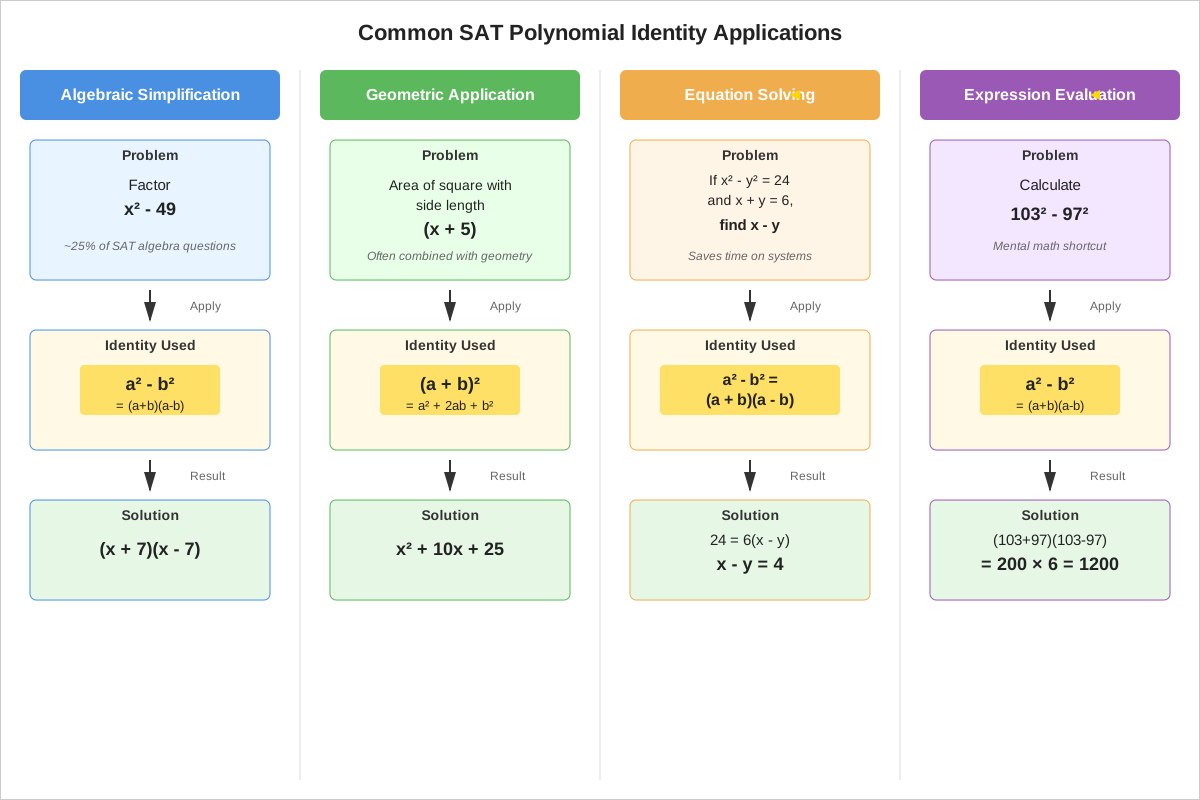
On the SAT, polynomial identities most commonly appear in three contexts: (1) direct factoring or expansion questions asking students to simplify expressions, (2) equation-solving problems where recognizing an identity provides a shortcut, and (3) word problems where the underlying mathematical structure follows a polynomial identity pattern. Questions may present expressions in non-standard forms, requiring students to rearrange terms before recognizing the applicable identity. The test also frequently combines polynomial identities with other concepts like rational expressions, systems of equations, or function notation.
Core Concepts
The Difference of Squares
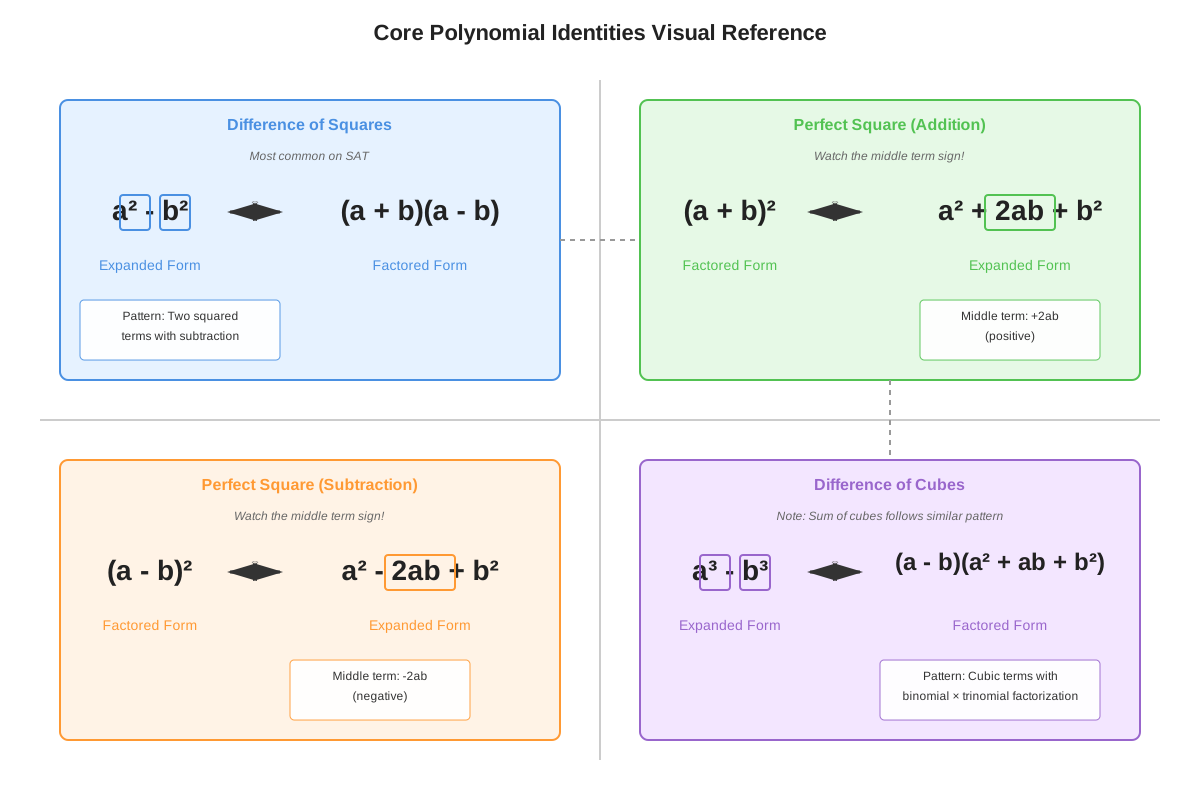
The difference of squares is perhaps the most frequently tested polynomial identity on the SAT. This identity states that for any two terms a and b:
a² - b² = (a + b)(a - b)This pattern works because when you multiply (a + b)(a - b), the middle terms cancel: a² - ab + ab - b² = a² - b². The key feature to recognize is that you have two perfect squares separated by a subtraction sign. This identity only works for subtraction; a² + b² does not factor using real numbers.
The difference of squares can appear in disguised forms. For example, 9x² - 25 is actually (3x)² - 5², which factors to (3x + 5)(3x - 5). Similarly, 49 - 4y² factors to (7 + 2y)(7 - 2y). The SAT often presents these in contexts where recognizing the pattern saves significant calculation time.
Extended applications include expressions like x⁴ - 16, which can be factored twice: first as (x²)² - 4² = (x² + 4)(x² - 4), then recognizing that x² - 4 is itself a difference of squares: (x² + 4)(x + 2)(x - 2).
Perfect Square Trinomials
Perfect square trinomials are polynomial expressions that result from squaring a binomial. The two fundamental patterns are:
(a + b)² = a² + 2ab + b²
(a - b)² = a² - 2ab + b²
The critical feature distinguishing perfect square trinomials is the middle term: it must equal exactly twice the product of the square roots of the first and last terms. For instance, x² + 6x + 9 is a perfect square because 6x = 2(x)(3), and it factors to (x + 3)².
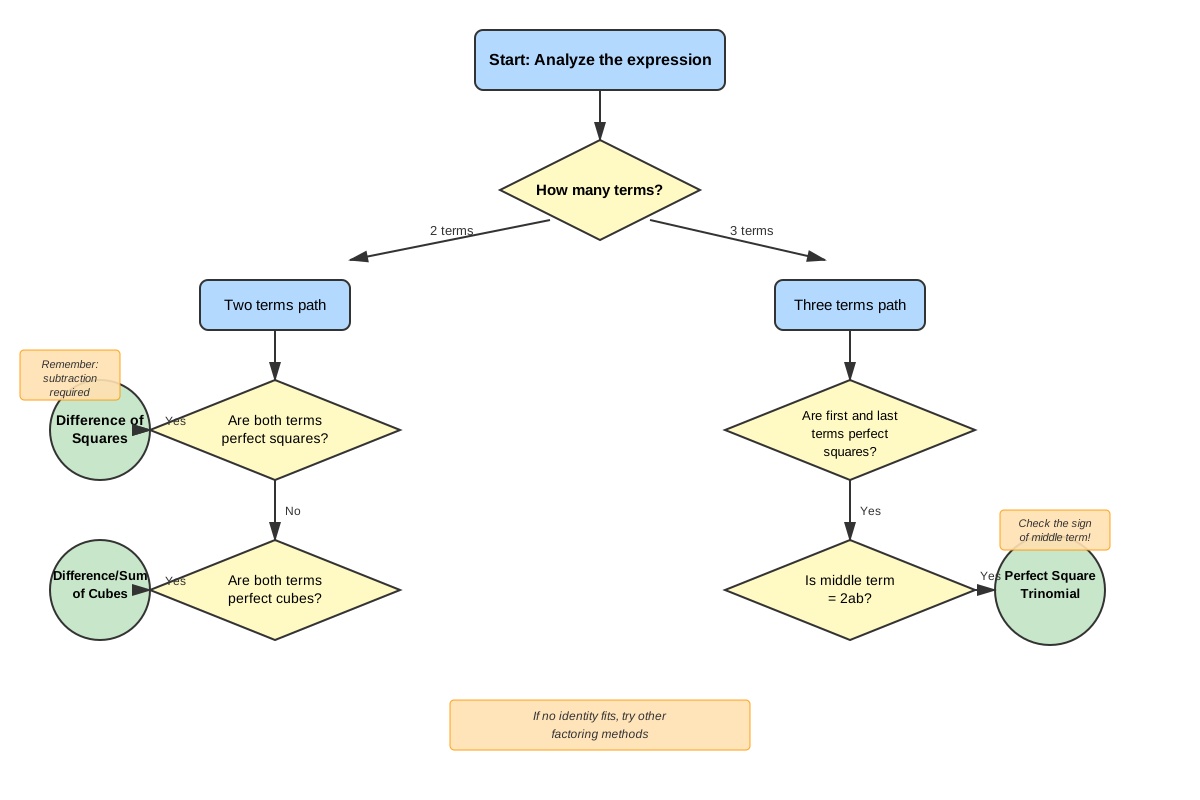
To identify a perfect square trinomial, follow these steps:
- Verify the first and last terms are perfect squares
- Calculate 2√(first term) × √(last term)
- Check if this equals the middle term (ignoring sign)
- If yes, factor as (√first term ± √last term)²
Common SAT applications include completing the square in quadratic equations, simplifying complex algebraic fractions, and solving geometry problems involving area. For example, if asked to find the value of x² + 10x + 25 when x = 7, recognizing this as (x + 5)² allows immediate substitution: (7 + 5)² = 144.
Sum and Difference of Cubes
While less common than squares, cube identities do appear on the SAT, particularly in higher-difficulty questions. The patterns are:
a³ + b³ = (a + b)(a² - ab + b²)
a³ - b³ = (a - b)(a² + ab + b²)
Notice the pattern: the first factor is the sum or difference of the cube roots, while the second factor is a trinomial. The sign pattern in the trinomial follows a specific sequence: for sum of cubes, the trinomial has minus then plus; for difference of cubes, it has plus then plus.
For example, 8x³ + 27 = (2x)³ + 3³ = (2x + 3)(4x² - 6x + 9). The SAT typically uses these identities in factoring problems or when simplifying rational expressions where cancellation becomes possible after factoring.
Binomial Expansion Patterns
Beyond the basic identities, understanding binomial expansion patterns helps with more complex polynomial manipulations:
(a + b)³ = a³ + 3a²b + 3ab² + b³
(a - b)³ = a³ - 3a²b + 3ab² - b³
The coefficients (1, 3, 3, 1) come from Pascal's Triangle. While the SAT rarely requires full expansion of higher powers, recognizing these patterns helps identify when an expression might simplify or when terms will cancel.
Factoring by Grouping with Identities
Factoring by grouping often combines with polynomial identities to solve complex expressions. When an expression has four terms, grouping pairs and factoring each pair may reveal a common binomial factor:
For example: x³ - x² - 9x + 9
- Group: (x³ - x²) - (9x - 9)
- Factor each: x²(x - 1) - 9(x - 1)
- Common factor: (x - 1)(x² - 9)
- Apply difference of squares: (x - 1)(x + 3)(x - 3)
Comparison Table of Key Identities
| Identity Name | Pattern | Factored Form | Key Recognition Feature |
|---|---|---|---|
| Difference of Squares | a² - b² | (a + b)(a - b) | Two perfect squares with subtraction |
| Perfect Square (positive) | a² + 2ab + b² | (a + b)² | Middle term = 2√(first)√(last) |
| Perfect Square (negative) | a² - 2ab + b² | (a - b)² | Middle term = -2√(first)√(last) |
| Sum of Cubes | a³ + b³ | (a + b)(a² - ab + b²) | Two perfect cubes with addition |
| Difference of Cubes | a³ - b³ | (a - b)(a² + ab + b²) | Two perfect cubes with subtraction |
Concept Relationships
Polynomial identities form an interconnected web of algebraic relationships. The difference of squares serves as the foundation, connecting directly to factoring techniques and quadratic equations. When solving equations like x² = 25, recognizing this as x² - 25 = 0 and applying the difference of squares yields (x + 5)(x - 5) = 0, leading to solutions x = ±5.
Perfect square trinomials extend from the difference of squares through the relationship (a + b)² - (a - b)² = 4ab, which itself demonstrates how identities can combine. This connection appears in SAT problems involving the expansion of expressions or finding relationships between variables.
The progression flows: Basic distributive property → Difference of squares → Perfect square trinomials → Cube identities → Complex factoring. Each level builds upon the previous, with more complex identities decomposing into simpler patterns. For instance, x⁴ - y⁴ factors first as a difference of squares (x² + y²)(x² - y²), then the second factor factors again as (x² + y²)(x + y)(x - y).
Polynomial identities also connect forward to rational expressions, where factoring both numerator and denominator often reveals common factors that cancel. They link to quadratic functions through vertex form conversions and to systems of equations when substitution creates polynomial expressions requiring simplification.
High-Yield Facts
⭐ The difference of squares a² - b² always factors to (a + b)(a - b), but a² + b² does not factor using real numbers
⭐ In a perfect square trinomial, the middle term coefficient must equal exactly twice the product of the square roots of the first and last terms
⭐ The difference of squares can be applied repeatedly: x⁴ - 16 = (x² + 4)(x² - 4) = (x² + 4)(x + 2)(x - 2)
⭐ When factoring a³ - b³, the trinomial factor has the pattern (a² + ab + b²) with plus signs
⭐ Recognizing (x + y)² = x² + 2xy + y² allows quick mental calculation when values are known
- The sum of cubes a³ + b³ factors to (a + b)(a² - ab + b²) with alternating signs in the trinomial
- Perfect square trinomials always have a positive last term regardless of the middle term's sign
- The expression (a + b)² - (a - b)² simplifies to 4ab, a useful identity for certain SAT problems
- Polynomial identities work with any algebraic expressions, not just simple variables: (2x + 3)² follows the same pattern as (a + b)²
- When an expression has four terms, factoring by grouping may reveal a polynomial identity in the resulting factors
- The coefficient pattern for (a + b)³ is 1, 3, 3, 1, which comes from Pascal's Triangle
- Completing the square relies on the perfect square trinomial identity to convert quadratic expressions to vertex form
Quick check — test yourself on Polynomial identities so far.
Try Flashcards →Common Misconceptions
Misconception: a² + b² can be factored like a² - b²
Correction: The sum of two squares a² + b² cannot be factored using real numbers. Only the difference of squares (with a minus sign) factors to (a + b)(a - b). This is one of the most common errors on the SAT.
Misconception: (a + b)² equals a² + b²
Correction: When squaring a binomial, you must include the middle term: (a + b)² = a² + 2ab + b². The 2ab term comes from multiplying the outer and inner terms when expanding (a + b)(a + b). Forgetting this middle term leads to incorrect simplifications.
Misconception: The middle term in a perfect square trinomial can be any value as long as the first and last terms are perfect squares
Correction: For an expression to be a perfect square trinomial, the middle term must equal exactly 2√(first term) × √(last term). For example, x² + 5x + 9 is NOT a perfect square because 5x ≠ 2(x)(3) = 6x.
Misconception: The difference of cubes and sum of cubes have the same factoring pattern
Correction: While similar, these identities differ in the signs within the trinomial factor. For a³ + b³, the trinomial is (a² - ab + b²) with a minus in the middle. For a³ - b³, the trinomial is (a² + ab + b²) with a plus in the middle. The first binomial factor matches the original sign.
Misconception: Polynomial identities only work with numerical coefficients of 1
Correction: These identities work with any coefficients. For example, 4x² - 25 = (2x)² - 5² = (2x + 5)(2x - 5). You must identify what expressions are being squared or cubed, which may involve coefficients other than 1.
Misconception: You can apply the difference of squares to expressions like x² - 7 because 7 is close to a perfect square
Correction: The difference of squares requires both terms to be perfect squares. While x² - 7 can be factored using irrational numbers as (x + √7)(x - √7), this is rarely useful on the SAT. The identity is most powerful when both terms are perfect squares of rational expressions.
Worked Examples
Example 1: Recognizing and Applying the Difference of Squares
Problem: If x² - y² = 48 and x + y = 8, what is the value of x - y?
Solution:
Step 1: Recognize that x² - y² follows the difference of squares pattern.
Using the identity a² - b² = (a + b)(a - b), we can write:
x² - y² = (x + y)(x - y)
Step 2: Substitute the known values into the factored form.
We know x² - y² = 48 and x + y = 8, so:
48 = (8)(x - y)
Step 3: Solve for x - y.
Dividing both sides by 8:
x - y = 48 ÷ 8 = 6
Answer: x - y = 6
Key Insight: This problem demonstrates why polynomial identities are so valuable on the SAT. Without recognizing the difference of squares, you would need to solve a system of equations, which takes significantly more time. The identity provides an immediate pathway to the solution.
Example 2: Working with Perfect Square Trinomials
Problem: Simplify the expression (x² + 10x + 25)/(x + 5) when x ≠ -5.
Solution:
Step 1: Examine the numerator to determine if it's a perfect square trinomial.
Check if x² + 10x + 25 fits the pattern a² + 2ab + b²:
- First term: x² = (x)²
- Last term: 25 = (5)²
- Middle term check: 2(x)(5) = 10x ✓
Step 2: Factor the numerator using the perfect square pattern.
Since the middle term matches, we can write:
x² + 10x + 25 = (x + 5)²
Step 3: Rewrite the original expression with the factored form.
(x² + 10x + 25)/(x + 5) = (x + 5)²/(x + 5)
Step 4: Simplify by canceling common factors.
(x + 5)²/(x + 5) = (x + 5)(x + 5)/(x + 5) = x + 5
Answer: x + 5
Key Insight: Recognizing perfect square trinomials is essential for simplifying rational expressions. This pattern appears frequently in SAT algebra questions, particularly when simplifying fractions or solving equations. Always check if a trinomial might be a perfect square before attempting other factoring methods.
Example 3: Combining Multiple Identities
Problem: Factor completely: 16x⁴ - 81
Solution:
Step 1: Recognize this as a difference of squares.
16x⁴ - 81 = (4x²)² - (9)²
Step 2: Apply the difference of squares identity.
(4x²)² - (9)² = (4x² + 9)(4x² - 9)
Step 3: Check if either factor can be factored further.
- First factor: 4x² + 9 is a sum of squares, which cannot be factored using real numbers
- Second factor: 4x² - 9 = (2x)² - (3)² is another difference of squares!
Step 4: Factor the second factor.
4x² - 9 = (2x + 3)(2x - 3)
Step 5: Write the complete factorization.
16x⁴ - 81 = (4x² + 9)(2x + 3)(2x - 3)
Answer: (4x² + 9)(2x + 3)(2x - 3)
Key Insight: Some expressions require applying polynomial identities multiple times. Always check each factor to see if it can be factored further. The difference of squares is particularly prone to this, as higher even powers can be factored repeatedly.
Exam Strategy
When approaching SAT questions involving polynomial identities, begin by scanning the expression for recognizable patterns before attempting any calculations. Look specifically for: two perfect squares with subtraction (difference of squares), three terms where the first and last are perfect squares (potential perfect square trinomial), or expressions involving cubes.
Trigger words and phrases that signal polynomial identity questions include: "factor completely," "simplify the expression," "which of the following is equivalent to," and "if x² - y² = ..." These phrases indicate that recognizing a pattern will likely provide the fastest solution path.
For multiple-choice questions, use the answer choices strategically. If asked to factor an expression, the answer choices often reveal which identity to apply. For instance, if all answers are products of binomials, you know factoring is required. You can also work backward by expanding answer choices to verify correctness, though this is typically slower than recognizing the pattern directly.
Time allocation for polynomial identity questions should be approximately 45-60 seconds for straightforward applications and up to 90 seconds for problems requiring multiple steps or combining identities with other concepts. If you don't recognize a pattern within 15-20 seconds, consider whether expanding or substituting specific values might reveal the structure.
Process of elimination tips: When factoring expressions, eliminate answer choices that have incorrect signs (particularly important for perfect square trinomials and cube identities). For difference of squares, eliminate any answer that doesn't have one factor with addition and one with subtraction. If asked whether an expression is a perfect square, quickly check if the middle term equals 2√(first)√(last)—if not, eliminate that option immediately.
Exam Tip: If a problem provides numerical values for variables and asks for an expression's value, check whether recognizing a polynomial identity allows you to avoid substitution entirely. For example, if given x + y and asked for x² - y², factor first, then substitute.
Memory Techniques
SOAP mnemonic for the difference of squares:
- Subtraction between terms
- Opposite signs in factors (one plus, one minus)
- Always two perfect squares
- Product of sum and difference
"Perfect Middle" for perfect square trinomials: The middle term must be Perfectly equal to 2 times the product of the square roots. Visualize a perfect sandwich where the middle (filling) is exactly twice as thick as the bread slices multiplied together.
"Same-Switch-Same" for sum and difference of cubes:
- First factor: Same sign as the original expression
- Trinomial factor: Switch the sign, then use the Same sign again
- Example: a³ + b³ → (a + b)(a² - ab + b²)
Visual pattern for (a + b)²: Imagine a square with side length (a + b). When you divide it into regions, you get one a² square, one b² square, and two ab rectangles—hence a² + 2ab + b².
"Difference Doubles Down" for x⁴ - 16: Remember that the difference of squares can be applied twice (doubles down) when you have fourth powers. First factor to squared terms, then check if those factor again.
Finger counting for cube coefficients: Hold up three fingers for (a + b)³. The coefficients are 1 (before your fingers), 3 (fingers), 3 (fingers again), 1 (after your fingers): 1, 3, 3, 1.
Summary
Polynomial identities are essential algebraic patterns that enable efficient manipulation of expressions on the SAT. The most critical identities—difference of squares, perfect square trinomials, and cube formulas—appear across multiple question types and difficulty levels. Mastering these patterns requires both recognition skills and the ability to apply them in various contexts, including factoring, simplifying rational expressions, and solving equations. The difference of squares (a² - b² = (a + b)(a - b)) and perfect square trinomials ((a ± b)² = a² ± 2ab + b²) account for the majority of SAT applications. Success with polynomial identities depends on pattern recognition rather than memorization of procedures, making practice with diverse problem types essential. Students who internalize these identities gain significant time advantages on the exam, often solving in seconds what might otherwise require minutes of calculation. The key to mastery lies in recognizing when an expression fits an identity pattern, even when presented in non-standard forms or combined with other algebraic concepts.
Key Takeaways
- The difference of squares a² - b² = (a + b)(a - b) is the most frequently tested polynomial identity on the SAT and can be applied multiple times to expressions with higher powers
- Perfect square trinomials must have a middle term that equals exactly 2√(first term) × √(last term); this is the critical test for recognition
- Sum of squares (a² + b²) does NOT factor using real numbers—only the difference of squares factors
- Polynomial identities work with any algebraic expressions, not just simple variables, so (3x - 2)² follows the same pattern as (a - b)²
- Recognizing these patterns before attempting calculations saves significant time and reduces computational errors on the SAT
- Cube identities (sum and difference of cubes) appear less frequently but are valuable for higher-difficulty questions
- Always check factored expressions to see if they can be factored further, particularly when dealing with fourth powers or higher
Related Topics
Quadratic Equations and Functions: Polynomial identities, especially perfect square trinomials, are fundamental to completing the square and converting between standard and vertex forms of quadratic functions. Mastering identities makes quadratic problem-solving significantly more efficient.
Rational Expressions: Simplifying complex fractions often requires factoring polynomials using identities to reveal common factors that cancel. This topic builds directly on polynomial identity recognition skills.
Systems of Equations: Many SAT systems problems can be solved more efficiently by recognizing polynomial identity patterns in the given equations, particularly when dealing with expressions like x² - y² or x² + 2xy + y².
Complex Numbers: The sum of squares a² + b², which doesn't factor with real numbers, does factor using complex numbers as (a + bi)(a - bi), extending polynomial identity concepts to advanced algebra.
Function Composition: Understanding how polynomial identities work prepares students for recognizing patterns in composite functions, particularly when simplifying expressions like f(g(x)).
Practice CTA
Now that you've mastered the core concepts of polynomial identities, it's time to solidify your understanding through practice. Work through the practice questions to test your pattern recognition skills and apply these identities in various SAT-style contexts. Use the flashcards to reinforce quick recognition of each identity pattern—speed and accuracy with these fundamentals will give you a significant advantage on test day. Remember, every minute saved by recognizing a polynomial identity is a minute you can invest in more challenging problems. You've built the foundation; now practice will make these patterns second nature!
Sign up free to keep reading
Create a free AnvayaPrep account to finish this SAT guide on Polynomial identities — plus flashcards and practice questions.