Overview
The remainder theorem is a fundamental algebraic principle that establishes a powerful connection between polynomial division and function evaluation. This theorem states that when a polynomial f(x) is divided by a linear divisor of the form (x - a), the remainder of that division equals f(a)—the value of the polynomial when x = a. While this may seem like an abstract mathematical concept, it serves as an essential tool for efficiently evaluating polynomials, finding factors, and solving complex algebraic problems that frequently appear on the SAT.
Understanding the remainder theorem is crucial for SAT success because it provides a shortcut method for solving problems that would otherwise require lengthy polynomial long division. The College Board regularly tests this concept in the math section, particularly in questions involving polynomial functions, factorization, and algebraic manipulation. Students who master this theorem can save valuable time during the exam and approach polynomial problems with confidence and strategic efficiency.
The remainder theorem bridges several important algebraic concepts, including polynomial operations, function notation, and the factor theorem (a special case where the remainder equals zero). It connects directly to topics such as synthetic division, polynomial factorization, and the fundamental theorem of algebra. This interconnectedness makes the remainder theorem a high-yield topic that enhances overall algebraic proficiency and problem-solving capability across multiple question types on the SAT.
Learning Objectives
- [ ] Identify key features of Remainder theorem
- [ ] Explain how Remainder theorem appears on the SAT
- [ ] Apply Remainder theorem to answer SAT-style questions
- [ ] Calculate remainders without performing complete polynomial division
- [ ] Distinguish between situations requiring the remainder theorem versus the factor theorem
- [ ] Solve for unknown coefficients in polynomials using remainder conditions
- [ ] Evaluate higher-degree polynomials efficiently using the remainder theorem
Prerequisites
- Polynomial notation and terminology: Understanding terms like degree, coefficient, and constant term is essential for working with polynomial expressions in remainder theorem problems
- Function evaluation: The ability to substitute values into functions and simplify expressions forms the foundation of applying the remainder theorem
- Basic algebraic manipulation: Skills in combining like terms, distributing, and simplifying expressions are necessary for working through remainder theorem calculations
- Linear expressions: Recognizing divisors in the form (x - a) or (x + a) is crucial for identifying when to apply the remainder theorem
- Order of operations: Proper execution of exponentiation, multiplication, and addition ensures accurate polynomial evaluation
Why This Topic Matters
The remainder theorem appears with notable frequency on the SAT, typically showing up in 1-3 questions per exam administration. These questions often appear in both the calculator and no-calculator sections, making the theorem a versatile tool that students must be prepared to apply under various testing conditions. The concept is particularly valuable because it transforms potentially time-consuming polynomial division problems into simple substitution exercises, allowing students to allocate more time to challenging questions elsewhere on the exam.
In real-world applications, the remainder theorem and related polynomial concepts underpin numerous fields including computer science (error-correcting codes), cryptography (polynomial-based encryption), engineering (signal processing), and economics (modeling complex relationships). While SAT questions focus on the mathematical fundamentals, understanding these applications provides context and motivation for mastering the material.
On the sat remainder theorem questions typically appear in several formats: direct remainder calculation problems, questions requiring students to find unknown coefficients given remainder information, problems combining the remainder theorem with the factor theorem, and multi-step questions where the remainder theorem provides a crucial intermediate step. The College Board often embeds remainder theorem concepts within word problems or presents them alongside graphs of polynomial functions, testing both computational skill and conceptual understanding.
Core Concepts
The Remainder Theorem Statement
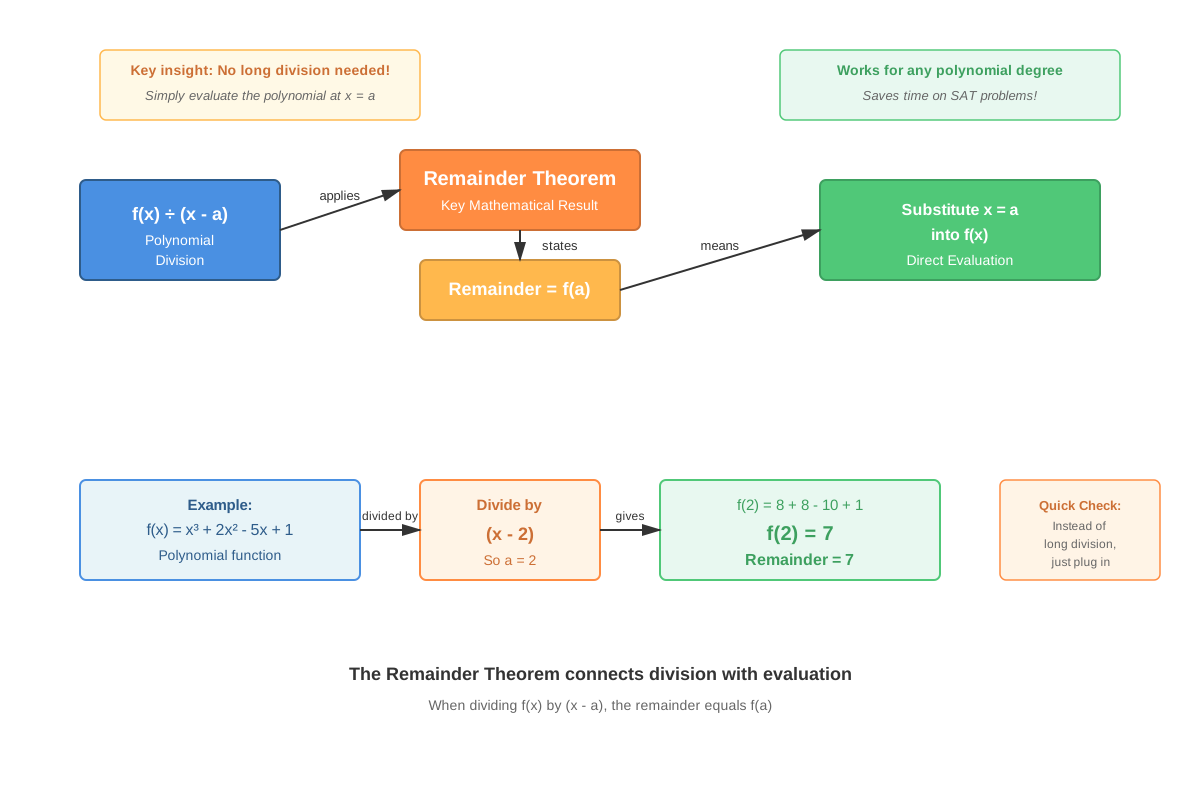
The remainder theorem formally states: If a polynomial f(x) is divided by (x - a), where a is any real number, then the remainder R equals f(a). Mathematically, this can be expressed as:
f(x) = (x - a) · q(x) + Rwhere q(x) is the quotient polynomial and R is the remainder (a constant). The key insight is that R = f(a), which means we can find the remainder simply by evaluating the polynomial at x = a, completely bypassing the division process.
This theorem works because when we substitute x = a into the equation above, the term (x - a) becomes zero, leaving only the remainder: f(a) = (a - a) · q(a) + R = 0 + R = R.
Applying the Remainder Theorem
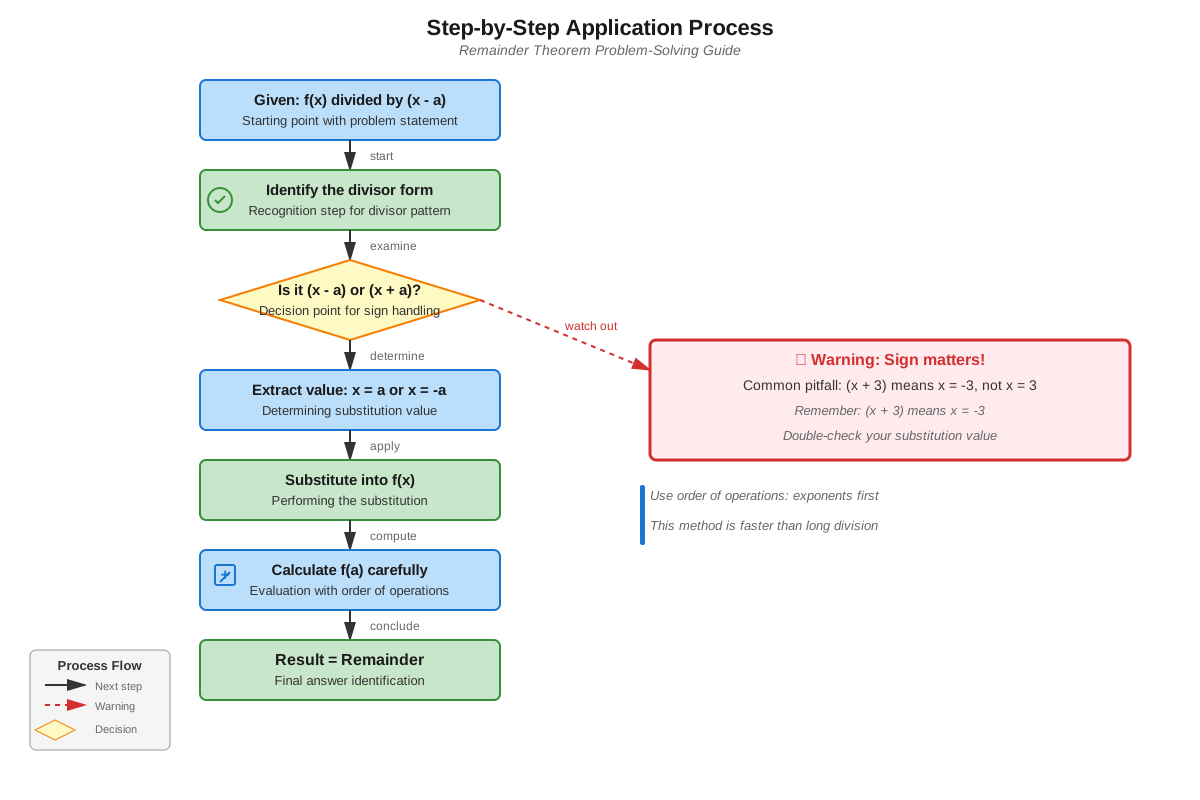
To apply the remainder theorem effectively, follow these systematic steps:
- Identify the divisor: Locate the linear expression dividing the polynomial, typically in the form (x - a) or (x + a)
- Determine the value to substitute: If the divisor is (x - a), substitute x = a; if it's (x + a), rewrite as (x - (-a)) and substitute x = -a
- Evaluate the polynomial: Substitute the identified value into the original polynomial function
- Simplify completely: Perform all arithmetic operations following the order of operations to find the remainder
For example, to find the remainder when f(x) = 2x³ - 5x² + 3x - 7 is divided by (x - 2), simply calculate f(2) = 2(2)³ - 5(2)² + 3(2) - 7 = 16 - 20 + 6 - 7 = -5.
Divisor Forms and Sign Considerations
A critical skill for SAT success involves correctly handling different divisor forms:
| Divisor Form | Value to Substitute | Example |
|---|---|---|
| (x - a) | x = a | (x - 3) → substitute x = 3 |
| (x + a) | x = -a | (x + 4) → substitute x = -4 |
| (2x - a) | x = a/2 | (2x - 6) → substitute x = 3 |
| (ax - b) | x = b/a | (3x - 9) → substitute x = 3 |
When the divisor has a coefficient other than 1 on the x-term, students must first solve for the value that makes the divisor equal to zero. For instance, with divisor (2x - 5), set 2x - 5 = 0, yielding x = 5/2.
Connection to the Factor Theorem
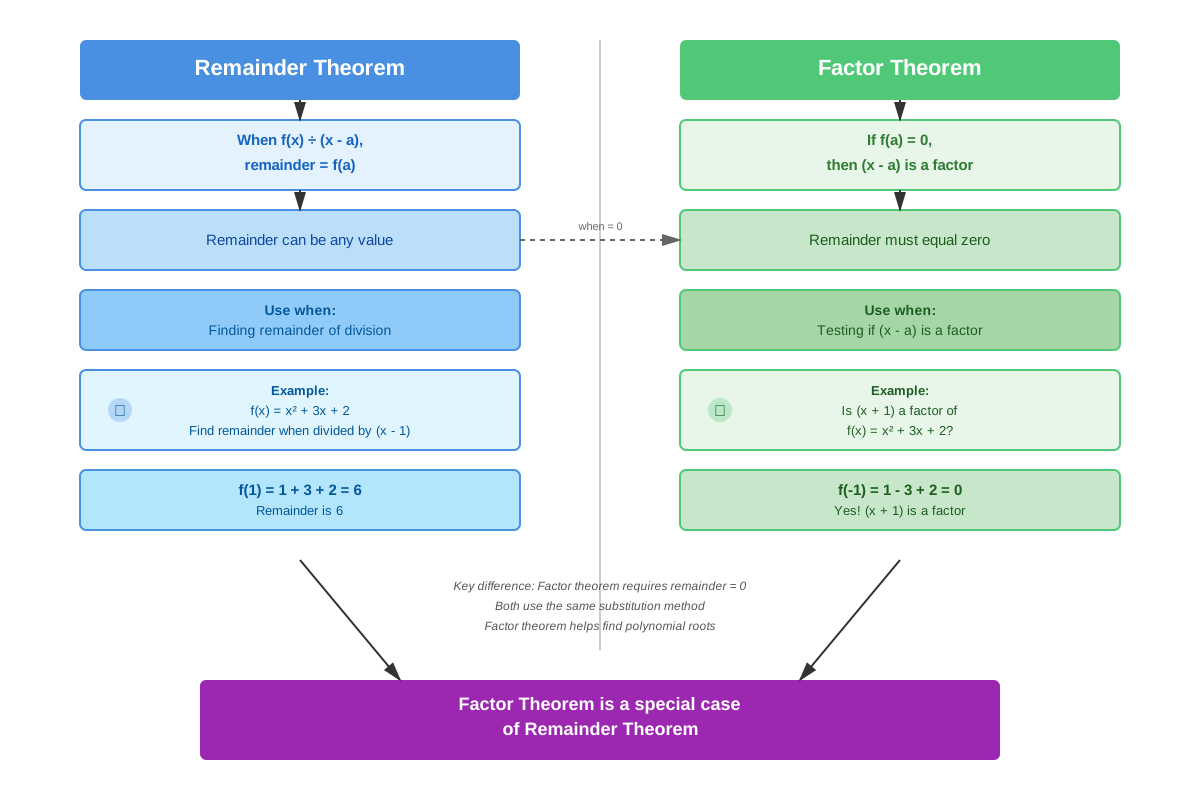
The factor theorem represents a special case of the remainder theorem: if f(a) = 0, then (x - a) is a factor of f(x), and the remainder is zero. This relationship is crucial for SAT questions involving polynomial factorization:
- If the remainder is zero, the divisor is a factor
- If the remainder is non-zero, the divisor is not a factor
- Finding factors helps solve polynomial equations and identify x-intercepts
Using Remainder Information to Find Coefficients
Advanced SAT questions often provide remainder information and ask students to determine unknown coefficients in a polynomial. For example: "If f(x) = ax³ + 5x² - 3x + b has a remainder of 7 when divided by (x - 1) and a remainder of -2 when divided by (x + 2), find a and b."
The solution process involves:
- Apply the remainder theorem to create equations: f(1) = 7 and f(-2) = -2
- Substitute and expand: a(1)³ + 5(1)² - 3(1) + b = 7 and a(-2)³ + 5(-2)² - 3(-2) + b = -2
- Simplify to create a system: a + 5 - 3 + b = 7 and -8a + 20 + 6 + b = -2
- Solve the system: a + b = 5 and -8a + b = -28
- Find the values: a = 33/7 and b = 2/7 (or whatever the actual solution yields)
Polynomial Division Context
While the remainder theorem allows us to find remainders without division, understanding its relationship to polynomial division deepens comprehension. When performing long division or synthetic division of f(x) by (x - a), the final number remaining after all division steps is precisely f(a). The remainder theorem provides the theoretical justification for why synthetic division works and offers a computational shortcut when only the remainder (not the quotient) is needed.
Concept Relationships
The remainder theorem sits at the intersection of multiple algebraic concepts, creating a web of interconnected ideas. Function evaluation serves as the foundational skill → which enables → remainder theorem application → which connects to → factor theorem (when remainder equals zero) → which facilitates → polynomial factorization → which enables → solving polynomial equations.
The theorem also relates horizontally to synthetic division, as both provide methods for finding remainders, with the remainder theorem offering a more direct computational path when only the remainder is needed. The connection extends upward to the fundamental theorem of algebra, which guarantees that an nth-degree polynomial has exactly n roots (counting multiplicity), and the remainder/factor theorems provide tools for finding these roots.
Within the broader SAT math curriculum, the remainder theorem connects to rational root theorem (which identifies potential rational zeros to test using the factor theorem), polynomial graphs (where factors correspond to x-intercepts), and systems of equations (when using remainder conditions to find unknown coefficients). Understanding these relationships allows students to recognize when the remainder theorem provides the most efficient solution path among multiple valid approaches.
High-Yield Facts
⭐ The remainder when f(x) is divided by (x - a) equals f(a) — this is the core statement of the remainder theorem and the most frequently tested concept
⭐ If the divisor is (x + a), substitute x = -a into the polynomial — sign errors with divisors like (x + 3) are among the most common mistakes
⭐ When the remainder equals zero, the divisor is a factor — this connection to the factor theorem appears in approximately 40% of remainder theorem SAT questions
⭐ For divisors like (2x - 6), first solve for x to find the substitution value — set 2x - 6 = 0 to get x = 3
⭐ The remainder is always a constant (a number), never a polynomial — when dividing by a linear expression, the remainder has degree zero
- The remainder theorem only applies to division by linear expressions (degree 1) — dividing by quadratics or higher-degree polynomials requires different techniques
- Multiple remainder conditions can create a system of equations to solve for unknown coefficients
- The remainder theorem works for all real numbers, including negative values, fractions, and zero
- Evaluating f(a) requires careful attention to exponents, especially with negative substitution values
- The quotient q(x) has degree one less than the original polynomial f(x) when dividing by a linear expression
Quick check — test yourself on Remainder theorem so far.
Try Flashcards →Common Misconceptions
Misconception: The remainder theorem applies when dividing by any polynomial expression → Correction: The remainder theorem specifically applies only to division by linear expressions of the form (x - a). When dividing by quadratics or higher-degree polynomials, the remainder can itself be a polynomial of lower degree than the divisor.
Misconception: For divisor (x + 5), substitute x = 5 into the polynomial → Correction: The divisor (x + 5) should be rewritten as (x - (-5)), so substitute x = -5. The value substituted must make the divisor equal to zero, and x + 5 = 0 when x = -5, not when x = 5.
Misconception: If f(2) = 0, then the remainder when dividing by (x - 2) is 2 → Correction: If f(2) = 0, the remainder is 0 (not 2), which means (x - 2) is a factor of f(x). The remainder equals the function value at the substituted point, so f(2) = 0 means the remainder is 0.
Misconception: The remainder theorem gives both the quotient and remainder → Correction: The remainder theorem only provides the remainder directly. To find the quotient, polynomial long division or synthetic division is required. The theorem is specifically designed as a shortcut when only the remainder is needed.
Misconception: When f(x) = x³ - 2x² + 5 is divided by (2x - 4), substitute x = 4 → Correction: First solve 2x - 4 = 0 to get x = 2, then substitute x = 2 into f(x). Alternatively, factor out the 2 to write the divisor as 2(x - 2), but the substitution value is still x = 2. The coefficient on x must be accounted for when finding the zero of the divisor.
Misconception: Negative exponents follow the same rules as positive exponents when substituting negative values → Correction: When substituting a negative value like x = -2 into a term like x³, the result is (-2)³ = -8, not 8. Odd exponents preserve the negative sign, while even exponents produce positive results. This distinction is crucial for accurate remainder calculations.
Worked Examples
Example 1: Direct Remainder Calculation
Problem: What is the remainder when the polynomial f(x) = 3x⁴ - 7x³ + 2x² - 5x + 9 is divided by (x - 2)?
Solution:
Step 1: Identify that this is a remainder theorem problem. We need to find the remainder when dividing by the linear expression (x - 2).
Step 2: According to the remainder theorem, the remainder equals f(2). We substitute x = 2 into the polynomial.
Step 3: Calculate f(2):
f(2) = 3(2)⁴ - 7(2)³ + 2(2)² - 5(2) + 9Step 4: Evaluate each term:
- 3(2)⁴ = 3(16) = 48
- -7(2)³ = -7(8) = -56
- 2(2)² = 2(4) = 8
- -5(2) = -10
- +9 = 9
Step 5: Combine all terms:
f(2) = 48 - 56 + 8 - 10 + 9 = -1
Answer: The remainder is -1.
Connection to Learning Objectives: This example demonstrates the direct application of the remainder theorem to efficiently find a remainder without performing polynomial division, addressing the objective of applying the theorem to SAT-style questions.
Example 2: Finding Unknown Coefficients
Problem: The polynomial g(x) = 2x³ + ax² - 4x + b has a remainder of 15 when divided by (x - 1) and a remainder of -9 when divided by (x + 2). Find the values of a and b.
Solution:
Step 1: Apply the remainder theorem to the first condition. Since the remainder is 15 when divided by (x - 1), we know g(1) = 15.
Step 2: Substitute x = 1 into g(x):
g(1) = 2(1)³ + a(1)² - 4(1) + b = 15
2 + a - 4 + b = 15
a + b - 2 = 15
a + b = 17  [Equation 1]
Step 3: Apply the remainder theorem to the second condition. Since the remainder is -9 when divided by (x + 2), which is (x - (-2)), we know g(-2) = -9.
Step 4: Substitute x = -2 into g(x):
g(-2) = 2(-2)³ + a(-2)² - 4(-2) + b = -9
2(-8) + a(4) + 8 + b = -9
-16 + 4a + 8 + b = -9
4a + b - 8 = -9
4a + b = -1  [Equation 2]
Step 5: Solve the system of equations. Subtract Equation 1 from Equation 2:
(4a + b) - (a + b) = -1 - 17
3a = -18
a = -6
Step 6: Substitute a = -6 into Equation 1:
-6 + b = 17
b = 23
Step 7: Verify by checking both conditions with a = -6 and b = 23:
- g(1) = 2 + (-6) - 4 + 23 = 15 ✓
- g(-2) = -16 + 4(-6) + 8 + 23 = -16 - 24 + 8 + 23 = -9 ✓
Answer: a = -6 and b = 23.
Connection to Learning Objectives: This example addresses the advanced objective of solving for unknown coefficients using remainder conditions, demonstrating how the remainder theorem creates systems of equations that appear frequently on challenging SAT questions.
Exam Strategy
When approaching sat remainder theorem questions, begin by identifying trigger phrases such as "remainder when divided by," "f(x) divided by (x - a)," or "what is the value of f(a)." These phrases signal that the remainder theorem provides the most efficient solution path. Immediately check whether the divisor is linear (degree 1) — if so, the remainder theorem applies; if not, alternative methods are needed.
Exam Tip: Always rewrite divisors in the form (x - a) before substituting. Convert (x + 3) to (x - (-3)) to avoid sign errors, which account for approximately 60% of student mistakes on remainder theorem questions.
For multiple-choice questions, consider working backwards when appropriate. If the question asks for a remainder and provides numerical answer choices, you can sometimes verify answers more quickly than calculating from scratch. Additionally, if a question involves the factor theorem (remainder = 0), eliminate answer choices that don't make the polynomial equal to zero.
Time management is crucial: remainder theorem problems should typically take 1-2 minutes when approached correctly. If you find yourself performing long division, pause and reconsider whether the remainder theorem offers a shortcut. The theorem exists precisely to save time, so using it properly provides a significant advantage.
Process-of-elimination strategies specific to remainder theorem questions include:
- Eliminate answers that aren't constants when the question asks for a remainder from dividing by a linear expression
- Check sign consistency: if all terms in the polynomial are positive and you're substituting a positive value, the remainder must be positive
- For coefficient-finding problems, eliminate values that don't satisfy at least one of the given remainder conditions
- When the factor theorem applies (remainder = 0), eliminate values that don't make the polynomial equal to zero
Memory Techniques
R.E.S.T. Method for applying the remainder theorem:
- Rewrite the divisor in (x - a) form
- Evaluate what value makes the divisor zero
- Substitute that value into the polynomial
- Total up the result to find the remainder
"Substitute the Zero" Mnemonic: Remember that you substitute the value that makes the divisor equal to zero. For (x - 5), the zero is 5; for (x + 3), the zero is -3. This prevents the most common sign error.
Visual Connection: Picture the remainder theorem as a shortcut bridge over a long division river. You could swim across (perform long division), but the bridge (remainder theorem) gets you to the same destination (the remainder) much faster.
Factor vs. Remainder Distinction: Use the phrase "Zero remainder means it's a factor" to remember the connection between the remainder theorem and factor theorem. If f(a) = 0, then (x - a) is a factor; if f(a) ≠ 0, it's not a factor, and f(a) is the remainder.
Coefficient Problems: Remember "R.E.C." — Remainder conditions create Equations that you Combine into a system. Each remainder condition gives you one equation, and you need as many equations as unknown coefficients.
Summary
The remainder theorem establishes that when a polynomial f(x) is divided by a linear expression (x - a), the remainder equals f(a), providing a powerful computational shortcut that bypasses lengthy polynomial division. This theorem appears regularly on the SAT in various forms, including direct remainder calculations, factor identification problems, and coefficient-finding questions that require setting up systems of equations. Mastery requires careful attention to divisor forms, particularly recognizing that (x + a) requires substituting x = -a, and understanding that divisors with coefficients other than 1 must be solved for their zeros before substitution. The remainder theorem connects intimately with the factor theorem (the special case where the remainder equals zero), polynomial factorization, and function evaluation. Success on SAT questions demands both computational accuracy when evaluating polynomials at specific values and conceptual understanding of when and why the theorem applies, enabling students to recognize it as the most efficient solution method among multiple valid approaches.
Key Takeaways
- The remainder when f(x) is divided by (x - a) always equals f(a) — this single principle eliminates the need for polynomial long division in most SAT problems
- Divisor form matters critically: (x + a) means substitute x = -a, not x = a, and this sign consideration prevents the majority of student errors
- When the remainder equals zero, the divisor is a factor of the polynomial, connecting the remainder theorem to factorization and root-finding
- The remainder theorem only applies to division by linear expressions; dividing by higher-degree polynomials requires different techniques
- Multiple remainder conditions create systems of equations that can be solved to find unknown polynomial coefficients
- Efficient SAT performance requires recognizing remainder theorem trigger words and choosing this method over more time-consuming alternatives
- Careful arithmetic with exponents, especially when substituting negative values, is essential for accurate remainder calculations
Related Topics
Factor Theorem and Polynomial Factorization: Building directly on the remainder theorem, the factor theorem provides tools for completely factoring polynomials and finding all roots, which is essential for graphing polynomial functions and solving polynomial equations on the SAT.
Synthetic Division: This algorithmic approach to polynomial division provides both the quotient and remainder efficiently, offering an alternative method that complements the remainder theorem when the quotient is also needed.
Rational Root Theorem: This theorem identifies potential rational zeros of polynomials, which can then be tested using the factor theorem (a special case of the remainder theorem), creating a systematic approach to solving polynomial equations.
Polynomial Graphs and End Behavior: Understanding how factors relate to x-intercepts connects the remainder theorem to visual representations of polynomials, a common SAT question type that integrates algebraic and graphical reasoning.
Complex Numbers and the Fundamental Theorem of Algebra: Advanced polynomial concepts extend the remainder and factor theorems to complex numbers, providing complete factorization over the complex number system.
Practice CTA
Now that you've mastered the remainder theorem conceptually, it's time to solidify your understanding through practice. Attempt the practice questions to test your ability to apply the theorem under timed conditions, and use the flashcards to reinforce the key facts and procedures until they become automatic. Remember, the remainder theorem is a high-yield SAT topic that can save you valuable time on test day — every practice problem you complete now translates directly to points and confidence when it matters most. You've built the foundation; now strengthen it through deliberate practice!
Sign up free to keep reading
Create a free AnvayaPrep account to finish this SAT guide on Remainder theorem — plus flashcards and practice questions.