Overview
End behavior describes how a polynomial function behaves as the input values (x-values) approach positive infinity or negative infinity. In simpler terms, it tells us what happens to the y-values of a function as we move far to the left or far to the right on a graph. This concept is fundamental to understanding polynomial functions and appears regularly on the SAT in both multiple-choice and grid-in formats.
Understanding end behavior is essential for the SAT because it allows students to quickly analyze polynomial graphs, make predictions about function values, and eliminate incorrect answer choices. Questions involving end behavior often test whether students can connect the algebraic form of a polynomial (its equation) to its graphical representation. This skill bridges algebra and graphing, two critical components of SAT math. Students who master end behavior can often solve complex-looking problems in seconds by recognizing patterns rather than performing lengthy calculations.
The concept of end behavior connects directly to polynomial degree and leading coefficients, forming the foundation for more advanced topics like polynomial division, rational functions, and limits in calculus. On the SAT, end behavior questions frequently appear alongside other polynomial concepts such as zeros, factors, and transformations. Mastering this topic provides a strategic advantage because it enables rapid graph analysis and helps students verify their answers to polynomial-related questions across multiple problem types.
Learning Objectives
- [ ] Identify key features of end behavior in polynomial functions
- [ ] Explain how end behavior appears on the SAT in various question formats
- [ ] Apply end behavior to answer SAT-style questions efficiently
- [ ] Determine end behavior from a polynomial's degree and leading coefficient
- [ ] Match polynomial equations to their corresponding graphs using end behavior analysis
- [ ] Predict the sign of function values at extreme x-values based on end behavior patterns
Prerequisites
- Polynomial structure and terminology: Understanding terms like degree, leading coefficient, and standard form is essential because end behavior is determined entirely by these characteristics
- Coordinate plane and graphing basics: Students must be able to interpret graphs and understand what "approaching infinity" means visually on a coordinate system
- Positive and negative number properties: Recognizing how positive and negative values behave when raised to even or odd powers is crucial for predicting end behavior
- Function notation: Familiarity with f(x) notation and the concept of input-output relationships helps students understand what "as x approaches infinity" means mathematically
Why This Topic Matters
End behavior has significant real-world applications in modeling phenomena that exhibit polynomial growth or decay. Scientists use end behavior analysis to predict long-term trends in population growth, economists model market behaviors over extended time periods, and engineers analyze stress patterns in materials under extreme conditions. Understanding how functions behave at extremes helps professionals make informed predictions and decisions.
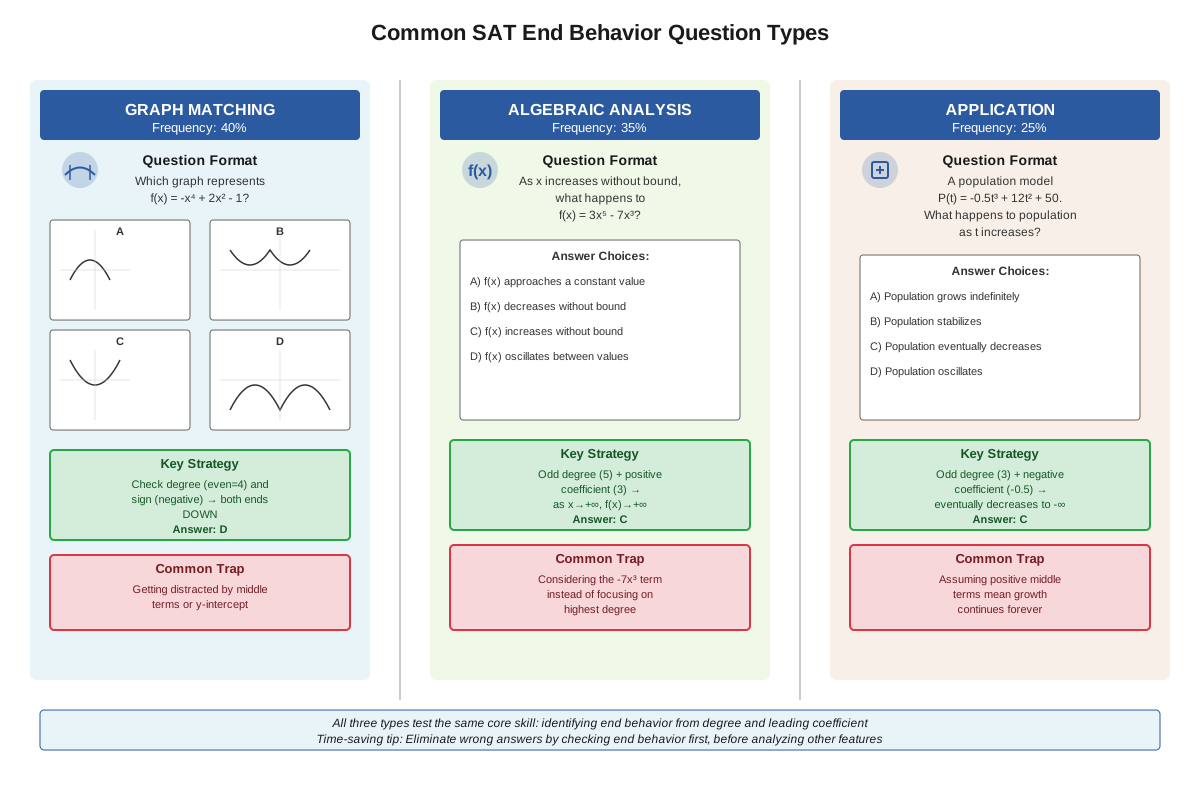
On the SAT, end behavior appears in approximately 2-4 questions per test, making it a high-yield topic that directly impacts scores. These questions typically appear in the calculator and no-calculator sections, often worth 1 point each but sometimes integrated into multi-part problems worth more. The College Board frequently tests end behavior through graph-matching problems (given an equation, select the correct graph), algebraic analysis questions (determine behavior from an equation), and application problems where students must interpret polynomial models.
Common SAT question formats include: presenting four graphs and asking which matches a given polynomial equation; providing a polynomial and asking what happens as x approaches negative infinity; showing a graph and asking which equation could represent it; and word problems involving polynomial models where students must determine long-term behavior. The topic also appears in questions that combine multiple concepts, such as determining the number of turning points while also analyzing end behavior.
Core Concepts
Understanding End Behavior Fundamentals
End behavior refers specifically to the behavior of a function's output values (y-values) as the input values (x-values) approach positive infinity (∞) or negative infinity (-∞). When mathematicians say "as x approaches infinity," they mean as x gets larger and larger without bound. Similarly, "as x approaches negative infinity" means as x becomes more and more negative without limit.
For polynomial functions, end behavior is entirely determined by two characteristics: the degree of the polynomial (the highest power of x) and the leading coefficient (the coefficient of the term with the highest power). This is a powerful simplification because it means we can ignore all other terms when analyzing end behavior—only the leading term matters for extreme values of x.
The Four End Behavior Patterns
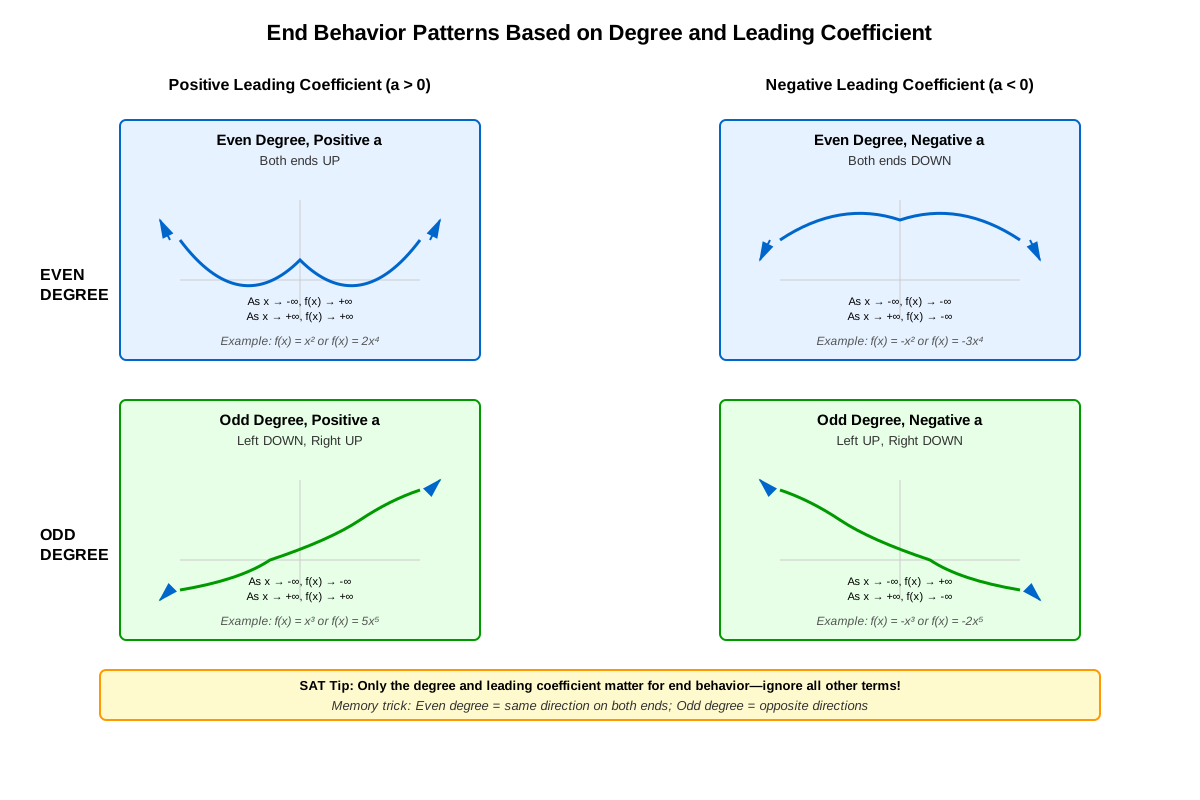
All polynomial functions exhibit one of four distinct end behavior patterns, determined by whether the degree is even or odd and whether the leading coefficient is positive or negative:
| Degree | Leading Coefficient | As x → -∞ | As x → +∞ | Visual Description |
|---|---|---|---|---|
| Even | Positive | f(x) → +∞ | f(x) → +∞ | Both ends point upward |
| Even | Negative | f(x) → -∞ | f(x) → -∞ | Both ends point downward |
| Odd | Positive | f(x) → -∞ | f(x) → +∞ | Left end down, right end up |
| Odd | Negative | f(x) → +∞ | f(x) → -∞ | Left end up, right end down |
Even Degree Polynomials
When a polynomial has an even degree (2, 4, 6, etc.), both ends of the graph point in the same direction. This occurs because raising any number (positive or negative) to an even power always produces a positive result. Consider f(x) = x²: whether x is -1000 or +1000, the result is positive and large.
For even-degree polynomials with a positive leading coefficient, both ends of the graph rise toward positive infinity. The graph resembles a parabola opening upward (though it may have additional curves in the middle). Example: f(x) = 2x⁴ - 3x² + 1 has degree 4 (even) and leading coefficient 2 (positive), so both ends point upward.
For even-degree polynomials with a negative leading coefficient, both ends of the graph fall toward negative infinity. The graph resembles an upside-down parabola (with possible additional features). Example: f(x) = -x⁶ + 5x³ - 2 has degree 6 (even) and leading coefficient -1 (negative), so both ends point downward.
Odd Degree Polynomials
When a polynomial has an odd degree (1, 3, 5, etc.), the two ends of the graph point in opposite directions. This happens because raising a negative number to an odd power produces a negative result, while raising a positive number to an odd power produces a positive result. Consider f(x) = x³: when x = -1000, f(x) is negative and large in magnitude; when x = +1000, f(x) is positive and large.
For odd-degree polynomials with a positive leading coefficient, the left end falls toward negative infinity while the right end rises toward positive infinity. The graph generally moves from bottom-left to top-right. Example: f(x) = x³ - 4x has degree 3 (odd) and leading coefficient 1 (positive), so it falls on the left and rises on the right.
For odd-degree polynomials with a negative leading coefficient, the left end rises toward positive infinity while the right end falls toward negative infinity. The graph generally moves from top-left to bottom-right. Example: f(x) = -2x⁵ + x² - 7 has degree 5 (odd) and leading coefficient -2 (negative), so it rises on the left and falls on the right.
Why Only the Leading Term Matters
The mathematical reason that only the leading term determines end behavior involves the concept of dominance. As x becomes very large (in either direction), the term with the highest power grows much faster than all other terms. For example, in f(x) = x⁴ - 1000x³ + 500000, when x = 100, the x⁴ term equals 100,000,000 while the -1000x³ term equals -1,000,000,000. However, when x = 10,000, the x⁴ term equals 10,000,000,000,000,000 while the -1000x³ term equals only -1,000,000,000,000,000. The x⁴ term eventually dominates completely.
Analyzing End Behavior from Standard Form
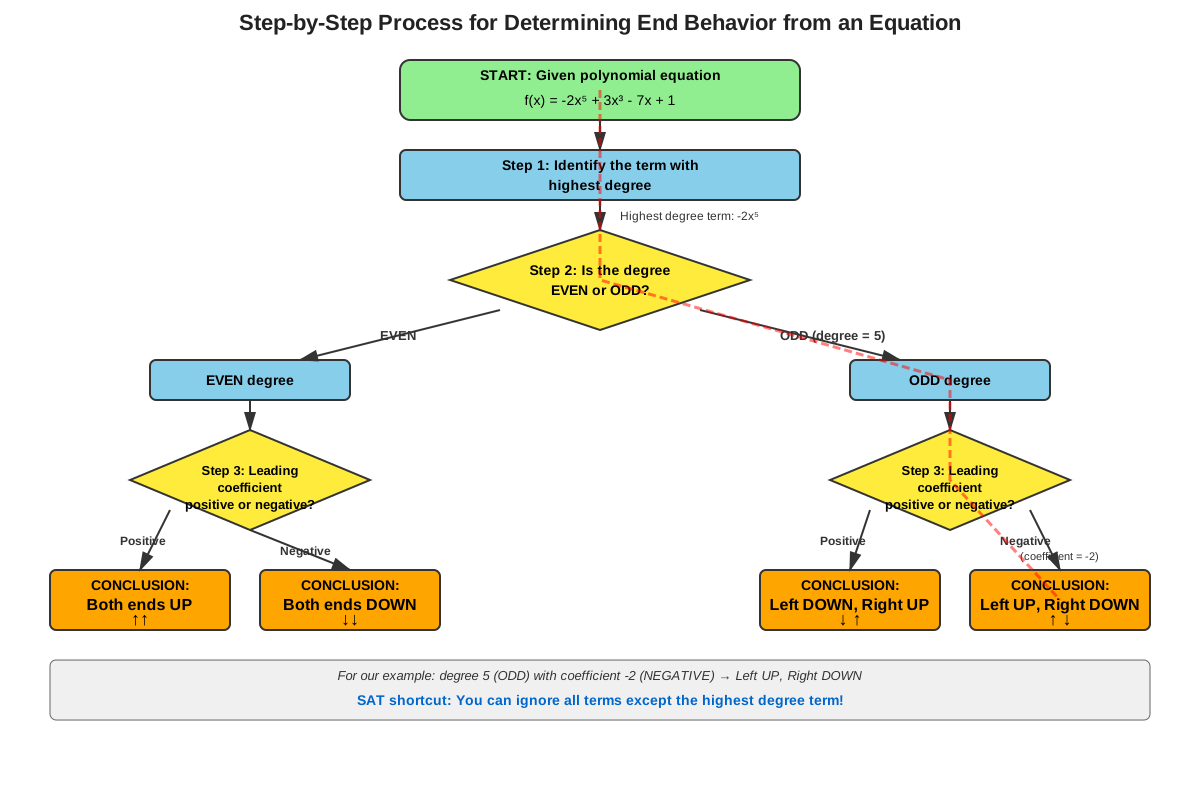
To determine end behavior from a polynomial in standard form:
- Identify the degree: Find the highest power of x in the polynomial
- Identify the leading coefficient: Find the coefficient of the term with the highest power
- Determine if the degree is even or odd: This tells you whether ends go in the same or opposite directions
- Determine if the leading coefficient is positive or negative: This tells you the specific direction(s)
- State the end behavior: Use notation like "as x → -∞, f(x) → +∞" or describe it verbally
End Behavior Notation
Mathematicians use specific notation to describe end behavior precisely:
- "As x → +∞, f(x) → +∞" means "as x approaches positive infinity, f(x) approaches positive infinity"
- "As x → -∞, f(x) → -∞" means "as x approaches negative infinity, f(x) approaches negative infinity"
This notation appears frequently on SAT questions, so students must be comfortable reading and interpreting it quickly.
Concept Relationships
End behavior serves as a bridge between algebraic and graphical representations of polynomials. The degree of a polynomial directly determines whether end behavior is symmetric (even degree) or asymmetric (odd degree), while the leading coefficient determines the vertical direction. This relationship flows as: Polynomial equation → Degree and leading coefficient identified → End behavior pattern determined → Graph characteristics predicted.
End behavior connects to polynomial zeros and factors because while zeros determine where a graph crosses the x-axis, end behavior determines the overall shape and direction. Together, these concepts allow complete graph sketching: zeros provide x-intercepts, end behavior provides the overall direction, and the degree indicates the maximum number of turning points.
The concept also relates to function transformations: while vertical and horizontal shifts move a graph, they don't change end behavior. However, vertical reflections (multiplying by -1) reverse end behavior by changing the sign of the leading coefficient. Understanding this relationship helps students predict how transformations affect polynomial graphs.
End behavior analysis prepares students for rational functions (studied in advanced courses), where end behavior becomes more complex and involves horizontal asymptotes. The foundational understanding that the highest-degree term dominates at extreme values carries forward to these more sophisticated functions.
High-Yield Facts
⭐ The degree and leading coefficient are the ONLY factors that determine end behavior—all other terms and coefficients are irrelevant for extreme x-values
⭐ Even-degree polynomials always have both ends pointing in the same direction (both up or both down)
⭐ Odd-degree polynomials always have ends pointing in opposite directions (one up, one down)
⭐ A positive leading coefficient means the right end points upward; a negative leading coefficient means the right end points downward
⭐ For even-degree polynomials with positive leading coefficients, both ends rise; this is the most common pattern tested on the SAT
- Linear functions (degree 1) always have opposite end behaviors because they have odd degree
- Quadratic functions (degree 2) always have matching end behaviors because they have even degree
- The end behavior of f(x) = -g(x) is the opposite of the end behavior of g(x) for all x-values
- Multiplying a polynomial by a positive constant doesn't change end behavior direction, only the rate of growth
- End behavior is unaffected by horizontal or vertical shifts of the polynomial graph
Quick check — test yourself on End behavior so far.
Try Flashcards →Common Misconceptions
Misconception: The constant term or middle coefficients affect end behavior → Correction: Only the degree and leading coefficient determine end behavior. The polynomial f(x) = x³ + 1000000 has the same end behavior as f(x) = x³ - 1000000 because both have degree 3 and leading coefficient 1.
Misconception: A polynomial with a negative term must have at least one end pointing downward → Correction: The presence of negative terms doesn't determine end behavior; only the sign of the leading coefficient matters. The polynomial f(x) = x⁴ - 100x³ - 500x² has both ends pointing upward because the leading coefficient (1) is positive and the degree (4) is even.
Misconception: Higher degree always means the graph goes higher → Correction: Degree determines the pattern of end behavior (same or opposite directions), not the height. A degree-2 polynomial can have larger y-values than a degree-5 polynomial depending on coefficients and the x-value being evaluated.
Misconception: If a graph crosses the x-axis multiple times, the end behavior must be complex → Correction: The number of x-intercepts doesn't affect end behavior. A polynomial can cross the x-axis five times and still have simple end behavior determined solely by its degree and leading coefficient.
Misconception: End behavior describes what happens in the middle of the graph → Correction: End behavior specifically describes what happens as x approaches positive or negative infinity—the extreme left and right portions of the graph. The middle behavior depends on zeros, turning points, and other factors.
Misconception: Factored form makes end behavior harder to determine → Correction: While factored form is excellent for finding zeros, you can still determine end behavior by identifying the degree (sum of all factor exponents) and the sign of the product of all leading coefficients. For f(x) = -2(x-1)(x+3)(x-5), the degree is 3 (odd) and the leading coefficient is -2 (negative), so the left end rises and the right end falls.
Worked Examples
Example 1: Determining End Behavior from an Equation
Problem: Determine the end behavior of f(x) = -3x⁴ + 7x³ - 2x + 5.
Solution:
Step 1: Identify the degree of the polynomial.
The highest power of x is 4, so the degree is 4.
Step 2: Determine if the degree is even or odd.
Since 4 is even, both ends of the graph will point in the same direction.
Step 3: Identify the leading coefficient.
The coefficient of x⁴ is -3, so the leading coefficient is -3.
Step 4: Determine if the leading coefficient is positive or negative.
The leading coefficient -3 is negative.
Step 5: Apply the end behavior rules.
Even degree + negative leading coefficient = both ends point downward.
Step 6: State the end behavior using proper notation.
As x → -∞, f(x) → -∞
As x → +∞, f(x) → -∞
Answer: Both ends of the graph fall toward negative infinity. Visually, this graph resembles an upside-down parabola (though with possible additional curves in the middle due to the cubic and linear terms).
Connection to Learning Objectives: This example demonstrates how to identify key features of end behavior and apply the systematic process to determine behavior from an algebraic expression.
Example 2: Matching Equations to Graphs (SAT-Style)
Problem: Which of the following graphs could represent the function f(x) = 2x⁵ - 8x³ + x - 3?
(Imagine four graphs labeled A, B, C, and D where:
- Graph A: Both ends point upward
- Graph B: Left end points up, right end points down
- Graph C: Left end points down, right end points up
- Graph D: Both ends point downward)
Solution:
Step 1: Identify the degree.
The highest power is 5, so degree = 5.
Step 2: Classify the degree.
5 is odd, so the ends must point in opposite directions.
Step 3: Eliminate graphs with same-direction ends.
Graphs A and D both show ends pointing in the same direction, which only happens with even-degree polynomials. Eliminate A and D.
Step 4: Identify the leading coefficient.
The coefficient of x⁵ is 2 (positive).
Step 5: Apply the odd-degree, positive-coefficient rule.
For odd degree with positive leading coefficient: left end falls (toward -∞) and right end rises (toward +∞).
Step 6: Match to remaining graphs.
Graph C shows left end down and right end up, matching our prediction.
Graph B shows left end up and right end down, which would require a negative leading coefficient.
Answer: Graph C
SAT Strategy Note: This problem demonstrates the power of end behavior for rapid elimination. By analyzing just the degree and leading coefficient, we eliminated two answer choices immediately and confidently selected the correct answer without needing to find zeros, calculate specific points, or perform any complex algebra.
Connection to Learning Objectives: This example shows how end behavior appears on the SAT in graph-matching questions and demonstrates the application of end behavior analysis to eliminate incorrect answers efficiently.
Exam Strategy
When approaching SAT questions involving end behavior, begin by immediately identifying the degree and leading coefficient—these two pieces of information solve most end behavior problems. Circle or underline these values to avoid errors. Many students waste time analyzing middle terms or calculating specific values when end behavior questions require only this basic identification.
Trigger words and phrases that signal end behavior questions include: "as x increases without bound," "for very large values of x," "as x approaches infinity," "which graph could represent," "the behavior of the function for extreme values," and "in the long run." When you see these phrases, immediately shift to end behavior analysis mode rather than attempting to solve algebraically.
For graph-matching questions, use end behavior as your first elimination tool. Determine whether the polynomial has even or odd degree, then immediately eliminate all graphs that don't match the required pattern (same-direction ends for even, opposite-direction ends for odd). This typically eliminates 2 of 4 answer choices within seconds. Then use the leading coefficient sign to select between the remaining options.
Process-of-elimination tips: If a polynomial has even degree, eliminate any graph showing opposite-direction ends. If the leading coefficient is positive, eliminate any graph where the right end points downward. If you're unsure about the degree, count the maximum number of turning points visible in each graph—a polynomial of degree n has at most n-1 turning points, which can help you eliminate impossible matches.
Time allocation: End behavior questions should take 30-45 seconds once you've mastered the concept. If you find yourself spending more than one minute, you're likely overcomplicating the problem. Remember that SAT questions test whether you understand the fundamental principle that only degree and leading coefficient matter—they don't require extensive calculation.
For multi-step problems that include end behavior as one component, handle the end behavior portion first. This often provides information that makes other parts of the question easier or helps verify your final answer. For example, if you're asked to find zeros and describe end behavior, determining end behavior first tells you whether the graph ultimately rises or falls, which can help you check if your zeros make sense.
Memory Techniques
EPOS Mnemonic for remembering the four patterns:
- Even Positive: Opens Skyward (both ends up)
- Even Negative: Dives Down (both ends down)
- Odd Positive: Starts Low, Ends High (left down, right up)
- Odd Negative: Starts High, Ends Low (left up, right down)
Visual Memory Aid: Picture the letters themselves:
- Even degree polynomials look like the letter U (both ends up) or ∩ (both ends down)
- Odd degree polynomials look like a stretched S or Z (opposite ends)
"Right Hand Rule": The leading coefficient's sign always tells you what the RIGHT end does. Positive = right end goes up, Negative = right end goes down. Then use the degree to determine if the left end matches (even) or opposes (odd) the right end.
Degree Rhyme: "Even is the same, odd is opposed" helps remember that even-degree polynomials have both ends going the same direction while odd-degree polynomials have ends going in opposite directions.
Leading Coefficient Anchor: Always start by asking "What does the right side do?" The leading coefficient answers this question directly: positive means up, negative means down. This anchors your analysis and prevents confusion.
Summary
End behavior describes how polynomial functions behave as x-values approach positive or negative infinity, and it is determined exclusively by two characteristics: the polynomial's degree and its leading coefficient. Even-degree polynomials have both ends pointing in the same direction (both up if the leading coefficient is positive, both down if negative), while odd-degree polynomials have ends pointing in opposite directions (right end up and left end down if the leading coefficient is positive, reversed if negative). This concept appears frequently on the SAT in graph-matching questions, algebraic analysis problems, and application scenarios. Mastering end behavior enables rapid elimination of incorrect answer choices and provides a powerful tool for verifying solutions to polynomial problems. The key insight is that all other terms in a polynomial become irrelevant at extreme x-values—only the leading term matters, making end behavior analysis remarkably simple once the fundamental patterns are understood.
Key Takeaways
- End behavior is determined solely by a polynomial's degree (even or odd) and leading coefficient (positive or negative)—all other terms are irrelevant for extreme x-values
- Even-degree polynomials always have both ends pointing in the same direction; odd-degree polynomials always have ends pointing in opposite directions
- A positive leading coefficient means the right end of the graph points upward; a negative leading coefficient means the right end points downward
- End behavior analysis is the fastest way to eliminate incorrect answer choices on SAT graph-matching questions
- The notation "as x → ∞" means "as x approaches infinity" and signals that you should analyze end behavior rather than calculate specific values
- Memorize the four patterns (even-positive, even-negative, odd-positive, odd-negative) for instant recognition on test day
- End behavior is unaffected by transformations like horizontal or vertical shifts, but vertical reflections reverse the pattern by changing the leading coefficient's sign
Related Topics
Polynomial Zeros and Factors: Understanding where polynomials cross the x-axis complements end behavior knowledge, allowing complete graph analysis. Mastering end behavior first makes zeros easier to understand because you'll know the overall shape into which zeros must fit.
Polynomial Division and Remainder Theorem: These algebraic techniques for manipulating polynomials build on understanding polynomial structure, including degree and leading coefficients—the same elements that determine end behavior.
Rational Functions and Asymptotes: The concept that the highest-degree term dominates at extreme values extends to rational functions, where end behavior analysis becomes more sophisticated and involves horizontal asymptotes.
Function Transformations: Understanding how reflections, stretches, and shifts affect polynomial graphs requires knowing that end behavior changes only with vertical reflections (which change the leading coefficient's sign).
Limits and Calculus: End behavior is essentially an informal introduction to limits at infinity, a fundamental calculus concept. Students who master end behavior have a significant advantage when beginning calculus.
Practice CTA
Now that you've mastered the core concepts of end behavior, it's time to solidify your understanding through practice! Attempt the practice questions to test your ability to quickly identify end behavior patterns and match equations to graphs. Use the flashcards to drill the four fundamental patterns until they become automatic—this speed and confidence will serve you well on test day. Remember, end behavior questions are high-yield opportunities to earn quick points on the SAT, and with practice, you can answer them in under 30 seconds each. You've got this!
Sign up free to keep reading
Create a free AnvayaPrep account to finish this SAT guide on End behavior — plus flashcards and practice questions.