Overview
Basic probability is a foundational mathematical concept that measures the likelihood of events occurring, expressed as a ratio between favorable outcomes and total possible outcomes. On the SAT, probability questions appear regularly in the math sections, testing students' ability to analyze situations involving chance, calculate numerical probabilities, and interpret results in context. These questions typically involve straightforward scenarios such as drawing cards, rolling dice, selecting items from groups, or analyzing survey data, making them highly predictable and scorable for well-prepared students.
Understanding sat basic probability is essential because these questions consistently appear on every administration of the exam, usually comprising 2-4 questions across both math sections. The SAT tests probability in practical, real-world contexts rather than abstract theoretical frameworks, meaning students must be able to translate word problems into mathematical expressions and interpret decimal or fractional answers meaningfully. Probability questions often integrate with other mathematical concepts including fractions, percentages, ratios, and data analysis, making this topic a critical bridge between arithmetic fundamentals and more complex statistical reasoning.
Mastering basic probability provides students with a reliable source of points on the SAT while building analytical skills applicable across the entire math section. The concepts covered here—sample spaces, independent and dependent events, complementary probabilities, and compound probability—form the complete toolkit needed to tackle any probability question the SAT presents. With focused practice, students can achieve near-perfect accuracy on these questions, making probability a high-yield area for score improvement.
Learning Objectives
- [ ] Identify key features of basic probability including sample spaces, outcomes, and probability values
- [ ] Explain how basic probability appears on the SAT in various question formats and contexts
- [ ] Apply basic probability to answer SAT-style questions involving single and multiple events
- [ ] Calculate probabilities for independent and dependent events using appropriate formulas
- [ ] Determine complementary probabilities and use them to solve complex problems efficiently
- [ ] Interpret probability values in real-world contexts and select appropriate answer formats
Prerequisites
- Fractions and decimals: Probability values are expressed as fractions, decimals, or percentages, requiring fluency in converting between these forms
- Basic arithmetic operations: Calculating probabilities involves multiplication, division, addition, and subtraction of rational numbers
- Ratios and proportions: Probability fundamentally represents a ratio of favorable outcomes to total outcomes
- Set theory basics: Understanding groups, subgroups, and counting principles helps identify sample spaces and outcomes
Why This Topic Matters
Probability appears in everyday decision-making, from weather forecasts (70% chance of rain) to medical testing (false positive rates) to game strategy (odds of winning). Understanding probability enables informed choices about risk, helps interpret statistical claims in media and research, and provides a framework for thinking about uncertainty systematically. In professional fields ranging from finance to medicine to engineering, probability forms the foundation for data analysis, quality control, and predictive modeling.
On the SAT, probability questions appear with remarkable consistency—students can expect 2-4 probability questions per exam, representing approximately 3-6% of the total math score. These questions typically appear as multiple-choice problems worth 1 point each, though occasionally they surface as student-produced response (grid-in) questions. The College Board considers probability a "Problem Solving and Data Analysis" topic, one of the three major math content areas, indicating its importance to the overall exam structure.
Common SAT probability scenarios include: selecting objects from containers (marbles from bags, cards from decks), analyzing survey or experimental data presented in tables, determining outcomes from spinners or dice, calculating probabilities from two-way frequency tables, and solving problems involving multiple sequential events. The exam favors practical, interpretable situations over abstract mathematical theory, meaning students who can translate real-world scenarios into probability calculations have a significant advantage.
Core Concepts
Fundamental Probability Definition
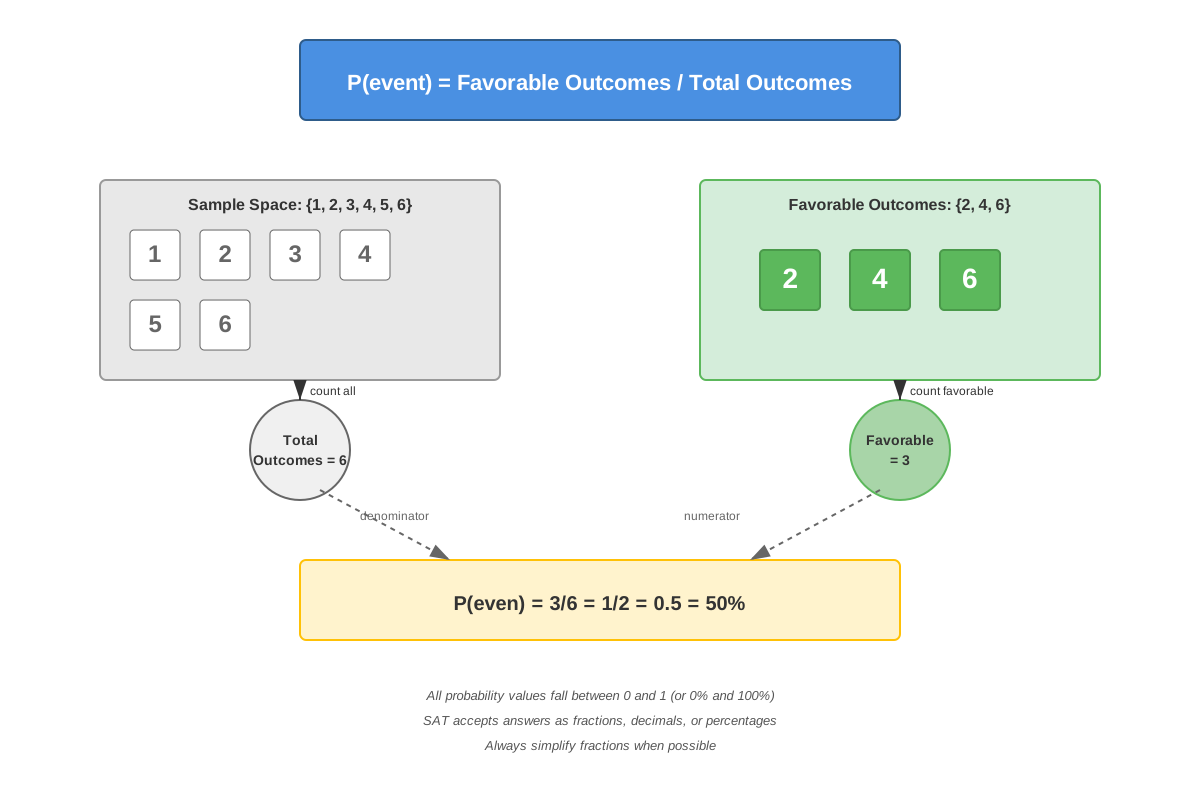
The basic probability of an event is calculated using the fundamental formula:
P(event) = Number of favorable outcomes / Total number of possible outcomesThis ratio always produces a value between 0 and 1 (inclusive), where 0 represents an impossible event and 1 represents a certain event. Probabilities can be expressed as fractions, decimals, or percentages—the SAT accepts any of these forms unless the question specifies otherwise.
For example, when rolling a standard six-sided die, the probability of rolling a 4 is 1/6 because there is one favorable outcome (rolling a 4) and six total possible outcomes (rolling 1, 2, 3, 4, 5, or 6). The probability of rolling an even number is 3/6 = 1/2 because three outcomes (2, 4, 6) are favorable out of six total possibilities.
Sample Space and Outcomes
The sample space is the complete set of all possible outcomes for a probability experiment. Identifying the sample space correctly is the critical first step in solving any probability problem. An outcome is a single result from the sample space, while an event is a collection of one or more outcomes.
Consider drawing a card from a standard 52-card deck. The sample space contains 52 distinct outcomes (each individual card). The event "drawing a heart" contains 13 outcomes (all hearts), so P(heart) = 13/52 = 1/4. The event "drawing a face card" contains 12 outcomes (4 jacks, 4 queens, 4 kings), so P(face card) = 12/52 = 3/13.
When determining sample spaces, students must ensure outcomes are:
- Equally likely: Each outcome has the same chance of occurring
- Mutually exclusive: No two outcomes can occur simultaneously
- Exhaustive: The outcomes cover all possibilities
Independent Events
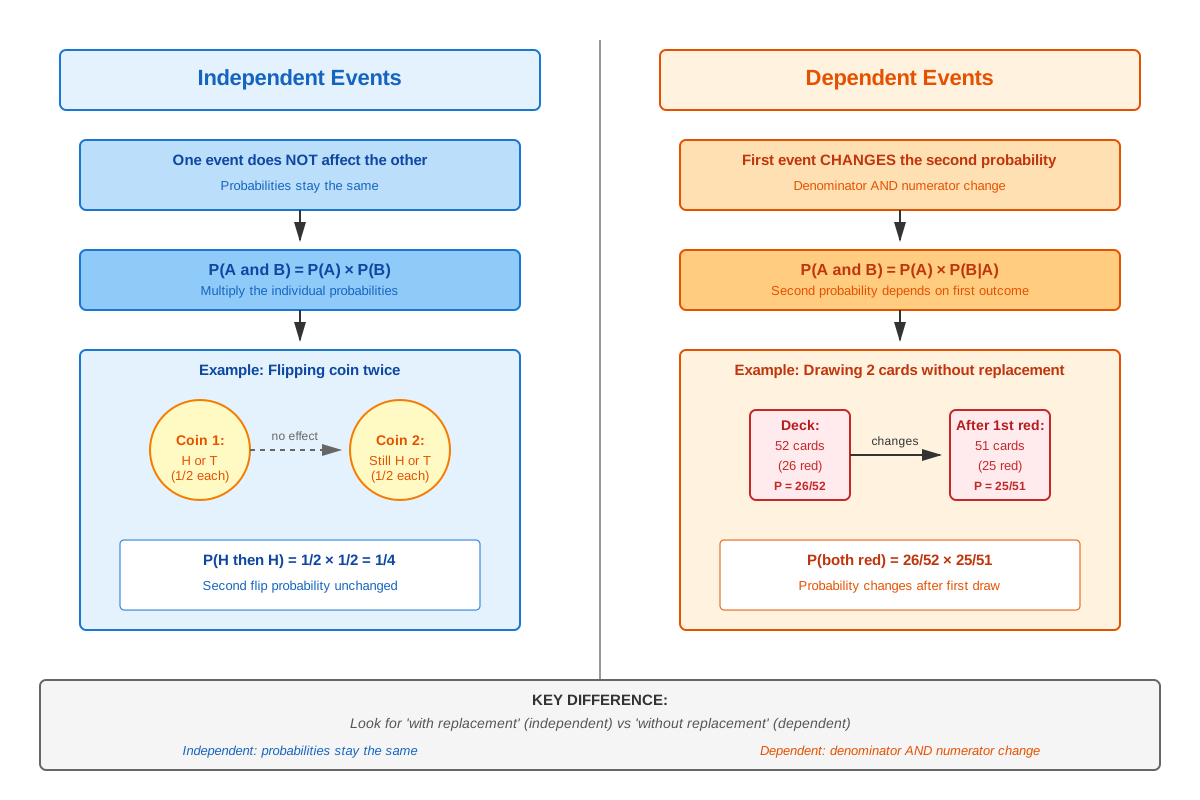
Two events are independent when the occurrence of one event does not affect the probability of the other event occurring. For independent events A and B, the probability that both events occur is:
P(A and B) = P(A) × P(B)Classic examples of independent events include:
- Rolling a die multiple times (each roll doesn't affect subsequent rolls)
- Flipping a coin repeatedly (previous flips don't influence future flips)
- Drawing cards with replacement (returning the card before drawing again)
For instance, if you flip a fair coin twice, the probability of getting heads both times is:
P(heads on first flip) × P(heads on second flip) = 1/2 × 1/2 = 1/4
This multiplication rule extends to any number of independent events. If you roll a die three times, the probability of rolling a 6 all three times is (1/6) × (1/6) × (1/6) = 1/216.
Dependent Events
Events are dependent when the occurrence of one event affects the probability of the other event. This commonly occurs in "without replacement" scenarios where selecting one item changes the composition of the remaining items.
For dependent events, calculate the probability of the first event, then calculate the probability of the second event given that the first has occurred:
P(A and B) = P(A) × P(B|A)where P(B|A) represents the probability of B given that A has occurred.
Example: A bag contains 5 red marbles and 3 blue marbles. If you draw two marbles without replacement, what's the probability both are red?
- P(first marble is red) = 5/8
- P(second marble is red | first was red) = 4/7 (only 4 red marbles remain out of 7 total)
- P(both red) = 5/8 × 4/7 = 20/56 = 5/14
Complementary Probability
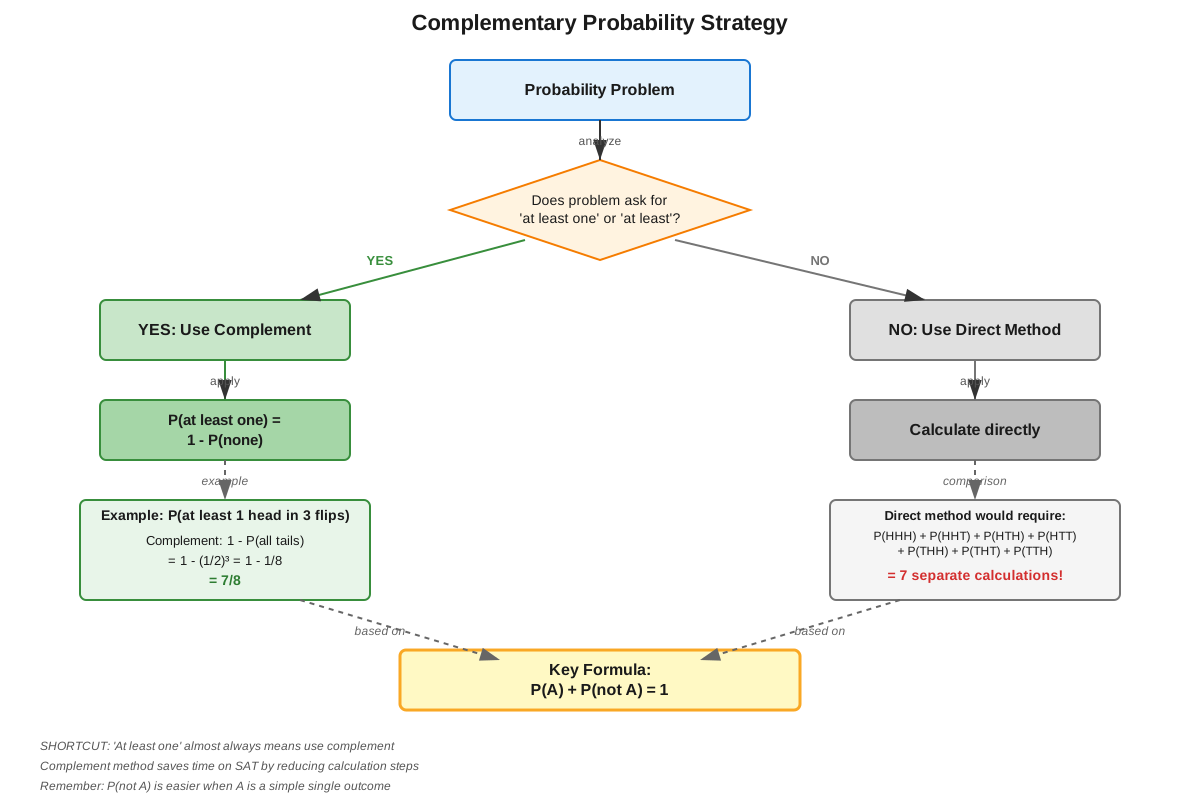
The complement of an event A, denoted A' or "not A," consists of all outcomes in the sample space that are not in A. The probabilities of an event and its complement always sum to 1:
P(A) + P(A') = 1Therefore:
P(A') = 1 - P(A)Complementary probability is particularly useful when calculating "at least one" probabilities. Instead of calculating all the ways an event can occur at least once, calculate the probability it never occurs and subtract from 1.
Example: If you flip a coin three times, what's the probability of getting at least one heads?
Rather than calculating P(exactly 1 heads) + P(exactly 2 heads) + P(exactly 3 heads), use the complement:
- P(at least one heads) = 1 - P(no heads)
- P(no heads) = P(all tails) = 1/2 × 1/2 × 1/2 = 1/8
- P(at least one heads) = 1 - 1/8 = 7/8
Compound Probability with "Or"
When calculating the probability that event A or event B occurs, the approach depends on whether the events are mutually exclusive (cannot both occur).
For mutually exclusive events (events that cannot happen simultaneously):
P(A or B) = P(A) + P(B)Example: When rolling a die, P(rolling a 2 or rolling a 5) = 1/6 + 1/6 = 2/6 = 1/3
For non-mutually exclusive events (events that can occur together):
P(A or B) = P(A) + P(B) - P(A and B)The subtraction prevents double-counting the overlap where both events occur.
Example: In a deck of cards, P(drawing a heart or drawing a king) = P(heart) + P(king) - P(king of hearts) = 13/52 + 4/52 - 1/52 = 16/52 = 4/13
Probability from Tables and Data
The SAT frequently presents probability problems using two-way frequency tables, charts, or survey data. To solve these problems:
- Identify the total number of outcomes (usually the grand total in a table)
- Identify the number of favorable outcomes (specific cell or sum of cells)
- Form the probability ratio
| Category A | Category B | Total | |
|---|---|---|---|
| Group 1 | 30 | 20 | 50 |
| Group 2 | 15 | 35 | 50 |
| Total | 45 | 55 | 100 |
From this table:
- P(Category A) = 45/100 = 0.45
- P(Group 1 and Category B) = 20/100 = 0.20
- P(Category A | Group 2) = 15/50 = 0.30 (conditional probability)
Concept Relationships
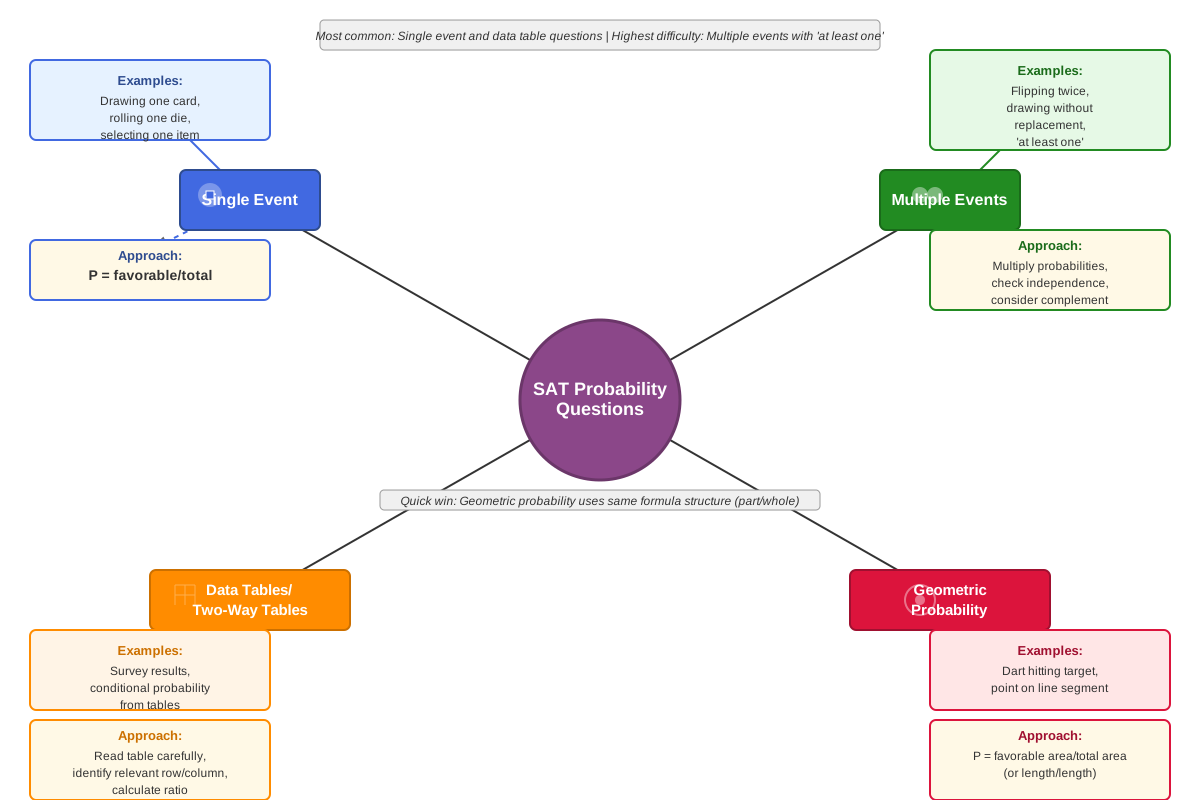
The fundamental probability formula serves as the foundation for all other probability concepts. From this base definition, the concept branches into two major pathways: single-event probability and multi-event probability.
Single-event probability → requires only identifying the sample space and counting favorable outcomes → connects directly to complementary probability (since every event has exactly one complement)
Multi-event probability → splits into two categories based on event relationship:
- Independent events → uses multiplication rule → applies to "with replacement" scenarios
- Dependent events → uses conditional probability → applies to "without replacement" scenarios
Both independent and dependent event calculations can incorporate compound probability with "or", which requires determining whether events are mutually exclusive before applying the appropriate formula.
Probability from tables and data integrates all previous concepts, as table-based problems may involve single events, multiple events, independent or dependent relationships, or complementary probabilities depending on the question asked.
The complementary probability concept serves as a powerful shortcut technique that connects back to all other probability types, particularly useful for "at least one" problems involving multiple independent events.
Quick check — test yourself on Basic probability so far.
Try Flashcards →High-Yield Facts
⭐ The probability of any event always falls between 0 and 1, inclusive (0 ≤ P(event) ≤ 1)
⭐ For independent events, multiply probabilities: P(A and B) = P(A) × P(B)
⭐ The sum of an event's probability and its complement equals 1: P(A) + P(not A) = 1
⭐ For mutually exclusive events, add probabilities: P(A or B) = P(A) + P(B)
⭐ In "without replacement" scenarios, the total number of outcomes decreases after each selection
- Probability can be expressed as a fraction, decimal, or percentage—all are equivalent
- The sample space must include all possible outcomes that are equally likely
- "At least one" problems are most efficiently solved using complementary probability
- When events can occur together (non-mutually exclusive), subtract the overlap: P(A or B) = P(A) + P(B) - P(A and B)
- Conditional probability P(B|A) means "probability of B given that A has already occurred"
- In a standard deck of cards: 52 total cards, 4 suits of 13 cards each, 12 face cards total
- A fair coin has P(heads) = P(tails) = 1/2; a fair die has P(any specific number) = 1/6
- The word "and" in probability typically signals multiplication; "or" typically signals addition
- Drawing with replacement creates independent events; drawing without replacement creates dependent events
Common Misconceptions
Misconception: After flipping heads three times in a row, tails is "due" and more likely on the next flip.
Correction: Each coin flip is an independent event with P(heads) = P(tails) = 1/2, regardless of previous outcomes. Past results do not influence future probabilities for independent events.
Misconception: P(A or B) always equals P(A) + P(B).
Correction: This formula only applies to mutually exclusive events. When events can occur simultaneously, you must subtract the overlap: P(A or B) = P(A) + P(B) - P(A and B) to avoid double-counting.
Misconception: Probability values can exceed 1 or be negative.
Correction: Probability is a ratio of favorable outcomes to total outcomes, so it must fall between 0 and 1, inclusive. A calculated value outside this range indicates an error in the setup or calculation.
Misconception: In dependent events, the probability of the second event remains the same as the first.
Correction: In dependent events (like drawing without replacement), the sample space changes after the first event, altering the probability of subsequent events. Always recalculate using the updated total.
Misconception: "At least one" means exactly one.
Correction: "At least one" means one or more (one, two, three, etc.). The most efficient solution method uses complementary probability: P(at least one) = 1 - P(none).
Misconception: When a problem states "randomly selected," some outcomes are more likely than others.
Correction: "Randomly selected" explicitly means all outcomes are equally likely. This is a key assumption that validates using the basic probability formula.
Misconception: The probability of two events both occurring is higher than either event alone.
Correction: P(A and B) = P(A) × P(B) for independent events, which is always less than or equal to either individual probability (since you're multiplying by a number ≤ 1).
Worked Examples
Example 1: Independent Events with Complementary Probability
Problem: A student takes a multiple-choice quiz with 3 questions. Each question has 4 answer choices, and the student guesses randomly on all questions. What is the probability that the student answers at least one question correctly?
Solution:
Step 1: Identify the type of problem. This involves multiple independent events (each question is independent) and asks for "at least one," suggesting complementary probability.
Step 2: Calculate the probability of answering a single question correctly.
- P(correct on one question) = 1/4 (one correct answer out of four choices)
- P(incorrect on one question) = 3/4
Step 3: Use complementary probability. "At least one correct" is the complement of "none correct."
- P(at least one correct) = 1 - P(all incorrect)
Step 4: Calculate P(all incorrect) using the multiplication rule for independent events.
- P(all incorrect) = P(incorrect on Q1) × P(incorrect on Q2) × P(incorrect on Q3)
- P(all incorrect) = 3/4 × 3/4 × 3/4 = 27/64
Step 5: Calculate the final answer.
- P(at least one correct) = 1 - 27/64 = 37/64
Answer: 37/64 or approximately 0.578
This problem demonstrates the power of complementary probability. Calculating P(exactly 1 correct) + P(exactly 2 correct) + P(exactly 3 correct) would require significantly more work and introduce more opportunities for error.
Example 2: Dependent Events from a Table
Problem: A survey of 200 students asked about their preferred study location. The results are shown below:
| Library | Home | Coffee Shop | Total | |
|---|---|---|---|---|
| Freshman | 25 | 30 | 15 | 70 |
| Sophomore | 35 | 40 | 20 | 95 |
| Junior | 15 | 10 | 10 | 35 |
| Total | 75 | 80 | 45 | 200 |
If two students are randomly selected without replacement, what is the probability that both are juniors who prefer the library?
Solution:
Step 1: Identify this as a dependent event problem (without replacement).
Step 2: Calculate the probability the first student is a junior who prefers the library.
- Number of juniors who prefer library = 15
- Total students = 200
- P(first student is junior who prefers library) = 15/200
Step 3: Calculate the probability the second student is also a junior who prefers the library, given the first was.
- After selecting one junior who prefers library, 14 such students remain
- Total students remaining = 199
- P(second is junior who prefers library | first was) = 14/199
Step 4: Multiply the probabilities (dependent events).
- P(both are juniors who prefer library) = 15/200 × 14/199
- P(both) = 210/39,800
- P(both) = 21/3,980 (simplified)
Answer: 21/3,980 or approximately 0.0053
This problem illustrates how table-based probability questions integrate with dependent events. The key insight is recognizing that "without replacement" changes both the numerator and denominator for the second selection.
Exam Strategy
When approaching SAT probability questions, follow this systematic process:
Step 1: Read carefully and identify the scenario type
- Single event or multiple events?
- Independent or dependent (with/without replacement)?
- Does it involve "and" (multiplication) or "or" (addition)?
- Is it asking for "at least one" (use complement)?
Step 2: Determine the sample space
- Count total possible outcomes carefully
- For tables, identify the correct total (row, column, or grand total)
- Ensure all outcomes are equally likely
Step 3: Count favorable outcomes
- Identify exactly which outcomes satisfy the condition
- For compound events, determine if events overlap (mutually exclusive or not)
Step 4: Set up the calculation
- Write the probability formula before calculating
- For multiple events, determine whether to multiply or add
- For "without replacement," remember to adjust both numerator and denominator
Trigger words to watch for:
- "At least one" → Use complementary probability (1 - P(none))
- "Without replacement" → Dependent events, adjust totals after each selection
- "With replacement" or "each time" → Independent events, probabilities stay constant
- "Or" → Addition (check if mutually exclusive)
- "And" → Multiplication
- "Given that" → Conditional probability, use subset as new total
Process of elimination tips:
- Eliminate any answer greater than 1 or less than 0
- If the problem involves "and," the answer should be smaller than either individual probability
- If the problem involves "or" with mutually exclusive events, the answer should be larger than either individual probability
- For "at least one" problems, the answer should be relatively large (often > 0.5)
Time allocation:
- Simple single-event problems: 30-45 seconds
- Multi-step problems with tables: 60-90 seconds
- Complex compound probability: 90-120 seconds
- If stuck after 2 minutes, make your best guess and flag for review
Exam Tip: When in doubt between multiplying and adding, ask yourself: "Am I looking for both events to happen (multiply) or either event to happen (add)?"
Memory Techniques
AND means Multiply, OR means Add - Remember "A.M." and "O.A."
- And = Multiply
- Or = Add
The COIN method for probability problems:
- Count the total outcomes (sample space)
- Observe favorable outcomes
- Identify if independent or dependent
- Note whether to multiply (and) or add (or)
Complement Shortcut Visualization: Picture a complete circle (probability = 1). Your event takes up part of the circle, and the complement fills the rest. Together they make the whole circle, so they must sum to 1.
"With" and "Without" Replacement Rule:
- With replacement = Watch probabilities stay the Wame (independent)
- Without replacement = Watch probabilities Waver (dependent)
The 0-to-1 Rule: Visualize a number line from 0 to 1. Impossible events sit at 0, certain events sit at 1, and all real probabilities fall somewhere between. This mental image helps catch calculation errors.
Table Probability Acronym - FIND:
- Favorable outcomes (specific cell or cells)
- Identify the correct total (row, column, or grand)
- Numerator over denominator
- Double-check your fraction can't be simplified
Summary
Basic probability measures the likelihood of events occurring, calculated as the ratio of favorable outcomes to total possible outcomes, always yielding a value between 0 and 1. The SAT tests probability through practical scenarios involving independent events (where one event doesn't affect another, solved by multiplying probabilities), dependent events (where one event affects another, requiring adjusted calculations for subsequent events), and complementary probability (where P(event) + P(not event) = 1). Students must identify sample spaces correctly, distinguish between "and" situations (multiplication) and "or" situations (addition, with adjustments for overlapping events), and recognize when complementary probability provides an efficient solution path, particularly for "at least one" problems. Table-based probability questions integrate these concepts by presenting data that requires identifying appropriate totals and favorable outcomes. Mastery requires systematic problem analysis, careful counting, and strategic formula selection based on event relationships and question structure.
Key Takeaways
- Probability equals favorable outcomes divided by total possible outcomes, always resulting in a value from 0 to 1
- Independent events (with replacement) use multiplication: P(A and B) = P(A) × P(B)
- Dependent events (without replacement) require adjusting totals after each selection
- Complementary probability (P(A) = 1 - P(not A)) efficiently solves "at least one" problems
- "And" typically signals multiplication; "or" typically signals addition (subtract overlap if events aren't mutually exclusive)
- Table-based problems require identifying the correct total (row, column, or grand total) based on the question
- The SAT presents probability in practical contexts—translate word problems into mathematical relationships systematically
Related Topics
Conditional Probability and Two-Way Tables: Builds on basic probability by exploring how probabilities change when given additional information, using the formula P(A|B) = P(A and B)/P(B). This advanced topic appears on the SAT in data analysis contexts.
Permutations and Combinations: Extends probability by providing systematic methods for counting outcomes in complex scenarios where order matters (permutations) or doesn't matter (combinations), enabling solution of more sophisticated probability problems.
Statistics and Data Analysis: Probability forms the foundation for statistical inference, hypothesis testing, and interpreting data distributions—all topics that appear in SAT math and science passages.
Expected Value: Combines probability with outcomes to calculate average results over many trials, appearing in SAT problems involving games, investments, or decision-making scenarios.
Mastering basic probability creates a strong foundation for these advanced topics while providing immediate score improvement on current SAT questions.
Practice CTA
Now that you've mastered the core concepts of basic probability, it's time to cement your understanding through active practice. Complete the practice questions to apply these concepts to SAT-style problems, and use the flashcards to reinforce key formulas and strategies. Remember: probability questions are among the most predictable on the SAT—consistent practice translates directly into points on test day. Every problem you solve builds pattern recognition and calculation speed, turning probability from a challenge into a reliable score booster. You've got this!
Sign up free to keep reading
Create a free AnvayaPrep account to finish this SAT guide on Basic probability — plus flashcards and practice questions.