Overview
Conditional probability is a fundamental concept in probability theory that measures the likelihood of an event occurring given that another event has already occurred. This concept is essential for the SAT Math section, where it frequently appears in both multiple-choice and grid-in questions. Understanding conditional probability allows students to solve complex real-world problems involving dependent events, such as analyzing survey data, medical test results, or quality control scenarios.
On the SAT, conditional probability questions often present data in two-way tables, tree diagrams, or word problems that require students to identify relationships between events. These questions test not only computational skills but also the ability to interpret information and recognize when events are dependent versus independent. Mastering this topic is crucial because it bridges basic probability concepts with more sophisticated statistical reasoning, a skill highly valued in college-level mathematics and data analysis courses.
The relationship between conditional probability and other math concepts is significant. It builds directly on fundamental probability principles while connecting to topics such as ratios, proportions, and data interpretation. Students who understand conditional probability can more easily tackle questions involving compound events, expected value, and statistical inference—all of which appear regularly on standardized tests.
Learning Objectives
- [ ] Identify key features of conditional probability
- [ ] Explain how conditional probability appears on the SAT
- [ ] Apply conditional probability to answer SAT-style questions
- [ ] Calculate conditional probabilities using the formula P(A|B) = P(A and B) / P(B)
- [ ] Interpret two-way tables to extract conditional probability information
- [ ] Distinguish between independent and dependent events using conditional probability
- [ ] Solve multi-step problems involving conditional probability in real-world contexts
Prerequisites
- Basic probability concepts: Understanding simple probability as favorable outcomes divided by total outcomes provides the foundation for conditional probability calculations
- Fractions and ratios: Conditional probability requires manipulating fractions and understanding proportional relationships between subsets of data
- Set notation and Venn diagrams: Familiarity with intersections and unions of sets helps visualize relationships between events
- Two-way tables: Reading and interpreting data organized in rows and columns is essential for most SAT conditional probability questions
- Percentages and decimals: Converting between different numerical representations is necessary for both calculations and answer interpretation
Why This Topic Matters
Conditional probability has profound real-world applications that extend far beyond the classroom. Medical professionals use it to interpret diagnostic test results, determining the actual likelihood a patient has a disease given a positive test. Insurance companies rely on conditional probability to assess risk factors and set premiums. Data scientists employ these principles to build predictive models, while quality control engineers use them to identify defective products in manufacturing processes.
On the SAT, conditional probability appears with notable frequency—typically 1-2 questions per test, representing approximately 2-4% of the Math section. These questions carry significant weight because they often appear in the medium-to-hard difficulty range, where correct answers can substantially boost scores. The College Board consistently includes conditional probability in the "Problem Solving and Data Analysis" domain, which comprises 29% of the SAT Math section.
SAT conditional probability questions commonly appear in several formats: two-way frequency tables with questions about specific subgroups, word problems describing sequential events, survey data requiring interpretation of conditional relationships, and scenarios involving sampling without replacement. Questions may ask students to calculate exact probabilities, compare different conditional probabilities, or identify which conditional probability statement correctly represents a given situation.
Core Concepts
Definition of Conditional Probability
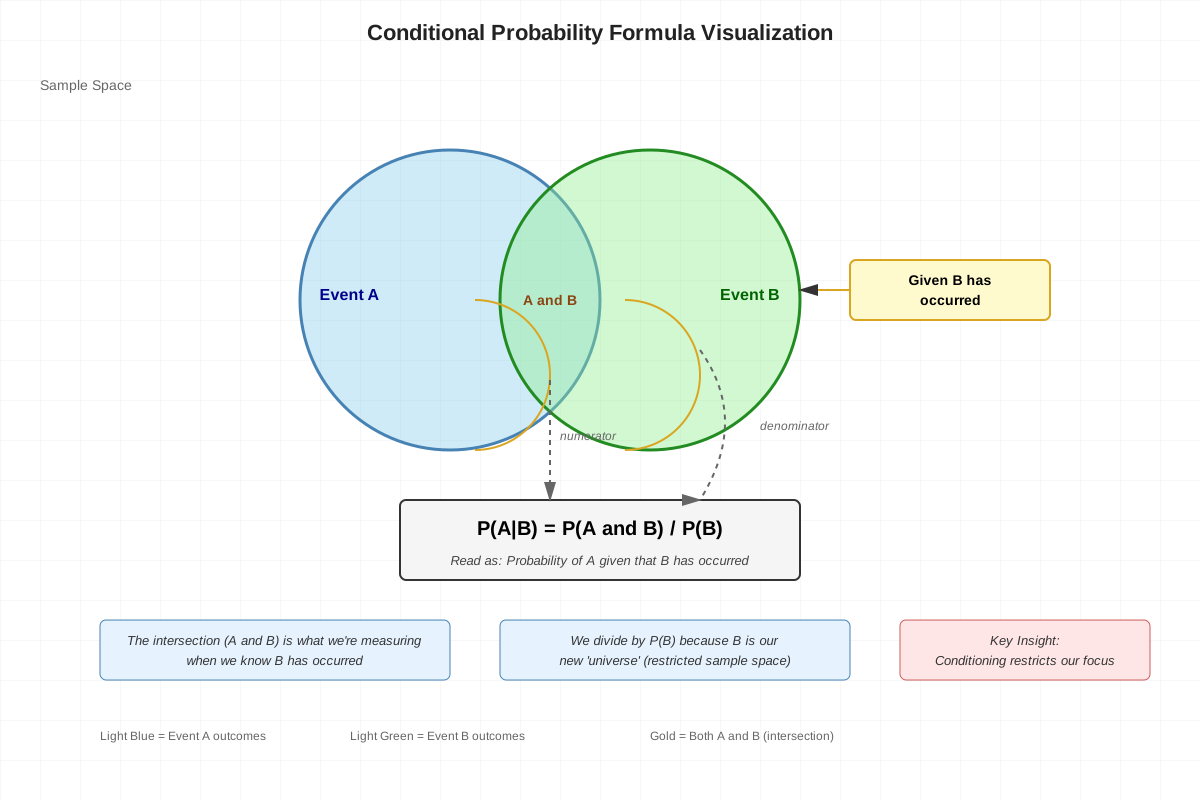
Conditional probability measures the probability of event A occurring given that event B has already occurred, denoted as P(A|B) and read as "the probability of A given B." This concept differs from simple probability because it restricts the sample space to only those outcomes where event B has occurred. The formal definition uses the formula:
P(A|B) = P(A and B) / P(B), where P(B) ≠ 0The numerator P(A and B) represents the probability that both events occur simultaneously (the intersection), while the denominator P(B) represents the probability of the conditioning event. This formula essentially asks: "Of all the times B happens, what fraction of those times does A also happen?"
Understanding the Sample Space Restriction
When calculating conditional probability, the key insight is that the sample space changes. Instead of considering all possible outcomes, we focus only on outcomes where the given condition is true. For example, if we're finding the probability that a student plays basketball given that they play a sport, we only consider students who play sports—not the entire student population. This restriction fundamentally changes the calculation and often increases or decreases probabilities compared to unconditional scenarios.
Two-Way Tables and Conditional Probability
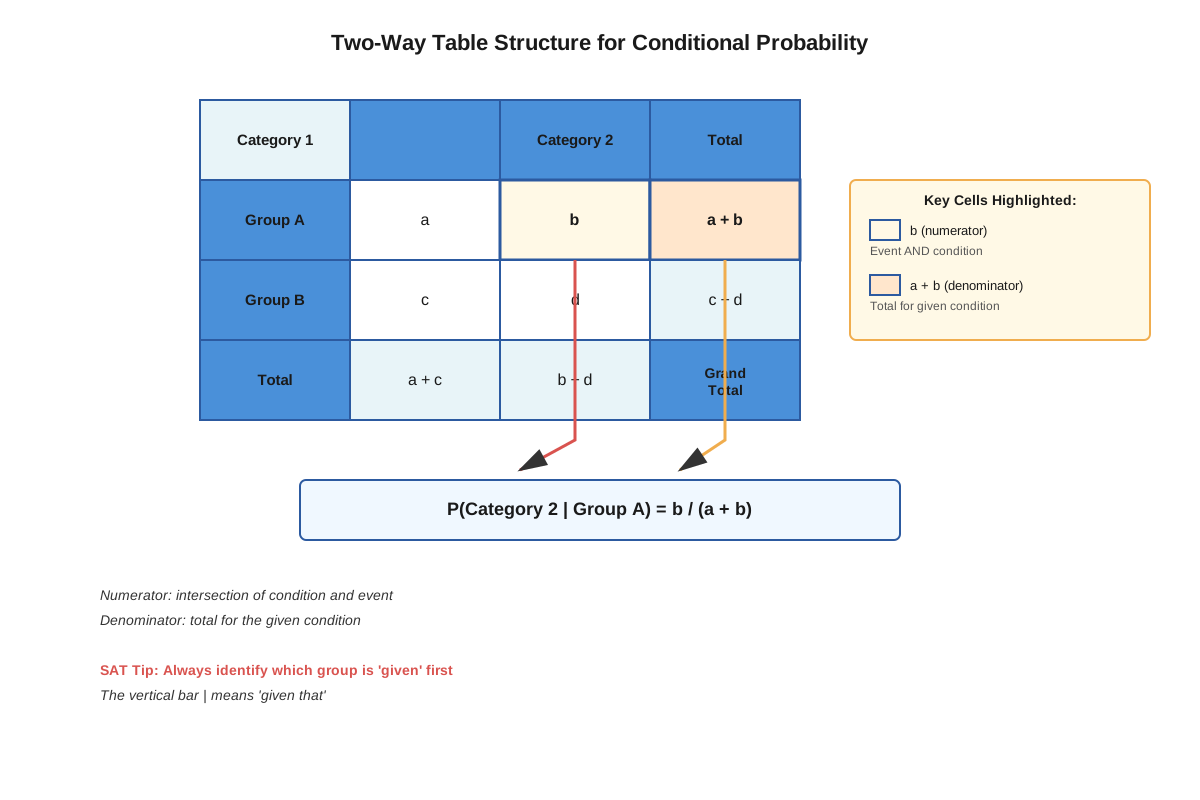
Two-way tables (also called contingency tables) are the most common way SAT presents conditional probability data. These tables organize information into rows and columns, with totals provided for each category. To find a conditional probability from a two-way table:
- Identify the condition (the "given" information)
- Locate the row or column representing that condition
- Find the total for that row or column (this becomes your denominator)
- Locate the cell representing both the condition and the desired outcome
- Divide the cell value by the row/column total
| Event A | Not Event A | Total | |
|---|---|---|---|
| Event B | 30 | 20 | 50 |
| Not Event B | 15 | 35 | 50 |
| Total | 45 | 55 | 100 |
For example, P(A|B) = 30/50 = 0.6, because among the 50 outcomes where B occurs, 30 also have A occurring.
Independent vs. Dependent Events
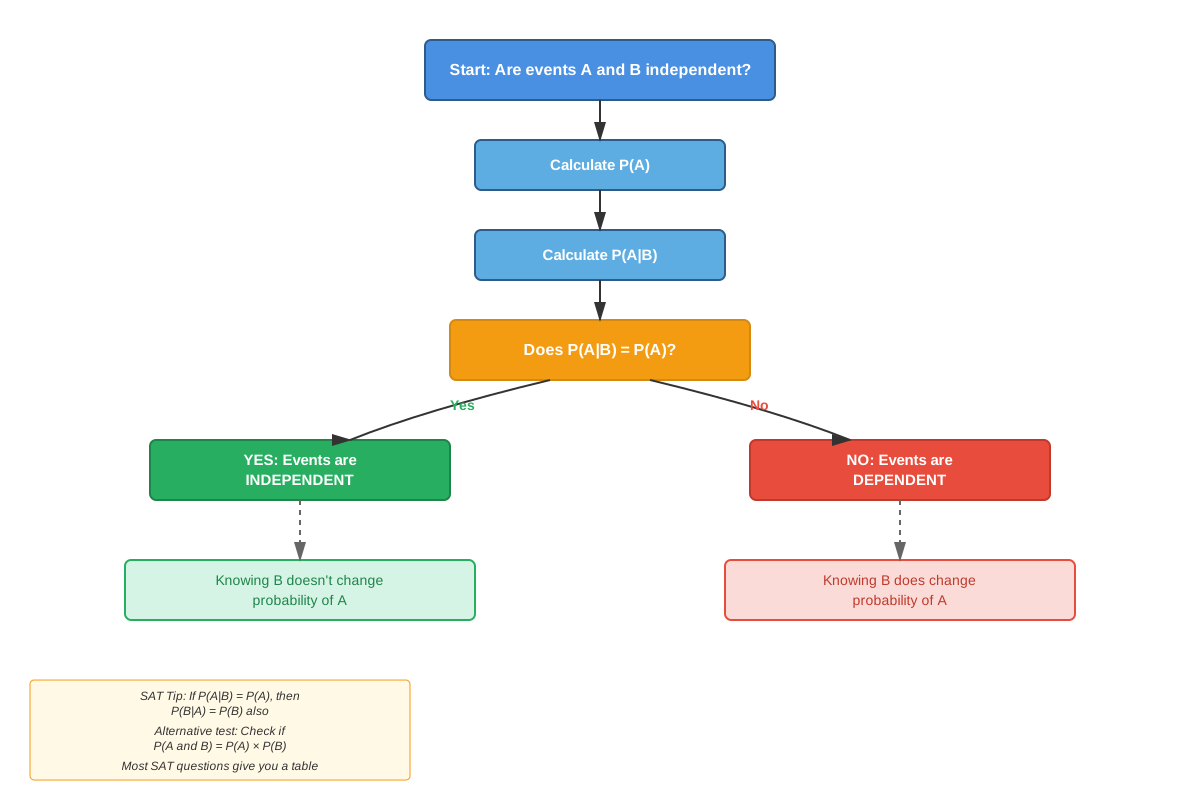
Two events are independent if the occurrence of one does not affect the probability of the other. Mathematically, events A and B are independent if and only if P(A|B) = P(A). When events are independent, P(A and B) = P(A) × P(B). Conversely, events are dependent when P(A|B) ≠ P(A), meaning the occurrence of B changes the likelihood of A.
Testing for independence using conditional probability is a high-yield SAT skill. If you calculate P(A|B) and find it equals P(A), the events are independent. If these probabilities differ, the events are dependent, and conditional probability must be used for accurate calculations.
The Multiplication Rule for Conditional Probability
Rearranging the conditional probability formula yields the multiplication rule: P(A and B) = P(B) × P(A|B). This formula is particularly useful for sequential events or multi-stage processes. For example, when drawing cards without replacement, the probability of drawing two aces equals the probability of drawing an ace first multiplied by the probability of drawing an ace second given that an ace was already drawn.
Common SAT Scenarios
The SAT frequently presents conditional probability through specific contexts:
Survey data: Questions about preferences, behaviors, or characteristics of subgroups within a population. Example: "What is the probability a randomly selected person prefers coffee given that they are over 30?"
Medical testing: Scenarios involving test accuracy, false positives, and disease prevalence. Example: "Given a positive test result, what is the probability the patient actually has the condition?"
Quality control: Manufacturing scenarios with defective items. Example: "If a randomly selected item is from Factory A, what is the probability it is defective?"
Academic performance: Student data relating grades, attendance, or participation. Example: "What is the probability a student passed the exam given that they attended all classes?"
Concept Relationships
Conditional probability serves as a bridge between basic probability concepts and advanced statistical reasoning. The foundational concept of simple probability (favorable outcomes divided by total outcomes) leads directly to conditional probability by introducing the idea of a restricted sample space. When the conditioning event occurs, we essentially create a new, smaller sample space for our probability calculation.
The relationship flows as follows: Basic Probability → Sample Space Concepts → Conditional Probability → Independence Testing → Compound Events → Bayes' Theorem (college level).
Within conditional probability itself, several concepts interconnect. The definition formula P(A|B) = P(A and B) / P(B) connects to the multiplication rule P(A and B) = P(B) × P(A|B), which are simply rearrangements of each other. Both formulas connect to two-way tables, which provide a visual and organizational structure for extracting the necessary values. The concept of independence connects back to conditional probability through the test: if P(A|B) = P(A), then A and B are independent.
Conditional probability also relates strongly to prerequisite topics. Understanding fractions and ratios is essential because conditional probability calculations involve dividing one subset by another. Set theory provides the conceptual framework for understanding intersections (A and B) and how conditioning restricts our universe of outcomes. Data interpretation skills from two-way tables transfer directly to extracting conditional probability information.
High-Yield Facts
⭐ The conditional probability formula is P(A|B) = P(A and B) / P(B), where P(B) ≠ 0
⭐ In two-way tables, conditional probability uses the row or column total (not the grand total) as the denominator
⭐ Events A and B are independent if and only if P(A|B) = P(A)
⭐ The multiplication rule states P(A and B) = P(B) × P(A|B)
⭐ When reading "given that" or "given" in a problem, the event after these words becomes the condition (denominator)
- P(A|B) and P(B|A) are generally not equal and represent different conditional probabilities
- The sum of all conditional probabilities given the same condition equals 1: P(A|B) + P(not A|B) = 1
- Conditional probability values range from 0 to 1, just like regular probability
- In sampling without replacement, events are dependent and require conditional probability
- The denominator in conditional probability must be greater than zero (the conditioning event must be possible)
- Conditional probability can be greater than, less than, or equal to the unconditional probability
- Two-way tables always provide enough information to calculate any conditional probability involving the displayed categories
- The phrase "among those" signals a conditional probability question
- Conditional probability is essential for understanding false positive and false negative rates in testing scenarios
- When events are independent, knowing one occurred provides no information about the other
Quick check — test yourself on Conditional probability so far.
Try Flashcards →Common Misconceptions
Misconception: P(A|B) and P(B|A) are the same thing → Correction: These represent different conditional probabilities. P(A|B) means "probability of A given B occurred" while P(B|A) means "probability of B given A occurred." The condition (denominator) is different in each case, leading to different values.
Misconception: The grand total in a two-way table is always the denominator for conditional probability → Correction: The denominator should be the total for the specific condition (row or column total), not the grand total. Using the grand total calculates unconditional probability, not conditional probability.
Misconception: If P(A|B) = 0.3, then P(B|A) must also equal 0.3 → Correction: These probabilities are calculated from different sample spaces and are generally unequal. You must calculate each separately using the appropriate row or column from the data.
Misconception: Conditional probability only applies when events happen in sequence → Correction: Conditional probability applies whenever we want to find the probability of one event given information about another, regardless of whether they occur sequentially or simultaneously. Survey data and two-way tables often involve simultaneous characteristics.
Misconception: If two events are dependent, they cannot both occur → Correction: Dependent events can definitely both occur; dependence simply means the occurrence of one affects the probability of the other. For example, drawing two aces without replacement involves dependent events, but both events can still happen.
Misconception: P(A and B) equals P(A|B) → Correction: P(A and B) is the joint probability of both events occurring, while P(A|B) is the conditional probability. They are related by the formula P(A and B) = P(B) × P(A|B), but they represent different concepts and typically have different values.
Misconception: When events are independent, conditional probability doesn't apply → Correction: Conditional probability still exists for independent events; it simply equals the unconditional probability. Independence means P(A|B) = P(A), not that P(A|B) is undefined or inapplicable.
Worked Examples
Example 1: Two-Way Table Analysis
Problem: A school surveyed 200 students about their participation in sports and music programs. The results are shown below:
| Plays Sports | Doesn't Play Sports | Total | |
|---|---|---|---|
| Plays Music | 45 | 35 | 80 |
| No Music | 75 | 45 | 120 |
| Total | 120 | 80 | 200 |
What is the probability that a randomly selected student plays music given that they play sports?
Solution:
Step 1: Identify what we're looking for. We need P(Plays Music | Plays Sports).
Step 2: Identify the condition. The condition is "plays sports," so we focus on the "Plays Sports" column.
Step 3: Find the denominator. The total number of students who play sports is 120 (the column total).
Step 4: Find the numerator. Among students who play sports, 45 also play music (the cell where both conditions meet).
Step 5: Calculate the conditional probability:
P(Plays Music | Plays Sports) = 45/120 = 3/8 = 0.375Answer: The probability is 3/8 or 0.375 or 37.5%.
Connection to Learning Objectives: This example demonstrates how to identify key features of conditional probability (the restricted sample space of sports players) and apply the concept to answer SAT-style questions using two-way tables.
Example 2: Testing for Independence
Problem: In a quality control test, a factory produces widgets from two machines. Machine A produces 60% of the widgets, and Machine B produces 40%. Among Machine A's widgets, 5% are defective. Among Machine B's widgets, 8% are defective. Are the events "widget is from Machine A" and "widget is defective" independent?
Solution:
Step 1: Calculate P(Defective | Machine A) = 0.05 (given directly)
Step 2: Calculate P(Defective) for all widgets:
P(Defective) = P(Machine A) × P(Defective | Machine A) + P(Machine B) × P(Defective | Machine B)
P(Defective) = 0.60 × 0.05 + 0.40 × 0.08
P(Defective) = 0.03 + 0.032 = 0.062
Step 3: Test for independence. For independence, we need P(Defective | Machine A) = P(Defective).
Step 4: Compare values:
- P(Defective | Machine A) = 0.05
- P(Defective) = 0.062
Since 0.05 ≠ 0.062, the events are NOT independent.
Answer: The events are dependent because the probability of a widget being defective changes based on which machine produced it.
Connection to Learning Objectives: This example shows how to distinguish between independent and dependent events using conditional probability and demonstrates the application of the multiplication rule in a multi-step problem.
Exam Strategy
When approaching SAT conditional probability questions, follow this systematic process:
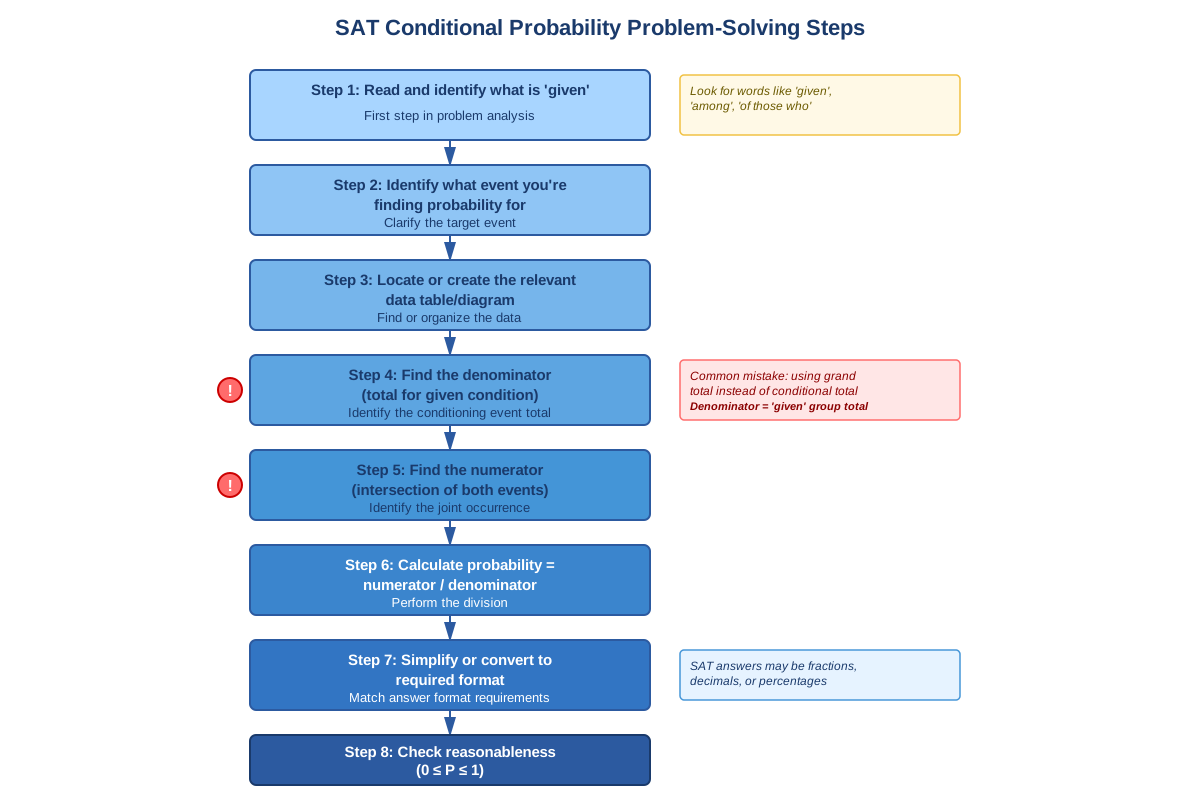
Step 1: Identify the condition. Look for trigger words like "given," "given that," "among," "of those," or "if we know." The event mentioned after these phrases becomes your condition and determines your denominator.
Step 2: Determine the question type. Is the question asking you to calculate a conditional probability, compare two conditional probabilities, or test for independence? This determines your approach.
Step 3: Organize the information. If data is presented in paragraph form, consider creating a quick two-way table. If a table is provided, identify which row or column represents your condition.
Step 4: Use the appropriate denominator. For conditional probability, always use the total for the specific condition (row or column total), never the grand total unless calculating unconditional probability.
Exam Tip: If you see "given that" in a question, immediately circle or underline it. This signals conditional probability and tells you which value becomes your denominator.
Process of elimination strategies:
- Eliminate any answer choice that uses the grand total as the denominator when a condition is specified
- Eliminate choices that confuse P(A|B) with P(B|A)—these are different values
- If testing for independence, eliminate choices that claim independence when P(A|B) ≠ P(A)
- Watch for answer choices that calculate P(A and B) instead of P(A|B)—these are related but different
Time allocation: Conditional probability questions typically require 60-90 seconds. Spend 15-20 seconds identifying the condition and organizing information, 30-40 seconds performing calculations, and 10-15 seconds checking your answer makes sense (probability between 0 and 1, reasonable in context).
Common trigger phrases to watch for:
- "Given that" or "given"
- "Among those who"
- "Of the students who"
- "If we know that"
- "Assuming that"
- "For those who"
Memory Techniques
Mnemonic for the conditional probability formula: "Condition Determines Denominator" (CDD). The condition (the "given" part) always goes in the denominator as P(B) in P(A|B) = P(A and B) / P(B).
Visualization strategy: Picture a Venn diagram where event B is highlighted. Conditional probability P(A|B) asks: "If I'm standing inside circle B, what's the chance I'm also in circle A?" This helps remember that we're restricting our view to only the B region.
The "Given = Ground" technique: Think of the given condition as the "ground" or foundation—it's where you're standing. Everything else is measured relative to that ground. This helps remember that the condition becomes your new sample space.
Acronym for two-way table problems: FIND
- Find the condition (row or column)
- Identify the cell (intersection of condition and desired outcome)
- Note the total (for the condition row/column)
- Divide (cell value by total)
The "Flip Warning": Remember that P(A|B) and P(B|A) are "flipped" versions—they're different! Use the phrase "Don't flip your condition" to remember that switching the condition changes the entire calculation.
Summary
Conditional probability is a critical SAT Math concept that measures the likelihood of an event occurring given that another event has already occurred. The fundamental formula P(A|B) = P(A and B) / P(B) requires identifying the condition (which becomes the denominator) and the intersection of both events (the numerator). On the SAT, conditional probability most commonly appears through two-way tables, where students must identify the appropriate row or column total as the denominator rather than using the grand total. Understanding the distinction between dependent and independent events is essential: events are independent when P(A|B) = P(A), meaning the condition doesn't change the probability. The multiplication rule P(A and B) = P(B) × P(A|B) connects conditional probability to compound events and sequential processes. Success on SAT conditional probability questions requires careful attention to trigger words like "given" or "among," systematic organization of information, and recognition that P(A|B) and P(B|A) represent different conditional probabilities that must be calculated separately.
Key Takeaways
- Conditional probability P(A|B) restricts the sample space to only outcomes where event B has occurred
- In two-way tables, use the row or column total (not the grand total) as the denominator for conditional probability
- The phrase "given that" signals conditional probability and identifies which event becomes the condition (denominator)
- Events are independent if and only if P(A|B) = P(A); otherwise, they are dependent
- P(A|B) and P(B|A) are generally different values and must be calculated separately
- The multiplication rule P(A and B) = P(B) × P(A|B) connects conditional probability to joint probability
- SAT conditional probability questions typically appear 1-2 times per test and often involve two-way tables or survey data
Related Topics
Independent Events and Probability: Building on conditional probability, this topic explores situations where P(A|B) = P(A) and how to calculate probabilities for multiple independent events using multiplication rules.
Expected Value: Conditional probability provides the foundation for calculating expected values in scenarios with different conditions or states, essential for decision-making problems.
Bayes' Theorem: An advanced application of conditional probability that allows calculation of P(B|A) when you know P(A|B), particularly important in medical testing and diagnostic scenarios.
Probability Distributions: Understanding conditional probability enables analysis of how probabilities change across different conditions, leading to concepts like conditional distributions in statistics.
Statistical Inference: Mastering conditional probability is essential for understanding hypothesis testing and confidence intervals, where conclusions are drawn given sample data.
Practice CTA
Now that you've mastered the core concepts of conditional probability, it's time to reinforce your understanding through practice! Work through the practice questions to apply these concepts to SAT-style problems, and use the flashcards to memorize key formulas and definitions. Remember, conditional probability is a high-yield topic that appears consistently on the SAT—investing time in practice now will pay dividends on test day. Each problem you solve strengthens your ability to quickly identify conditions, organize information, and calculate accurate probabilities. You've got this!
Sign up free to keep reading
Create a free AnvayaPrep account to finish this SAT guide on Conditional probability — plus flashcards and practice questions.