Overview
Independent events form a cornerstone of probability theory and represent one of the most frequently tested concepts in SAT math questions. Understanding independent events means recognizing when the outcome of one event has absolutely no effect on the probability of another event occurring. This concept appears regularly on the SAT, often embedded within word problems that require students to calculate combined probabilities or determine whether two scenarios influence each other. Mastering this topic is essential not only for direct probability questions but also for data analysis problems that test logical reasoning about statistical relationships.
The SAT tests independent events through various question formats, including multiple-choice problems involving coin flips, dice rolls, card draws with replacement, and real-world scenarios like weather predictions or survey results. Questions may ask students to calculate the probability of multiple independent events occurring together, identify whether given events are independent, or apply the multiplication rule for independent events. The ability to quickly recognize independence and apply the appropriate formulas can mean the difference between a correct answer in under a minute and wasting valuable test time on incorrect approaches.
Independent events connect to broader mathematical concepts including conditional probability, the fundamental counting principle, and statistical inference. While independent events maintain constant probabilities regardless of previous outcomes, dependent events (the contrasting concept) require different calculation methods. This topic builds upon basic probability foundations and serves as a gateway to more advanced statistical reasoning that appears throughout the SAT Math section, particularly in the Problem Solving and Data Analysis domain.
Learning Objectives
- [ ] Identify key features of independent events
- [ ] Explain how independent events appears on the SAT
- [ ] Apply independent events to answer SAT-style questions
- [ ] Calculate the probability of multiple independent events occurring simultaneously using the multiplication rule
- [ ] Distinguish between independent and dependent events in various contexts
- [ ] Solve multi-step probability problems involving combinations of independent events
- [ ] Interpret real-world scenarios to determine whether events exhibit independence
Prerequisites
- Basic probability concepts: Understanding that probability represents the ratio of favorable outcomes to total possible outcomes, expressed as a fraction, decimal, or percentage between 0 and 1
- Fraction and decimal operations: Necessary for multiplying probabilities and converting between different numerical representations
- Set theory fundamentals: Helps visualize sample spaces and understand how events relate to the universal set of all possible outcomes
- Ratio and proportion: Essential for interpreting probability statements and comparing likelihoods of different events
Why This Topic Matters
Independent events appear in countless real-world applications, from weather forecasting (the probability of rain today doesn't affect tomorrow's probability in independent models) to quality control in manufacturing (defect rates in separate production batches), medical testing (multiple independent diagnostic tests), and financial risk assessment (diversified investment portfolios). Understanding independence helps distinguish between correlation and causation, a critical thinking skill that extends far beyond mathematics into scientific reasoning and everyday decision-making.
On the SAT, independent events questions appear with high frequency, typically comprising 2-4 questions per test administration. These questions most commonly appear in the Problem Solving and Data Analysis category but can also surface in the Heart of Algebra section when combined with algebraic expressions. The College Board consistently includes at least one multi-step probability problem involving independent events, making this a high-yield topic for score improvement.
SAT questions on independent events typically manifest in several formats: direct calculation problems asking for the probability of multiple events occurring together, comparison questions requiring students to evaluate whether events are independent, word problems embedded in real-world contexts (sports statistics, game scenarios, survey data), and occasionally as part of more complex problems involving conditional probability or expected value. Recognition of independence triggers—such as "with replacement," "separate trials," or "does not affect"—becomes crucial for rapid problem identification.
Core Concepts
Definition of Independent Events
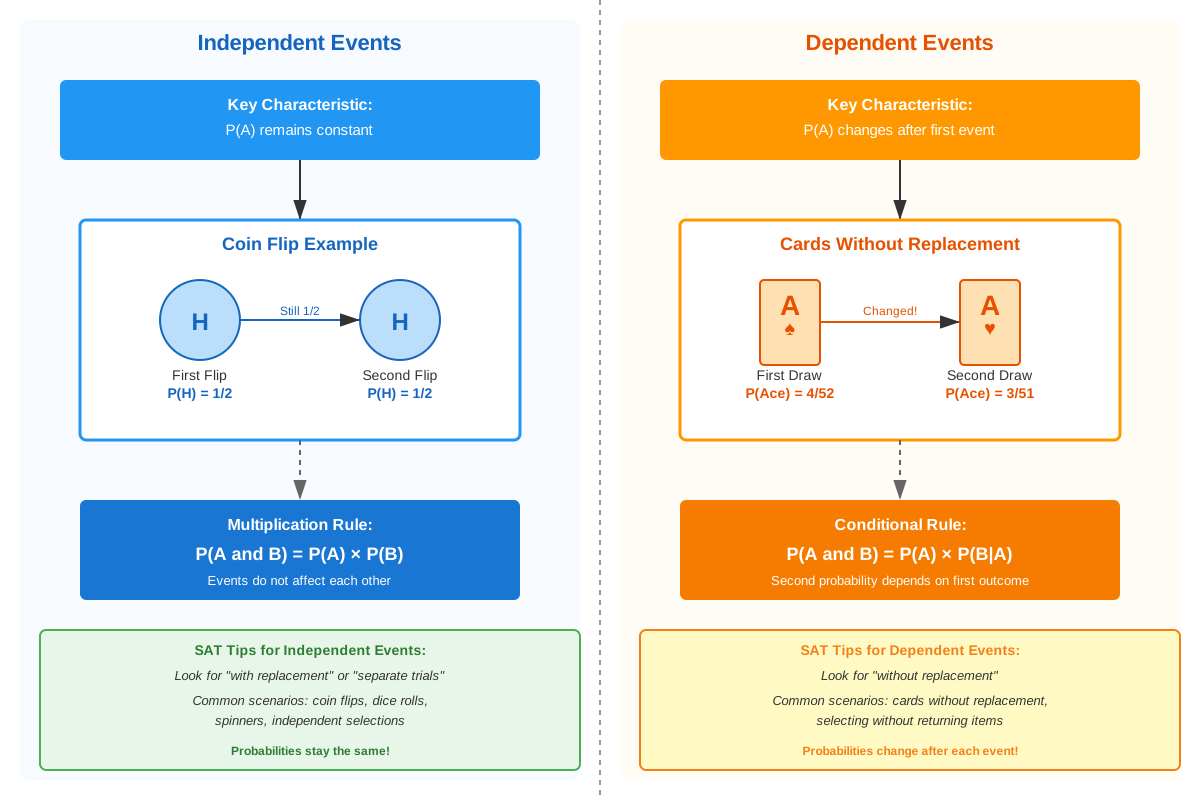
Two events A and B are independent events if and only if the occurrence of one event does not change the probability of the other event occurring. Mathematically, events A and B are independent when:
P(A and B) = P(A) × P(B)This multiplication rule represents the fundamental property of independence. Alternatively, independence can be verified through conditional probability: events A and B are independent if P(A|B) = P(A), meaning the probability of A given that B has occurred equals the probability of A without any condition.
For example, when flipping a fair coin twice, the result of the first flip (heads or tails) has absolutely no influence on the second flip. Each flip maintains a 50% probability for heads regardless of previous outcomes. This exemplifies perfect independence—the defining characteristic that separates independent events from dependent scenarios.
The Multiplication Rule for Independent Events
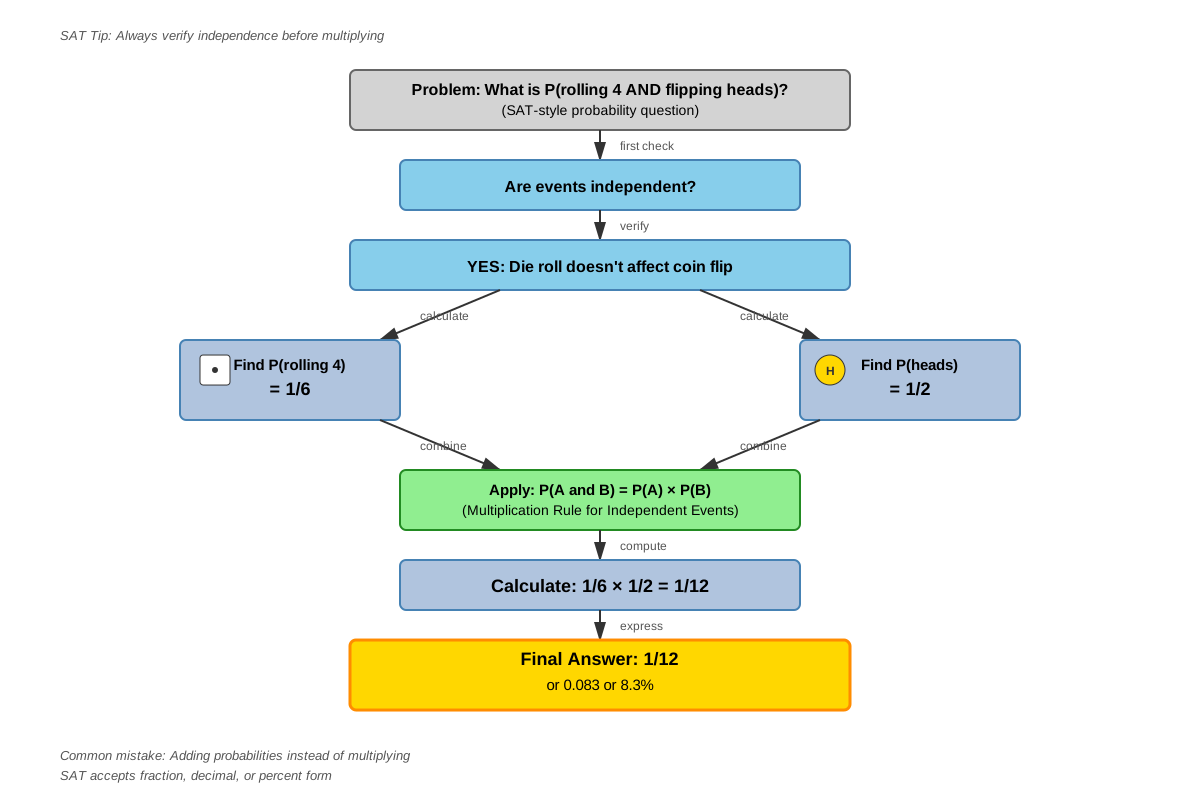
The multiplication rule states that to find the probability of two or more independent events all occurring, multiply their individual probabilities together:
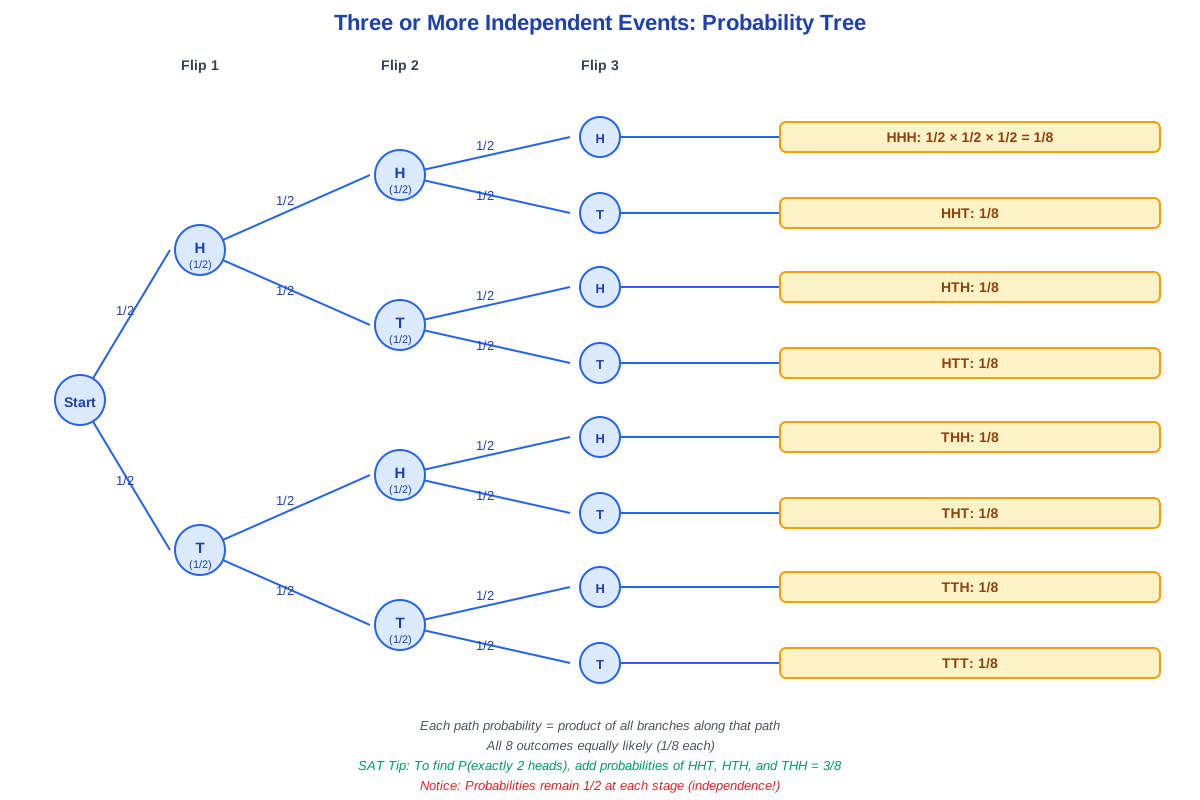
P(A and B and C) = P(A) × P(B) × P(C)This rule extends to any number of independent events. The key insight is that "and" in probability language translates to multiplication when dealing with independent events. This differs fundamentally from dependent events, where conditional probabilities must be considered.
Consider rolling a standard six-sided die three times and wanting all three rolls to show a 6. Since each roll is independent:
P(three sixes) = (1/6) × (1/6) × (1/6) = 1/216 ≈ 0.0046Each die roll maintains its 1/6 probability regardless of previous results, making multiplication straightforward.
Identifying Independence in Context
Recognizing independence requires careful analysis of whether one event's outcome affects another's probability. Several key indicators signal independence:
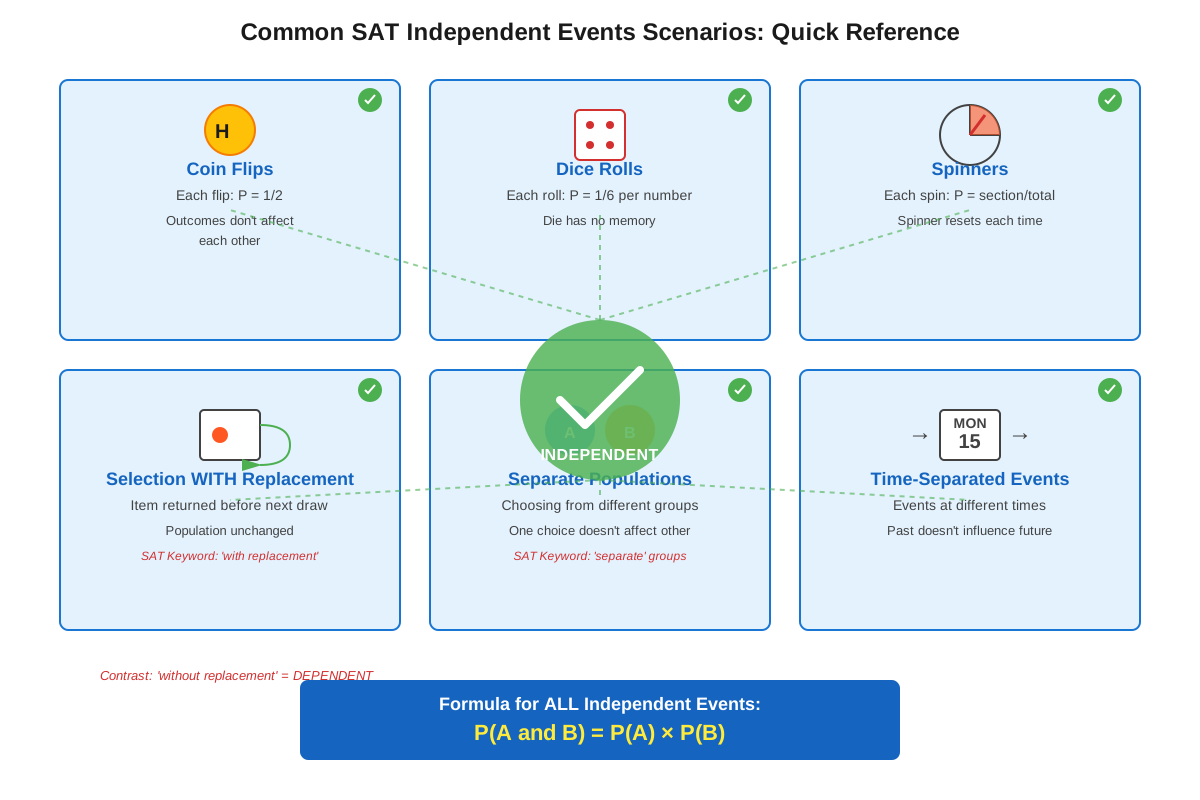
Replacement scenarios: When items are returned to a population before the next selection, events remain independent. Drawing a card from a deck, noting it, replacing it, and shuffling before the next draw creates independent events.
Separate populations or trials: Events occurring in completely different contexts or time periods are typically independent. The outcome of a basketball game in New York doesn't affect a separate game in California.
Physical separation: Events with no causal connection or shared mechanism are independent. A coin flip in one room and a die roll in another room are independent.
Stated independence: SAT problems often explicitly state that events are independent or use phrases like "does not affect," "separate trials," or "independent of."
Contrast with Dependent Events
Understanding independence requires recognizing its opposite: dependent events. Events are dependent when the occurrence of one changes the probability of the other. Classic examples include:
| Independent Events | Dependent Events | |
|---|---|---|
| Drawing cards with replacement | Drawing cards without replacement | |
| Separate coin flips | Conditional probabilities (P(A\ | B) ≠ P(A)) |
| Rolling two different dice | Selecting items from a shrinking population | |
| Weather on different planets | Sequential selections affecting available choices |
For dependent events, the multiplication rule requires conditional probability: P(A and B) = P(A) × P(B|A), where P(B|A) represents the probability of B given that A has occurred.
Multiple Independent Events
SAT questions frequently involve three or more independent events. The multiplication rule extends naturally: continue multiplying each individual probability. For instance, if a basketball player has a 70% free throw success rate and attempts are independent:
P(making 4 consecutive free throws) = 0.7 × 0.7 × 0.7 × 0.7 = 0.2401This represents approximately a 24% chance of success for all four attempts.
Complementary Events and Independence
The complement rule combines powerfully with independence. If the probability of event A is P(A), then the probability of A not occurring is P(not A) = 1 - P(A). For independent events, this enables alternative calculation strategies.
For example, finding the probability that at least one of three independent events occurs can be easier by calculating the complement: P(at least one) = 1 - P(none occur). If each event has probability 0.3:
P(at least one) = 1 - P(none) = 1 - (0.7 × 0.7 × 0.7) = 1 - 0.343 = 0.657This approach often simplifies complex "at least one" problems that appear frequently on the SAT.
Concept Relationships
The concept of independent events serves as a central node connecting multiple probability and statistics topics. Basic probability (calculating single-event probabilities) → leads to → independent events (combining multiple probabilities through multiplication) → enables → complex probability scenarios (multi-step problems with various combinations).
Independent events directly contrast with dependent events, where conditional probability must be applied. Understanding this distinction requires recognizing how sample space changes (or doesn't change) between trials. When the sample space remains constant across events, independence is maintained; when it shrinks or changes, dependence emerges.
The multiplication rule for independent events connects to the fundamental counting principle, which states that if one event can occur in m ways and another independent event can occur in n ways, together they can occur in m × n ways. This relationship bridges probability and combinatorics.
Conditional probability P(A|B) provides the formal test for independence: events are independent if and only if P(A|B) = P(A). This relationship shows that independence is actually a special case where conditioning on another event provides no new information.
The complement rule (P(not A) = 1 - P(A)) combines with independent events to solve "at least one" problems efficiently, creating a powerful problem-solving strategy that appears throughout SAT probability questions.
High-Yield Facts
⭐ Two events A and B are independent if and only if P(A and B) = P(A) × P(B)
⭐ For independent events, the probability of one event does not change based on whether the other event occurs
⭐ Drawing with replacement creates independent events; drawing without replacement creates dependent events
⭐ The multiplication rule for independent events extends to any number of events: multiply all individual probabilities
⭐ "At least one" problems are often solved most efficiently using complements: P(at least one) = 1 - P(none)
- Independent events can have any probabilities; they don't need to be equal to each other
- Physical separation or different time periods typically indicate independence
- The word "and" in probability problems involving independent events signals multiplication
- If P(A|B) = P(A), then events A and B are independent
- Three or more events can all be mutually independent, requiring each pair to satisfy the independence condition
- Independence is symmetric: if A is independent of B, then B is independent of A
- The probability of independent events both occurring is always less than or equal to the probability of either event alone (since you're multiplying by a number ≤ 1)
- Repeated trials of the same random process under identical conditions produce independent events
- Independence can be assumed when a problem states events are "separate," "unrelated," or "do not affect each other"
- Zero probability events (impossible events) are technically independent of all other events
Quick check — test yourself on Independent events so far.
Try Flashcards →Common Misconceptions
Misconception: If two events are independent, they cannot both happen at the same time.
Correction: Independence has nothing to do with whether events can occur simultaneously. Independent events can absolutely both occur; independence only means one event's occurrence doesn't change the other's probability. Rolling a 6 on one die and rolling a 6 on another die are independent events that can both happen.
Misconception: Independent events must have equal probabilities.
Correction: Independence describes the relationship between events, not their individual probabilities. An event with probability 0.2 can be independent of an event with probability 0.8. The probabilities can be completely different as long as one doesn't affect the other.
Misconception: The multiplication rule P(A and B) = P(A) × P(B) works for all events.
Correction: This multiplication rule only applies to independent events. For dependent events, you must use P(A and B) = P(A) × P(B|A), incorporating conditional probability. Using the simple multiplication rule for dependent events produces incorrect answers.
Misconception: If events happen at different times, they must be independent.
Correction: Temporal separation doesn't guarantee independence. Drawing two cards sequentially without replacement involves different times but creates dependent events because the first draw affects the second. Independence requires that one event doesn't change the other's probability, regardless of timing.
Misconception: Mutually exclusive events (events that cannot both occur) are independent.
Correction: Mutually exclusive events are actually the opposite of independent. If A and B are mutually exclusive, then P(A and B) = 0, but P(A) × P(B) ≠ 0 (assuming both have positive probability). Mutually exclusive events are always dependent because knowing one occurred tells you the other definitely did not occur.
Misconception: After several coin flips showing heads, tails becomes more likely on the next flip (the "gambler's fallacy").
Correction: Each coin flip is independent with constant 50% probability for each outcome. Previous results do not influence future flips. The coin has no memory of past outcomes, and the probability remains exactly 50% for heads and 50% for tails on every single flip.
Misconception: Independence means the events are unrelated or have nothing to do with each other conceptually.
Correction: Events can be conceptually related but still statistically independent. For example, a student's math test score and science test score might both relate to academic performance, but if the tests cover different material and are taken on different days without one affecting preparation for the other, they could be independent events statistically.
Worked Examples
Example 1: Multiple Independent Trials
Problem: A quality control inspector tests electronic components. Each component has a 95% probability of passing inspection, and each test is independent. If the inspector randomly selects and tests 3 components, what is the probability that all 3 pass inspection?
Solution:
Step 1: Identify that the events are independent. The problem states each test is independent, and each component has the same 95% passing probability regardless of other components' results.
Step 2: Define the events:
- Event A: First component passes (P(A) = 0.95)
- Event B: Second component passes (P(B) = 0.95)
- Event C: Third component passes (P(C) = 0.95)
Step 3: Apply the multiplication rule for independent events:
P(all 3 pass) = P(A and B and C) = P(A) × P(B) × P(C)Step 4: Calculate:
P(all 3 pass) = 0.95 × 0.95 × 0.95 = 0.857375Step 5: Express the answer appropriately. The probability is approximately 0.857 or 85.7%.
Connection to learning objectives: This example demonstrates applying independent events to calculate combined probabilities using the multiplication rule, a core SAT skill. It shows how to identify independence from context and execute the calculation systematically.
Example 2: Complement Strategy with Independent Events
Problem: A basketball player makes 60% of her three-point shots. Assuming each shot is independent, what is the probability that she makes at least one shot if she attempts 3 three-point shots?
Solution:
Step 1: Recognize that "at least one" means one or more successes (1, 2, or 3 made shots). Calculating each case separately would be tedious.
Step 2: Use the complement strategy. The complement of "at least one success" is "zero successes" (missing all shots).
Step 3: Calculate the probability of missing all three shots. If she makes 60% of shots, she misses 40%:
P(miss one shot) = 1 - 0.60 = 0.40Step 4: Apply the multiplication rule for independent events to find the probability of missing all three:
P(miss all 3) = 0.40 × 0.40 × 0.40 = 0.064Step 5: Use the complement rule:
P(at least one made) = 1 - P(miss all 3) = 1 - 0.064 = 0.936Answer: The probability is 0.936 or 93.6%.
Connection to learning objectives: This example illustrates a sophisticated application of independent events combined with complement strategy, a high-yield technique for SAT problems. It demonstrates how recognizing problem structure enables efficient solution methods and shows the power of combining multiple probability concepts.
Exam Strategy
When approaching sat independent events questions, begin by carefully reading the problem to identify whether events are explicitly stated as independent or whether context clues indicate independence. Look for trigger phrases such as "with replacement," "each trial is independent," "separate events," "does not affect," or scenarios involving physically separate processes. These signals immediately tell you to apply the multiplication rule.
Exam Tip: If a problem involves selecting items "with replacement" or describes "repeated trials under identical conditions," you're dealing with independent events. Without these phrases, consider whether the sample space changes between events.
Develop a systematic approach: (1) identify all relevant events and their individual probabilities, (2) verify independence through context or explicit statement, (3) determine whether you need "and" (multiply probabilities) or "or" (add probabilities for mutually exclusive events), and (4) execute calculations carefully, keeping track of decimal places.
For "at least one" questions, immediately consider the complement approach. Calculate the probability of the opposite outcome (usually "none" or "zero successes"), then subtract from 1. This strategy typically requires fewer calculations and reduces error risk compared to adding multiple probability cases.
Process of elimination tips: Eliminate answer choices that exceed 1.0 (impossible for probabilities) or that are negative. When multiplying probabilities less than 1, the result must be smaller than any individual probability—use this to eliminate unreasonably large answers. If a problem involves three independent events each with probability 0.5, the combined probability must be less than 0.5, eliminating any answer ≥ 0.5.
Time allocation: Most independent events problems should take 60-90 seconds. If you're spending more than 2 minutes, you may be overcomplicating the approach. Mark the question, make your best educated guess, and return if time permits. The multiplication rule application should be quick once you've identified independence.
Watch for hybrid problems that combine independent events with other concepts like ratios, percentages, or algebraic expressions. These multi-concept questions require you to first extract the relevant probabilities (perhaps by converting percentages or ratios) before applying independence rules.
Memory Techniques
"AND means MULTIPLY": For independent events, the word "and" connecting events translates directly to multiplication of probabilities. Whenever you see "Event A and Event B both occur" with independent events, multiply P(A) × P(B).
"REPLACE = INDEPENDENT": Create a mental association between replacement and independence. "With replacement" scenarios maintain constant probabilities across trials, ensuring independence. Visualize physically putting an item back and mixing before the next selection.
The "COIN" mnemonic for independence checks:
- Constant probability (does the probability stay the same?)
- One doesn't affect the other (is there causal separation?)
- Independent statement (does the problem say "independent"?)
- No sample space change (does the population remain the same?)
Complement Strategy Reminder: "At Least = 1 Minus None" — whenever you see "at least one," think "1 minus the probability of zero occurrences." This creates an automatic trigger for the complement approach.
Visual Independence Check: Imagine two separate boxes or containers. If events occur in completely separate boxes with no connection between them, they're independent. If one event changes what's in the box for the next event, they're dependent.
Summary
Independent events represent a fundamental probability concept where one event's occurrence does not influence another event's probability. The defining mathematical property is P(A and B) = P(A) × P(B), which enables straightforward calculation of combined probabilities through multiplication. Recognition of independence—through explicit statements, replacement scenarios, or physically separate processes—is crucial for selecting the correct solution approach. The SAT frequently tests this concept through multi-step probability problems, often embedding independence within real-world contexts like quality control, sports statistics, or repeated trials. Mastery requires distinguishing independent from dependent events, applying the multiplication rule accurately, and employing strategic techniques like the complement approach for "at least one" problems. Understanding that independence means constant probability across events, regardless of previous outcomes, forms the conceptual foundation. Success on SAT independent events questions depends on rapid recognition of independence indicators, systematic application of the multiplication rule, and strategic use of complements to simplify complex calculations.
Key Takeaways
- Independent events satisfy P(A and B) = P(A) × P(B); multiply individual probabilities to find combined probability
- One event's occurrence does not change the probability of another event in independent scenarios
- "With replacement" and "separate trials" are key phrases indicating independence on the SAT
- Use the complement strategy (1 - P(none)) for efficient solution of "at least one" problems
- Dependent events require conditional probability P(B|A), not simple multiplication
- The multiplication rule extends to any number of independent events: keep multiplying
- Independence is a relationship between events, not a property of individual events alone
Related Topics
Conditional Probability: Building on independent events, conditional probability explores P(A|B) scenarios where events are dependent. Mastering independence provides the foundation for understanding when and how conditioning changes probabilities, a more advanced SAT topic.
Dependent Events and Sampling Without Replacement: The natural contrast to independent events, this topic examines how probabilities change when sample spaces shrink. Understanding independence makes dependent event calculations clearer through comparison.
Expected Value: Combines probability (including independent events) with outcomes to calculate long-term averages. Independent events often appear within expected value problems on the SAT.
Binomial Probability: Extends independent events to scenarios with repeated trials having exactly two outcomes (success/failure). This advanced topic builds directly on the multiplication rule for independent events.
Two-Way Tables and Statistical Independence: Connects independent events to data analysis, showing how to verify independence using frequency tables and conditional probabilities from real data sets.
Practice CTA
Now that you've mastered the core concepts of independent events, it's time to solidify your understanding through active practice. Attempt the practice questions to test your ability to identify independence, apply the multiplication rule, and solve multi-step probability problems under timed conditions. Use the flashcards to reinforce key definitions and formulas until they become automatic. Remember: understanding the concept is just the first step—fluency comes from repeated application. Each practice problem you solve builds the pattern recognition and calculation speed essential for SAT success. You've got this!
Sign up free to keep reading
Create a free AnvayaPrep account to finish this SAT guide on Independent events — plus flashcards and practice questions.