Overview
Geometric probability is a specialized branch of probability that combines spatial reasoning with chance calculations. Unlike traditional probability problems that involve counting discrete outcomes (like rolling dice or drawing cards), geometric probability deals with continuous regions—areas, lengths, angles, or volumes—where the likelihood of an event is determined by comparing measurements of geometric figures. On the SAT, this topic represents a critical intersection of geometry and probability concepts, requiring students to visualize spatial relationships while applying proportional reasoning.
Understanding geometric probability is essential for SAT success because it frequently appears in both the calculator and no-calculator sections of the math test. These questions test a student's ability to synthesize multiple mathematical domains simultaneously: they must recognize geometric shapes, calculate their measurements (areas, perimeters, arc lengths), and then express probabilities as ratios. The College Board consistently includes 1-2 geometric probability questions per test, making this a high-yield topic that can significantly impact overall scores.
This topic builds naturally upon foundational geometry concepts (area formulas, circle properties, coordinate geometry) and basic probability principles (favorable outcomes divided by total outcomes). Mastering sat geometric probability strengthens spatial reasoning skills that extend beyond probability itself, enhancing performance on questions involving optimization, coordinate geometry, and data interpretation. The proportional thinking required here also connects to ratio and percent problems, making it a cornerstone concept that reinforces multiple mathematical competencies tested throughout the SAT.
Learning Objectives
- [ ] Identify key features of geometric probability, including the use of continuous regions rather than discrete outcomes
- [ ] Explain how geometric probability appears on the SAT, including common question formats and geometric figures used
- [ ] Apply geometric probability to answer SAT-style questions involving areas, lengths, and angles
- [ ] Calculate probabilities using ratios of geometric measurements (area-to-area, length-to-length, angle-to-angle)
- [ ] Recognize when a probability problem requires geometric rather than counting-based approaches
- [ ] Solve multi-step problems that combine geometric calculations with probability reasoning
- [ ] Interpret geometric probability scenarios presented in both visual and verbal formats
Prerequisites
- Basic probability concepts: Understanding that probability equals favorable outcomes divided by total outcomes provides the foundational framework for geometric probability ratios
- Area formulas for common shapes: Calculating areas of rectangles, triangles, circles, and composite figures is essential since most geometric probability problems involve area comparisons
- Circle properties: Knowledge of radius, diameter, circumference, arc length, and sector area is crucial for circular geometric probability problems
- Coordinate geometry basics: Understanding the coordinate plane helps solve problems involving regions defined by inequalities or bounded by lines
- Ratio and proportion: Geometric probability fundamentally relies on setting up and simplifying ratios between measurements
Why This Topic Matters
Geometric probability has significant real-world applications across multiple fields. Urban planners use it to estimate service coverage areas, engineers apply it to quality control and manufacturing tolerances, meteorologists employ it for precipitation forecasting within specific regions, and game designers utilize it for creating balanced gameplay mechanics. The concept appears in everyday scenarios like estimating the likelihood of hitting a target, determining parking availability in a lot, or calculating the chance of a randomly dropped object landing in a specific zone.
On the SAT, geometric probability appears with notable consistency. Test statistics show that approximately 1-2 questions per exam directly test this concept, typically worth 2-3% of the total math score. These questions most commonly appear as medium-to-hard difficulty problems in both multiple-choice and student-produced response formats. The College Board favors certain presentation styles: problems involving circles (sectors, concentric circles, or circles inscribed in squares), rectangular regions with shaded portions, and coordinate plane scenarios where students must determine the probability of points falling within specific boundaries.
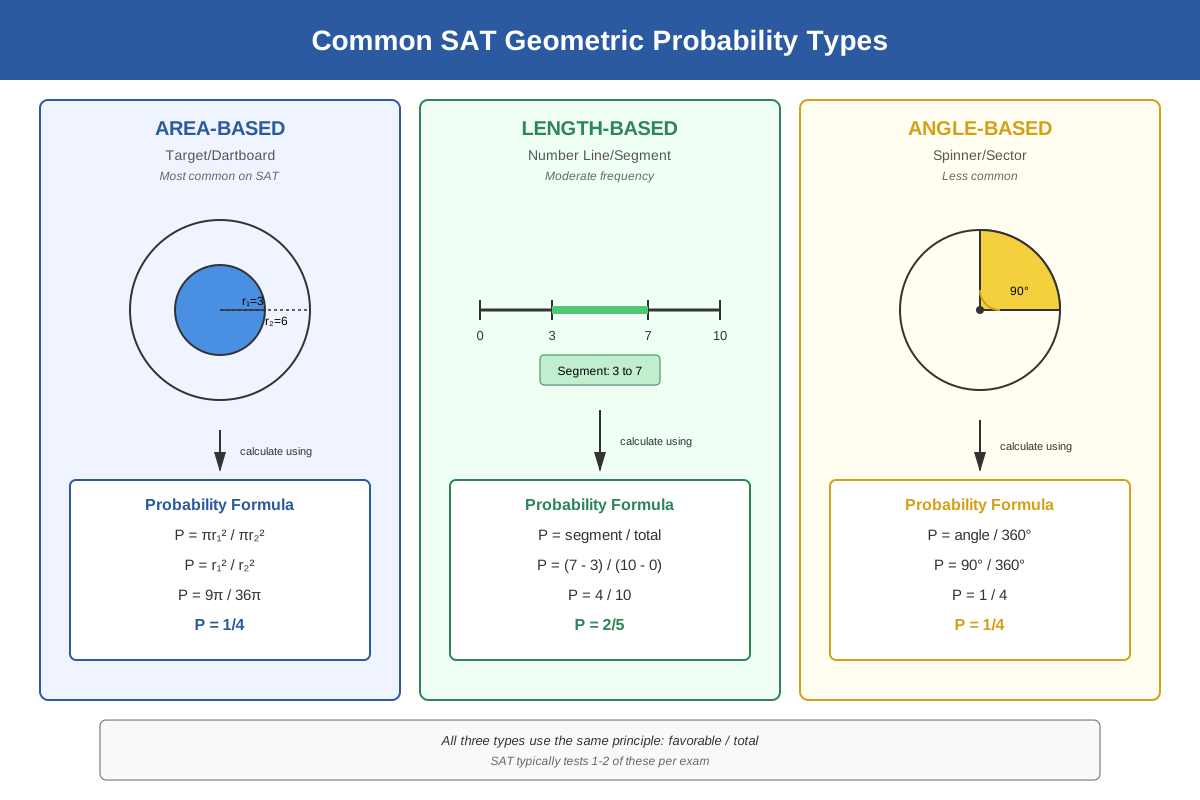
The topic typically manifests in three primary ways on the exam: (1) area-based problems where students compare a shaded region to a total region, (2) length-based problems involving line segments or arc lengths, and (3) angle-based problems using sectors or spinners. Questions often embed geometric probability within real-world contexts like dartboards, target practice, random selection of points, or probability of landing in specific zones. The SAT particularly favors problems that require students to first calculate geometric measurements before determining probability, testing multiple skills simultaneously.
Core Concepts
Fundamental Definition of Geometric Probability
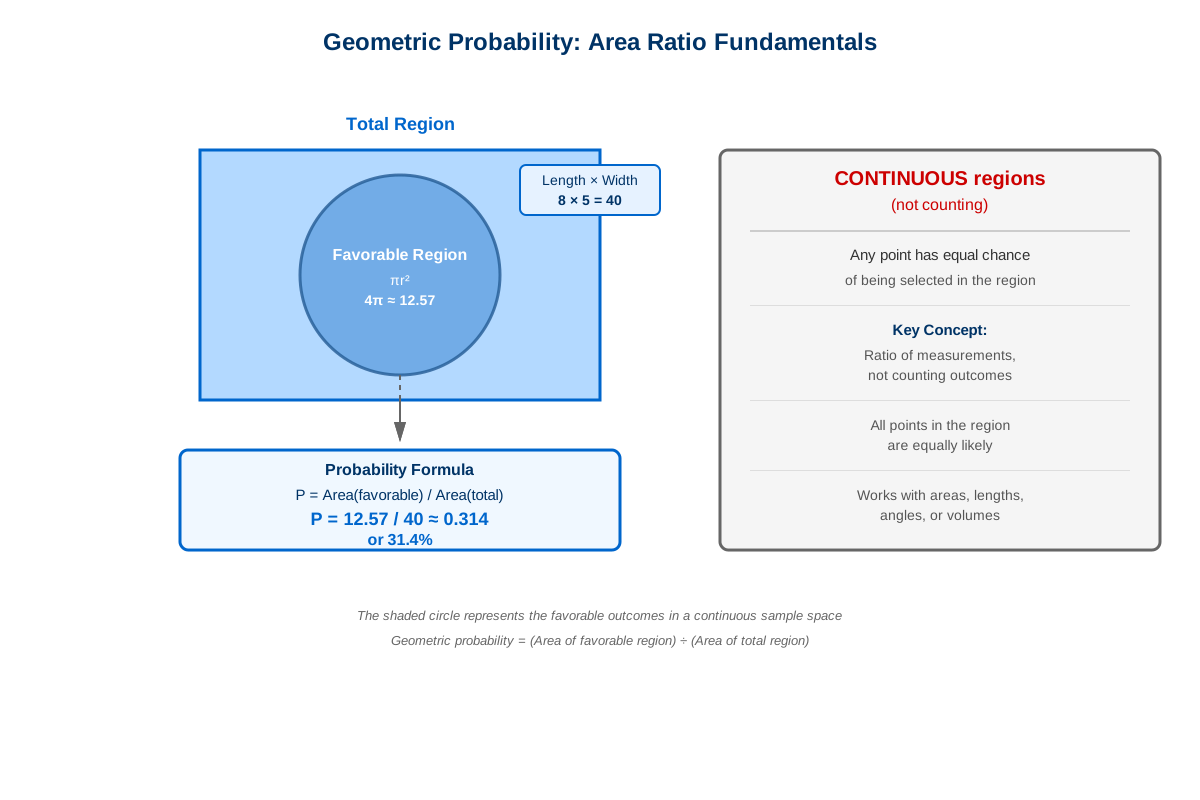
Geometric probability measures the likelihood of an event occurring within a continuous geometric space rather than through discrete counting. The core principle states that when outcomes are equally likely across a geometric region, the probability of an event equals the ratio of the favorable region's measurement to the total region's measurement. This measurement can be length (one-dimensional), area (two-dimensional), volume (three-dimensional), or angle measure, depending on the context.
The general formula for geometric probability is:
P(event) = (Measurement of favorable region) / (Measurement of total region)The key distinction from classical probability is that geometric probability deals with infinite possible outcomes within a continuous space. For example, when randomly selecting a point within a circle, there are infinitely many possible locations, making traditional counting methods impossible. Instead, we rely on proportional measurements.
Area-Based Geometric Probability
Area-based problems constitute the most common type of sat geometric probability question. These problems present a total region (often a rectangle, circle, or composite figure) with a designated favorable region (typically shaded or described). The probability equals the ratio of the favorable area to the total area.
Standard approach for area-based problems:
- Identify the total region and calculate its area
- Identify the favorable region and calculate its area
- Form the ratio: P = (favorable area) / (total area)
- Simplify the fraction or convert to decimal/percent as required
Common configurations include:
- Circles inscribed in squares
- Concentric circles (circles within circles)
- Shaded portions of rectangles
- Overlapping regions
- Sectors and segments of circles
Example scenario: A dartboard consists of a square with side length 10 inches containing a circle with radius 4 inches. If a dart lands randomly on the board, what is the probability it lands within the circle?
- Total area (square) = 10² = 100 square inches
- Favorable area (circle) = π(4²) = 16π square inches
- Probability = 16π/100 = 4π/25 ≈ 0.503 or about 50.3%
Length-Based Geometric Probability
Length-based geometric probability applies when the favorable and total outcomes are measured along one-dimensional paths. These problems often involve line segments, perimeters, or arc lengths. The probability equals the ratio of the favorable length to the total length.
Typical scenarios include:
- Selecting a random point on a line segment
- Choosing a random location along a circular path
- Determining probability based on portions of a perimeter
Example scenario: On a number line from 0 to 12, what is the probability that a randomly selected point falls between 3 and 7?
- Total length = 12 - 0 = 12 units
- Favorable length = 7 - 3 = 4 units
- Probability = 4/12 = 1/3
Angle-Based Geometric Probability
Angle-based problems involve sectors of circles or spinners where probability depends on the central angle measure. Since a complete circle contains 360° (or 2π radians), the probability of landing in a specific sector equals the sector's angle divided by 360°.
P(sector) = (Central angle of sector) / 360°Alternatively, using radians:
P(sector) = (Central angle in radians) / 2πThese problems frequently appear as spinner questions or pie chart scenarios where students must determine the likelihood of landing in a particular wedge.
Coordinate Plane Geometric Probability
Coordinate plane problems present regions defined by inequalities, bounded by lines or curves, or described through geometric constraints. Students must visualize the total region and favorable region, then calculate their respective areas using coordinate geometry techniques.
Common approaches:
- Identify vertices of polygonal regions
- Use area formulas for triangles and rectangles
- Apply integration concepts for curved boundaries (rare on SAT)
- Count unit squares for irregular regions on grids
Composite Figure Geometric Probability
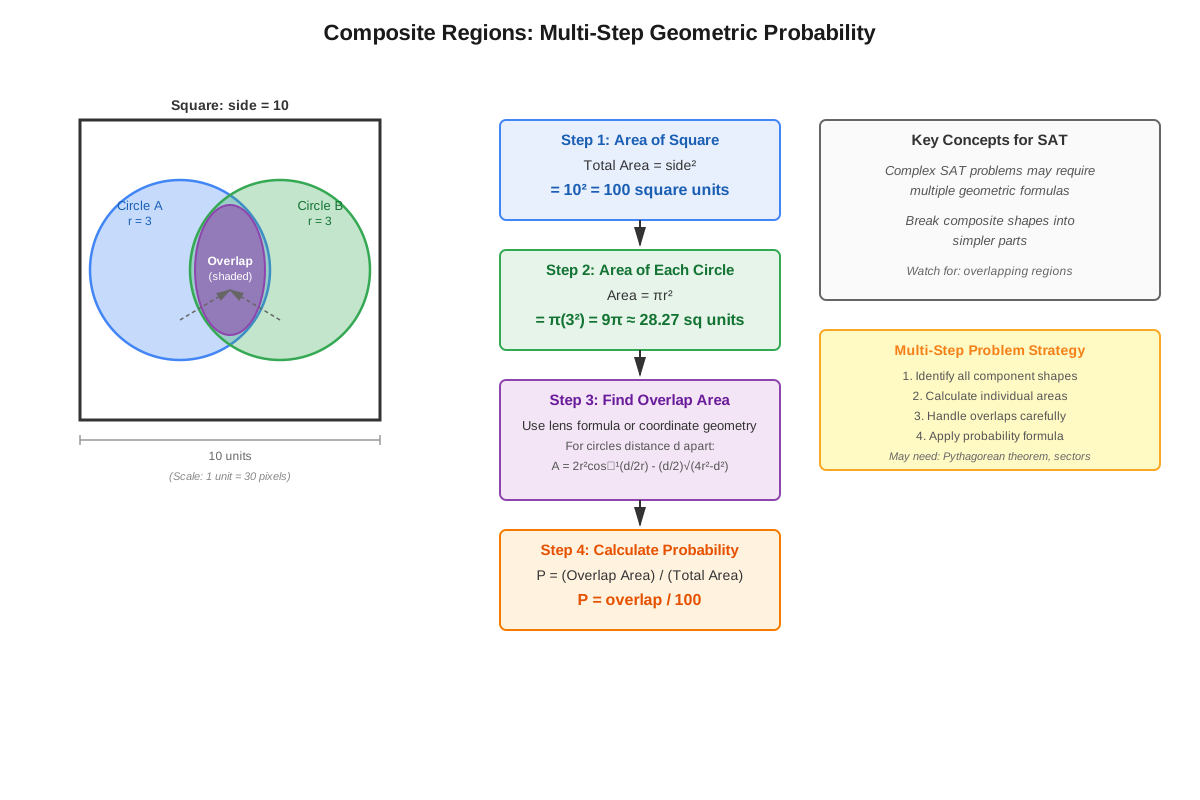
Many SAT questions involve composite figures—shapes formed by combining or subtracting multiple basic shapes. These require breaking down complex regions into manageable components, calculating each area separately, then combining results appropriately.
Strategy for composite figures:
- Decompose the figure into recognizable shapes (rectangles, triangles, circles, semicircles)
- Calculate each component's area
- Add or subtract areas as needed to find total and favorable regions
- Form the probability ratio
| Problem Type | Measurement Used | Formula Structure | Common Figures |
|---|---|---|---|
| Area-based | Square units | (Favorable area) / (Total area) | Circles, rectangles, triangles |
| Length-based | Linear units | (Favorable length) / (Total length) | Line segments, arcs |
| Angle-based | Degrees or radians | (Sector angle) / 360° | Circles, spinners |
| Volume-based | Cubic units (rare on SAT) | (Favorable volume) / (Total volume) | Spheres, cylinders |
Concept Relationships
The concepts within geometric probability form a hierarchical structure built upon the fundamental definition. The fundamental definition (ratio of measurements) → branches into three primary types (area-based, length-based, and angle-based) → each type applies to specific geometric contexts (coordinate plane, composite figures, circles, polygons) → all types converge in multi-step problems that may require calculating multiple measurements before determining probability.
Geometric probability connects directly to prerequisite topics: area formulas provide the measurement tools needed for calculations, basic probability supplies the conceptual framework of favorable/total outcomes, circle properties enable angle-based and circular region problems, and coordinate geometry allows visualization and calculation of regions defined algebraically.
The topic also relates forward to more advanced concepts: conditional probability can incorporate geometric constraints, expected value problems may use geometric probability to weight outcomes, and optimization problems sometimes require maximizing or minimizing geometric probabilities. Additionally, the proportional reasoning developed here strengthens skills applicable to similar figures, scale factors, and trigonometric ratios.
Within the broader SAT math curriculum, geometric probability serves as a synthesis topic that demonstrates mathematical maturity—the ability to integrate multiple domains (geometry, algebra, probability) to solve complex problems. Success here indicates readiness for college-level mathematics where such interdisciplinary thinking is essential.
High-Yield Facts
⭐ Geometric probability equals the ratio of favorable measurement to total measurement, where measurement can be length, area, angle, or volume
⭐ For area-based problems, always ensure both measurements use the same units (both in square inches, both in square centimeters, etc.)
⭐ When a circle is inscribed in a square with side length s, the circle's radius is s/2, and the probability of landing in the circle is π/4 ≈ 0.785
⭐ The probability of a randomly selected point falling in a sector equals (central angle in degrees)/360° or (central angle in radians)/2π
⭐ For concentric circles, the probability of landing in the ring between them equals (R² - r²)π / R²π = (R² - r²)/R², where R is the outer radius and r is the inner radius
- Geometric probability problems always result in values between 0 and 1 (or 0% and 100%)
- When comparing regions, the favorable region must be entirely contained within or part of the total region
- If a problem asks for the probability of NOT landing in a region, calculate 1 minus the probability of landing in that region
- For problems involving random points on line segments, the probability is independent of the segment's position—only the relative lengths matter
- Composite figures require careful attention to whether regions overlap or are mutually exclusive; overlapping regions should not be double-counted
Quick check — test yourself on Geometric probability so far.
Try Flashcards →Common Misconceptions
Misconception: Geometric probability can be calculated by counting discrete points within a region.
Correction: Geometric probability involves continuous spaces with infinitely many possible outcomes, requiring measurement ratios rather than counting. You cannot count infinite points; you must measure the regions they occupy.
Misconception: The probability of landing in a circle inscribed in a square is 1/2 because the circle takes up about half the space.
Correction: The actual probability is π/4 ≈ 0.785 or about 78.5%. This must be calculated precisely using the area ratio: πr²/(2r)² = π/4, not estimated visually.
Misconception: When calculating probability with circles, you can use radius instead of area in the ratio.
Correction: For area-based probability, you must use area measurements. Using radius directly gives incorrect results because area scales with the square of the radius. For example, doubling the radius quadruples the area, not doubles it.
Misconception: In coordinate plane problems, the probability depends on where the region is located.
Correction: Geometric probability depends only on the size (measurement) of regions, not their position. A 2×3 rectangle has the same area whether it's centered at the origin or positioned at (100, 100).
Misconception: For angle-based probability, you can use any angle measure without conversion.
Correction: The angle must be expressed as a fraction of the complete rotation. If using degrees, divide by 360°; if using radians, divide by 2π. Mixing units or forgetting the denominator leads to incorrect probabilities.
Misconception: Geometric probability problems always involve shaded regions in diagrams.
Correction: Many SAT geometric probability questions are presented verbally without diagrams, requiring students to visualize and sketch the scenario themselves. The ability to translate verbal descriptions into geometric representations is crucial.
Misconception: The probability of landing exactly on a boundary line or point is significant.
Correction: In continuous geometric probability, the probability of landing on any specific point or line (which has zero area) is zero. Only regions with positive area have non-zero probability.
Worked Examples
Example 1: Concentric Circles
Problem: A target consists of two concentric circles. The inner circle has a radius of 3 inches, and the outer circle has a radius of 9 inches. If an arrow hits the target randomly, what is the probability that it lands in the ring between the two circles (not in the inner circle)?
Solution:
Step 1: Identify what we're looking for—the probability of landing in the ring (the region between the circles).
Step 2: Calculate the total area (entire outer circle):
- Total area = π(9²) = 81π square inches
Step 3: Calculate the favorable area (the ring between circles):
- The ring area equals the outer circle area minus the inner circle area
- Ring area = π(9²) - π(3²) = 81π - 9π = 72π square inches
Step 4: Form the probability ratio:
- P(landing in ring) = (favorable area) / (total area)
- P = 72π / 81π = 72/81 = 8/9
Step 5: Simplify and interpret:
- P = 8/9 ≈ 0.889 or about 88.9%
Connection to learning objectives: This problem demonstrates applying geometric probability to SAT-style questions by calculating areas of circular regions and forming appropriate ratios. It illustrates a key feature of geometric probability: comparing measurements of nested figures.
Example 2: Coordinate Plane Rectangle
Problem: In the coordinate plane, a rectangle has vertices at (2, 1), (2, 5), (8, 5), and (8, 1). A smaller rectangle inside has vertices at (3, 2), (3, 4), (6, 4), and (6, 2). If a point is randomly selected from the larger rectangle, what is the probability it falls within the smaller rectangle?
Solution:
Step 1: Visualize or sketch the scenario. The larger rectangle spans from x = 2 to x = 8 and y = 1 to y = 5. The smaller rectangle spans from x = 3 to x = 6 and y = 2 to y = 4.
Step 2: Calculate the area of the larger (total) rectangle:
- Width = 8 - 2 = 6 units
- Height = 5 - 1 = 4 units
- Total area = 6 × 4 = 24 square units
Step 3: Calculate the area of the smaller (favorable) rectangle:
- Width = 6 - 3 = 3 units
- Height = 4 - 2 = 2 units
- Favorable area = 3 × 2 = 6 square units
Step 4: Form the probability ratio:
- P(point in smaller rectangle) = 6/24 = 1/4
Step 5: Express the answer:
- P = 1/4 = 0.25 or 25%
Connection to learning objectives: This example shows how geometric probability appears on the SAT using coordinate geometry, requiring students to extract dimensions from coordinates, calculate areas, and apply the fundamental probability ratio. It demonstrates the importance of translating coordinate information into geometric measurements.
Example 3: Spinner with Multiple Sectors
Problem: A circular spinner is divided into four sectors with central angles of 90°, 120°, 60°, and 90°. The 120° sector is labeled "Win." What is the probability of landing on "Win" when spinning?
Solution:
Step 1: Verify that the angles sum to 360° (a complete circle):
- 90° + 120° + 60° + 90° = 360° ✓
Step 2: Identify the favorable outcome:
- The "Win" sector has a central angle of 120°
Step 3: Apply the angle-based probability formula:
- P(Win) = (favorable angle) / (total angle)
- P(Win) = 120° / 360°
Step 4: Simplify:
- P(Win) = 120/360 = 1/3
Step 5: Express the answer:
- P = 1/3 ≈ 0.333 or about 33.3%
Connection to learning objectives: This problem illustrates angle-based geometric probability, a common SAT question type. It demonstrates identifying key features (central angles) and applying the appropriate measurement ratio for circular sectors.
Exam Strategy
When approaching geometric probability questions on the SAT, begin by identifying the type of measurement involved: area, length, or angle. This determines which formulas and approaches to use. Look for trigger words like "randomly selected point," "lands on," "falls within," or "probability of hitting"—these signal geometric probability rather than counting-based probability.
Key trigger phrases to recognize:
- "A point is randomly selected from..."
- "If a dart lands randomly on..."
- "What is the probability that a randomly chosen point..."
- "A spinner is divided into sectors..."
- "The shaded region represents..."
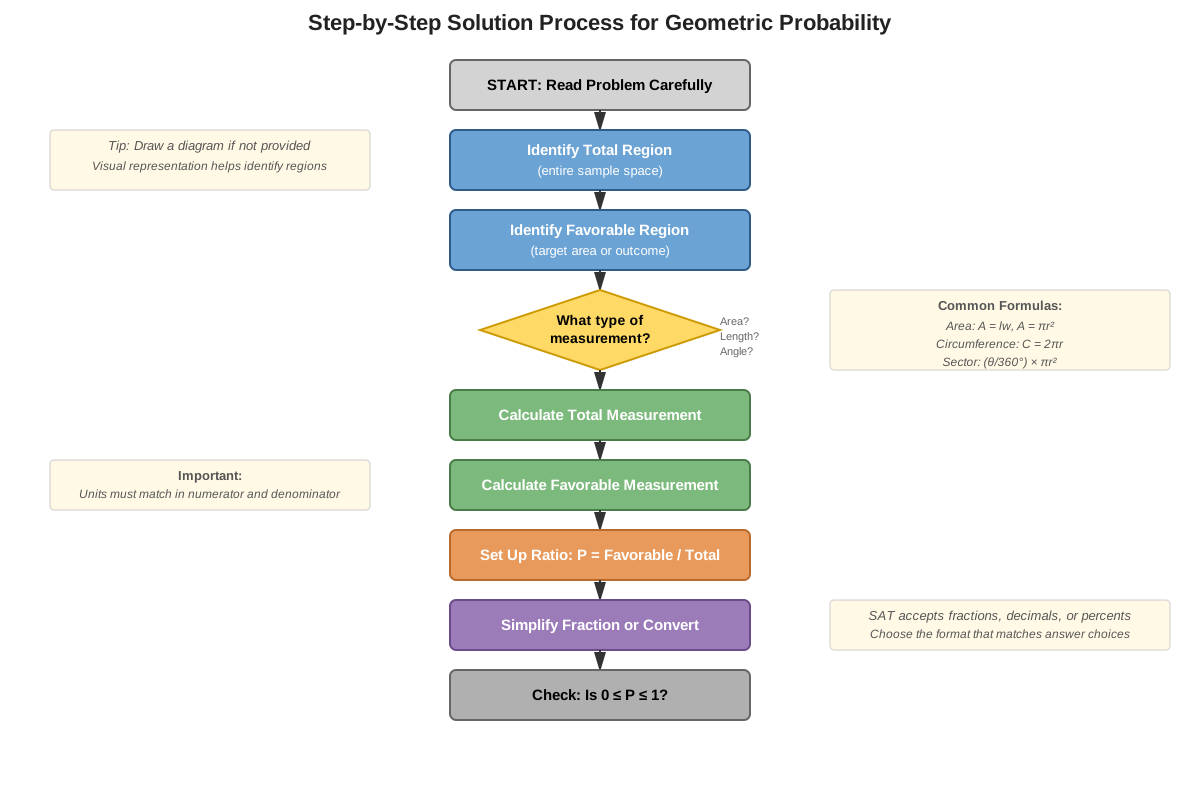
Step-by-step approach for any geometric probability question:
- Identify the total region and determine what measurement type is needed (area, length, or angle)
- Identify the favorable region based on the event described
- Calculate the total measurement using appropriate formulas
- Calculate the favorable measurement using appropriate formulas
- Form the ratio and simplify
- Check reasonableness: probability must be between 0 and 1
Process-of-elimination strategies:
- Eliminate any answer choice greater than 1 or less than 0 (impossible probabilities)
- If the favorable region appears to be about half the total region, eliminate answers far from 0.5
- For circles inscribed in squares, the probability is always π/4 ≈ 0.785; eliminate answers significantly different from this
- If the problem involves concentric circles and asks for the outer ring, the probability should be high (close to 1)
Time allocation advice:
Geometric probability questions typically require 1.5-2.5 minutes to solve completely. Budget approximately:
- 20-30 seconds: reading and visualizing the problem
- 30-60 seconds: calculating the first measurement (usually total region)
- 30-60 seconds: calculating the second measurement (usually favorable region)
- 20-30 seconds: forming the ratio and simplifying
If a problem requires calculating areas of multiple complex shapes, it may warrant up to 3 minutes. However, if you cannot identify the approach within 30 seconds, mark it for review and move on—these questions often become clearer on a second attempt.
Common SAT tricks to watch for:
- Providing radius when you need area (requiring you to square the radius)
- Mixing units (giving diameter and radius, or different length units)
- Asking for the probability of NOT landing in a region (requiring 1 - P)
- Presenting composite figures that require addition or subtraction of areas
- Including irrelevant information to test whether you can identify what matters
Memory Techniques
FARM mnemonic for the geometric probability formula:
- Favorable measurement
- All (total) measurement
- Ratio
- Must be between 0 and 1
"Circle in Square" visualization: Remember that a circle inscribed in a square always has probability π/4. Visualize a pizza (circle) in a square box—the pizza takes up about 78.5% of the box space. This specific value appears frequently on the SAT.
"Angle over 360" rhyme: For sectors and spinners, remember "angle over three-sixty, probability's a certainty" to recall that you divide the sector angle by 360°.
The "Same Units" rule: Before forming any ratio, check that both measurements use the same units. Create a mental image of trying to compare apples to oranges—it doesn't work. Convert all measurements to matching units first.
Concentric circles acronym - DOOR:
- Difference of areas
- Outer circle minus inner circle
- Over total (outer circle area)
- Ratio gives probability
Visualization strategy for coordinate plane problems: Always sketch a quick diagram, even if one isn't provided. Label key points and shade the favorable region. This external visualization prevents mental confusion and calculation errors.
Summary
Geometric probability represents a crucial synthesis of geometry and probability concepts on the SAT, requiring students to calculate probabilities using ratios of continuous measurements rather than discrete counting. The fundamental principle—probability equals favorable measurement divided by total measurement—applies across three primary contexts: area-based problems (most common), length-based problems, and angle-based problems. Success requires mastery of geometric formulas (especially for circles, rectangles, and triangles), the ability to decompose composite figures, and skill in forming and simplifying ratios. SAT questions typically present scenarios involving dartboards, targets, spinners, coordinate plane regions, or shaded portions of figures, often requiring multi-step solutions that first calculate geometric measurements before determining probability. The topic appears consistently on every SAT administration, making it high-yield for test preparation. Students must recognize trigger phrases indicating geometric probability, avoid common misconceptions about using incorrect measurements, and verify that calculated probabilities fall within the valid range of 0 to 1.
Key Takeaways
- Geometric probability uses measurement ratios (favorable/total) rather than counting outcomes, applicable to areas, lengths, angles, or volumes
- Area-based problems dominate SAT questions, particularly involving circles inscribed in squares (probability = π/4) and concentric circles
- Always use matching units in both numerator and denominator; convert all measurements to the same unit before forming ratios
- Angle-based probability for sectors equals the central angle divided by 360° (or by 2π if using radians)
- Composite figures require decomposition into basic shapes, calculating each component separately, then combining appropriately
- Coordinate plane problems need visualization and extraction of dimensions from given points before applying area formulas
- Probabilities must fall between 0 and 1; use this as a reasonableness check and elimination strategy on multiple-choice questions
Related Topics
Conditional Probability: Building on geometric probability, conditional probability examines how probabilities change when additional information or constraints are known. Mastering geometric probability provides the foundation for understanding how regions and measurements interact in conditional scenarios.
Expected Value: This topic extends probability concepts by calculating weighted averages of outcomes. Geometric probability can determine the weights for different spatial outcomes in expected value problems.
Similar Figures and Scale Factor: Understanding how areas scale with the square of linear dimensions (and volumes with the cube) deepens comprehension of geometric probability, especially when comparing regions of different sizes.
Trigonometry and Circles: Advanced circle problems involving arc lengths, sector areas, and inscribed angles build directly on the circular geometric probability concepts, particularly angle-based calculations.
Integration and Area Under Curves: In advanced mathematics, geometric probability extends to finding areas under curves using calculus, representing the natural progression from basic geometric probability.
Practice CTA
Now that you've mastered the core concepts of geometric probability, it's time to solidify your understanding through active practice. Attempt the practice questions designed specifically for this topic—they mirror actual SAT question formats and difficulty levels. Use the flashcards to reinforce key formulas, trigger phrases, and common problem types until they become automatic. Remember, geometric probability is a high-yield topic that appears on every SAT administration, so your investment in practice here directly translates to points on test day. Challenge yourself to work through problems without immediately checking answers, building the problem-solving stamina you'll need during the actual exam. You've got this!
Sign up free to keep reading
Create a free AnvayaPrep account to finish this SAT guide on Geometric probability — plus flashcards and practice questions.