Overview
Probability with percentages is a critical mathematical concept that frequently appears on the SAT Math section, combining two fundamental areas: probability theory and percentage calculations. This topic requires students to understand how to express the likelihood of events occurring as percentages rather than fractions or decimals, and to work backward from percentage information to determine probabilities. The SAT regularly tests this skill through real-world scenarios involving surveys, data analysis, population statistics, and conditional probability situations where percentage representations make the information more accessible and interpretable.
Mastering sat probability with percentages is essential because it bridges multiple mathematical domains that appear throughout the exam. Questions in this category often integrate data interpretation, ratio reasoning, and algebraic thinking, making them high-value problems that can significantly impact overall scores. The College Board consistently includes 2-4 questions per test that directly or indirectly assess this skill, and these questions frequently appear in both the calculator and no-calculator sections. Understanding how to convert between probability representations (fractions, decimals, and percentages) and apply percentage-based reasoning to probability scenarios is non-negotiable for students targeting scores above 650.
The relationship between probability and percentages extends throughout the math curriculum, connecting to topics such as ratios and proportions, data analysis, statistics, and even algebraic problem-solving. When students encounter tables, charts, or word problems involving likelihood or frequency, they must seamlessly translate between different representations while maintaining mathematical accuracy. This topic also serves as a foundation for more advanced statistical reasoning that appears in college-level coursework, making it both immediately practical for test success and valuable for future academic preparation.
Learning Objectives
- [ ] Identify key features of Probability with percentages
- [ ] Explain how Probability with percentages appears on the SAT
- [ ] Apply Probability with percentages to answer SAT-style questions
- [ ] Convert between probability representations (fractions, decimals, and percentages) with accuracy
- [ ] Calculate conditional probabilities expressed as percentages from two-way tables and data sets
- [ ] Solve multi-step problems that combine percentage calculations with probability rules
- [ ] Interpret percentage-based probability information in real-world contexts and data visualizations
Prerequisites
- Basic probability concepts: Understanding sample spaces, outcomes, and the fundamental probability formula (favorable outcomes / total outcomes) is essential for working with percentage representations
- Percentage calculations: Ability to convert between fractions, decimals, and percentages, and to calculate percentages of quantities, forms the computational foundation
- Ratio and proportion reasoning: Recognizing equivalent ratios and setting up proportions helps when scaling probability information
- Two-way tables and data interpretation: Reading and extracting information from tables and charts is necessary since many SAT probability questions present data visually
- Basic algebra: Solving for unknown variables and setting up equations enables students to work backward from percentage information
Why This Topic Matters
In real-world applications, probabilities are most commonly communicated as percentages because they provide intuitive understanding for general audiences. Weather forecasts express rain chances as percentages, medical studies report treatment success rates as percentages, and businesses analyze customer behavior using percentage-based metrics. Understanding probability with percentages enables students to critically evaluate statistical claims, make informed decisions based on data, and communicate quantitative reasoning effectively in professional and personal contexts.
On the SAT, probability questions account for approximately 5-8% of the Math section, with percentage-based probability appearing in roughly 2-4 questions per test. These questions typically fall into the "Problem Solving and Data Analysis" domain, which comprises about 29% of the Math section. The College Board specifically emphasizes real-world problem-solving and data interpretation, making percentage-based probability questions particularly common because they mirror how probability information appears in authentic contexts like surveys, scientific studies, and demographic data.
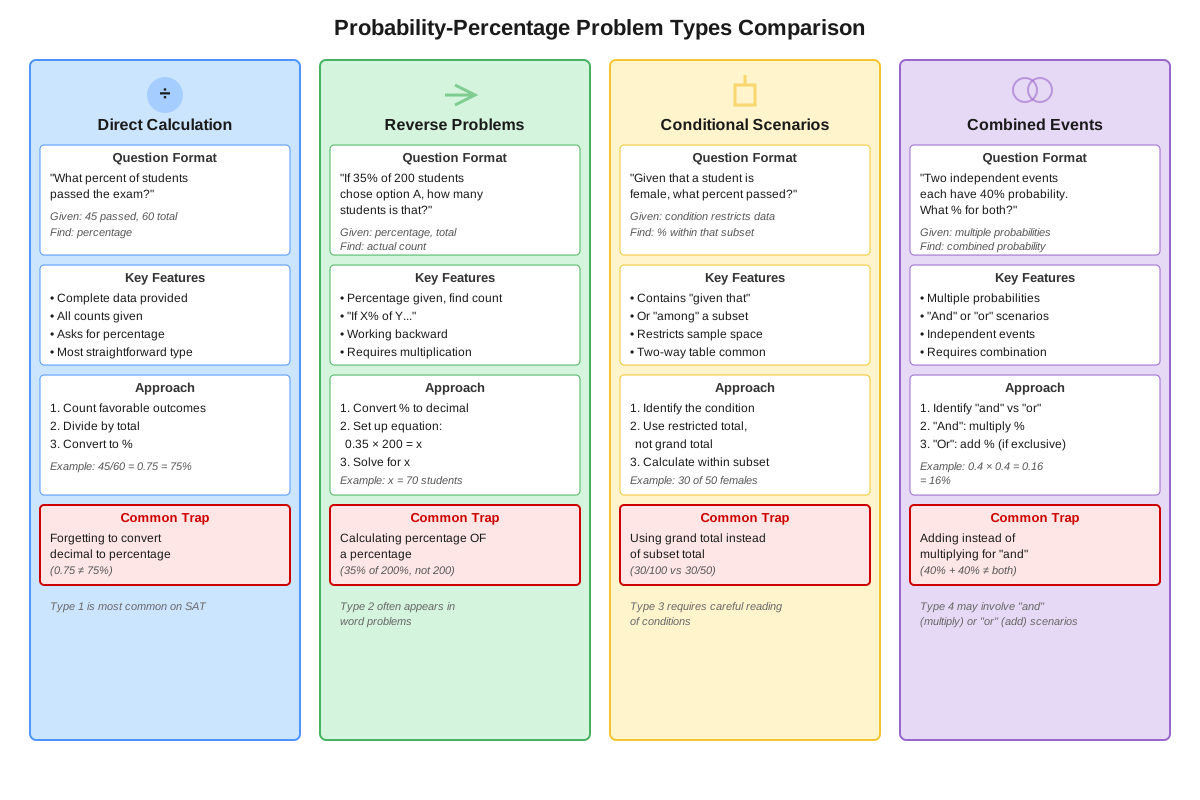
Common question formats include: analyzing two-way frequency tables to determine conditional probabilities expressed as percentages; calculating the probability of compound events and converting the result to a percentage; interpreting survey results where percentages are given and probability calculations are required; and solving word problems where percentage information must be converted to probability values for further calculations. Questions may also involve determining sample sizes or specific counts when given percentage-based probability information, requiring students to work backward through the calculations.
Core Concepts
Understanding Probability as a Percentage
Probability represents the likelihood of an event occurring, expressed as a ratio of favorable outcomes to total possible outcomes. When we express probability as a percentage, we multiply the probability value (typically a fraction or decimal) by 100%. The fundamental formula remains:
Probability = (Number of favorable outcomes) / (Total number of possible outcomes)
Percentage = Probability × 100%
For example, if a bag contains 3 red marbles and 7 blue marbles, the probability of selecting a red marble is 3/10 or 0.3, which equals 30%. This conversion is bidirectional: given a 30% probability, students must recognize this represents 0.3 as a decimal or 3/10 as a fraction for calculation purposes.
Converting Between Representations
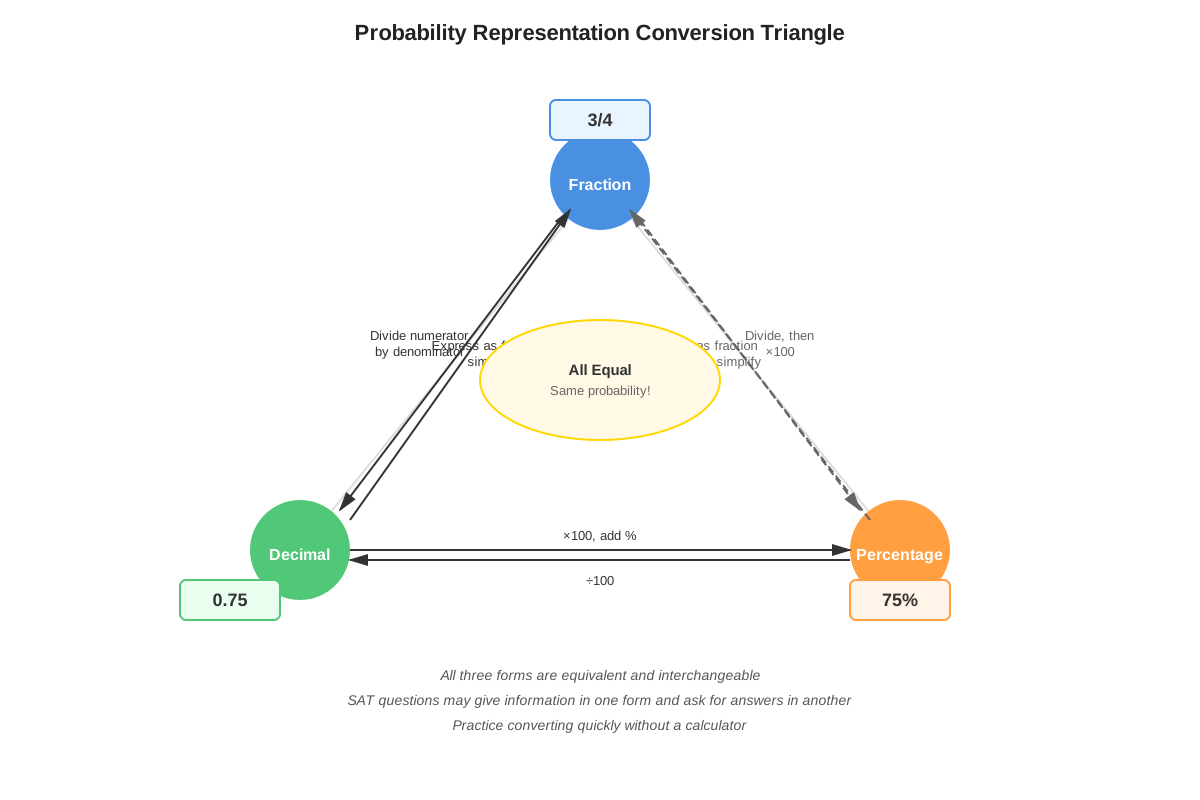
Fluency in converting between fractions, decimals, and percentages is fundamental to success with this topic. The conversion process follows these patterns:
| Starting Form | To Decimal | To Percentage | To Fraction |
|---|---|---|---|
| Fraction (3/5) | Divide: 3 ÷ 5 = 0.6 | Multiply decimal by 100: 60% | Already in fraction form |
| Decimal (0.6) | Already in decimal form | Multiply by 100: 60% | Write over power of 10: 6/10 = 3/5 |
| Percentage (60%) | Divide by 100: 0.6 | Already in percentage form | Write over 100: 60/100 = 3/5 |
On the SAT, questions may provide information in one format and ask for answers in another, or require intermediate conversions during multi-step problems. Students must perform these conversions automatically to maintain efficiency.
Calculating Probabilities from Percentage Data
Many SAT problems present data where percentages are given, and students must determine actual probabilities or counts. For instance, if 35% of 200 students prefer mathematics, the actual count is 0.35 × 200 = 70 students. If asked for the probability that a randomly selected student prefers mathematics, the answer is 35% or 0.35 or 7/20, depending on the required format.
The key steps for these problems are:
- Identify what percentage information is provided
- Determine what the percentage represents (part of what whole?)
- Convert percentages to decimals for calculations if needed
- Calculate the required probability value
- Express the answer in the requested format
Conditional Probability with Percentages
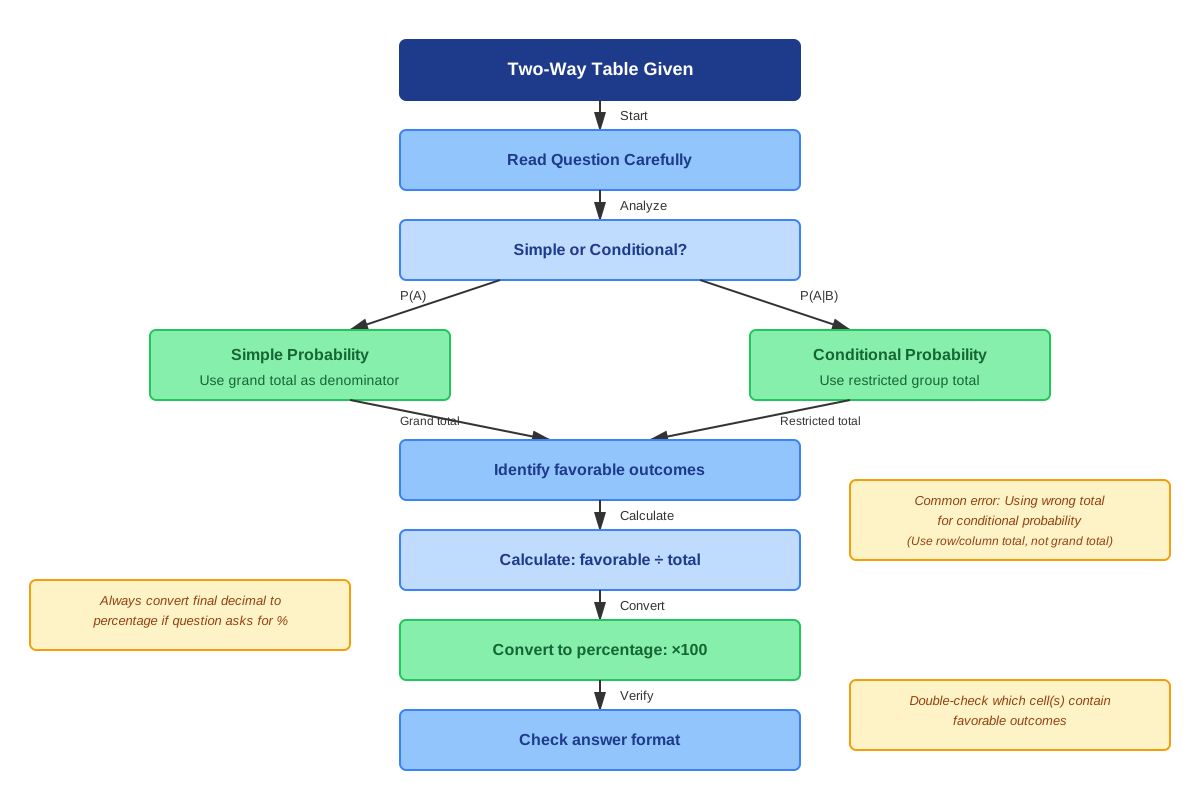
Conditional probability questions ask for the probability of an event given that another event has already occurred. These frequently appear with two-way tables on the SAT. The formula for conditional probability is:
P(A|B) = P(A and B) / P(B)When working with percentages, this translates to finding what percentage of a specific subgroup meets a certain condition. For example, given a table showing student preferences by grade level, a question might ask: "What percentage of seniors prefer online learning?" This requires:
- Identifying the relevant subgroup (seniors)
- Finding how many in that subgroup meet the condition (prefer online learning)
- Calculating the ratio and converting to a percentage
Complementary Probabilities
The complement of an event A (denoted A') represents all outcomes where A does not occur. The fundamental relationship is:
P(A) + P(A') = 1 or 100%If the probability of rain is 35%, the probability of no rain is 65%. SAT questions often test whether students recognize when using the complement simplifies calculations. For instance, finding the probability that at least one event occurs is often easier by calculating 100% minus the probability that no events occur.
Compound Events and Percentages
When dealing with multiple events, students must apply probability rules while maintaining percentage representations. For independent events (where one outcome doesn't affect another):
P(A and B) = P(A) × P(B)If the probability of Event A is 40% and Event B is 25%, the probability of both occurring is 0.40 × 0.25 = 0.10 = 10%.
For mutually exclusive events (events that cannot occur simultaneously):
P(A or B) = P(A) + P(B)Understanding when to multiply versus add probabilities is crucial, and percentage representations don't change these fundamental rules—they simply require conversion to decimal form for calculations, then back to percentages for final answers.
Concept Relationships
The concepts within probability with percentages form an interconnected system where each skill builds upon and reinforces others. Converting between representations serves as the foundational skill that enables all other work in this topic. This conversion ability → leads to → calculating probabilities from percentage data, where students must translate given information into usable mathematical forms. Both of these skills → support → conditional probability calculations, which require extracting specific subsets from larger data sets and expressing relationships as percentages.
Complementary probabilities → connects to → all probability calculations because recognizing when to use 100% minus a given probability can dramatically simplify problem-solving. This concept particularly → enhances → compound event calculations, where finding the probability that at least one event occurs often requires complement reasoning.
The entire topic → builds upon → prerequisite knowledge of basic probability, percentage calculations, and data interpretation. Students must seamlessly integrate ratio reasoning (from prerequisites) with probability rules to solve complex problems. Additionally, this topic → connects forward to → statistics and data analysis questions throughout the SAT, where percentage-based reasoning appears in contexts beyond pure probability, such as margin of error, confidence intervals, and population sampling.
The relationship map flows: Basic Probability + Percentage Skills → Representation Conversion → Simple Probability Calculations → Conditional Probability → Complement Rule → Compound Events → Complex Multi-Step Problems.
High-Yield Facts
- ⭐ Probability expressed as a percentage always falls between 0% (impossible) and 100% (certain), with 50% representing equally likely outcomes
- ⭐ To convert probability to percentage: multiply by 100%; to convert percentage to probability: divide by 100%
- ⭐ Conditional probability P(A|B) asks "what percentage of B also satisfies A?" and requires focusing only on the subset where B occurs
- ⭐ The complement rule states that P(A) + P(not A) = 100%, which is essential for "at least one" probability questions
- ⭐ For independent events, multiply probabilities (as decimals) then convert back to percentage: P(A and B) = P(A) × P(B)
- When a two-way table is given, always verify whether the question asks for a percentage of the total population or a percentage of a specific subgroup
- Percentages in probability problems can represent either the probability itself or the proportion of a population—context determines interpretation
- "At least one" probability questions are almost always easier to solve using the complement: 100% minus the probability of none
- When percentages don't sum to 100% in a problem, check whether overlapping categories or multiple-response options are involved
- Converting percentages to fractions in lowest terms can reveal patterns and simplify calculations, especially when dealing with common percentages like 25%, 50%, or 75%
- Survey-based probability questions typically present percentage data and ask for conditional probabilities or specific counts
- The phrase "given that" or "among those who" signals a conditional probability question requiring subset analysis
Quick check — test yourself on Probability with percentages so far.
Try Flashcards →Common Misconceptions
Misconception: Probabilities expressed as percentages can exceed 100% if multiple events are considered.
Correction: Individual probabilities never exceed 100%. When dealing with multiple events, students may add probabilities that sum beyond 100%, but this indicates the events are not mutually exclusive and overlap must be accounted for using proper probability rules.
Misconception: To find conditional probability, simply multiply the two relevant percentages together.
Correction: Conditional probability P(A|B) requires dividing the percentage of outcomes where both A and B occur by the percentage where B occurs: P(A and B) / P(B). Multiplication is only appropriate for independent events when finding joint probability.
Misconception: When a problem states "35% of students," this percentage can be used directly in calculations without considering the total number of students.
Correction: Percentages represent proportions of a whole. To find actual counts or probabilities involving specific numbers, students must identify the total population and calculate the actual value: 35% of 200 students = 0.35 × 200 = 70 students.
Misconception: The complement of a 40% probability is -40%.
Correction: The complement represents what remains to reach 100%, so the complement of 40% is 100% - 40% = 60%. Probabilities and their complements are always positive values that sum to exactly 100%.
Misconception: In a two-way table, the percentage of a cell relative to its row total equals the percentage relative to the column total.
Correction: These represent different conditional probabilities. A cell's percentage of its row total answers "given this row, what percentage is in this column?" while the percentage of the column total answers the reverse question. These values are typically different unless the table has special symmetry.
Misconception: When two events each have a 50% probability, the probability of both occurring is 100%.
Correction: For independent events, probabilities multiply: 50% × 50% = 0.5 × 0.5 = 0.25 = 25%. The 50% + 50% = 100% calculation would apply only to mutually exclusive events when finding the probability of one OR the other occurring.
Worked Examples
Example 1: Two-Way Table with Conditional Probability
Problem: A survey of 500 high school students asked about their preferred study method. The results are shown below:
| Online Resources | Textbooks | Total | |
|---|---|---|---|
| Underclassmen | 140 | 110 | 250 |
| Upperclassmen | 160 | 90 | 250 |
| Total | 300 | 200 | 500 |
What percentage of students who prefer online resources are upperclassmen?
Solution:
Step 1: Identify that this is a conditional probability question. The phrase "of students who prefer online resources" indicates we're looking at only the subset of students who prefer online resources.
Step 2: Find the total number of students who prefer online resources: 300 students (from the "Online Resources" column total).
Step 3: Find the number of upperclassmen who prefer online resources: 160 students (from the intersection of "Upperclassmen" row and "Online Resources" column).
Step 4: Calculate the conditional probability:
P(Upperclassmen | Online Resources) = 160/300
Step 5: Convert to percentage:
160/300 = 0.5333... = 53.33% or approximately 53.3%
Answer: Approximately 53.3% of students who prefer online resources are upperclassmen.
Connection to Learning Objectives: This problem demonstrates how to identify conditional probability situations, extract relevant data from two-way tables, and express the result as a percentage—all core SAT skills for this topic.
Example 2: Complement Rule with Percentages
Problem: A quality control inspector finds that 3% of manufactured parts are defective. If the inspector randomly selects 2 parts independently, what is the probability that at least one part is NOT defective? Express your answer as a percentage rounded to the nearest tenth.
Solution:
Step 1: Recognize that "at least one is NOT defective" is easier to solve using the complement rule. The complement of "at least one is NOT defective" is "both are defective."
Step 2: Find the probability that one part is defective: 3% = 0.03
Step 3: Since the selections are independent, the probability that both parts are defective is:
P(both defective) = 0.03 × 0.03 = 0.0009
Step 4: Apply the complement rule:
P(at least one NOT defective) = 1 - P(both defective)
P(at least one NOT defective) = 1 - 0.0009 = 0.9991
Step 5: Convert to percentage:
0.9991 × 100% = 99.91%
Answer: 99.91% or 99.9% when rounded to the nearest tenth.
Alternative approach check: We could also calculate this directly by finding P(first not defective and second defective) + P(first defective and second not defective) + P(both not defective), but this requires three separate calculations and is more time-consuming. The complement approach demonstrates strategic problem-solving.
Connection to Learning Objectives: This example shows how to apply the complement rule with percentage-based probabilities, work with independent events, and recognize when strategic approaches save time on the SAT.
Exam Strategy
When approaching sat probability with percentages questions, begin by carefully reading to identify what type of probability is being requested. Look for key phrases: "given that" or "among those who" signals conditional probability; "at least one" suggests using the complement rule; "and" typically means multiplication while "or" suggests addition (for mutually exclusive events).
Trigger words and phrases to watch for include:
- "What percent" or "What is the probability" (indicates the answer format needed)
- "Randomly selected" (confirms this is a probability question)
- "Given that" or "of those who" (conditional probability)
- "At least" or "at most" (often requires complement rule)
- "Independent" or "without replacement" (determines whether probabilities change)
Process-of-elimination strategies specific to this topic:
- Eliminate any answer choices that exceed 100% for single-event probabilities
- If the question involves conditional probability, eliminate answers that match the overall population percentage (the conditional probability is usually different)
- For complement questions, eliminate the answer that equals the given probability (the complement must be different)
- Check whether answer choices are in the requested format (percentage vs. decimal vs. fraction) and eliminate mismatches
- For "at least one" questions, eliminate 0% and 100% unless the scenario is impossible or certain
Time allocation advice: Probability with percentages questions typically require 1-2 minutes. If a two-way table is involved, spend 15-20 seconds orienting yourself to the table structure before attempting calculations. If you find yourself performing more than three separate calculations, pause and consider whether a complement or alternative approach would be more efficient. These questions reward strategic thinking over computational brute force.
Calculation tips: Always convert percentages to decimals before multiplying or dividing probabilities, then convert back to percentages for the final answer. When working with two-way tables, circle or mark the relevant row, column, or cell to avoid using incorrect values. Double-check whether the question asks for a percentage of the total or a percentage of a subgroup—this is the most common source of errors.
Memory Techniques
Mnemonic for Probability Conversion: "Percent Divides Decimal Multiplies" (PDDM)
- To go from Percent to Decimal: Divide by 100
- To go from Decimal to percent: Multiply by 100
Visualization for Conditional Probability: Picture a "zoom lens" focusing on only the relevant subgroup. When you see "given that" or "of those who," mentally zoom in on just that portion of the data, making it your new "whole" or 100%.
Acronym for Complement Rule: "COIN" - Complement Of probability Is Not (100% minus the probability)
Memory aid for "At Least One": "ALONE = At Least One Needs Everything else eliminated" (use the complement by finding the probability of NONE, then subtract from 100%)
Visualization for Independent Events: Picture two separate containers or scenarios that don't affect each other. When events are independent, you're finding the overlap of two separate circles, which requires multiplication (making the result smaller than either individual probability).
Mnemonic for Two-Way Tables: "ROW your boat to Conditional probability"
- When finding conditional probability from a table, identify the relevant ROW or Column first, then find the specific cell within it
Summary
Probability with percentages represents a crucial intersection of statistical reasoning and percentage calculations that appears consistently on the SAT Math section. Mastery requires fluency in converting between fractions, decimals, and percentages; understanding when to apply conditional probability formulas by focusing on specific subgroups; recognizing opportunities to use the complement rule for "at least one" scenarios; and correctly applying multiplication for independent events versus addition for mutually exclusive events. The most successful students approach these questions strategically, identifying the probability type before calculating, using two-way tables efficiently by isolating relevant rows or columns, and choosing computational approaches that minimize steps and potential errors. Whether working with survey data, quality control scenarios, or demographic information, the fundamental principle remains constant: probability expressed as a percentage represents the ratio of favorable outcomes to total possible outcomes, scaled to 100%, and this representation must be converted appropriately for calculations while maintaining mathematical precision throughout multi-step problems.
Key Takeaways
- Probability as a percentage is simply the probability value (favorable/total) multiplied by 100%, and all conversions between fractions, decimals, and percentages must be performed fluently
- Conditional probability questions require focusing on a specific subgroup as the new "total" and calculating what percentage of that subgroup meets the additional condition
- The complement rule (P(A) + P(not A) = 100%) is essential for efficiently solving "at least one" probability questions by calculating 100% minus the probability of none
- Two-way tables require careful identification of whether the question asks for a percentage of the total population or a percentage of a specific row/column subgroup
- Independent events require multiplying probabilities (as decimals), while mutually exclusive events use addition when finding "or" probabilities
- Strategic problem-solving—recognizing when to use complements, when to convert representations, and when to apply specific probability rules—is more valuable than computational speed alone
- Always verify that final answers are expressed in the requested format (percentage, decimal, or fraction) and fall within the logical range of 0% to 100% for single-event probabilities
Related Topics
Statistics and Data Analysis: Building on probability with percentages, this broader topic includes measures of central tendency, data distributions, and statistical inference, all of which frequently incorporate percentage-based reasoning in SAT questions.
Ratios, Rates, and Proportions: The mathematical foundation underlying percentage calculations extends to ratio and proportion problems, where similar conversion and scaling techniques apply to different contexts.
Scatterplots and Data Modeling: Advanced data interpretation questions may combine probability concepts with trend analysis, requiring students to estimate probabilities from graphical representations where percentages indicate likelihood.
Systems of Equations with Percentages: Some SAT problems integrate probability scenarios into algebraic contexts, requiring students to set up and solve equations where percentages and probabilities form the constraints.
Mastering probability with percentages provides the quantitative reasoning foundation necessary for these advanced topics and strengthens overall mathematical problem-solving abilities essential for SAT success.
Practice CTA
Now that you've thoroughly reviewed probability with percentages, it's time to cement your understanding through active practice. Attempt the practice questions designed specifically for this topic, focusing on applying the strategies and techniques covered in this guide. Use the flashcards to reinforce key formulas, conversion methods, and probability rules until they become automatic. Remember that SAT success comes not just from understanding concepts but from developing the speed and accuracy to apply them under timed conditions. Each practice problem you complete builds the pattern recognition and strategic thinking that will serve you on test day. You've invested the time to learn this high-yield topic—now invest the effort to master it through deliberate practice!
Sign up free to keep reading
Create a free AnvayaPrep account to finish this SAT guide on Probability with percentages — plus flashcards and practice questions.