Overview
Area quadratic problems represent a critical intersection of geometry and algebra on the SAT math section, where students must translate real-world spatial scenarios into quadratic equations and solve them to find dimensions, measurements, or optimal values. These problems typically involve rectangles, squares, triangles, or composite shapes where one or more dimensions are expressed as variables, and the area relationship creates a quadratic equation. Mastering this topic is essential because it appears consistently on every SAT administration, often as medium-to-hard difficulty questions that separate average scorers from high achievers.
The SAT frequently tests sat area quadratic problems by presenting scenarios where students must set up equations from word problems, manipulate algebraic expressions, and interpret solutions in geometric contexts. These questions assess multiple competencies simultaneously: reading comprehension of mathematical scenarios, algebraic manipulation skills, geometric reasoning, and the ability to reject extraneous solutions that are mathematically valid but contextually impossible (such as negative lengths). Understanding how to approach these problems systematically can yield significant point gains, as they often appear in both the calculator and no-calculator sections.
Area quadratic problems connect foundational geometric formulas (area of rectangles, triangles, circles) with quadratic equation solving techniques (factoring, quadratic formula, completing the square). This topic bridges the gap between pure algebraic manipulation and applied problem-solving, demonstrating how mathematical tools work together to solve practical questions. Students who master this topic develop stronger pattern recognition skills and learn to translate between verbal descriptions, visual representations, and algebraic expressions—competencies that extend far beyond this specific question type.
Learning Objectives
- [ ] Identify key features of Area quadratic problems
- [ ] Explain how Area quadratic problems appears on the SAT
- [ ] Apply Area quadratic problems to answer SAT-style questions
- [ ] Translate word problems involving area into accurate quadratic equations
- [ ] Determine which solutions to quadratic equations are contextually valid in geometric scenarios
- [ ] Recognize and apply optimization strategies for area problems involving constraints
Prerequisites
- Basic geometric formulas: Students must know area formulas for rectangles (A = lw), squares (A = s²), triangles (A = ½bh), and circles (A = πr²) to set up initial equations
- Solving quadratic equations: Proficiency with factoring, the quadratic formula, and completing the square is essential for finding solutions once equations are established
- Algebraic expression manipulation: The ability to expand binomials, combine like terms, and rearrange equations enables proper setup of quadratic equations
- Variable representation: Understanding how to assign variables to unknown quantities and express related quantities in terms of those variables forms the foundation of problem translation
Why This Topic Matters
Area quadratic problems have profound real-world applications in architecture, construction, landscaping, manufacturing, and any field requiring spatial optimization. Engineers use these principles to maximize usable space within constraints, farmers determine optimal field dimensions for fencing, and designers calculate material requirements for projects. The mathematical reasoning developed through these problems—translating constraints into equations and finding optimal solutions—applies directly to resource allocation, cost minimization, and efficiency maximization across countless professions.
On the SAT, area quadratic problems appear with remarkable consistency, typically comprising 2-4 questions per test administration. These questions most commonly appear as word problems in the Heart of Algebra and Passport to Advanced Math domains, with approximately 60% appearing in the calculator-permitted section and 40% in the no-calculator section. The College Board particularly favors these problems because they assess multiple standards simultaneously: modeling with mathematics, reasoning abstractly, and attending to precision. Questions range from straightforward setups requiring basic factoring to complex multi-step problems involving optimization or systems of constraints.
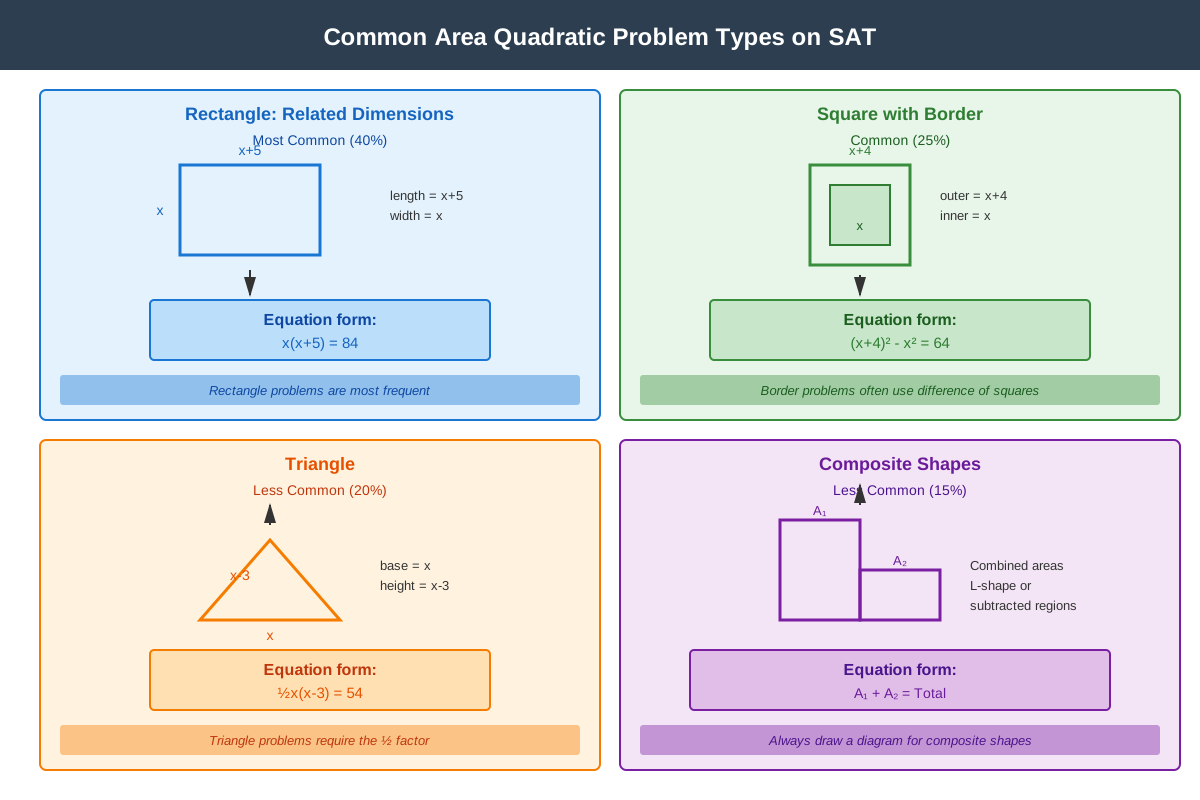
Common SAT presentations include: rectangular gardens with fixed perimeter seeking maximum area, rectangular plots where one dimension exceeds another by a specific amount, border or frame problems where material is added around existing shapes, and optimization scenarios where students must find dimensions that produce specific area relationships. The test frequently embeds these problems in practical contexts (fencing, carpeting, painting, gardening) to assess whether students can extract mathematical relationships from realistic scenarios rather than simply manipulating abstract equations.
Core Concepts
Setting Up Area Quadratic Equations
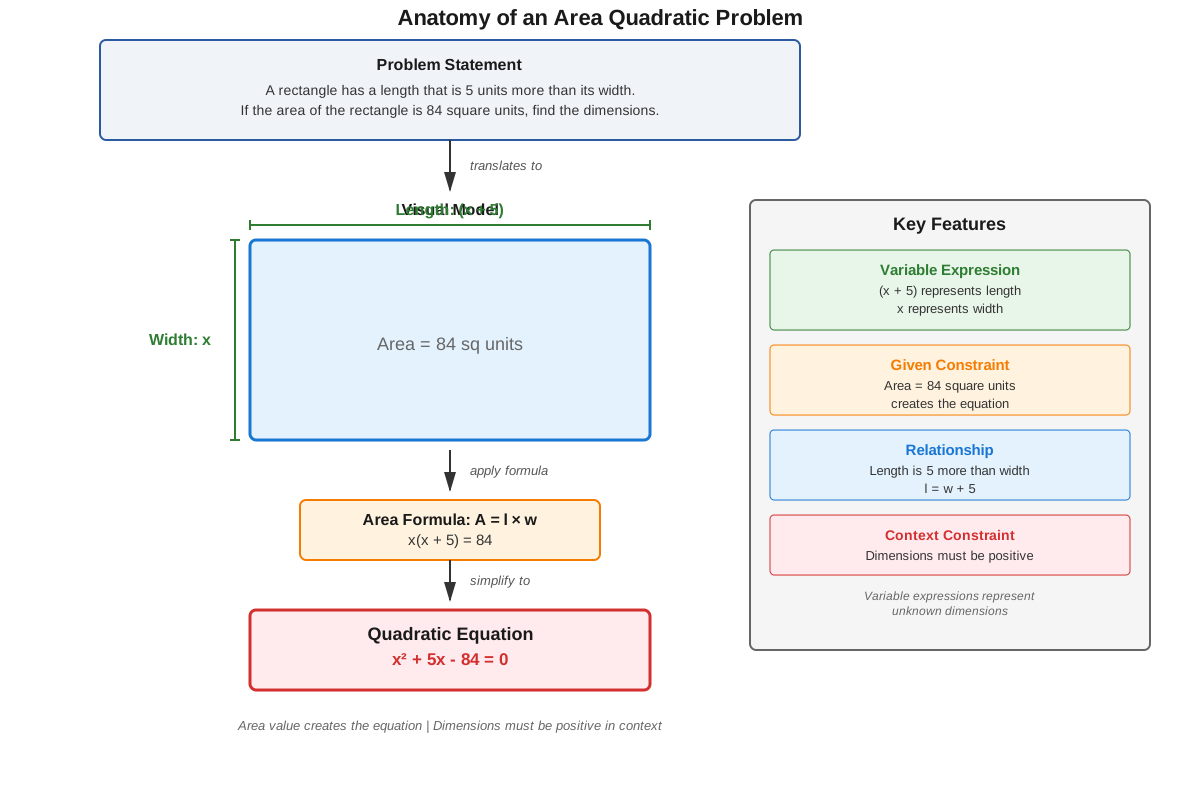
The foundation of solving area quadratic problems lies in accurately translating verbal descriptions into algebraic equations. This process requires identifying the unknown quantity (typically a dimension), assigning it a variable, expressing related quantities in terms of that variable, and applying the appropriate area formula. For rectangular problems, if one dimension is x, the other dimension must be expressed using given relationships (e.g., "3 more than x" becomes x + 3, "twice x" becomes 2x). The area equation then takes the form: Area = (first dimension)(second dimension).
Consider a fundamental setup: "A rectangle has length 5 feet more than its width, and its area is 84 square feet." Let w = width. Then length = w + 5. The area equation becomes: w(w + 5) = 84. Expanding yields w² + 5w = 84, which rearranges to the standard form w² + 5w - 84 = 0. This systematic approach—identify variable, express relationships, apply formula, rearrange to standard form—applies to virtually all area quadratic problems on the SAT.
Standard Quadratic Form and Solution Methods
Once the area relationship is expressed as a quadratic equation, students must convert it to standard form: ax² + bx + c = 0. This form enables application of various solution methods. The three primary techniques are:
- Factoring: When the quadratic factors cleanly, express as (x + m)(x + n) = 0 and apply the zero product property
- Quadratic Formula: x = [-b ± √(b² - 4ac)] / (2a), reliable for all quadratic equations
- Completing the Square: Useful when the equation is nearly a perfect square trinomial
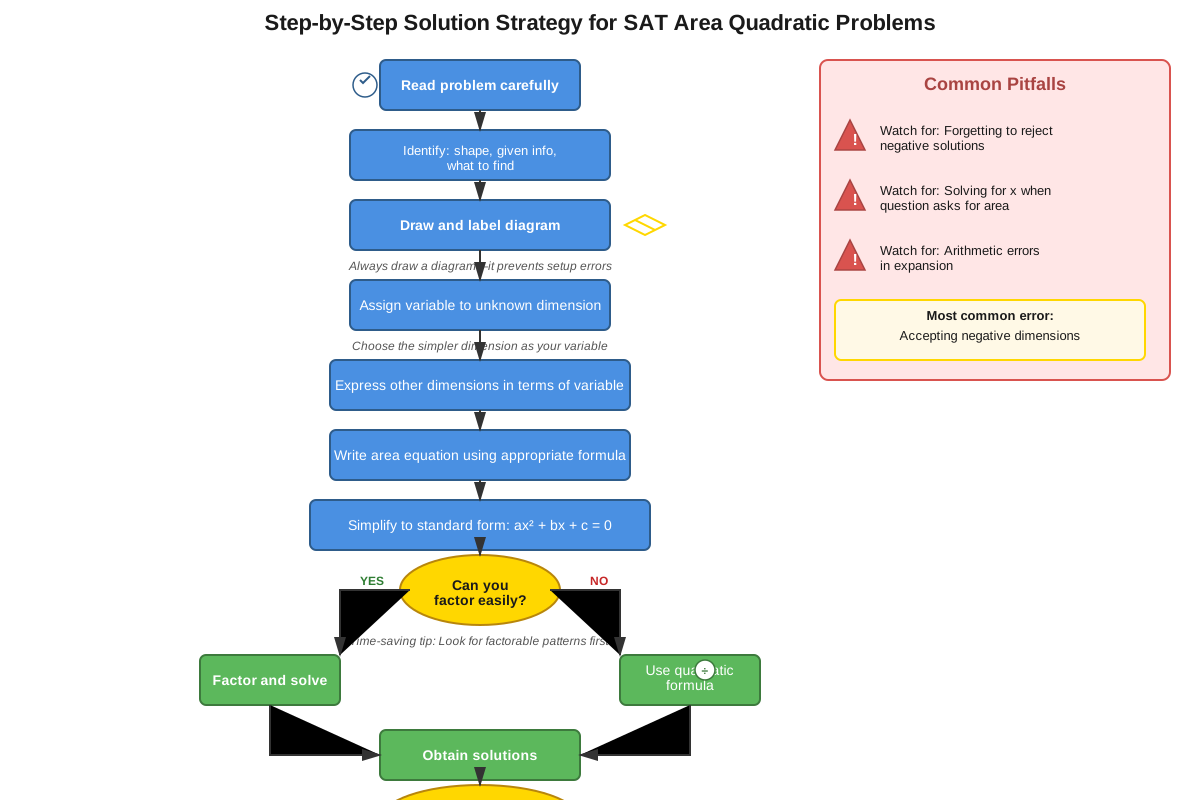
For SAT purposes, factoring is fastest when applicable, but the quadratic formula guarantees success with any equation. Students should recognize factorable patterns quickly: difference of squares (x² - 16 = 0), perfect square trinomials (x² + 6x + 9 = 0), and simple trinomials where factors of c sum to b.
Contextual Solution Validation
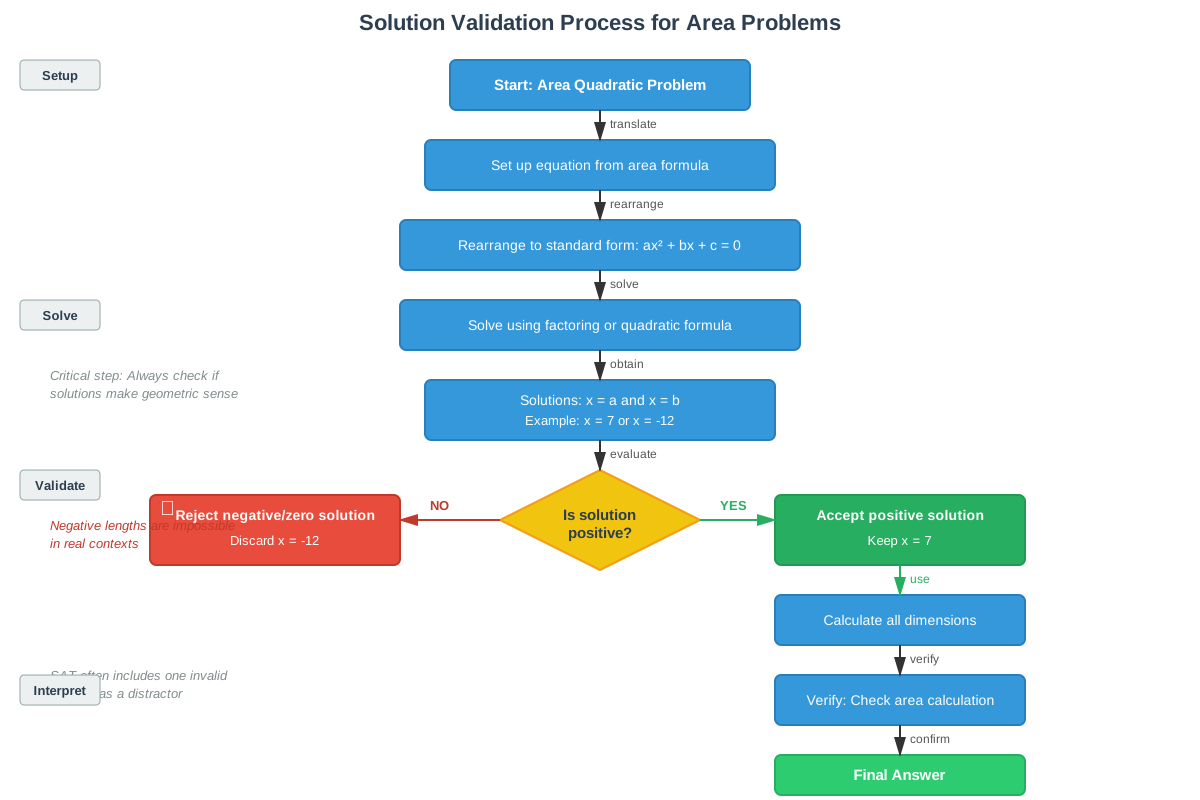
A critical aspect distinguishing area problems from pure algebra is contextual solution validation. Quadratic equations typically yield two solutions, but geometric contexts impose constraints: dimensions cannot be negative, and they must produce reasonable values given the problem context. After solving the quadratic equation, students must evaluate each solution against these constraints.
For example, solving x² + 5x - 84 = 0 yields x = 7 or x = -12. In a geometric context where x represents width, x = -12 is mathematically valid but contextually impossible—negative dimensions don't exist in physical space. Therefore, x = 7 is the only acceptable solution. The SAT frequently includes both solutions as answer choices to test whether students perform this validation step.
Optimization Problems with Constraints
Advanced area quadratic problems involve optimization: finding dimensions that maximize or minimize area subject to constraints. A classic example involves fixed perimeter: "A rectangle has perimeter 40 feet. What dimensions maximize its area?"
Let w = width. Then length = 20 - w (since 2w + 2l = 40 means l = 20 - w). Area = w(20 - w) = 20w - w². This is a quadratic function opening downward (negative leading coefficient), so its maximum occurs at the vertex. Using the vertex formula x = -b/(2a), we get w = -20/(2(-1)) = 10. Therefore, the square (10 × 10) maximizes area for a fixed perimeter—a result that generalizes to all rectangles.
Composite Shape Problems
Some SAT problems involve composite shapes where area relationships create quadratic equations. These might include rectangles with cut-out corners, L-shaped regions, or shapes with borders. The key is breaking complex shapes into simpler components and expressing total area as a sum or difference.
Example: "A rectangular garden measures x by (x + 4) feet. A uniform path 2 feet wide surrounds it. The total area including the path is 168 square feet." The outer rectangle has dimensions (x + 4) by (x + 8), since the path adds 2 feet on each side. The equation becomes: (x + 4)(x + 8) = 168, which expands to x² + 12x + 32 = 168, or x² + 12x - 136 = 0.
Relationship Between Dimensions
Many SAT area problems specify relationships between dimensions using phrases like "the length is 3 more than twice the width" or "one side exceeds the other by 7." Accurately translating these relationships is crucial:
| Verbal Description | Algebraic Expression |
|---|---|
| "x more than y" | y + x |
| "x less than y" | y - x |
| "x times y" | xy |
| "x more than twice y" | 2y + x |
| "the square of x" | x² |
| "x exceeds y by z" | x = y + z |
Misinterpreting these relationships is a primary source of errors. Students should practice translating verbal descriptions into algebra systematically, always checking that their expressions match the described relationship.
Concept Relationships
Area quadratic problems integrate multiple mathematical domains in a hierarchical structure. At the foundation lie geometric formulas (area of rectangles, triangles, circles), which provide the initial equations. These formulas connect to algebraic expression manipulation, where students expand products and combine like terms to create standard-form quadratic equations. This leads to quadratic solution techniques (factoring, quadratic formula), which produce candidate answers. Finally, contextual reasoning filters these mathematical solutions to identify physically meaningful answers.
The relationship flows: Geometric Context → Variable Assignment → Algebraic Expression → Quadratic Equation → Solution Methods → Contextual Validation → Final Answer. Each step depends on the previous one, and errors at any stage propagate forward. This interconnection explains why area quadratic problems effectively assess multiple competencies simultaneously.
Within the broader SAT math curriculum, area quadratic problems connect backward to prerequisite topics (basic geometry, linear equations, algebraic manipulation) and forward to advanced topics (functions, parabolas, optimization). They serve as a bridge between concrete geometric thinking and abstract algebraic reasoning, preparing students for calculus concepts like optimization and related rates. Mastering this topic strengthens problem-solving frameworks applicable to systems of equations, exponential growth models, and other SAT topics requiring translation between contexts.
Quick check — test yourself on Area quadratic problems so far.
Try Flashcards →High-Yield Facts
⭐ Area quadratic problems always require converting word problems into equations of the form ax² + bx + c = 0
⭐ Quadratic equations typically produce two solutions, but geometric contexts usually accept only one (positive, reasonable value)
⭐ For rectangles with fixed perimeter P, maximum area occurs when the rectangle is a square with side length P/4
⭐ The phrase "x more than y" translates to y + x, not x - y (order matters)
⭐ When a problem involves borders or frames, the outer dimensions increase by twice the border width (once on each side)
- Standard form ax² + bx + c = 0 is required before applying the quadratic formula or factoring techniques
- Negative solutions to dimension problems are mathematically valid but contextually impossible and should be rejected
- The discriminant b² - 4ac determines the number of real solutions: positive means two solutions, zero means one, negative means none
- Area problems involving "consecutive integers" for dimensions create equations like x(x + 1) = Area
- Optimization problems with constraints typically involve expressing one variable in terms of another, then creating a quadratic function to maximize or minimize
Common Misconceptions
Misconception: When a problem states "the length is 5 more than the width," students write length = 5 + w and width = w, then multiply to get 5 + w² for area.
Correction: The area is (5 + w)(w) = 5w + w², not 5 + w². The distributive property must be applied correctly when multiplying binomials.
Misconception: Both solutions from a quadratic equation are always valid answers to area problems.
Correction: Geometric contexts impose constraints. Dimensions must be positive and reasonable. Always check solutions against the problem context and reject impossible values like negative lengths or dimensions that violate stated constraints.
Misconception: For a border problem, if a 2-foot border surrounds a rectangle with width w, the outer width is w + 2.
Correction: The outer width is w + 4 because the border adds 2 feet on the left side AND 2 feet on the right side. Always add twice the border width to each dimension.
Misconception: The quadratic formula always gives exact answers that match answer choices directly.
Correction: Sometimes the quadratic formula produces irrational solutions involving radicals. Students must simplify radicals and may need to approximate values. Additionally, the problem might ask for area or perimeter rather than the dimension itself, requiring additional calculation.
Misconception: "Three less than twice the width" means 3 - 2w.
Correction: This phrase means 2w - 3. The structure "x less than y" always translates to y - x, not x - y. The quantity being subtracted from comes after "less than."
Misconception: When factoring fails immediately, the equation has no solution.
Correction: Not all quadratics factor with integer coefficients. The quadratic formula works for all quadratic equations and should be the backup method when factoring isn't apparent within 30 seconds.
Worked Examples
Example 1: Rectangle with Dimension Relationship
Problem: A rectangular garden has a length that is 7 meters more than its width. If the area of the garden is 144 square meters, what is the width of the garden?
Solution:
Step 1: Assign variables and express relationships.
Let w = width (in meters)
Then length = w + 7 (since length is 7 more than width)
Step 2: Write the area equation.
Area = length × width
144 = (w + 7)(w)
144 = w² + 7w
Step 3: Convert to standard form.
w² + 7w - 144 = 0
Step 4: Solve the quadratic equation.
Looking for factors of -144 that sum to 7: 16 and -9
(w + 16)(w - 9) = 0
w = -16 or w = 9
Step 5: Validate solutions contextually.
w = -16: Impossible—width cannot be negative
w = 9: Valid—positive dimension
Step 6: Verify the answer.
If width = 9, then length = 9 + 7 = 16
Area = 9 × 16 = 144 ✓
Answer: The width is 9 meters.
Connection to Learning Objectives: This example demonstrates identifying key features (dimension relationship), translating to a quadratic equation, solving, and validating solutions—core skills for SAT area quadratic problems.
Example 2: Border/Frame Problem
Problem: A rectangular photograph measures 8 inches by 10 inches. It is placed in a frame with a uniform border of width x inches. If the total area of the photograph and frame together is 168 square inches, what is the width of the border?
Solution:
Step 1: Identify dimensions with border.
Original photo: 8 inches by 10 inches
With border of width x on all sides:
- New width = 8 + 2x (x added on left and right)
- New length = 10 + 2x (x added on top and bottom)
Step 2: Write the area equation.
Total area = (8 + 2x)(10 + 2x) = 168
Step 3: Expand and simplify.
80 + 16x + 20x + 4x² = 168
4x² + 36x + 80 = 168
4x² + 36x - 88 = 0
Step 4: Simplify by dividing by 4.
x² + 9x - 22 = 0
Step 5: Factor.
Looking for factors of -22 that sum to 9: 11 and -2
(x + 11)(x - 2) = 0
x = -11 or x = 2
Step 6: Validate solutions.
x = -11: Impossible—border width cannot be negative
x = 2: Valid—positive measurement
Step 7: Verify.
New dimensions: (8 + 4) by (10 + 4) = 12 by 14
Area = 12 × 14 = 168 ✓
Answer: The border width is 2 inches.
Connection to Learning Objectives: This problem illustrates a common SAT variation where dimensions increase by twice the added amount, requiring careful setup and systematic solution validation.
Exam Strategy
When approaching sat area quadratic problems on the SAT, begin by carefully reading the problem to identify what quantity is unknown and what relationships are given. Underline or circle key phrases that indicate mathematical relationships ("more than," "less than," "twice," "exceeds by"). Draw a quick diagram if the problem involves a geometric shape—visual representation helps prevent setup errors and clarifies dimension relationships.
Trigger words and phrases to watch for include: "area," "perimeter," "length exceeds width by," "uniform border," "surrounding," "dimensions," "maximize," "optimize," "square feet/meters/inches," and any phrase indicating one quantity in terms of another. These signals indicate you'll need to set up a quadratic equation from geometric relationships.
For process of elimination, immediately eliminate answer choices that are negative when the problem asks for dimensions, areas, or other quantities that must be positive. If the problem provides constraints (like "the width must be less than 15 feet"), eliminate choices violating those constraints. When answer choices are far apart numerically, consider working backward: plug each choice into the original problem conditions to see which satisfies all requirements—this can be faster than algebraic solution for some problems.
Time allocation: Budget 1.5-2 minutes for straightforward area quadratic problems and up to 3 minutes for complex optimization or multi-step problems. If you're stuck after 1 minute, mark the question and return to it—don't let one problem consume excessive time. Practice recognizing when to use factoring (faster but only works for certain equations) versus the quadratic formula (slower but always works).
Exam Tip: Always write down your variable assignment explicitly (e.g., "Let w = width"). This prevents confusion in multi-step problems and helps you remember what your final answer represents—the SAT often asks for area when you've solved for a dimension, or vice versa.
Memory Techniques
AREA Acronym for problem-solving steps:
- Assign variables to unknowns
- Relate dimensions using given information
- Equation setup using area formula
- Algebraic solution (factor or formula)
- Reject invalid solutions (negative or unreasonable)
Visualization Strategy: When reading area problems, immediately sketch the shape described. Label one dimension with a variable (x or w) and write expressions for other dimensions directly on the diagram. This visual reference prevents errors when setting up equations and helps you verify that your final answer makes geometric sense.
"Twice the Border" Reminder: For border/frame problems, remember the phrase "borders grow both ways." A 3-inch border adds 3 inches on the left AND 3 inches on the right, so the dimension increases by 6 inches total. Visualize the border wrapping around the shape to reinforce this concept.
Relationship Translation Mnemonic: "Less than flips, more than doesn't." When you see "x less than y," flip the order to get y - x. When you see "x more than y," keep the order as y + x. This simple rule prevents the most common translation errors.
Summary
Area quadratic problems on the SAT require students to translate geometric scenarios into quadratic equations, solve those equations using factoring or the quadratic formula, and validate solutions within the problem context. These problems consistently appear on every SAT administration, testing the integration of geometric formulas, algebraic manipulation, and contextual reasoning. Success requires systematic problem-solving: assigning variables, expressing dimension relationships accurately, applying area formulas, converting to standard quadratic form, solving algebraically, and rejecting contextually impossible solutions. The most common problem types involve rectangles with dimension relationships, optimization with constraints, and border/frame scenarios. Students must recognize that quadratic equations typically produce two mathematical solutions, but geometric contexts usually accept only one physically meaningful answer. Mastery of this topic demonstrates mathematical modeling ability—translating real-world situations into mathematical language and interpreting solutions appropriately—a skill the SAT values highly and one that extends far beyond this specific question type.
Key Takeaways
- Area quadratic problems integrate geometry and algebra, requiring translation of word problems into equations of the form ax² + bx + c = 0
- Always validate solutions contextually—reject negative dimensions and values that violate problem constraints
- Border/frame problems require adding twice the border width to each dimension (once per side)
- Phrases like "x more than y" translate to y + x; "x less than y" translates to y - x (order matters)
- For fixed perimeter, maximum area occurs when the rectangle is a square
- Draw diagrams and label dimensions with variables to prevent setup errors
- These problems appear 2-4 times per SAT test, making them high-yield for score improvement
Related Topics
Quadratic Functions and Parabolas: Understanding how quadratic equations relate to parabolic graphs enables visualization of optimization problems and helps identify maximum/minimum values without calculation. This topic extends area problems into function analysis.
Systems of Equations: Some advanced area problems involve multiple shapes or constraints that create systems of equations, one or more of which may be quadratic. Mastering area quadratics prepares students for these more complex scenarios.
Polynomial Operations: Expanding binomials and factoring polynomials are essential skills for area problems. Deeper study of polynomial algebra strengthens the manipulation skills needed for efficient problem-solving.
Optimization and Calculus Concepts: While calculus isn't tested on the SAT, the optimization thinking developed through area quadratic problems (finding maximum/minimum values) provides conceptual preparation for calculus and appears in advanced SAT problems involving quadratic functions.
Practice CTA
Now that you've mastered the core concepts of area quadratic problems, it's time to solidify your understanding through practice. Attempt the practice questions designed specifically for this topic—they mirror actual SAT question formats and difficulty levels. Use the flashcards to reinforce key formulas, translation patterns, and solution strategies until they become automatic. Remember: the SAT rewards systematic problem-solving and careful validation of answers. Each practice problem you complete builds the pattern recognition and confidence needed to tackle these high-yield questions efficiently on test day. Your investment in mastering this topic will pay dividends across multiple questions on every SAT administration!
Sign up free to keep reading
Create a free AnvayaPrep account to finish this SAT guide on Area quadratic problems — plus flashcards and practice questions.