Overview
Projectile problems are among the most frequently tested applications of quadratic equations on the SAT math section. These problems model the motion of objects launched into the air—such as balls, rockets, or water from fountains—using quadratic functions that describe height as a function of time. Understanding projectile motion requires synthesizing multiple algebraic skills: interpreting quadratic functions, finding maximum values, determining zeros, and translating between mathematical representations and real-world contexts.
The SAT consistently features sat projectile problems because they elegantly test whether students can move beyond mechanical computation to genuine mathematical reasoning. These questions assess the ability to extract meaningful information from equations, graphs, and word problems while applying knowledge of parabolas, vertex form, and the relationship between algebraic expressions and physical phenomena. Typically appearing 1-2 times per test, projectile problems often serve as medium-to-hard difficulty questions that separate high scorers from average performers.
Mastering projectile problems strengthens foundational understanding of quadratic equations while building critical thinking skills applicable across the SAT math curriculum. The concepts connect directly to function interpretation, coordinate geometry, and algebraic modeling—all high-yield topics. Students who develop fluency with projectile motion gain confidence tackling complex word problems and multi-step reasoning questions that appear throughout the exam.
Learning Objectives
- [ ] Identify key features of projectile problems, including initial height, maximum height, and time to ground
- [ ] Explain how projectile problems appears on the SAT, including common question formats and representations
- [ ] Apply projectile problems to answer SAT-style questions involving height functions and time calculations
- [ ] Determine the vertex of a projectile motion parabola and interpret its meaning in context
- [ ] Calculate when a projectile reaches a specific height or returns to ground level
- [ ] Convert between different forms of quadratic equations to extract relevant information efficiently
Prerequisites
- Quadratic equations in standard form: Essential for recognizing the structure h(t) = at² + bt + c in projectile problems
- Vertex form of quadratics: Necessary for quickly identifying maximum height and time at which it occurs
- Factoring and the quadratic formula: Required for finding when projectiles reach specific heights or hit the ground
- Function notation and evaluation: Needed to interpret h(t) expressions and calculate height at given times
- Coordinate plane interpretation: Important for reading projectile motion graphs and understanding parabolic paths
Why This Topic Matters
Projectile problems represent one of the most practical applications of quadratic functions, connecting abstract algebra to observable physical phenomena. In real-world contexts, engineers use these principles to design everything from basketball court layouts to water fountain trajectories, from rocket launches to bridge construction. Understanding projectile motion develops spatial reasoning and the ability to translate between mathematical models and physical reality—skills valuable far beyond standardized testing.
On the SAT, projectile problems appear with remarkable consistency. Approximately 15-20% of all quadratic equation questions involve projectile motion scenarios, making this one of the highest-yield applications to master. These questions typically appear in both the calculator and no-calculator sections, with difficulty ratings ranging from medium to hard. The College Board favors projectile problems because they efficiently assess multiple competencies: algebraic manipulation, function interpretation, problem-solving, and contextual reasoning.
Common SAT presentations include: word problems describing objects thrown upward with given initial velocities; graphs showing parabolic height-versus-time relationships; equations in various forms requiring interpretation of coefficients; and multi-part questions asking students to find maximum height, time in air, or specific height occurrences. Questions may ask for the meaning of constants in equations, require comparing two different projectiles, or involve determining when a projectile reaches a particular elevation.
Core Concepts
The Standard Projectile Motion Equation
The fundamental model for projectile problems on the SAT follows the form:
h(t) = -16t² + v₀t + h₀Where:
- h(t) represents the height (in feet) at time t seconds
- t represents time elapsed since launch (in seconds)
- -16 is the constant representing half the acceleration due to gravity (in ft/s²)
- v₀ is the initial upward velocity (in feet per second)
- h₀ is the initial height from which the object is launched (in feet)
The coefficient -16 appears because gravity accelerates objects downward at approximately 32 ft/s², and the kinematic equation includes ½ of this value. Some problems use -4.9 when working in meters (since gravity is approximately 9.8 m/s²). The negative sign indicates that gravity pulls downward, creating a downward-opening parabola.
Key Features of Projectile Motion
Understanding what each component reveals about the physical situation is crucial for SAT success:
| Feature | Mathematical Representation | Physical Meaning |
|---|---|---|
| Initial Height | h₀ (constant term) | Height at t = 0; launch elevation |
| Initial Velocity | v₀ (coefficient of t) | Speed and direction at launch |
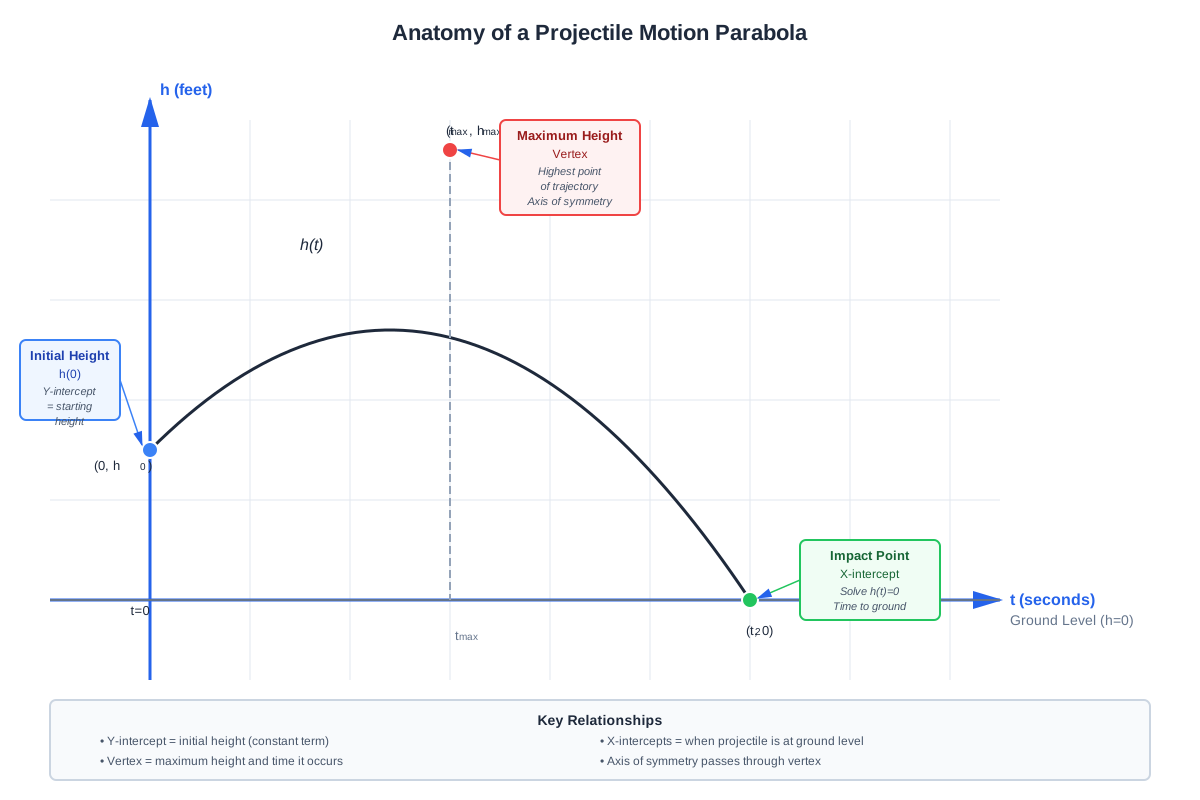
| Maximum Height | y-coordinate of vertex | Highest point reached |
| Time to Max Height | x-coordinate of vertex | When peak occurs |
| Ground Level | When h(t) = 0 | When object lands |
| Time in Air | Larger positive zero | Total flight duration |
Finding Maximum Height
The maximum height occurs at the vertex of the parabola. For a quadratic in standard form h(t) = at² + bt + c, the vertex occurs at:
t = -b/(2a)For projectile problems where a = -16 and b = v₀:
t = -v₀/(2(-16)) = v₀/32Once the time is found, substitute back into the original equation to find the maximum height. Alternatively, if the equation is given in vertex form h(t) = a(t - h)² + k, the vertex is simply (h, k), where k represents the maximum height directly.
Determining When the Projectile Hits the Ground
To find when a projectile returns to ground level, set h(t) = 0 and solve for t. This requires:
- Factoring (when possible): Factor the quadratic and apply the zero product property
- Quadratic formula (when factoring is difficult): Use t = [-b ± √(b² - 4ac)]/(2a)
- Graphing calculator (when permitted): Find the positive x-intercept
The positive solution represents the landing time (the negative solution, if any, represents a time before launch and is physically meaningless).
Interpreting Different Forms
SAT questions present projectile equations in various forms, each revealing different information:
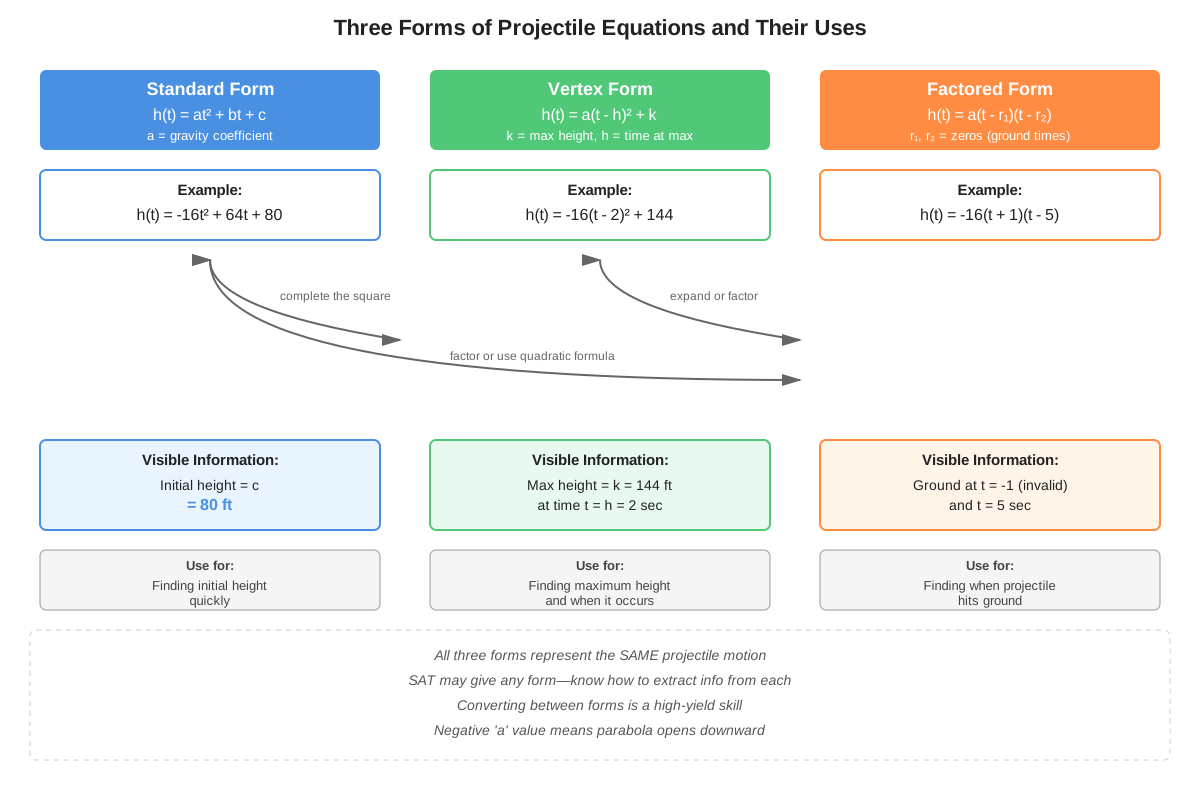
Standard Form: h(t) = -16t² + v₀t + h₀
- Immediately shows initial height (h₀)
- Requires calculation to find maximum height and time
Vertex Form: h(t) = -16(t - p)² + q
- Immediately shows maximum height (q) and when it occurs (p)
- Requires expansion or substitution to find initial height
Factored Form: h(t) = -16(t - 0)(t - T)
- Immediately shows when object is at ground level (t = 0 and t = T)
- Requires expansion to find initial velocity and height
Solving for Specific Heights
When asked "at what time(s) does the projectile reach height H?", set h(t) = H and solve the resulting quadratic equation. This often yields two solutions:
- The smaller positive value: time on the way up
- The larger positive value: time on the way down
If only one positive solution exists, the projectile just barely reaches that height at its peak. If no real solutions exist, the projectile never reaches that height.
Concept Relationships
The core concepts in projectile problems form an interconnected system. The standard projectile equation serves as the foundation, from which all other features derive. The initial conditions (h₀ and v₀) determine the specific parabola's position and shape, which in turn determines the vertex location representing maximum height and optimal time. The zeros of the function connect to the vertex through the axis of symmetry, which passes through the vertex at the midpoint between zeros.
Understanding quadratic forms creates efficiency: recognizing vertex form immediately reveals maximum height without calculation, while factored form shows ground-level times directly. These forms are mathematically equivalent but strategically different—choosing the right form for each question saves valuable time.
Projectile problems connect backward to prerequisite topics: factoring skills enable finding zeros, function evaluation allows calculating height at specific times, and coordinate geometry helps interpret graphs. They connect forward to more advanced topics like optimization problems, parametric equations, and calculus applications in future coursework.
The relationship map flows: Initial Conditions → Quadratic Equation → Parabolic Graph → Key Features (vertex, zeros, y-intercept) → Physical Interpretations (max height, landing time, initial height) → Problem Solutions.
High-Yield Facts
⭐ The coefficient of t² in projectile problems is always negative (typically -16 for feet or -4.9 for meters), creating a downward-opening parabola
⭐ The vertex of a projectile parabola represents the maximum height and the time at which it occurs
⭐ Initial height equals h(0), found by evaluating the function at t = 0 or identifying the constant term
⭐ The time to reach maximum height is t = v₀/32 when using the standard -16t² + v₀t + h₀ form
⭐ Setting h(t) = 0 and solving gives the time(s) when the projectile is at ground level; the positive solution is the landing time
- The initial velocity v₀ is positive when launching upward and negative when launching downward
- A projectile reaches the same height at two different times (once ascending, once descending) unless that height is the maximum
- The axis of symmetry of the parabola passes through the vertex at t = v₀/32
- Greater initial velocity results in higher maximum height and longer flight time (assuming same initial height)
- The discriminant b² - 4ac determines whether a projectile reaches a given height: positive means two times, zero means once (at peak), negative means never
- In vertex form h(t) = a(t - h)² + k, the value k is the maximum height and h is when it occurs
- The average of the two times when a projectile is at ground level equals the time of maximum height
Quick check — test yourself on Projectile problems so far.
Try Flashcards →Common Misconceptions
Misconception: The coefficient -16 represents gravity directly.
Correction: The -16 represents half the gravitational acceleration (32 ft/s²) due to the kinematic equation h = h₀ + v₀t + ½at², where a = -32 ft/s².
Misconception: The initial velocity v₀ is always the maximum velocity.
Correction: Initial velocity is the speed at launch; the maximum speed actually occurs at ground level on the way down due to gravitational acceleration. The velocity at the peak is zero.
Misconception: A projectile is in the air for twice the time it takes to reach maximum height only if launched from ground level.
Correction: The symmetry property (time up equals time down) only applies when initial and final heights are equal. When launched from an elevated position, the descent takes longer than the ascent.
Misconception: Negative time solutions should be ignored without consideration.
Correction: While negative times are usually physically meaningless for the problem context, they can provide mathematical insight. For instance, a negative solution to h(t) = 0 indicates the object was already in motion before t = 0 in the mathematical model.
Misconception: The vertex form h(t) = a(t - h)² + k means the maximum height is h.
Correction: In vertex form, k represents the maximum height (the y-coordinate of the vertex), while h represents the time when maximum height occurs (the x-coordinate). This notation can be confusing since h appears in both h(t) and as the vertex x-coordinate.
Misconception: If h(t) = -16t² + 64t, the initial height is 64 feet.
Correction: The initial height is h(0) = 0 feet (the constant term). The 64 is the initial velocity in feet per second. Always evaluate h(0) to find initial height.
Misconception: A larger coefficient on the t² term means the projectile goes higher.
Correction: The coefficient on t² is determined by gravity and is constant for all projectiles on Earth (-16 for feet, -4.9 for meters). Maximum height depends on initial velocity and initial height, not the t² coefficient.
Worked Examples
Example 1: Finding Maximum Height and Landing Time
Problem: A ball is thrown upward from a platform 6 feet above the ground with an initial velocity of 48 feet per second. The height h(t) in feet after t seconds is given by h(t) = -16t² + 48t + 6.
(a) What is the maximum height reached by the ball?
(b) When does the ball hit the ground?
Solution:
(a) To find maximum height, first find when it occurs using t = -b/(2a):
t = -48/(2(-16)) = -48/(-32) = 1.5 secondsNow substitute t = 1.5 into the height equation:
h(1.5) = -16(1.5)² + 48(1.5) + 6
h(1.5) = -16(2.25) + 72 + 6
h(1.5) = -36 + 72 + 6 = 42 feet
The maximum height is 42 feet, occurring at 1.5 seconds.
(b) To find when the ball hits the ground, set h(t) = 0:
-16t² + 48t + 6 = 0Divide by -2 to simplify:
8t² - 24t - 3 = 0Using the quadratic formula with a = 8, b = -24, c = -3:
t = [24 ± √(576 + 96)]/16 = [24 ± √672]/16 = [24 ± 25.92]/16This gives t ≈ 3.12 seconds (positive solution) or t ≈ -0.12 seconds (rejected as physically meaningless).
The ball hits the ground after approximately 3.12 seconds.
Connection to Learning Objectives: This example demonstrates identifying key features (maximum height, landing time), applying the vertex formula, and solving quadratic equations in context.
Example 2: Comparing Two Projectiles
Problem: Two stones are thrown from the same height. Stone A's height is given by h₁(t) = -16t² + 40t + 5, and Stone B's height is given by h₂(t) = -16t² + 32t + 5. Which stone reaches a greater maximum height, and by how much?
Solution:
For Stone A, the time to maximum height is:
t = 40/32 = 1.25 secondsMaximum height for Stone A:
h₁(1.25) = -16(1.25)² + 40(1.25) + 5
h₁(1.25) = -16(1.5625) + 50 + 5
h₁(1.25) = -25 + 50 + 5 = 30 feet
For Stone B, the time to maximum height is:
t = 32/32 = 1 secondMaximum height for Stone B:
h₂(1) = -16(1)² + 32(1) + 5
h₂(1) = -16 + 32 + 5 = 21 feet
Stone A reaches a greater maximum height by 30 - 21 = 9 feet.
Alternative approach using vertex form: Convert to vertex form by completing the square to see maximum heights directly, which is faster for comparison problems.
Connection to Learning Objectives: This example shows how to apply projectile problem concepts to comparative analysis and demonstrates the efficiency of recognizing that higher initial velocity (40 vs. 32) produces greater maximum height when other factors are equal.
Exam Strategy
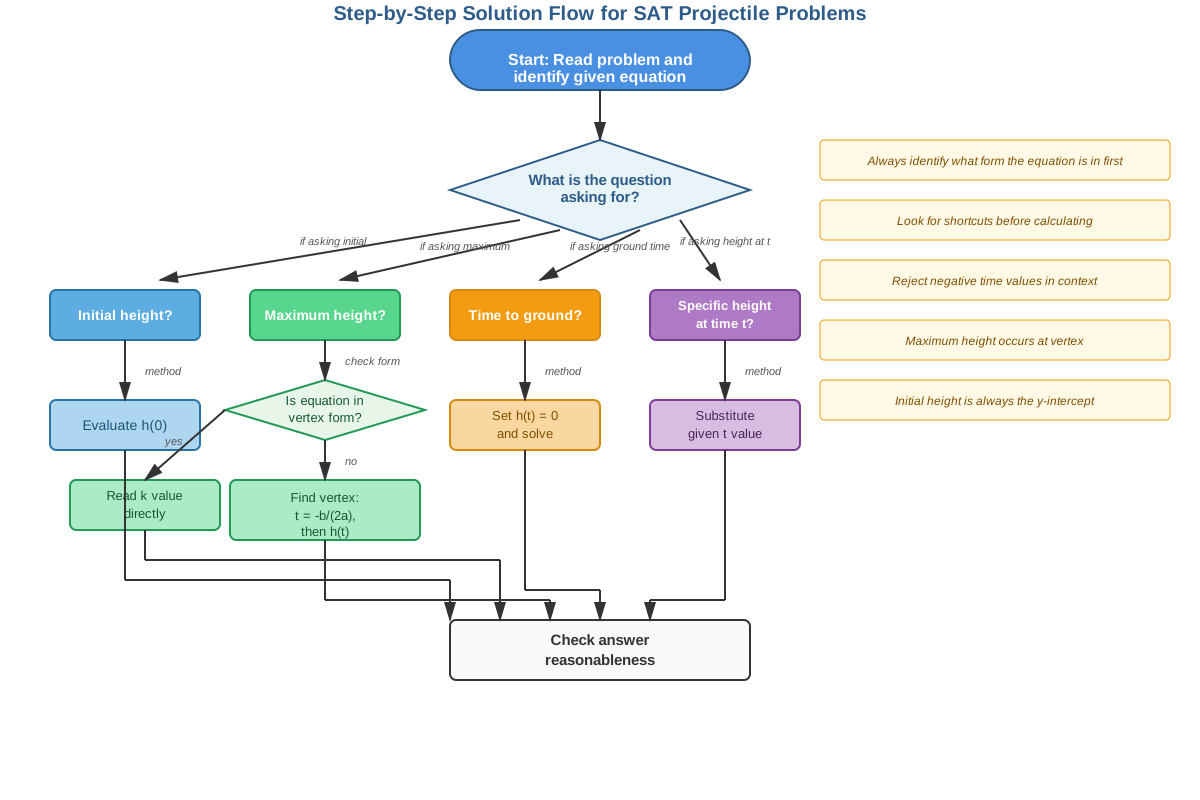
When approaching sat projectile problems, begin by identifying what the question asks: maximum height, landing time, initial conditions, or specific height occurrences. This determines which strategy to employ.
Trigger words and phrases to recognize:
- "Maximum height" or "highest point" → find the vertex
- "Hits the ground" or "reaches ground level" → set h(t) = 0
- "Initial height" or "launched from" → find h(0) or identify h₀
- "How long in the air" → find the positive zero
- "Reaches a height of" → set h(t) equal to that value
- "Initial velocity" → identify the coefficient of t
Strategic approach sequence:
- Identify the given form of the equation (standard, vertex, or factored)
- Determine what information is immediately available from that form
- Decide whether conversion to another form would be more efficient
- Set up the appropriate equation or calculation based on the question
- Verify the answer makes physical sense (positive time, reasonable height)
Process of elimination tips:
- Eliminate answers with negative time values unless the context specifically allows them
- Eliminate maximum heights lower than the initial height (projectiles must go up before coming down)
- Eliminate landing times shorter than the time to reach maximum height (must go up before coming down)
- Check whether answer choices are in the correct units (feet vs. meters, seconds vs. minutes)
Time allocation: Projectile problems typically require 1.5-2.5 minutes. If a problem requires more than 3 minutes, consider whether there's a more efficient approach or whether to mark it and return later. Using vertex form when finding maximum height saves significant time compared to calculating the vertex from standard form.
Exam Tip: When calculator use is permitted, verify algebraic solutions by graphing the function and using trace or calculate features to find key points. This catches arithmetic errors and builds confidence.
Memory Techniques
Mnemonic for projectile equation components: "Height Varies Inversely, Time" (HVIT)
- Height function: h(t)
- Velocity: positive coefficient (v₀)
- Inverse gravity: negative coefficient (-16)
- Time: independent variable
Vertex time formula memory aid: "Velocity Over Thirty-Two" (v₀/32) for the time to maximum height in standard projectile problems using feet.
Visual memory technique: Picture the parabola as a fountain arc. The peak of the water is the vertex (maximum height), the starting point is the y-intercept (initial height), and where water hits the ground is the positive x-intercept (landing time). The force of the pump represents initial velocity.
Acronym for problem-solving steps: "FIGS"
- Form: Identify which form the equation is in
- Information: Determine what's given and what's needed
- Goal: Set up the appropriate equation
- Solve: Calculate and verify the answer
Symmetry reminder: "Up Time = Down Time" only when starting and ending heights are equal. Visualize a symmetric parabola for ground-to-ground launches, but an asymmetric one for elevated launches.
Summary
Projectile problems on the SAT test the application of quadratic equations to real-world motion scenarios. The standard form h(t) = -16t² + v₀t + h₀ models height as a function of time, where -16 represents gravitational acceleration, v₀ is initial velocity, and h₀ is initial height. Success requires identifying key features: the vertex reveals maximum height and when it occurs (found using t = v₀/32), the y-intercept shows initial height (h₀), and the positive zero indicates landing time (found by setting h(t) = 0). Different forms of quadratic equations—standard, vertex, and factored—each reveal different information immediately, making form recognition crucial for efficiency. Questions typically ask for maximum height, time in air, initial conditions, or when specific heights occur. Mastery involves translating between mathematical representations and physical interpretations, choosing efficient solution strategies, and verifying that answers make physical sense within the problem context.
Key Takeaways
- The standard projectile equation h(t) = -16t² + v₀t + h₀ contains all information about motion, with -16 representing half of gravitational acceleration
- Maximum height occurs at the vertex; calculate the time using t = v₀/32, then substitute to find the height
- Initial height equals h(0), which is the constant term h₀ in standard form
- Landing time is found by setting h(t) = 0 and solving for the positive value of t
- Recognizing equation form (standard, vertex, or factored) determines the most efficient solution strategy
- The vertex represents the highest point and occurs at the axis of symmetry, midway through the projectile's flight when launched from and returning to the same height
- Always verify solutions make physical sense: times should be positive, maximum height should exceed initial height, and landing time should be greater than time to maximum height
Related Topics
Quadratic Functions and Graphs: Understanding parabola properties, transformations, and the relationship between algebraic and graphical representations deepens projectile problem mastery and enables quick visual verification of solutions.
Systems of Equations with Quadratics: Some advanced SAT problems involve two projectiles, requiring solving systems where both equations are quadratic, building on projectile motion fundamentals.
Optimization Problems: Projectile problems are a specific case of optimization, where finding maximum or minimum values of quadratic functions applies to various contexts beyond motion.
Polynomial Functions: Mastering quadratic projectile problems provides foundation for understanding higher-degree polynomials and their applications in modeling complex phenomena.
Rational Functions and Asymptotes: While projectile problems use polynomials, the problem-solving strategies transfer to analyzing rational functions, particularly in identifying key features and interpreting graphs.
Practice CTA
Now that you've mastered the core concepts of projectile problems, it's time to solidify your understanding through active practice. Work through the practice questions to apply these strategies to SAT-style problems, and use the flashcards to reinforce key formulas and concepts. Remember, projectile problems reward systematic thinking and form recognition—skills that improve rapidly with focused practice. Each problem you solve builds pattern recognition that will save you valuable time on test day. You've got this!
Sign up free to keep reading
Create a free AnvayaPrep account to finish this SAT guide on Projectile problems — plus flashcards and practice questions.