Overview
Quadratic systems represent one of the most frequently tested algebraic concepts on the SAT math section, appearing in approximately 3-5 questions per exam. A quadratic system consists of two or more equations where at least one equation is quadratic (containing a variable raised to the second power), and students must find the values that satisfy all equations simultaneously. These systems typically involve a quadratic equation paired with a linear equation, though occasionally two quadratic equations appear together.
Understanding quadratic systems is essential for SAT success because these problems test multiple mathematical skills simultaneously: algebraic manipulation, graphical interpretation, solution verification, and logical reasoning. The College Board frequently uses quadratic systems to assess higher-order thinking, as these problems require students to integrate knowledge of parabolas, lines, intersection points, and coordinate geometry. Questions may ask for the number of solutions, the sum or product of solutions, specific coordinate values, or relationships between parameters.
Mastery of quadratic systems builds directly upon foundational algebra skills including solving linear equations, factoring quadratics, and understanding the quadratic formula. This topic serves as a bridge between basic equation-solving and more advanced mathematical modeling, making it crucial not only for SAT performance but also for college-level mathematics. The ability to visualize these systems graphically and solve them algebraically represents a key milestone in mathematical maturity that the SAT specifically targets in medium-to-hard difficulty questions.
Learning Objectives
- [ ] Identify key features of quadratic systems including the types of equations involved and possible solution sets
- [ ] Explain how quadratic systems appears on the SAT, including common question formats and answer types
- [ ] Apply quadratic systems to answer SAT-style questions using both algebraic and graphical approaches
- [ ] Determine the number of solutions to a quadratic system without fully solving it
- [ ] Use substitution and elimination methods efficiently to solve quadratic systems
- [ ] Interpret the graphical meaning of quadratic system solutions as intersection points
- [ ] Recognize when a quadratic system has zero, one, two, or infinitely many solutions
Prerequisites
- Linear equations and systems of linear equations: Understanding how to solve two linear equations simultaneously provides the foundational method (substitution and elimination) used for quadratic systems
- Quadratic equations: Ability to solve quadratic equations using factoring, completing the square, and the quadratic formula is essential since solving quadratic systems reduces to solving a quadratic equation
- Graphing parabolas and lines: Visual understanding of how parabolas and lines behave helps predict the number of solutions and verify algebraic answers
- Coordinate geometry: Knowledge of ordered pairs, the coordinate plane, and how equations relate to graphs enables interpretation of solutions as intersection points
- Algebraic manipulation: Skills in expanding, factoring, and simplifying expressions are necessary for the substitution and elimination processes
Why This Topic Matters
Quadratic systems appear in real-world contexts ranging from physics (projectile motion intersecting with barriers) to economics (supply and demand curves where one relationship is nonlinear) to engineering (optimization problems with constraints). Understanding how different mathematical relationships interact simultaneously develops critical thinking skills applicable far beyond mathematics.
On the SAT, quadratic systems typically appear 3-5 times per exam, representing approximately 5-8% of the total math score. These questions appear in both the calculator and no-calculator sections, with varying difficulty levels. The College Board particularly favors these problems because they efficiently test multiple standards simultaneously and differentiate between students at different skill levels.
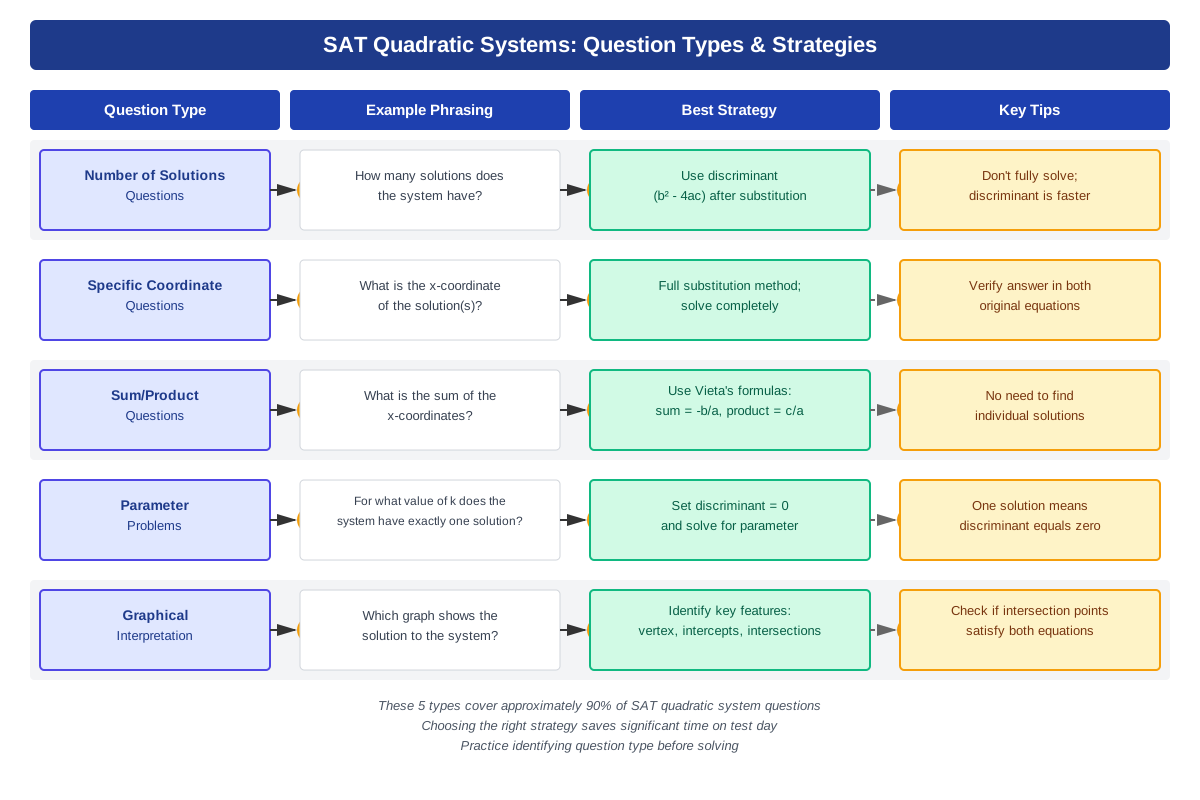
Common SAT question formats include: asking for the number of solutions (intersection points) given specific parameters; requesting the sum or product of x-coordinates or y-coordinates of solutions; providing a graph and asking which system it represents; giving a system with unknown constants and asking what value makes the system have exactly one solution; or presenting a word problem that translates into a quadratic system. Questions may be multiple-choice or student-produced response (grid-in) format, with the latter often testing whether students can find specific numerical values from solutions.
Core Concepts
Definition and Components of Quadratic Systems
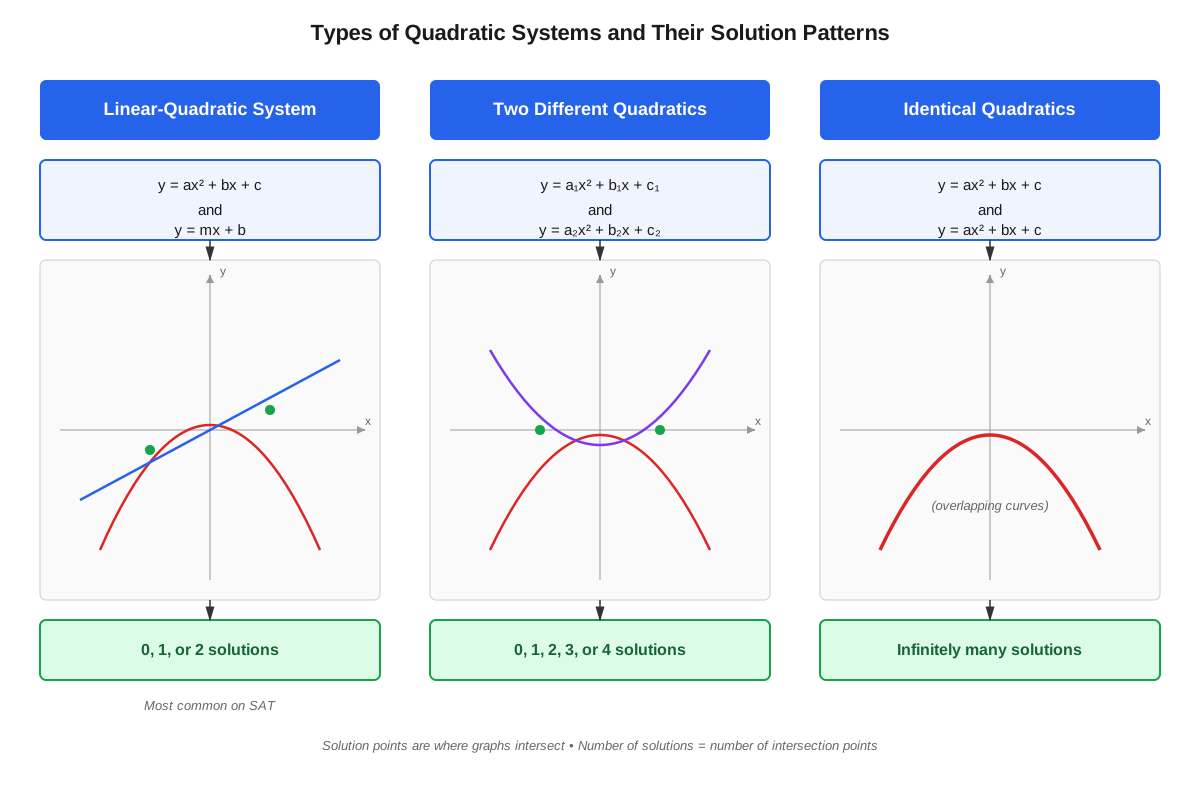
A quadratic system consists of two or more equations that must be satisfied simultaneously, where at least one equation is quadratic. The most common form on the SAT quadratic systems involves:
- One quadratic equation: typically y = ax² + bx + c or a circle/parabola in standard form
- One linear equation: typically y = mx + b or ax + by = c
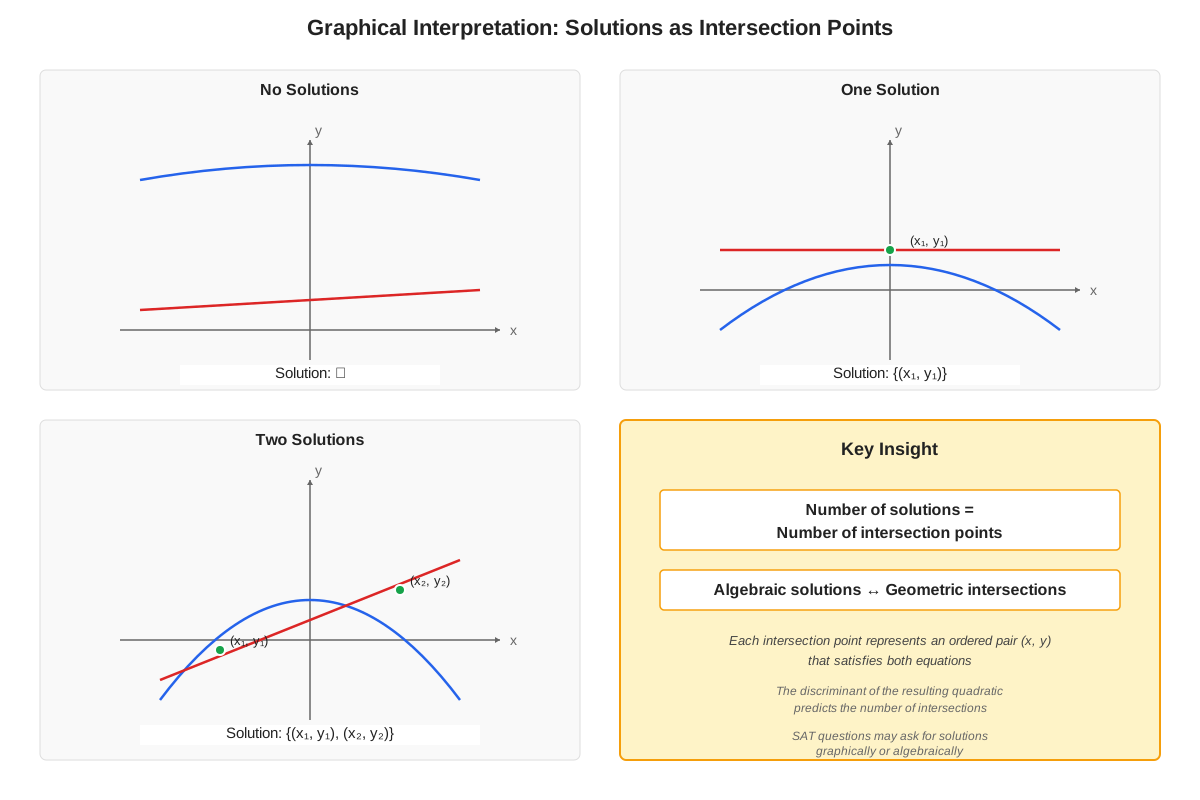
The solution to a quadratic system is the set of ordered pairs (x, y) that satisfy both equations. Graphically, these solutions represent the intersection points of the curves represented by each equation.
Types of Quadratic Systems
| System Type | Example | Graphical Representation |
|---|---|---|
| Linear-Quadratic | y = x² - 4 and y = 2x + 1 | Line intersecting parabola |
| Quadratic-Quadratic | y = x² + 1 and y = -x² + 5 | Two parabolas intersecting |
| Circle-Linear | x² + y² = 25 and y = x + 1 | Line intersecting circle |
| Circle-Quadratic | x² + y² = 16 and y = x² - 2 | Parabola intersecting circle |
The linear-quadratic system is by far the most common on the SAT, appearing in approximately 80% of quadratic system questions.
Number of Solutions
Understanding how many solutions a quadratic system can have is crucial for SAT success:
- Zero solutions: The graphs do not intersect (e.g., a line above a parabola that opens downward)
- One solution: The graphs are tangent, touching at exactly one point
- Two solutions: The graphs intersect at two distinct points (most common scenario)
- Infinitely many solutions: The equations represent the same curve (rare on SAT)
The number of solutions depends on the discriminant of the resulting quadratic equation after substitution. If the system reduces to ax² + bx + c = 0, then:
- Discriminant (b² - 4ac) > 0: two solutions
- Discriminant = 0: one solution
- Discriminant < 0: zero solutions
Substitution Method
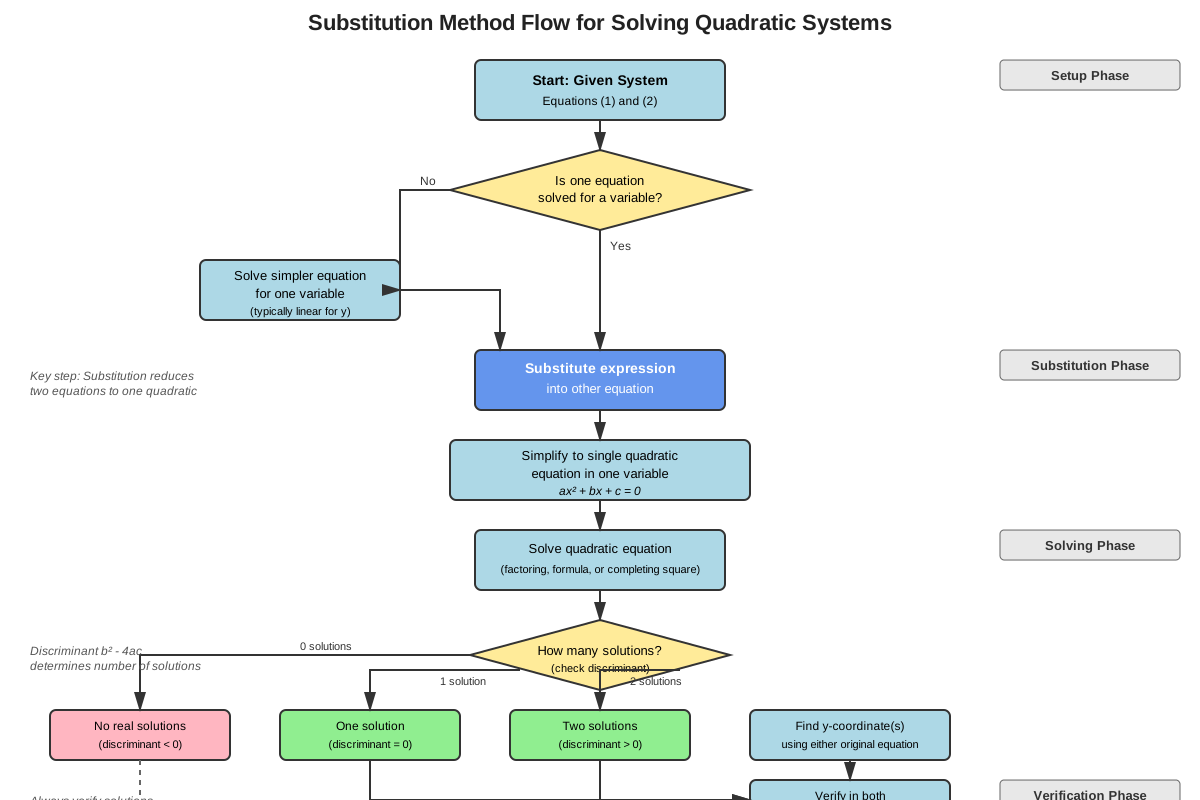
The substitution method is the primary technique for solving quadratic systems on the SAT:
- Solve one equation (usually the linear equation) for one variable in terms of the other
- Substitute this expression into the other equation
- Simplify to obtain a single-variable quadratic equation
- Solve the quadratic equation using factoring, quadratic formula, or completing the square
- Substitute the solution(s) back to find the corresponding values of the other variable
- Write solutions as ordered pairs and verify if required
Example process: Given y = 2x + 3 and y = x² - 1
Step 1: The first equation is already solved for y
Step 2: Substitute into second equation: 2x + 3 = x² - 1
Step 3: Rearrange: x² - 2x - 4 = 0
Step 4: Use quadratic formula: x = (2 ± √(4 + 16))/2 = (2 ± √20)/2 = 1 ± √5
Step 5: Find y-values: y = 2(1 + √5) + 3 = 5 + 2√5 and y = 2(1 - √5) + 3 = 5 - 2√5
Step 6: Solutions are (1 + √5, 5 + 2√5) and (1 - √5, 5 - 2√5)
Elimination Method
While less common for quadratic systems, the elimination method can be useful when both equations are in standard form:
- Align equations with like terms in columns
- Multiply one or both equations to create opposite coefficients for one variable
- Add or subtract equations to eliminate that variable
- Solve the resulting equation
- Back-substitute to find the other variable
This method works best when dealing with circle equations or when both equations are quadratic.
Graphical Interpretation
Every solution to a quadratic system corresponds to an intersection point on the coordinate plane. Understanding this visual representation helps with:
- Estimating solutions: When graphs are provided, approximate coordinates can be read directly
- Verifying solution count: Visual inspection confirms whether zero, one, or two intersections exist
- Checking reasonableness: Algebraic solutions should match the graphical behavior
- Understanding parameters: Seeing how changing coefficients affects intersection points
For a line y = mx + b intersecting a parabola y = ax² + cx + d:
- If the line's slope is steep and y-intercept is high, it may miss the parabola entirely
- If the line passes through the vertex region, two intersections are likely
- If the line is tangent to the parabola, exactly one solution exists
Special Cases and Parameters
SAT questions frequently involve parameters (unknown constants) and ask students to determine values that produce a specific number of solutions:
Finding parameter for one solution: Set the discriminant equal to zero
Finding parameter for two solutions: Set the discriminant greater than zero
Finding parameter for no solutions: Set the discriminant less than zero
Example: For what value of k does the system y = x² + 2 and y = x + k have exactly one solution?
Substitute: x + k = x² + 2
Rearrange: x² - x + (2 - k) = 0
For one solution: discriminant = 0
(-1)² - 4(1)(2 - k) = 0
1 - 8 + 4k = 0
4k = 7
k = 7/4
Concept Relationships
The core concepts within quadratic systems are deeply interconnected. The substitution method relies on understanding both linear equations (to isolate a variable) and quadratic equations (to solve the resulting single-variable equation). The number of solutions connects directly to the discriminant from quadratic equation theory, which in turn determines the graphical interpretation (how many intersection points exist).
Graphical interpretation ↔ Number of solutions: These are two perspectives on the same concept—algebraic (discriminant) and geometric (intersections)
Substitution method → Single quadratic equation → Discriminant analysis → Number of solutions
Parameters in systems → Discriminant conditions → Specific parameter values
Quadratic systems build upon prerequisite knowledge of linear systems by adding the complexity of nonlinear relationships. While linear systems can have zero, one, or infinitely many solutions, quadratic systems typically have zero, one, or two solutions (infinitely many is rare and occurs only when equations are identical). This topic also connects forward to more advanced mathematics including systems of inequalities, conic sections, and multivariable calculus.
The relationship between algebraic and graphical approaches is bidirectional: algebraic solutions can be verified graphically, and graphical observations can guide algebraic strategy. For instance, if a graph shows two intersection points with positive x-coordinates, the algebraic solutions should yield two positive x-values.
Quick check — test yourself on Quadratic systems so far.
Try Flashcards →High-Yield Facts
⭐ Most quadratic systems on the SAT involve one linear equation and one quadratic equation
⭐ The substitution method is the most efficient approach for 90% of SAT quadratic system problems
⭐ A linear-quadratic system can have 0, 1, or 2 solutions (never more than 2)
⭐ Solutions to a quadratic system represent intersection points of the graphs
⭐ The discriminant (b² - 4ac) determines the number of solutions: positive = 2, zero = 1, negative = 0
- When a line is tangent to a parabola, the system has exactly one solution
- The sum of x-coordinates of solutions equals -b/a in the reduced quadratic equation ax² + bx + c = 0
- The product of x-coordinates of solutions equals c/a in the reduced quadratic equation
- If both equations are already solved for y, substitution is immediate by setting them equal
- Circle-linear systems follow the same solution principles as parabola-linear systems
- SAT questions often ask for the sum or product of solutions rather than the solutions themselves
- Graphical questions may provide the graph and ask which system matches it
- Parameter questions typically require setting the discriminant to a specific condition
Common Misconceptions
Misconception: A quadratic system always has two solutions because quadratic equations have two solutions.
Correction: The number of solutions depends on whether and how the graphs intersect. A line can miss a parabola entirely (0 solutions), touch it at one point (1 solution), or cross it at two points (2 solutions).
Misconception: The substitution method only works when one equation is linear.
Correction: Substitution works for any system where one equation can be solved for a variable. Even with two quadratic equations, if one is y = x² + 3, substitution is straightforward.
Misconception: If you get two x-values, those are the two solutions to the system.
Correction: Each x-value must be paired with its corresponding y-value to form a complete solution. The system has two solutions as ordered pairs: (x₁, y₁) and (x₂, y₂).
Misconception: When the discriminant is negative, there's an error in the work.
Correction: A negative discriminant correctly indicates that the system has no real solutions—the graphs don't intersect. This is a valid answer to "how many solutions does the system have?"
Misconception: The elimination method is always faster than substitution for quadratic systems.
Correction: For most SAT quadratic systems (linear-quadratic), substitution is faster because one equation is already solved for a variable. Elimination is more useful for specific cases like two circles or specially structured equations.
Misconception: You must find the exact solutions to determine how many solutions exist.
Correction: The discriminant reveals the number of solutions without solving completely. For questions asking only "how many solutions," calculate b² - 4ac and stop.
Worked Examples
Example 1: Finding Solutions to a Linear-Quadratic System
Problem: Solve the system:
- y = x² - 3x + 1
- y = 2x - 5
Solution:
Step 1: Identify that both equations are solved for y, so set them equal:
x² - 3x + 1 = 2x - 5
Step 2: Rearrange to standard form:
x² - 3x + 1 - 2x + 5 = 0
x² - 5x + 6 = 0
Step 3: Factor the quadratic:
(x - 2)(x - 3) = 0
Step 4: Solve for x:
x = 2 or x = 3
Step 5: Find corresponding y-values using the linear equation (simpler):
When x = 2: y = 2(2) - 5 = -1
When x = 3: y = 2(3) - 5 = 1
Step 6: Write solutions as ordered pairs:
(2, -1) and (3, 1)
Verification: Check both solutions in the original quadratic equation:
For (2, -1): -1 = (2)² - 3(2) + 1 = 4 - 6 + 1 = -1 ✓
For (3, 1): 1 = (3)² - 3(3) + 1 = 9 - 9 + 1 = 1 ✓
Connection to learning objectives: This example demonstrates applying the substitution method to solve a quadratic system and identifying the complete solution set as ordered pairs.
Example 2: Determining Parameter Value for Specific Number of Solutions
Problem: For what value of c does the system have exactly one solution?
- y = x² + 4x + 7
- y = 3x + c
Solution:
Step 1: Set equations equal (substitution):
x² + 4x + 7 = 3x + c
Step 2: Rearrange to standard form:
x² + 4x + 7 - 3x - c = 0
x² + x + (7 - c) = 0
Step 3: Identify coefficients for discriminant:
a = 1, b = 1, c = 7 - c (note: using c for both the parameter and the coefficient position)
Step 4: For exactly one solution, set discriminant = 0:
b² - 4ac = 0
(1)² - 4(1)(7 - c) = 0
1 - 28 + 4c = 0
4c = 27
c = 27/4 or 6.75
Step 5: Interpret the result:
When c = 27/4, the line y = 3x + 27/4 is tangent to the parabola y = x² + 4x + 7, touching it at exactly one point.
Connection to learning objectives: This example shows how to determine the number of solutions without fully solving the system and demonstrates the relationship between discriminant and solution count—key skills for SAT questions involving parameters.
Exam Strategy
Approach SAT quadratic system questions systematically:
- Identify the system type: Determine whether you have linear-quadratic, quadratic-quadratic, or another combination
- Read what's being asked: Many questions ask for the number of solutions, sum of x-coordinates, or a parameter value—not the actual solutions
- Choose your method: Substitution is usually fastest when one equation is solved for a variable
- Work algebraically first: Even if a graph is provided, verify algebraically unless the question specifically asks for estimation
Trigger words and phrases to watch for:
- "How many solutions" → Think discriminant analysis
- "Exactly one solution" → Set discriminant equal to zero
- "Sum of the x-coordinates" → Use -b/a after reducing to standard form
- "Product of the solutions" → Use c/a after reducing to standard form
- "Intersect at" → Solutions are intersection points
- "For what value of [parameter]" → Set up discriminant condition
Process-of-elimination tips:
- If answer choices are 0, 1, 2, or 3 for "number of solutions," eliminate 3 immediately for linear-quadratic systems
- If you calculate a negative discriminant, eliminate any answer choice suggesting solutions exist
- For parameter questions, plug answer choices back into the discriminant equation to verify
- If a graph shows two clear intersection points, eliminate "0 solutions" and "1 solution" immediately
Time allocation advice:
- Budget 1-2 minutes for straightforward "solve the system" questions
- Allow 2-3 minutes for parameter questions requiring discriminant analysis
- If a question asks only for the number of solutions, don't waste time finding actual solutions
- If stuck, sketch a quick graph to visualize the situation and eliminate impossible answers
Exam Tip: When the SAT asks for the sum or product of solutions, you rarely need to find the individual solutions. Use Vieta's formulas (sum = -b/a, product = c/a) directly from the reduced quadratic equation.
Memory Techniques
Mnemonic for solution count: "Discriminant Determines Destiny"
- Discriminant > 0: Double solutions (2)
- Discriminant = 0: Definitely one solution (1)
- Discriminant < 0: Dead end, no solutions (0)
Visualization strategy: Picture a parabola as a smile or frown, and a line as a stick. The stick can:
- Miss the smile completely (0 intersections)
- Rest on the smile's edge (1 intersection, tangent)
- Poke through the smile (2 intersections)
Acronym for substitution steps: "SOLVE IT RIGHT"
- Solve one equation for a variable
- Insert (substitute) into the other equation
- Rearrange to standard form
- Identify coefficients
- Get solutions using appropriate method
- Hook back to find other variable
- Test solutions in original equations
Memory aid for what solutions represent: "Intersection Points = Solutions" (IPS)
Every solution is an intersection point; every intersection point is a solution.
Discriminant decision tree:
Calculate b² - 4ac
    ↓
Is it positive? → 2 solutions
Is it zero? → 1 solution
Is it negative? → 0 solutions
Summary
Quadratic systems, consisting of two equations where at least one is quadratic, represent a high-yield SAT topic that tests multiple algebraic skills simultaneously. The most common format pairs a linear equation with a quadratic equation, producing 0, 1, or 2 solutions that correspond to the intersection points of a line and parabola on the coordinate plane. The substitution method—solving one equation for a variable and substituting into the other—is the primary solution technique, reducing the system to a single quadratic equation. The discriminant (b² - 4ac) of this resulting equation determines the number of solutions without requiring complete solution: positive discriminant yields two solutions, zero yields one, and negative yields none. SAT questions frequently ask for the number of solutions, the sum or product of coordinates, or parameter values that produce a specific solution count. Success requires fluency in solving quadratic equations, understanding the graphical interpretation of solutions as intersection points, and recognizing when to use discriminant analysis rather than complete solution. Mastering quadratic systems provides essential preparation for approximately 5-8% of SAT math questions and builds critical algebraic reasoning skills.
Key Takeaways
- Quadratic systems most commonly involve one linear and one quadratic equation, with solutions representing intersection points of their graphs
- The substitution method is the most efficient approach: solve one equation for a variable and substitute into the other
- A linear-quadratic system can have 0, 1, or 2 solutions—never more than 2
- The discriminant (b² - 4ac) of the reduced quadratic equation determines solution count: positive = 2, zero = 1, negative = 0
- SAT questions often ask for the number of solutions or sum/product of coordinates rather than the actual solutions themselves
- For parameter questions, set the discriminant equal to the appropriate value (0 for one solution) and solve for the parameter
- Always verify that solutions are ordered pairs (x, y), not just x-values
Related Topics
Systems of Inequalities: After mastering quadratic systems of equations, the next step involves systems where inequalities replace equal signs, requiring shading regions rather than finding specific points. Understanding quadratic systems provides the foundation for identifying boundary curves.
Conic Sections: Circles, ellipses, and hyperbolas create more complex quadratic systems. The techniques learned here extend directly to these advanced topics, which occasionally appear on SAT Subject Tests and college placement exams.
Polynomial Functions: Quadratic systems represent a special case of polynomial systems. Mastery here builds toward understanding higher-degree polynomial intersections and behavior.
Optimization Problems: Many real-world optimization scenarios involve finding maximum or minimum values subject to constraints, which translates mathematically into solving systems where one equation represents the objective and another represents the constraint.
Parametric Equations: Understanding how parameters affect solution count in quadratic systems prepares students for parametric representations where both x and y are expressed in terms of a third variable.
Practice CTA
Now that you've mastered the core concepts of quadratic systems, it's time to solidify your understanding through practice! Attempt the practice questions to apply these techniques to SAT-style problems, and use the flashcards to reinforce key facts and formulas. Remember, quadratic systems appear frequently on the SAT, so every practice problem you complete increases your confidence and speed for test day. The difference between knowing the concepts and mastering them lies in deliberate practice—start now and watch your problem-solving skills transform!
Sign up free to keep reading
Create a free AnvayaPrep account to finish this SAT guide on Quadratic systems — plus flashcards and practice questions.