Overview
Systems of inequalities represent one of the most powerful mathematical tools tested on the SAT math section. Unlike single inequalities that describe one constraint, a system combines multiple inequalities to define a region of solutions that simultaneously satisfy all conditions. On the SAT, these problems typically appear as graphical representations where students must identify solution regions, or as algebraic scenarios requiring interpretation of multiple constraints. Mastering this topic is essential because it bridges algebraic reasoning with visual-spatial understanding, a combination that appears in approximately 3-5 questions per test administration.
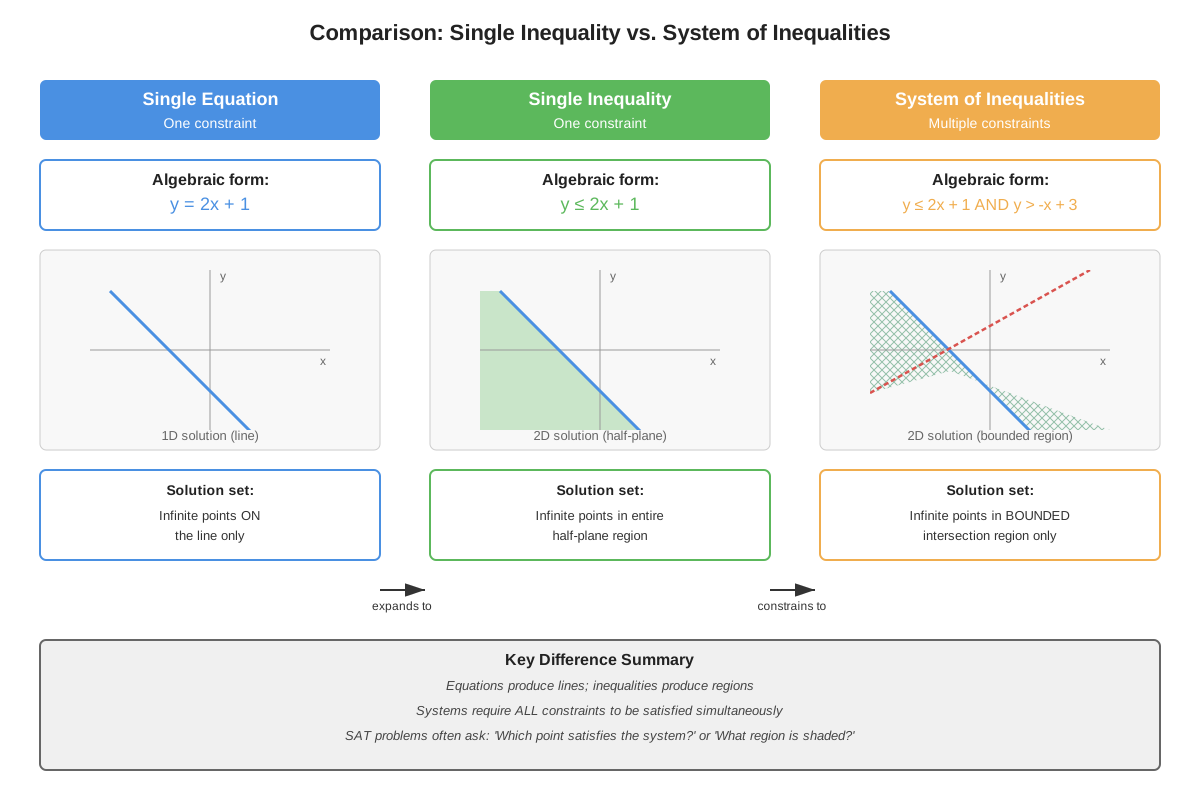
The concept of sat systems of inequalities extends naturally from linear equations and single inequalities. While a linear equation produces a line of solutions and a single inequality produces a half-plane region, a system of inequalities creates a bounded or unbounded region where all constraints overlap. This intersection of conditions mirrors real-world optimization problems—from budgeting scenarios with multiple constraints to geometric problems involving feasible regions. The SAT frequently embeds these systems within word problems, requiring students to translate verbal descriptions into mathematical inequalities before solving.
Understanding systems of inequalities strengthens broader mathematical reasoning skills essential for SAT success. This topic connects directly to coordinate geometry, linear functions, and algebraic manipulation while building toward more advanced concepts like linear programming. Students who master this material gain significant advantages in both the calculator and no-calculator sections, as these problems test multiple competencies simultaneously: graphing proficiency, algebraic translation, logical reasoning, and spatial visualization.
Learning Objectives
- [ ] Identify key features of systems of inequalities including solution regions, boundary lines, and constraint intersections
- [ ] Explain how systems of inequalities appears on the SAT through graphical representations, word problems, and coordinate plane scenarios
- [ ] Apply systems of inequalities to answer SAT-style questions involving feasible regions and constraint satisfaction
- [ ] Graph systems of inequalities accurately by determining boundary line types (solid vs. dashed) and shading appropriate regions
- [ ] Translate real-world scenarios into systems of inequalities and interpret solutions within context
- [ ] Determine whether specific coordinate points satisfy given systems of inequalities through substitution and verification
Prerequisites
- Linear equations and graphing: Understanding slope-intercept form and how to graph lines is fundamental since inequality boundaries are linear functions
- Single linear inequalities: Knowledge of inequality symbols (<, >, ≤, ≥) and how to shade regions above or below boundary lines provides the foundation for systems
- Coordinate plane navigation: Ability to plot points and identify coordinates is essential for verifying solutions and interpreting graphical representations
- Algebraic manipulation: Skills in isolating variables and rearranging equations enable students to convert inequalities into graphable forms
- Set theory basics: Understanding intersection concepts helps visualize how multiple constraint regions overlap to create solution sets
Why This Topic Matters
Systems of inequalities model countless real-world situations where multiple constraints must be satisfied simultaneously. Budget planning requires balancing income against various expenses, manufacturing processes must optimize production within resource limitations, and dietary planning involves meeting nutritional requirements while staying within caloric bounds. These practical applications make systems of inequalities one of the most applicable mathematical concepts students encounter, extending far beyond the classroom into careers in business, engineering, economics, and data science.
On the SAT, systems of inequalities questions appear with notable frequency and variety. Approximately 8-12% of math questions involve inequality concepts, with systems representing roughly one-third of these. The College Board consistently includes 2-4 questions per test that directly assess systems of inequalities, appearing in both multiple-choice and student-produced response formats. These questions typically fall into the "Problem Solving and Data Analysis" or "Heart of Algebra" content domains, carrying significant weight in overall math scores.
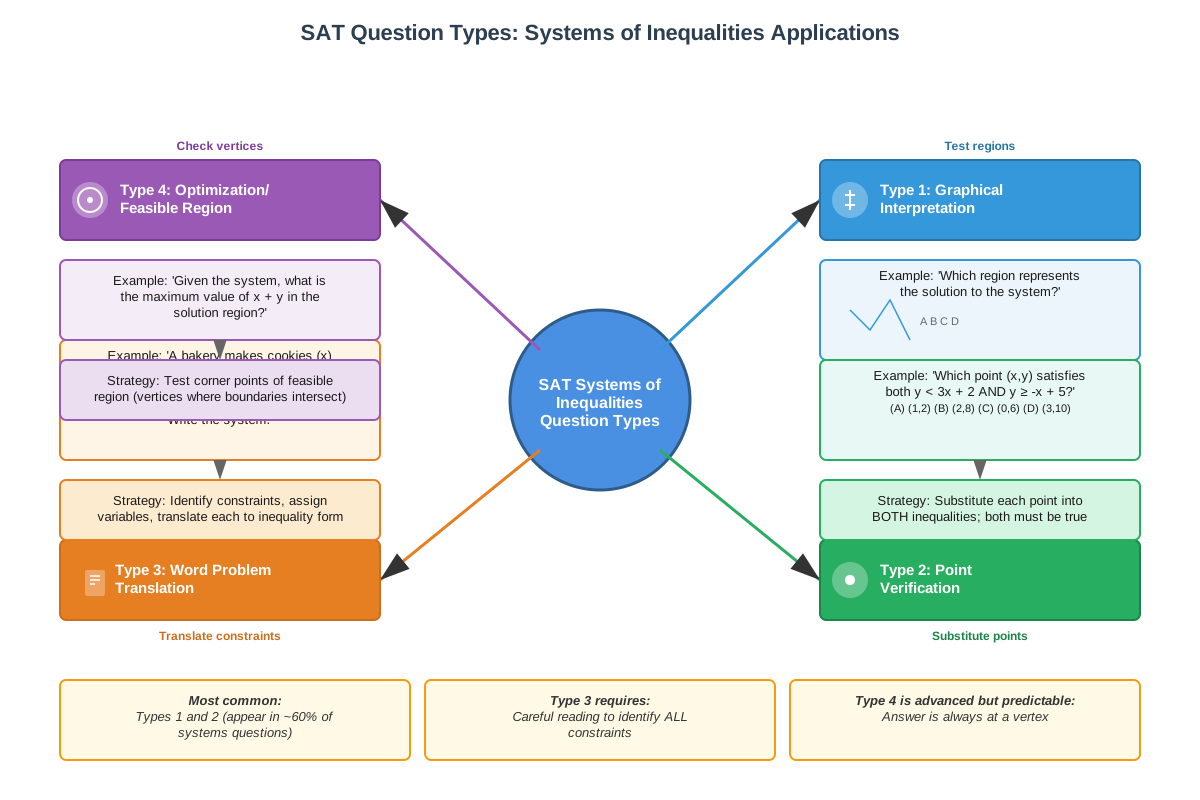
The SAT presents systems of inequalities through several common formats: graphical interpretation questions showing shaded regions with students identifying the correct system; word problems describing constraints that must be translated into inequalities; coordinate geometry problems asking whether specific points satisfy given systems; and optimization scenarios requiring students to find maximum or minimum values within feasible regions. Recognition of these patterns enables strategic preparation and confident test-day performance.
Core Concepts
Definition and Components
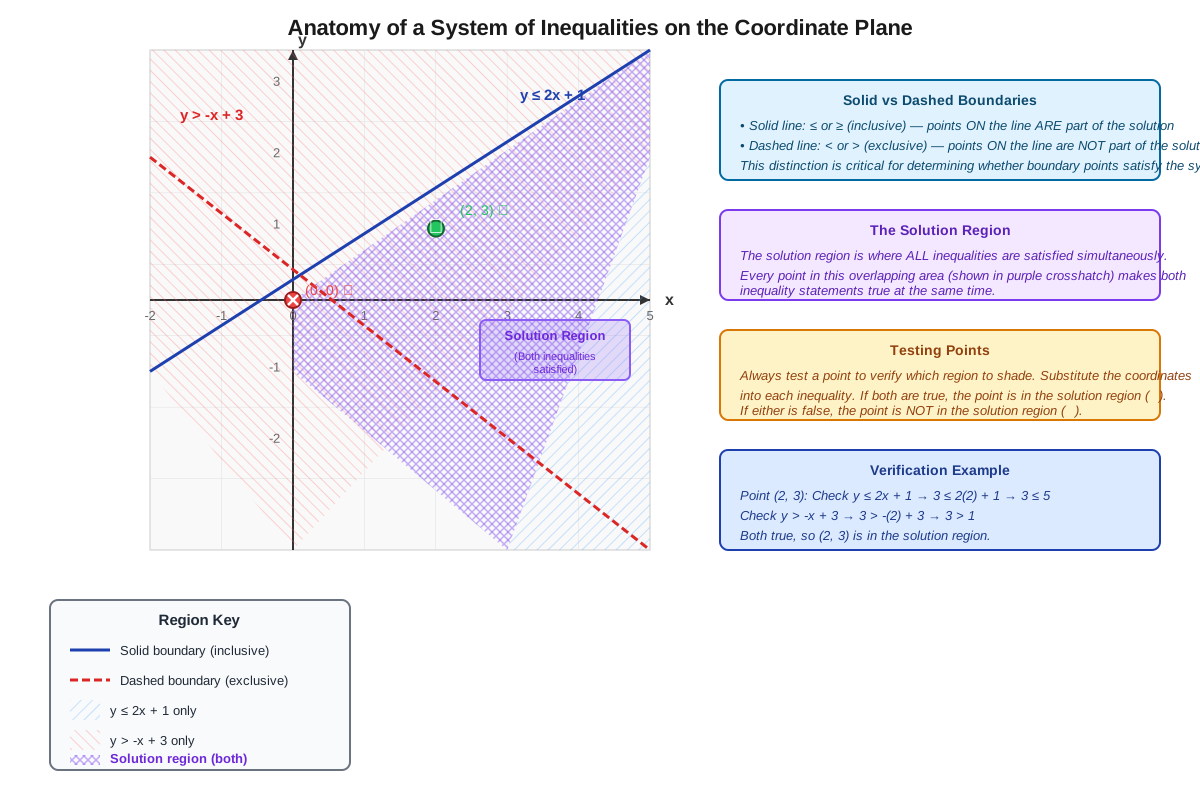
A system of inequalities consists of two or more inequalities considered simultaneously, where solutions must satisfy every inequality in the system. Each inequality in the system represents a constraint that divides the coordinate plane into regions. The solution set to the system is the intersection of all individual solution regions—the area where all constraints overlap.
Each inequality within a system has three critical components:
- Boundary line: The linear equation formed by replacing the inequality symbol with an equals sign
- Boundary type: Solid lines (for ≤ or ≥) include points on the line in the solution; dashed lines (for < or >) exclude boundary points
- Solution region: The half-plane above or below the boundary line where the inequality is true
Graphing Systems of Inequalities
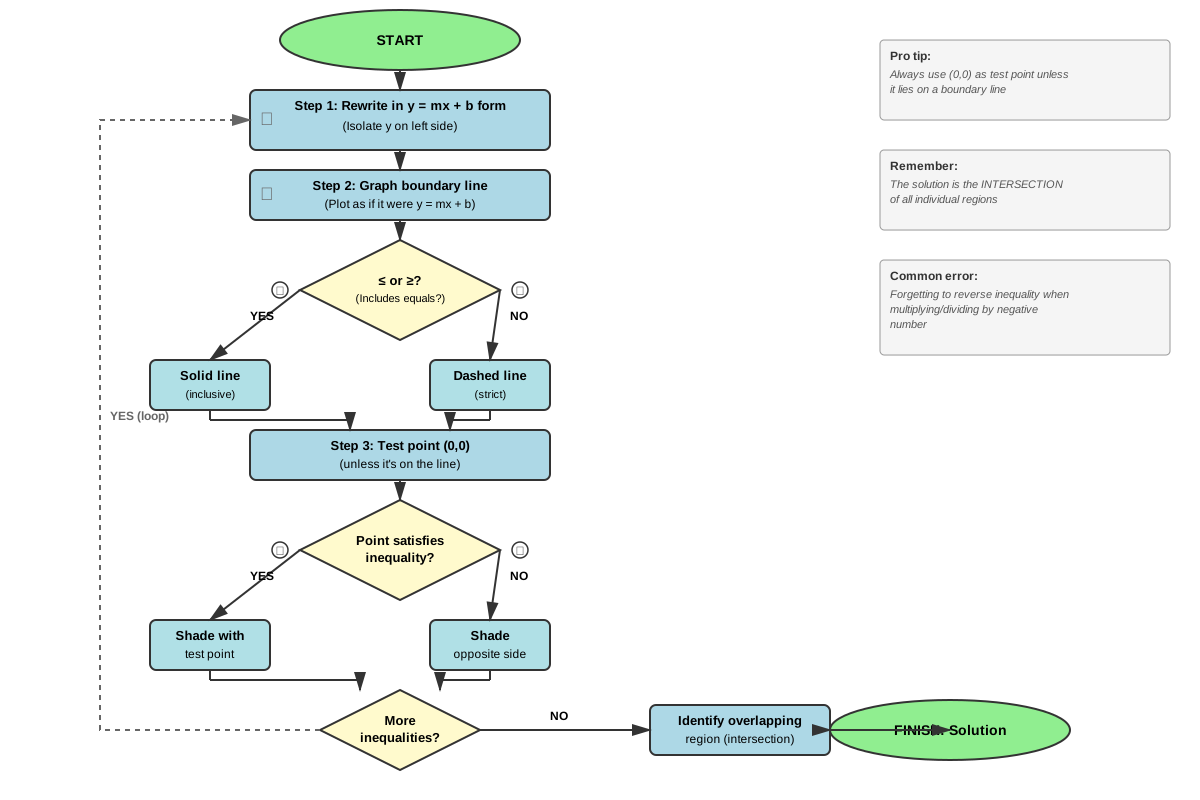
The systematic process for graphing systems of inequalities involves five essential steps:
- Convert each inequality to slope-intercept form (y = mx + b or y < mx + b, etc.) when possible
- Graph each boundary line using appropriate line type (solid or dashed)
- Shade the solution region for each individual inequality
- Identify the overlap region where all shadings intersect
- Verify the solution by testing a point within the overlapping region
When graphing, the inequality symbol determines shading direction:
- y > mx + b or y ≥ mx + b: Shade above the line
- y < mx + b or y ≤ mx + b: Shade below the line
- x > c or x ≥ c: Shade to the right of the vertical line
- x < c or x ≤ c: Shade to the left of the vertical line
Solution Regions and Feasible Sets
The solution region or feasible region represents all coordinate pairs (x, y) that simultaneously satisfy every inequality in the system. This region may be:
- Bounded: Enclosed on all sides, forming a polygon (triangle, quadrilateral, etc.)
- Unbounded: Extending infinitely in one or more directions
- Empty: No points satisfy all constraints simultaneously (inconsistent system)
- The entire plane: All points satisfy all constraints (rare on SAT)
| Region Type | Characteristics | SAT Frequency |
|---|---|---|
| Bounded polygon | Finite area, clear vertices | High |
| Unbounded region | Extends infinitely, one or more open sides | Medium |
| Empty set | No overlap between constraints | Low |
| Single line/point | Degenerate case, minimal solution | Very Low |
Testing Points in Systems
To verify whether a specific point satisfies a system of inequalities, substitute the coordinates into each inequality. The point is a solution only if it makes all inequalities true. This technique serves multiple purposes on the SAT:
- Verifying graphical solutions
- Eliminating incorrect answer choices
- Checking work after algebraic manipulation
- Identifying boundary points versus interior points
The test point method also helps determine which side of a boundary line to shade. The origin (0, 0) serves as an excellent test point unless a boundary line passes through it. If substituting (0, 0) makes the inequality true, shade the region containing the origin; otherwise, shade the opposite side.
Translating Word Problems
SAT questions frequently present systems of inequalities within real-world contexts requiring translation from verbal descriptions to mathematical notation. Key translation patterns include:
- "At least" → ≥
- "At most" → ≤
- "More than" → >
- "Less than" → <
- "No more than" / "Maximum" → ≤
- "No less than" / "Minimum" → ≥
- "Between" → Two inequalities forming bounds
When translating, identify:
- Variables: What quantities are unknown?
- Constraints: What limitations exist?
- Relationships: How do quantities relate mathematically?
Special Cases and Boundary Conditions
Several special configurations appear regularly on the SAT:
Parallel boundaries: When inequalities have the same slope, their boundary lines never intersect. The system may have no solution (if shading regions don't overlap) or a strip-shaped solution region (if regions overlap between parallel lines).
Perpendicular boundaries: Create four distinct regions around their intersection point, with the solution typically occupying one quadrant formed by the boundaries.
Vertical and horizontal boundaries: Inequalities like x ≥ 2 or y < -3 create rectangular solution regions when combined, simplifying visualization and calculation.
Concept Relationships
Systems of inequalities build directly upon single linear inequalities, which themselves extend from linear equations. The progression follows: linear equations → produce single lines → linear inequalities → produce half-plane regions → systems of inequalities → produce intersection regions. This hierarchical relationship means mastery of earlier concepts is essential for success with systems.
Within the topic itself, concepts interconnect systematically: boundary lines determine the edges of solution regions, while inequality symbols dictate both boundary types (solid vs. dashed) and shading direction. The test point method verifies both individual inequality solutions and system solutions, connecting algebraic and graphical representations. Translation skills bridge word problems to algebraic systems, which then connect to graphical representations through the graphing process.
Systems of inequalities also connect forward to optimization problems and linear programming, where students find maximum or minimum values within feasible regions. The vertices of bounded solution regions become critical points for optimization, linking this topic to coordinate geometry and function evaluation. Additionally, systems of inequalities relate to absolute value inequalities, which can be rewritten as systems, and to quadratic inequalities, which extend the concept beyond linear boundaries.
High-Yield Facts
⭐ The solution to a system of inequalities is the intersection (overlap) of all individual solution regions, not their union.
⭐ Boundary lines are solid for ≤ and ≥ (inclusive), dashed for < and > (exclusive).
⭐ To shade correctly: y > expression means shade above; y < expression means shade below.
⭐ A point satisfies a system only if it satisfies every single inequality in the system.
⭐ The origin (0, 0) is the best test point unless a boundary line passes through it.
- Systems with parallel boundary lines either have no solution or a strip-shaped solution region.
- Bounded solution regions on the SAT typically form triangles or quadrilaterals.
- When translating "at least" or "minimum," use ≥; for "at most" or "maximum," use ≤.
- Vertical lines (x = c) and horizontal lines (y = c) create rectangular solution regions when combined.
- If all test points fail, the system may be inconsistent (no solution) or the shading may be reversed.
- The number of boundary lines equals the number of inequalities in the system.
- Corner points (vertices) of bounded regions are found where boundary lines intersect.
- Substituting a point's coordinates into an inequality produces a true or false statement, never an equation to solve.
Quick check — test yourself on Systems of inequalities so far.
Try Flashcards →Common Misconceptions
Misconception: The solution to a system of inequalities includes all regions that satisfy at least one inequality. → Correction: The solution includes only the region where ALL inequalities are satisfied simultaneously. It's an intersection (AND condition), not a union (OR condition).
Misconception: Boundary lines are always solid in systems of inequalities. → Correction: Boundary line type depends on the inequality symbol. Use solid lines for ≤ and ≥ (points on the line are included), and dashed lines for < and > (points on the line are excluded).
Misconception: When graphing y < 2x + 3, shade above the line because the inequality points upward. → Correction: The inequality symbol's direction relates to the y-value, not visual direction. For y < expression, shade below the line where y-values are smaller; for y > expression, shade above where y-values are larger.
Misconception: If a point lies on a boundary line, it always satisfies the system. → Correction: Points on boundary lines satisfy the system only if the boundary is solid (≤ or ≥). If the boundary is dashed (< or >), points on the line are explicitly excluded from the solution set.
Misconception: Testing one point is sufficient to verify the solution region for a system. → Correction: While testing one point can verify a region, it's safest to test a point clearly within the suspected solution region, away from boundaries. Testing multiple points or using the test point method for each inequality separately provides greater certainty.
Misconception: Systems of inequalities always have solutions. → Correction: Some systems are inconsistent, meaning no points satisfy all constraints simultaneously. This occurs when constraint regions don't overlap, resulting in an empty solution set.
Worked Examples
Example 1: Graphing and Identifying Solution Regions
Problem: Graph the system of inequalities and identify which of the following points lies in the solution region:
y ≥ -x + 4
y < 2x - 1
Points to test: A) (2, 3), B) (3, 2), C) (4, 1), D) (1, 4)
Solution:
Step 1: Graph the first inequality y ≥ -x + 4
- Boundary line: y = -x + 4 (slope = -1, y-intercept = 4)
- Line type: Solid (because of ≥)
- Shading: Above the line (because y ≥)
Step 2: Graph the second inequality y < 2x - 1
- Boundary line: y = 2x - 1 (slope = 2, y-intercept = -1)
- Line type: Dashed (because of <)
- Shading: Below the line (because y <)
Step 3: Identify the overlap region
The solution region is where both shadings overlap—above the first line AND below the second line. This creates a bounded region between the two lines.
Step 4: Test each point by substituting into both inequalities
Point A (2, 3):
- First inequality: 3 ≥ -(2) + 4 → 3 ≥ 2 ✓ True
- Second inequality: 3 < 2(2) - 1 → 3 < 3 ✗ False
- Not a solution (fails second inequality)
Point B (3, 2):
- First inequality: 2 ≥ -(3) + 4 → 2 ≥ 1 ✓ True
- Second inequality: 2 < 2(3) - 1 → 2 < 5 ✓ True
- This is a solution (satisfies both inequalities)
Point C (4, 1):
- First inequality: 1 ≥ -(4) + 4 → 1 ≥ 0 ✓ True
- Second inequality: 1 < 2(4) - 1 → 1 < 7 ✓ True
- This is also a solution
Point D (1, 4):
- First inequality: 4 ≥ -(1) + 4 → 4 ≥ 3 ✓ True
- Second inequality: 4 < 2(1) - 1 → 4 < 1 ✗ False
- Not a solution (fails second inequality)
Answer: Points B and C lie in the solution region. This example demonstrates the critical importance of testing points in ALL inequalities and understanding that the solution region is the intersection of individual constraint regions.
Example 2: Translating and Solving a Word Problem
Problem: A student has $50 to spend on notebooks and pens. Notebooks cost $5 each and pens cost $2 each. The student needs at least 3 notebooks and wants to buy at least 8 items total. Write a system of inequalities representing this situation and determine whether buying 4 notebooks and 6 pens satisfies all constraints.
Solution:
Step 1: Define variables
- Let n = number of notebooks
- Let p = number of pens
Step 2: Translate each constraint into an inequality
Budget constraint: Total cost cannot exceed $50
- 5n + 2p ≤ 50
Minimum notebooks: At least 3 notebooks needed
- n ≥ 3
Minimum total items: At least 8 items total
- n + p ≥ 8
Non-negativity constraints: Cannot buy negative quantities
- n ≥ 0 and p ≥ 0 (though n ≥ 3 already ensures n ≥ 0)
Step 3: Write the complete system
5n + 2p ≤ 50
n ≥ 3
n + p ≥ 8
p ≥ 0
Step 4: Test whether (n, p) = (4, 6) satisfies all constraints
Budget constraint: 5(4) + 2(6) ≤ 50 → 20 + 12 ≤ 50 → 32 ≤ 50 ✓ True
Minimum notebooks: 4 ≥ 3 ✓ True
Minimum total items: 4 + 6 ≥ 8 → 10 ≥ 8 ✓ True
Non-negativity: 6 ≥ 0 ✓ True
Answer: Yes, buying 4 notebooks and 6 pens satisfies all constraints. The student would spend $32, have more than the minimum notebooks, and purchase 10 items total. This example illustrates how real-world constraints translate into systems of inequalities and how to verify solutions within context, addressing the learning objective of applying systems to SAT-style questions.
Exam Strategy
When approaching SAT systems of inequalities questions, begin by identifying the question type: graphical interpretation, algebraic verification, or word problem translation. For graphical questions, immediately note boundary line types (solid vs. dashed) and shading patterns. The solution region is always where shadings overlap, never where they're separate. If answer choices show different systems, eliminate options with incorrect boundary types first—this often removes 2-3 choices immediately.
Trigger words and phrases signal specific mathematical translations:
- "At least," "minimum," "no fewer than" → ≥
- "At most," "maximum," "no more than" → ≤
- "Exceeds," "more than," "greater than" → >
- "Below," "less than," "under" → <
- "Between" → Two inequalities creating bounds
- "Combined," "total," "altogether" → Addition in the inequality
For process-of-elimination strategies, use the test point method aggressively. When answer choices present different systems, test the same point (preferably the origin if possible) in each system. Eliminate any system that produces inconsistent results with the given information. If a question shows a graph and asks for the system, test a point clearly inside the shaded region—it must satisfy all inequalities in the correct answer. Then test a point clearly outside the shaded region—it must fail at least one inequality in the correct answer.
Time allocation for systems of inequalities questions should follow this pattern: spend 30-45 seconds reading and identifying the question type, 60-90 seconds on the primary solution method (graphing, translating, or testing), and reserve 15-30 seconds for verification. If a question requires graphing from scratch, consider whether testing answer choices might be faster than complete graphing. On the SAT, efficiency often trumps thoroughness—a correct answer obtained through strategic testing is worth the same as one obtained through complete graphing.
When stuck, remember that systems of inequalities questions often have visual or logical shortcuts. If two answer choices differ by only one inequality symbol, test a boundary point to determine which symbol is correct. If a word problem seems complex, list all constraints separately before combining them into a system. Breaking complex problems into smaller steps prevents errors and builds confidence.
Memory Techniques
SOLID mnemonic for boundary lines:
- Solid lines for
- Or-equal-to symbols (≤ and ≥)
- Lines that
- Include
- Dots (points on the boundary)
SHADE process for graphing:
- Simplify each inequality to slope-intercept form
- Hatch the boundary line (solid or dashed)
- Above or below? Determine shading direction
- Draw all inequalities on the same graph
- Encircle the overlap region (the solution)
ALL-AND rule for solutions: A point is a solution if it satisfies ALL inequalities, meaning it's in the region where AND connects all constraints. This distinguishes systems (intersection/AND) from compound inequalities with OR conditions (union).
Visualization strategy: Picture systems of inequalities as fences creating an enclosed area. Each inequality is one fence, and the solution region is the "yard" where all fences overlap. Solid fences include their boundary (you can stand on the fence), while dashed fences exclude it (you can't stand on the fence itself).
Symbol direction memory aid: The inequality symbol "points" toward the smaller value. In y < 2x + 3, the symbol points toward y, meaning y is smaller than 2x + 3, so shade where y-values are smaller (below the line). In y > -x + 5, the symbol opens toward y, meaning y is larger, so shade where y-values are larger (above the line).
Summary
Systems of inequalities represent multiple constraints that must be satisfied simultaneously, creating solution regions where all individual inequality regions overlap. Mastery requires three interconnected skills: graphing inequalities with appropriate boundary types and shading, testing points to verify solutions algebraically, and translating real-world scenarios into mathematical systems. The SAT tests these skills through graphical interpretation questions, algebraic verification problems, and contextual word problems. Success depends on understanding that solutions must satisfy every inequality in the system (intersection, not union), recognizing that boundary line types depend on inequality symbols (solid for ≤ and ≥, dashed for < and >), and applying systematic approaches to both graphing and testing. The most efficient test-taking strategy combines visual pattern recognition with strategic point testing, allowing students to eliminate incorrect answers quickly while verifying correct solutions confidently. Students who internalize the relationship between algebraic and graphical representations, practice translating verbal constraints into mathematical notation, and develop fluency with the test point method will consistently succeed on SAT systems of inequalities questions.
Key Takeaways
- The solution to a system of inequalities is the intersection (overlap) of all individual solution regions where every constraint is satisfied simultaneously
- Boundary lines are solid for ≤ and ≥ (inclusive inequalities) and dashed for < and > (exclusive inequalities)
- Shade above the boundary line for y > or y ≥ expressions; shade below for y < or y ≤ expressions
- Test points by substituting coordinates into every inequality—a point is a solution only if it makes all inequalities true
- Translate word problems systematically: identify variables, extract constraints, convert verbal phrases to inequality symbols, then verify solutions in context
- Use the origin (0, 0) as a test point unless a boundary line passes through it, making it the most efficient verification strategy
- SAT questions favor bounded polygonal solution regions and frequently test the ability to match graphs with algebraic systems or translate real-world constraints
Related Topics
Linear Programming and Optimization: Building on systems of inequalities, linear programming finds maximum or minimum values of objective functions within feasible regions, using vertices of bounded solution regions as critical points for evaluation.
Absolute Value Inequalities: These can be rewritten as systems of linear inequalities, connecting algebraic manipulation skills with systems concepts and extending solution techniques to more complex constraint types.
Quadratic Inequalities: Extending beyond linear boundaries, quadratic inequalities create parabolic boundaries and curved solution regions, requiring similar graphing and testing strategies with added complexity.
Piecewise Functions: Understanding how different rules apply in different regions of the coordinate plane connects to how systems of inequalities partition the plane into distinct solution and non-solution regions.
Matrix Methods for Systems: Advanced techniques for solving systems of equations extend to inequality systems in higher mathematics, making this topic foundational for linear algebra and optimization theory.
Practice CTA
Now that you've mastered the core concepts of systems of inequalities, it's time to solidify your understanding through active practice. Challenge yourself with the practice questions designed specifically to mirror SAT question formats and difficulty levels. Use the flashcards to reinforce key definitions, translation patterns, and graphing procedures until they become automatic. Remember: systems of inequalities questions are high-yield on the SAT, and every practice problem you complete builds the pattern recognition and problem-solving speed that translates directly into test-day points. Your investment in deliberate practice now will pay dividends when you encounter these questions under timed conditions. Start practicing—you've got this!
Sign up free to keep reading
Create a free AnvayaPrep account to finish this SAT guide on Systems of inequalities — plus flashcards and practice questions.