Overview
Mixture rational equations are a specialized category of rational equations that model real-world scenarios involving the combination of two or more substances with different concentrations, rates, or properties. These equations appear regularly on the SAT math section and require students to translate word problems into algebraic expressions involving fractions and rational expressions. Unlike simple linear equations, mixture problems demand careful attention to units, proportions, and the relationship between parts and wholes.
On the SAT, mixture rational equations typically appear as word problems involving solutions with different concentrations (such as acid solutions or salt water), rates of work, or average rates of speed. These problems test not only algebraic manipulation skills but also logical reasoning and the ability to set up equations from verbal descriptions. Students must identify what quantity remains constant throughout the mixing process and use that invariant to construct their equation. The rational component enters when dealing with concentrations (amount of substance divided by total volume) or rates (work completed divided by time).
Mastering sat mixture rational equations is essential because these problems integrate multiple mathematical skills: translating word problems into equations, working with rational expressions, solving for unknown variables, and verifying that solutions make sense in context. This topic connects directly to proportional reasoning, systems of equations, and rate problems—all high-yield areas on the SAT. Furthermore, mixture problems frequently appear in the calculator-permitted section, where students can verify their algebraic work numerically, making them excellent opportunities to earn points through multiple solution strategies.
Learning Objectives
- [ ] Identify key features of mixture rational equations
- [ ] Explain how mixture rational equations appears on the SAT
- [ ] Apply mixture rational equations to answer SAT-style questions
- [ ] Construct rational equations from word problems involving mixtures of different concentrations
- [ ] Determine which quantity remains constant in a mixture problem and use it to set up equations
- [ ] Solve mixture rational equations using cross-multiplication and algebraic manipulation
- [ ] Verify solutions by checking whether they satisfy the original problem constraints and make physical sense
Prerequisites
- Linear equations and solving for variables: Mixture problems ultimately reduce to equations that must be solved algebraically
- Rational expressions and operations: Understanding how to add, subtract, and simplify fractions with variables is essential
- Proportional reasoning: Mixture problems rely on understanding ratios and how they change when quantities are combined
- Unit analysis: Tracking units (liters, grams, percentages) prevents setup errors and helps verify answers
- Word problem translation: Converting verbal descriptions into mathematical expressions is the critical first step
Why This Topic Matters
Mixture rational equations represent one of the most practical applications of algebra that students encounter on the SAT. In real-world contexts, professionals in chemistry, pharmacology, environmental science, and manufacturing regularly solve mixture problems to achieve desired concentrations or properties. Understanding these equations develops critical thinking skills about how quantities interact when combined and how to work backward from a desired outcome to determine necessary inputs.
On the SAT, mixture problems appear with moderate frequency—typically 1-2 questions per test—but they are considered high-yield because they can be solved reliably with proper setup and practice. These questions most commonly appear in the calculator-permitted section and are worth the same points as simpler questions, making them excellent targets for score improvement. The College Board favors mixture problems because they assess multiple competencies simultaneously: reading comprehension, mathematical modeling, algebraic manipulation, and logical reasoning.
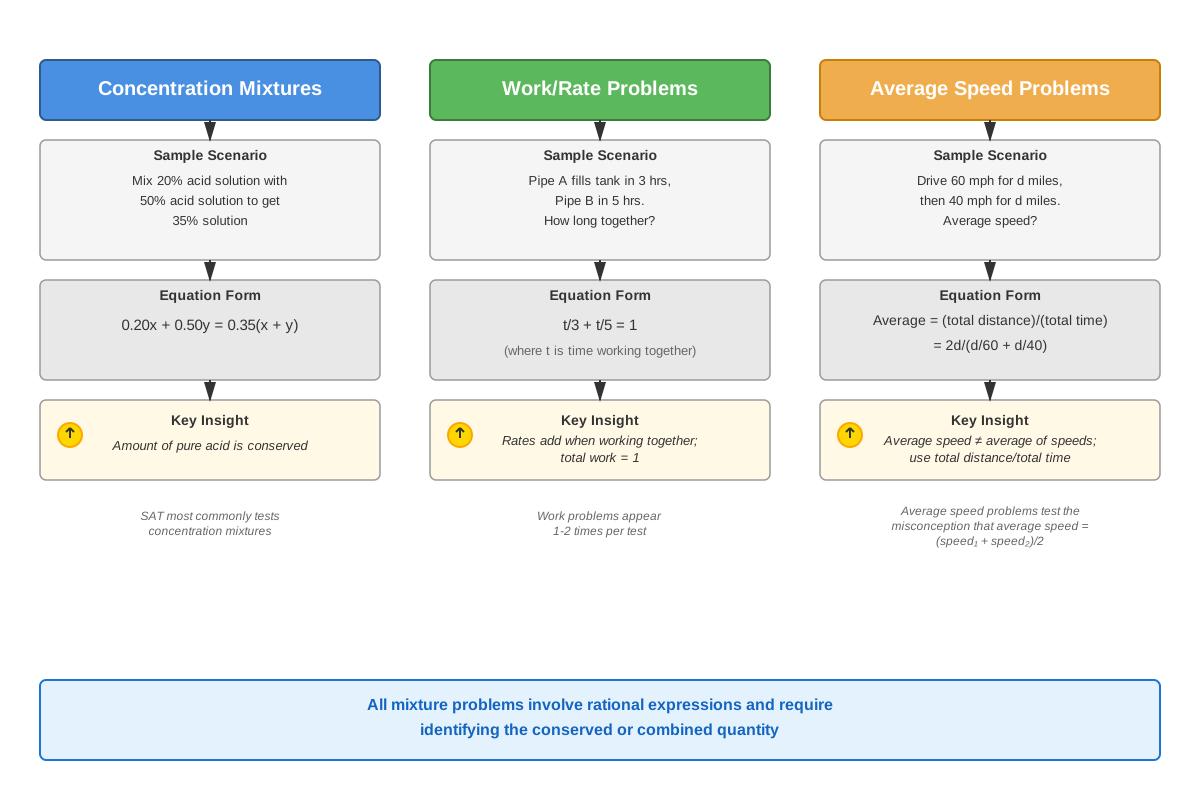
Mixture rational equations typically appear in three main formats on the SAT: concentration problems (mixing solutions with different percentages of a substance), rate problems (combining work rates or travel rates), and weighted average problems (finding average speeds or prices). The rational equation structure emerges because concentrations are ratios (solute/solution), rates are ratios (work/time or distance/time), and weighted averages involve ratios of totals. Recognizing these patterns allows students to quickly identify the problem type and apply the appropriate solution strategy.
Core Concepts
Understanding Mixture Problems
A mixture rational equation is an equation involving fractions where the numerators and denominators represent quantities that are combined or mixed. The fundamental principle underlying all mixture problems is the conservation principle: when two or more substances are mixed, certain quantities (like the total amount of pure substance) remain conserved even though concentrations or ratios may change.
The general structure of a mixture problem involves:
- Two or more initial substances with known properties (concentration, rate, or value)
- A mixing or combining process
- A final mixture with a desired or resulting property
- An unknown quantity that must be determined
The Concentration Mixture Model
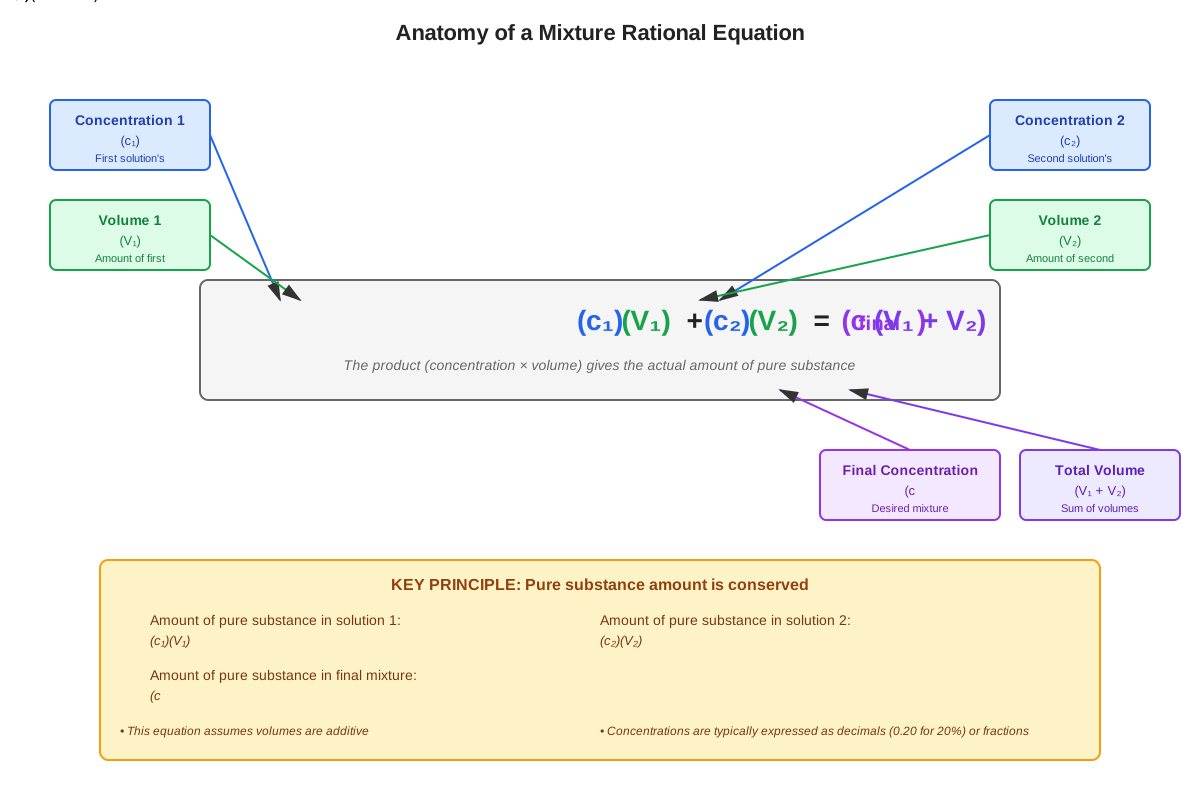
The most common type of mixture problem on the SAT involves concentration—the ratio of a pure substance to the total solution. The key equation for concentration problems is:
(Concentration₁)(Volume₁) + (Concentration₂)(Volume₂) = (Concentration_final)(Volume_final)This equation expresses the conservation of the pure substance: the total amount of pure substance before mixing equals the total amount after mixing. Each term represents the amount of pure substance in a particular solution.
For example, if mixing x liters of 20% acid solution with y liters of 50% acid solution to create a 35% acid solution:
- Amount of pure acid from first solution: 0.20x
- Amount of pure acid from second solution: 0.50y
- Amount of pure acid in final solution: 0.35(x + y)
- Conservation equation: 0.20x + 0.50y = 0.35(x + y)
Setting Up Mixture Equations
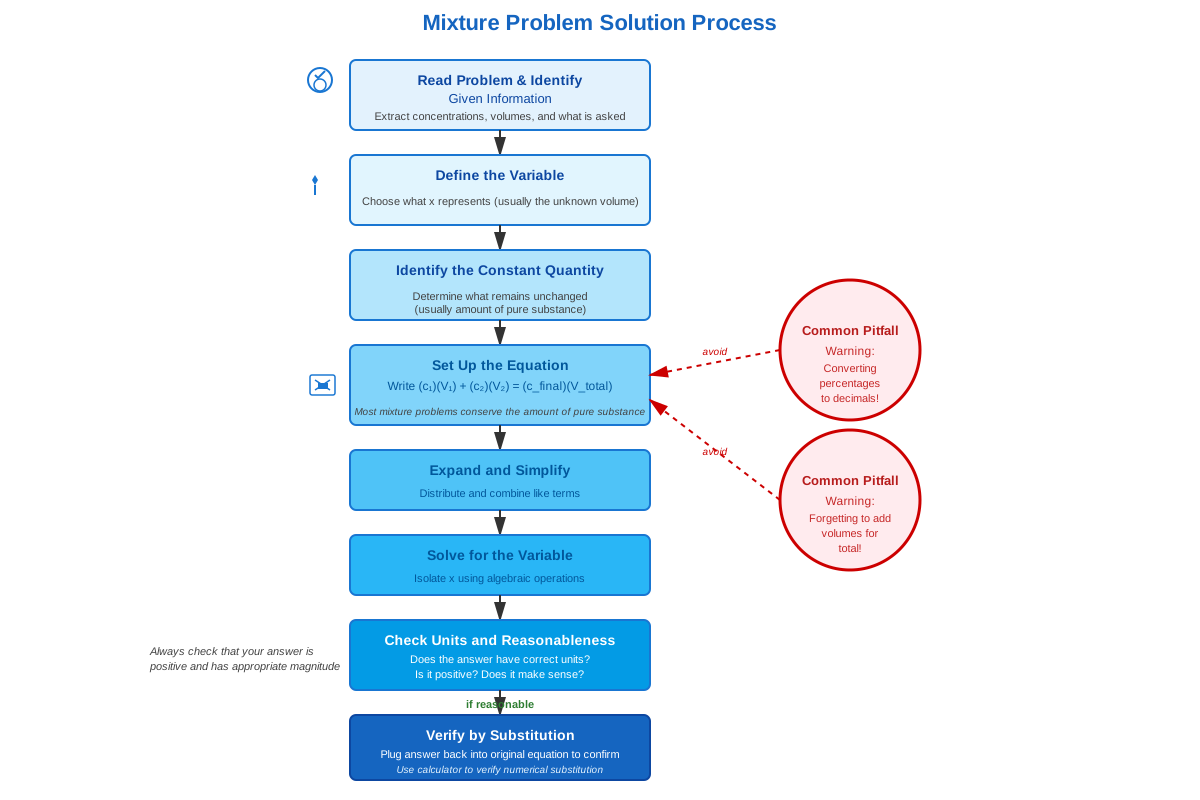
The systematic approach to setting up mixture rational equations involves five steps:
- Identify the conserved quantity: What remains constant throughout the mixing process? (pure acid, pure salt, total work, total distance)
- Define variables: Assign variables to unknown quantities (usually volumes, masses, or times)
- Express concentrations or rates: Write each concentration as a decimal or fraction
- Write the conservation equation: Amount in first substance + Amount in second substance = Amount in final mixture
- Simplify and solve: Use algebraic techniques to isolate the variable
The Rational Equation Structure
Mixture problems become rational equations when the unknown appears in a denominator or when the problem involves rates. Consider a problem where you need to find what concentration of solution to add:
If adding x liters of pure acid (100% concentration) to 10 liters of 30% acid solution to create a 50% solution:
1.00x + 0.30(10) = 0.50(x + 10)This is a linear equation. However, if the question asks "what concentration c should be added," the equation becomes:
c·x + 0.30(10) = 0.50(x + 10)When solving for c, you get a rational expression: c = [0.50(x + 10) - 3]/x
Rate Mixture Problems
Rate problems involve combining different rates of work, travel, or production. The fundamental equation is:
Rate = Work/Time or Rate = Distance/TimeWhen two entities work together, their combined rate equals the sum of individual rates:
Rate₁ + Rate₂ = Combined RateFor example, if one pipe fills a tank in 4 hours (rate = 1/4 tank per hour) and another fills it in 6 hours (rate = 1/6 tank per hour), working together their combined rate is:
1/4 + 1/6 = 3/12 + 2/12 = 5/12 tank per hourTime to fill together: 1 tank ÷ (5/12 tank/hour) = 12/5 hours = 2.4 hours
Weighted Average Problems
Weighted averages appear when combining quantities with different values or rates. The weighted average formula is:
Weighted Average = (Value₁ × Quantity₁ + Value₂ × Quantity₂)/(Quantity₁ + Quantity₂)This becomes a rational equation when solving for an unknown quantity or value. For instance, finding how many pounds of $8/lb coffee to mix with 5 pounds of $12/lb coffee to create a mixture worth $10/lb:
(8x + 12(5))/(x + 5) = 10This is a rational equation because the variable appears in the denominator.
Solving Techniques
To solve mixture rational equations:
- Clear denominators: Multiply both sides by the least common denominator (LCD)
- Distribute and expand: Apply the distributive property to eliminate parentheses
- Collect like terms: Group all terms with the variable on one side
- Isolate the variable: Use inverse operations to solve
- Check the solution: Verify the answer makes sense in the original context
Common Equation Forms
| Problem Type | Typical Equation Structure | Key Variable |
|---|---|---|
| Concentration mixture | c₁V₁ + c₂V₂ = c_f(V₁ + V₂) | Volume to add |
| Work rate | 1/t₁ + 1/t₂ = 1/t_combined | Time to complete together |
| Average speed | d₁/r₁ + d₂/r₂ = total time | Speed or time |
| Value mixture | v₁q₁ + v₂q₂ = v_avg(q₁ + q₂) | Quantity to mix |
Concept Relationships
The concepts within mixture rational equations build upon each other in a logical progression. Conservation principles form the foundation → these lead to setting up equations that express what remains constant → these equations often contain rational expressions when rates or concentrations are involved → solving requires algebraic manipulation techniques → finally, verification ensures the solution makes physical sense.
Mixture rational equations connect to prerequisite topics in essential ways. Proportional reasoning provides the conceptual framework for understanding how concentrations and rates behave. Rational expressions supply the algebraic tools needed to manipulate fractions with variables. Linear equations represent the simplified form that mixture equations reduce to after clearing denominators.
This topic also connects forward to more advanced mathematical concepts. Mixture problems are simplified versions of systems of equations where multiple constraints must be satisfied simultaneously. They introduce the concept of optimization—finding the right combination to achieve a desired outcome. The rate problems within this topic directly prepare students for calculus concepts involving related rates and accumulation.
The relationship map: Proportional Reasoning → Concentration/Rate Definitions → Conservation Equations → Rational Equation Setup → Algebraic Solution → Contextual Verification → Application to Complex Scenarios
Quick check — test yourself on Mixture rational equations so far.
Try Flashcards →High-Yield Facts
⭐ The amount of pure substance is conserved: (concentration₁)(volume₁) + (concentration₂)(volume₂) = (concentration_final)(volume_final)
⭐ Convert percentages to decimals: 25% = 0.25, 8% = 0.08 before setting up equations
⭐ When working together, rates add: If pipe A fills at rate r₁ and pipe B at rate r₂, together they fill at rate r₁ + r₂
⭐ The final volume equals the sum of mixed volumes: V_final = V₁ + V₂ (unless otherwise stated)
⭐ Pure substance means 100% concentration: Use 1.00 or 100% when adding pure acid, pure water, etc.
- Water has 0% concentration of solute: Adding water dilutes a solution; use 0.00 for water's concentration
- Time to complete together: 1/t_together = 1/t₁ + 1/t₂ for work rate problems
- Cross-multiplication solves simple rational equations: If a/b = c/d, then ad = bc
- Check that solutions are positive and reasonable: Negative volumes or concentrations over 100% indicate setup errors
- Units must be consistent: Convert all volumes to the same unit (liters or milliliters) before calculating
- The variable often represents what you're adding: "How much should be added" means the variable is the amount added, not the final amount
- Weighted averages lie between the extremes: The final concentration must be between the two initial concentrations
Common Misconceptions
Misconception: The final concentration is the average of the two initial concentrations.
Correction: The final concentration is a weighted average that depends on the volumes mixed. If equal volumes are mixed, then it's the simple average, but if volumes differ, the final concentration is closer to the concentration of the larger volume.
Misconception: When adding pure substance (100% concentration), you can ignore it in the equation.
Correction: Pure substance must be included with concentration = 1.00. For example, adding x liters of pure acid contributes 1.00x liters of pure acid to the mixture.
Misconception: In work rate problems, if person A takes 3 hours and person B takes 5 hours, together they take 8 hours.
Correction: Rates add, not times. Person A works at rate 1/3 per hour, person B at 1/5 per hour, so together they work at rate 1/3 + 1/5 = 8/15 per hour, taking 15/8 = 1.875 hours total.
Misconception: The variable should represent the final amount.
Correction: Typically, the variable represents the unknown quantity being added or mixed. The final amount is then expressed as the sum of the initial amounts plus what's added.
Misconception: You can solve mixture problems by just setting concentrations equal.
Correction: You must multiply each concentration by its volume to get the amount of pure substance, then set up the conservation equation. Concentrations alone don't account for different volumes.
Misconception: Adding water to a solution increases the amount of pure substance.
Correction: Adding water (0% concentration) increases total volume but keeps the amount of pure substance constant, thereby decreasing the concentration. The equation is: (original concentration)(original volume) = (new concentration)(original volume + water added).
Worked Examples
Example 1: Concentration Mixture Problem
Problem: A chemist has 200 mL of a 15% acid solution. How many milliliters of a 40% acid solution must be added to create a 25% acid solution?
Solution:
Step 1: Identify the conserved quantity.
The amount of pure acid remains conserved throughout the mixing process.
Step 2: Define the variable.
Let x = milliliters of 40% solution to be added
Step 3: Set up the conservation equation.
- Pure acid in 15% solution: 0.15(200) = 30 mL
- Pure acid in 40% solution: 0.40(x) mL
- Pure acid in final 25% solution: 0.25(200 + x) mL
Conservation equation:
0.15(200) + 0.40x = 0.25(200 + x)Step 4: Solve algebraically.
30 + 0.40x = 50 + 0.25x
0.40x - 0.25x = 50 - 30
0.15x = 20
x = 20/0.15 = 133.33 mL
Step 5: Verify the solution.
- Pure acid from 15% solution: 30 mL
- Pure acid from 40% solution: 0.40(133.33) = 53.33 mL
- Total pure acid: 83.33 mL
- Total volume: 200 + 133.33 = 333.33 mL
- Final concentration: 83.33/333.33 = 0.25 = 25% ✓
Answer: 133.33 mL (or approximately 133 mL) of the 40% solution must be added.
This problem directly addresses the learning objective of applying mixture rational equations to SAT-style questions and demonstrates the key features of identifying conserved quantities and setting up proper equations.
Example 2: Work Rate Problem
Problem: Printer A can complete a job in 6 hours. Printer B can complete the same job in 4 hours. If both printers work together, how long will it take them to complete the job?
Solution:
Step 1: Identify the rates.
- Printer A's rate: 1 job / 6 hours = 1/6 job per hour
- Printer B's rate: 1 job / 4 hours = 1/4 job per hour
Step 2: Find the combined rate.
When working together, rates add:
Combined rate = 1/6 + 1/4Find common denominator (LCD = 12):
Combined rate = 2/12 + 3/12 = 5/12 job per hourStep 3: Calculate time to complete one job.
Time = Work / Rate = 1 job / (5/12 job per hour) = 1 × 12/5 = 12/5 hours = 2.4 hoursStep 4: Convert to mixed number or minutes if needed.
12/5 hours = 2 hours and 2/5 hour = 2 hours and 24 minutes
Step 5: Verify the solution.
- In 2.4 hours, Printer A completes: 2.4/6 = 0.4 = 2/5 of the job
- In 2.4 hours, Printer B completes: 2.4/4 = 0.6 = 3/5 of the job
- Total work completed: 2/5 + 3/5 = 5/5 = 1 complete job ✓
Answer: Working together, the printers will complete the job in 2.4 hours (or 2 hours 24 minutes).
This example demonstrates how mixture rational equations appear in rate contexts on the SAT and shows the importance of understanding that rates combine additively.
Exam Strategy
When approaching mixture rational equations on the SAT, begin by carefully reading the problem to identify what type of mixture is involved: concentration, rate, or weighted average. Look for trigger words such as "solution," "concentration," "percent," "mixture," "combined," "together," "average rate," or "working simultaneously." These signal that you're dealing with a mixture problem.
The most efficient strategy is to create a table or chart organizing the given information. For concentration problems, create columns for: substance, concentration, volume, and amount of pure substance. For rate problems, use: entity, rate, time, and work completed. This visual organization prevents setup errors and makes the conservation equation obvious.
Exam Tip: Always define your variable clearly before setting up the equation. Write "Let x = ..." explicitly. This prevents confusion about whether x represents the amount added, the final amount, or something else entirely.
Process of elimination works well on multiple-choice mixture problems. After solving, check whether your answer makes physical sense: concentrations must be between 0% and 100%, times must be positive, and final mixtures should have properties between the initial values. Eliminate any answer choices that violate these constraints before calculating.
For time management, allocate 2-3 minutes for mixture problems. If you're stuck after 90 seconds, mark the question and return to it later. These problems reward careful setup more than computational speed, so rushing leads to errors. Use the calculator section strategically—you can verify your algebraic solution by substituting your answer back into the original equation.
Watch for trap answers that represent common errors: the sum of times instead of the reciprocal sum for rate problems, the simple average instead of weighted average for concentration problems, or the amount added instead of the final total. The SAT deliberately includes these as wrong answer choices.
Memory Techniques
CAVE mnemonic for setting up concentration problems:
- Concentration times volume equals
- Amount of pure substance
- Volumes add to give final volume
- Equation: C₁V₁ + C₂V₂ = C_f(V₁ + V₂)
"Rates Add, Times Don't" for work problems: When entities work together, add their rates (1/t₁ + 1/t₂), never add their individual times.
The "Pure Substance" visualization: Imagine physically separating the pure substance (acid, salt, etc.) from each solution and pouring it into a single container. The total amount in that container equals the pure substance in the final mixture. This mental image reinforces the conservation principle.
"Between the Bounds" rule: The final concentration, rate, or value must always fall between the two initial values (unless adding pure substance or pure solvent). If your answer violates this, you've made an error.
Percentage-Decimal conversion finger trick: To convert percentage to decimal, "move the decimal point two fingers to the left." 25% → 0.25, 8% → 0.08. This prevents the common error of using 25 instead of 0.25 in equations.
Summary
Mixture rational equations represent a high-yield SAT topic that integrates algebraic manipulation with real-world problem-solving. These equations model situations where substances with different concentrations, rates, or values are combined to produce a mixture with specific properties. The fundamental principle underlying all mixture problems is conservation: the total amount of pure substance, total work, or total value remains constant throughout the mixing process. Success on SAT mixture problems requires three key skills: translating word problems into mathematical equations, recognizing which quantity is conserved, and solving rational equations through algebraic manipulation. The most common types are concentration mixtures (combining solutions with different percentages), work rate problems (entities working together), and weighted averages (combining items with different values). Students must convert percentages to decimals, ensure unit consistency, and verify that solutions make physical sense. By systematically organizing information, setting up conservation equations, and checking answers against reasonable bounds, students can reliably solve these problems and earn valuable points on the SAT.
Key Takeaways
- Mixture rational equations are based on conservation: the amount of pure substance before mixing equals the amount after mixing
- The fundamental equation structure is: (concentration₁)(volume₁) + (concentration₂)(volume₂) = (concentration_final)(volume_final)
- For work rate problems, rates add when working together: 1/t₁ + 1/t₂ = 1/t_combined
- Always convert percentages to decimals (25% = 0.25) before setting up equations
- The final concentration or value must lie between the two initial values (unless adding pure substance)
- Organize information in a table before writing equations to prevent setup errors
- Verify solutions by checking that they satisfy the original equation and make physical sense (positive values, reasonable concentrations)
Related Topics
Systems of Equations: Mixture problems with multiple unknowns or constraints extend naturally into systems of equations, where two or more equations must be solved simultaneously. Mastering mixture rational equations provides the foundation for understanding how multiple relationships interact.
Proportional Relationships and Direct Variation: The concept of concentration as a ratio connects directly to proportional reasoning. Understanding how ratios scale when quantities change is essential for both mixture problems and broader SAT algebra topics.
Rational Functions and Their Graphs: While mixture equations are typically solved algebraically, understanding rational functions helps visualize how concentration or rate changes as variables change, particularly useful for optimization problems.
Rate-Time-Distance Problems: Work rate mixture problems are structurally identical to combined motion problems where two objects travel at different speeds. The same mathematical framework applies to both contexts.
Weighted Averages and Statistics: Mixture problems involving value or price connect to statistical concepts of weighted means, preparing students for data analysis questions on the SAT.
Practice CTA
Now that you've mastered the core concepts of mixture rational equations, it's time to solidify your understanding through practice. Attempt the practice questions designed specifically for this topic—they mirror actual SAT question formats and difficulty levels. Work through each problem systematically, using the strategies and techniques outlined in this guide. Don't just check your answers; analyze your problem-solving process to identify where you excel and where you need additional practice. Use the flashcards to reinforce key formulas, trigger words, and common pitfalls. Remember: mixture problems reward careful setup and logical thinking more than computational speed. With focused practice, these questions transform from challenging obstacles into reliable point-earning opportunities. You've got this!
Sign up free to keep reading
Create a free AnvayaPrep account to finish this SAT guide on Mixture rational equations — plus flashcards and practice questions.