Overview
Proportional relationships form one of the most fundamental and frequently tested concepts in SAT math. These relationships describe situations where two quantities maintain a constant ratio—when one quantity changes, the other changes by a consistent multiplicative factor. Understanding proportional relationships is essential not only for direct proportion questions but also for solving problems involving rates, percentages, scale drawings, unit conversions, and even more complex algebraic scenarios that appear throughout the SAT Math section.
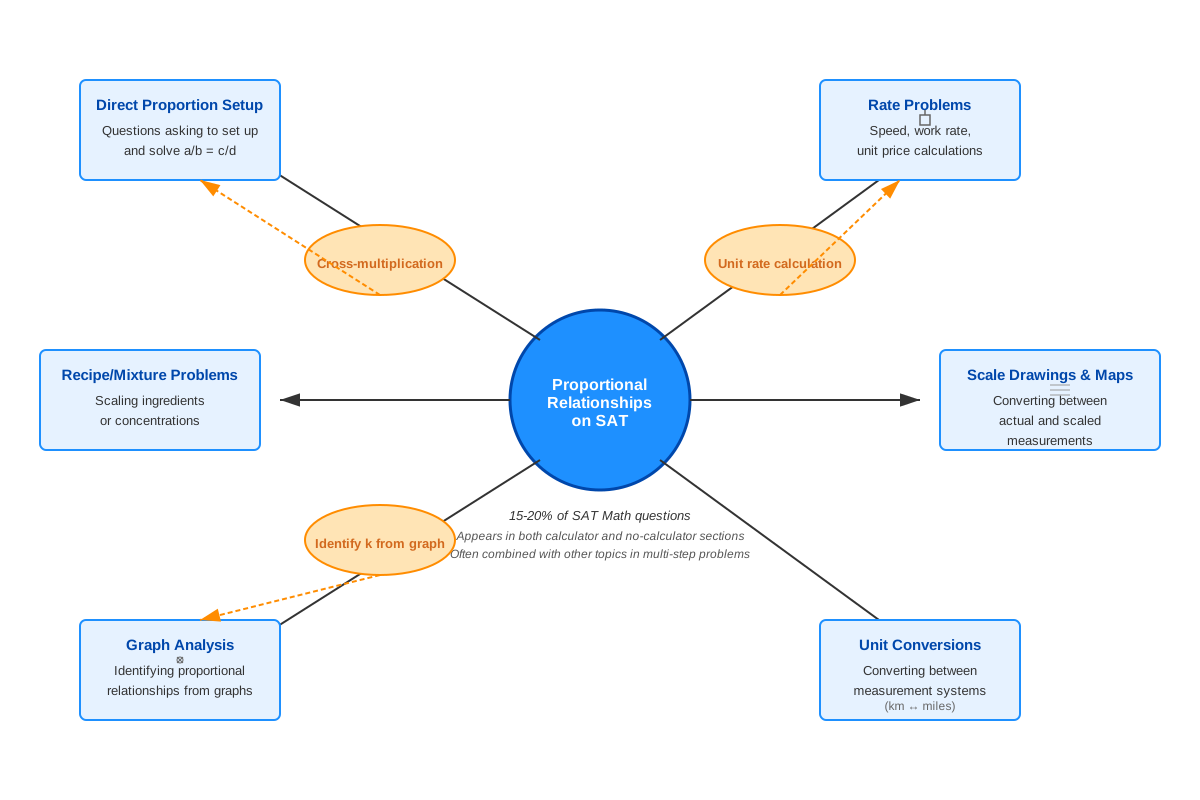
The SAT tests proportional relationships in multiple formats: through word problems involving real-world scenarios like recipe scaling or travel calculations, through graphical representations where students must identify linear relationships passing through the origin, and through algebraic expressions where the constant of proportionality must be determined or applied. Questions may appear in both the calculator and no-calculator sections, and they often serve as building blocks for more complex multi-step problems. Mastering this topic provides a significant advantage because proportional reasoning underlies approximately 15-20% of SAT Math questions either directly or indirectly.
Within the broader landscape of SAT mathematics, proportional relationships connect directly to linear functions, coordinate geometry, and algebraic reasoning. They serve as the foundation for understanding direct variation, inverse variation, and the behavior of linear equations. The ability to recognize, set up, and solve proportional relationships efficiently distinguishes high-scoring students from those who struggle with time management and accuracy on test day.
Learning Objectives
- [ ] Identify key features of proportional relationships including constant ratios and linear graphs through the origin
- [ ] Explain how proportional relationships appear on the SAT in various question formats and contexts
- [ ] Apply proportional relationships to answer SAT-style questions accurately and efficiently
- [ ] Distinguish between proportional and non-proportional relationships from tables, graphs, and equations
- [ ] Calculate the constant of proportionality from multiple representations
- [ ] Set up and solve proportion equations for real-world SAT scenarios
- [ ] Interpret the meaning of the constant of proportionality in context
Prerequisites
- Basic algebraic manipulation: Solving simple equations and isolating variables is necessary for setting up and solving proportions
- Fraction operations: Cross-multiplication and simplifying ratios require comfort with fraction arithmetic
- Coordinate plane basics: Identifying points and understanding linear graphs helps recognize proportional relationships visually
- Unit awareness: Understanding different units of measurement is essential for rate problems and conversions
- Ratio fundamentals: Comparing two quantities forms the foundation of proportional reasoning
Why This Topic Matters
Proportional relationships appear everywhere in daily life: adjusting recipe quantities for different serving sizes, calculating fuel efficiency, converting currencies, determining sale prices, and scaling maps or blueprints. This real-world applicability makes proportional reasoning one of the most practical mathematical skills students develop. In professional contexts, engineers use proportions for scale models, healthcare workers calculate medication dosages based on body weight, and business analysts project costs and revenues using proportional models.
On the SAT specifically, proportional relationships questions appear with remarkable frequency—typically 4-6 questions per test directly assess this concept, with many additional questions incorporating proportional reasoning as part of multi-step solutions. These questions appear in various forms: as straightforward ratio problems worth quick points, as word problems requiring careful setup, as graph interpretation questions, and as algebraic modeling scenarios. The College Board consistently includes proportional relationships in both the Heart of Algebra and Problem Solving and Data Analysis content domains.
Common SAT question formats include: determining whether a relationship is proportional from a table of values, finding missing values in proportional scenarios, identifying the equation that represents a proportional relationship, interpreting the constant of proportionality in context, solving real-world problems involving rates and unit conversions, and analyzing graphs to determine proportional relationships. Questions may involve distance-rate-time scenarios, pricing and cost calculations, scale drawings, density problems, or concentration mixtures.
Core Concepts
Definition of Proportional Relationships
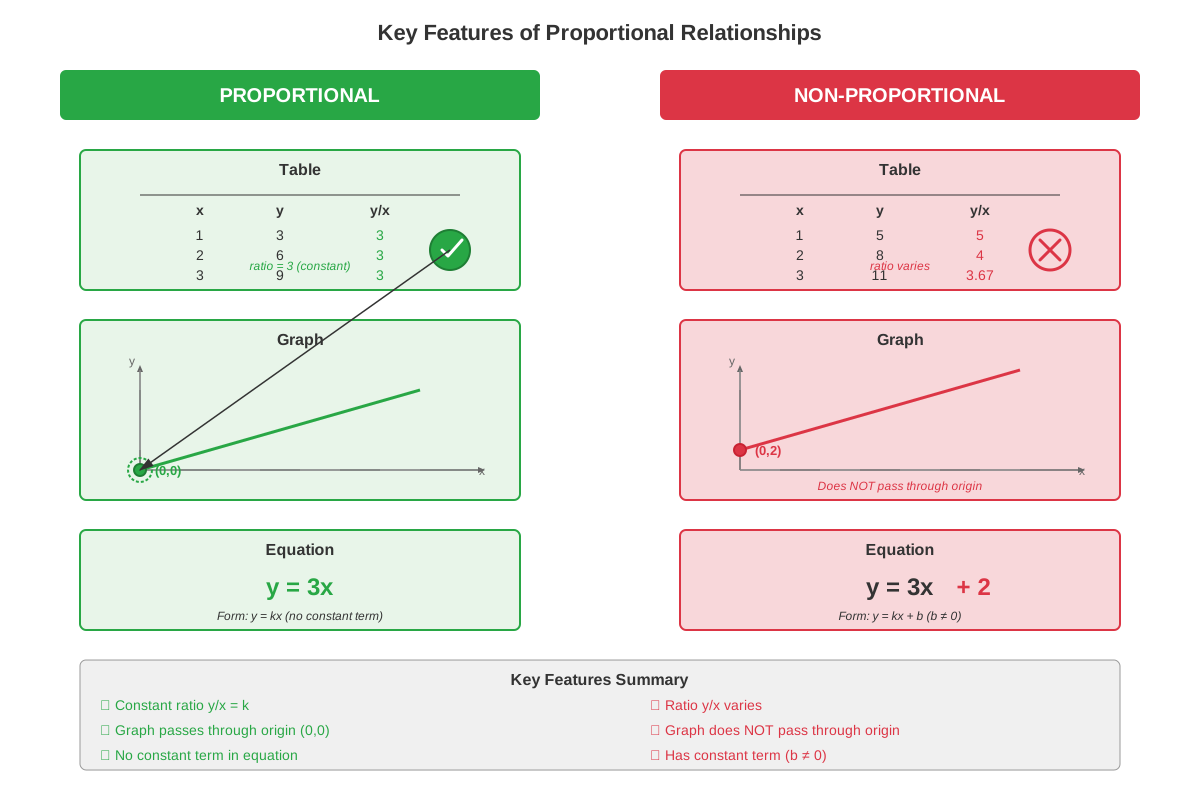
A proportional relationship exists between two variables when their ratio remains constant. Mathematically, if y is proportional to x, then y/x = k, where k is the constant of proportionality. This can be rewritten as the equation y = kx, which represents a direct variation. The key characteristic is that as one variable increases or decreases, the other changes by the same multiplicative factor.
For example, if 3 pounds of apples cost $6, and 5 pounds cost $10, the relationship is proportional because 6/3 = 2 and 10/5 = 2. The constant of proportionality is $2 per pound. Doubling the pounds doubles the cost; tripling the pounds triples the cost.
Identifying Proportional Relationships from Tables
When examining a table of values, a relationship is proportional if and only if the ratio of corresponding y-values to x-values remains constant for all pairs. To verify proportionality:
- Calculate y/x for each row in the table
- Check if all ratios are equal
- If any ratio differs, the relationship is not proportional
| x | y | y/x |
|---|---|---|
| 2 | 6 | 3 |
| 4 | 12 | 3 |
| 7 | 21 | 3 |
This table shows a proportional relationship with k = 3, giving the equation y = 3x.
Important note: A proportional relationship must include the point (0, 0). If a table or scenario doesn't pass through the origin, it cannot be proportional, even if the rate of change is constant. For instance, a phone plan with a $20 base fee plus $0.10 per minute is linear but not proportional.
Graphical Representation
The graph of a proportional relationship is always a straight line passing through the origin (0, 0). The slope of this line equals the constant of proportionality. This visual characteristic provides a quick identification method on the SAT—if a line doesn't pass through the origin, the relationship isn't proportional.
The steepness of the line indicates the size of the constant of proportionality. A steeper line means a larger k value, indicating that y increases more rapidly relative to x. For example, y = 5x produces a steeper line than y = 2x because the constant of proportionality is larger.
Equation Forms
Proportional relationships can be expressed in several equivalent forms:
- Standard form: y = kx
- Ratio form: y/x = k
- Proportion form: y₁/x₁ = y₂/x₂
All three forms represent the same relationship. The SAT may present the relationship in any form and ask students to convert between them or identify which form applies to a given situation.
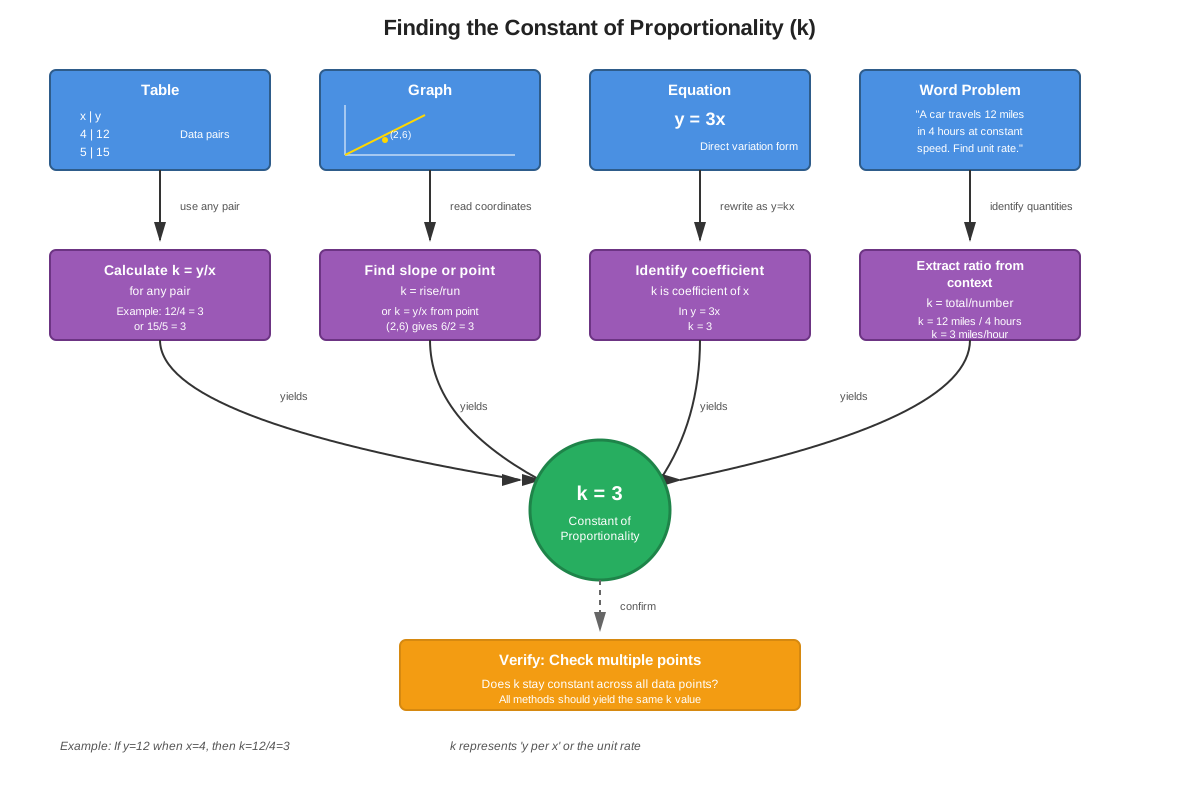
Finding the Constant of Proportionality
To determine k from any representation:
From a table: Divide any y-value by its corresponding x-value (y/x = k)
From a graph: Calculate the slope using any point (k = rise/run = y/x)
From a word problem: Identify the unit rate or the amount of y per one unit of x
From an equation: Identify the coefficient of x when the equation is in y = kx form
Setting Up Proportions
Many SAT problems require setting up a proportion equation to solve for an unknown value. The key is maintaining consistent units and positions:
part₁/whole₁ = part₂/whole₂or
quantity₁/quantity₂ = corresponding₁/corresponding₂For example: "If 5 notebooks cost $12, how much do 8 notebooks cost?"
Set up: 5 notebooks/$12 = 8 notebooks/x dollars
Cross-multiply: 5x = 96, so x = $19.20
Unit Rates and Conversions
A unit rate expresses the constant of proportionality as the amount of one quantity per single unit of another. Common SAT examples include miles per hour, dollars per pound, or meters per second. Unit rates simplify proportional calculations because multiplying the unit rate by any quantity gives the corresponding value.
Converting between units relies on proportional relationships. For instance, converting 5 feet to inches uses the proportion: 1 foot/12 inches = 5 feet/x inches, yielding x = 60 inches.
Scale Drawings and Similar Figures
Scale drawings represent proportional relationships between actual dimensions and drawing dimensions. If a map uses a scale of 1 inch : 50 miles, then the relationship between map distance (m) and actual distance (a) is m = a/50 or a = 50m.
Similar figures maintain proportional corresponding sides. If two triangles are similar with a scale factor of 3:5, then all corresponding side lengths maintain this ratio, allowing calculation of unknown dimensions.
Concept Relationships
The core concepts within proportional relationships build upon each other systematically. The definition (constant ratio) → establishes the foundation → which manifests in the equation form y = kx → which produces the graphical representation (line through origin) → and appears in tables as constant y/x ratios.
Finding the constant of proportionality serves as the central skill connecting all representations. Once k is determined from any format (table, graph, equation, or context), it can be used to set up proportions for solving problems. Unit rates represent a specific application of the constant of proportionality where one quantity equals 1.
These concepts connect to prerequisite knowledge of ratios by extending simple comparisons to functional relationships. They link forward to linear functions (proportional relationships are special cases where b = 0 in y = mx + b), to systems of equations (where proportional relationships might be compared), and to more advanced topics like direct and inverse variation.
The relationship to broader SAT math appears in: percentages (proportional relationships with k = 0.01 times the percent), probability (ratios of favorable to total outcomes), similar triangles (proportional corresponding sides), and rate problems (distance = rate × time is proportional when rate is constant).
High-Yield Facts
- ⭐ A proportional relationship always produces a straight line passing through the origin (0, 0) when graphed
- ⭐ The constant of proportionality k equals y/x for any point in the relationship and represents the slope of the line
- ⭐ The equation of a proportional relationship is always y = kx, never y = kx + b where b ≠ 0
- ⭐ In a table of proportional values, all y/x ratios must be identical
- ⭐ To solve proportion problems, set up equivalent ratios and cross-multiply: a/b = c/d means ad = bc
- Unit rates represent the constant of proportionality expressed as "per one unit"
- If two quantities are proportional, doubling one quantity exactly doubles the other
- The constant of proportionality has units: if y is in dollars and x is in pounds, k is in dollars per pound
- Scale factors in similar figures represent proportional relationships between corresponding dimensions
- A relationship with a constant rate of change but not passing through the origin is linear but not proportional
Quick check — test yourself on Proportional relationships so far.
Try Flashcards →Common Misconceptions
Misconception: All linear relationships are proportional relationships.
Correction: Only linear relationships passing through the origin (0, 0) are proportional. A line like y = 2x + 3 is linear but not proportional because it has a y-intercept of 3. Proportional relationships require that when x = 0, y must also equal 0.
Misconception: The constant of proportionality is always a whole number.
Correction: The constant k can be any real number—whole, fraction, decimal, or even irrational. For example, if 3 items cost $7, then k = 7/3 ≈ 2.33 dollars per item.
Misconception: In a proportion a/b = c/d, you can add across: (a+c)/(b+d).
Correction: Proportions maintain equality through cross-multiplication (ad = bc), not by adding numerators and denominators. The equation 2/3 = 4/6 is true, but (2+4)/(3+6) = 6/9 = 2/3, which only coincidentally works here and fails in general cases.
Misconception: If a graph shows a straight line, the relationship must be proportional.
Correction: The line must specifically pass through the origin. A straight line with any other y-intercept represents a linear but non-proportional relationship. Always check whether (0, 0) is on the line.
Misconception: The constant of proportionality is the same regardless of which variable is considered dependent.
Correction: If y = 3x, then k = 3 (y per x). However, if we solve for x, we get x = y/3, making the constant 1/3 (x per y). The constant depends on which quantity is expressed per unit of the other.
Misconception: Proportional relationships only apply to positive values.
Correction: Proportional relationships extend to negative values as well. If y = -2x, this is still proportional with k = -2. The graph passes through the origin but has a negative slope.
Worked Examples
Example 1: Identifying and Using Proportional Relationships
Problem: A car travels 135 miles in 3 hours at a constant speed. If the relationship between distance and time is proportional, how far will the car travel in 7 hours?
Solution:
Step 1: Verify the relationship is proportional. Since the car travels at constant speed and starts from position zero, distance is proportional to time.
Step 2: Find the constant of proportionality (the speed).
k = distance/time = 135 miles/3 hours = 45 miles per hour
Step 3: Write the equation.
distance = 45 × time, or d = 45t
Step 4: Calculate the distance for 7 hours.
d = 45 × 7 = 315 miles
Alternative method using proportions:
Set up: 135 miles/3 hours = d miles/7 hours
Cross-multiply: 135 × 7 = 3 × d
945 = 3d
d = 315 miles
Connection to learning objectives: This problem demonstrates identifying a proportional relationship from context, finding the constant of proportionality, and applying it to solve for an unknown value—all core SAT skills.
Example 2: Distinguishing Proportional from Non-Proportional Relationships
Problem: Examine the following table and determine whether the relationship between x and y is proportional. If so, find the equation. If not, explain why.
| x | y |
|---|---|
| 1 | 5 |
| 2 | 10 |
| 3 | 15 |
| 4 | 20 |
Solution:
Step 1: Calculate y/x for each row.
- Row 1: 5/1 = 5
- Row 2: 10/2 = 5
- Row 3: 15/3 = 5
- Row 4: 20/4 = 5
Step 2: Check if all ratios are equal.
All ratios equal 5, so the relationship is proportional.
Step 3: Identify the constant of proportionality.
k = 5
Step 4: Write the equation.
y = 5x
Verification: Check if (0, 0) would fit the pattern. When x = 0, y = 5(0) = 0. ✓
Now consider this modified table:
| x | y |
|---|---|
| 1 | 7 |
| 2 | 12 |
| 3 | 17 |
| 4 | 22 |
Calculate y/x:
- Row 1: 7/1 = 7
- Row 2: 12/2 = 6
- Row 3: 17/3 ≈ 5.67
- Row 4: 22/4 = 5.5
The ratios are not constant, so this relationship is NOT proportional. (This is actually y = 5x + 2, a linear but non-proportional relationship.)
Connection to learning objectives: This example practices identifying proportional relationships from tables and distinguishing them from similar linear relationships—a common SAT trap.
Exam Strategy
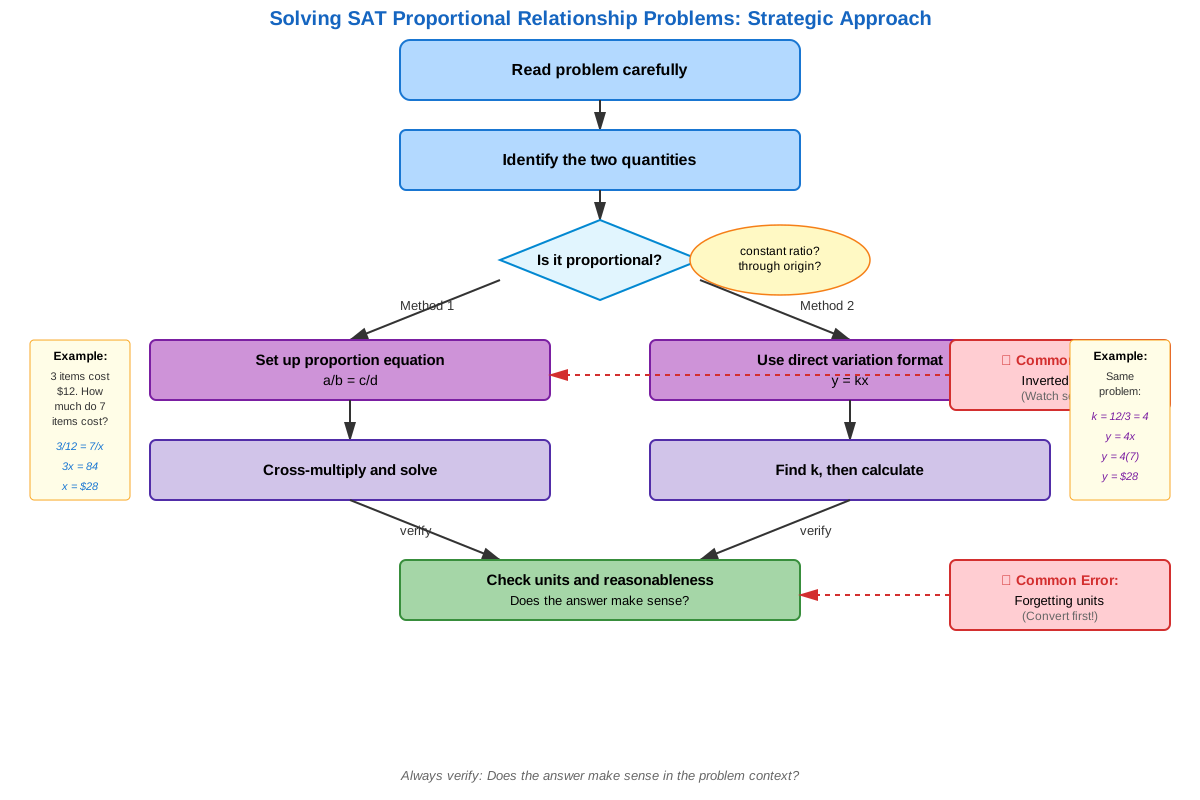
When approaching sat proportional relationships questions, follow this systematic process:
Step 1: Identify the question type. Look for trigger words like "proportional," "constant rate," "per," "directly varies," or scenarios involving consistent ratios. Questions asking about graphs through the origin or tables with constant ratios signal proportional relationships.
Step 2: Determine what's given and what's asked. SAT questions often provide information in one format (table, graph, or context) and ask for answers in another. Identify the constant of proportionality first, as it's the key to converting between representations.
Step 3: Check for the origin. If analyzing a graph or table, verify that (0, 0) is included or would logically fit. This single check eliminates non-proportional options immediately.
Step 4: Set up your equation or proportion carefully. Maintain consistent units and positions. Write out "x units/y units = a units/b units" to avoid mixing up numerators and denominators.
Step 5: Solve and verify. After calculating, check if your answer makes logical sense. If 5 items cost $10, then 10 items should cost $20 (double), not $15 or $25.
Trigger phrases to watch for:
- "Directly proportional" or "varies directly" → y = kx
- "At this rate" or "at the same rate" → constant of proportionality applies
- "Per" (miles per hour, dollars per pound) → unit rate = k
- "Scale of" or "scale factor" → proportional relationship between dimensions
- "Constant speed/rate/price" → proportionality likely applies
Process of elimination tips:
- Eliminate any equation with a non-zero y-intercept (y = mx + b where b ≠ 0)
- Eliminate graphs that don't pass through the origin
- Eliminate tables where y/x ratios vary
- For word problems, eliminate answers that don't match the units requested
Time allocation: Straightforward proportional relationship questions should take 30-60 seconds. Multi-step problems involving proportions might require 90-120 seconds. If you're spending more than 2 minutes, mark the question and return to it later.
Memory Techniques
"ZERO Hero" mnemonic: For a relationship to be proportional, it must pass through ZERO (the origin). If there's no zero-zero point, there's no proportional relationship—the ZERO is the HERO that identifies proportionality.
"K is the Key" reminder: The constant of proportionality (k) unlocks all proportional relationship problems. Once you find k, you can answer any question about that relationship. Always make finding k your first priority.
"Y over X, that's the fix": When checking tables or finding k, always calculate y/x (not x/y) to maintain consistency with the standard form y = kx.
Visualization strategy: Picture a straight line shooting through the bullseye (origin) of a target. If the line misses the bullseye, it's not proportional. This mental image helps quickly identify proportional graphs.
"Cross and Multiply, Don't Cry": When solving proportions in the form a/b = c/d, cross-multiply to get ad = bc. This rhyme helps remember the correct procedure under test pressure.
Unit Rate Acronym - PURE:
- Per one unit
- Understand the context
- Ratio y to x
- Equals the constant k
Summary
Proportional relationships represent one of the most fundamental and frequently tested concepts on the SAT Math section, appearing in approximately 15-20% of questions either directly or as part of multi-step problems. These relationships exist when two quantities maintain a constant ratio, expressed mathematically as y = kx, where k is the constant of proportionality. The defining characteristics include: a constant y/x ratio across all values, a graph that is a straight line passing through the origin (0, 0), and the property that multiplying one variable by any factor multiplies the other by the same factor. Students must be able to identify proportional relationships from tables, graphs, equations, and word problems; distinguish them from similar linear relationships that don't pass through the origin; calculate the constant of proportionality from any representation; and apply proportional reasoning to solve real-world problems involving rates, unit conversions, scale drawings, and similar figures. Mastery requires understanding that while all proportional relationships are linear, not all linear relationships are proportional—the critical difference being the y-intercept, which must be zero for proportionality.
Key Takeaways
- Proportional relationships always graph as straight lines through the origin (0, 0) with equation y = kx
- The constant of proportionality k equals y/x for any point and represents both the slope and the unit rate
- Verify proportionality in tables by checking that all y/x ratios are identical
- Set up proportions carefully with consistent units: a/b = c/d, then cross-multiply to solve
- Linear relationships with non-zero y-intercepts (y = mx + b where b ≠ 0) are NOT proportional
- The constant of proportionality has units derived from the quantities involved (e.g., dollars per pound)
- Proportional reasoning underlies many SAT topics including rates, percentages, scale factors, and unit conversions
Related Topics
Linear Functions and Equations: Proportional relationships are special cases of linear functions where the y-intercept equals zero. Understanding the broader category of linear functions (y = mx + b) helps distinguish proportional from non-proportional linear relationships.
Direct and Inverse Variation: While proportional relationships represent direct variation (y = kx), inverse variation (y = k/x) presents a related but distinct concept where the product rather than the ratio remains constant.
Systems of Equations: Proportional relationships often appear in systems where two different proportional scenarios must be compared or combined to find solutions.
Similarity and Geometric Scaling: Similar figures maintain proportional corresponding sides, connecting proportional relationships to geometry and spatial reasoning.
Percent Problems: Percentages represent proportional relationships where the constant of proportionality involves the factor 0.01, making percent calculations a specific application of proportional reasoning.
Mastering proportional relationships provides the foundation for success across these related topics and strengthens overall mathematical reasoning for the SAT.
Practice CTA
Now that you've thoroughly reviewed proportional relationships, it's time to solidify your understanding through active practice. Attempt the practice questions designed specifically for this topic, focusing on applying the identification strategies, calculation methods, and problem-solving approaches covered in this guide. Use the flashcards to reinforce key definitions, formulas, and characteristics until you can recall them instantly. Remember, proportional relationships appear frequently on the SAT, making every minute spent practicing this topic a high-yield investment in your score. Challenge yourself to work through problems efficiently, aiming for both accuracy and speed. You've got this!
Sign up free to keep reading
Create a free AnvayaPrep account to finish this SAT guide on Proportional relationships — plus flashcards and practice questions.