Overview
Rates with rational expressions represent a critical intersection of algebraic manipulation and real-world problem-solving that appears frequently on the SAT math section. These problems involve situations where rates—such as speed, work completion, or flow—are expressed as fractions containing variables in the numerator, denominator, or both. Understanding how to work with these expressions is essential because they model countless practical scenarios: how long it takes two workers to complete a job together, how fast a boat travels upstream versus downstream, or how quickly a tank fills when multiple pipes operate simultaneously.
On the SAT, rates with rational expressions questions test a student's ability to set up equations from word problems, manipulate complex fractions, and solve for unknown variables. These problems often appear in both the calculator and no-calculator sections, typically as medium to hard difficulty questions worth valuable points. The College Board frequently uses rate problems to assess mathematical reasoning and modeling skills—two of the exam's core competencies. Students who master this topic gain a significant advantage because these questions, while challenging for many test-takers, follow predictable patterns once the underlying principles are understood.
This topic builds directly on fundamental concepts of rates, proportions, and rational expressions while connecting to broader themes of equation-solving and algebraic modeling. Success with sat rates with rational expressions requires fluency in fraction operations, equation manipulation, and the ability to translate verbal descriptions into mathematical relationships. The skills developed here extend beyond the SAT, forming the foundation for calculus, physics, and real-world quantitative reasoning.
Learning Objectives
- [ ] Identify key features of rates with rational expressions
- [ ] Explain how rates with rational expressions appears on the SAT
- [ ] Apply rates with rational expressions to answer SAT-style questions
- [ ] Construct rational expression equations from verbal rate descriptions
- [ ] Simplify and solve equations involving combined rates
- [ ] Interpret solutions to rate problems in context and verify reasonableness
- [ ] Distinguish between different types of rate problems (work, distance, flow) and apply appropriate solution strategies
Prerequisites
- Basic rate formula (Rate = Work/Time or Distance/Time): Essential for understanding how rates are expressed and manipulated in rational form
- Operations with fractions: Required for adding, subtracting, multiplying, and dividing rational expressions
- Solving linear and simple rational equations: Necessary for isolating variables and finding solutions
- Finding common denominators: Critical for combining rational expressions with different denominators
- Cross-multiplication: Used frequently to solve proportions and rational equations
- Variable manipulation and algebraic substitution: Needed to work with expressions containing multiple variables
Why This Topic Matters
In real-world applications, rates with rational expressions model countless practical situations. Engineers use them to calculate project completion times with varying team sizes, logistics professionals determine optimal shipping routes considering different speeds and conditions, and financial analysts compute compound rates of return. Understanding these expressions enables problem-solving in physics (relative motion), economics (productivity analysis), and engineering (flow rates in systems).
On the SAT, rate problems with rational expressions appear in approximately 2-4 questions per test, representing roughly 4-7% of the math section. These questions typically appear as word problems requiring multi-step solutions, making them high-value targets for score improvement. The College Board classifies these as "Problem Solving and Data Analysis" or "Passport to Advanced Math" questions, depending on complexity. They frequently appear in positions 10-20 on each math section, indicating medium to high difficulty.
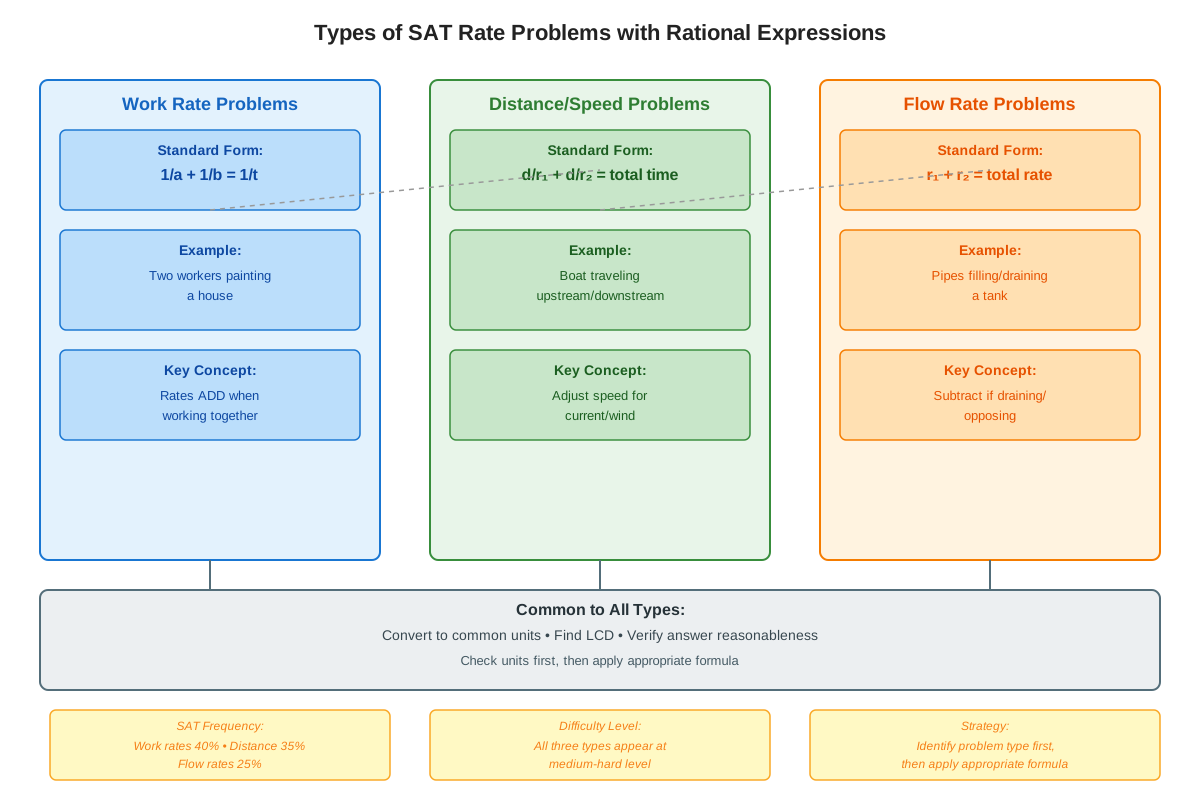
Common SAT presentations include: work problems where two or more entities complete tasks at different rates; distance-rate-time problems with opposing or complementary motions; and mixture or flow problems involving filling or emptying containers. The exam often adds complexity by asking for combined rates, time to completion with varying conditions, or requiring students to interpret what their algebraic solution means in context.
Core Concepts
Understanding Rate as a Rational Expression
A rate expresses how one quantity changes relative to another, typically written as a fraction. When variables appear in these fractions, we have rational expressions. The fundamental rate relationships are:
- Work Rate: Rate = Work Completed / Time Taken
- Speed: Rate = Distance / Time
- Flow Rate: Rate = Volume / Time
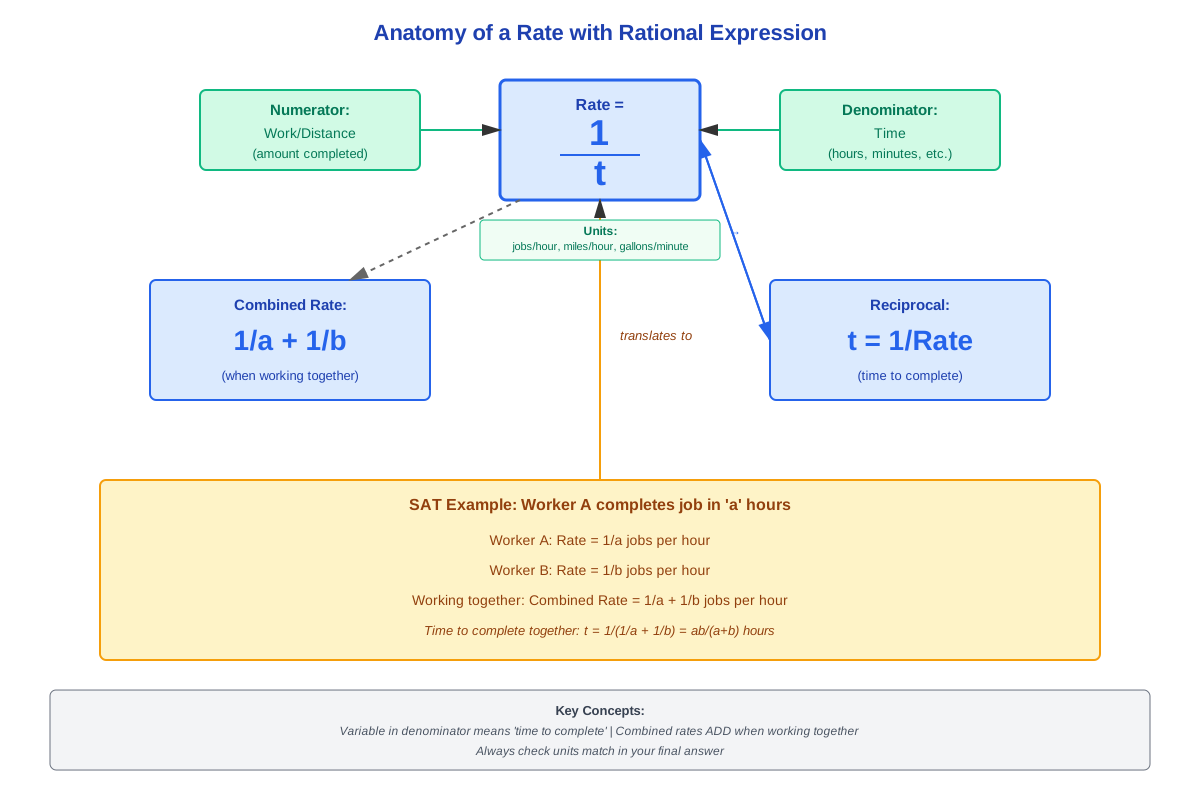
For example, if a worker completes a job in x hours, their rate is 1/x jobs per hour. If a car travels d miles in t hours, its speed is d/t miles per hour. These rational expressions become the building blocks for more complex problems.
Combined Rates and Addition
When multiple entities work together or rates combine, we add their individual rates. This principle is counterintuitive for many students but fundamental to solving rate problems.
If Worker A completes a job in a hours (rate = 1/a) and Worker B completes the same job in b hours (rate = 1/b), their combined rate when working together is:
Combined Rate = 1/a + 1/bTo find the time to complete one job together, we solve:
Time = 1 / (1/a + 1/b) = ab/(a+b)This formula appears frequently on the SAT and should be memorized. Notice that the combined time is NOT the average of the individual times—it's always less than the average because both workers contribute simultaneously.
Setting Up Rate Equations from Word Problems
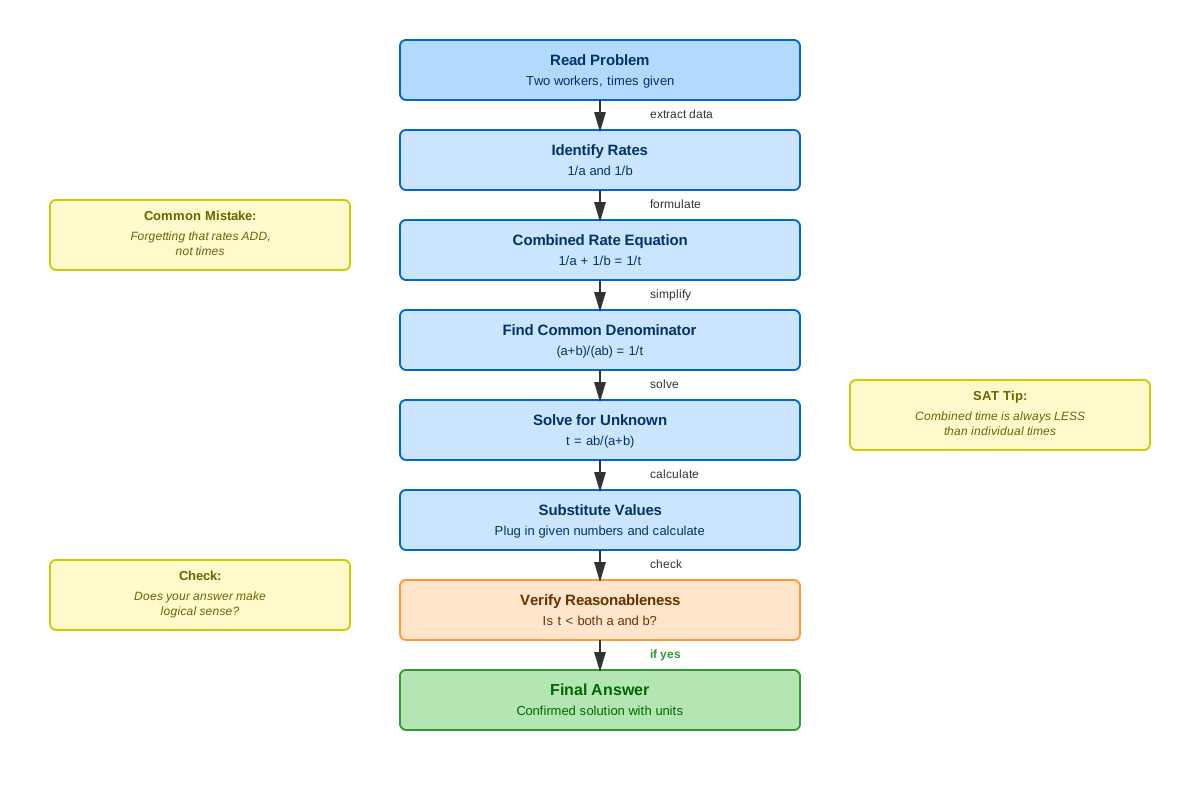
The critical skill for SAT success is translating verbal descriptions into algebraic equations. Follow this systematic approach:
- Identify what's being asked: time, rate, or amount of work/distance
- Define variables clearly: write down what each variable represents
- Express individual rates: convert "completes in x hours" to rate = 1/x
- Set up the equation: use the relationship (Rate)(Time) = Work or (Rate)(Time) = Distance
- Solve and interpret: find the numerical answer and verify it makes sense
Opposing and Complementary Rates
Opposing rates occur when forces work against each other (upstream/downstream, filling/draining). Subtract the rates:
Net Rate = Rate₁ - Rate₂Complementary rates occur when forces work together (downstream with current, multiple pipes filling). Add the rates:
Net Rate = Rate₁ + Rate₂| Scenario Type | Rate Relationship | Example |
|---|---|---|
| Working together | Add rates | Two workers completing a project |
| Opposing forces | Subtract rates | Boat going upstream against current |
| Sequential work | Use individual rates separately | One worker, then another |
| Partial completion | Multiply rate by time | Worker completes 3 hours of 5-hour job |
Solving Rational Equations in Rate Problems
Once the equation is established, solve using these techniques:
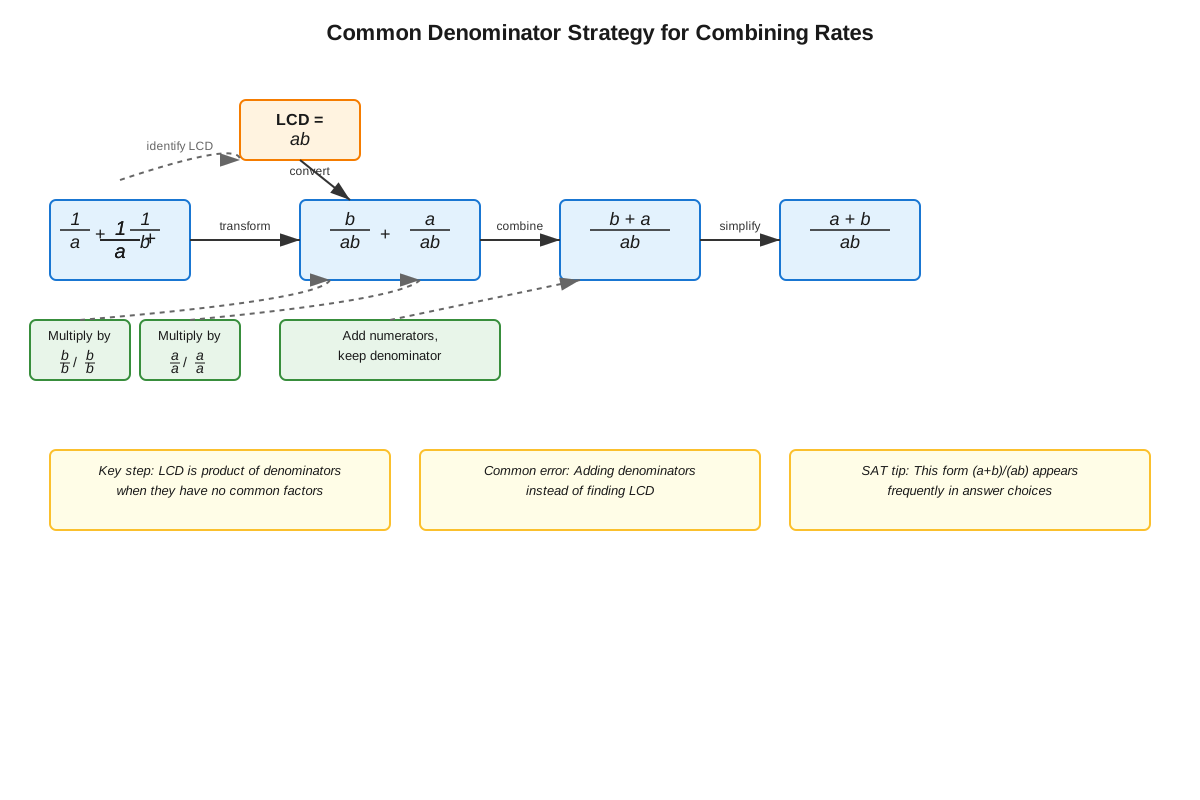
- Find common denominator: Combine fractions on one or both sides
- Clear denominators: Multiply both sides by the LCD
- Solve the resulting equation: Use standard algebraic techniques
- Check for extraneous solutions: Verify solutions don't create zero denominators or negative times
For example, solving 1/x + 1/(x+2) = 1/3:
- LCD is 3x(x+2)
- Multiply through: 3(x+2) + 3x = x(x+2)
- Simplify: 6x + 6 = x² + 2x
- Rearrange: x² - 4x - 6 = 0
- Solve using quadratic formula or factoring
Distance-Rate-Time Problems with Rational Expressions
The fundamental relationship Distance = Rate × Time can be rearranged to create rational expressions:
- Rate = Distance/Time
- Time = Distance/Rate
When problems involve relative motion (two objects moving toward or away from each other), set up equations based on whether distances add or remain separate. For objects moving toward each other, their rates add; for objects moving in the same direction, consider relative rate as the difference.
Work Problems with Fractional Completion
Many SAT problems involve partial work completion. If a worker completes a job in t hours and works for h hours, the fraction completed is h/t. When multiple workers contribute different amounts:
(Rate₁)(Time₁) + (Rate₂)(Time₂) = Total Work CompletedThis principle extends to any number of workers or time periods, making it versatile for complex scenarios.
Concept Relationships
The core concepts in rates with rational expressions form an interconnected system. Individual rates serve as the foundation, expressed as rational expressions (1/t for work, d/t for distance). These individual rates combine through addition when entities work together or subtraction when they oppose each other, creating combined rates that are themselves rational expressions.
The process of setting up equations from word problems draws on understanding both individual and combined rates, translating verbal descriptions into algebraic relationships. This setup phase leads directly to solving rational equations, which requires techniques from prerequisite algebra knowledge: finding common denominators, clearing fractions, and solving the resulting polynomial equations.
Distance-rate-time problems and work problems represent parallel applications of the same underlying principles, differing mainly in context rather than mathematical structure. Both rely on the fundamental relationship that (Rate)(Time) = Output, whether that output is distance traveled or work completed.
Relationship map: Individual Rates → Combined Rates (via addition/subtraction) → Equation Setup → Rational Equation Solving → Solution Interpretation → Context Verification
This topic connects backward to prerequisite knowledge of fractions, proportions, and basic rate concepts, while connecting forward to more advanced topics like optimization, related rates in calculus, and systems of equations.
Quick check — test yourself on Rates with rational expressions so far.
Try Flashcards →High-Yield Facts
⭐ When two entities work together, ADD their rates: If rates are 1/a and 1/b, combined rate is 1/a + 1/b
⭐ Time to complete together: For individual times a and b, combined time is ab/(a+b), NOT (a+b)/2
⭐ Rate × Time = Work: This fundamental relationship applies to all work problems; work is typically set to 1 (one complete job)
⭐ Opposing rates subtract: Upstream speed = boat speed - current speed; draining while filling = fill rate - drain rate
⭐ Individual rate from completion time: If a job takes t hours, the rate is 1/t jobs per hour
- Distance = Rate × Time can be rearranged to create rational expressions for rate or time
- When solving rational equations, always check that solutions don't create zero denominators
- Negative time solutions are extraneous in rate problems—reject them
- The combined rate of two workers is always faster (greater) than either individual rate
- Partial work formula: Fraction completed = (Rate)(Time worked) = Time worked / Total time needed
⭐ Common denominator technique: To solve 1/a + 1/b = 1/c, multiply through by abc
- In relative motion problems, objects moving toward each other have rates that add; same direction requires subtraction
- The reciprocal of a combined rate gives the time to complete one unit of work
- SAT rate problems often require interpreting what the variable represents, not just solving for it
- When rates vary over time, set up separate equations for each time period and add the work completed
Common Misconceptions
Misconception: When two workers complete a job together, the time required is the average of their individual times.
Correction: The combined time uses the formula ab/(a+b), which is always less than the average (a+b)/2. Working together is more efficient than the average suggests because both contribute simultaneously.
Misconception: Rates should be subtracted when entities work together.
Correction: Rates are added when working together toward the same goal. Subtraction applies only when forces oppose each other (like upstream motion or simultaneous filling and draining).
Misconception: In the equation Rate × Time = Work, "Work" must equal the total job size.
Correction: Work represents the amount completed in that time period, which might be partial. For one complete job, Work = 1, but for partial completion, Work can be any fraction.
Misconception: If a worker completes a job in x hours, their rate is x jobs per hour.
Correction: The rate is 1/x jobs per hour (the reciprocal). In x hours they complete 1 job, so per hour they complete 1/x of the job.
Misconception: All solutions to rational equations are valid in rate problems.
Correction: Always check solutions in context. Negative times, zero denominators, or values that contradict the problem setup (like a rate faster than physically possible) must be rejected as extraneous.
Misconception: Distance-rate-time problems and work-rate-time problems require different formulas.
Correction: Both use the same fundamental structure: (Rate)(Time) = Output. The only difference is whether output is distance or work completed. The mathematical approach is identical.
Misconception: When a problem states "working together they complete the job in t hours," you should add the times.
Correction: This statement gives you the combined time directly. You would add the rates (1/a + 1/b) to find the combined rate, then take the reciprocal to get time.
Worked Examples
Example 1: Classic Work Problem
Problem: Sarah can paint a room in 6 hours. Michael can paint the same room in 4 hours. How long will it take them to paint the room working together?
Solution:
Step 1: Identify individual rates
- Sarah's rate: 1/6 room per hour
- Michael's rate: 1/4 room per hour
Step 2: Find combined rate by adding
Combined rate = 1/6 + 1/4Step 3: Find common denominator (LCD = 12)
Combined rate = 2/12 + 3/12 = 5/12 room per hourStep 4: Find time to complete 1 room
Time = Work / Rate = 1 ÷ (5/12) = 1 × (12/5) = 12/5 = 2.4 hoursAlternatively, using the formula directly:
Time = (6 × 4)/(6 + 4) = 24/10 = 2.4 hoursAnswer: 2.4 hours or 2 hours 24 minutes
Connection to Learning Objectives: This example demonstrates identifying key features (individual rates, combined rates), applying the concept to solve an SAT-style question, and constructing the appropriate rational expression equation.
Example 2: Opposing Rates with Variables
Problem: A tank can be filled by Pipe A in x hours and drained by Pipe B in x + 3 hours. If both pipes are open, the tank fills in 6 hours. Find x.
Solution:
Step 1: Set up individual rates
- Pipe A (filling) rate: 1/x tank per hour
- Pipe B (draining) rate: 1/(x + 3) tank per hour
Step 2: Set up equation for net rate
Since they work in opposition (one fills, one drains), subtract rates:
Net rate = 1/x - 1/(x+3)Step 3: Use given information
The tank fills in 6 hours, so net rate = 1/6:
1/x - 1/(x+3) = 1/6Step 4: Solve the rational equation
Find common denominator on left side:
[(x+3) - x] / [x(x+3)] = 1/6
3 / [x(x+3)] = 1/6
Cross-multiply:
3 × 6 = x(x+3)
18 = x² + 3x
x² + 3x - 18 = 0
Step 5: Factor or use quadratic formula
(x + 6)(x - 3) = 0
x = -6 or x = 3
Step 6: Interpret in context
Since time cannot be negative, x = 3 hours.
Verification: Pipe A fills in 3 hours (rate = 1/3), Pipe B drains in 6 hours (rate = 1/6). Net rate = 1/3 - 1/6 = 1/6, meaning 6 hours to fill. ✓
Answer: x = 3 hours
Connection to Learning Objectives: This example shows how to construct equations from verbal descriptions, distinguish between combined and opposing rates, solve rational equations with variables, and verify solutions in context.
Exam Strategy
When approaching sat rates with rational expressions questions, begin by carefully reading the problem to identify what type of rate scenario is presented: work, distance, or flow. Look for trigger phrases like "working together" (add rates), "against the current" (subtract rates), "completes in x hours" (rate = 1/x), or "how long to finish" (solve for time).
Step-by-step approach:
- Identify and label: What is being asked? What are the given values?
- Define variables: Write down explicitly what each variable represents
- Express rates: Convert all completion times to rates (reciprocals)
- Set up equation: Use Rate × Time = Work or Distance = Rate × Time
- Solve systematically: Clear denominators, solve, check for extraneous solutions
- Verify reasonableness: Does the answer make sense in context?
Process of elimination tips: If answer choices are given, eliminate options that are:
- Negative (time cannot be negative)
- Larger than the slowest individual time when asking for combined time
- Smaller than the fastest individual time when asking for combined time
- Equal to the average of individual times (combined time is always less than average)
Time allocation: Budget 2-3 minutes for straightforward rate problems, up to 4 minutes for complex multi-step problems with variables. If stuck after 90 seconds, mark for review and move on—these problems often become clearer on a second attempt.
Common SAT tricks to watch for:
- Asking for rate instead of time (or vice versa)—read carefully
- Providing combined time and asking for individual time
- Including irrelevant information to distract
- Requiring interpretation of what the solution means in context
Exam Tip: Always write down the formula Rate × Time = Work before starting. This simple step prevents setup errors and keeps your work organized.
Memory Techniques
Mnemonic for combined work time: "Add Bottoms, Multiply Tops" → ab/(a+b)
- Add the denominators (individual times)
- Multiply the numerators (both are 1, so multiply the times themselves)
- Formula: (time₁ × time₂)/(time₁ + time₂)
Acronym for problem-solving steps: RIDES
- Read carefully and identify rate type
- Identify what's being asked
- Define variables and rates
- Establish equation
- Solve and verify
Visualization strategy: Picture rates as "speed of completion." A rate of 1/4 means "one-fourth of the job per hour"—visualize a progress bar filling by 25% each hour. When two workers combine, their progress bars fill simultaneously, making the total job complete faster.
Remember opposing vs. combining:
- Together = Total rates (add)
- Opposing = One minus other (subtract)
Reciprocal relationship: Time and rate are reciprocals. If you know one, flip it to get the other:
- Time t → Rate 1/t
- Rate r → Time 1/r
Summary
Rates with rational expressions represent a high-yield SAT topic that combines algebraic manipulation with practical problem-solving. The fundamental principle is that rates are expressed as fractions (work/time or distance/time), and when variables appear in these fractions, standard rational expression techniques apply. When entities work together toward the same goal, their rates add; when they oppose each other, rates subtract. The most commonly tested scenario involves finding combined work time using the formula ab/(a+b) for individual times a and b. Success requires three key skills: translating word problems into algebraic equations, manipulating rational expressions to solve for unknowns, and interpreting solutions in context to verify reasonableness. Students must remember that rate and time are reciprocals—if completion takes t hours, the rate is 1/t per hour. SAT questions often test whether students can distinguish between different rate scenarios, set up appropriate equations, and avoid common pitfalls like averaging times or forgetting to check for extraneous solutions.
Key Takeaways
- Rates with rational expressions appear in 2-4 questions per SAT, making them high-value for score improvement
- When working together, always add rates (not times); the formula for combined time is ab/(a+b)
- Individual rate equals the reciprocal of completion time: if a job takes t hours, rate = 1/t jobs per hour
- Opposing forces (upstream, draining while filling) require subtracting rates to find net rate
- The fundamental relationship Rate × Time = Work (or Distance) applies to all rate problems regardless of context
- Always verify solutions are positive and make sense in context—negative times and zero denominators indicate extraneous solutions
- Systematic problem setup (identify, define, express, establish, solve) prevents errors and saves time on test day
Related Topics
Systems of Equations with Rational Expressions: Builds on this topic by involving multiple equations with rates, often requiring substitution or elimination methods to solve. Mastering rates with rational expressions provides the foundation for these more complex scenarios.
Proportions and Variation: Direct and inverse variation problems share the rational expression structure and often involve rates. Understanding how quantities relate proportionally extends the rate concepts learned here.
Quadratic Equations in Context: Many rate problems lead to quadratic equations when solved, requiring factoring or the quadratic formula. The interpretation skills developed here transfer directly to these problems.
Rational Functions and Their Graphs: Advanced study of rational expressions includes analyzing their behavior graphically, building on the algebraic manipulation skills practiced in rate problems.
Related Rates in Calculus: For students continuing to calculus, the conceptual understanding of how rates combine and interact provides essential preparation for related rates problems involving derivatives.
Practice CTA
Now that you've mastered the core concepts of rates with rational expressions, it's time to solidify your understanding through practice. Attempt the practice questions to test your ability to identify rate scenarios, set up equations, and solve them efficiently. Use the flashcards to reinforce key formulas and concepts until they become automatic. Remember, the SAT rewards both accuracy and speed—consistent practice with these problems will build the confidence and fluency you need to excel on test day. Every problem you solve strengthens your mathematical reasoning and brings you closer to your target score!
Sign up free to keep reading
Create a free AnvayaPrep account to finish this SAT guide on Rates with rational expressions — plus flashcards and practice questions.