Overview
Density problems are a critical category of questions on the SAT math section that test a student's ability to work with the fundamental relationship between mass, volume, and density. These problems require understanding that density represents how much matter is packed into a given space, expressed through the formula D = M/V (density equals mass divided by volume). While the concept itself is straightforward, the SAT frequently embeds density problems within multi-step word problems, unit conversion challenges, and proportional reasoning scenarios that demand careful analysis and systematic problem-solving.
Mastering sat density problems is essential because they appear regularly on the exam and serve as a bridge between pure mathematical computation and real-world application. These questions test not only arithmetic skills but also the ability to manipulate formulas, convert between units, and reason proportionally—all high-value competencies that appear throughout the SAT math section. Density problems often combine multiple mathematical concepts in a single question, making them efficient vehicles for testing mathematical maturity and problem-solving flexibility.
From a broader perspective, density problems connect directly to the larger unit of Ratios, Rates, and Proportions. Density itself is a rate (mass per unit volume), and solving density problems requires facility with proportional relationships, unit rates, and dimensional analysis. Students who master density problems develop transferable skills that apply to speed-distance-time problems, concentration problems, population density questions, and any scenario involving compound rates or intensive properties.
Learning Objectives
- [ ] Identify key features of density problems, including the three variables (mass, volume, density) and their relationships
- [ ] Explain how density problems appears on the SAT, including common question formats and embedded complexity
- [ ] Apply density problems to answer SAT-style questions with accuracy and efficiency
- [ ] Manipulate the density formula algebraically to solve for any of the three variables
- [ ] Convert between different units of measurement within density problems
- [ ] Recognize when a word problem involves density relationships even when the term "density" is not explicitly mentioned
- [ ] Combine density concepts with proportional reasoning to solve multi-step problems
Prerequisites
- Basic algebraic manipulation: Solving for variables in simple equations is essential because density problems require rearranging D = M/V to isolate different variables
- Unit conversion fundamentals: Understanding how to convert between metric units (grams to kilograms, milliliters to liters) and occasionally between metric and imperial systems
- Ratio and proportion concepts: Density is fundamentally a ratio, and many problems require setting up proportions to find unknown quantities
- Dimensional analysis: The ability to track units through calculations ensures correct setup and helps catch errors
- Basic geometry formulas: Volume calculations for common shapes (rectangular prisms, cylinders, spheres) often appear in density problems
Why This Topic Matters
Density problems appear on virtually every SAT administration, typically accounting for 1-3 questions per test. These questions frequently appear in both the calculator and no-calculator sections, though more complex multi-step versions tend to appear in the calculator-permitted portion. The SAT values density problems because they efficiently assess multiple competencies simultaneously: formula manipulation, unit awareness, proportional reasoning, and real-world application of mathematical concepts.
In real-world contexts, density is fundamental to countless applications. Engineers use density to select materials for construction projects, ensuring structures are both strong and lightweight. Chemists rely on density to identify unknown substances and verify purity. Environmental scientists use population density to study ecosystems and urban planning. Medical professionals use bone density measurements to diagnose osteoporosis. By testing density concepts, the SAT assesses whether students can apply mathematical reasoning to practical scenarios they'll encounter in college science courses and professional contexts.
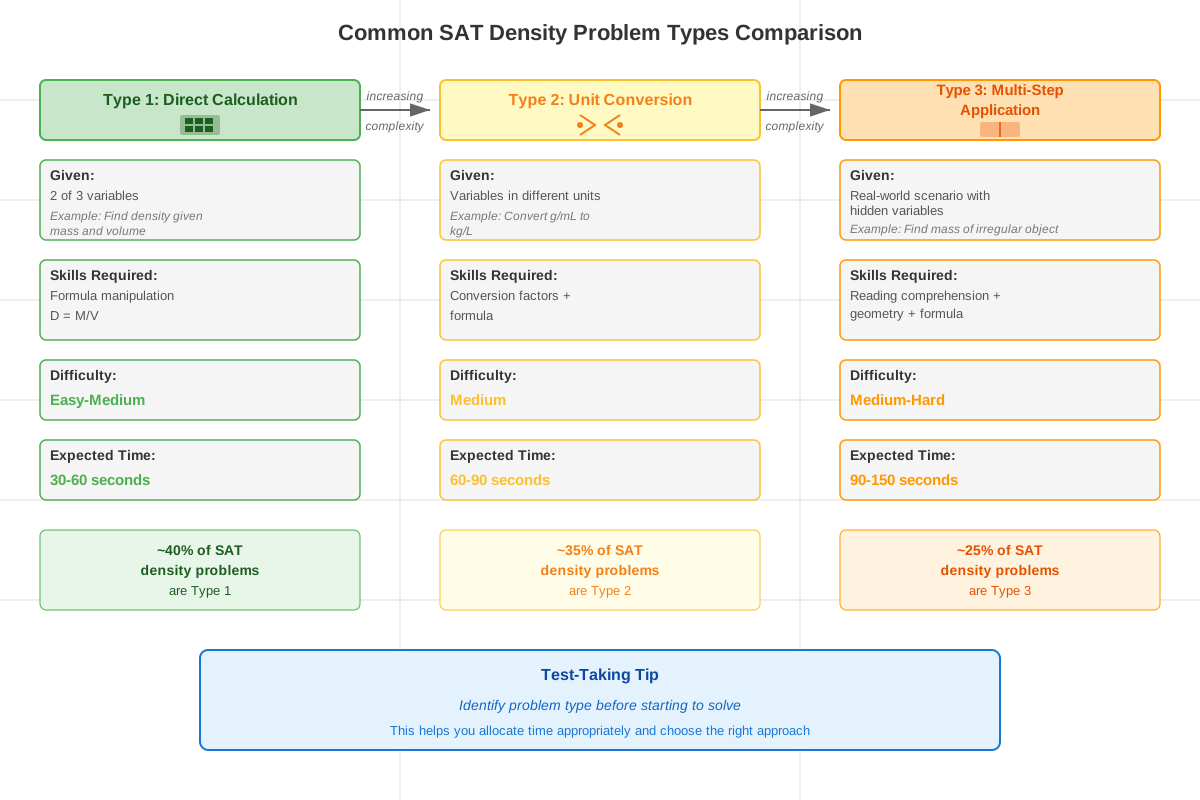
On the exam, density problems commonly appear disguised within word problems about materials science (comparing metals or liquids), environmental contexts (population per square mile), or practical scenarios (determining if an object will float). The SAT rarely asks straightforward "plug and chug" density calculations; instead, questions typically require students to recognize the density relationship within a complex scenario, extract relevant information, perform unit conversions, and execute multi-step solutions. This makes density problems excellent discriminators between students who merely memorize formulas and those who truly understand mathematical relationships.
Core Concepts
The Fundamental Density Formula
Density is defined as the amount of mass contained in a given volume. The fundamental relationship is expressed as:
Density = Mass / Volume
or
D = M / V
This formula can be algebraically rearranged to solve for any of the three variables:
- To find mass: M = D × V
- To find volume: V = M / D
- To find density: D = M / V
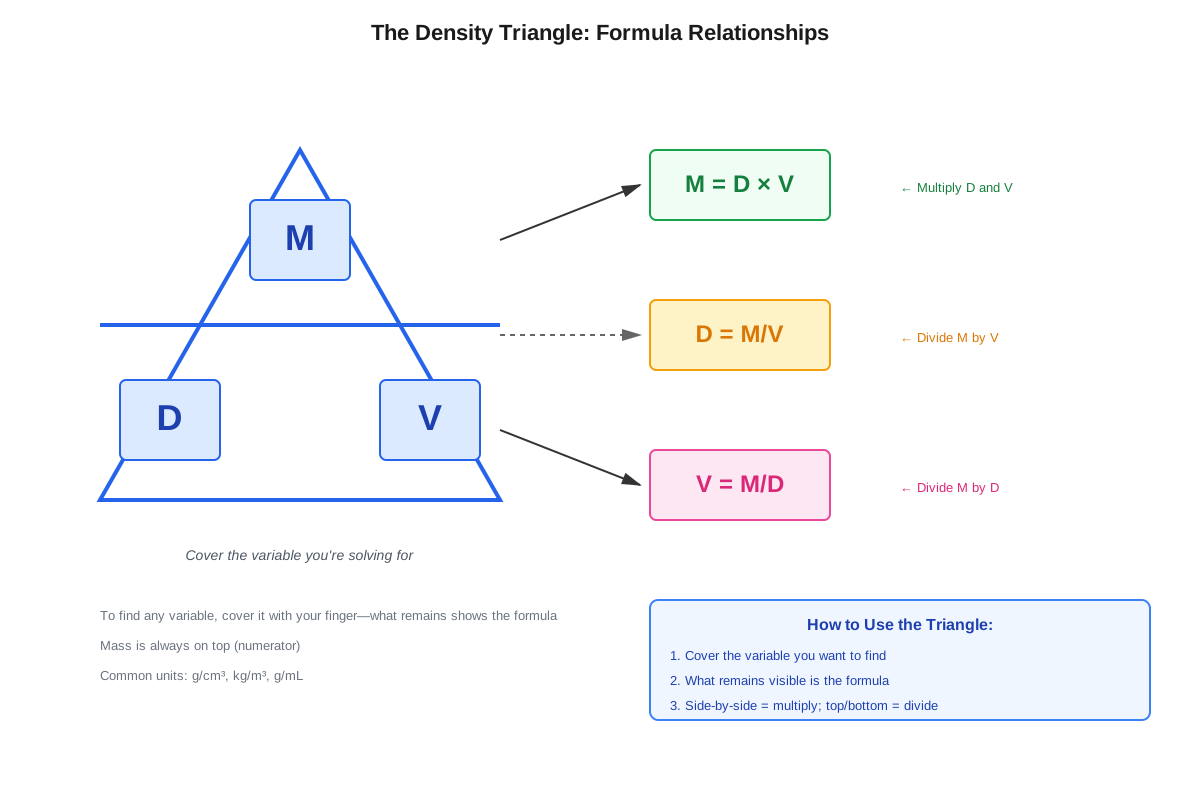
Understanding that these three forms are equivalent is crucial for SAT success. Many students memorize only one form and struggle when questions require solving for mass or volume. The triangle method (visualizing D at the top, M and V at the bottom) can help remember these relationships, though algebraic fluency is more reliable.
Units and Dimensional Analysis
Density problems on the SAT require careful attention to units. Common density units include:
| Substance Type | Common Density Units |
|---|---|
| Solids | g/cm³, kg/m³, g/mL |
| Liquids | g/mL, g/cm³, kg/L |
| Gases | g/L, kg/m³ |
| Population | people/mi², people/km² |
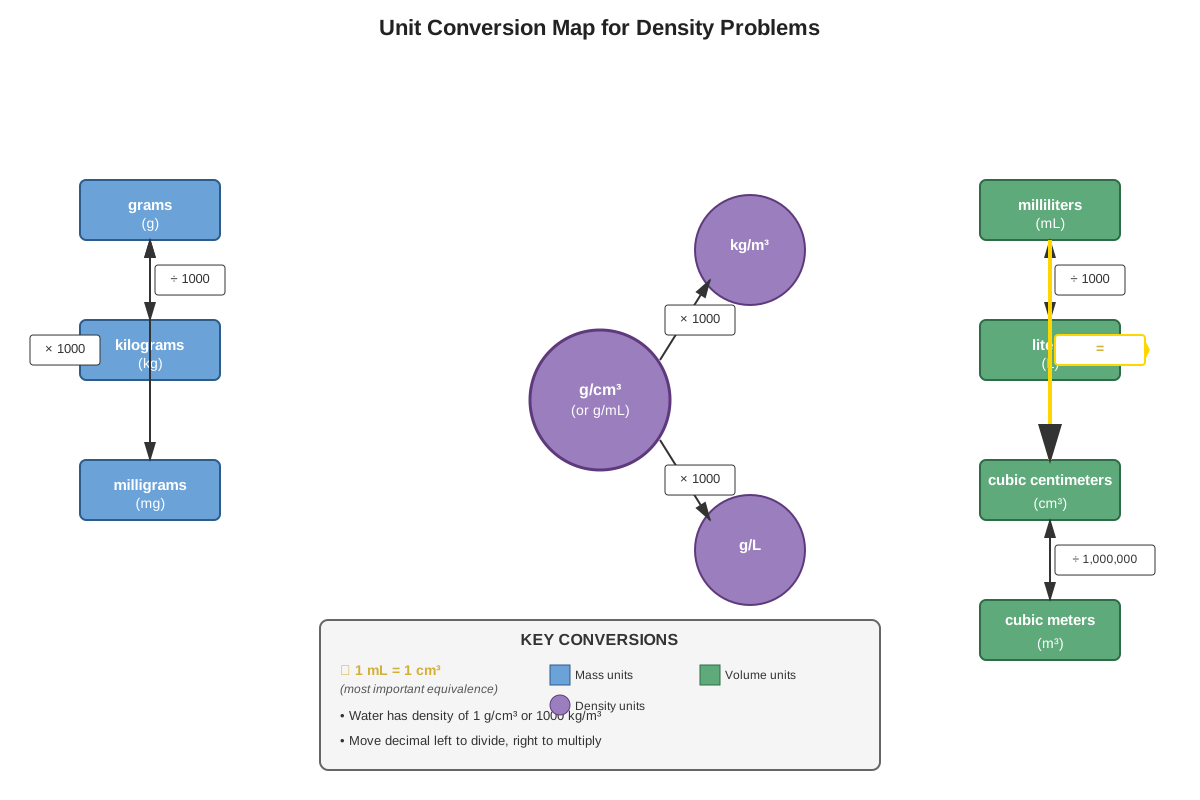
The SAT frequently tests whether students can work with mismatched units. For example, a problem might provide mass in kilograms and volume in cubic centimeters, requiring conversion before calculation. Key conversion relationships include:
- 1 cm³ = 1 mL (for water and similar liquids)
- 1 L = 1000 mL = 1000 cm³
- 1 m³ = 1,000,000 cm³
- 1 kg = 1000 g
Dimensional analysis is the systematic method of tracking units through calculations. When multiplying or dividing quantities, units behave like algebraic variables—they can cancel. For example, if calculating mass using M = D × V with density in g/cm³ and volume in cm³, the cm³ units cancel, leaving grams for mass.
Proportional Reasoning in Density Problems
Since density is a rate (mass per unit volume), it remains constant for a given substance under fixed conditions. This creates proportional relationships that the SAT exploits. If you know the density of a material, you can determine the mass of any volume of that material, or the volume of any mass.
For example, if aluminum has a density of 2.7 g/cm³, then:
- 1 cm³ has mass 2.7 g
- 2 cm³ has mass 5.4 g
- 10 cm³ has mass 27 g
This proportional relationship means that doubling the volume doubles the mass (for a constant density), and halving the volume halves the mass. The SAT tests this understanding through comparison questions: "If object A has twice the volume of object B but the same mass, how do their densities compare?"
Comparative Density Problems
The SAT frequently asks students to compare densities of different objects or materials. These problems test conceptual understanding rather than computational skill. Key principles include:
- Higher density means more mass in the same volume (or the same mass in less volume)
- Objects with density less than water (1 g/cm³) will float; objects with greater density will sink
- When comparing two objects, if they have equal volumes, the denser object has more mass; if they have equal masses, the denser object has less volume
These comparison problems often appear as multiple-choice questions where students must reason through relationships without explicit calculation.
Multi-Step Density Problems
The most challenging SAT density problems require multiple steps, often combining:
- Volume calculation from geometric dimensions: Finding the volume of a rectangular prism (V = l × w × h), cylinder (V = πr²h), or sphere (V = 4/3πr³)
- Unit conversion: Converting between measurement systems
- Density calculation or application: Using D = M/V or its rearrangements
- Proportional reasoning: Scaling up or down based on changed conditions
For example, a problem might describe a cylindrical metal rod, provide its dimensions in centimeters and its mass in kilograms, then ask for its density in g/cm³. This requires calculating volume using the cylinder formula, converting mass from kg to g, then applying D = M/V.
Density in Context: Population and Area Density
While most density problems involve physical mass and volume, the SAT also tests population density and similar area-based rates. Population density uses the same mathematical structure:
Population Density = Number of People / AreaThese problems follow identical logical patterns to mass-volume density but use different units (people/mi² or people/km²). The SAT includes these to test whether students recognize the underlying mathematical structure regardless of context.
Concept Relationships
The core concepts in density problems form an interconnected web of mathematical relationships. The fundamental density formula (D = M/V) serves as the foundation, from which all other concepts derive. This formula connects directly to algebraic manipulation, as students must rearrange it to solve for different variables depending on what the problem provides and asks for.
Units and dimensional analysis overlay every density calculation, ensuring that the numerical work produces meaningful results. This concept connects back to the prerequisite knowledge of unit conversion and forward to the practical execution of multi-step problems. Without proper unit tracking, even correct mathematical reasoning produces incorrect answers.
Proportional reasoning emerges from recognizing that density is a constant rate for a given material. This connects density problems to the broader unit of Ratios, Rates, and Proportions, showing that density is simply one specific type of rate. The proportional relationship enables comparative density problems, where students reason about relative densities without explicit calculation.
Multi-step density problems represent the synthesis of all previous concepts. These problems require: (1) geometric knowledge to calculate volumes, (2) unit conversion skills, (3) algebraic manipulation of the density formula, and (4) proportional reasoning to interpret results. The relationship map flows as:
Fundamental Formula → Algebraic Manipulation → Specific Variable Solved
↓
Units & Dimensional Analysis
↓
Proportional Reasoning → Comparative Problems
↓
Multi-Step Integration → SAT-Level Questions
Quick check — test yourself on Density problems so far.
Try Flashcards →High-Yield Facts
⭐ The density formula D = M/V can be rearranged to M = D × V or V = M / D depending on which variable you need to find
⭐ 1 cm³ = 1 mL, making conversions between these units straightforward for liquids and small solids
⭐ Water has a density of approximately 1 g/cm³ (or 1 g/mL), serving as a reference point for determining if objects float or sink
⭐ When comparing objects of equal volume, the object with greater mass has greater density
⭐ Density remains constant for a given substance, so if you double the volume, you double the mass (proportional relationship)
- Units must match across the formula; if density is in g/cm³, mass must be in grams and volume in cm³
- Population density follows the same mathematical structure as physical density but uses people/area instead of mass/volume
- To convert from g/cm³ to kg/m³, multiply by 1000 (since 1 g/cm³ = 1000 kg/m³)
- The SAT often provides excess information in density problems to test whether students can identify relevant data
- Objects with density greater than 1 g/cm³ sink in water; objects with density less than 1 g/cm³ float
- Dimensional analysis (tracking units through calculations) helps catch setup errors before computing final answers
- Multi-step density problems often require calculating volume from geometric formulas before applying D = M/V
- When a problem asks "how many times denser," divide the two densities to find the ratio
Common Misconceptions
Misconception: Density increases when you have more of a substance (e.g., "a larger piece of aluminum is denser than a smaller piece")
Correction: Density is an intensive property that remains constant for a given material regardless of the amount. A 1 cm³ piece of aluminum has the same density as a 100 cm³ piece. What changes is the total mass, not the density.
Misconception: The formula D = M/V means density equals mass minus volume
Correction: The "/" symbol represents division, not subtraction. Density equals mass divided by volume. This is a rate calculation, not a difference calculation.
Misconception: Units don't matter as long as the numbers are correct
Correction: Units are critical in density problems. Using g/cm³ versus kg/m³ changes the numerical answer by a factor of 1000. The SAT specifically tests unit awareness, and answer choices often include results from common unit errors.
Misconception: You can only use the formula D = M/V when solving for density
Correction: The formula can and must be rearranged depending on what variable is unknown. If you need mass, use M = D × V. If you need volume, use V = M / D. Algebraic flexibility is essential.
Misconception: Population density problems are fundamentally different from mass-volume density problems
Correction: Population density uses identical mathematical reasoning and formula structure (density = quantity / space). The only difference is the context and units. The problem-solving approach remains the same.
Misconception: If object A has twice the mass of object B, then object A is twice as dense
Correction: Density depends on both mass and volume. Object A could have twice the mass because it has twice the volume (same density) or because it's made of a denser material (different density). You need information about both mass and volume to determine density.
Misconception: Heavier objects are always denser
Correction: "Heavy" refers to total mass, while "dense" refers to mass per unit volume. A large foam block might be heavier than a small steel ball, but the steel is much denser because it has more mass per unit volume.
Worked Examples
Example 1: Basic Density Calculation with Unit Conversion
Problem: A rectangular metal block measures 5 cm × 4 cm × 2 cm and has a mass of 540 grams. What is the density of the metal in g/cm³?
Solution:
Step 1: Identify what we know and what we need to find.
- Given: dimensions (5 cm × 4 cm × 2 cm), mass (540 g)
- Find: density in g/cm³
Step 2: Calculate the volume of the rectangular block.
- Volume = length × width × height
- V = 5 cm × 4 cm × 2 cm = 40 cm³
Step 3: Apply the density formula.
- D = M / V
- D = 540 g / 40 cm³
- D = 13.5 g/cm³
Step 4: Check units and reasonableness.
- Units are correct (g/cm³ as requested)
- The answer is reasonable (most metals have densities between 2-20 g/cm³)
Answer: The density is 13.5 g/cm³
Connection to Learning Objectives: This problem demonstrates identifying key features (mass, volume, density), applying the formula, and working with appropriate units—core skills for SAT density problems.
Example 2: Multi-Step Problem with Comparison
Problem: Substance A has a density of 2.4 g/cm³. Substance B has a mass of 180 grams and a volume of 50 cm³. If you have 100 cm³ of Substance A and 100 cm³ of Substance B, what is the difference in their masses?
Solution:
Step 1: Find the density of Substance B.
- D = M / V
- D_B = 180 g / 50 cm³ = 3.6 g/cm³
Step 2: Calculate the mass of 100 cm³ of Substance A.
- M = D × V
- M_A = 2.4 g/cm³ × 100 cm³ = 240 g
Step 3: Calculate the mass of 100 cm³ of Substance B.
- M = D × V
- M_B = 3.6 g/cm³ × 100 cm³ = 360 g
Step 4: Find the difference in masses.
- Difference = M_B - M_A = 360 g - 240 g = 120 g
Answer: The difference in masses is 120 grams (Substance B is heavier)
Connection to Learning Objectives: This problem requires calculating density from given information, applying proportional reasoning (using density to find mass for a different volume), and comparing results—all high-yield SAT skills.
Exam Strategy
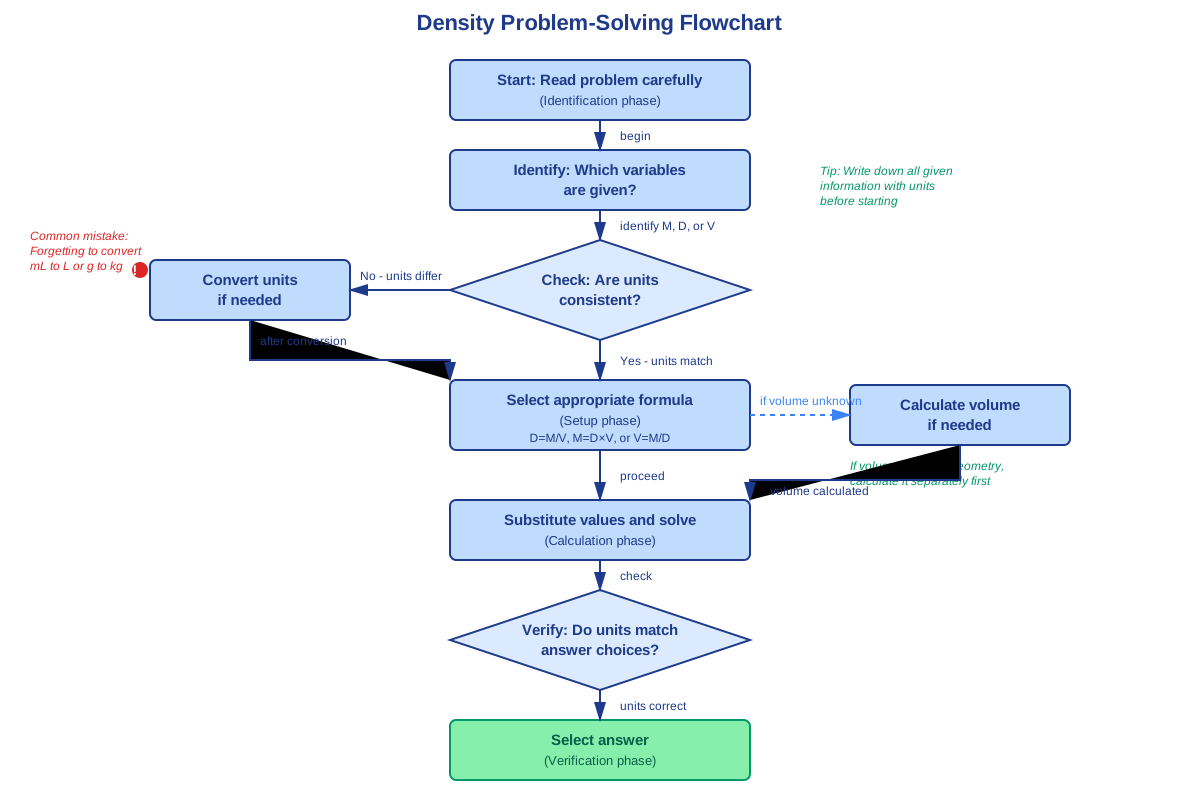
When approaching SAT density problems, begin by identifying the three key variables: mass, volume, and density. Determine which two are provided (either directly or through information that allows calculation) and which one you need to find. This diagnostic step prevents wasting time on incorrect solution paths.
Trigger words and phrases that signal density problems include:
- "mass per unit volume"
- "how much does [volume] weigh"
- "material with density"
- "population per square mile"
- "concentration" (in some contexts)
- "how tightly packed"
- Comparisons like "denser," "heavier for the same size," or "more compact"
Watch for hidden volume calculations. The SAT rarely provides volume directly in challenging problems. Instead, you'll receive dimensions requiring you to calculate volume using geometric formulas. Recognize common shapes: rectangular prisms (V = lwh), cylinders (V = πr²h), and spheres (V = 4/3πr³).
For process-of-elimination strategies:
- Check units in answer choices—eliminate any that don't match the requested units
- Estimate magnitude—if calculating density of a solid and your answer is 0.001 g/cm³, you've likely made an error (most solids are denser than water at 1 g/cm³)
- Test extreme cases—if a problem involves proportions, check whether answer choices make sense when variables are doubled or halved
- Eliminate answers that violate physical principles (e.g., negative density, or claiming a substance denser than water will float)
Time allocation: Simple density problems should take 45-60 seconds. Multi-step problems involving volume calculations and unit conversions may require 90-120 seconds. If you're exceeding two minutes, mark the question and return to it after completing easier problems. Don't let a single density problem consume excessive time.
Calculator usage: For calculator-permitted sections, use your calculator for all arithmetic, but write out the setup first. This prevents input errors and allows you to check your work. For no-calculator sections, look for opportunities to simplify before computing—often the SAT designs problems where numbers cancel nicely.
Memory Techniques
The Density Triangle: Visualize a triangle with D at the top and M and V at the bottom. Cover the variable you're solving for, and the remaining arrangement shows the formula:
- Cover D: M/V (density = mass/volume)
- Cover M: D × V (mass = density × volume)
- Cover V: M/D (volume = mass/density)
"Does My Volume" Mnemonic: The first letters (D, M, V) help remember the three variables in density problems. The phrase structure also reminds you that density describes "my volume" (how much mass is in a given volume).
Water = 1 Reference Point: Remember that water's density is approximately 1 g/cm³ (or 1 g/mL). This serves as an anchor for estimating reasonableness and determining floating/sinking. Objects denser than water (>1) sink; objects less dense (<1) float.
Unit Conversion Ladder: Visualize a ladder for metric conversions:
kg (top)
  ↓ ×1000
g (middle)
  ↓ ×1000
mg (bottom)
Going down multiplies by 1000; going up divides by 1000.
"Same Stuff, Same Density" Principle: Create a mental image of cutting a block of material in half. Both pieces are the same material, so both have the same density. This visualization reinforces that density is intensive (doesn't depend on amount).
Summary
Density problems on the SAT test the fundamental relationship between mass, volume, and density through the formula D = M/V and its algebraic rearrangements. Success requires three core competencies: formula manipulation (solving for any of the three variables), unit awareness (converting between measurement systems and tracking dimensions), and proportional reasoning (recognizing that density remains constant for a given material). The SAT embeds density concepts within multi-step word problems that often require calculating volumes from geometric dimensions, converting units, and comparing densities of different materials. Students must recognize density relationships even when the term "density" isn't explicitly mentioned, particularly in population density contexts. The most effective approach involves systematically identifying which variables are known, which must be found, ensuring unit consistency, and applying dimensional analysis to verify results. Mastering density problems provides transferable skills applicable throughout the Ratios, Rates, and Proportions unit and demonstrates the mathematical maturity that distinguishes high-scoring students.
Key Takeaways
- The density formula D = M/V can be rearranged to solve for any variable: M = D × V or V = M / D
- Units must be consistent throughout calculations; 1 cm³ = 1 mL is a critical conversion for SAT problems
- Density is an intensive property that remains constant for a given material regardless of the amount
- Multi-step problems often require calculating volume from geometric formulas before applying density relationships
- Water's density of 1 g/cm³ serves as a reference point for determining if objects float (density < 1) or sink (density > 1)
- Population density problems use identical mathematical reasoning to mass-volume density, just with different units
- Dimensional analysis (tracking units through calculations) prevents common errors and validates problem setup
Related Topics
Speed, Distance, and Time Problems: These follow the same mathematical structure as density problems (rate = quantity/time instead of density = mass/volume), making the problem-solving approaches directly transferable.
Concentration Problems: Chemistry-based concentration questions (molarity, percent composition) use similar reasoning about amount per unit volume, extending density concepts to solution chemistry.
Unit Rate Problems: Understanding density as a specific type of unit rate (mass per unit volume) connects to broader rate problems involving cost per item, miles per gallon, or work per hour.
Geometric Volume Calculations: Mastery of density problems requires facility with volume formulas for three-dimensional shapes, making solid geometry a natural extension.
Proportional Relationships and Scaling: Since density remains constant, problems involving scaled versions of objects (doubling dimensions, halving size) build on proportional reasoning developed through density work.
Practice CTA
Now that you've mastered the core concepts of density problems, it's time to solidify your understanding through active practice. Attempt the practice questions to test your ability to identify problem types, manipulate formulas, and execute multi-step solutions under timed conditions. Use the flashcards to reinforce key formulas, unit conversions, and common problem patterns until they become automatic. Remember: density problems appear on virtually every SAT, and the skills you develop here—formula manipulation, unit awareness, and proportional reasoning—transfer to numerous other question types. Consistent practice transforms these concepts from abstract formulas into intuitive problem-solving tools that will boost your math score.
Sign up free to keep reading
Create a free AnvayaPrep account to finish this SAT guide on Density problems — plus flashcards and practice questions.