Overview
Inverse variation is a fundamental mathematical relationship that appears regularly on the SAT math section, particularly within questions involving ratios, rates, and proportions. Unlike direct variation where two quantities increase or decrease together, inverse variation describes a relationship where one quantity increases as the other decreases in a specific, predictable pattern. When two variables are inversely proportional, their product remains constant—a principle that underlies countless real-world phenomena from physics to economics.
Understanding sat inverse variation is crucial for test success because it appears in multiple question formats: word problems involving work rates, physics scenarios with speed and time, and abstract algebraic relationships. The SAT frequently tests whether students can recognize inverse relationships from verbal descriptions, translate them into equations, and manipulate these equations to solve for unknown values. Questions may present inverse variation explicitly or embed it within more complex scenarios requiring multi-step reasoning.
This topic connects directly to broader mathematical concepts including proportional reasoning, algebraic manipulation, and function behavior. Mastery of inverse variation strengthens understanding of rational functions, hyperbolic graphs, and the general principle that mathematical relationships can be multiplicative rather than additive. Students who thoroughly understand inverse variation gain a powerful analytical tool applicable across numerous SAT problem types, making this a high-yield topic worthy of focused study.
Learning Objectives
- [ ] Identify key features of inverse variation in equations, graphs, and word problems
- [ ] Explain how inverse variation appears on the SAT in various question formats
- [ ] Apply inverse variation to answer SAT-style questions efficiently and accurately
- [ ] Distinguish between inverse variation and direct variation in problem contexts
- [ ] Construct inverse variation equations from verbal descriptions and data tables
- [ ] Solve multi-step problems involving inverse variation with other mathematical concepts
Prerequisites
- Basic algebraic manipulation: Solving equations for unknown variables is essential since inverse variation problems require isolating variables and substituting values
- Understanding of proportions: Recognizing proportional relationships provides the foundation for distinguishing inverse from direct variation
- Multiplication and division fluency: Inverse variation fundamentally involves products remaining constant, requiring confident arithmetic skills
- Function notation: Many SAT questions present inverse variation using function notation like f(x) = k/x
Why This Topic Matters
Inverse variation models countless real-world phenomena that students encounter in science, economics, and everyday life. When driving a fixed distance, speed and time are inversely related—doubling speed halves travel time. In physics, pressure and volume of gases follow inverse relationships. In business, the number of workers and time to complete a project vary inversely (assuming equal productivity). Understanding these relationships enables students to analyze situations quantitatively and make predictions based on changing conditions.
On the SAT, inverse variation appears in approximately 2-4 questions per test, making it a high-frequency topic that can significantly impact scores. Questions typically appear in both the calculator and no-calculator sections, with difficulty ranging from straightforward identification to complex multi-step applications. The College Board particularly favors word problems that require students to translate verbal descriptions into mathematical relationships, then manipulate those relationships to find specific values.
Common SAT presentations include: work-rate problems where multiple people complete tasks; physics scenarios involving speed, distance, and time; abstract function problems asking about the relationship between variables; and data interpretation questions where students must identify inverse patterns from tables or graphs. The topic frequently combines with other concepts like systems of equations, quadratic relationships, or geometric formulas, making it a versatile tool in the SAT problem-solving toolkit.
Core Concepts
Definition of Inverse Variation
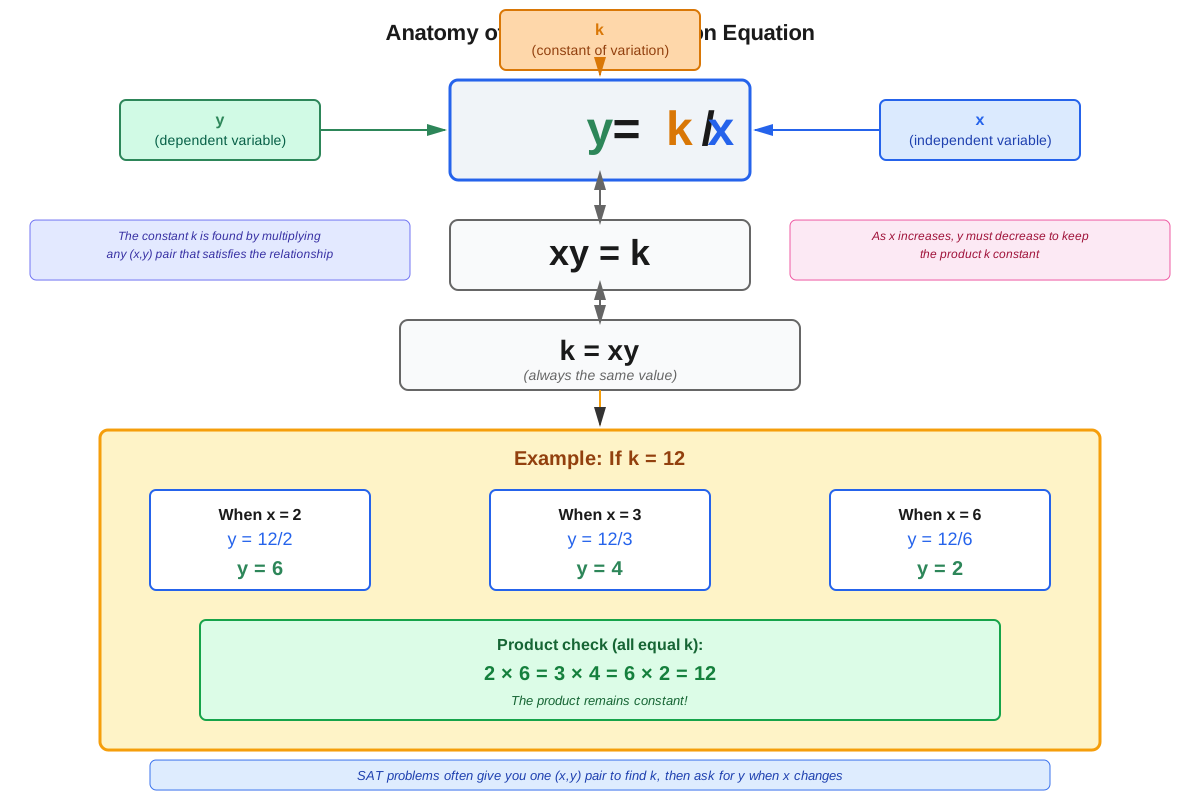
Two quantities exhibit inverse variation (also called inverse proportion) when their product equals a constant value. Mathematically, if variables x and y vary inversely, then:
xy = kwhere k is the constant of variation (or constant of proportionality), a non-zero value that remains unchanged regardless of the specific values of x and y. This relationship can be equivalently expressed as:
y = k/xThis form clearly shows that y is inversely proportional to x: as x increases, y must decrease to maintain the constant product k, and vice versa. The constant k determines the "strength" of the relationship—larger k values mean larger products, while the inverse nature of the relationship remains consistent.
Recognizing Inverse Variation
Several key features distinguish inverse variation from other mathematical relationships:
Algebraic form: The equation contains one variable in the numerator and another in the denominator, with no addition or subtraction terms (y = k/x, not y = k/x + 3)
Product property: Multiplying the two variables always yields the same result regardless of their individual values
Reciprocal relationship: If x doubles, y is halved; if x triples, y becomes one-third its original value
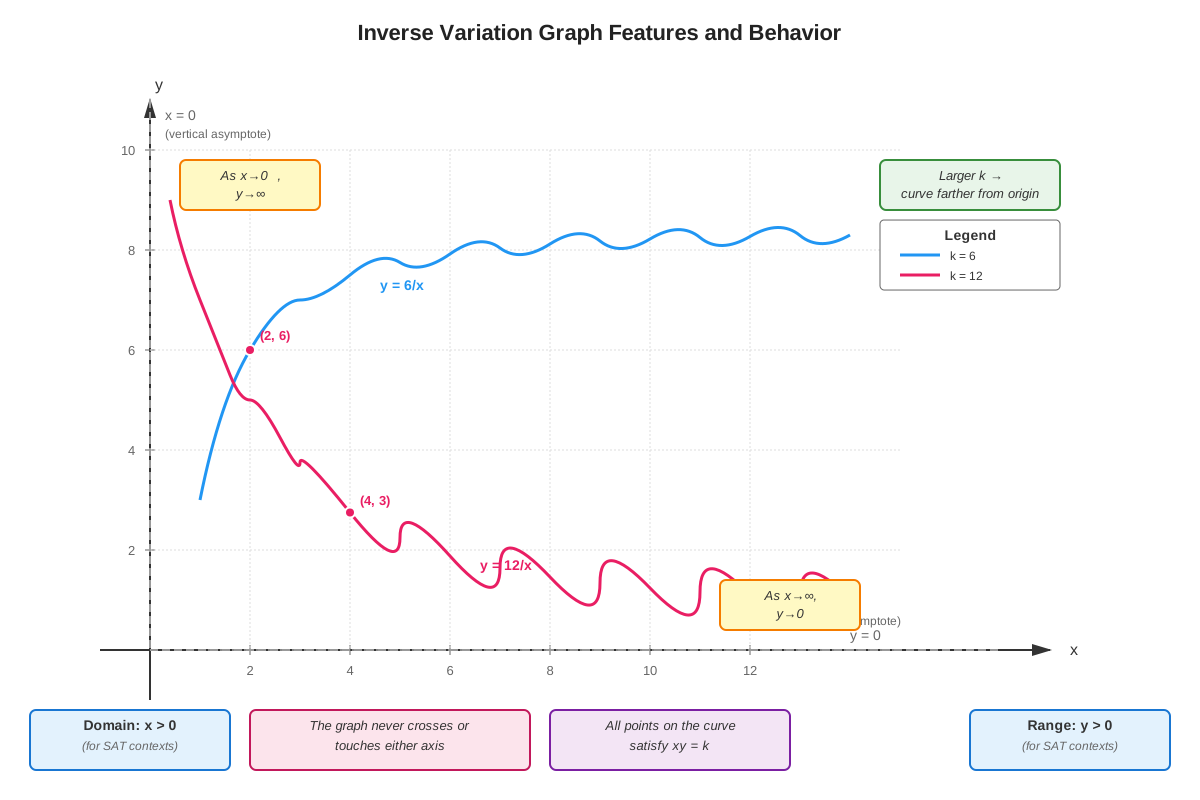
Graph characteristics: The graph of an inverse variation is a hyperbola with two branches in opposite quadrants, approaching but never touching the x and y axes (these axes are asymptotes)
Finding the Constant of Variation
To solve inverse variation problems, students must first determine the constant k using given information. The process follows these steps:
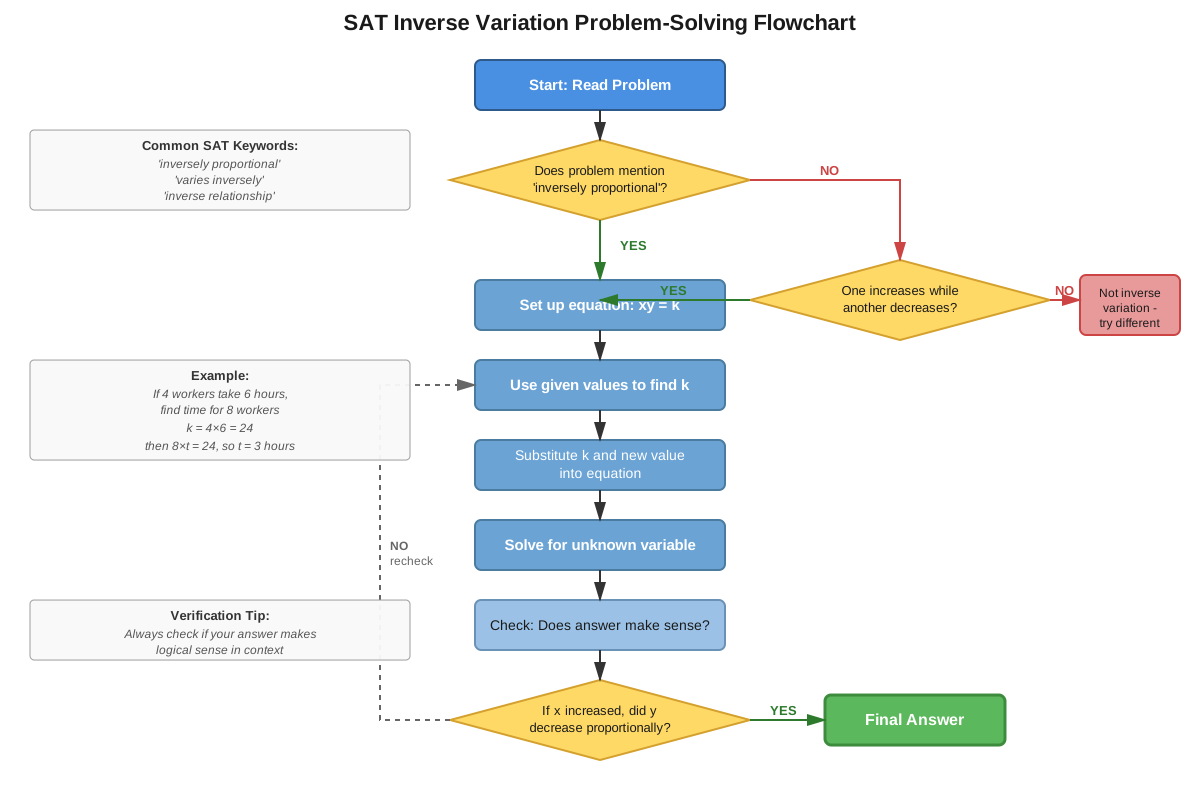
- Identify that the relationship is inverse variation (from context or explicit statement)
- Write the general equation: xy = k or y = k/x
- Substitute known values for both variables
- Solve for k
- Write the complete equation with the specific k value
- Use this equation to find unknown values
Example: If y varies inversely with x, and y = 12 when x = 5, find k.
xy = k
(5)(12) = k
k = 60
The complete relationship is xy = 60 or y = 60/x.
Inverse Variation in Word Problems
SAT word problems rarely state "inverse variation" explicitly. Instead, they describe situations where inverse relationships exist. Common verbal cues include:
- "inversely proportional to"
- "varies inversely with"
- "as one increases, the other decreases"
- "the product remains constant"
- Work problems: "working together" or "shared workload"
- Time-distance-speed scenarios with fixed distance
Translation strategy: Identify the two quantities that change, determine which remains constant, and construct the equation accordingly.
Comparison with Direct Variation
Understanding the distinction between direct and inverse variation is crucial for SAT success:
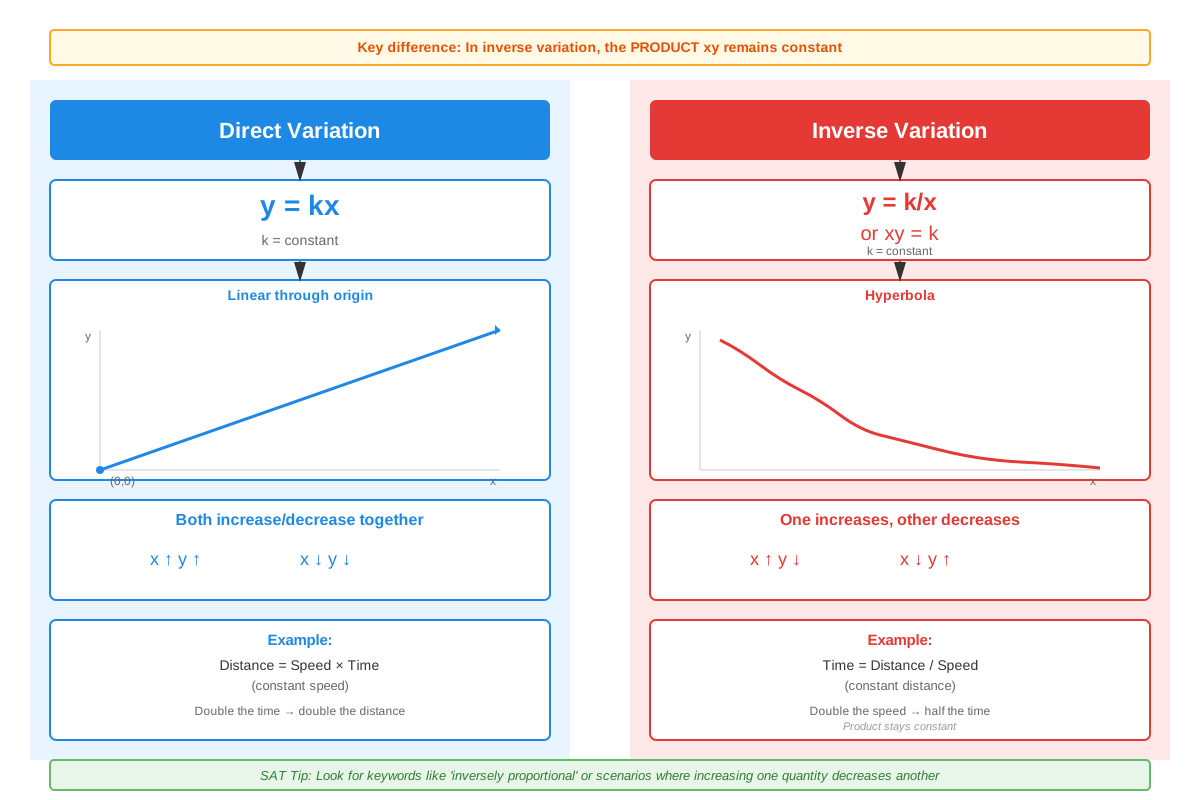
| Feature | Direct Variation | Inverse Variation |
|---|---|---|
| Equation | y = kx | y = k/x or xy = k |
| Relationship | Both increase/decrease together | One increases as other decreases |
| Constant | Ratio y/x = k | Product xy = k |
| Graph | Straight line through origin | Hyperbola (curved) |
| Example | Distance = speed × time (fixed speed) | Speed × time = distance (fixed distance) |
Solving for Unknown Values
Once the constant k is determined, finding unknown values requires substitution and algebraic manipulation:
Given: xy = 60 (from previous example), find y when x = 8
(8)y = 60
y = 60/8
y = 7.5
Alternative approach using proportions: When comparing two situations with the same inverse relationship:
x₁y₁ = x₂y₂This proportion method is particularly efficient when k is not explicitly needed in the final answer.
Multiple Variable Inverse Variation
Some SAT problems involve one variable inversely proportional to multiple variables or their product:
z = k/(xy)This means z varies inversely with the product of x and y. If either x or y doubles while the other remains constant, z is halved.
Concept Relationships
Inverse variation connects to prerequisite knowledge of proportional reasoning by extending the concept beyond simple direct relationships. While direct variation (y = kx) represents linear growth, inverse variation (y = k/x) introduces rational functions and hyperbolic behavior. This relationship → leads to → understanding of asymptotic behavior and limits, foundational concepts in calculus.
The constant of variation k → serves as → the bridge between different states of the same inverse relationship, allowing students to move from known conditions to unknown scenarios. This principle → parallels → the use of constants in physics equations and economic models, demonstrating mathematical modeling of real phenomena.
Inverse variation → combines with → systems of equations when problems involve multiple relationships simultaneously. For example, a problem might state that y varies inversely with x (xy = k₁) while z varies directly with y (z = k₂y), requiring students to → synthesize → both relationships to find connections between x and z.
The graphical representation of inverse variation → introduces → hyperbolas and asymptotic behavior, which → connects to → rational functions studied in algebra. Understanding that the graph approaches but never reaches the axes → reinforces → the concept that neither variable can equal zero in a true inverse relationship (since division by zero is undefined).
Work-rate problems involving inverse variation → build upon → the fundamental rate formula (work = rate × time) and → extend to → collaborative work scenarios where multiple rates combine. This → demonstrates → how inverse variation appears in practical contexts rather than purely abstract mathematical relationships.
High-Yield Facts
⭐ If two quantities vary inversely, their product always equals a constant: xy = k
⭐ The equation for inverse variation can be written as y = k/x, where k ≠ 0
⭐ In inverse variation, when one variable doubles, the other is halved (reciprocal changes)
⭐ The graph of inverse variation is a hyperbola with the x and y axes as asymptotes
⭐ Common SAT contexts for inverse variation include work rates, speed-time relationships with fixed distance, and pressure-volume relationships
- The constant of variation k can be found by multiplying any corresponding pair of x and y values
- Inverse variation never passes through the origin (unlike direct variation)
- Neither variable in an inverse relationship can equal zero (division by zero is undefined)
- The phrase "inversely proportional" is mathematically equivalent to "varies inversely"
- When comparing two states of the same inverse relationship: x₁y₁ = x₂y₂
- Inverse variation represents a decreasing function when k > 0 and x > 0
- The rate of decrease in an inverse relationship slows as x increases (the curve flattens)
- Multiple workers completing a task in less time is a classic inverse variation scenario
Quick check — test yourself on Inverse variation so far.
Try Flashcards →Common Misconceptions
Misconception: Inverse variation means the variables are opposites or negatives of each other → Correction: Inverse variation describes a multiplicative relationship where the product is constant, not an additive relationship involving negatives. If x = 5 and y = 4 with xy = 20, when x = 10, y = 2 (not -10).
Misconception: The constant k in inverse variation must always be positive → Correction: While k is often positive in real-world contexts, mathematically k can be any non-zero real number. Negative k values produce hyperbolas in quadrants II and IV rather than I and III.
Misconception: If y varies inversely with x, then x varies directly with y → Correction: If y varies inversely with x, then x also varies inversely with y. The relationship is symmetric: xy = k can be rearranged to show either variable in terms of the other, maintaining the inverse relationship.
Misconception: Inverse variation and negative correlation are the same thing → Correction: Inverse variation is a specific mathematical relationship (xy = k) where variables change in predictable, reciprocal ways. Negative correlation is a statistical concept describing a general tendency for variables to move in opposite directions without requiring a specific functional form.
Misconception: In work problems, more workers always means proportionally less time → Correction: This assumes inverse variation (workers × time = constant work), which only holds when workers have equal productivity and work independently. The SAT may present scenarios where this assumption is explicitly stated or must be inferred from context.
Misconception: The equation y = k/x + c represents inverse variation → Correction: True inverse variation has the form y = k/x with no additional constant term. Adding c creates a shifted hyperbola that is not pure inverse variation, as the product xy no longer equals a constant.
Worked Examples
Example 1: Classic Inverse Variation Problem
Problem: The time t (in hours) required to complete a construction project varies inversely with the number of workers n. If 8 workers can complete the project in 15 hours, how many hours will it take 12 workers to complete the same project?
Solution:
Step 1: Identify the inverse relationship. The problem states "varies inversely," so we know tn = k.
Step 2: Find the constant of variation using the given information (n = 8, t = 15).
tn = k
(15)(8) = k
k = 120
Step 3: Write the complete equation: tn = 120
Step 4: Find t when n = 12.
t(12) = 120
t = 120/12
t = 10Answer: 12 workers will complete the project in 10 hours.
Alternative approach using proportions: Since t₁n₁ = t₂n₂:
(15)(8) = t₂(12)
120 = 12t₂
t₂ = 10
Connection to learning objectives: This problem demonstrates identifying inverse variation from verbal description, constructing the appropriate equation, and applying it to find an unknown value—core skills tested on the SAT.
Example 2: Multi-Step Problem with Inverse Variation
Problem: The intensity I of light varies inversely with the square of the distance d from the light source. If the intensity is 100 units at a distance of 5 meters, what is the intensity at a distance of 10 meters?
Solution:
Step 1: Recognize this is inverse variation with a squared term: I = k/d²
Step 2: Find k using I = 100 when d = 5.
100 = k/(5²)
100 = k/25
k = 100 × 25
k = 2500
Step 3: Write the complete equation: I = 2500/d²
Step 4: Find I when d = 10.
I = 2500/(10²)
I = 2500/100
I = 25Answer: The intensity at 10 meters is 25 units.
Key insight: When distance doubles (5 to 10), intensity becomes one-fourth (100 to 25) because the relationship involves the square of distance. This demonstrates that inverse variation can involve powers of variables, not just simple reciprocals.
Connection to learning objectives: This problem shows how inverse variation appears in physics contexts on the SAT and requires recognizing that the inverse relationship involves d² rather than just d, testing deeper conceptual understanding.
Exam Strategy
Recognition triggers: Train yourself to identify inverse variation from these SAT phrases: "inversely proportional," "varies inversely," "as one increases the other decreases," "the product remains constant," or scenarios involving work rates with multiple people, speed-time relationships with fixed distance, or intensity-distance relationships.
Equation setup approach: When encountering a potential inverse variation problem, immediately write xy = k or y = k/x and identify which quantities correspond to x and y. Use the given information to find k before attempting to answer the question. This systematic approach prevents errors from trying to solve too quickly.
Process of elimination for multiple choice: If a problem involves inverse variation and asks for a value when one variable changes, eliminate answers that suggest direct variation (both increasing together). For example, if x doubles and the question asks for the new y value, eliminate any answer showing y doubling—it should be halved.
Time management: Inverse variation problems typically require 1-2 minutes. Spend 30 seconds identifying the relationship and finding k, then 30-60 seconds solving for the unknown. If you cannot identify the relationship type within 30 seconds, mark the question and return to it later rather than guessing at the relationship.
Calculator usage: For calculator-permitted sections, use your calculator to verify that the product xy equals the same value for different pairs of data points when checking if a relationship is inverse variation. This quick verification can prevent errors from misidentifying the relationship type.
Common trap answers: The SAT often includes distractor answers that result from treating inverse variation as direct variation or from arithmetic errors in finding k. Always verify your answer makes logical sense—if workers increase, time should decrease; if distance increases, intensity should decrease.
Graph interpretation: When presented with a graph, inverse variation appears as a hyperbola. If asked whether a relationship is inverse variation, check if the curve approaches but never touches the axes and exists in opposite quadrants (typically quadrant I and III for positive k).
Memory Techniques
"Product Stays Put" mnemonic: Remember that in Inverse variation, the Product stays Put (constant). This reinforces that xy = k is the defining equation.
Visual anchor: Picture a seesaw—when one side goes up, the other goes down. This represents the reciprocal nature of inverse variation, though remember the mathematical relationship is multiplicative (xy = k), not additive.
"Flip the script" technique: In inverse variation, you "flip" one variable to the denominator: y = k/x. The word "inverse" suggests flipping or reversing, which corresponds to the reciprocal relationship.
HYPERBOLA acronym:
- Hyperbola shape on graph
- Y times x equals constant
- Product remains same
- Equation: y = k/x
- Reciprocal changes
- Both variables non-zero
- Opposite quadrants
- Line never touches axes
- Asymptotes are axes
Work problem shortcut: "More workers, less time" naturally suggests inverse variation. Create the mental link: MORE × LESS = CONSTANT (workers × time = total work).
Comparison memory aid: Direct = Division gives constant (y/x = k); Inverse = Product gives constant (xy = k). The "D" in Direct and Division link together, while "I" and "P" in Inverse and Product connect.
Summary
Inverse variation describes a fundamental mathematical relationship where two quantities multiply to produce a constant value, expressed as xy = k or equivalently y = k/x. This relationship appears throughout SAT math sections in contexts ranging from work-rate problems to physics scenarios, making it essential for test success. The key distinguishing feature is that as one variable increases, the other decreases proportionally such that their product never changes. Students must be able to recognize inverse variation from verbal descriptions, construct appropriate equations, determine the constant of variation from given information, and apply these equations to solve for unknown values. Unlike direct variation where variables change in the same direction, inverse variation creates a hyperbolic graph with asymptotic behavior at the axes. Mastery requires understanding both the algebraic manipulation (finding k and solving for unknowns) and the conceptual recognition (identifying when real-world situations involve inverse relationships). The most common SAT applications involve multiple workers completing tasks, speed-time relationships with fixed distances, and intensity-distance relationships in physics contexts.
Key Takeaways
- Inverse variation means the product of two variables equals a constant: xy = k or y = k/x
- When one variable in an inverse relationship doubles, the other is halved (reciprocal changes)
- The constant k is found by multiplying any corresponding pair of values from the relationship
- SAT problems rarely state "inverse variation" explicitly—look for contextual clues like work rates or "inversely proportional"
- The graph of inverse variation is a hyperbola that approaches but never touches the x and y axes
- Distinguish inverse variation (product constant) from direct variation (ratio constant) by analyzing how variables change together
- Common SAT contexts include multiple workers completing tasks, speed-time with fixed distance, and intensity-distance relationships
Related Topics
Direct Variation: Understanding how y = kx differs from y = k/x strengthens proportional reasoning skills and helps distinguish relationship types on the SAT. Mastering inverse variation makes direct variation problems more intuitive by contrast.
Rational Functions: Inverse variation (y = k/x) is the simplest form of rational function, providing foundation for understanding more complex rational expressions, asymptotic behavior, and function transformations in advanced algebra.
Work-Rate Problems: These problems frequently combine inverse variation with systems of equations, requiring students to set up multiple relationships and solve simultaneously—a high-yield SAT skill.
Quadratic Variation: Some SAT problems involve variation with squared terms (y = k/x² or y = kx²), extending the basic variation concepts to more complex relationships common in physics applications.
Systems of Equations: Inverse variation often appears within larger problems requiring simultaneous solution of multiple equations, making it a building block for more complex algebraic reasoning.
Practice CTA
Now that you understand the core principles of inverse variation, it's time to solidify your mastery through practice. Attempt the practice questions to apply these concepts in SAT-style scenarios, testing your ability to recognize, construct, and solve inverse variation problems under exam conditions. Use the flashcards to reinforce key definitions, formulas, and recognition triggers until they become automatic. Remember: inverse variation appears on virtually every SAT, making your investment in this topic directly translatable to points on test day. Consistent practice transforms understanding into the quick, confident problem-solving that distinguishes top scorers!
Sign up free to keep reading
Create a free AnvayaPrep account to finish this SAT guide on Inverse variation — plus flashcards and practice questions.