Overview
Direct variation is a fundamental mathematical relationship that describes how two quantities change together in a constant ratio. When one variable increases, the other increases proportionally; when one decreases, the other decreases proportionally. This concept appears frequently on the SAT and forms the foundation for understanding more complex proportional relationships, linear functions, and real-world applications involving rates and scaling.
On the SAT, direct variation questions test a student's ability to recognize proportional relationships, set up equations correctly, and solve for unknown values efficiently. These problems often appear in both the calculator and no-calculator sections, sometimes disguised within word problems about physics, economics, or everyday scenarios. Mastering direct variation is essential because it connects to numerous other math topics including linear equations, slope, unit rates, and proportional reasoning—all high-yield areas for the exam.
Understanding direct variation provides a powerful problem-solving framework that extends beyond the SAT. The concept underlies scientific laws (like Hooke's Law), financial calculations (currency conversion), and practical applications (recipe scaling, map reading). Students who develop fluency with direct variation gain both computational skills and conceptual understanding that accelerates their performance across multiple question types on test day.
Learning Objectives
- [ ] Identify key features of direct variation
- [ ] Explain how direct variation appears on the SAT
- [ ] Apply direct variation to answer SAT-style questions
- [ ] Write and manipulate direct variation equations in the form y = kx
- [ ] Calculate the constant of variation from given data points
- [ ] Distinguish between direct variation and other proportional relationships
- [ ] Solve multi-step problems involving direct variation in real-world contexts
Prerequisites
- Basic algebraic manipulation: Solving for variables, isolating terms, and working with equations is essential for setting up and solving direct variation problems
- Understanding of ratios and proportions: Direct variation is fundamentally a proportional relationship, requiring comfort with equivalent ratios
- Linear equation concepts: Recognizing that direct variation represents a special case of linear functions helps with graphical interpretation
- Multiplication and division fluency: Quick calculation with fractions and decimals speeds up problem-solving significantly
Why This Topic Matters
Direct variation appears in 3-5 questions per SAT exam, making it a high-frequency topic that offers reliable scoring opportunities. Questions typically appear as word problems requiring equation setup, as algebraic manipulation challenges, or as data interpretation tasks involving tables and graphs. The College Board consistently tests whether students can translate verbal descriptions into mathematical relationships and apply proportional reasoning to novel contexts.
In real-world applications, direct variation models countless phenomena: distance traveled varies directly with time at constant speed; cost varies directly with quantity purchased; electrical current varies directly with voltage at constant resistance. Professionals in engineering, finance, science, and data analysis use direct variation daily to make predictions, scale solutions, and understand relationships between variables.
The SAT specifically favors direct variation because it assesses multiple competencies simultaneously: reading comprehension (interpreting word problems), algebraic fluency (manipulating equations), numerical reasoning (calculating with constants), and logical thinking (recognizing when relationships are proportional). Students who master this topic gain confidence across the entire Problem Solving and Data Analysis domain, as well as portions of Heart of Algebra and Passport to Advanced Math.
Core Concepts
Definition and Standard Form
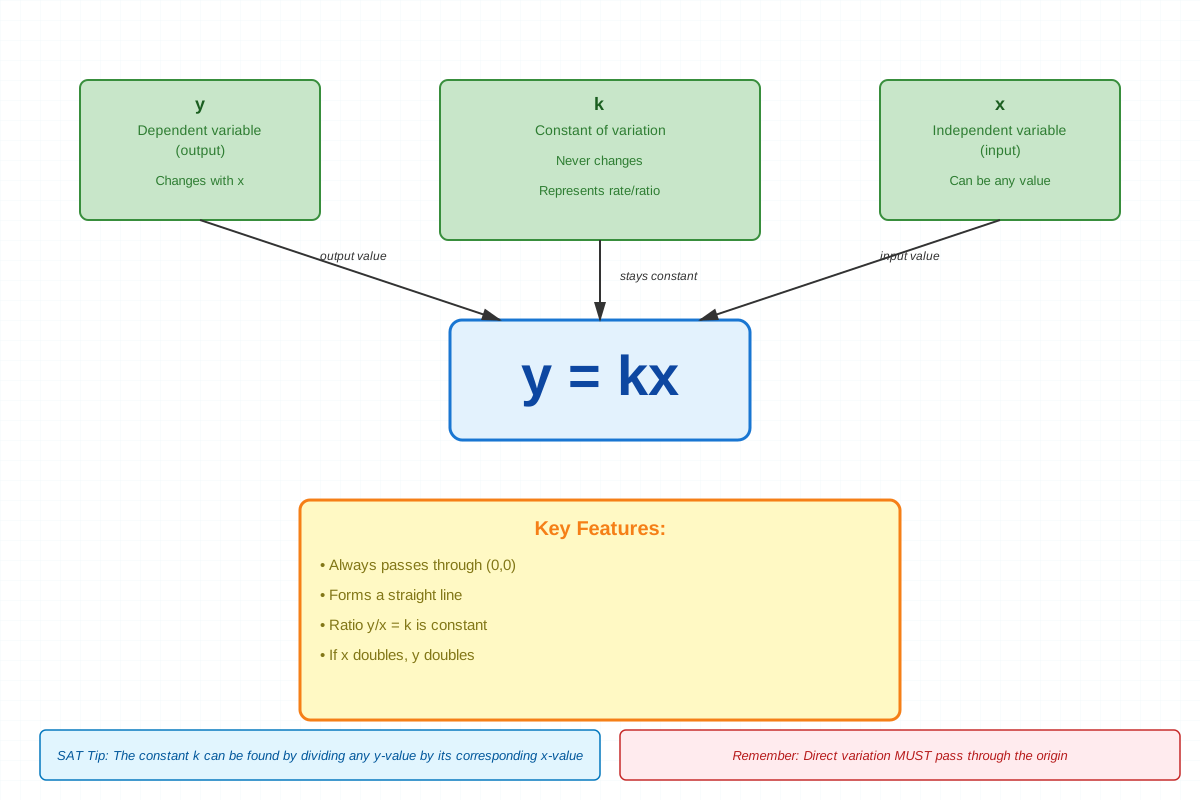
Direct variation describes a relationship between two variables where their ratio remains constant. When variable y varies directly with variable x, the relationship can be expressed as:
y = kxwhere k is the constant of variation (also called the constant of proportionality). This constant k represents the ratio y/x and must be non-zero. The equation y = kx is the standard form for direct variation.
Key characteristics of direct variation include:
- The equation passes through the origin (0, 0) when graphed
- The constant k represents the rate of change or slope
- If x doubles, y doubles; if x triples, y triples
- The relationship is linear with no y-intercept term
The Constant of Variation
The constant of variation k can be found by rearranging the direct variation equation:
k = y/xTo find k from given information:
- Identify a complete pair of corresponding values (x, y)
- Substitute these values into k = y/x
- Calculate k by dividing y by x
- Use this k value to find other unknown values in the relationship
For example, if y varies directly with x, and y = 15 when x = 3, then:
- k = 15/3 = 5
- The complete equation is y = 5x
- This means y is always 5 times as large as x
Recognizing Direct Variation in Word Problems
SAT direct variation problems use specific trigger phrases that signal the relationship:
- "y varies directly with x"
- "y is directly proportional to x"
- "y is proportional to x"
- "y varies as x"
- "y is directly related to x"
These phrases all indicate the same mathematical relationship: y = kx. The SAT may also describe direct variation contextually without using these exact phrases, requiring students to recognize proportional relationships from the problem structure.
Solving Direct Variation Problems
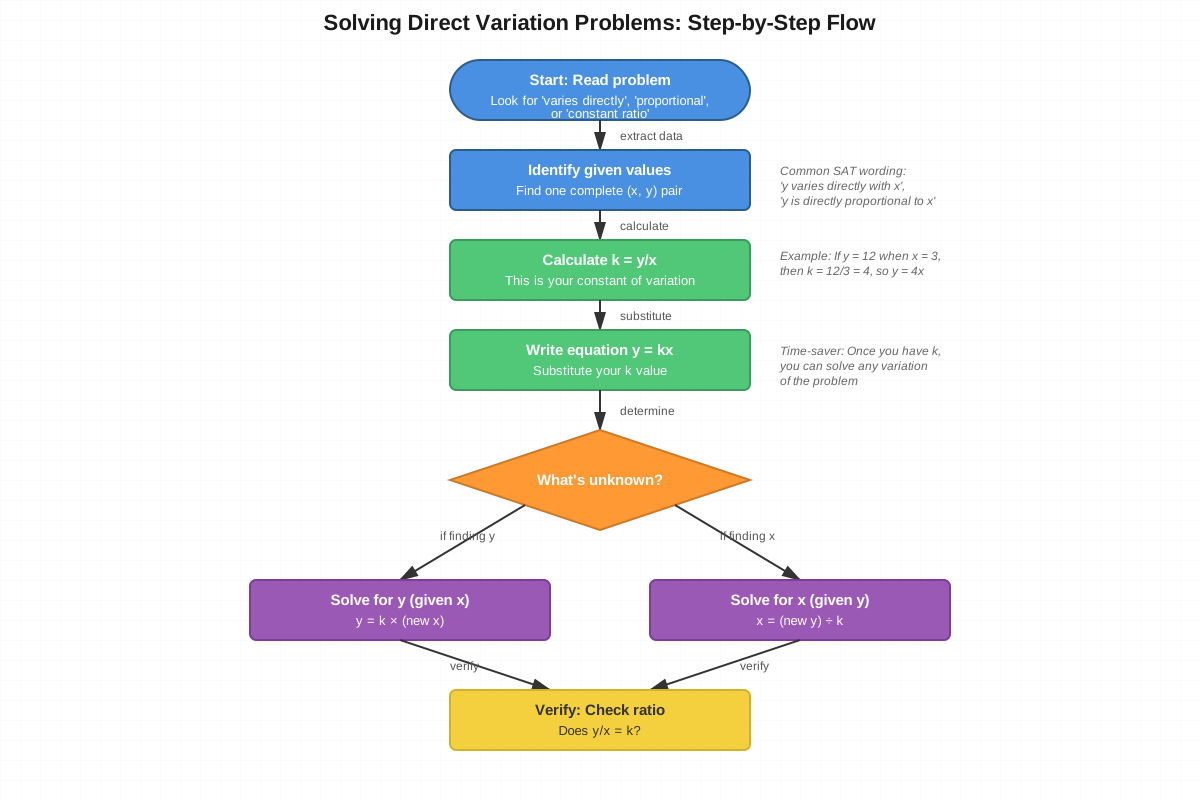
The standard problem-solving process follows these steps:
- Identify the relationship: Confirm that direct variation applies
- Set up the equation: Write y = kx with appropriate variable names
- Find the constant: Use given values to calculate k
- Write the complete equation: Substitute k back into y = kx
- Solve for the unknown: Use the equation to find the requested value
Direct Variation in Tables and Graphs
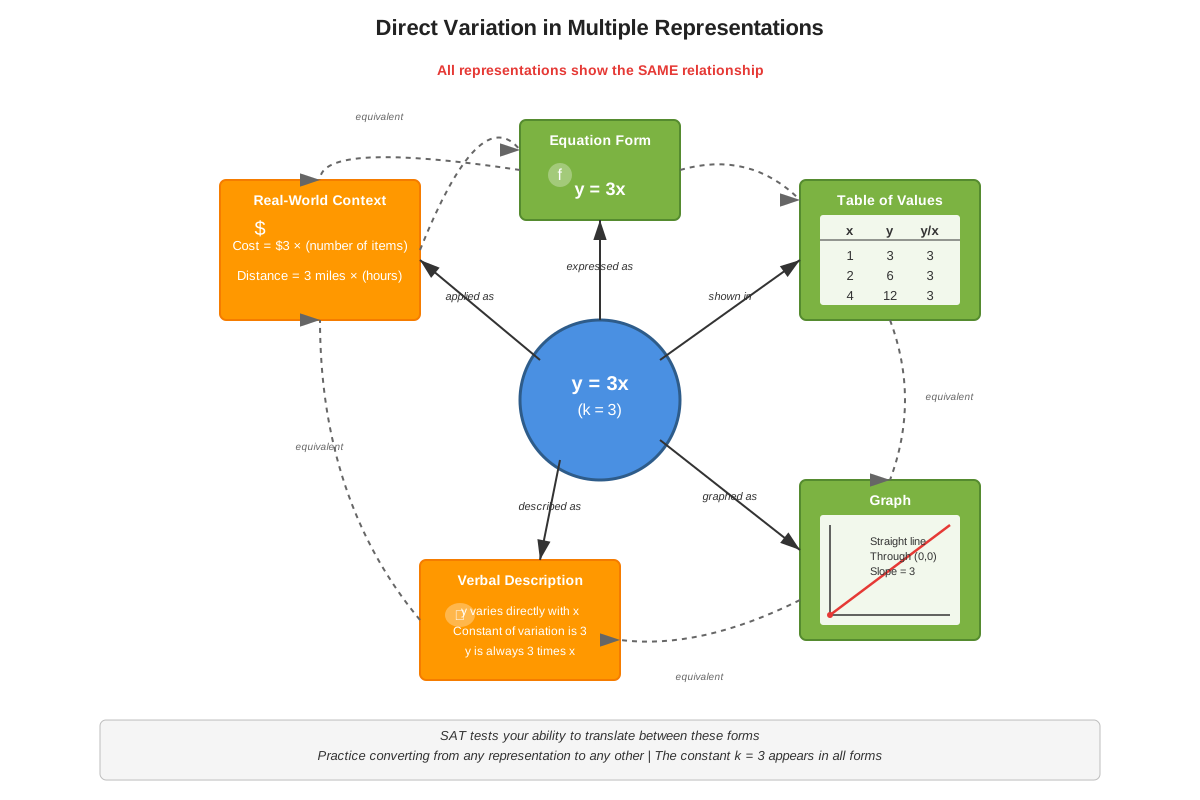
When presented in table form, direct variation exhibits a constant ratio between corresponding values:
| x | y | y/x |
|---|---|---|
| 2 | 6 | 3 |
| 4 | 12 | 3 |
| 5 | 15 | 3 |
| 8 | 24 | 3 |
Notice that y/x always equals 3, confirming k = 3 and y = 3x.
Graphically, direct variation always produces a straight line passing through the origin. The slope of this line equals the constant of variation k. If k is positive, the line rises from left to right; if k is negative, the line falls from left to right.
Multiple Variable Direct Variation
Some SAT problems involve direct variation with multiple variables or combined relationships. For instance, "z varies directly with the product of x and y" translates to:
z = kxyOr "w varies directly with x and inversely with y" (combining direct and inverse variation):
w = kx/yThese compound relationships require careful translation from words to equations, but follow the same principles: identify the relationship structure, find k using given values, then solve for unknowns.
Direct Variation vs. Other Relationships
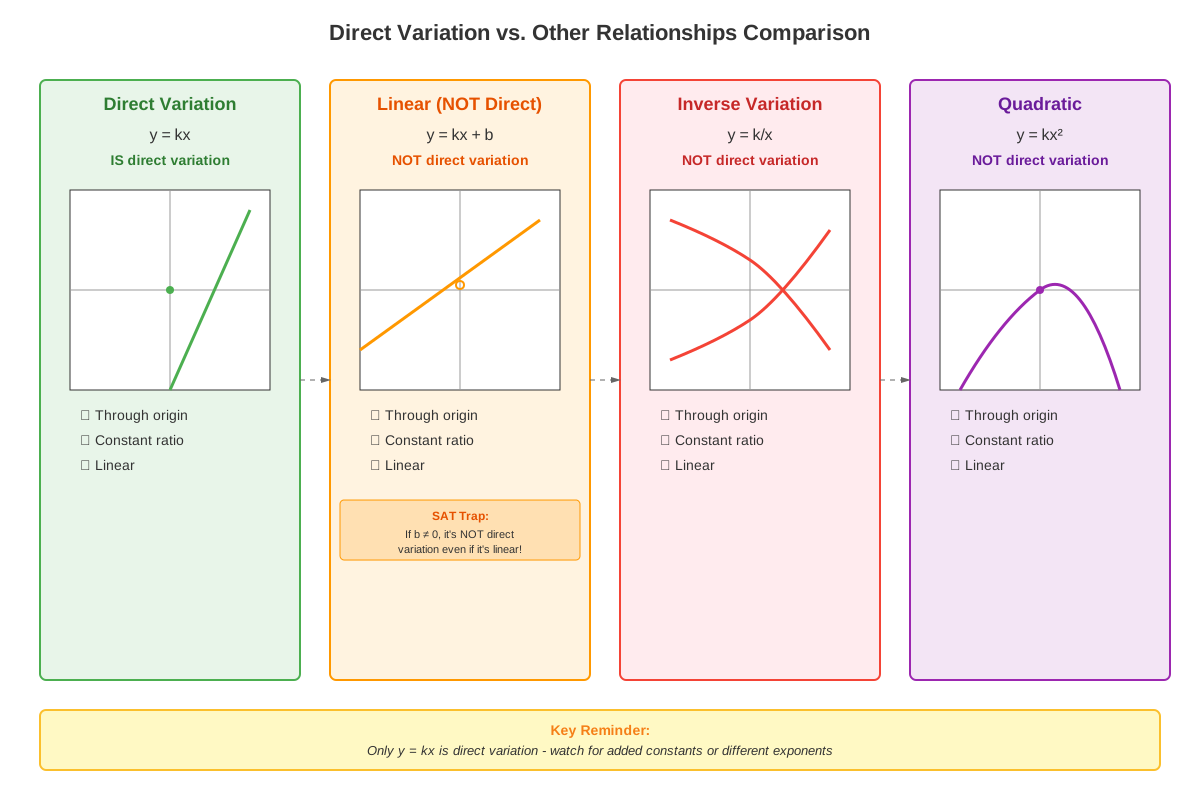
Not all proportional-looking relationships are direct variation. Key distinctions:
| Relationship Type | Equation Form | Passes Through Origin? |
|---|---|---|
| Direct Variation | y = kx | Yes |
| Linear (general) | y = mx + b | Only if b = 0 |
| Inverse Variation | y = k/x | No |
| Quadratic | y = kx² | Yes, but not linear |
The critical test: Does the equation have the form y = kx with no additional terms? If yes, it's direct variation. If there's a constant added (y = kx + b where b ≠ 0), it's linear but not direct variation.
Concept Relationships
Direct variation serves as a foundational concept connecting multiple mathematical domains. The relationship flows as follows:
Ratios and Proportions → Direct Variation → Linear Functions → Rate Problems
Within direct variation itself, concepts build sequentially:
- Understanding the definition (y = kx) enables recognition of the relationship in problems
- Calculating the constant of variation (k) allows creation of specific equations
- Writing complete equations enables solving for unknown values
- Recognizing graphical representations connects algebraic and visual reasoning
Direct variation connects backward to prerequisite topics:
- Equivalent ratios: The constant k represents a ratio that remains equivalent across all value pairs
- Solving equations: Finding k and solving for unknowns requires algebraic manipulation skills
- Multiplication properties: Understanding that scaling one variable scales the other proportionally
Forward connections to more advanced topics include:
- Slope: The constant k is identical to the slope m in y = mx
- Unit rates: Direct variation with k = 1 represents a unit rate relationship
- Systems of equations: Direct variation equations can be part of larger systems
- Functions: Direct variation represents a special class of linear functions
High-Yield Facts
⭐ Direct variation always has the form y = kx where k is a non-zero constant
⭐ The graph of a direct variation relationship is a straight line through the origin (0, 0)
⭐ The constant of variation k equals the ratio y/x for any point in the relationship
⭐ If y varies directly with x and x doubles, then y also doubles (proportional scaling)
⭐ Direct variation equations have no constant term added or subtracted (no "+b" or "-c")
- The constant k can be positive or negative, affecting whether y increases or decreases as x increases
- Direct variation is a special case of linear equations where the y-intercept equals zero
- When given one complete (x, y) pair, you can determine the entire direct variation relationship
- The phrase "directly proportional" is mathematically equivalent to "varies directly"
- In a table of values, direct variation produces a constant quotient when dividing y by x
- Direct variation problems often involve real-world contexts like distance-time, cost-quantity, or measurement conversions
- The constant k has units that are the quotient of y's units divided by x's units
Quick check — test yourself on Direct variation so far.
Try Flashcards →Common Misconceptions
Misconception: All linear relationships are direct variation. → Correction: Only linear relationships passing through the origin (with no constant term) qualify as direct variation. The equation y = 2x + 3 is linear but NOT direct variation because of the "+3" term.
Misconception: The constant of variation k must always be a whole number. → Correction: The constant k can be any non-zero real number, including fractions, decimals, and negative numbers. For example, y = 0.5x and y = -3x are both valid direct variation relationships.
Misconception: Direct variation means both variables increase together. → Correction: When k is positive, both variables increase together, but when k is negative, one variable increases while the other decreases. The relationship y = -4x is still direct variation even though y decreases as x increases.
Misconception: Finding k requires complex calculations. → Correction: Finding k simply requires dividing any y-value by its corresponding x-value: k = y/x. This is straightforward arithmetic once you identify a complete value pair.
Misconception: Direct variation and inverse variation are the same thing. → Correction: These are opposite relationships. Direct variation follows y = kx (product is constant: y/x = k), while inverse variation follows y = k/x (product is constant: xy = k). In direct variation, increasing x increases y; in inverse variation, increasing x decreases y.
Misconception: You need multiple data points to establish direct variation. → Correction: A single complete (x, y) pair is sufficient to determine the constant k and write the complete direct variation equation, assuming you know the relationship is direct variation.
Misconception: The variables must be named x and y. → Correction: Any variables can be used. Problems might use d and t (distance and time), C and n (cost and number), or any other letters. The relationship structure y = kx remains the same regardless of variable names.
Worked Examples
Example 1: Standard Direct Variation Problem
Problem: The distance a spring stretches varies directly with the force applied to it. If a force of 12 newtons stretches the spring 8 centimeters, how far will the spring stretch when a force of 18 newtons is applied?
Solution:
Step 1: Identify the relationship and variables.
- Distance (d) varies directly with force (F)
- Equation form: d = kF
Step 2: Find the constant of variation using the given information.
- When F = 12, d = 8
- k = d/F = 8/12 = 2/3
Step 3: Write the complete equation.
- d = (2/3)F
Step 4: Solve for the unknown.
- When F = 18: d = (2/3)(18) = 36/3 = 12
Answer: The spring will stretch 12 centimeters.
Connection to learning objectives: This problem demonstrates identifying direct variation from a word problem, calculating the constant of variation, and applying the relationship to find an unknown value—core SAT skills.
Example 2: Table-Based Direct Variation
Problem: The table below shows the relationship between x and y. If y varies directly with x, what is the value of y when x = 15?
| x | y |
|---|---|
| 3 | 7.5 |
| 6 | 15 |
| 9 | 22.5 |
Solution:
Step 1: Verify direct variation by checking if y/x is constant.
- For x = 3: y/x = 7.5/3 = 2.5
- For x = 6: y/x = 15/6 = 2.5
- For x = 9: y/x = 22.5/9 = 2.5
- Constant ratio confirmed: k = 2.5
Step 2: Write the equation.
- y = 2.5x
Step 3: Find y when x = 15.
- y = 2.5(15) = 37.5
Answer: y = 37.5
Alternative approach: Use proportional reasoning without finding k explicitly.
- If x = 3 gives y = 7.5, then x = 15 (which is 5 times larger) gives y = 5(7.5) = 37.5
Connection to learning objectives: This example shows how to identify direct variation from tabular data and demonstrates two solution methods—using the equation and using proportional scaling—both valuable for SAT efficiency.
Exam Strategy
When approaching SAT direct variation questions, follow this strategic framework:
Recognition Phase: Identify trigger language such as "varies directly," "is proportional to," or "is directly related to." Also watch for contextual clues like constant rates, scaling scenarios, or relationships described as "per unit." If a problem states that doubling one quantity doubles another, direct variation likely applies.
Setup Phase: Immediately write y = kx (or use appropriate variable names from the problem). Resist the urge to solve mentally—writing the equation prevents errors and provides a clear roadmap. Label what you know and what you need to find.
Calculation Phase: Find k first using any complete value pair provided. Double-check your division (k = y/x, not x/y). Once you have k, substitute it back into the equation before solving for unknowns. This two-step process (find k, then use k) prevents confusion.
Verification Phase: Check if your answer makes logical sense. If x increased, should y increase or decrease based on the sign of k? Does the magnitude seem reasonable? For table problems, verify that your calculated k produces all given values correctly.
Time Management: Direct variation problems should take 45-90 seconds once recognized. If you're spending more than 2 minutes, you may be overcomplicating the approach. Remember that these are fundamentally ratio problems—keep the solution straightforward.
Process of Elimination Tips:
- Eliminate answer choices that don't maintain proportionality (if x doubles but the answer choice doesn't double y, eliminate it)
- For negative k values, eliminate choices where both variables increase together
- If the problem states the relationship passes through the origin, eliminate any equation with a constant term
Common Trap Avoidance: The SAT often includes answer choices representing k = x/y instead of k = y/x. Always verify which variable is divided by which. Also watch for problems that look like direct variation but include additional constant terms—these are linear but not direct variation.
Memory Techniques
"DIVE" Mnemonic for Direct Variation Problem-Solving:
- Define the relationship (identify that it's direct variation)
- Isolate k (calculate the constant of variation)
- Verify the equation (write y = kx with your k value)
- Evaluate the unknown (solve for what's asked)
Visualization Strategy: Picture a seesaw that's perfectly balanced at the origin. As one side goes up, the other goes up proportionally. The constant k represents how steep the seesaw tilts. This mental image reinforces that direct variation passes through (0,0) and maintains constant proportionality.
"K is the Key" Reminder: The constant of variation unlocks every direct variation problem. Once you have k, you have the complete relationship. Think of k as a key that opens the door to solving for any unknown value.
Acronym for Trigger Phrases - "VIPER":
- Varies directly
- Is proportional
- Proportional to
- Equals a constant times
- Related directly
Formula Memory Aid: Remember "y = kx" by thinking "You know x" (sounds like y = kx). This silly phrase helps recall the standard form during test pressure.
Graph Memory Technique: "Direct variation = Direct to origin." The line goes directly through (0,0), no detours, no y-intercept to stop at first.
Summary
Direct variation represents one of the most testable and practical mathematical relationships on the SAT, describing situations where two quantities maintain a constant ratio. The relationship always takes the form y = kx, where k is the non-zero constant of variation, and always produces a straight line through the origin when graphed. To solve direct variation problems, students must recognize the relationship from verbal descriptions or data patterns, calculate the constant k using k = y/x from any complete value pair, write the complete equation, and apply it to find unknown values. The SAT tests this concept through word problems involving real-world scenarios, table interpretation, and algebraic manipulation. Success requires distinguishing direct variation from other linear relationships (checking for the absence of constant terms), understanding that proportional scaling applies (doubling x doubles y), and executing the solution process efficiently. Mastery of direct variation provides a foundation for understanding rates, linear functions, and proportional reasoning across multiple SAT math domains.
Key Takeaways
- Direct variation follows the equation y = kx where k is a non-zero constant, and the graph always passes through the origin
- The constant of variation k equals y/x for any point in the relationship and represents the rate of change
- Trigger phrases like "varies directly with," "is proportional to," and "is directly related to" signal direct variation relationships
- To solve problems: identify the relationship, find k using given values, write the complete equation, then solve for unknowns
- Direct variation exhibits proportional scaling—if one variable doubles, triples, or halves, the other does the same
- Distinguish direct variation from general linear equations by confirming no constant term is added or subtracted
- The SAT tests direct variation through word problems, tables, graphs, and algebraic contexts, making it a high-yield topic worth mastering
Related Topics
Inverse Variation: While direct variation follows y = kx, inverse variation follows y = k/x, where the product xy remains constant. Understanding both types of variation enables students to distinguish between proportional and inversely proportional relationships.
Linear Functions and Slope: Direct variation represents a special case of linear functions where b = 0 in y = mx + b. Mastering direct variation builds intuition for understanding slope as a rate of change in more general linear contexts.
Systems of Equations: Direct variation equations often appear within systems of equations on the SAT. Combining direct variation with other equations requires both substitution and elimination techniques.
Rates and Unit Rates: Direct variation with k = 1 represents a unit rate. Understanding this connection helps solve speed-distance-time problems and other rate-based questions efficiently.
Proportional Reasoning: Direct variation is the algebraic formalization of proportional thinking. Mastery enables students to set up and solve proportion problems across geometry, probability, and data analysis.
Practice CTA
Now that you've mastered the core concepts of direct variation, it's time to solidify your understanding through active practice. Complete the practice questions to test your ability to recognize direct variation relationships, calculate constants of variation, and solve multi-step problems under timed conditions. Use the flashcards to reinforce key definitions and formulas until they become automatic. Remember, direct variation appears on nearly every SAT, making your investment in practice highly valuable for test day success. Approach each practice problem strategically, and you'll build both speed and confidence with this high-yield topic!
Sign up free to keep reading
Create a free AnvayaPrep account to finish this SAT guide on Direct variation — plus flashcards and practice questions.