Overview
Recipe scaling is a fundamental application of ratios, rates, and proportions that appears consistently on the SAT Math section. This topic tests a student's ability to maintain proportional relationships when adjusting quantities—whether increasing or decreasing ingredient amounts in a recipe, scaling production quantities, or adjusting measurements for different serving sizes. The concept extends beyond literal cooking scenarios to include any situation where quantities must be adjusted proportionally while maintaining the same relationships between components.
Understanding recipe scaling is essential for SAT success because it represents one of the most practical applications of proportional reasoning that test-makers favor. Questions involving sat recipe scaling typically appear 2-3 times per exam and can be worth 10-15 points toward your total math score. These problems assess whether students can identify the correct scaling factor, apply it consistently across multiple quantities, and recognize when relationships should remain constant versus when they change proportionally.
Recipe scaling connects directly to broader mathematical concepts including unit rates, dimensional analysis, and linear relationships. Mastering this topic strengthens your ability to work with ratios in various contexts—from mixture problems to scale drawings, from population density calculations to unit conversions. The proportional reasoning skills developed through recipe scaling problems form the foundation for more advanced topics in algebra, geometry, and data analysis that appear throughout the SAT Math section.
Learning Objectives
- [ ] Identify key features of recipe scaling problems, including the original quantity, desired quantity, and scaling factor
- [ ] Explain how recipe scaling appears on the SAT in various contexts and question formats
- [ ] Apply recipe scaling to answer SAT-style questions accurately and efficiently
- [ ] Calculate scaling factors using division and apply them through multiplication to all relevant quantities
- [ ] Recognize when to scale quantities proportionally versus when certain values remain constant
- [ ] Solve multi-step problems that combine recipe scaling with other mathematical operations
- [ ] Interpret word problems to extract the necessary information for scaling calculations
Prerequisites
- Basic fraction and decimal operations: Recipe scaling requires multiplying and dividing fractions and decimals to determine and apply scaling factors
- Understanding of ratios and proportions: The fundamental concept that two quantities maintain a constant relationship is essential for recognizing what changes and what stays the same
- Unit conversion familiarity: Many recipe scaling problems involve converting between measurement units (cups to tablespoons, ounces to pounds)
- Algebraic equation solving: Setting up and solving proportions often requires basic algebraic manipulation
- Word problem interpretation: Extracting relevant numerical information from contextual scenarios is critical for identifying what needs to be scaled
Why This Topic Matters
Recipe scaling represents one of the most universally applicable mathematical concepts students encounter in daily life. From adjusting recipes for different numbers of guests to calculating material quantities for construction projects, from determining medication dosages based on body weight to scaling business production, proportional reasoning appears constantly in real-world decision-making. This practical relevance makes it a favorite topic for SAT test-makers who aim to assess mathematical reasoning in authentic contexts.
On the SAT, recipe scaling problems appear with high frequency—typically 2-4 questions per exam across both the calculator and no-calculator sections. These questions account for approximately 5-8% of the total Math score and appear in various formats: multiple-choice questions requiring a single scaled quantity, grid-in questions demanding precise calculations, and multi-part problems where scaling is one step in a longer solution process. The College Board consistently includes these problems because they effectively measure proportional reasoning, a skill identified as essential for college readiness.
Common SAT presentations include: literal recipe problems asking students to adjust ingredient quantities for different serving sizes; manufacturing scenarios requiring production scaling; mixture problems involving concentrations that must be maintained; and rate problems where time, distance, or work quantities need proportional adjustment. The topic also appears disguised in geometry problems (scaling dimensions while maintaining shape), in data interpretation questions (adjusting sample sizes), and in scientific contexts (scaling experimental quantities).
Core Concepts
Understanding the Scaling Factor
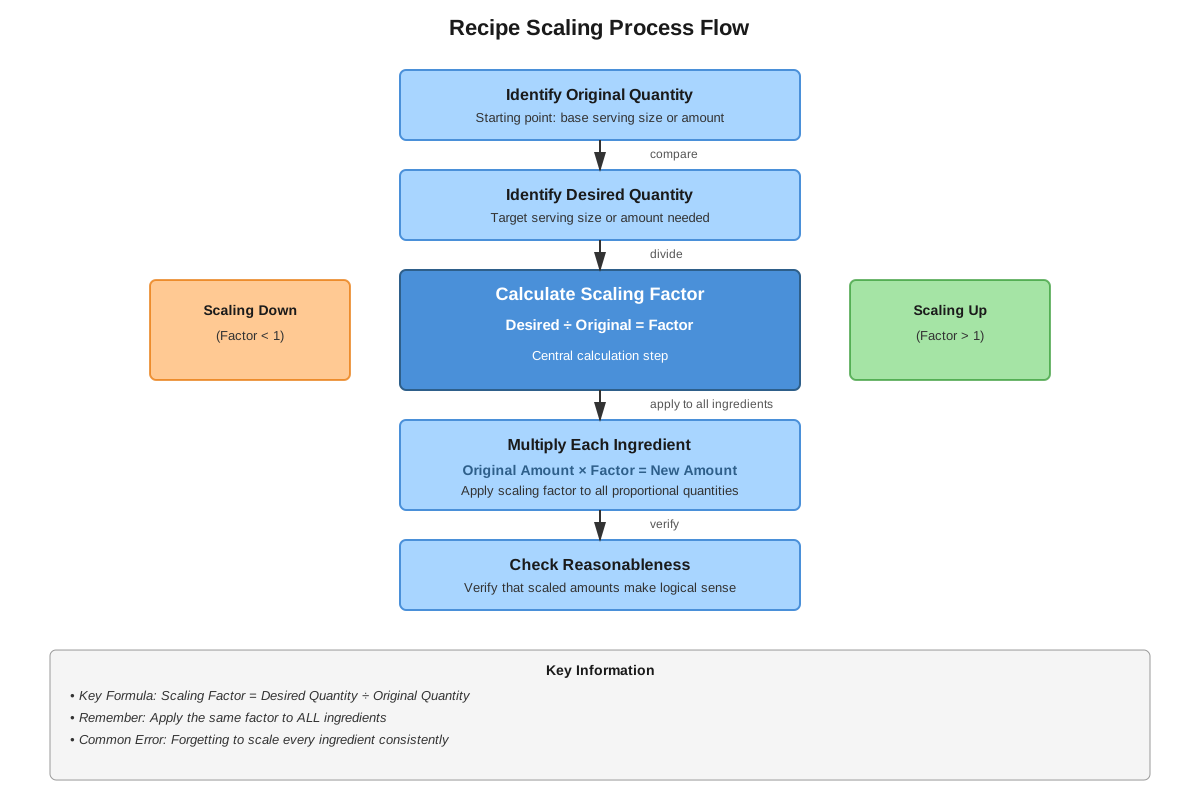
The scaling factor is the multiplier that relates the original quantity to the desired quantity. This fundamental value determines how all proportional quantities in a problem must be adjusted. To find the scaling factor, divide the desired quantity by the original quantity:
Scaling Factor = Desired Quantity ÷ Original QuantityFor example, if a recipe serves 4 people and you need to serve 10 people, the scaling factor is 10 ÷ 4 = 2.5. This means every ingredient quantity must be multiplied by 2.5 to maintain the correct proportions. The scaling factor can be greater than 1 (scaling up), less than 1 (scaling down), or equal to 1 (no change needed).
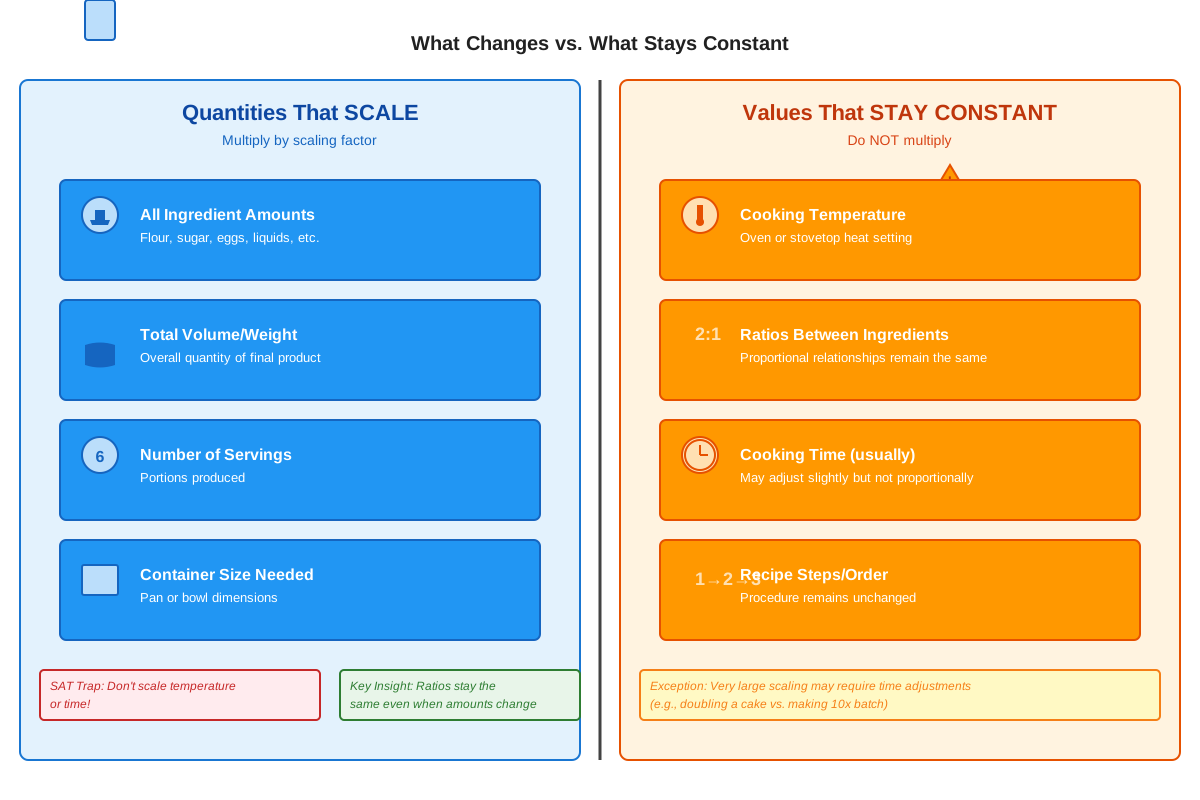
Understanding whether to scale up or down is crucial. When the scaling factor exceeds 1, quantities increase; when it falls between 0 and 1, quantities decrease. Students must recognize that the scaling factor applies to all ingredients and proportional quantities but not to non-scalable elements like cooking temperature or certain time requirements.
Identifying What to Scale
Not every number in a recipe scaling problem requires adjustment. Proportional quantities—those that must maintain their relationship to the total—need scaling, while constant values remain unchanged. Ingredients, serving sizes, and yield quantities are proportional and must be scaled. However, cooking temperatures, certain timing elements (like "bake until golden brown"), and sequential steps typically remain constant.
Consider this distinction: if a recipe for 12 cookies requires 2 cups of flour and baking at 350°F for 15 minutes, and you want to make 24 cookies, you would double the flour to 4 cups (proportional), but the temperature stays at 350°F (constant). The baking time might need slight adjustment based on pan size and arrangement, but this isn't a simple proportional relationship—it's a more complex physical consideration.
The Proportion Setup Method
Many recipe scaling problems can be solved by setting up a proportion—two equivalent ratios set equal to each other. This method is particularly useful when the problem provides partial information and asks for a missing quantity:
Original Ingredient / Original Servings = New Ingredient / New ServingsThis cross-multiplication approach allows students to solve for any unknown value. For instance, if 3 cups of flour make 24 muffins, how much flour is needed for 40 muffins?
3 cups / 24 muffins = x cups / 40 muffins
24x = 120
x = 5 cups
The proportion method is especially valuable when the scaling factor isn't immediately obvious or when working with complex fractions.
Multi-Ingredient Scaling
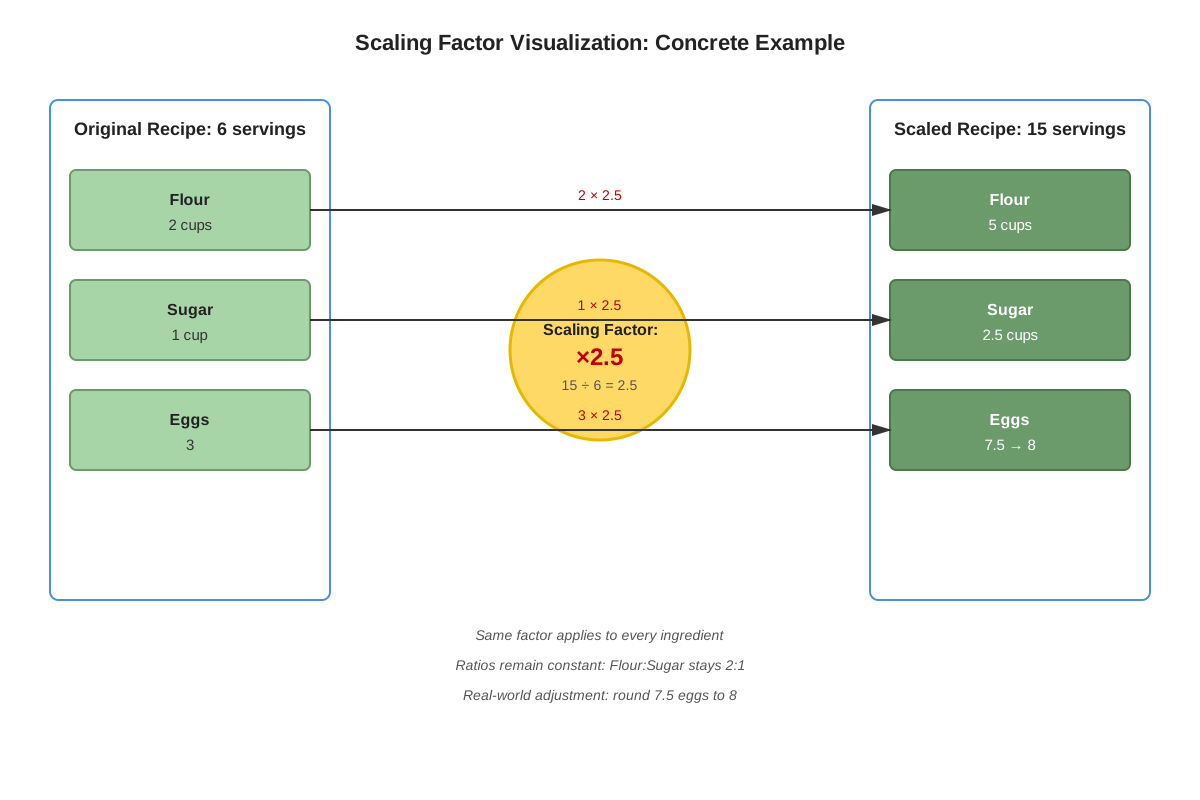
Real SAT problems often require scaling multiple ingredients simultaneously while maintaining their relationships. The key principle: apply the same scaling factor to all proportional quantities. If a recipe calls for 2 cups flour, 1 cup sugar, and 3 eggs for 12 servings, and you need 18 servings:
- Calculate the scaling factor: 18 ÷ 12 = 1.5
- Apply to flour: 2 × 1.5 = 3 cups
- Apply to sugar: 1 × 1.5 = 1.5 cups
- Apply to eggs: 3 × 1.5 = 4.5 eggs (which might require rounding to 4 or 5 in practice)
The relationships between ingredients remain constant: the flour-to-sugar ratio stays 2:1, and the flour-to-egg ratio stays 2:3, regardless of the total quantity produced.
Inverse Scaling Relationships
Some recipe scaling problems involve inverse relationships where one quantity increases as another decreases. For example, if 4 workers can complete a catering order in 6 hours, how long would it take 8 workers? This isn't direct scaling—doubling the workers doesn't double the time; it halves it.
The formula for inverse relationships:
Workers₁ × Time₁ = Workers₂ × Time₂Understanding when relationships are direct (more ingredients → more servings) versus inverse (more workers → less time) is critical for SAT success.
Unit Consistency in Scaling
Recipe scaling problems frequently involve unit conversions that must be handled correctly. If a recipe calls for 8 ounces of chocolate and you're scaling by a factor of 1.5, the result is 12 ounces—but the problem might ask for the answer in pounds, requiring division by 16.
Common conversions in recipe scaling problems:
- 1 cup = 16 tablespoons = 48 teaspoons
- 1 pound = 16 ounces
- 1 gallon = 4 quarts = 8 pints = 16 cups
Always check whether the answer format requires a different unit than the one used in calculations.
Scaling with Mixed Numbers and Fractions
SAT recipe scaling problems often involve fractional quantities that require careful arithmetic. When scaling 2⅓ cups by a factor of 1.5, students must either convert to an improper fraction (7/3 × 3/2 = 7/2 = 3½ cups) or to a decimal (2.333... × 1.5 = 3.5 cups).
| Original Amount | Scaling Factor | Calculation Method | Result |
|---|---|---|---|
| 2⅓ cups | 1.5 | (7/3) × (3/2) | 3½ cups |
| 1¾ teaspoons | 0.8 | (7/4) × (4/5) | 1⅖ teaspoons |
| 3.25 ounces | 2.4 | 3.25 × 2.4 | 7.8 ounces |
Maintaining precision throughout calculations prevents rounding errors that could lead to incorrect answer choices.
Concept Relationships
Recipe scaling fundamentally relies on the concept of proportional relationships, where two quantities maintain a constant ratio. This connects directly to the prerequisite understanding of ratios and proportions—the scaling factor is simply the ratio of new to original quantities. When students calculate a scaling factor and apply it to multiple ingredients, they're using the transitive property of equality: if A/B = C/D and A/B = E/F, then C/D = E/F.
The relationship map for recipe scaling concepts:
Original Recipe → Scaling Factor Calculation → Application to All Ingredients → Verification of Proportional Relationships
This linear progression can branch into more complex paths:
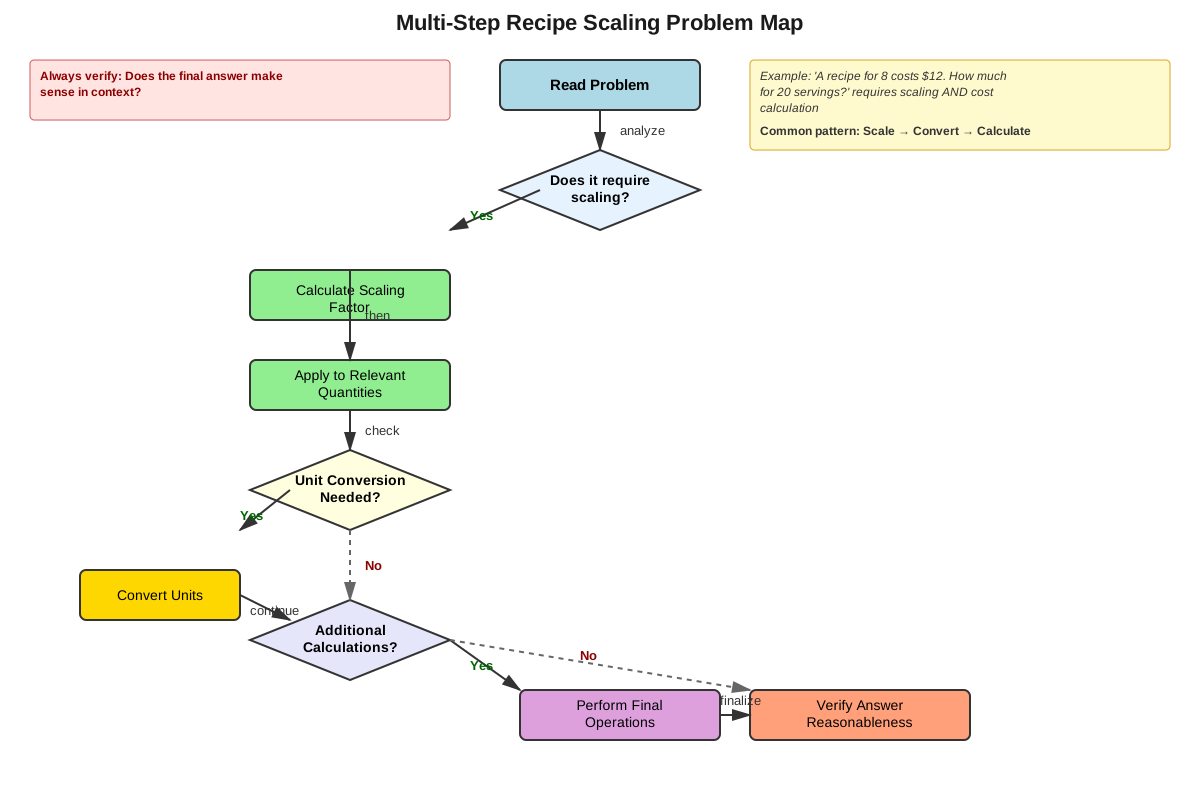
Scaling Factor → Unit Conversion → Final Answer (when units must change)
Multiple Ingredients → Individual Scaling → Sum or Comparison (when the question asks about totals or differences)
Direct Scaling ↔ Inverse Scaling (recognizing which relationship applies)
Recipe scaling also connects forward to more advanced topics. The proportional reasoning developed here applies directly to similar figures in geometry (where corresponding sides maintain constant ratios), to percent problems (which are special cases of proportional relationships), and to linear functions (where the scaling factor becomes the slope). Understanding that recipe scaling maintains ratios prepares students for mixture problems, where concentrations must be preserved, and for rate problems, where speed, time, and distance maintain proportional relationships.
The connection to unit rates is particularly strong: when you scale a recipe, you're essentially using the unit rate (ingredients per serving) and multiplying by the new number of servings. This reinforces the concept that unit rates provide a standardized way to compare and scale quantities.
Quick check — test yourself on Recipe scaling so far.
Try Flashcards →High-Yield Facts
⭐ The scaling factor equals the desired quantity divided by the original quantity: This is the foundational calculation for all recipe scaling problems.
⭐ Apply the same scaling factor to all proportional quantities: Every ingredient and yield amount must be multiplied by the identical scaling factor to maintain correct proportions.
⭐ Cooking temperatures and certain timing elements typically do not scale proportionally: These are constant values that remain unchanged regardless of batch size.
⭐ Setting up a proportion (original ingredient/original servings = new ingredient/new servings) allows you to solve for any unknown value: This method works when you don't need to explicitly calculate the scaling factor.
⭐ Unit conversions must be performed carefully, either before or after scaling: Inconsistent units are a common source of errors in recipe scaling problems.
- Scaling factors greater than 1 indicate scaling up (making more), while factors between 0 and 1 indicate scaling down (making less)
- The ratio between any two ingredients remains constant regardless of the total quantity produced
- When a problem involves rates (like workers and time), check whether the relationship is direct or inverse
- Mixed numbers should be converted to improper fractions or decimals before multiplying by the scaling factor
- If a scaled quantity results in an impractical number (like 4.5 eggs), the SAT will typically ask for the exact mathematical result, not a practical adjustment
- Multi-step problems may require scaling as an intermediate step before performing additional operations like addition, subtraction, or comparison
Common Misconceptions
Misconception: The scaling factor is always a whole number or simple fraction.
Correction: Scaling factors can be any positive number, including complex decimals like 1.375 or 0.6. Students must be comfortable calculating and working with any scaling factor that results from dividing the desired by the original quantity.
Misconception: All numbers in a recipe problem need to be scaled, including temperatures and times.
Correction: Only proportional quantities (ingredients, servings, yields) require scaling. Temperatures remain constant, and time relationships are often more complex than simple proportional scaling. Always identify which values are proportional to the serving size before applying the scaling factor.
Misconception: When scaling down (making less), you add or subtract rather than multiply by a factor less than 1.
Correction: Scaling always involves multiplication by the scaling factor, whether scaling up or down. If you need half a recipe, multiply by 0.5; don't subtract half from each ingredient individually, as this won't maintain proportions correctly.
Misconception: You can scale each ingredient by a different factor and still get the same recipe.
Correction: The defining characteristic of recipe scaling is that all ingredients must be scaled by the same factor to maintain the correct proportions and produce the intended result. Using different factors for different ingredients creates an entirely different recipe.
Misconception: In inverse relationships (like workers and time), you use the same scaling approach as direct relationships.
Correction: Inverse relationships require recognizing that as one quantity increases, the other decreases proportionally. The product of the two quantities remains constant (workers × time = constant work), not their ratio. Doubling workers halves the time, not doubles it.
Misconception: Rounding can be done at any step in the calculation process.
Correction: Premature rounding introduces errors that compound through subsequent calculations. Maintain full precision (or at least 3-4 decimal places) throughout the problem, rounding only the final answer to match the requested format or answer choices.
Worked Examples
Example 1: Basic Recipe Scaling with Multiple Ingredients
Problem: A cookie recipe that makes 24 cookies requires 2 cups of flour, 1½ cups of sugar, and ¾ cup of butter. If you want to make 36 cookies, how many cups of flour, sugar, and butter will you need?
Solution:
Step 1: Calculate the scaling factor.
- Desired quantity: 36 cookies
- Original quantity: 24 cookies
- Scaling factor = 36 ÷ 24 = 1.5
Step 2: Apply the scaling factor to flour.
- Original flour: 2 cups
- Scaled flour: 2 × 1.5 = 3 cups
Step 3: Apply the scaling factor to sugar.
- Original sugar: 1½ cups = 1.5 cups
- Scaled sugar: 1.5 × 1.5 = 2.25 cups = 2¼ cups
Step 4: Apply the scaling factor to butter.
- Original butter: ¾ cup = 0.75 cups
- Scaled butter: 0.75 × 1.5 = 1.125 cups = 1⅛ cups
Answer: You will need 3 cups of flour, 2¼ cups of sugar, and 1⅛ cups of butter.
Connection to Learning Objectives: This problem demonstrates identifying the key features (original and desired quantities), calculating the scaling factor, and applying it consistently to multiple ingredients—core skills for SAT recipe scaling questions.
Example 2: Multi-Step Problem with Unit Conversion
Problem: A soup recipe serves 8 people and requires 48 ounces of chicken broth. If you want to serve 12 people and the broth is sold in 1-quart containers, how many quarts of broth should you purchase? (Note: 1 quart = 32 ounces)
Solution:
Step 1: Calculate the scaling factor.
- Desired servings: 12 people
- Original servings: 8 people
- Scaling factor = 12 ÷ 8 = 1.5
Step 2: Scale the broth quantity.
- Original broth: 48 ounces
- Scaled broth: 48 × 1.5 = 72 ounces
Step 3: Convert ounces to quarts.
- 72 ounces ÷ 32 ounces per quart = 2.25 quarts
Step 4: Determine practical purchase amount.
- Since broth is sold in whole quart containers, you need to purchase 3 quarts (you cannot buy 0.25 of a container, and having slightly extra is better than not enough).
Answer: You should purchase 3 quarts of chicken broth.
Connection to Learning Objectives: This problem combines recipe scaling with unit conversion and practical reasoning, demonstrating how SAT questions integrate multiple mathematical concepts. It also shows the importance of reading carefully—the question asks how many to purchase, not the exact mathematical amount needed.
Exam Strategy
When approaching recipe scaling questions on the SAT, begin by identifying the three critical pieces of information: the original quantity (servings, batch size, etc.), the desired quantity, and the ingredients or values that need scaling. Underline or circle these values in the problem to prevent confusion during calculation.
Exam Tip: Always calculate the scaling factor first and write it down. This single number becomes your tool for the entire problem, and having it clearly noted prevents recalculation errors.
Watch for trigger words and phrases that signal recipe scaling problems:
- "serves X people" or "makes X servings"
- "adjust the recipe for"
- "scale up/down"
- "proportionally increase/decrease"
- "maintain the same ratio"
- "how much of [ingredient] is needed for [different quantity]"
These phrases indicate that proportional reasoning is required and that you'll need to find and apply a scaling factor.
For process of elimination on multiple-choice questions, use these strategies:
- Eliminate answers that don't make logical sense (e.g., if scaling up, the answer must be larger than the original)
- Check whether the answer maintains the correct proportions by comparing ratios
- Verify that units match what the question asks for
- If stuck, work backwards from answer choices by dividing by the scaling factor to see if you get the original amount
Time allocation: Recipe scaling problems typically require 60-90 seconds. If a problem involves multiple ingredients or unit conversions, allow up to 2 minutes. If you're spending more than 2 minutes, mark the question and return to it after completing easier problems. The calculation itself is straightforward, so extended time usually indicates misunderstanding the question rather than computational difficulty.
For grid-in questions, be especially careful with:
- Fraction versus decimal format (both are usually acceptable, but verify)
- Proper fraction reduction (12/8 should be entered as 3/2 or 1.5)
- Decimal precision (use at least 3 decimal places if not terminating)
Memory Techniques
Mnemonic for the scaling process: "FIND-APPLY-CHECK"
- Find the scaling factor (desired ÷ original)
- Identify what needs scaling (ingredients, not temperature)
- Note the units (convert if necessary)
- Do the multiplication (scaling factor × each ingredient)
- Apply to all proportional quantities
- Preserve the relationships (ratios stay constant)
- Perform any additional operations (adding, comparing)
- Look at units in the answer
- Yield your final answer
- Check reasonableness (is it larger/smaller as expected?)
- Have you answered what was asked?
- Ensure precision (no premature rounding)
- Confirm all ingredients scaled
- Keep proportions constant
Visualization strategy: Picture a recipe card with two columns—"Original" and "Scaled." The scaling factor is an arrow connecting them, showing that every ingredient in the original column gets multiplied by this arrow to reach the scaled column. Temperature and certain times sit outside these columns because they don't travel across the arrow.
Acronym for what to scale: "IYS" (Ingredients, Yield, Servings)—these are the quantities that change proportionally. Everything else requires careful consideration before scaling.
Summary
Recipe scaling is a high-yield SAT Math topic that tests proportional reasoning through practical contexts. The fundamental skill involves calculating a scaling factor by dividing the desired quantity by the original quantity, then applying this factor consistently to all proportional quantities while recognizing that certain values (like temperature) remain constant. Success requires distinguishing between direct proportional relationships (where quantities increase or decrease together) and inverse relationships (where one increases as the other decreases), maintaining precision throughout calculations, and handling unit conversions correctly. SAT questions may present recipe scaling in literal cooking contexts or disguised in manufacturing, mixture, or rate problems. The key to mastering this topic is recognizing the proportional structure underlying all scaling problems: when the total changes by a certain factor, all components must change by that same factor to maintain their relationships. Students who can quickly identify the scaling factor, apply it accurately to multiple quantities, and verify that proportions remain constant will efficiently handle the 2-4 recipe scaling questions that typically appear on each SAT administration.
Key Takeaways
- The scaling factor (desired ÷ original) is the single multiplier applied to all proportional quantities in a recipe scaling problem
- Ingredients, servings, and yields scale proportionally, but temperatures and certain timing elements remain constant
- Setting up proportions (original ingredient/original servings = new ingredient/new servings) provides an alternative solution method
- Unit conversions must be handled carefully, ensuring consistency before or after applying the scaling factor
- The ratio between any two ingredients remains constant regardless of the total quantity produced
- Multi-step problems may require scaling as one component of a larger calculation involving addition, subtraction, or comparison
- Maintaining precision throughout calculations and rounding only the final answer prevents compounding errors that lead to incorrect answer choices
Related Topics
Percent Problems: Recipe scaling connects directly to percent increase and decrease problems, where the scaling factor can be expressed as a percentage (scaling by 1.5 is equivalent to a 50% increase). Mastering recipe scaling provides the proportional reasoning foundation for all percent calculations.
Mixture Problems: When combining solutions of different concentrations or mixing ingredients with different properties, the same proportional reasoning used in recipe scaling applies. Understanding how to maintain ratios prepares students for these more complex scenarios.
Rate Problems: Distance-rate-time problems and work-rate problems involve proportional relationships similar to recipe scaling. The concept that doubling time at a constant rate doubles distance mirrors how doubling servings doubles ingredient quantities.
Similar Figures in Geometry: When geometric figures are scaled, corresponding sides maintain constant ratios—exactly the principle underlying recipe scaling. The scaling factor in geometry problems functions identically to the recipe scaling factor.
Unit Conversion and Dimensional Analysis: Recipe scaling problems frequently require converting between measurement units, reinforcing systematic approaches to unit conversion that apply across all SAT Math topics.
Practice CTA
Now that you've mastered the core concepts of recipe scaling, it's time to solidify your understanding through practice. Attempt the practice questions to apply these strategies to SAT-style problems, and use the flashcards to reinforce the key facts and formulas. Remember, recipe scaling problems are among the most predictable on the SAT—with focused practice, these questions become reliable points toward your target score. Each problem you solve strengthens your proportional reasoning skills, which will serve you across multiple SAT Math topics. You've got this!
Sign up free to keep reading
Create a free AnvayaPrep account to finish this SAT guide on Recipe scaling — plus flashcards and practice questions.