Overview
Dimensional analysis is a powerful mathematical technique that allows students to convert between different units of measurement and solve complex multi-step problems by tracking units throughout calculations. On the SAT math section, this skill appears frequently in word problems involving rates, conversions, and proportional relationships. Rather than memorizing countless conversion formulas, dimensional analysis provides a systematic approach that reduces errors and builds confidence when tackling unfamiliar unit combinations.
The SAT regularly tests dimensional analysis through real-world scenarios: converting speeds from miles per hour to feet per second, calculating costs across different quantities and time periods, or determining rates of work completion. These problems often appear in both the calculator and no-calculator sections, making dimensional analysis an essential tool for efficient problem-solving. Questions may involve single conversions or require chaining multiple conversion factors together, testing both conceptual understanding and computational accuracy.
Understanding sat dimensional analysis connects directly to broader mathematical concepts including ratios, rates, proportions, and algebraic reasoning. This topic serves as a bridge between arithmetic operations and algebraic thinking, requiring students to set up equations strategically while maintaining logical consistency through unit tracking. Mastery of dimensional analysis not only improves performance on direct conversion questions but also enhances overall problem-solving ability across the entire math section.
Learning Objectives
- [ ] Identify key features of dimensional analysis
- [ ] Explain how dimensional analysis appears on the SAT
- [ ] Apply dimensional analysis to answer SAT-style questions
- [ ] Set up conversion factor chains correctly with proper unit cancellation
- [ ] Recognize when dimensional analysis is the most efficient solution strategy
- [ ] Verify answer reasonableness by checking final units against the question requirements
Prerequisites
- Basic fraction operations: Dimensional analysis relies heavily on multiplying and dividing fractions, as conversion factors are expressed as ratios
- Understanding of rates: Rates like miles per hour or dollars per pound form the foundation of most dimensional analysis problems
- Ratio and proportion concepts: Conversion factors are equivalent ratios that maintain proportional relationships between different units
- Unit awareness: Recognizing different measurement systems (metric, imperial) and common units within each system
Why This Topic Matters
Dimensional analysis represents one of the most practical mathematical skills tested on the SAT, with applications extending far beyond standardized testing. In everyday life, this technique helps with cooking conversions, travel planning, financial calculations, and understanding scientific data. Professionals in engineering, medicine, chemistry, and economics use dimensional analysis daily to ensure accuracy in calculations where unit errors could have serious consequences.
On the SAT, dimensional analysis questions appear in approximately 3-5 questions per test, representing roughly 5-8% of the math section. These questions typically fall into the "Problem Solving and Data Analysis" category and range from straightforward single-step conversions to complex multi-step problems requiring strategic thinking. The College Board specifically includes these questions because they assess both mathematical reasoning and practical problem-solving skills that students will need in college and career settings.
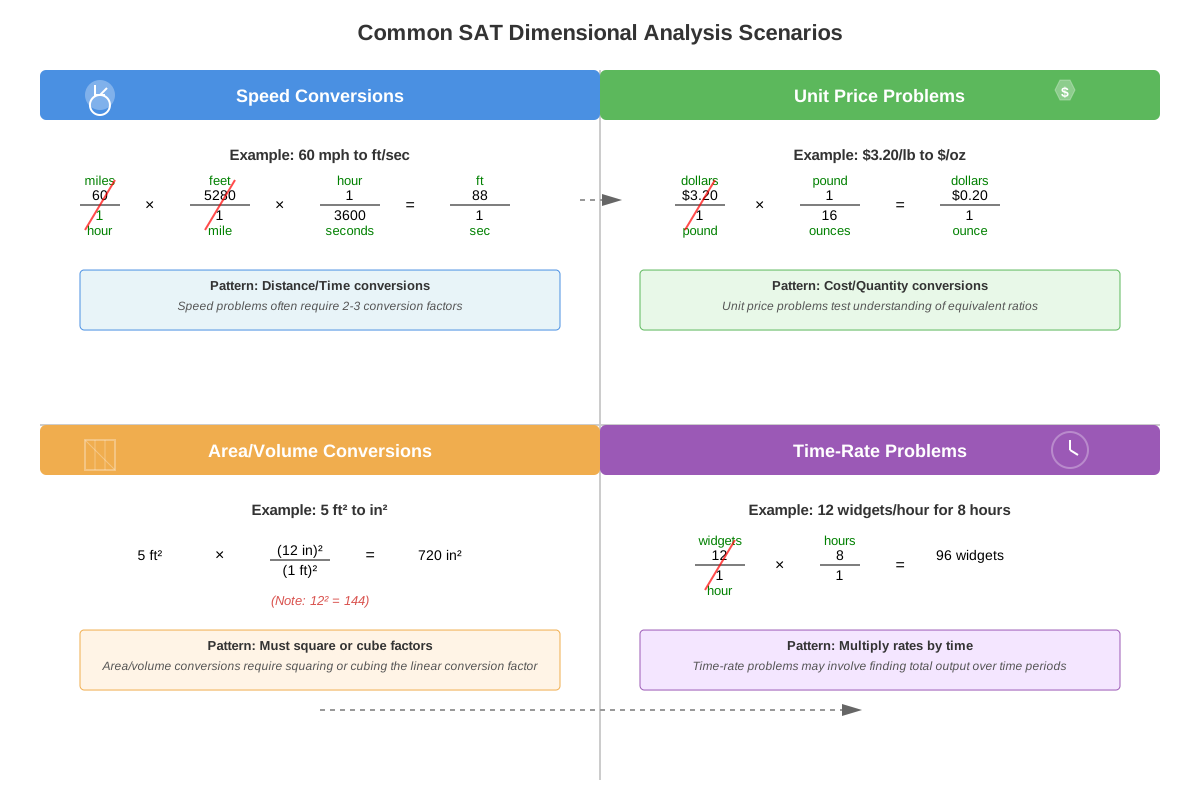
Common SAT question formats include: converting between measurement systems (metric to imperial or vice versa), calculating unit prices or rates, determining time-based rates of change, solving problems involving area or volume conversions (which require squaring or cubing conversion factors), and interpreting real-world scenarios where multiple unit conversions must be chained together. Questions may present conversion information directly or require students to derive conversion factors from given relationships.
Core Concepts
The Fundamental Principle of Dimensional Analysis
Dimensional analysis (also called the factor-label method or unit-factor method) is based on a simple but powerful principle: multiplying by a conversion factor that equals 1 does not change the value of a quantity, only its units. A conversion factor is a fraction where the numerator and denominator represent equivalent quantities expressed in different units. For example, since 1 foot equals 12 inches, both 12 inches/1 foot and 1 foot/12 inches equal 1.
The key insight is that units behave like algebraic variables—they can be canceled when they appear in both the numerator and denominator. This cancellation property ensures that calculations proceed logically and helps identify errors immediately. If the final units don't match what the question asks for, an error has occurred in the setup or calculation.
Setting Up Conversion Factors
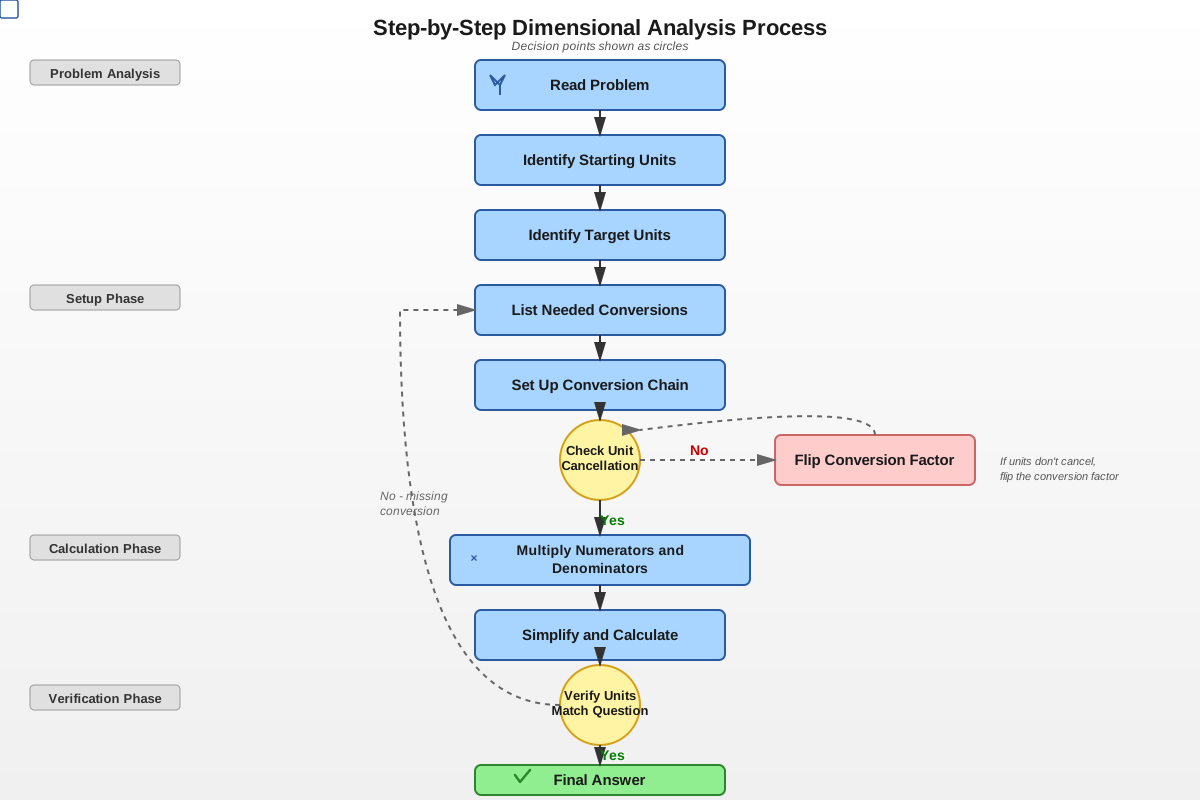
Every conversion factor must be constructed so that unwanted units cancel and desired units remain. The general strategy involves:
- Identify the starting unit (what you have)
- Identify the target unit (what you want)
- Write the conversion factor as a fraction with the target unit in the numerator and the starting unit in the denominator
- Multiply the original quantity by the conversion factor
- Cancel units that appear in both numerator and denominator
- Perform the arithmetic to obtain the final answer
For example, to convert 5 feet to inches, knowing that 1 foot = 12 inches:
5 feet × (12 inches / 1 foot) = 60 inchesNotice how "feet" cancels, leaving only "inches" as the final unit.
Chaining Multiple Conversions
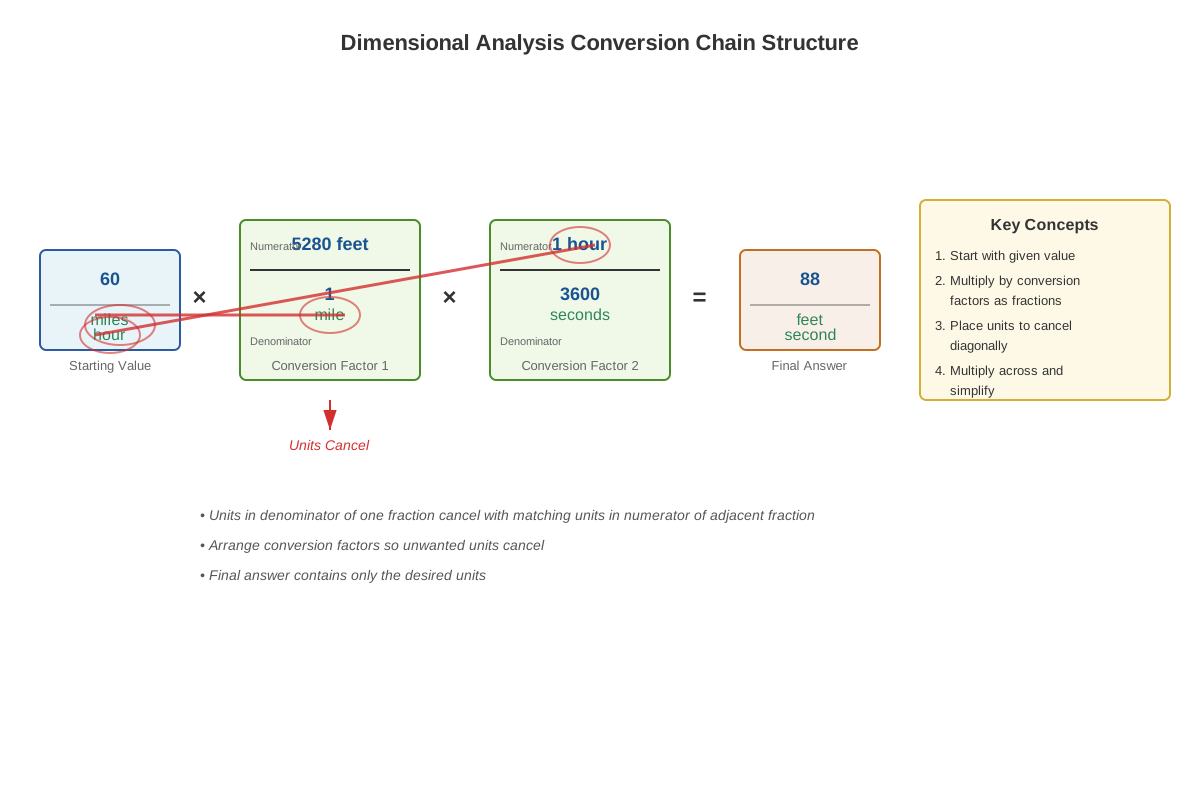
Many SAT problems require multiple conversion steps. The strategy remains the same: arrange conversion factors so that each intermediate unit cancels, leaving only the desired final unit. This process is called conversion factor chaining.
Consider converting 60 miles per hour to feet per second:
60 miles/hour × (5,280 feet/1 mile) × (1 hour/60 minutes) × (1 minute/60 seconds) = 88 feet/secondEach conversion factor is positioned so that units cancel systematically: miles cancels with miles, hours cancels with hours (through minutes), and minutes cancels with minutes, leaving feet/second.
Complex Unit Conversions
When dealing with squared or cubed units (area or volume), the conversion factor must be raised to the corresponding power. This is a frequent source of errors on the SAT.
To convert square feet to square inches:
1 square foot = 1 ft² = (12 inches)² = 144 square inchesSimilarly, for cubic units:
1 cubic foot = 1 ft³ = (12 inches)³ = 1,728 cubic inchesRate Conversions
Rate problems involve compound units (distance/time, cost/quantity, work/time) and require careful attention to both numerator and denominator units. The SAT frequently tests whether students can correctly convert both parts of a rate.
| Rate Type | Example | Common Conversions |
|---|---|---|
| Speed | miles/hour | to feet/second, meters/second |
| Unit Price | dollars/pound | to cents/ounce, dollars/kilogram |
| Flow Rate | gallons/minute | to liters/hour, cubic feet/second |
| Work Rate | jobs/hour | to jobs/day, tasks/minute |
Strategic Setup for Word Problems
SAT dimensional analysis questions are embedded in word problems that require translation from English to mathematical expressions. Key steps include:
- Extract all given information with units clearly labeled
- Identify what the question asks for (including units)
- List available conversion factors (given or from general knowledge)
- Map a conversion path from starting units to target units
- Set up the calculation with all conversion factors in place
- Verify unit cancellation before computing
- Check answer reasonableness (Is 88 feet/second reasonable for 60 mph? Yes, because cars travel faster than people walk)
Concept Relationships
Dimensional analysis serves as the practical application of several interconnected mathematical concepts. At its foundation, ratios and proportions provide the theoretical basis—every conversion factor is an equivalent ratio. When students multiply by conversion factors, they're applying proportional reasoning to maintain equality while changing representation.
The relationship flows as follows: Basic unit understanding → Ratio equivalence → Conversion factors → Dimensional analysis → Complex rate problems. Each step builds on the previous, with dimensional analysis representing the synthesis of these foundational skills into a problem-solving methodology.
Dimensional analysis connects forward to more advanced topics including algebraic equation solving (where unit tracking helps verify solutions), function interpretation (understanding what units mean in context), and data analysis (converting units in tables and graphs). The technique also reinforces fraction operations through repeated practice with multiplication and division of complex fractions.
Within the topic itself, simple single-step conversions form the building blocks for multi-step conversions, which in turn enable solving complex rate problems. Area and volume conversions extend the basic technique by requiring exponentiation of conversion factors. Each concept layer adds complexity while maintaining the same fundamental principle of unit cancellation.
Quick check — test yourself on Dimensional analysis so far.
Try Flashcards →High-Yield Facts
⭐ Conversion factors always equal 1 because the numerator and denominator represent equivalent quantities in different units
⭐ Units cancel like algebraic variables when they appear in both numerator and denominator
⭐ The SAT provides necessary conversion factors in the question or reference information when they're not common knowledge
⭐ For area conversions, square the linear conversion factor; for volume conversions, cube it
⭐ Always check that final units match what the question asks for before selecting an answer
- Common conversions to memorize: 1 mile = 5,280 feet; 1 hour = 60 minutes = 3,600 seconds; 1 foot = 12 inches
- When converting rates, both the numerator and denominator units may need conversion
- Conversion factors can be flipped (inverted) depending on which unit needs to cancel
- Multiple conversion paths may exist; choose the one with fewest steps and simplest arithmetic
- Dimensional analysis works for any units: currency, time, distance, mass, volume, or abstract quantities
- Setting up the problem correctly is more important than computational speed
- If units don't cancel to give the desired result, the setup contains an error
- Dimensional analysis can verify whether an equation or formula is dimensionally consistent
- The technique works equally well with metric and imperial units
- Calculator errors are less likely when the setup is clear and systematic
Common Misconceptions
Misconception: Conversion factors can be written in any orientation without affecting the answer → Correction: The orientation matters critically. The unit you want to eliminate must be positioned so it cancels with an existing unit. Writing 1 foot/12 inches when you need to cancel feet will give an incorrect answer.
Misconception: When converting area or volume, use the same conversion factor as for linear measurements → Correction: Area conversions require squaring the linear conversion factor, and volume conversions require cubing it. Converting 1 square foot to square inches requires (12)² = 144, not 12.
Misconception: All conversion factors must be memorized → Correction: The SAT provides necessary conversion information either in the question itself or in the reference section. Focus on understanding the process rather than memorizing obscure conversions.
Misconception: Dimensional analysis only works for unit conversions → Correction: The technique applies to any problem involving rates, proportions, or scaling relationships, even when units aren't explicitly mentioned. It's a general problem-solving framework.
Misconception: If the arithmetic is correct, the answer must be right → Correction: Correct arithmetic with incorrect setup yields wrong answers. Always verify that units cancel properly and the final units match the question requirements before computing.
Misconception: Conversion factors change the actual quantity → Correction: Conversion factors only change the representation, not the underlying quantity. 60 miles per hour and 88 feet per second represent the same speed, just expressed differently.
Worked Examples
Example 1: Multi-Step Rate Conversion
Problem: A factory produces 450 widgets per hour. If the factory operates 16 hours per day, how many widgets does it produce per week?
Solution:
Step 1: Identify given information and target
- Given: 450 widgets/hour, 16 hours/day
- Target: widgets/week
Step 2: Identify necessary conversions
- 1 day = 16 operating hours (given)
- 1 week = 7 days (general knowledge)
Step 3: Set up conversion chain
450 widgets/hour × 16 hours/day × 7 days/weekStep 4: Verify unit cancellation
- "hours" cancels between first and second factors
- "days" cancels between second and third factors
- Final unit: widgets/week ✓
Step 5: Calculate
450 × 16 × 7 = 50,400 widgets/weekConnection to learning objectives: This problem demonstrates applying dimensional analysis to SAT-style questions by chaining multiple conversion factors and tracking units throughout the calculation.
Example 2: Area Conversion with Unit Price
Problem: Carpet costs $2.50 per square foot. What is the cost per square yard?
Solution:
Step 1: Recognize this requires area conversion
- Given: $2.50/ft²
- Target: $/yd²
- Key relationship: 1 yard = 3 feet
Step 2: Determine area conversion factor
- Since 1 yard = 3 feet (linear)
- Then 1 square yard = (3 feet)² = 9 square feet
Step 3: Set up conversion
$2.50/ft² × 9 ft²/yd²Step 4: Verify unit cancellation
- "ft²" cancels
- Final unit: $/yd² ✓
Step 5: Calculate
$2.50 × 9 = $22.50 per square yardStep 6: Check reasonableness
- A square yard is larger than a square foot, so the cost per square yard should be higher ✓
- The factor of 9 makes sense because 9 square feet fit in 1 square yard ✓
Connection to learning objectives: This example shows how dimensional analysis appears on the SAT in practical contexts and demonstrates the critical concept of squaring conversion factors for area measurements.
Exam Strategy
Primary Strategy: Always write out the complete dimensional analysis setup before calculating. This prevents unit errors and makes the solution process transparent to reviewers (and yourself).
When approaching SAT dimensional analysis questions, look for these trigger phrases: "convert," "express in terms of," "how many [unit A] per [unit B]," "at this rate," "if this continues," and "what is the [quantity] in [different units]." These phrases signal that unit conversion or rate calculation is required.
Process-of-elimination tips:
- Immediately eliminate answer choices with incorrect units
- Eliminate answers that are unreasonably large or small (use estimation)
- If converting to smaller units, the number should increase; if converting to larger units, the number should decrease
- For rate problems, check whether the answer makes intuitive sense in context
Time allocation: Spend 30-45 seconds setting up the problem correctly, even if it feels slow. A correct setup leads to quick, accurate calculation. Rushing the setup causes errors that waste more time. For complex multi-step conversions, budget 90-120 seconds total.
Calculator usage: When allowed, use the calculator for arithmetic but write the setup on paper. Enter the entire expression as one calculation to minimize rounding errors: (60 × 5280) ÷ (60 × 60) rather than calculating intermediate steps separately.
Verification technique: After solving, quickly check dimensional consistency. Ask: "Do my final units match what the question asked for?" If not, don't second-guess—there's an error in the setup. Also perform a sanity check: "Is this answer reasonable given the context?"
Memory Techniques
CUPS Mnemonic for the dimensional analysis process:
- Conversion factors identified
- Units positioned for cancellation
- Perform multiplication/division
- Sanity check the result
Visualization Strategy: Picture units as physical objects that can be "canceled out" by crossing them off. Imagine drawing a line through matching units in numerator and denominator, just like canceling common factors in fractions.
"Bigger to Smaller, Number Gets Bigger": When converting from larger units to smaller units (feet to inches, hours to minutes), the numerical value increases. Conversely, converting from smaller to larger units decreases the number. This provides a quick reasonableness check.
Area and Volume Acronym - "SQUARE and CUBE":
- Square the conversion for Area
- Cube the conversion for Volume
The "Fraction Flip" Rule: Remember that any conversion factor can be flipped (inverted) depending on what needs to cancel. If 1 mile = 5,280 feet, then both (5,280 ft / 1 mi) and (1 mi / 5,280 ft) are valid conversion factors—choose based on what cancels.
Summary
Dimensional analysis is a systematic method for converting between units and solving rate problems by multiplying quantities by conversion factors that equal one. The technique relies on treating units like algebraic variables that cancel when they appear in both numerator and denominator. On the SAT, dimensional analysis appears in 3-5 questions per test, typically embedded in real-world scenarios involving speed conversions, unit pricing, work rates, or measurement system changes. Success requires careful setup with conversion factors positioned for proper unit cancellation, attention to squared or cubed conversions for area and volume, and verification that final units match question requirements. The method connects fundamental concepts of ratios and proportions to practical problem-solving, serving as both a computational tool and a logical framework for approaching complex multi-step problems efficiently and accurately.
Key Takeaways
- Dimensional analysis converts units by multiplying by conversion factors that equal 1, allowing units to cancel like algebraic variables
- Always set up the complete conversion chain before calculating to ensure proper unit cancellation
- For area conversions, square the linear conversion factor; for volume conversions, cube it
- The SAT provides necessary conversion information—focus on process mastery rather than memorizing conversions
- Verify answers by checking that final units match the question and that the numerical result is reasonable in context
- Conversion factors can be inverted (flipped) depending on which unit needs to cancel
- Multi-step conversions require chaining factors systematically, canceling intermediate units along the way
Related Topics
Unit Rates and Proportional Relationships: Dimensional analysis extends naturally to solving proportion problems and finding unit rates, which appear frequently throughout the SAT math section. Mastering dimensional analysis provides the foundation for these related question types.
Linear Functions and Slope: Understanding rates through dimensional analysis helps interpret slope as a rate of change with specific units, connecting algebraic and geometric representations of functions.
Scientific Notation and Orders of Magnitude: When dimensional analysis involves very large or small numbers, scientific notation becomes essential for managing calculations efficiently.
Percent Change and Growth: Converting between different time periods (daily to annual rates, for example) uses dimensional analysis principles and appears in finance and science contexts on the SAT.
Geometry Formulas with Mixed Units: Applying area and volume formulas when measurements are given in different units requires dimensional analysis for conversion before calculation.
Practice CTA
Now that you understand the principles and strategies of dimensional analysis, it's time to solidify your mastery through practice. Work through the practice questions to apply these concepts to SAT-style problems, and use the flashcards to reinforce key conversion factors and problem-solving steps. Remember: dimensional analysis is a skill that improves dramatically with practice. Each problem you solve strengthens your ability to set up conversions quickly and accurately, building the confidence you need to tackle any unit conversion question on test day. You've got this!
Sign up free to keep reading
Create a free AnvayaPrep account to finish this SAT guide on Dimensional analysis — plus flashcards and practice questions.