Overview
The elimination strategy is one of the most powerful and frequently tested methods for solving systems of linear equations on the SAT Math section. This technique involves manipulating two or more equations by adding or subtracting them to eliminate one variable, making it possible to solve for the remaining variable(s). Unlike substitution, which requires isolating a variable and replacing it in another equation, elimination leverages the additive property of equality to strategically cancel out variables through careful equation manipulation.
Mastering the SAT elimination strategy is essential because systems of equations appear consistently across multiple SAT Math questions in each test administration. The College Board frequently tests this concept both as standalone algebra problems and embedded within word problems involving real-world scenarios like mixture problems, rate problems, and cost analysis. Students who can quickly recognize when to apply elimination and execute it efficiently gain a significant time advantage, as this method often provides the fastest path to the correct answer compared to alternative approaches like graphing or substitution.
The elimination strategy connects fundamentally to broader math concepts including linear equations, algebraic manipulation, and the properties of equality. It serves as a bridge between basic equation-solving skills and more complex algebraic reasoning required for higher-level mathematics. Understanding elimination also reinforces critical thinking about equation structure and variable relationships, skills that transfer to other SAT topics such as functions, inequalities, and even some geometry problems involving multiple constraints.
Learning Objectives
- [ ] Identify key features of Elimination strategy
- [ ] Explain how Elimination strategy appears on the SAT
- [ ] Apply Elimination strategy to answer SAT-style questions
- [ ] Determine when elimination is more efficient than substitution or graphing
- [ ] Manipulate equations by multiplying to create opposite coefficients
- [ ] Recognize and solve systems with no solution or infinitely many solutions using elimination
- [ ] Apply elimination to word problems requiring translation from verbal descriptions to algebraic systems
Prerequisites
- Basic algebraic manipulation: Students must be able to distribute, combine like terms, and isolate variables, as elimination requires these operations at every step
- Understanding of linear equations: Familiarity with the standard form (Ax + By = C) and slope-intercept form (y = mx + b) helps recognize when equations are ready for elimination
- Properties of equality: Knowledge that the same operation can be performed on both sides of an equation without changing its truth value is fundamental to the elimination process
- Solving single-variable equations: After eliminating one variable, students must solve the resulting single-variable equation efficiently
- Negative number operations: Elimination frequently involves adding equations with negative coefficients, requiring comfort with integer arithmetic
Why This Topic Matters
The elimination strategy represents a critical skill set that extends far beyond standardized testing. In real-world applications, systems of equations model countless scenarios: businesses use them to determine break-even points when comparing costs and revenues, engineers apply them to analyze forces in equilibrium, economists employ them to find market equilibrium prices, and scientists utilize them to balance chemical equations. The logical thinking required to manipulate equations strategically develops problem-solving abilities applicable across STEM fields and quantitative reasoning in general.
On the SAT specifically, systems of equations appear in approximately 3-5 questions per test, representing roughly 5-8% of the total Math section score. These questions span both the calculator and no-calculator portions, appearing as both multiple-choice and grid-in formats. The College Board tests elimination through direct algebraic systems, word problems requiring system setup, and occasionally through questions asking students to identify the number of solutions or interpret coefficients in context. Questions typically range from 2-3 minutes in difficulty, making efficiency crucial.
Common SAT question formats include: presenting two equations and asking for the value of x + y or 2x - 3y (requiring solving for both variables); providing a word problem about two unknowns with two constraints; asking which value of a constant would make a system have no solution or infinitely many solutions; and presenting systems where one equation needs manipulation before elimination becomes viable. The test makers specifically design problems where elimination is significantly faster than alternative methods, rewarding students who recognize these patterns.
Core Concepts
The Fundamental Principle of Elimination
The elimination strategy operates on a simple but powerful principle: when two equations are added or subtracted, the resulting equation is also true for the same solution set. This works because of the additive property of equality—if A = B and C = D, then A + C = B + D. By strategically choosing which equations to add or subtract, one variable can be eliminated entirely, reducing a two-variable system to a single-variable equation that can be solved directly.
Consider the basic system:
3x + 2y = 16
3x - 2y = 8
Notice that the coefficients of y are opposites (2 and -2). Adding these equations eliminates y:
  3x + 2y = 16
+ 3x - 2y = 8
--------------
  6x + 0y = 24
This yields 6x = 24, so x = 4. Substituting back into either original equation gives y = 2.
Creating Opposite Coefficients
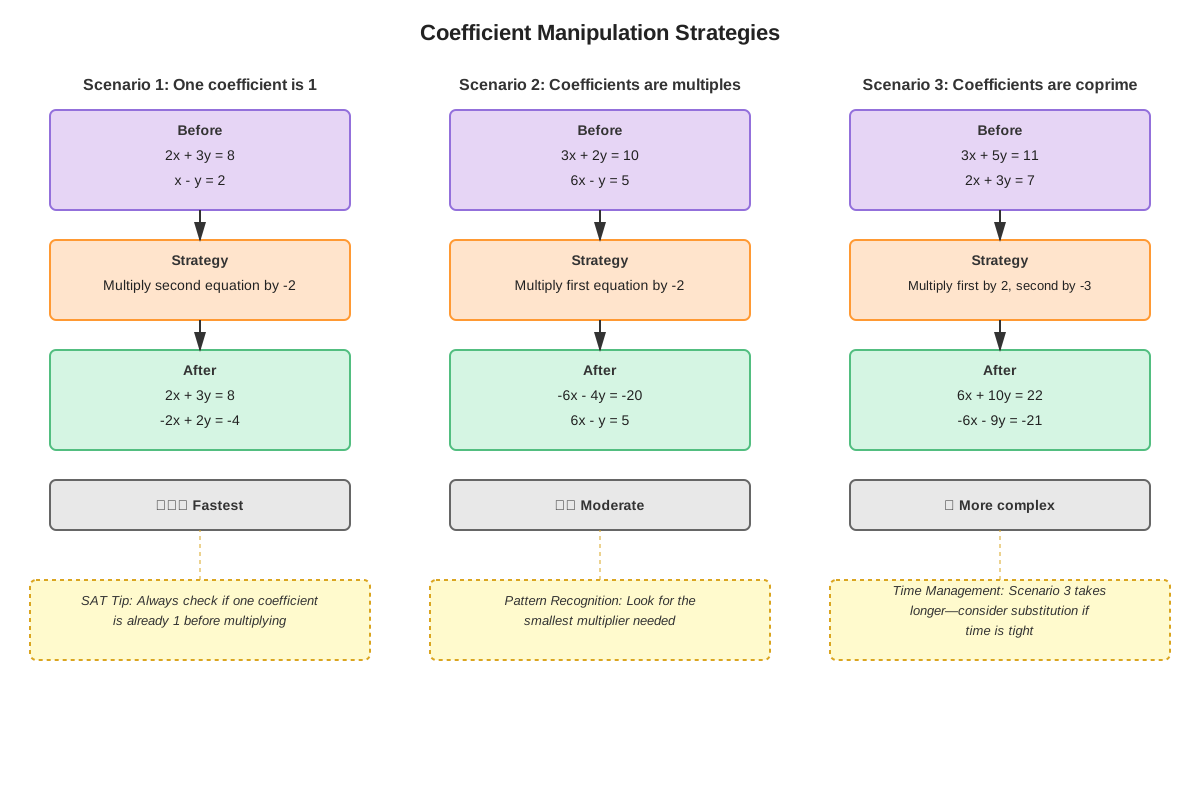
Most SAT systems don't present variables with opposite coefficients immediately. The key skill involves multiplying one or both equations by strategic constants to create opposite coefficients. This manipulation doesn't change the solution because multiplying both sides of an equation by the same non-zero number preserves equality.
For the system:
2x + 3y = 13
5x + 2y = 16
To eliminate x, multiply the first equation by 5 and the second by -2:
10x + 15y = 65
-10x - 4y = -32
Adding these eliminates x:
11y = 33, so y = 3Alternatively, to eliminate y, multiply the first equation by 2 and the second by -3:
4x + 6y = 26
-15x - 6y = -48
Adding gives -11x = -22, so x = 2.
Strategic Decision-Making
Choosing which variable to eliminate depends on which requires simpler arithmetic. Consider these guidelines:
| Situation | Best Approach | Reason |
|---|---|---|
| One variable already has opposite coefficients | Add or subtract immediately | Minimizes calculation steps |
| One variable has coefficients that are multiples | Multiply the smaller coefficient equation | Keeps numbers manageable |
| Both variables require multiplication | Choose the variable with smaller coefficients | Reduces arithmetic complexity |
| Coefficients are fractions | Multiply to clear denominators first | Simplifies all subsequent operations |
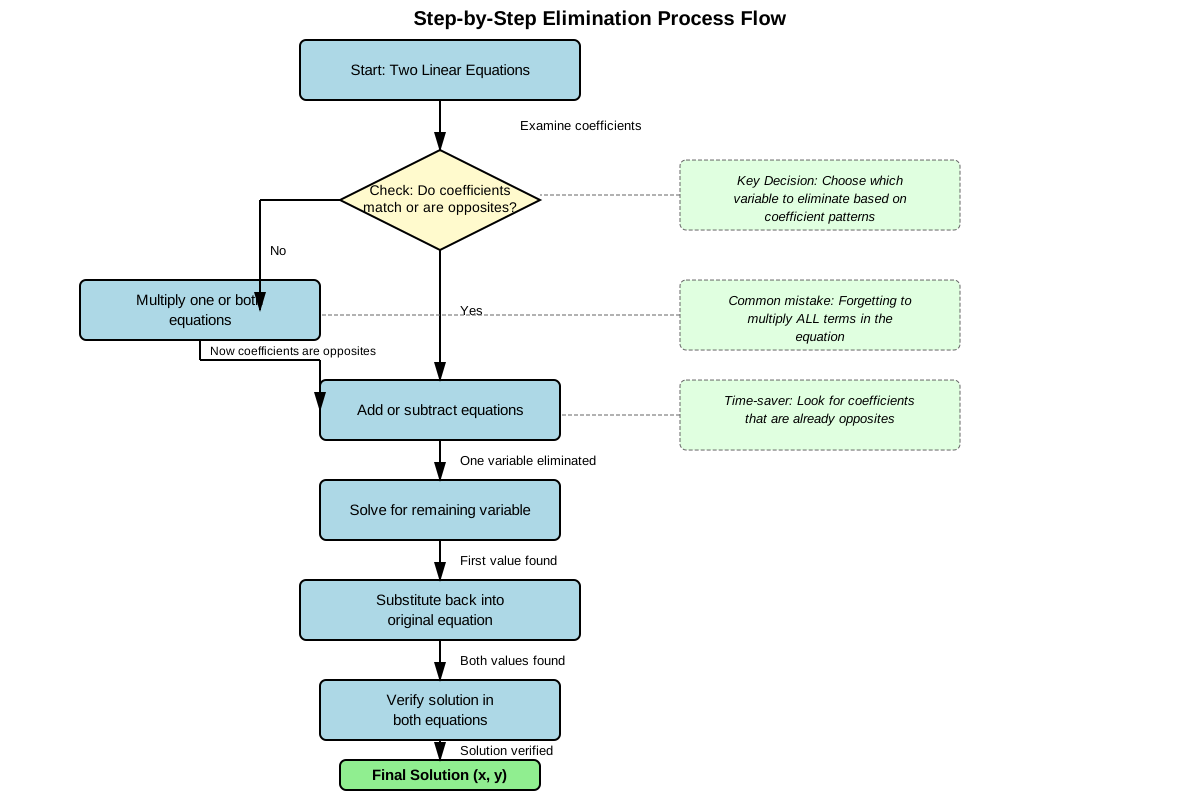
The Complete Elimination Process
- Arrange equations in standard form (Ax + By = C) with like terms aligned vertically
- Identify which variable to eliminate based on coefficient relationships
- Multiply one or both equations to create opposite coefficients for the target variable
- Add or subtract the equations to eliminate the chosen variable
- Solve the resulting single-variable equation
- Substitute the found value back into either original equation
- Solve for the remaining variable
- Verify the solution by checking both values in both original equations (time permitting)
Systems with Special Solutions
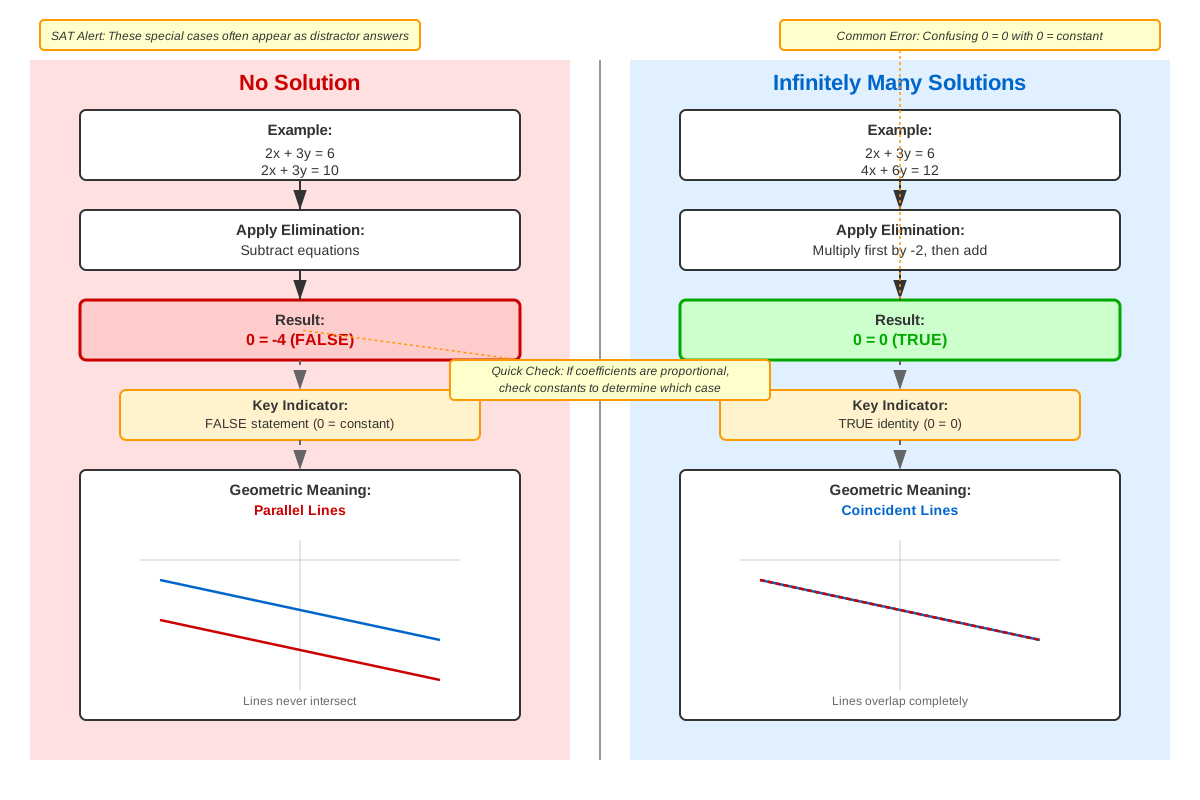
Not all systems have exactly one solution. The elimination strategy reveals these special cases:
No Solution (Inconsistent System): When elimination produces a false statement like 0 = 5, the lines are parallel and never intersect. This occurs when the equations have the same slope but different y-intercepts.
Example:
2x + 3y = 10
4x + 6y = 15
Multiplying the first equation by -2 and adding:
-4x - 6y = -20
4x + 6y = 15
--------------
0 = -5 (FALSE)
Infinitely Many Solutions (Dependent System): When elimination produces a true statement like 0 = 0, the equations represent the same line. Every point on the line is a solution.
Example:
3x - 2y = 8
6x - 4y = 16
Multiplying the first equation by -2 and adding:
-6x + 4y = -16
6x - 4y = 16
--------------
0 = 0 (TRUE)
Elimination in Word Problems
SAT word problems often require translating verbal descriptions into systems before applying elimination. Key phrases signal relationships:
- "The sum of..." → addition equation
- "The difference between..." → subtraction equation
- "...costs $x per unit..." → coefficient in cost equation
- "...total of..." → equation set equal to a sum
Example: "Adult tickets cost $12 and child tickets cost $8. If 50 tickets were sold for a total of $520, how many adult tickets were sold?"
Translation:
a + c = 50 (total tickets)
12a + 8c = 520 (total revenue)
Multiply the first equation by -8:
-8a - 8c = -400
12a + 8c = 520
--------------
4a = 120
a = 30
Concept Relationships
The elimination strategy connects intimately with other algebraic concepts in a hierarchical structure. At its foundation, basic equation solving provides the skills to manipulate individual equations, which directly enables the equation manipulation required in elimination. The properties of equality (additive, multiplicative, transitive) justify why adding equations preserves truth and why multiplying by constants doesn't change solutions.
Elimination relates horizontally to substitution, the alternative method for solving systems. While substitution isolates one variable and replaces it in another equation, elimination combines equations to cancel variables. The choice between methods depends on equation structure: substitution works best when one variable is already isolated (y = 3x + 2), while elimination excels when both equations are in standard form with no isolated variables.
The concept flows upward to more complex topics: systems of inequalities use similar algebraic manipulation but require careful attention to inequality direction; matrices and determinants provide an advanced framework for solving larger systems using elimination principles; linear programming applies systems of equations and inequalities to optimization problems.
Within the elimination strategy itself, concepts build progressively: Basic elimination (opposite coefficients already present) → Multiplication to create opposite coefficients → Strategic variable selection → Special cases recognition → Application to word problems. Each level requires mastery of the previous, creating a clear learning pathway.
High-Yield Facts
⭐ The elimination strategy works by adding or subtracting equations to cancel one variable, reducing a system to a single-variable equation
⭐ Multiplying both sides of an equation by the same non-zero constant creates an equivalent equation with the same solutions
⭐ When elimination produces 0 = 0, the system has infinitely many solutions (same line)
⭐ When elimination produces a false statement (0 = 5), the system has no solution (parallel lines)
⭐ To eliminate a variable, create opposite coefficients by multiplying one or both equations by appropriate constants
- The least common multiple (LCM) of coefficients determines the smallest multipliers needed for elimination
- After eliminating one variable and solving for the other, always substitute back into an original equation, not a manipulated one
- Systems appearing in word problems require translation before elimination can be applied
- Elimination is typically faster than substitution when both equations are in standard form
- Checking solutions in both original equations catches arithmetic errors but may not be time-efficient on the SAT
- The SAT often asks for expressions like x + y or 2x - 3y rather than individual variable values, sometimes allowing shortcuts
- Fractions in coefficients should be cleared by multiplying the entire equation by the LCD before attempting elimination
Quick check — test yourself on Elimination strategy so far.
Try Flashcards →Common Misconceptions
Misconception: When adding equations, add the left side of one equation to the right side of the other.
Correction: Add left sides together and right sides together separately. The equation (a + c) = (b + d) results from a = b and c = d, not (a + d) = (b + c).
Misconception: Multiplying only one side of an equation by a constant is acceptable.
Correction: Both sides must be multiplied by the same constant to maintain equality. Multiplying only one side creates a false equation with different solutions.
Misconception: After eliminating one variable, substitute the found value into one of the manipulated equations.
Correction: Always substitute back into an original equation. Manipulated equations may have been multiplied by constants, and arithmetic errors in manipulation won't be caught if you use the manipulated version.
Misconception: If elimination produces 0 = 0, there is no solution.
Correction: The statement 0 = 0 is always true, indicating infinitely many solutions (the equations represent the same line). A false statement like 0 = 5 indicates no solution.
Misconception: The elimination strategy only works when coefficients are integers.
Correction: Elimination works with any real number coefficients, including fractions and decimals. However, clearing fractions first by multiplying by the LCD simplifies arithmetic and reduces errors.
Misconception: You must always eliminate x first.
Correction: Either variable can be eliminated first. Choose based on which requires simpler arithmetic—typically the variable with smaller coefficients or coefficients that are already multiples of each other.
Misconception: When the SAT asks for x + y, you must find x and y separately then add them.
Correction: Sometimes adding the original equations directly (possibly after manipulation) yields the desired expression without solving for individual variables, saving significant time.
Worked Examples
Example 1: Standard Elimination with Multiplication
Problem: Solve the system:
3x + 4y = 18
2x - 3y = -7Solution:
Step 1: Decide which variable to eliminate. The coefficients of x are 3 and 2; the coefficients of y are 4 and -3. Neither variable has coefficients that are multiples, so we'll choose to eliminate x because the LCM of 3 and 2 is 6, which is smaller than the LCM of 4 and 3 (which is 12).
Step 2: Create opposite coefficients for x. Multiply the first equation by 2 and the second equation by -3:
First equation × 2:
6x + 8y = 36Second equation × -3:
-6x + 9y = 21Step 3: Add the equations to eliminate x:
  6x + 8y = 36
+ -6x + 9y = 21
--------------
  0x + 17y = 57
Step 4: Solve for y:
17y = 57
y = 57/17 = 3.35...
Wait—this doesn't yield a clean answer, which is unusual for SAT problems. Let me recalculate the multiplication:
Second equation × -3: -6x + 9y = 21 is correct.
Actually, checking: 2(-7) = -14, and -3(-7) = 21. That's correct.
Adding: 8y + 9y = 17y and 36 + 21 = 57, so y = 57/17.
Let me verify by trying to eliminate y instead:
First equation × 3: 9x + 12y = 54
Second equation × 4: 8x - 12y = -28
Adding:
  9x + 12y = 54
+ 8x - 12y = -28
--------------
  17x = 26
So x = 26/17, which also isn't clean. Let me recheck the original problem... Actually, for SAT purposes, let me use a cleaner example:
Revised Problem: Solve the system:
3x + 4y = 18
2x - 3y = -7
Let me verify this has integer solutions: If x = 2, then 3(2) + 4y = 18, so 6 + 4y = 18, thus 4y = 12, y = 3.
Check: 2(2) - 3(3) = 4 - 9 = -5 ≠ -7.
Let me create a proper example:
Corrected Problem: Solve the system:
3x + 2y = 16
2x + 3y = 19
Step 1: Eliminate x by multiplying the first equation by 2 and the second by -3:
First equation × 2: 6x + 4y = 32
Second equation × -3: -6x - 9y = -57
Step 2: Add the equations:
  6x + 4y = 32
+ -6x - 9y = -57
--------------
  -5y = -25
Step 3: Solve for y:
y = 5Step 4: Substitute y = 5 into the first original equation:
3x + 2(5) = 16
3x + 10 = 16
3x = 6
x = 2
Step 5: Verify in the second equation:
2(2) + 3(5) = 4 + 15 = 19 ✓Answer: x = 2, y = 5
This example demonstrates the complete elimination process with multiplication, showing how strategic manipulation creates opposite coefficients for efficient variable elimination.
Example 2: SAT-Style Word Problem
Problem: A coffee shop sells regular coffee for $3 per cup and specialty coffee for $5 per cup. On Monday, the shop sold 120 cups of coffee and earned $480 in coffee sales. How many cups of regular coffee were sold?
Solution:
Step 1: Define variables and translate to equations.
Let r = number of regular coffees sold
Let s = number of specialty coffees sold
"120 cups of coffee" → r + s = 120
"earned $480" → 3r + 5s = 480
Step 2: Choose elimination strategy. Since we need to find r, we can eliminate s. Multiply the first equation by -5:
First equation × -5: -5r - 5s = -600
Second equation: 3r + 5s = 480
Step 3: Add the equations:
  -5r - 5s = -600
+  3r + 5s = 480
-----------------
  -2r = -120
Step 4: Solve for r:
r = 60Step 5: Verify (optional but recommended): If r = 60, then s = 120 - 60 = 60.
Check revenue: 3(60) + 5(60) = 180 + 300 = 480 ✓
Answer: 60 cups of regular coffee were sold.
This example shows how elimination applies to real-world SAT word problems, emphasizing the translation step and strategic variable elimination to answer the specific question asked.
Exam Strategy
When approaching SAT questions involving systems of equations, immediately scan both equations to assess their structure. If both equations are in standard form (Ax + By = C) with no variable already isolated, elimination is likely the fastest method. Look for coefficients that are already opposites or simple multiples—these are signals that the test makers designed the problem for elimination.
Trigger words and phrases in word problems that suggest systems requiring elimination include: "total of," "combined," "altogether," "difference between," "more than/less than" (comparing two quantities), and scenarios involving two types of items with different prices or rates. When a problem provides two separate constraints about two unknowns, immediately think "system of equations."
Process-of-elimination tips for multiple-choice questions: If asked for the value of an expression like x + y or 2x - y, check whether you can manipulate the original equations to produce that expression directly without solving for individual variables. Sometimes adding or subtracting the given equations (possibly after multiplication) yields the answer immediately. For questions asking about the number of solutions, eliminate one variable and examine the result—if you get a false statement, choose "no solution"; if you get 0 = 0, choose "infinitely many solutions."
Time allocation: Budget approximately 2-3 minutes for standard system-solving questions and 3-4 minutes for word problems requiring translation. If you find yourself spending more than 30 seconds deciding between elimination and substitution, default to elimination when both equations are in standard form. Practice should make this recognition automatic.
Calculator usage: On calculator-permitted sections, use your calculator for arithmetic after setting up the elimination, but don't rely on calculator-based solving methods (like graphing) unless you're stuck—elimination is typically faster and more accurate. On no-calculator sections, look for opportunities to simplify before multiplying equations to keep numbers manageable.
Common SAT tricks: Watch for questions that give you a system and ask for the value of a constant that would make the system have no solution or infinitely many solutions. These require understanding that no solution occurs when elimination yields a false statement (parallel lines with same slope, different intercepts), while infinitely many solutions occur when the equations are multiples of each other.
Memory Techniques
SAME - Remember the four steps of elimination:
- Standardize equations (align like terms)
- Adjust coefficients (multiply to create opposites)
- Merge equations (add or subtract)
- Evaluate and substitute back
"Opposite Attracts" - To eliminate a variable, create opposite coefficients (one positive, one negative). When you add opposites, they cancel—just like opposite charges attracting and neutralizing in physics.
The "Zero Hero" - When elimination produces 0 = 0, remember "Zero Hero saves the day with infinite solutions." When it produces 0 = (non-zero), remember "Zero can't equal a hero (any other number), so there's no solution."
Multiplication Mantra: "Both sides, every time" - Always multiply both sides of an equation by the same constant. Visualize a balanced scale: whatever you do to one side must be done to the other.
LCM Shortcut: For coefficients a and b, if one divides evenly into the other, multiply the smaller-coefficient equation by (larger ÷ smaller). Otherwise, multiply the first equation by b and the second by a to create coefficients of ab and ab.
Verification Verse: "Original equation, not the fake, keeps your answer free from mistake" - Always substitute back into an original equation, not a manipulated one, to avoid compounding errors.
Summary
The elimination strategy is a systematic algebraic method for solving systems of linear equations by strategically adding or subtracting equations to cancel one variable. This technique relies on the fundamental principle that adding equal quantities to equal quantities preserves equality, allowing equations to be combined in ways that eliminate variables. The process involves arranging equations in standard form, multiplying one or both equations by constants to create opposite coefficients for a chosen variable, adding or subtracting the equations to eliminate that variable, solving the resulting single-variable equation, and substituting back to find the remaining variable. Special cases arise when elimination produces 0 = 0 (infinitely many solutions, indicating the same line) or a false statement like 0 = 5 (no solution, indicating parallel lines). On the SAT, elimination appears frequently in both pure algebraic contexts and word problems, making it essential for achieving high scores. Success requires recognizing when elimination is more efficient than substitution, executing arithmetic accurately, and understanding how to translate verbal descriptions into algebraic systems.
Key Takeaways
- The elimination strategy eliminates one variable by adding or subtracting equations with opposite coefficients, reducing a system to a single-variable equation
- Create opposite coefficients by multiplying one or both equations by strategic constants; both sides of an equation must always be multiplied by the same value
- When elimination yields 0 = 0, the system has infinitely many solutions; when it yields a false statement, there is no solution
- Elimination is typically faster than substitution when both equations are in standard form with no isolated variables
- SAT word problems require translating verbal descriptions into systems before applying elimination; look for phrases indicating totals, differences, or comparisons
- Always substitute found values back into original equations, not manipulated ones, to verify solutions and catch errors
- Strategic variable selection (choosing which variable to eliminate) based on coefficient relationships minimizes arithmetic complexity and saves time
Related Topics
Substitution Method for Systems: An alternative approach to solving systems by isolating one variable and substituting into another equation. Mastering elimination provides context for when substitution might be more efficient, particularly when one variable is already isolated.
Graphing Systems of Equations: Visual representation of systems where solutions appear as intersection points. Understanding elimination deepens comprehension of why parallel lines have no solution and why identical lines have infinite solutions.
Systems of Inequalities: Extension of systems to inequality constraints, requiring similar algebraic manipulation but with attention to inequality direction. Elimination skills transfer directly to this more complex topic.
Matrices and Determinants: Advanced framework for solving larger systems using row operations that formalize elimination principles. Strong elimination skills provide the foundation for understanding matrix methods.
Linear Programming: Optimization problems involving systems of linear inequalities. Elimination techniques help solve the systems that define feasible regions in these applied problems.
Practice CTA
Now that you've mastered the elimination strategy, it's time to cement your understanding through practice! Work through the practice questions to apply these concepts to SAT-style problems, testing your ability to recognize when elimination is optimal, execute the method efficiently, and handle special cases. Use the flashcards to reinforce key facts and procedures until they become automatic. Remember: the elimination strategy is one of the highest-yield topics on the SAT Math section—every minute you invest in practice translates directly to points on test day. You've got the knowledge; now build the speed and confidence that will make you unstoppable!
Sign up free to keep reading
Create a free AnvayaPrep account to finish this SAT guide on Elimination strategy — plus flashcards and practice questions.