Overview
Finding unknown coefficients is a critical skill in the SAT Math section that tests a student's ability to determine missing numerical values in algebraic expressions, equations, and systems of equations. This topic appears frequently on the SAT, often embedded within questions about linear equations, systems of equations, and polynomial expressions. Students must use given conditions—such as solution points, parallel or perpendicular relationships, or specific equation properties—to work backward and calculate the values of unknown parameters.
The concept bridges fundamental algebra with more advanced problem-solving strategies. When the SAT presents a system of linear equations with an unknown coefficient, students must recognize that additional information (like "the system has no solution" or "infinitely many solutions") provides the key to determining that coefficient. This requires understanding not just how to solve equations, but how the structure and relationships between equations reveal information about their coefficients. Mastering this topic demonstrates mathematical maturity and the ability to think flexibly about algebraic relationships.
SAT finding unknown coefficients questions typically appear 2-4 times per test, making this a high-yield topic for score improvement. These problems integrate seamlessly with other math concepts including slope-intercept form, systems of equations, function notation, and algebraic manipulation. Success with finding unknown coefficients strengthens overall algebraic reasoning and prepares students for more complex mathematical modeling scenarios that appear throughout the exam.
Learning Objectives
- [ ] Identify key features of finding unknown coefficients
- [ ] Explain how finding unknown coefficients appears on the SAT
- [ ] Apply finding unknown coefficients to answer SAT-style questions
- [ ] Determine unknown coefficients using information about solutions to systems of equations
- [ ] Recognize when systems have no solution, one solution, or infinitely many solutions based on coefficients
- [ ] Use point-slope relationships to find missing coefficients in linear equations
- [ ] Apply coefficient relationships in parallel and perpendicular line scenarios
Prerequisites
- Linear equations in slope-intercept form (y = mx + b): Understanding the roles of slope and y-intercept is essential for identifying how coefficients affect line behavior
- Solving systems of linear equations: Students must know substitution and elimination methods to manipulate equations and isolate unknown coefficients
- Basic algebraic manipulation: Distributing, combining like terms, and isolating variables are fundamental operations needed throughout coefficient problems
- Understanding of solution types: Recognizing when systems have one solution, no solution, or infinitely many solutions provides the framework for coefficient analysis
- Coordinate geometry basics: Plotting points and understanding how equations relate to graphs helps visualize coefficient relationships
Why This Topic Matters
In real-world applications, finding unknown coefficients models countless practical scenarios. Engineers determine unknown parameters in physical systems by testing specific conditions. Economists calculate coefficients in supply-demand models using market data. Data scientists fit models to observations by finding optimal coefficient values. This mathematical skill translates directly to problem-solving in science, technology, engineering, and business contexts.
On the SAT, coefficient problems appear in approximately 10-15% of algebra questions, making them one of the most frequently tested advanced algebra concepts. These questions typically appear in both the calculator and no-calculator sections, with difficulty ratings ranging from medium to hard. The College Board specifically targets this skill because it assesses deeper algebraic understanding rather than mere procedural computation.
Common SAT presentations include: systems of equations where students must find a coefficient that makes the system have no solution or infinitely many solutions; linear equations passing through given points with one coefficient missing; quadratic or polynomial expressions where coefficient values determine specific properties; and word problems where real-world constraints determine unknown parameters. The topic often appears in multi-step problems worth significant points, making it essential for students aiming for scores above 650 in the Math section.
Core Concepts
Understanding Coefficients in Linear Equations
A coefficient is the numerical factor that multiplies a variable in an algebraic expression. In the linear equation 3x + 5y = 12, the coefficients are 3 and 5. When finding unknown coefficients, one or more of these values is represented by a variable (often k, a, b, or c), and students must determine its value using additional information.
The standard form of a linear equation is Ax + By = C, where A, B, and C are coefficients. In slope-intercept form y = mx + b, m is the slope coefficient and b is the constant term (y-intercept). Understanding how these coefficients control the equation's behavior is fundamental to finding their values when they're unknown.
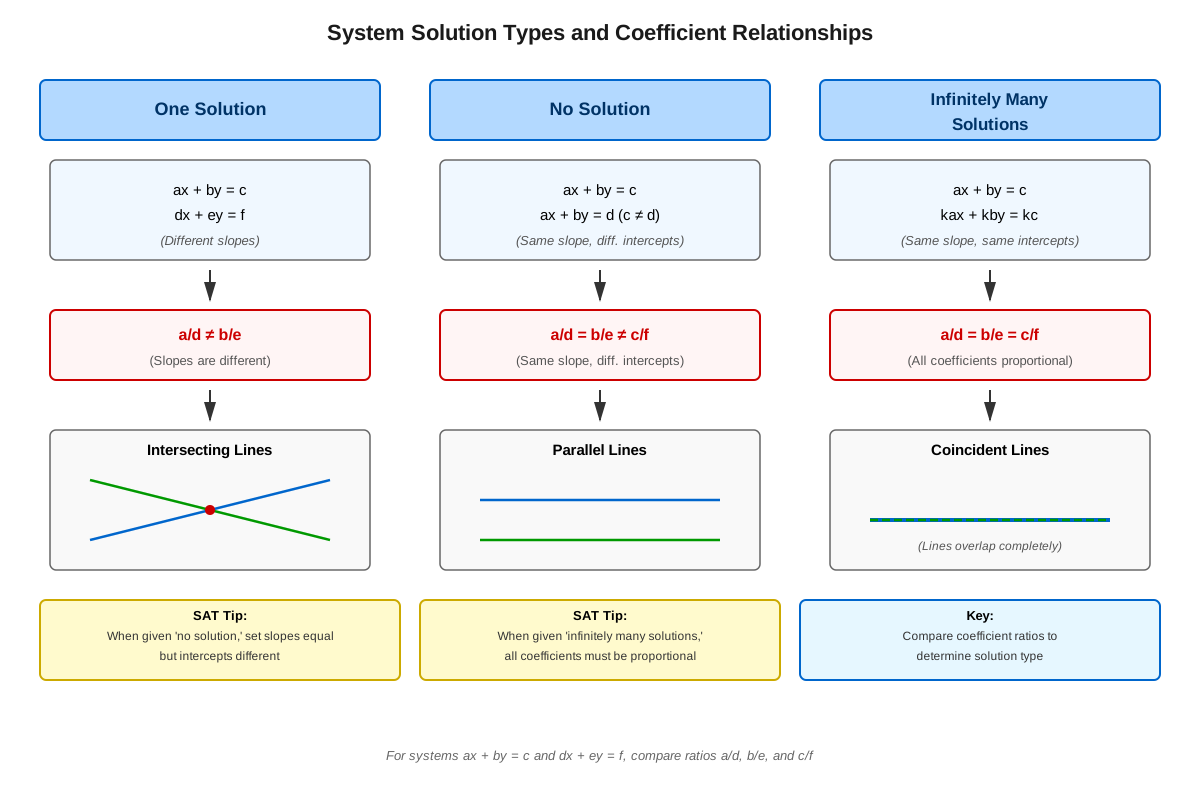
Systems with No Solution
Two linear equations form a system with no solution when they represent parallel lines—lines that never intersect. Parallel lines have identical slopes but different y-intercepts. Consider this system:
2x + 3y = 6
4x + ky = 8
For no solution, the lines must be parallel. Converting to slope-intercept form, the first equation becomes y = (-2/3)x + 2. The second equation becomes y = (-4/k)x + 8/k. For parallel lines, the slopes must be equal: -2/3 = -4/k. Solving yields k = 6. However, we must verify the y-intercepts differ: 2 ≠ 8/6, confirming no solution exists when k = 6.
Systems with Infinitely Many Solutions
A system has infinitely many solutions when both equations represent the same line. This occurs when one equation is a scalar multiple of the other—all coefficients maintain the same ratio. Consider:
3x + 2y = 12
kx + 8y = 48
For infinitely many solutions, the second equation must be a multiple of the first. Multiplying the first equation by 4 gives 12x + 8y = 48. Comparing with kx + 8y = 48, we find k = 12. Every coefficient and constant term maintains the same ratio (4:1), making the equations identical.
Using Point Solutions to Find Coefficients
When an equation passes through a specific point, substituting that point's coordinates creates an equation in the unknown coefficient. If the line y = kx + 3 passes through (2, 7), substitute x = 2 and y = 7:
7 = k(2) + 3
7 = 2k + 3
4 = 2k
k = 2
This method extends to any equation form. The key principle: a point on a line satisfies the line's equation, creating a solvable equation for the unknown coefficient.
Coefficient Relationships in Parallel and Perpendicular Lines
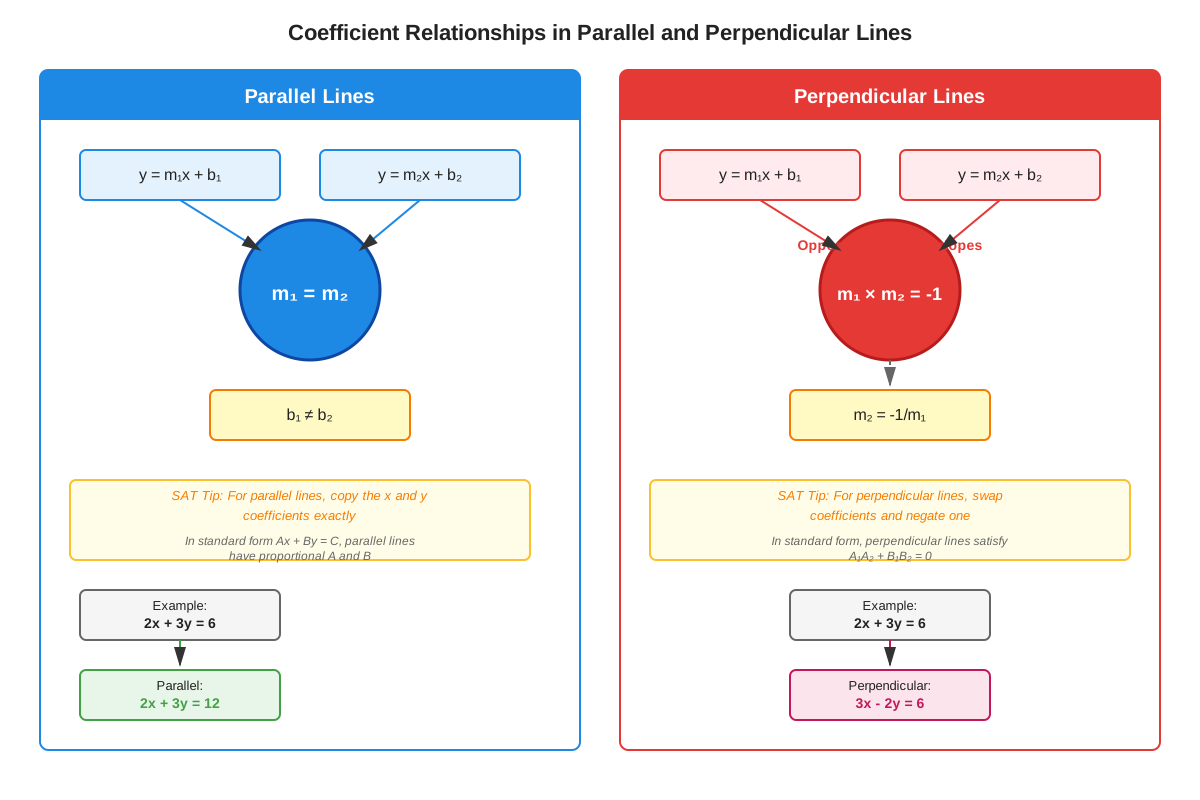
Parallel lines have equal slopes. If y = 3x + 5 is parallel to y = kx - 2, then k = 3. Perpendicular lines have slopes that are negative reciprocals. If y = (2/3)x + 1 is perpendicular to y = kx + 4, then k = -3/2 (since 2/3 × -3/2 = -1).
These relationships frequently appear in SAT coefficient problems, requiring students to recognize geometric relationships and translate them into algebraic conditions.
Multi-Step Coefficient Problems
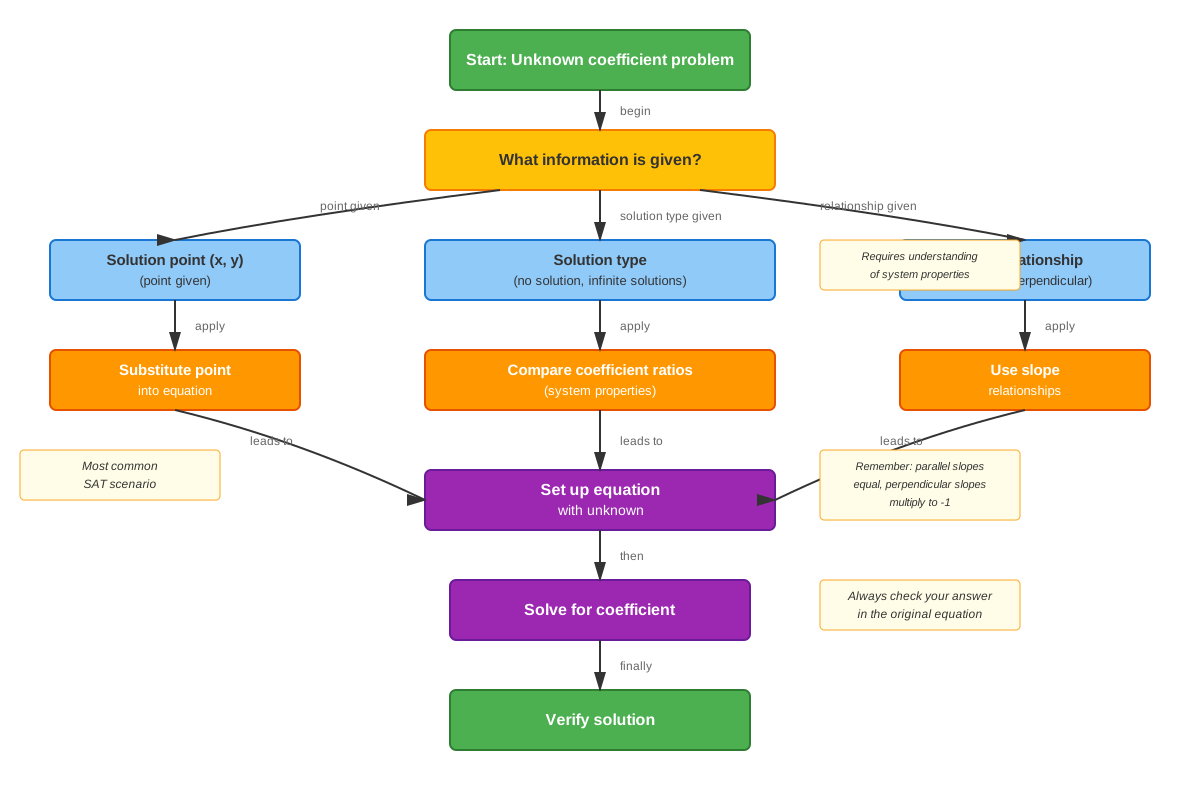
Complex SAT problems combine multiple concepts. A system might have an unknown coefficient in one equation and require determining its value based on the system having a specific solution type. These problems demand:
- Identifying what condition determines the coefficient (no solution, infinitely many solutions, or passing through a point)
- Setting up the appropriate equation or relationship
- Solving algebraically for the unknown coefficient
- Verifying the answer satisfies all given conditions
| Condition | Coefficient Relationship | Key Strategy |
|---|---|---|
| No solution | Equal slopes, different intercepts | Set slope ratios equal; verify intercepts differ |
| Infinitely many solutions | All coefficients proportional | Find the scalar multiple relating equations |
| Passes through point | Point satisfies equation | Substitute coordinates; solve for coefficient |
| Parallel lines | Equal slopes | Set slope coefficients equal |
| Perpendicular lines | Slopes are negative reciprocals | Set product of slopes equal to -1 |
Concept Relationships
Finding unknown coefficients builds directly on solving linear equations and systems of equations. The relationship flows: basic equation solving → understanding coefficient roles → recognizing solution types → finding unknown coefficients. Each skill depends on the previous foundation.
Within this topic, concepts interconnect hierarchically. Understanding how coefficients determine slope and intercept enables recognizing parallel and perpendicular relationships. This recognition, combined with knowledge of solution types (no solution, one solution, infinitely many solutions), allows students to set up equations that determine unknown coefficients. The process always follows: identify condition → translate to algebraic relationship → solve for coefficient → verify.
Connections to broader SAT math topics include: linear functions (coefficients determine function behavior), coordinate geometry (coefficients control line position and orientation), algebraic manipulation (solving for coefficients requires advanced equation-solving skills), and mathematical modeling (real-world scenarios often require finding parameters from given conditions). Mastering coefficient problems strengthens all these related areas, creating a robust algebraic foundation for advanced SAT math questions.
High-Yield Facts
⭐ A system of linear equations has no solution when the lines are parallel: equal slopes but different y-intercepts
⭐ A system has infinitely many solutions when one equation is a scalar multiple of the other
⭐ To find a coefficient when an equation passes through a point, substitute the point's coordinates and solve
⭐ Parallel lines have equal slopes; perpendicular lines have slopes that multiply to -1
⭐ In standard form Ax + By = C, the slope is -A/B
- When comparing coefficients in systems, convert both equations to the same form first
- A coefficient of zero eliminates that variable from the equation entirely
- The ratio of x-coefficients must equal the ratio of y-coefficients for infinitely many solutions
- If only the constant terms differ but coefficients are proportional, the system has no solution
- Unknown coefficients can appear in any position: with x, with y, or as the constant term
Quick check — test yourself on Finding unknown coefficients so far.
Try Flashcards →Common Misconceptions
Misconception: If two equations have the same x-coefficient, they must be parallel.
Correction: Parallel lines require equal slopes, which depends on the ratio of x-coefficient to y-coefficient, not just the x-coefficient alone. The equation 2x + 3y = 6 is not parallel to 2x + 5y = 10 because their slopes (-2/3 and -2/5) differ.
Misconception: A system with infinitely many solutions requires all coefficients to be identical.
Correction: The equations must be scalar multiples, meaning all terms (coefficients and constants) maintain the same ratio. The system 2x + 4y = 6 and 3x + 6y = 9 has infinitely many solutions because the second equation is 1.5 times the first, even though no coefficients are identical.
Misconception: When finding a coefficient using a point, any value that makes the equation "work" is correct.
Correction: The coefficient must make the specific point satisfy the equation. Students sometimes solve incorrectly or fail to verify their answer by substituting back into the original equation with the point's coordinates.
Misconception: Perpendicular lines have slopes that are opposites (like 3 and -3).
Correction: Perpendicular slopes are negative reciprocals, not just opposites. The perpendicular slope to 3 is -1/3, and the perpendicular slope to 2/5 is -5/2. The product of perpendicular slopes always equals -1.
Misconception: If a system has no solution, the equations must have no variables in common.
Correction: Systems with no solution contain the same variables but represent parallel lines. The issue isn't variable presence but the geometric relationship between the lines. Both equations contain x and y; they simply never intersect.
Misconception: Unknown coefficients can only be positive integers.
Correction: Coefficients can be any real number: negative, fractional, zero, or irrational. SAT problems commonly feature fractional and negative coefficient answers, so students must consider all possibilities.
Worked Examples
Example 1: Finding a Coefficient for No Solution
Problem: For what value of k does the following system have no solution?
3x - 6y = 12
2x + ky = 8Solution:
Step 1: Understand the condition. No solution means parallel lines, which have equal slopes but different y-intercepts.
Step 2: Convert both equations to slope-intercept form to identify slopes.
First equation: 3x - 6y = 12
- Solve for y: -6y = -3x + 12
- Divide by -6: y = (1/2)x - 2
- Slope₁ = 1/2
Second equation: 2x + ky = 8
- Solve for y: ky = -2x + 8
- Divide by k: y = (-2/k)x + 8/k
- Slope₂ = -2/k
Step 3: Set slopes equal for parallel lines.
1/2 = -2/k
k = -2 ÷ (1/2)
k = -2 × 2
k = -4
Step 4: Verify y-intercepts differ to confirm no solution (not just infinitely many solutions).
- y-intercept₁ = -2
- y-intercept₂ = 8/(-4) = -2
Wait! The y-intercepts are equal, which would mean infinitely many solutions, not no solution. Let me recalculate.
Actually, checking the original problem: if k = -4, then 2x - 4y = 8, which simplifies to x - 2y = 4. The first equation 3x - 6y = 12 simplifies to x - 2y = 4. These are identical, giving infinitely many solutions.
For NO solution, we need equal slopes but different y-intercepts. Since slope₁ = 1/2, we need slope₂ = 1/2 but the equations cannot be multiples.
Reconsidering: The first equation has slope 1/2. For the second equation to have slope 1/2:
-2/k = 1/2
-2 = k/2
k = -4
But this makes them identical lines. For no solution with these equations, we'd need to change the constant term. Given the problem as stated, k = -4 creates infinitely many solutions. If the second equation were 2x + ky = 10 (different constant), then k = -4 would give no solution.
Correct approach for this problem: The system has no solution when k = -4 AND the constant terms create different y-intercepts. With the given constants, k = -4 actually creates infinitely many solutions. This illustrates the importance of checking both conditions.
Example 2: Finding a Coefficient Using a Point
Problem: The line y = kx - 5 passes through the point (4, 7). What is the value of k?
Solution:
Step 1: Understand that if the point (4, 7) lies on the line, it must satisfy the equation.
Step 2: Substitute x = 4 and y = 7 into the equation.
7 = k(4) - 5Step 3: Solve for k.
7 = 4k - 5
7 + 5 = 4k
12 = 4k
k = 3
Step 4: Verify by substituting k = 3 back into the original equation.
y = 3x - 5Check with point (4, 7):
7 = 3(4) - 5
7 = 12 - 5
7 = 7 ✓Answer: k = 3
This problem demonstrates the straightforward application of point-substitution to find unknown coefficients, a method that appears frequently on the SAT.
Exam Strategy
When approaching SAT questions on finding unknown coefficients, first identify what condition determines the coefficient. Look for key phrases: "no solution" signals parallel lines with equal slopes; "infinitely many solutions" indicates equations that are scalar multiples; "passes through the point" means substitute coordinates; "parallel to" requires equal slopes; "perpendicular to" requires negative reciprocal slopes.
Trigger words and phrases to watch for:
- "For what value of k..." or "For what value of a..."
- "The system has no solution"
- "The system has infinitely many solutions"
- "Passes through the point"
- "Parallel to the line"
- "Perpendicular to the line"
- "The lines intersect at exactly one point" (generic case, often a distractor)
Process-of-elimination strategy: If answer choices are provided, substitute each value back into the problem conditions. For coefficient problems, this verification often takes less time than solving algebraically and catches calculation errors. If the problem asks for a coefficient that makes a system have no solution, test each answer choice by checking if it creates parallel lines with different intercepts.
Time allocation: Spend 1-2 minutes on straightforward coefficient problems (like finding k when a line passes through a point). Allocate 2-3 minutes for complex system problems requiring multiple steps. If a problem seems to require extensive calculation, check whether substituting answer choices would be faster.
Common trap: The SAT often includes answer choices that result from common errors—like using opposite slopes instead of negative reciprocals for perpendicular lines, or finding the value that creates infinitely many solutions when the problem asks for no solution. Always verify your answer satisfies the exact condition stated in the problem.
Memory Techniques
SPINE for system solution types:
- Same slopes, different intercepts = Parallel = No solution
- Identical equations (scalar multiples) = Infinitely many solutions
- Everything else = Exactly one solution
"Negative Reciprocal Flip" for perpendicular slopes: To find the perpendicular slope, flip the fraction and change the sign. If slope is 3/4, perpendicular is -4/3. If slope is -2 (or -2/1), perpendicular is 1/2.
"Point Plugs In": When a line passes through a point, the point's coordinates plug directly into the equation. Visualize literally inserting the numbers into the equation's x and y positions.
"Ratio Match" for infinitely many solutions: All coefficients and constants must maintain the same ratio. Visualize a proportion: a/b = c/d = e/f. If any ratio breaks, the system doesn't have infinitely many solutions.
Slope from Standard Form: In Ax + By = C, the slope is "Negative A over B" or -A/B. Visualize the negative sign jumping from the x-term to the fraction.
Summary
Finding unknown coefficients is a high-yield SAT math skill that requires understanding how numerical parameters control equation behavior. Students must recognize that additional conditions—such as a system having no solution, infinitely many solutions, or an equation passing through a specific point—provide the information needed to determine unknown coefficient values. The key to success lies in translating verbal conditions into algebraic relationships: no solution means parallel lines with equal slopes but different intercepts; infinitely many solutions means equations are scalar multiples; passing through a point means the coordinates satisfy the equation. Mastery requires fluency with slope-intercept and standard forms, understanding of parallel and perpendicular line relationships, and systematic problem-solving that includes verification. These problems integrate multiple algebraic concepts and appear frequently on the SAT, making them essential for students targeting high math scores.
Key Takeaways
- Unknown coefficients are determined by using additional conditions like solution types, points, or line relationships
- Systems with no solution have equal slopes but different y-intercepts (parallel lines)
- Systems with infinitely many solutions have equations that are scalar multiples of each other
- When an equation passes through a point, substitute the coordinates and solve for the coefficient
- Parallel lines have equal slopes; perpendicular lines have slopes that multiply to -1
- Always verify your coefficient answer by checking it satisfies all given conditions
- Convert equations to slope-intercept form (y = mx + b) to easily compare slopes and identify relationships
Related Topics
Systems of Linear Equations (General): Mastering coefficient problems strengthens overall system-solving skills and prepares for more complex multi-variable scenarios.
Linear Functions and Modeling: Understanding how coefficients control function behavior enables tackling real-world modeling problems where parameters must be determined from data.
Quadratic Equations with Unknown Coefficients: The same principles extend to finding coefficients in quadratic expressions, often using information about roots or vertex location.
Inequalities with Parameters: Finding coefficient values that satisfy inequality conditions builds on the same logical framework as equation coefficient problems.
Parametric Equations: Advanced problems involve finding parameters in equations where both x and y are expressed in terms of a third variable.
Practice CTA
Now that you've mastered the concepts of finding unknown coefficients, it's time to solidify your understanding through practice! Attempt the practice questions to apply these strategies to SAT-style problems, and use the flashcards to reinforce key facts and relationships. Remember, coefficient problems reward systematic thinking and careful verification—skills that improve dramatically with focused practice. Each problem you solve builds the pattern recognition and algebraic fluency that will serve you throughout the SAT Math section. You've got this!
Sign up free to keep reading
Create a free AnvayaPrep account to finish this SAT guide on Finding unknown coefficients — plus flashcards and practice questions.