Overview
Unknown coefficients is a critical algebraic concept that appears frequently on the SAT Math section, particularly within questions involving quadratic equations, polynomials, and systems of equations. This topic tests a student's ability to determine missing numerical values in algebraic expressions by using given conditions, constraints, or relationships. When the SAT presents an equation or expression with one or more unknown coefficients, students must leverage their understanding of algebraic properties, equation solving, and logical reasoning to find these values.
Mastering unknown coefficients is essential for SAT success because it bridges multiple mathematical domains. Questions involving this concept often combine knowledge of quadratic equations, polynomial operations, factoring, the relationship between roots and coefficients, and systems of equations. The College Board frequently uses unknown coefficient problems to assess higher-order thinking skills, as these questions require students to work backward from given information, apply multiple solution strategies, and verify their answers through substitution or logical checking.
This topic connects directly to broader math concepts tested on the SAT, including function notation, graphing parabolas, solving equations, and understanding how changes in coefficients affect the behavior of functions. Students who develop proficiency with sat unknown coefficients problems gain a significant advantage, as these questions often appear in both the calculator and no-calculator sections and can range from straightforward substitution problems to complex multi-step reasoning challenges worth valuable points.
Learning Objectives
- [ ] Identify key features of unknown coefficients in algebraic expressions and equations
- [ ] Explain how unknown coefficients appears on the SAT and recognize common question formats
- [ ] Apply unknown coefficients techniques to answer SAT-style questions efficiently
- [ ] Determine unknown coefficients using substitution of given points or values
- [ ] Use the relationship between roots and coefficients in quadratic equations to find missing values
- [ ] Solve systems of equations that arise from multiple conditions on unknown coefficients
- [ ] Verify solutions by checking that determined coefficients satisfy all given constraints
Prerequisites
- Basic algebraic manipulation: Essential for rearranging equations and isolating variables when solving for unknown coefficients
- Solving linear and quadratic equations: Required to find coefficient values once equations are set up
- Understanding of polynomial structure: Necessary to recognize the role of coefficients in expressions like ax² + bx + c
- Substitution method: Fundamental technique for replacing variables with known values to create solvable equations
- Factoring techniques: Often needed to work with quadratic expressions when determining coefficients
- Function notation: Important for understanding how coefficients affect function values at specific inputs
Why This Topic Matters
Unknown coefficients problems appear with remarkable frequency on the SAT, typically showing up in 2-4 questions per test across both the calculator and no-calculator sections. These questions are considered medium to high difficulty and often serve as score differentiators between students aiming for scores in the 650-700 range versus those targeting 750+. The College Board values this topic because it assesses multiple competencies simultaneously: algebraic fluency, logical reasoning, and the ability to work with abstract relationships.
In real-world applications, determining unknown coefficients is fundamental to fields like engineering, economics, and data science. When scientists fit mathematical models to experimental data, they're essentially finding unknown coefficients that make their equations match observed phenomena. Economists use similar techniques to determine parameters in supply and demand functions, while engineers calculate coefficients in equations describing physical systems.
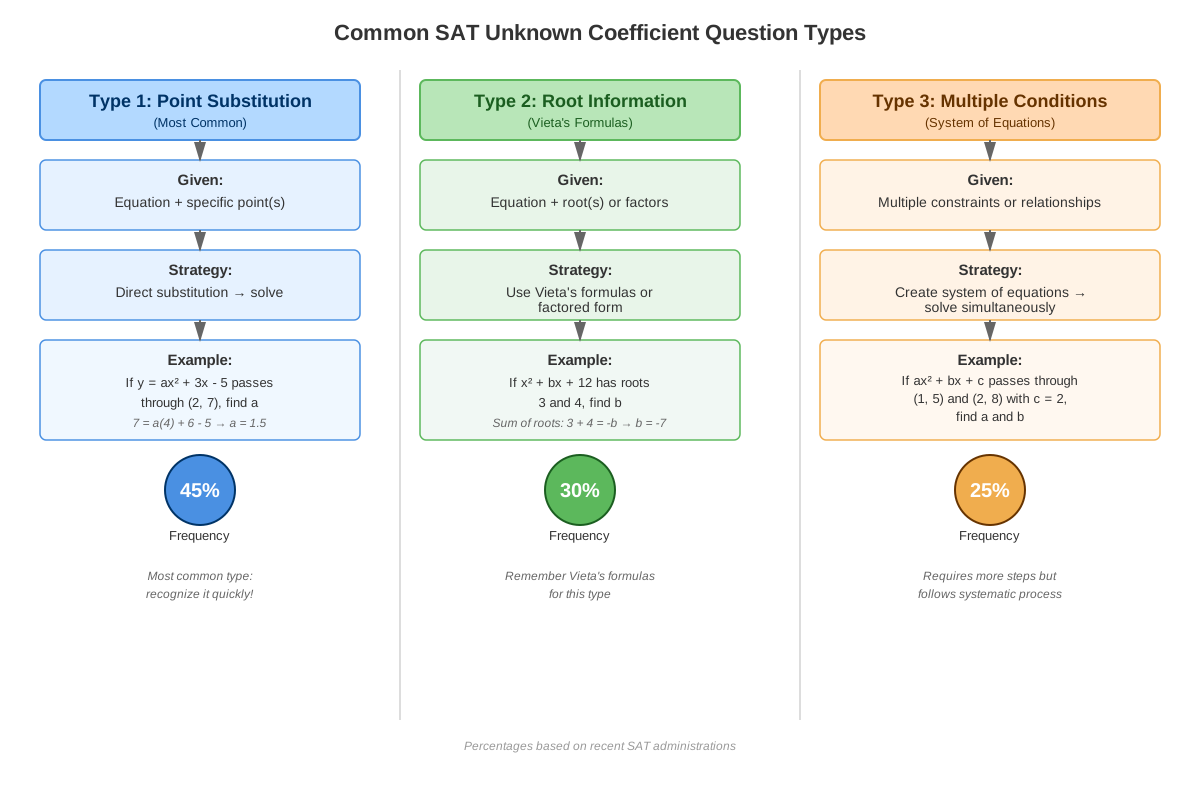
On the SAT, unknown coefficients questions commonly appear in several formats: finding a coefficient given that a specific point lies on a parabola, determining values that make two expressions equivalent for all values of x, using the sum or product of roots to find coefficients in quadratic equations, or finding coefficients when given information about factors or zeros. These questions may be presented as multiple-choice or grid-in problems, and they frequently integrate with other topics like systems of equations, function transformations, or polynomial division.
Core Concepts
Understanding Unknown Coefficients
Unknown coefficients refer to the numerical multipliers in algebraic expressions whose values must be determined using given information or constraints. In a general quadratic expression ax² + bx + c, the letters a, b, and c represent coefficients. When one or more of these values is unknown, students must use algebraic techniques to find them. The fundamental principle underlying all unknown coefficient problems is that equations must hold true for the specific conditions given in the problem.
Substitution Method for Finding Coefficients
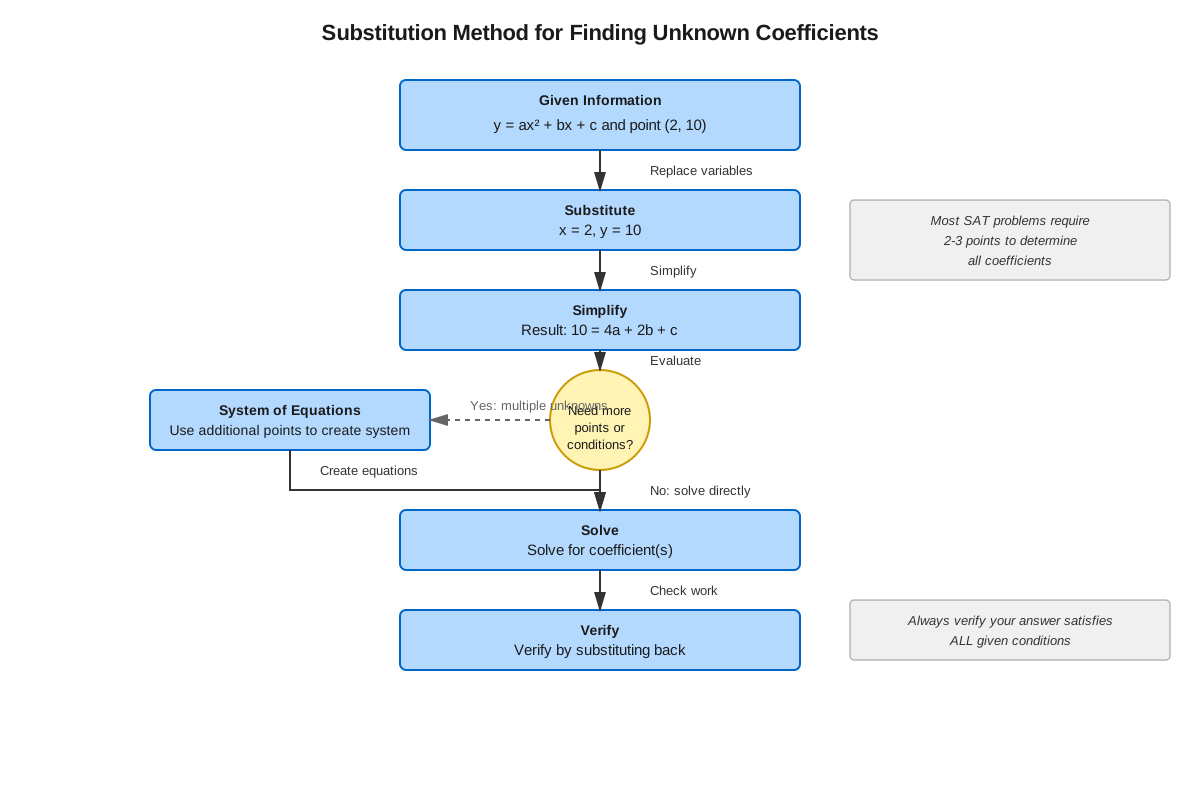
The most direct approach to finding unknown coefficients involves substituting known values into an equation and solving for the unknowns. When a problem states that a point (h, k) lies on a curve or satisfies an equation, students can replace x with h and y (or f(x)) with k, creating an equation with fewer unknowns.
Example structure: If the point (2, 5) lies on the parabola y = ax² + 3x + c, substitute to get:
5 = a(2)² + 3(2) + c
5 = 4a + 6 + c
-1 = 4a + c
This creates a relationship between a and c. If additional information is provided (another point, or a specific value for one coefficient), students can solve the system completely.
Identity Method: Coefficients of Equivalent Expressions
When two polynomial expressions are equal for all values of the variable (not just specific values), their corresponding coefficients must be equal. This principle is crucial for SAT problems that state expressions are "equivalent" or "equal for all x."
Example: If 3x² + bx + 7 = ax² + 4x + c for all values of x, then:
- Coefficient of x²: 3 = a
- Coefficient of x: b = 4
- Constant term: 7 = c
This method allows students to quickly extract multiple coefficient values by matching terms with the same degree.
Roots and Coefficients Relationship
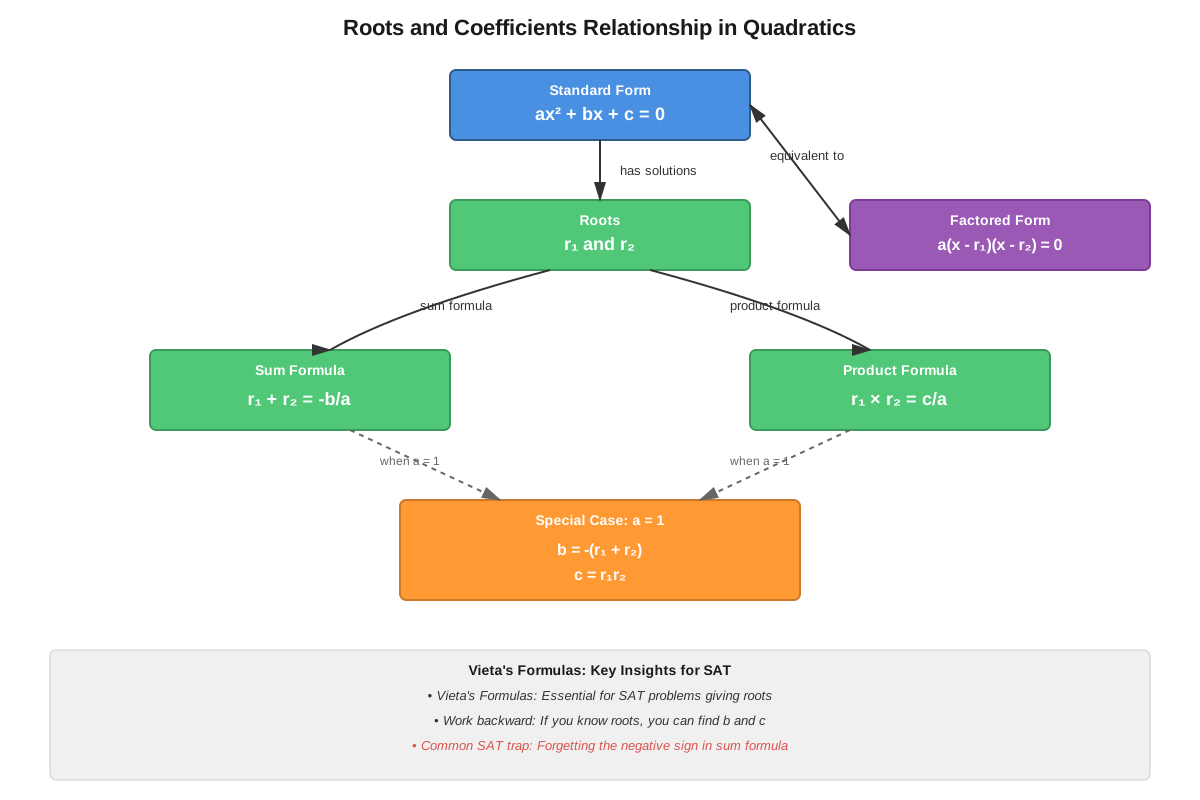
For a quadratic equation ax² + bx + c = 0 with roots r and s, Vieta's formulas provide powerful relationships:
| Relationship | Formula | Application |
|---|---|---|
| Sum of roots | r + s = -b/a | Find b when roots and a are known |
| Product of roots | r × s = c/a | Find c when roots and a are known |
These relationships are particularly high-yield for SAT questions that provide information about zeros, x-intercepts, or solutions and ask for coefficient values.
Factor Form and Coefficients
When a quadratic is written in factored form y = a(x - r)(x - s), the coefficients in standard form can be determined by expanding. The value of 'a' represents the vertical stretch/compression, while r and s are the roots. This connection between forms is frequently tested.
Expansion process:
- Multiply the binomials: (x - r)(x - s) = x² - (r+s)x + rs
- Distribute the leading coefficient: a[x² - (r+s)x + rs] = ax² - a(r+s)x + ars
- Identify coefficients: b = -a(r+s) and c = ars
Systems of Equations from Multiple Conditions
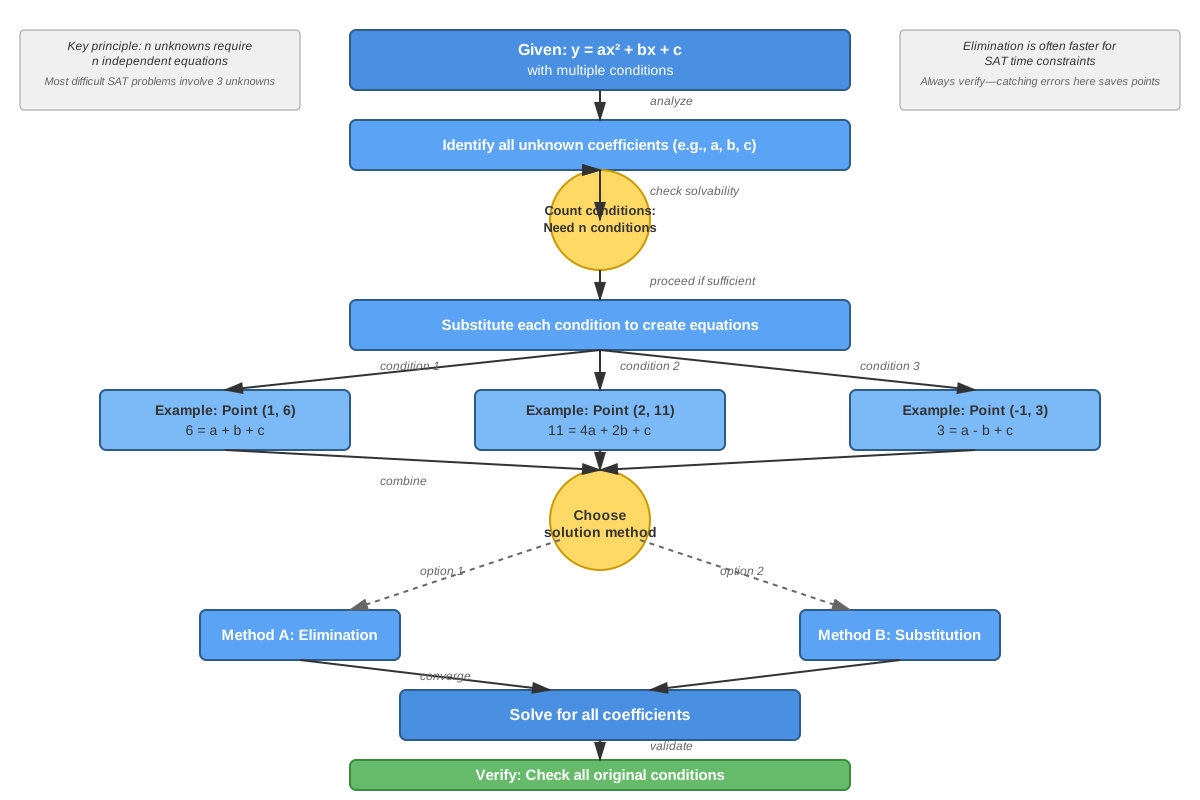
Many SAT problems provide two or more conditions that each generate an equation involving unknown coefficients. Students must set up a system and solve using substitution or elimination.
Strategic approach:
- Translate each condition into an equation
- Count unknowns versus equations (need equal numbers for unique solution)
- Choose the most efficient solving method
- Solve systematically
- Verify the solution satisfies all original conditions
Vertex Form and Coefficients
When information about the vertex (h, k) of a parabola is given, the vertex form y = a(x - h)² + k can be used to find the leading coefficient 'a' if an additional point is known. This form directly reveals how the coefficient affects the parabola's shape and position.
Concept Relationships
The concepts within unknown coefficients form an interconnected web of techniques. The substitution method serves as the foundation, enabling students to convert verbal conditions into algebraic equations. This leads directly to systems of equations when multiple conditions are present, requiring students to combine equations strategically. The identity method represents a special case where substitution applies for all values simultaneously, creating multiple simple equations from one equivalence statement.
The roots-coefficients relationship (Vieta's formulas) connects to both substitution and factored form concepts. When roots are known, these formulas provide an alternative to expansion for finding coefficients. The factor form concept bridges to standard form through algebraic expansion, while also connecting back to roots since factors directly reveal zeros.
Relationship flow: Given conditions → Substitution creates equations → System solving yields coefficients → Verification through factor form or root checking → Confirmation in standard form
This topic builds on prerequisite knowledge of solving equations and polynomial structure, while enabling progression to more advanced topics like polynomial division, rational functions, and curve fitting. Mastery of unknown coefficients strengthens overall algebraic fluency, which supports success across nearly all SAT Math topics.
Quick check — test yourself on Unknown coefficients so far.
Try Flashcards →High-Yield Facts
⭐ When a point (x₀, y₀) satisfies an equation, substituting these values creates an equation in the unknown coefficients
⭐ If two expressions are equal for ALL values of x, their corresponding coefficients must be equal
⭐ For quadratic ax² + bx + c = 0 with roots r and s: sum of roots = -b/a and product of roots = c/a
⭐ The number of independent equations needed equals the number of unknown coefficients to find a unique solution
⭐ In factored form a(x - r)(x - s), the value 'a' can be found by substituting any point other than the roots
- When expanding (x - r)(x - s), the coefficient of x is -(r + s) and the constant term is rs
- If a quadratic passes through (0, k), then the constant term c equals k
- The leading coefficient 'a' in a quadratic determines whether the parabola opens upward (a > 0) or downward (a < 0)
- Two points on a parabola create two equations, sufficient to find two unknown coefficients if one is known
- Verification by substituting back into the original conditions is essential to catch algebraic errors
- Grid-in questions on unknown coefficients often have integer or simple fraction answers
- When given the vertex and one other point, vertex form is more efficient than standard form
Common Misconceptions
Misconception: If one point is given, all coefficients in a quadratic can be determined.
Correction: A single point provides only one equation. For a quadratic with three coefficients (a, b, c), at least two pieces of independent information are needed if one coefficient is known, or three pieces if all are unknown.
Misconception: When two expressions are equal at one specific value of x, their coefficients must be equal.
Correction: Coefficients are equal only when expressions are equivalent for ALL values of x (an identity). Equality at one point creates one equation relating the coefficients but doesn't make them individually equal.
Misconception: The sum of roots formula is r + s = b/a.
Correction: The correct formula is r + s = -b/a (note the negative sign). This comes from the quadratic formula and is one of the most commonly tested relationships on the SAT.
Misconception: In y = a(x - r)(x - s), the value of 'a' can be found using either root.
Correction: Substituting a root into this equation gives 0 = 0, which provides no information about 'a'. A different point (not a root) must be used to determine the leading coefficient.
Misconception: Unknown coefficient problems always have unique solutions.
Correction: If insufficient information is provided (fewer independent equations than unknowns), the problem may have infinitely many solutions or may ask for a relationship between coefficients rather than specific values.
Worked Examples
Example 1: Using Two Points to Find Coefficients
Problem: The quadratic function f(x) = ax² - 4x + c passes through the points (1, 3) and (2, 5). What is the value of a + c?
Solution:
Step 1: Substitute the first point (1, 3) into the equation.
f(1) = 3
a(1)² - 4(1) + c = 3
a - 4 + c = 3
a + c = 7
Step 2: Notice that the question asks for a + c, which we've already found! However, let's verify using the second point to ensure consistency.
Step 3: Substitute the second point (2, 5).
f(2) = 5
a(2)² - 4(2) + c = 5
4a - 8 + c = 5
4a + c = 13
Step 4: Now we have a system:
- Equation 1: a + c = 7
- Equation 2: 4a + c = 13
Step 5: Subtract Equation 1 from Equation 2:
(4a + c) - (a + c) = 13 - 7
3a = 6
a = 2
Step 6: Substitute back into Equation 1:
2 + c = 7
c = 5
Step 7: Find a + c:
a + c = 2 + 5 = 7Answer: 7
Connection to learning objectives: This problem demonstrates applying substitution method to create a system of equations from multiple points, then solving to find unknown coefficients.
Example 2: Using Roots to Find Coefficients
Problem: A quadratic function has roots at x = 3 and x = -2, and its graph passes through the point (1, -8). If the function can be written as f(x) = ax² + bx + c, what is the value of c?
Solution:
Step 1: Use factored form with the given roots.
f(x) = a(x - 3)(x - (-2))
f(x) = a(x - 3)(x + 2)
Step 2: Use the point (1, -8) to find 'a'.
f(1) = -8
a(1 - 3)(1 + 2) = -8
a(-2)(3) = -8
-6a = -8
a = 4/3
Step 3: Expand to standard form to find c.
f(x) = (4/3)(x - 3)(x + 2)
f(x) = (4/3)(x² + 2x - 3x - 6)
f(x) = (4/3)(x² - x - 6)
f(x) = (4/3)x² - (4/3)x - 8
Step 4: Identify the constant term.
c = -8Alternative approach using Vieta's formulas:
- Product of roots: (3)(-2) = -6 = c/a
- We found a = 4/3, so: -6 = c/(4/3)
- Therefore: c = -6 × (4/3) = -8
Answer: c = -8
Connection to learning objectives: This example shows how to use the relationship between roots and coefficients, apply factor form, and convert between forms to identify specific coefficient values.
Exam Strategy
When approaching sat unknown coefficients questions, begin by carefully identifying what information is given and what must be found. Look for key phrases like "passes through," "has roots at," "equivalent for all x," or "vertex at" — each signals a specific technique. Create a mental checklist: How many unknowns? How many conditions? Do the numbers match?
Trigger words and phrases to recognize:
- "For all values of x" → Use identity method (equate coefficients)
- "Passes through the point" → Use substitution method
- "Has roots/zeros at" → Use Vieta's formulas or factor form
- "Vertex at" → Consider vertex form
- "Equivalent expressions" → Match corresponding coefficients
Process of elimination tips:
- If a problem provides two conditions and asks for one coefficient, you can often find it without solving for all unknowns
- Check answer choices by substituting back into the original conditions
- Eliminate answers that would make the leading coefficient zero (unless the problem specifies it's not a quadratic)
- For grid-in questions, verify your answer makes sense in context (e.g., if a parabola opens upward, a must be positive)
Time allocation advice: Spend 30-45 seconds setting up equations carefully. Rushing this step leads to errors that waste more time later. For problems requiring systems of equations, choose substitution over elimination when one equation is already solved for a variable. Budget 1.5-2 minutes total for straightforward unknown coefficient problems, and up to 3 minutes for complex multi-step versions. If you're stuck after setting up equations, move on and return later rather than spending 4+ minutes on a single problem.
Memory Techniques
VIETA mnemonic for remembering Vieta's formulas:
- Very Important: Equal To Algebra
- Sum = -b/a (think: "Subtract Before Adding")
- Product = c/a (think: "Constant After")
SIFT method for unknown coefficient problems:
- Substitute given points or values
- Identify the number of unknowns vs. equations
- Form a system if needed
- Test your answer by substituting back
Visualization strategy: Picture a parabola with labeled points. Each point you're given is like a "pin" that constrains where the parabola can be. One pin allows rotation, two pins lock the shape (if one coefficient is known), three pins determine everything.
Coefficient position acronym - ABC:
- A = affects opening direction and width (leading coefficient)
- B = affects axis of symmetry position (linear coefficient)
- C = affects y-intercept (constant term)
Summary
Unknown coefficients problems require students to determine missing numerical values in algebraic expressions using given conditions and constraints. The core techniques include substitution (replacing variables with known values to create equations), the identity method (equating coefficients when expressions are equivalent for all values), and Vieta's formulas (relating roots to coefficients in quadratics). Success depends on recognizing which technique applies, setting up accurate equations, and solving systems efficiently. Students must understand that the number of independent conditions must match the number of unknowns for a unique solution. These problems frequently integrate multiple algebraic concepts and appear in various formats on the SAT, making them high-value targets for focused practice. Mastery requires both procedural fluency in solving equations and conceptual understanding of how coefficients affect function behavior.
Key Takeaways
- Unknown coefficients are found by creating equations through substitution of known values or by equating coefficients of equivalent expressions
- The number of independent conditions needed equals the number of unknown coefficients to solve for
- Vieta's formulas (sum of roots = -b/a, product of roots = c/a) provide powerful shortcuts when root information is given
- Always verify solutions by substituting back into all original conditions to catch errors
- Factor form a(x - r)(x - s) connects directly to roots and can be expanded to find standard form coefficients
- "For all x" signals that coefficients of like terms must be equal (identity method)
- Strategic problem setup and careful equation formation prevent time-consuming mistakes
Related Topics
Systems of Linear Equations: Unknown coefficient problems often generate systems that require solving. Mastering substitution and elimination methods enhances efficiency with coefficient problems.
Polynomial Operations and Expansion: Understanding how to expand factored forms and combine like terms is essential for converting between forms and identifying coefficients in standard form.
Function Transformations: Knowledge of how coefficients affect graph shape, position, and orientation deepens understanding of why coefficient values matter and helps with verification.
Quadratic Formula and Discriminant: The relationship between coefficients and roots extends beyond Vieta's formulas to include the discriminant b² - 4ac, which determines the nature of solutions.
Rational Functions and Partial Fractions: Advanced applications of unknown coefficients appear in decomposing rational expressions, building on the same fundamental techniques.
Practice CTA
Now that you've mastered the core concepts and strategies for unknown coefficients, it's time to solidify your understanding through active practice. Work through the practice questions to apply these techniques to authentic SAT-style problems, and use the flashcards to reinforce key formulas and relationships. Remember: every unknown coefficient problem you solve builds pattern recognition that makes the next one faster and easier. The difference between a good score and a great score often comes down to confidence with medium-difficulty topics like this one — and confidence comes from practice. You've got the tools; now put them to work!
Sign up free to keep reading
Create a free AnvayaPrep account to finish this SAT guide on Unknown coefficients — plus flashcards and practice questions.