Overview
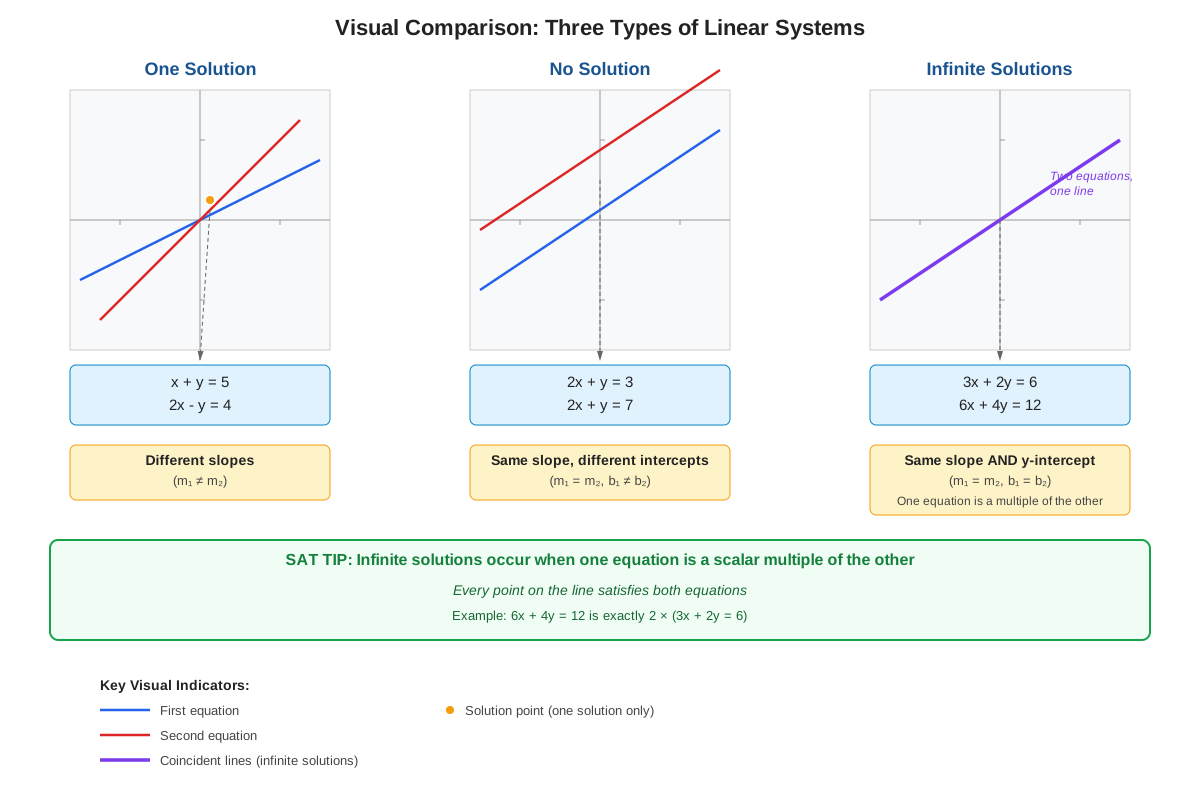
Infinite solution systems represent a special category of linear equation systems where two or more equations describe the exact same line, resulting in every point on that line being a solution to the system. Unlike systems with one unique solution (intersecting lines) or no solution (parallel lines), infinite solution systems occur when equations are mathematically equivalent—they may look different superficially, but they represent identical relationships. Understanding this concept is crucial for SAT success because the College Board frequently tests students' ability to recognize when systems have infinitely many solutions, often by asking them to determine unknown coefficients that would create such a system.
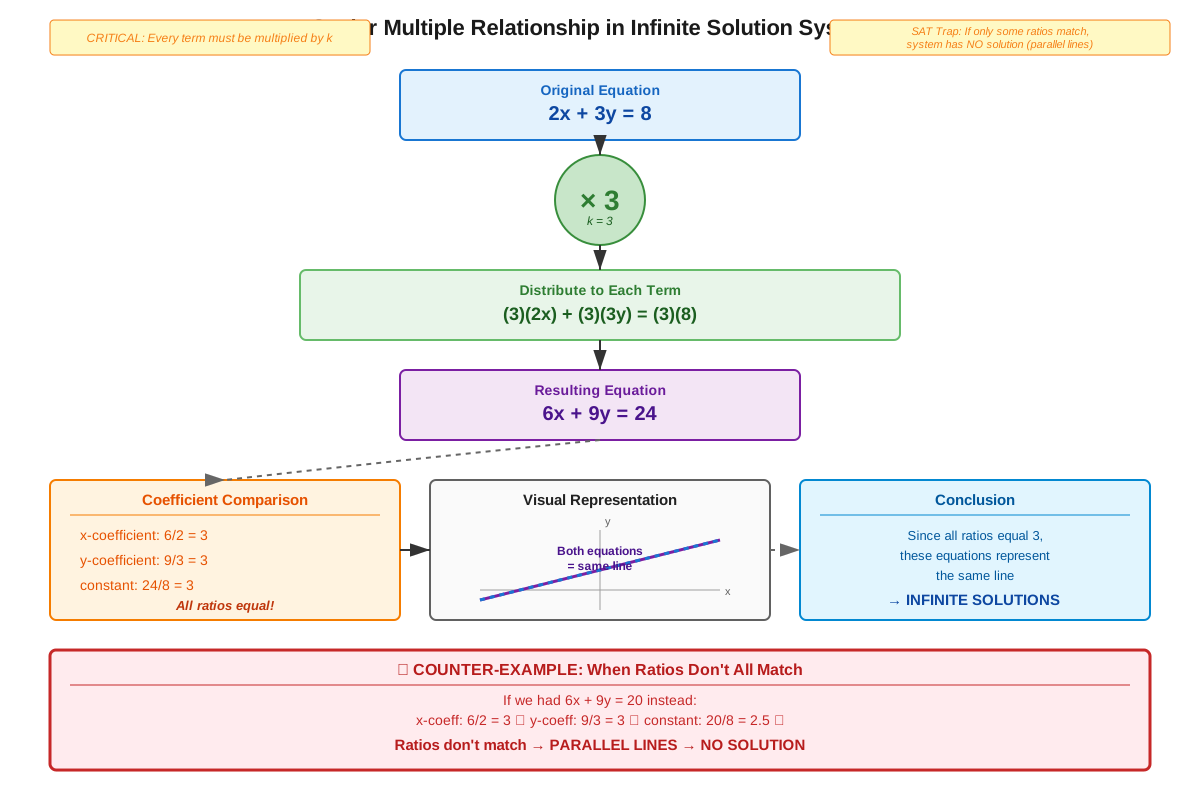
This topic appears regularly on the SAT math section, particularly in questions involving algebraic manipulation and systems of equations. Students must recognize that infinite solution systems occur when one equation is a scalar multiple of another, meaning you can multiply every term in one equation by the same constant to obtain the other equation. The SAT tests this concept through various question formats: determining the value of a constant that creates infinite solutions, identifying which system has infinite solutions from multiple choices, or explaining why a particular system has infinitely many solutions rather than one or none.
Mastering sat infinite solution systems connects directly to broader algebraic concepts including linear equations, slope-intercept form, graphing, and proportional relationships. This topic serves as a bridge between basic equation-solving and more advanced concepts like linear independence and parametric equations. Students who thoroughly understand infinite solution systems demonstrate sophisticated algebraic reasoning—they can move beyond mechanical equation-solving to analyze the structural relationships between equations, a skill that appears throughout higher mathematics and is heavily weighted on standardized tests.
Learning Objectives
- [ ] Identify key features of infinite solution systems
- [ ] Explain how infinite solution systems appears on the SAT
- [ ] Apply infinite solution systems to answer SAT-style questions
- [ ] Determine the value of unknown coefficients that create infinite solution systems
- [ ] Distinguish between systems with one solution, no solution, and infinite solutions by analyzing coefficients
- [ ] Convert between different forms of linear equations to recognize equivalent equations
- [ ] Verify algebraically whether a given system has infinite solutions
Prerequisites
- Linear equations in two variables: Understanding how to write and manipulate equations like ax + by = c is essential because infinite solution systems involve comparing two such equations
- Slope-intercept form (y = mx + b): Converting equations to this form helps identify when two lines have identical slopes and y-intercepts, indicating infinite solutions
- Solving systems of equations: Familiarity with substitution and elimination methods provides the foundation for recognizing when these methods reveal infinite solutions
- Proportional relationships: Recognizing when ratios are equivalent helps identify when one equation is a scalar multiple of another
- Basic algebraic manipulation: Skills like distributing, combining like terms, and isolating variables are necessary for transforming equations to compare them
Why This Topic Matters
In real-world applications, infinite solution systems model situations where multiple descriptions represent the same constraint or relationship. For example, if two different recipes for a mixture specify the same ratio of ingredients (just scaled differently), they represent infinite solution systems—any amount satisfying one recipe automatically satisfies the other. In economics, different formulations of budget constraints might represent the same purchasing limitations, and in physics, equivalent force equations might describe the same physical situation from different perspectives.
On the SAT, infinite solution systems appear in approximately 2-4 questions per test, making them a high-yield topic for focused study. These questions typically appear in both the calculator and no-calculator sections, with point values ranging from 1-4 points depending on complexity. The College Board particularly favors questions where students must determine an unknown coefficient (often represented by a constant like k, a, or c) that would make a system have infinitely many solutions. This question type tests both conceptual understanding and algebraic manipulation skills simultaneously.
Common SAT question formats include: presenting two equations with an unknown constant and asking what value creates infinite solutions; providing graphs or tables and asking students to identify which system has infinite solutions; or embedding the concept within word problems where students must recognize that two different descriptions represent the same relationship. The topic also appears in grid-in questions where students must calculate and enter the specific value that creates infinite solutions, making it impossible to guess and requiring genuine mastery.
Core Concepts
Definition of Infinite Solution Systems
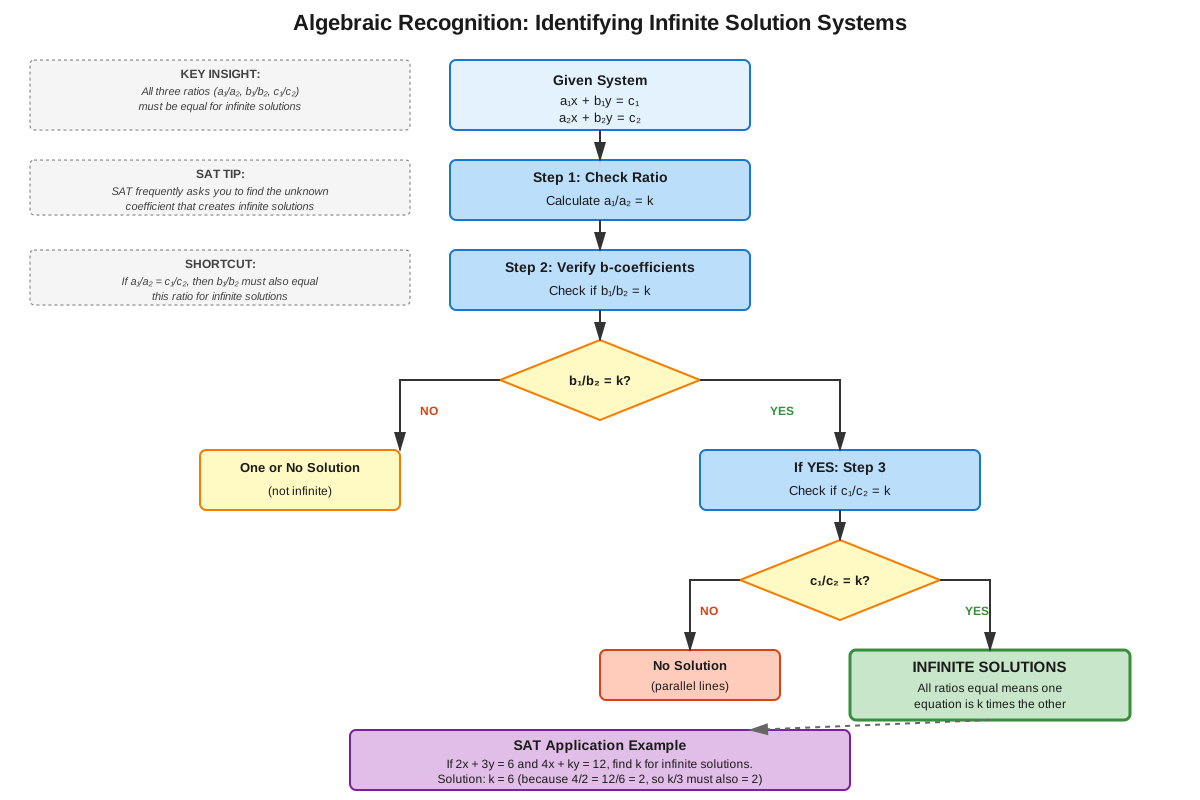
An infinite solution system is a system of linear equations where all equations represent the same line, meaning every point on that line satisfies all equations simultaneously. Mathematically, this occurs when the equations are dependent—one equation can be derived from another through multiplication by a constant. For a system of two linear equations in standard form:
a₁x + b₁y = c₁
a₂x + b₂y = c₂
The system has infinite solutions when the ratios of corresponding coefficients are equal:
a₁/a₂ = b₁/b₂ = c₁/c₂This proportionality condition indicates that the second equation is simply the first equation multiplied by the constant k = a₂/a₁. When graphed, both equations produce identical lines, so every point on the line is a solution to both equations.
Recognizing Infinite Solutions Through Coefficient Comparison
The most efficient method for identifying infinite solution systems on the SAT involves comparing coefficients systematically. Consider the system:
3x + 6y = 9
2x + 4y = 6
To check for infinite solutions, calculate the ratios:
- Coefficient of x: 3/2 = 1.5
- Coefficient of y: 6/4 = 1.5
- Constant terms: 9/6 = 1.5
Since all three ratios equal 1.5, the second equation is exactly 2/3 times the first equation, confirming infinite solutions. If any ratio differs, the system either has one unique solution (different slopes) or no solution (same slope, different y-intercepts).
Algebraic Methods Revealing Infinite Solutions
When solving systems using elimination or substitution, infinite solution systems produce a true identity statement like 0 = 0 or 5 = 5, rather than a specific value for a variable. For example, using elimination on:
4x - 2y = 10
-6x + 3y = -15
Multiply the first equation by 3 and the second by 2:
12x - 6y = 30
-12x + 6y = -30
Adding these equations yields: 0 = 0
This identity confirms infinite solutions because the equations are equivalent—the second is -3/2 times the first.
Determining Unknown Coefficients
SAT questions frequently present systems with an unknown constant and ask what value creates infinite solutions. The strategy involves setting up proportions between coefficients. For example:
6x + ky = 15
2x + 3y = 5
For infinite solutions, the ratios must be equal:
6/2 = k/3 = 15/5From 6/2 = 3 and 15/5 = 3, we need k/3 = 3, so k = 9.
This approach works because we're ensuring the second equation is exactly 1/3 of the first equation (or equivalently, the first is 3 times the second).
Slope-Intercept Form Analysis
Converting equations to slope-intercept form (y = mx + b) provides another reliable method for identifying infinite solutions. Two lines have infinite solutions if and only if they have identical slopes (m) and identical y-intercepts (b). Consider:
2x + 4y = 8
x + 2y = 4
Converting both to slope-intercept form:
- First equation: 4y = -2x + 8 → y = -½x + 2
- Second equation: 2y = -x + 4 → y = -½x + 2
Both equations yield identical forms, confirming infinite solutions. This method is particularly useful when equations appear in different forms initially.
Comparison Table: Types of Linear Systems
| System Type | Coefficient Relationship | Graphical Representation | Algebraic Result | Number of Solutions |
|---|---|---|---|---|
| Infinite Solutions | a₁/a₂ = b₁/b₂ = c₁/c₂ | Identical lines (coincident) | Identity (0 = 0) | Infinitely many |
| One Solution | a₁/a₂ ≠ b₁/b₂ | Lines intersect at one point | Specific values for x and y | Exactly one |
| No Solution | a₁/a₂ = b₁/b₂ ≠ c₁/c₂ | Parallel lines | Contradiction (0 = 5) | Zero |
Parametric Representation
When a system has infinite solutions, the solution set can be expressed parametrically using a parameter (often t). For the system:
x + 2y = 5
2x + 4y = 10
We can express solutions as: x = 5 - 2t, y = t, where t can be any real number. Each value of t generates a specific solution point, and all these points lie on the same line. While the SAT rarely asks for parametric form explicitly, understanding this representation deepens comprehension of why "infinite" solutions exist.
Concept Relationships
The concept of infinite solution systems builds directly on understanding linear equations and their graphical representations. A single linear equation in two variables has infinitely many solutions (all points on its line), but when we create a system of two equations, we're asking which points satisfy both conditions simultaneously. This leads to three possibilities: the lines intersect at one point (one solution), never intersect because they're parallel (no solution), or are actually the same line (infinite solutions).
The relationship flows: Basic linear equations → Systems of equations → Classification by number of solutions → Infinite solution systems as a special case. Within infinite solution systems, the core relationship is: Proportional coefficients → Equivalent equations → Identical lines → Infinite solutions.
Infinite solution systems connect to proportional relationships because recognizing that one equation is a scalar multiple of another requires understanding proportionality. They also relate to linear independence (a more advanced concept)—infinite solution systems occur precisely when equations are linearly dependent. The concept extends to matrices and determinants in higher mathematics, where a zero determinant indicates dependent equations.
Understanding infinite solutions enhances comprehension of no-solution systems because both involve equations with proportional x and y coefficients—the difference lies in whether the constant terms are also proportional. This creates a natural comparison: same slope with different y-intercepts (no solution) versus same slope with same y-intercept (infinite solutions).
High-Yield Facts
⭐ A system has infinite solutions when one equation is a scalar multiple of the other—every coefficient and constant term maintains the same ratio
⭐ For equations a₁x + b₁y = c₁ and a₂x + b₂y = c₂, infinite solutions occur when a₁/a₂ = b₁/b₂ = c₁/c₂
⭐ When solving by elimination or substitution, infinite solution systems produce identity statements like 0 = 0, not specific variable values
⭐ In slope-intercept form, infinite solutions require both identical slopes AND identical y-intercepts
⭐ SAT questions asking for a constant that creates infinite solutions require setting up equal ratios between all corresponding coefficients
- Graphically, infinite solution systems appear as a single line, not two distinct lines
- The term "dependent equations" is synonymous with equations that produce infinite solutions
- If multiplying one equation by any non-zero constant produces the other equation, the system has infinite solutions
- Converting both equations to the same form (standard or slope-intercept) makes comparison easier
- Infinite solution systems represent the same constraint expressed in different ways—they contain no new information relative to each other
Quick check — test yourself on Infinite solution systems so far.
Try Flashcards →Common Misconceptions
Misconception: If two equations look different, they cannot have infinite solutions → Correction: Equations can appear very different superficially but still represent the same line. For example, 2x + 4y = 6 and 3x + 6y = 9 look different but both simplify to the same relationship (x + 2y = 3), creating infinite solutions.
Misconception: A system has infinite solutions if the coefficients of x are proportional → Correction: ALL coefficients must be proportional, including the y coefficients and constant terms. If only x coefficients are proportional, the system likely has one unique solution or no solution, depending on the y coefficients.
Misconception: Getting 0 = 0 when solving means there's no solution → Correction: The identity 0 = 0 (or any true statement like 5 = 5) indicates infinite solutions. A contradiction like 0 = 3 indicates no solution. The identity means the equations are equivalent, so any solution to one automatically satisfies the other.
Misconception: Infinite solutions means the variables can be any value → Correction: While there are infinitely many solutions, they're constrained to lie on a specific line. Not every (x, y) pair is a solution—only those satisfying the equation. For example, if the line is y = 2x + 1, the point (0, 0) is NOT a solution despite there being infinite solutions.
Misconception: To find the constant k that creates infinite solutions, just make the x coefficients equal → Correction: The constant k must make ALL ratios equal. If 3x + ky = 6 and x + 2y = 2, you need 3/1 = k/2 = 6/2, which gives k = 6, not k = 3 (which would only match x coefficients).
Misconception: Parallel lines have infinite solutions because they never intersect → Correction: Parallel lines have NO solutions because they never intersect—there's no point satisfying both equations. Infinite solutions occur when lines are coincident (the same line), not parallel.
Misconception: If one equation is a multiple of the other, they must have infinite solutions → Correction: This is correct only if EVERY term (including the constant) is multiplied by the same factor. If 2x + 4y = 6 and 4x + 8y = 10, the left sides are proportional but the constants aren't (6 × 2 ≠ 10), creating parallel lines with no solution.
Worked Examples
Example 1: Determining an Unknown Coefficient
Problem: For what value of k does the following system have infinite solutions?
6x - 9y = 12
4x + ky = 8Solution:
Step 1: Identify the condition for infinite solutions. All coefficient ratios must be equal:
6/4 = -9/k = 12/8Step 2: Simplify the ratios we can calculate:
- 6/4 = 3/2 = 1.5
- 12/8 = 3/2 = 1.5
Step 3: Set up the equation for k:
-9/k = 3/2Step 4: Cross-multiply to solve:
-9 × 2 = 3 × k
-18 = 3k
k = -6
Step 5: Verify by checking if the second equation becomes a multiple of the first:
- First equation: 6x - 9y = 12
- Second equation with k = -6: 4x - 6y = 8
- Multiply second by 3/2: (3/2)(4x - 6y) = (3/2)(8) → 6x - 9y = 12 ✓
Answer: k = -6
This problem directly addresses the learning objective of determining unknown coefficients and demonstrates the high-yield fact about equal ratios. The SAT frequently presents this exact question format.
Example 2: Identifying System Type from Multiple Choices
Problem: Which of the following systems has infinite solutions?
A) 2x + 3y = 6 and 2x + 3y = 12
B) x + y = 5 and 2x + 2y = 10
C) 3x - y = 4 and 3x - y = 4
D) x + 2y = 3 and 2x + 4y = 8
Solution:
Step 1: Analyze option A:
- Equations: 2x + 3y = 6 and 2x + 3y = 12
- Coefficient ratios: 2/2 = 1, 3/3 = 1, but 6/12 = 0.5
- The constant terms aren't proportional → No solution (parallel lines)
Step 2: Analyze option B:
- Equations: x + y = 5 and 2x + 2y = 10
- Coefficient ratios: 1/2 = 0.5, 1/2 = 0.5, 5/10 = 0.5
- All ratios equal → Infinite solutions ✓
Step 3: Verify option B by showing one equation is a multiple of the other:
- Multiply first equation by 2: 2(x + y) = 2(5) → 2x + 2y = 10
- This exactly matches the second equation, confirming infinite solutions
Step 4: Quickly check remaining options to confirm:
- Option C: Both equations are identical (special case of infinite solutions, but let's verify others)
- Option D: 1/2 = 0.5, 2/4 = 0.5, but 3/8 = 0.375 → ratios not equal → one solution
Answer: B (and technically C, though C is trivially infinite solutions since the equations are identical)
This example demonstrates how to efficiently eliminate options and apply the coefficient comparison method under time pressure, addressing the exam strategy learning objective.
Exam Strategy
When approaching SAT questions on infinite solution systems, begin by identifying the question type. If asked to find a constant that creates infinite solutions, immediately set up the proportion equation using all three coefficient pairs. Write out "a₁/a₂ = b₁/b₂ = c₁/c₂" and fill in the known values—this systematic approach prevents errors from trying to solve mentally.
Trigger words and phrases to watch for include: "infinitely many solutions," "infinite number of solutions," "for what value of [constant] does the system have infinite solutions," "the equations represent the same line," and "dependent equations." Questions might also ask indirectly: "for what value of k are the equations equivalent?" or "what value makes the second equation a multiple of the first?"
For process of elimination, remember these patterns:
- If a question asks what value creates infinite solutions and you're unsure, eliminate any answer choice that would make only two of the three ratios equal
- If comparing systems, eliminate any where the x and y coefficient ratios differ (these have one solution)
- Eliminate systems where x and y coefficient ratios match but the constant ratio differs (these have no solution)
- When in doubt between "no solution" and "infinite solutions," check the constant term ratio—if it matches the coefficient ratios, choose infinite solutions
Time allocation: These questions typically require 60-90 seconds. Spend 15 seconds identifying the question type, 30-45 seconds setting up and solving the proportion, and 15-30 seconds verifying your answer. If a question asks you to identify which of four systems has infinite solutions, budget 20 seconds per system for quick ratio checks, totaling about 80 seconds.
Exam Tip: Always verify your answer by substituting back. If you found k = 6, plug it into the equation and confirm all ratios equal the same value. This 10-second check catches calculation errors and is worth the time investment.
Use the elimination method strategically: if you start solving a system and get 0 = 0, immediately recognize this as infinite solutions and stop calculating—don't waste time trying to find specific x and y values that don't exist. Conversely, if you get a contradiction like 0 = 5, recognize no solution and move on.
Memory Techniques
Mnemonic for coefficient conditions: "All Ratios Equal" (ARE) reminds you that for infinite solutions, ALL ratios must be equal: a₁/a₂ = b₁/b₂ = c₁/c₂.
Visualization strategy: Picture two identical transparencies stacked perfectly on top of each other—they appear as one line because they're the same. This mental image reinforces that infinite solution systems are actually the same line written twice, not two different lines.
Acronym for solving steps: "RICE"
- Ratios: Write out the three ratios
- Identify: Identify which ratios you can calculate
- Calculate: Calculate the unknown using equal ratios
- Evaluate: Evaluate by checking your answer
Memory aid for system types: Think of the number of solutions as related to how the lines interact:
- One solution = lines cross once
- No solution = lines never meet (parallel)
- Infinite solutions = lines always together (same line)
Rhyme for identity statements: "Zero equals zero means solutions galore; zero equals five means solutions no more." This helps distinguish between infinite solutions (identity) and no solution (contradiction).
Summary
Infinite solution systems occur when two or more linear equations represent the same line, making every point on that line a solution to all equations simultaneously. The fundamental characteristic of these systems is that one equation can be obtained by multiplying every term of another equation by the same constant, creating proportional coefficients. Mathematically, for equations a₁x + b₁y = c₁ and a₂x + b₂y = c₂, infinite solutions exist when a₁/a₂ = b₁/b₂ = c₁/c₂. On the SAT, this concept appears frequently in questions asking students to determine unknown coefficients that would create infinite solutions, requiring them to set up and solve proportion equations. When solving systems algebraically through elimination or substitution, infinite solution systems produce identity statements like 0 = 0 rather than specific variable values. Graphically, these systems appear as a single line rather than two distinct lines. Mastering this topic requires understanding the distinction between infinite solutions (same line), one solution (intersecting lines), and no solution (parallel lines), with the key differentiator being whether all coefficient ratios—including the constant term—are equal. Success on SAT questions demands both conceptual understanding of why proportional coefficients create infinite solutions and procedural fluency in calculating unknown constants through ratio equations.
Key Takeaways
- Infinite solution systems occur when all coefficient ratios are equal: a₁/a₂ = b₁/b₂ = c₁/c₂, indicating one equation is a scalar multiple of the other
- When solving algebraically, infinite solutions produce identity statements (0 = 0), not specific values for variables
- SAT questions frequently ask for the value of an unknown constant that creates infinite solutions—solve by setting up equal ratios between all corresponding coefficients
- Graphically, infinite solution systems appear as a single line because both equations represent identical relationships
- The key distinction: same slope with same y-intercept = infinite solutions; same slope with different y-intercept = no solution; different slopes = one solution
- Converting equations to slope-intercept form (y = mx + b) provides an alternative method—infinite solutions require identical m and b values in both equations
- Always verify answers by checking that all three ratios (x coefficient, y coefficient, and constant term) equal the same value
Related Topics
Systems with No Solution: Understanding parallel lines and how they differ from infinite solution systems by having proportional x and y coefficients but non-proportional constant terms. Mastering infinite solutions makes recognizing no-solution systems easier through comparison.
Systems with One Unique Solution: The most common system type where lines intersect at exactly one point. Understanding infinite solutions provides contrast that clarifies why non-proportional coefficients create unique solutions.
Linear Equations in Standard Form: Deeper study of ax + by = c format and how to manipulate these equations efficiently. Strong skills here make identifying infinite solution systems faster and more reliable.
Matrices and Determinants: Advanced topic where infinite solution systems correspond to matrices with zero determinants. Understanding infinite solutions provides foundational intuition for linear algebra concepts.
Parametric Equations: Representing infinite solution sets using parameters (x = a + bt, y = c + dt). This extends the concept of infinite solutions into a more sophisticated mathematical framework.
Practice CTA
Now that you've mastered the core concepts of infinite solution systems, it's time to solidify your understanding through active practice. Attempt the practice questions designed specifically for this topic—they mirror actual SAT question formats and difficulty levels. Work through each problem systematically, applying the coefficient ratio method and verification strategies you've learned. Use the flashcards to reinforce the high-yield facts and key formulas until they become automatic. Remember, the difference between understanding a concept and mastering it for test day lies in deliberate practice. Each problem you solve builds the pattern recognition and confidence you need to tackle these questions quickly and accurately under exam conditions. You've got this—start practicing now!
Sign up free to keep reading
Create a free AnvayaPrep account to finish this SAT guide on Infinite solution systems — plus flashcards and practice questions.