Overview
The standard form of a linear equation is one of the most fundamental representations students encounter in SAT math. Written as Ax + By = C, where A, B, and C are integers and A is typically non-negative, this form provides unique advantages for analyzing linear relationships. Unlike slope-intercept form (y = mx + b) which immediately reveals slope and y-intercept, or point-slope form which emphasizes a specific point, standard form excels at revealing x- and y-intercepts quickly and facilitates solving systems of equations efficiently. Understanding how to manipulate and interpret equations in standard form is crucial for success on the SAT, as these questions frequently appear in both the calculator and no-calculator sections.
The SAT regularly tests standard form through multiple question types: identifying intercepts, converting between forms, solving systems of equations, and analyzing constraints in word problems. Questions may ask students to rewrite equations, determine which form best reveals specific information, or apply standard form to real-world scenarios involving budgets, mixtures, or optimization problems. The ability to recognize when standard form is advantageous and to convert fluently between different forms separates high-scoring students from those who struggle with linear functions.
Mastery of standard form connects directly to broader mathematical concepts tested on the SAT. It serves as the foundation for understanding linear inequalities, systems of equations, and coordinate geometry. The skills developed while working with standard form—algebraic manipulation, strategic thinking about equation forms, and recognizing structural patterns—transfer directly to more complex topics including quadratic equations, exponential functions, and even some trigonometry problems. This topic represents a high-yield investment of study time, as it appears in approximately 10-15% of SAT math questions either directly or as a component of multi-step problems.
Learning Objectives
- [ ] Identify key features of Standard form
- [ ] Explain how Standard form appears on the SAT
- [ ] Apply Standard form to answer SAT-style questions
- [ ] Convert equations between standard form, slope-intercept form, and point-slope form efficiently
- [ ] Determine x- and y-intercepts directly from standard form equations
- [ ] Recognize when standard form provides strategic advantages over other forms
- [ ] Solve systems of linear equations using standard form with elimination method
- [ ] Interpret the coefficients A, B, and C in real-world contexts
Prerequisites
- Basic algebraic manipulation: Ability to add, subtract, multiply, and divide algebraic expressions; essential for converting between equation forms and isolating variables
- Understanding of linear equations: Knowledge that linear equations graph as straight lines and represent constant rates of change; provides context for why different forms exist
- Coordinate plane familiarity: Comfort plotting points and understanding x- and y-axes; necessary for visualizing intercepts and graphing from standard form
- Slope-intercept form (y = mx + b): Recognition of this common form and its components; enables comparison and conversion between forms
- Order of operations and distributive property: Mastery of PEMDAS and distributing terms; required for algebraic manipulation when rearranging equations
Why This Topic Matters
In real-world applications, standard form naturally models situations involving constraints and combinations. Budget problems (3 dollars per item A plus 5 dollars per item B equals 60 dollars total), mixture problems (2 liters of solution X plus 3 liters of solution Y equals 10 liters), and resource allocation scenarios all translate directly into standard form equations. Engineers use standard form when analyzing systems with multiple variables, economists employ it for constraint modeling, and computer scientists utilize it in linear programming algorithms. The form's symmetry between variables makes it ideal for situations where neither variable is clearly "dependent" on the other.
On the SAT, standard form appears in approximately 3-5 questions per test, accounting for roughly 5-10% of the math section. Questions typically fall into several categories: direct conversion problems (worth 1 point each), intercept identification (medium difficulty), systems of equations (often multi-step problems worth more points), and word problems requiring equation setup in standard form. The College Board particularly favors questions that test whether students understand why to choose standard form over other representations, making conceptual understanding as important as computational skill.
Common SAT question formats include: "Which of the following equations is equivalent to [given equation] in standard form?"; "What is the x-intercept of the line represented by 4x + 3y = 24?"; "If 2x + 5y = 20 and 3x - 5y = 10, what is the value of x?"; and word problems that require students to set up equations representing constraints. The test also includes questions where students must recognize that standard form makes certain features (like intercepts) immediately visible, testing strategic thinking alongside computational ability.
Core Concepts
Definition and Structure of Standard Form
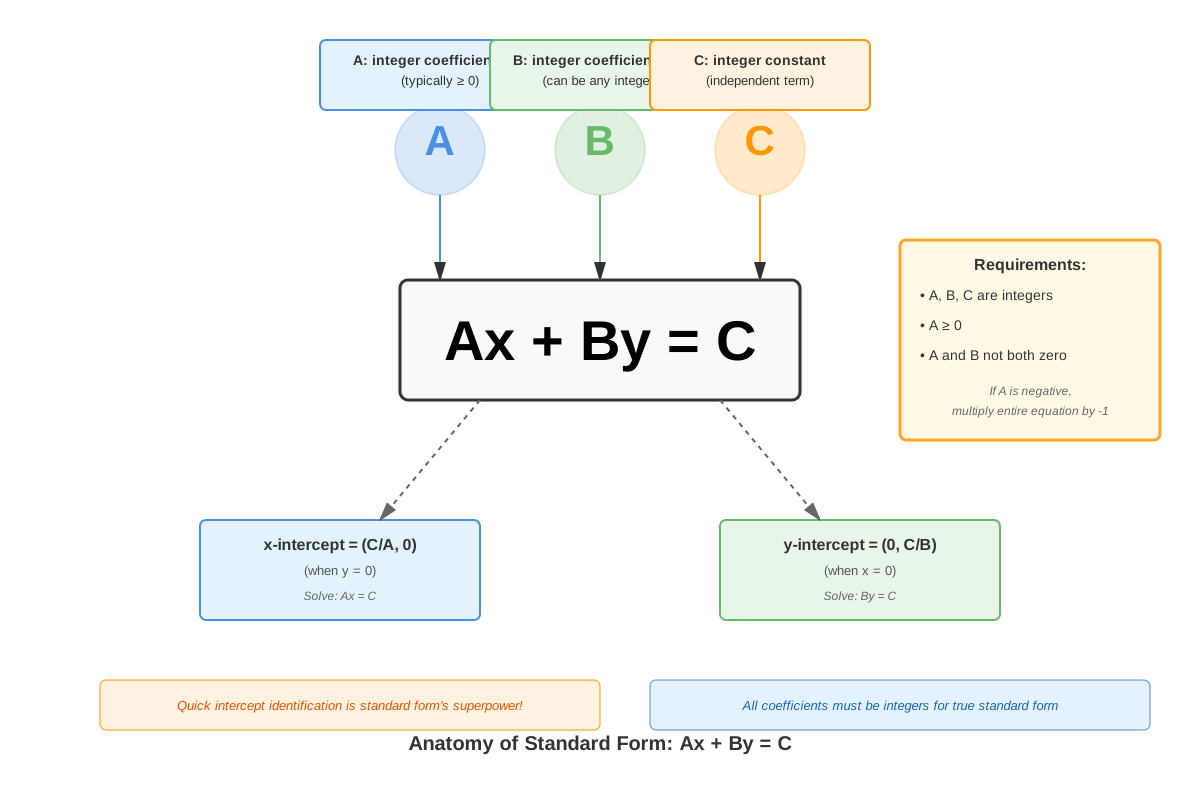
Standard form (also called sat standard form in test prep contexts) is written as Ax + By = C, where A, B, and C are integers, and by convention, A should be non-negative (A ≥ 0). The coefficients A and B should not share a common factor other than 1 (the equation should be in simplest form), and ideally all coefficients are integers rather than fractions or decimals. For example, 3x + 4y = 12 is in proper standard form, while -3x + 4y = 12 should be rewritten as 3x - 4y = -12 to make A positive, and 6x + 9y = 15 should be simplified to 2x + 3y = 5 by dividing all terms by the greatest common factor of 3.
The structure of standard form places both variables on the same side of the equation, creating a balanced representation that treats x and y symmetrically. This symmetry makes standard form particularly useful when neither variable is clearly the "input" or "output" variable, or when working with systems of equations where you want to add or subtract equations directly. The constant term C stands alone on the right side, representing the sum of the weighted x and y values.
Converting to Standard Form
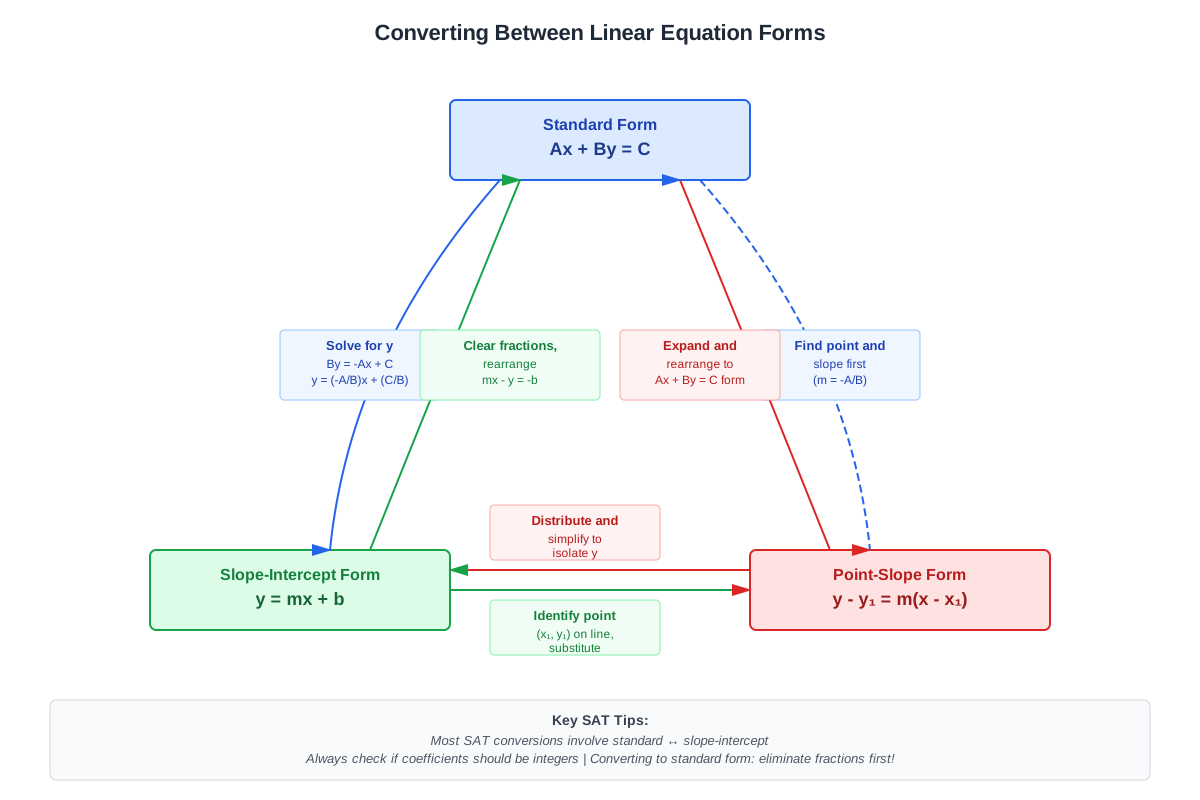
Converting from slope-intercept form (y = mx + b) to standard form requires moving all variable terms to the left side and ensuring integer coefficients. The process follows these steps:
- Start with y = mx + b
- Subtract mx from both sides: -mx + y = b
- Multiply through by -1 if needed to make the x-coefficient positive: mx - y = -b
- If coefficients are fractions, multiply all terms by the least common denominator
- Simplify by dividing out any common factors
For example, converting y = (2/3)x + 4:
- Subtract (2/3)x: -(2/3)x + y = 4
- Multiply by 3: -2x + 3y = 12
- Multiply by -1: 2x - 3y = -12
Converting from point-slope form (y - y₁ = m(x - x₁)) follows similar principles: distribute the slope, move all variable terms to one side, and ensure integer coefficients. The key is systematic algebraic manipulation while maintaining equation balance.
Finding Intercepts from Standard Form
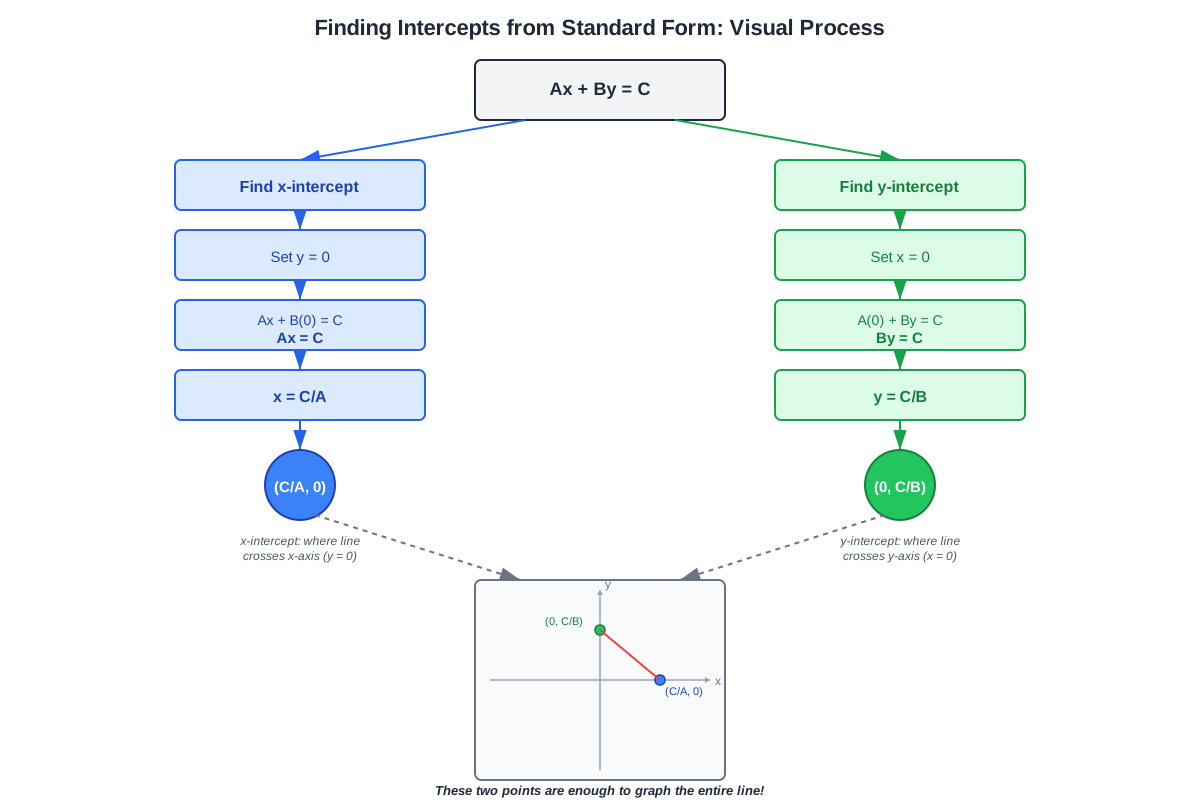
One of the most powerful features of standard form is the ease of finding intercepts. The x-intercept (where the line crosses the x-axis, meaning y = 0) is found by substituting y = 0 into the equation:
Ax + B(0) = C → Ax = C → x = C/A
The y-intercept (where the line crosses the y-axis, meaning x = 0) is found by substituting x = 0:
A(0) + By = C → By = C → y = C/B
For the equation 6x + 4y = 24:
- x-intercept: 6x = 24 → x = 4, giving point (4, 0)
- y-intercept: 4y = 24 → y = 6, giving point (0, 6)
This direct calculation method is significantly faster than converting to slope-intercept form first, making standard form the strategic choice when intercepts are needed.
Graphing from Standard Form
To graph a line from standard form, the intercept method is most efficient:
- Find the x-intercept by setting y = 0
- Find the y-intercept by setting x = 0
- Plot both intercept points
- Draw a straight line through them
This three-step process works for any linear equation in standard form (except for horizontal or vertical lines). For example, graphing 3x + 2y = 12:
- x-intercept: 3x = 12 → x = 4 → point (4, 0)
- y-intercept: 2y = 12 → y = 6 → point (0, 6)
- Plot (4, 0) and (0, 6), then connect with a straight line
Alternatively, students can find the slope by rearranging to slope-intercept form (slope = -A/B) and use it with one intercept, but the two-intercept method is typically faster and less error-prone.
Standard Form in Systems of Equations
Standard form is the preferred representation when solving systems of equations using the elimination method (also called the addition method). When both equations are in standard form with aligned variables, adding or subtracting equations eliminates one variable:
2x + 3y = 13
4x - 3y = 5
Adding these equations eliminates y: 6x = 18 → x = 3
The alignment of variables in standard form makes this process straightforward, whereas slope-intercept form would require rearrangement first. The SAT frequently tests this application, particularly in no-calculator sections where elimination is more efficient than substitution.
Interpreting Coefficients in Context
In word problems, the coefficients A, B, and C carry specific meanings. Consider a problem: "Adult tickets cost $8 and child tickets cost $5. The theater collected $240 in ticket sales." This translates to 8x + 5y = 240, where:
- A = 8 represents the cost per adult ticket
- B = 5 represents the cost per child ticket
- C = 240 represents the total revenue
- x represents the number of adult tickets
- y represents the number of child tickets
Understanding these relationships allows students to set up equations from word problems and interpret solutions in context. The SAT often asks which equation correctly represents a given scenario, testing whether students can translate between verbal descriptions and algebraic standard form.
Special Cases and Restrictions
Certain lines have special standard form representations:
- Horizontal lines (y = k): 0x + 1y = k or simply y = k
- Vertical lines (x = h): 1x + 0y = h or simply x = h
- Lines through the origin: Ax + By = 0 (where C = 0)
When A = 0, the equation By = C represents a horizontal line with no x-intercept (unless C = 0). When B = 0, the equation Ax = C represents a vertical line with no y-intercept (unless C = 0). Recognizing these special cases prevents errors when finding intercepts or converting forms.
Concept Relationships
The concepts within standard form build hierarchically: understanding the definition and structure provides the foundation for all other skills. From this base, converting to standard form and finding intercepts branch as parallel skills—both require manipulating the equation but serve different purposes. These skills converge in graphing from standard form, which applies intercept-finding to create visual representations. Meanwhile, the structure of standard form directly enables systems of equations solving through elimination, which represents a more advanced application. Finally, interpreting coefficients in context sits at the top of the hierarchy, requiring synthesis of all previous concepts to translate between real-world scenarios and mathematical representations.
Standard form connects backward to prerequisite topics: algebraic manipulation skills enable conversion between forms, coordinate plane understanding makes intercepts meaningful, and slope-intercept form knowledge provides a comparison point that highlights standard form's unique advantages. The relationship is bidirectional—mastering standard form deepens understanding of why multiple equation forms exist and when each is optimal.
Looking forward, standard form connects to advanced topics: linear inequalities use the same Ax + By structure with inequality symbols instead of equals signs; linear programming relies on systems of inequalities in standard form to model constraints; matrices represent systems of equations where standard form alignment becomes crucial; and parametric equations sometimes convert to standard form for analysis. The concept map flows: Basic Algebra → Standard Form → Systems of Equations → Linear Programming, with branches to Graphing and Real-World Modeling at each level.
Quick check — test yourself on Standard form so far.
Try Flashcards →High-Yield Facts
⭐ Standard form is written as Ax + By = C where A, B, and C are integers and A ≥ 0
⭐ The x-intercept equals C/A (found by setting y = 0); the y-intercept equals C/B (found by setting x = 0)
⭐ To convert from slope-intercept form to standard form, move the mx term to the left side and clear any fractions
⭐ Standard form is optimal for solving systems of equations using the elimination method
⭐ The slope of a line in standard form Ax + By = C is -A/B
- When converting to standard form, multiply through by the least common denominator to eliminate fractions
- The coefficients A and B should have no common factors other than 1 in simplified standard form
- If A is negative in standard form, multiply the entire equation by -1 to make A positive
- Parallel lines in standard form have the same ratio of A to B coefficients (same slope -A/B)
- Perpendicular lines in standard form have A and B coefficients that are negative reciprocals when considering slope
- A line in standard form with C = 0 passes through the origin (0, 0)
- Standard form naturally represents constraint equations in optimization and word problems
- The equation Ax + By = C represents a line with undefined slope when B = 0 (vertical line)
- When both A and B are positive in standard form, the line has negative slope and both intercepts are positive
- The distance from a point (x₀, y₀) to a line Ax + By = C is given by |Ax₀ + By₀ - C|/√(A² + B²)
Common Misconceptions
Misconception: Standard form requires A, B, and C to all be positive. → Correction: Only A must be non-negative (A ≥ 0); B and C can be negative. For example, 3x - 4y = -12 is valid standard form.
Misconception: The x-intercept is found by setting x = 0. → Correction: The x-intercept is found by setting y = 0, then solving for x. Setting x = 0 gives the y-intercept. This reversal is one of the most common errors on the SAT.
Misconception: Standard form and slope-intercept form always give different graphs. → Correction: Different forms of the same equation represent the same line. For example, 2x + y = 4 and y = -2x + 4 graph identically; they're just different representations.
Misconception: You cannot find the slope from standard form without converting to slope-intercept form. → Correction: The slope can be calculated directly as -A/B from the equation Ax + By = C, saving time on SAT questions.
Misconception: If an equation has fractions, it cannot be in standard form. → Correction: While standard form conventionally uses integers, an equation with fractions can be converted to standard form by multiplying through by the LCD. The equation (1/2)x + (1/3)y = 1 becomes 3x + 2y = 6 in standard form.
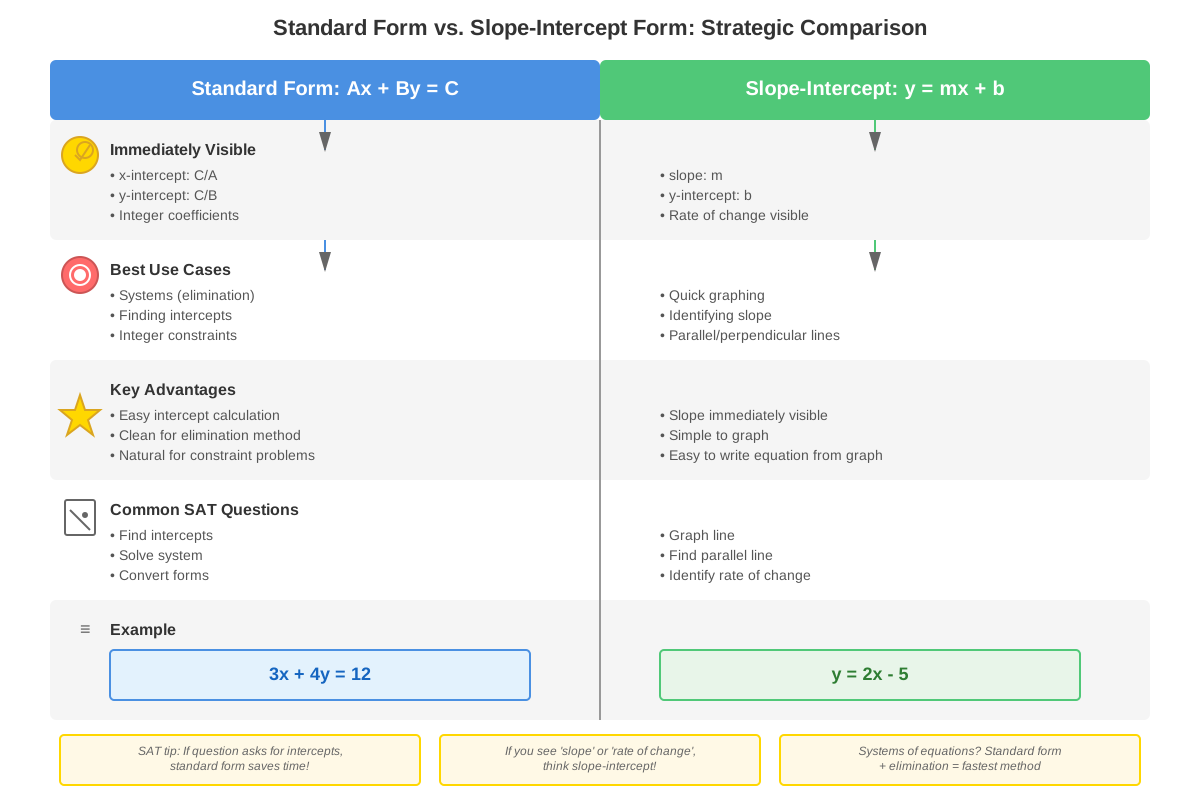
Misconception: Standard form is always the best form to use. → Correction: Each form has advantages. Standard form excels for finding intercepts and solving systems, but slope-intercept form is better for quickly identifying slope and y-intercept, and point-slope form is ideal when you know a point and slope.
Misconception: In standard form, C always represents the y-intercept. → Correction: C is the constant term, but the y-intercept is C/B (found by setting x = 0 and solving By = C). Only when B = 1 does C equal the y-intercept.
Misconception: You must always simplify standard form by dividing out common factors. → Correction: While simplified form is conventional and preferred, equations like 6x + 9y = 15 are technically in standard form even though they could be simplified to 2x + 3y = 5. However, SAT answer choices typically present simplified versions.
Worked Examples
Example 1: Converting and Finding Intercepts
Problem: The equation of a line is given as y = -(3/4)x + 6. Rewrite this equation in standard form, then find both intercepts.
Solution:
Step 1: Start with y = -(3/4)x + 6
Step 2: Add (3/4)x to both sides to move the x-term left:
(3/4)x + y = 6
Step 3: Eliminate the fraction by multiplying all terms by 4:
4 · (3/4)x + 4 · y = 4 · 6
3x + 4y = 24
Step 4: Verify this is proper standard form: A = 3 (positive ✓), B = 4, C = 24 (all integers ✓, no common factors ✓)
Step 5: Find x-intercept by setting y = 0:
3x + 4(0) = 24
3x = 24
x = 8
x-intercept: (8, 0)
Step 6: Find y-intercept by setting x = 0:
3(0) + 4y = 24
4y = 24
y = 6
y-intercept: (0, 6)
Connection to Learning Objectives: This problem demonstrates conversion to standard form (Objective 4), identification of key features (Objective 1), and finding intercepts directly from standard form (Objective 5).
Example 2: System of Equations Application
Problem: A coffee shop sells regular coffee for $3 per cup and specialty coffee for $5 per cup. On Monday, they sold a total of 120 cups and earned $480. How many cups of each type did they sell?
Solution:
Step 1: Define variables:
Let x = number of regular coffee cups
Let y = number of specialty coffee cups
Step 2: Set up equations in standard form:
Total cups: x + y = 120
Total revenue: 3x + 5y = 480
Step 3: Solve using elimination. Multiply the first equation by -3:
-3x - 3y = -360
3x + 5y = 480
Step 4: Add the equations to eliminate x:
-3x - 3y = -360
3x + 5y = 480
_______________
0x + 2y = 120
Step 5: Solve for y:
2y = 120
y = 60
Step 6: Substitute y = 60 into x + y = 120:
x + 60 = 120
x = 60
Step 7: Verify in the revenue equation:
3(60) + 5(60) = 180 + 300 = 480 ✓
Answer: The shop sold 60 cups of regular coffee and 60 cups of specialty coffee.
Connection to Learning Objectives: This problem demonstrates setting up equations in standard form from word problems (Objective 8), interpreting coefficients in context (Objective 8), and applying standard form to solve SAT-style questions (Objective 3). The use of elimination method showcases why standard form is strategically advantageous (Objective 6).
Exam Strategy
When approaching SAT questions involving standard form, first identify what the question is asking: conversion between forms, finding specific features (intercepts, slope), solving systems, or setting up equations from word problems. This identification determines the optimal strategy. If the question asks for intercepts, recognize that standard form provides the fastest path—avoid the temptation to convert to slope-intercept form first, as this adds unnecessary steps and opportunities for error.
Trigger words and phrases to watch for include: "in standard form," "x-intercept," "y-intercept," "where the line crosses," "rewrite the equation," and "system of equations." When you see "x-intercept," immediately think "set y = 0"; when you see "y-intercept," think "set x = 0." For system problems, look for phrases like "total cost," "combined," or "together," which signal that standard form with elimination will be efficient.
Process-of-elimination strategies specific to standard form:
- Eliminate answer choices where A is negative (unless all choices have negative A, indicating the test-maker wants you to recognize an equivalent form)
- Eliminate choices with common factors in A, B, and C when the question asks for "simplified" or "proper" standard form
- When converting from slope-intercept form, eliminate choices that don't preserve the y-intercept relationship (C/B should equal the original b value)
- For intercept questions, eliminate choices that would require the line to pass through impossible points given the context
Time allocation: Standard form questions typically require 45-90 seconds. Conversion problems should take 45-60 seconds; intercept problems 30-45 seconds; system problems 90-120 seconds. If you find yourself spending more than 2 minutes on a standard form question, you may be using an inefficient method—consider whether there's a more direct approach using standard form's properties rather than converting to another form.
Exam Tip: On calculator-permitted sections, you can verify your standard form conversions by graphing both the original and converted equations—they should produce identical lines. However, this verification should be a last resort if time permits, not your primary method.
Memory Techniques
Mnemonic for Standard Form Structure: "Always Before C" reminds you that in Ax + By = C, the variables come before the constant, and A (the x-coefficient) comes before B (the y-coefficient).
Intercept Memory Device: "X-intercept: Y equals Zero" and "Y-intercept: X equals Zero" creates a cross-pattern that helps you remember which variable to set to zero for each intercept. The letter you're NOT finding gets set to zero.
Acronym for Conversion Steps: "MICE" - Move variables to one side, Isolate constant term, Clear fractions, Ensure A is positive. This covers the four key steps when converting any equation to standard form.
Visualization Strategy: Picture standard form as a "balance scale" with Ax + By on one side and C on the other. This mental image reinforces that both variables stay together on the left, balanced against the constant on the right. When solving systems, visualize stacking two balance scales and adding them together to eliminate one variable.
Slope Memory Trick: For finding slope from standard form, remember "Negative A over B" or visualize the equation rearranged: By = -Ax + C, so y = (-A/B)x + C/B, making the slope -A/B visible. The negative sign is crucial and often forgotten.
Summary
Standard form (Ax + By = C) represents linear equations with integer coefficients where both variables appear on the same side, providing unique advantages for specific mathematical tasks. This form excels at revealing intercepts quickly—the x-intercept equals C/A and the y-intercept equals C/B—making it the optimal choice when graphing via the intercept method or when intercept values are explicitly requested. Converting to standard form requires systematic algebraic manipulation: moving all variable terms to one side, clearing fractions by multiplying through by the LCD, and ensuring A is non-negative with no common factors among coefficients. The form's symmetrical treatment of variables makes it ideal for solving systems of equations through elimination, as aligned variables can be directly added or subtracted. On the SAT, standard form appears in approximately 5-10% of math questions, testing conversion skills, intercept identification, systems solving, and real-world modeling where coefficients represent rates, costs, or constraints. Success requires recognizing when standard form provides strategic advantages over slope-intercept or point-slope forms, executing conversions accurately, and interpreting coefficients meaningfully in context. Mastery of standard form builds foundational skills for advanced topics including linear inequalities, optimization, and matrix operations while strengthening overall algebraic fluency essential for SAT success.
Key Takeaways
- Standard form Ax + By = C requires integer coefficients with A ≥ 0 and no common factors, positioning both variables on the left side of the equation
- X-intercepts are found by setting y = 0 and solving for x (giving C/A); y-intercepts are found by setting x = 0 and solving for y (giving C/B)—this is standard form's primary advantage
- Converting to standard form involves moving variable terms to one side, clearing fractions, and ensuring proper coefficient properties through systematic algebraic manipulation
- Standard form is the optimal choice for solving systems of equations using elimination because aligned variables enable direct addition or subtraction of equations
- The slope of a line in standard form can be calculated as -A/B without converting to slope-intercept form, saving time on SAT questions
- In word problems, coefficients A and B represent rates or unit values while C represents totals, making standard form natural for constraint and combination scenarios
- Strategic form selection matters on the SAT—use standard form for intercepts and systems, slope-intercept form for slope and y-intercept, and choose based on what the question asks
Related Topics
Linear Inequalities in Standard Form: Extends standard form to inequalities (Ax + By ≤ C), requiring understanding of solution regions and boundary lines. Mastering standard form equations provides the foundation for graphing inequality solutions and understanding feasible regions in optimization problems.
Systems of Linear Inequalities: Combines multiple inequalities in standard form to model complex constraints, essential for linear programming. The alignment and structure learned with standard form equations transfers directly to analyzing systems of inequalities.
Parallel and Perpendicular Lines: Uses the relationship between A and B coefficients in standard form to determine line relationships. Understanding that parallel lines have equal -A/B ratios and perpendicular lines have negative reciprocal slopes builds on standard form mastery.
Distance from Point to Line: Applies the formula |Ax₀ + By₀ - C|/√(A² + B²) using standard form coefficients, connecting algebra to geometry. This advanced application demonstrates why standard form's structure is mathematically significant beyond basic graphing.
Matrix Representation of Systems: Translates systems of equations in standard form into matrix notation, bridging algebra and linear algebra. The aligned structure of standard form makes this transition natural and reinforces why form matters in mathematics.
Practice CTA
Now that you've mastered the core concepts of standard form, it's time to solidify your understanding through active practice. Attempt the practice questions to test your ability to convert between forms, find intercepts efficiently, and solve systems of equations. The flashcards will help you memorize key formulas and relationships, ensuring quick recall during the actual SAT. Remember, standard form questions are high-yield—appearing in 5-10% of the math section—so every minute spent practicing this topic directly improves your score potential. Approach each practice problem strategically, asking yourself whether standard form provides advantages over other forms, and build the pattern recognition that separates good scores from great ones. You've got this!
Sign up free to keep reading
Create a free AnvayaPrep account to finish this SAT guide on Standard form — plus flashcards and practice questions.