Overview
Mixture systems represent a critical category of word problems on the SAT math section that combine algebraic reasoning with real-world scenarios. These problems involve combining two or more substances, solutions, or groups with different characteristics (such as concentration, price, or composition) to create a new mixture with specific properties. Understanding mixture systems requires translating verbal descriptions into mathematical equations and solving systems of linear equations to find unknown quantities.
On the SAT, mixture problems test a student's ability to set up and solve systems of equations based on two fundamental principles: the conservation of total quantity and the conservation of the characteristic being mixed (such as total value, total pure substance, or total percentage). These problems frequently appear in both the calculator and no-calculator sections, often presented as real-world scenarios involving solutions in chemistry, pricing in retail, or blending in manufacturing contexts. Mastering sat mixture systems is essential because these questions assess multiple skills simultaneously: reading comprehension, algebraic translation, equation manipulation, and logical reasoning.
Mixture systems connect directly to broader mathematical concepts including systems of linear equations, percentages, ratios, and proportional reasoning. They serve as practical applications of abstract algebraic principles, demonstrating how mathematical modeling solves concrete problems. Success with mixture problems builds confidence in tackling multi-step word problems and strengthens the foundational skills needed for more advanced mathematical topics in college and beyond.
Learning Objectives
- [ ] Identify key features of mixture systems including the two fundamental conservation principles
- [ ] Explain how mixture systems appears on the SAT in various contexts (solutions, pricing, blending)
- [ ] Apply mixture systems to answer SAT-style questions with accuracy and efficiency
- [ ] Construct systems of equations from verbal descriptions of mixture scenarios
- [ ] Distinguish between different types of mixture problems (concentration, value, composition)
- [ ] Solve mixture systems using substitution, elimination, or algebraic manipulation
- [ ] Verify solutions by checking against all given constraints in the problem
Prerequisites
- Linear equations and solving for variables: Essential for manipulating equations to isolate unknowns in mixture problems
- Systems of linear equations: Mixture problems always involve at least two equations with two unknowns
- Percentages and decimal conversion: Concentrations and compositions are typically expressed as percentages
- Basic algebraic manipulation: Distributing, combining like terms, and factoring are necessary skills
- Word problem translation: Converting verbal descriptions into mathematical expressions forms the foundation of mixture problems
Why This Topic Matters
Mixture systems represent authentic applications of algebra that students encounter in chemistry labs, business decisions, and everyday life. Whether calculating the concentration of a saline solution, determining the optimal blend of coffee beans at different price points, or mixing paints to achieve a desired color intensity, mixture problems model real quantitative reasoning. These scenarios demonstrate that mathematics extends beyond abstract manipulation to practical problem-solving.
On the SAT, mixture problems appear with moderate frequency—typically 1-2 questions per test—but carry significant weight because they assess multiple competencies simultaneously. According to College Board data, mixture problems appear most commonly in the calculator-permitted section as multi-step word problems worth one point each. They may also appear as grid-in questions where students must calculate exact numerical answers. The SAT favors mixture problems because they efficiently test whether students can read critically, translate language to mathematics, and execute algebraic procedures accurately.
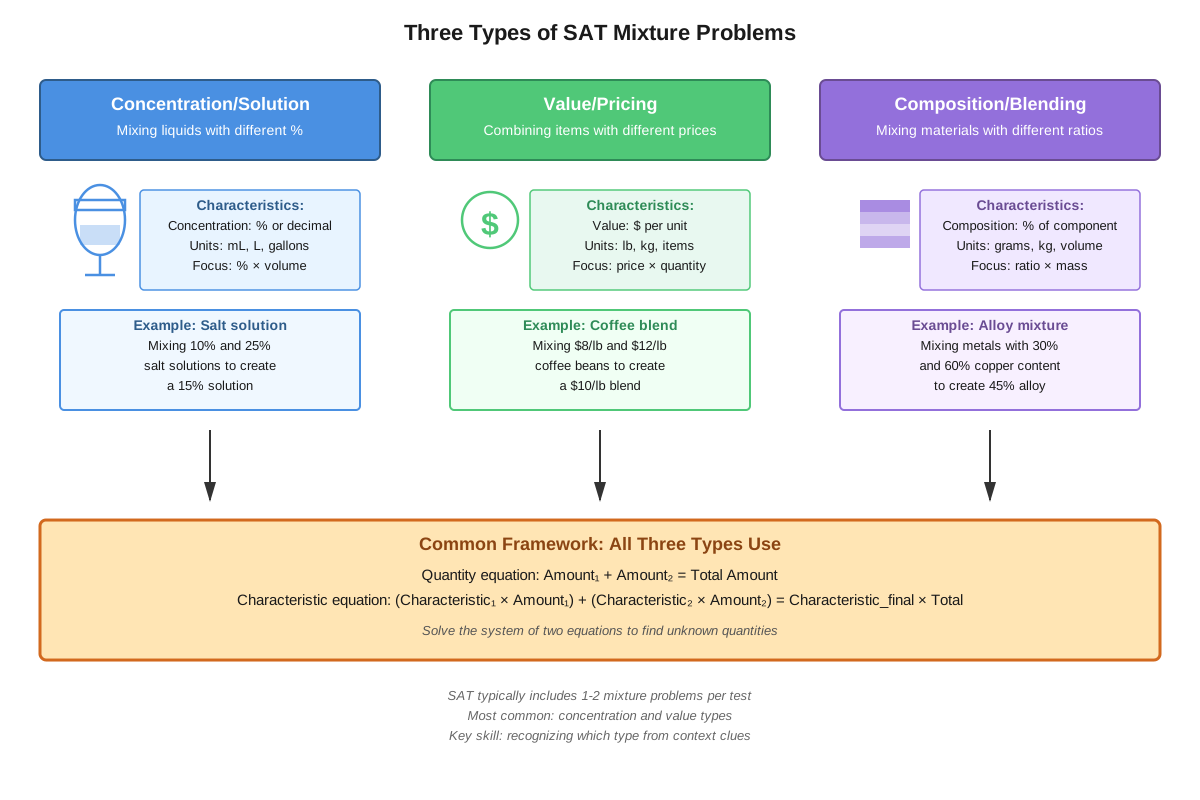
Common SAT presentations include: solution concentration problems (mixing different percentage solutions), value/pricing problems (combining items at different costs to achieve a target average price), and composition problems (blending materials with different properties). Questions may ask for the amount of each component, the final concentration or price, or the ratio between components. Recognition of the mixture framework allows students to apply a systematic approach rather than attempting ad-hoc reasoning for each unique scenario.
Core Concepts
The Two Fundamental Equations
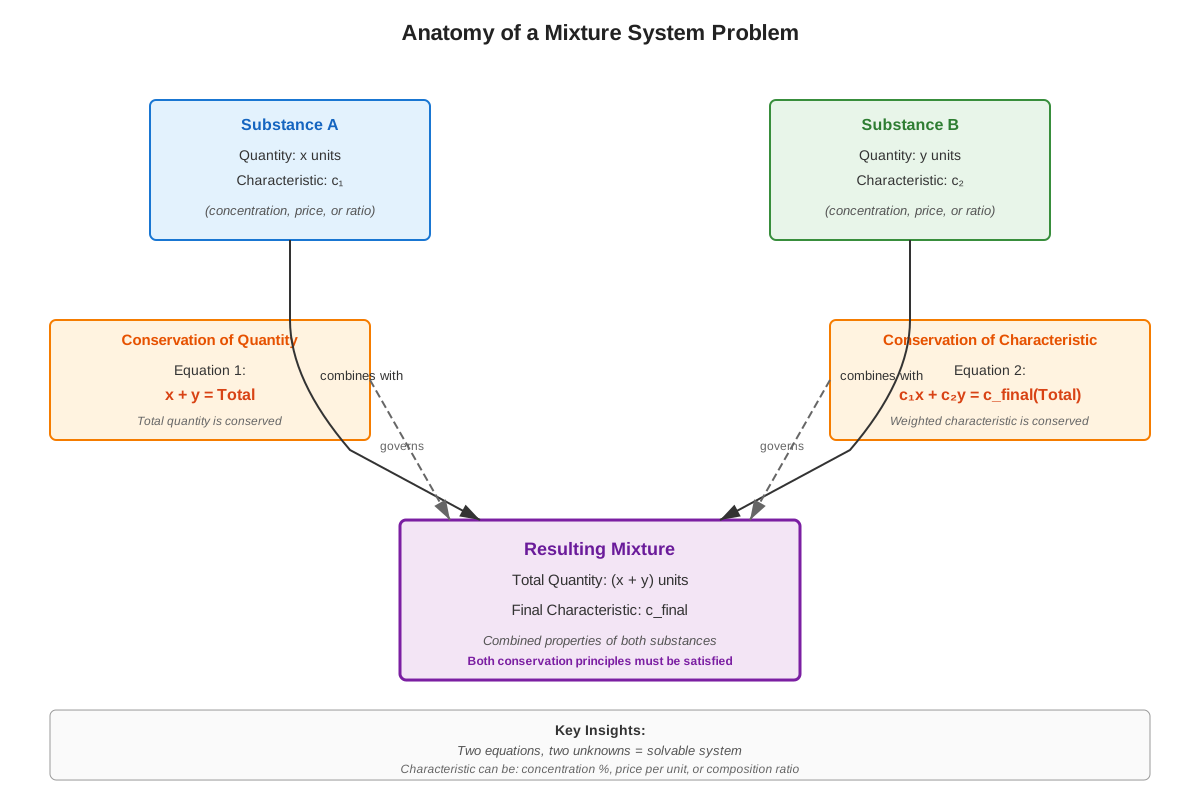
Every mixture system relies on two conservation principles that generate two equations. The first equation represents the conservation of total quantity—the sum of the individual amounts equals the total mixture amount. If mixing quantity A of substance 1 with quantity B of substance 2, then:
A + B = Total AmountThe second equation represents the conservation of the characteristic being mixed. This characteristic might be total value (price × quantity), total pure substance (concentration × quantity), or total composition (percentage × quantity). The general form is:
(Characteristic₁)(Amount₁) + (Characteristic₂)(Amount₂) = (Characteristic_final)(Total Amount)These two equations form a system that can be solved using substitution, elimination, or other algebraic methods. Understanding this framework is crucial because it applies universally across all mixture problem types.
Solution Concentration Problems
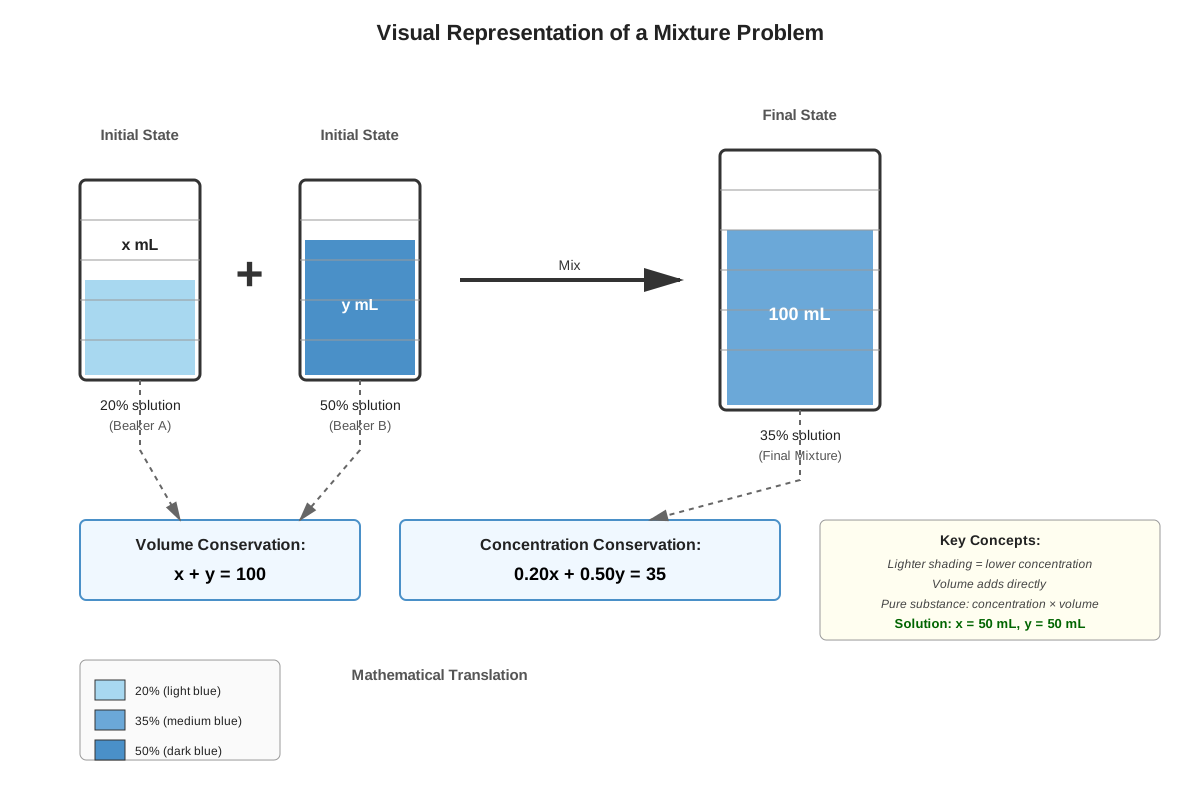
Solution concentration problems involve mixing liquids with different percentages of a dissolved substance. For example, mixing a 20% salt solution with a 50% salt solution to create a 35% salt solution. The key insight is that the percentage represents the decimal fraction of pure substance in the solution.
The setup follows this pattern:
- Let x = amount of first solution
- Let y = amount of second solution
- Equation 1 (total volume): x + y = final volume
- Equation 2 (pure substance): 0.20x + 0.50y = 0.35(x + y)
The second equation states that the pure salt from the first solution plus the pure salt from the second solution equals the pure salt in the final mixture. Converting percentages to decimals (20% = 0.20) is essential for accurate calculation.
Value/Pricing Problems
Value problems involve combining items at different unit prices to achieve a target total value or average price. A classic example: mixing coffee beans costing $8 per pound with beans costing $12 per pound to create a blend worth $10 per pound.
The framework:
- Let x = pounds of $8 coffee
- Let y = pounds of $12 coffee
- Equation 1 (total weight): x + y = total pounds
- Equation 2 (total value): 8x + 12y = 10(x + y)
The second equation multiplies each quantity by its unit price, then sets the sum equal to the desired total value. This type frequently appears in retail, fundraising, or ticket sales contexts on the SAT.
Composition/Blending Problems
Composition problems involve mixing materials with different percentages of a particular component. For instance, mixing two metal alloys with different gold percentages to achieve a specific gold content in the final alloy.
These follow the same mathematical structure as concentration problems but apply to solid mixtures rather than solutions. The percentage represents the fraction by weight of the desired component in each material.
Problem-Solving Process
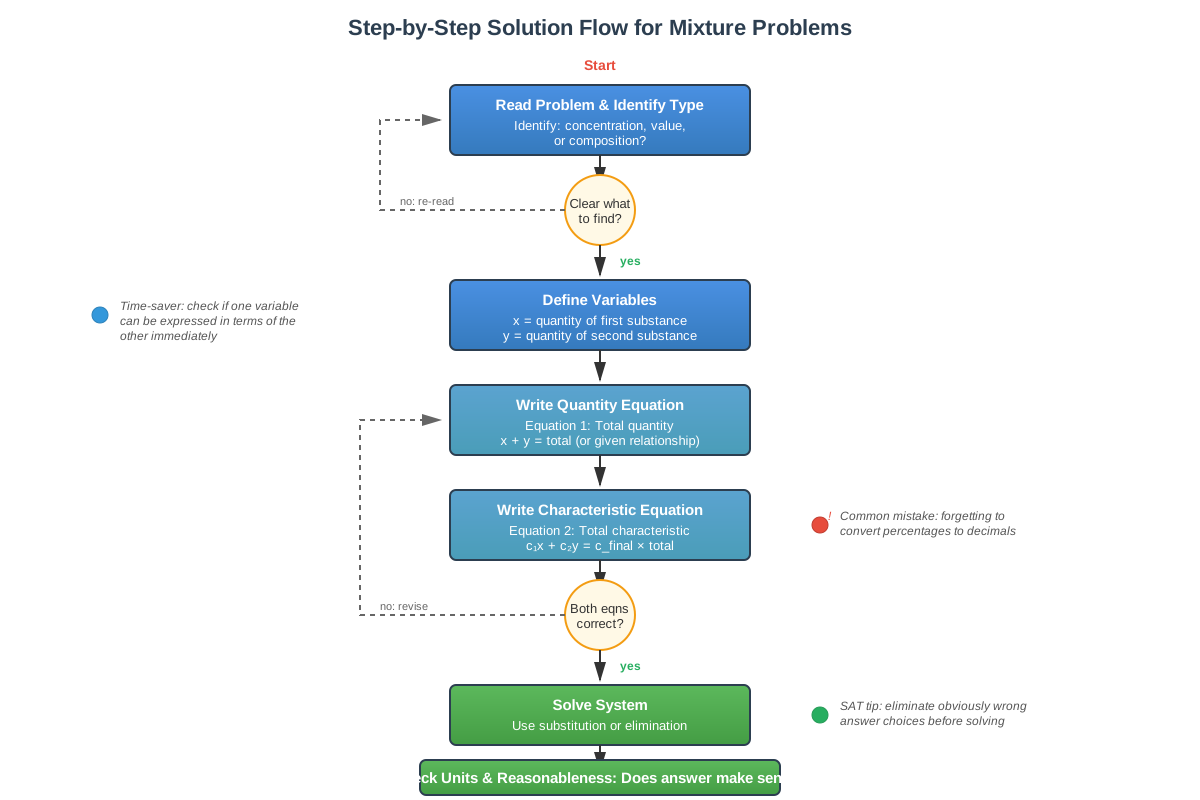
A systematic approach ensures success with any mixture problem:
- Identify what is being mixed (solutions, items, materials)
- Define variables for the unknown quantities (typically the amounts of each component)
- Write the quantity equation (sum of parts = total)
- Write the characteristic equation (weighted sum of characteristics = final characteristic × total)
- Solve the system using substitution or elimination
- Verify the solution by checking both equations and ensuring the answer makes logical sense
Common Variations
| Problem Type | First Equation | Second Equation | Key Feature |
|---|---|---|---|
| Concentration | x + y = total volume | c₁x + c₂y = c_final(total) | Percentages as decimals |
| Value/Price | x + y = total quantity | p₁x + p₂y = p_final(total) | Unit prices multiply quantities |
| Composition | x + y = total mass | %₁x + %₂y = %_final(total) | Component percentages |
| Dilution | x + y = total volume | c₁x + 0y = c_final(total) | One component has 0% characteristic |
The dilution variation occurs when adding pure solvent (0% concentration) to a solution, or adding a free item (0% cost) to a collection.
Concept Relationships
The core mixture system framework (two conservation equations) serves as the foundation from which all specific problem types derive. Conservation of quantity → generates the first equation → which expresses total amount. Conservation of characteristic → generates the second equation → which expresses the weighted average principle.
Mixture systems connect directly to systems of linear equations as the solution method. The two equations with two unknowns require either substitution (solving one equation for a variable and substituting into the other) or elimination (combining equations to eliminate a variable). This prerequisite skill becomes the computational engine for mixture problems.
Percentages and decimals feed into mixture systems because concentrations and compositions are expressed as percentages. Converting percentages to decimal multipliers (35% = 0.35) enables the algebraic manipulation needed in the characteristic equation.
The relationship map: Word problem → identify mixture type → define variables → write quantity equation → write characteristic equation → solve system → verify solution → answer question. Each step depends on the previous one, making the process sequential and systematic.
Mixture systems also connect forward to more advanced topics like optimization problems, weighted averages, and rate problems (which use similar conservation principles). Mastering mixture systems builds the problem-solving framework applicable to these related areas.
High-Yield Facts
⭐ Every mixture problem generates exactly two equations: one for total quantity and one for the characteristic being mixed
⭐ Convert all percentages to decimals before writing the characteristic equation (30% becomes 0.30)
⭐ The characteristic equation follows the pattern: (char₁)(amt₁) + (char₂)(amt₂) = (char_final)(total)
⭐ In dilution problems, pure solvent has 0% concentration of the dissolved substance
⭐ The final characteristic (concentration, price, percentage) must fall between the two original characteristics
- The sum of the amounts of each component always equals the total mixture amount
- Unit consistency is critical: if concentrations are percentages, use percentages throughout; if prices are per pound, quantities must be in pounds
- Substitution method works well when one equation easily solves for a variable
- Elimination method works well when coefficients align or can be easily manipulated
- Always verify that your solution makes physical sense (no negative amounts, final characteristic in reasonable range)
- Grid-in questions may ask for ratios, requiring an additional calculation after solving the system
- Some problems provide the total amount; others require you to express the answer in terms of variables
- Word problems may include extraneous information; identify only the relevant quantities
- The order of mixing does not affect the final result (commutative property)
- Some SAT questions ask "which equation represents..." rather than asking you to solve completely
Quick check — test yourself on Mixture systems so far.
Try Flashcards →Common Misconceptions
Misconception: The final concentration is always the average of the two original concentrations.
Correction: The final concentration is a weighted average based on the amounts of each component. If equal amounts are mixed, then the final concentration is the simple average, but unequal amounts shift the final concentration toward the component present in greater quantity.
Misconception: Percentages can be added directly in the characteristic equation.
Correction: Percentages must be converted to decimal multipliers before being multiplied by quantities. The equation 0.20x + 0.50y = 0.35(x + y) is correct; writing 20x + 50y = 35(x + y) produces an incorrect result.
Misconception: The characteristic equation should set the sum of characteristics equal to the final characteristic.
Correction: The characteristic equation multiplies each characteristic by its corresponding amount, then sums these products. It's not c₁ + c₂ = c_final, but rather c₁x + c₂y = c_final(x + y).
Misconception: In dilution problems, adding pure water increases the total amount of dissolved substance.
Correction: Adding pure solvent (0% concentration) increases total volume but does not change the absolute amount of dissolved substance. Only the concentration (substance per unit volume) decreases.
Misconception: Mixture problems always ask you to solve for both variables.
Correction: SAT questions may ask for only one variable, the ratio between variables, the total amount, or even just which equation correctly represents the situation. Read the question carefully to determine what is actually being asked.
Misconception: The more expensive or more concentrated component should always be the larger quantity.
Correction: The problem determines the quantities; there's no rule about which component must be larger. The final characteristic depends on the weighted contributions of both components.
Worked Examples
Example 1: Solution Concentration Problem
Problem: A chemist needs to create 100 mL of a 30% acid solution by mixing a 20% acid solution with a 50% acid solution. How many milliliters of the 20% solution should be used?
Solution:
Step 1: Define variables
- Let x = milliliters of 20% solution
- Let y = milliliters of 50% solution
Step 2: Write the quantity equation (total volume)
x + y = 100Step 3: Write the characteristic equation (pure acid content)
The pure acid from the 20% solution plus the pure acid from the 50% solution equals the pure acid in the final 30% solution:
0.20x + 0.50y = 0.30(100)Simplifying:
0.20x + 0.50y = 30Step 4: Solve the system using substitution
From equation 1: y = 100 - x
Substitute into equation 2:
0.20x + 0.50(100 - x) = 30
0.20x + 50 - 0.50x = 30
-0.30x = -20
x = 66.67 mL
Step 5: Find y
y = 100 - 66.67 = 33.33 mLStep 6: Verify
- Total volume: 66.67 + 33.33 = 100 ✓
- Pure acid: 0.20(66.67) + 0.50(33.33) = 13.33 + 16.67 = 30 ✓
- Final concentration: 30/100 = 0.30 = 30% ✓
Answer: 66.67 mL (or 66⅔ mL) of the 20% solution should be used.
Connection to learning objectives: This example demonstrates identifying the key features (two conservation equations), applying the mixture system framework to an SAT-style question, and constructing equations from a verbal description.
Example 2: Value/Pricing Problem
Problem: A store owner mixes cashews selling for $12 per pound with peanuts selling for $6 per pound to create a 20-pound mixture that sells for $8 per pound. How many pounds of cashews are in the mixture?
Solution:
Step 1: Define variables
- Let c = pounds of cashews
- Let p = pounds of peanuts
Step 2: Write the quantity equation (total weight)
c + p = 20Step 3: Write the characteristic equation (total value)
The value of cashews plus the value of peanuts equals the value of the mixture:
12c + 6p = 8(20)Simplifying:
12c + 6p = 160Step 4: Solve using elimination
Multiply equation 1 by -6:
-6c - 6p = -120Add to equation 2:
12c + 6p = 160
-6c - 6p = -120
_______________
6c = 40
c = 6.67 pounds
Step 5: Find p
p = 20 - 6.67 = 13.33 poundsStep 6: Verify
- Total weight: 6.67 + 13.33 = 20 ✓
- Total value: 12(6.67) + 6(13.33) = 80 + 80 = 160 ✓
- Average price: 160/20 = $8 per pound ✓
Answer: 6.67 pounds (or 6⅔ pounds) of cashews are in the mixture.
Connection to learning objectives: This example shows how mixture systems appear in pricing contexts on the SAT, demonstrates the elimination method for solving systems, and illustrates verification of solutions against all constraints.
Exam Strategy
When approaching mixture problems on the SAT, begin by identifying the trigger words that signal a mixture system: "mixing," "combining," "blending," "solution," "alloy," "average price," "concentration," or "percentage." These words indicate that the two-equation framework applies.
Read the problem twice: first for overall understanding, second to identify the specific quantities and characteristics. Underline or circle the key numbers (percentages, prices, amounts) and what they represent. Determine what the question is actually asking—sometimes it requests only one variable, a ratio, or verification of an equation rather than a complete solution.
Set up before solving: Resist the urge to start calculating immediately. Write down your variable definitions clearly, then construct both equations systematically. This setup phase prevents errors and provides a roadmap for the solution. If the problem seems complex, the systematic approach simplifies it.
Use the answer choices strategically: On multiple-choice questions, you can test answer choices by substituting them back into the problem conditions. If the question asks for the amount of one component, plug that value into your equations to see if it produces consistent results. This backsolving technique can be faster than algebraic solution for certain problems.
Watch for unit consistency: Ensure all quantities use the same units (all milliliters, all pounds, all dollars). Convert if necessary before writing equations. Similarly, ensure percentages are converted to decimals when used as multipliers.
Time allocation: Mixture problems typically require 2-3 minutes. If you're stuck after 90 seconds, mark the question and return to it later. Don't let one mixture problem consume excessive time at the expense of easier questions.
Process of elimination tips:
- Eliminate answers that fall outside the range between the two original characteristics
- Eliminate answers that would require negative amounts of a component
- Eliminate answers that don't satisfy the total quantity constraint
- If the problem involves equal amounts, the answer should be the simple average
Common question variations:
- "Which equation represents..." → You only need to set up, not solve
- "What is the ratio..." → Solve for both variables, then express as a ratio
- "How much more..." → Find the difference between two quantities
- Grid-in format → Calculate the exact numerical answer, including decimals or fractions
Memory Techniques
Mnemonic for the two equations: "QC" = Quantity and Characteristic. Every mixture problem needs both.
Visualization strategy: Picture a container being filled from two sources. The total volume (quantity equation) is the sum of what flows from each source. The color intensity or flavor strength (characteristic equation) depends on the weighted contribution from each source. This mental image reinforces that the final characteristic is a weighted average.
Acronym for problem-solving steps: "IDWSV"
- Identify what's being mixed
- Define variables
- Write both equations
- Solve the system
- Verify the solution
Percentage conversion reminder: "Percent means per hundred" → divide by 100 to convert to decimal. 30% = 30/100 = 0.30.
Characteristic equation pattern: Think "Part + Part = Whole" but with weights: (characteristic₁)(part₁) + (characteristic₂)(part₂) = (characteristic_final)(whole)
Dilution shortcut: When adding pure solvent, remember "Zero changes nothing but the total"—the pure substance amount stays constant, only the total volume increases.
Summary
Mixture systems represent a high-yield SAT math topic that combines algebraic reasoning with real-world problem-solving. Every mixture problem, regardless of context, relies on two fundamental conservation principles: conservation of total quantity and conservation of the characteristic being mixed. These principles generate a system of two linear equations with two unknowns that can be solved using substitution or elimination. The three main types—solution concentration, value/pricing, and composition/blending—all follow the same mathematical framework, differing only in context and units. Success requires systematic problem-solving: identify the mixture type, define variables clearly, write both equations carefully (converting percentages to decimals), solve the system algebraically, and verify the solution against all given constraints. Understanding that the final characteristic represents a weighted average based on the amounts of each component prevents common misconceptions. Mastering mixture systems builds confidence with multi-step word problems and demonstrates the practical application of systems of linear equations.
Key Takeaways
- Every mixture problem generates exactly two equations: one for total quantity (sum of parts = whole) and one for the characteristic being mixed (weighted sum = final characteristic × total)
- Convert all percentages to decimal multipliers before writing the characteristic equation (30% becomes 0.30)
- The characteristic equation follows the universal pattern: (char₁)(amt₁) + (char₂)(amt₂) = (char_final)(total amount)
- The final characteristic must fall between the two original characteristics and represents a weighted average based on the amounts of each component
- Systematic problem-solving (identify, define, write equations, solve, verify) ensures accuracy and efficiency on SAT mixture problems
- Dilution problems involve adding a component with 0% of the characteristic, which increases total amount without adding more of the pure substance
- Always verify solutions by checking both equations and ensuring the answer makes physical sense (no negative amounts, reasonable final characteristic)
Related Topics
Systems of Linear Equations (General): Mixture systems represent a specific application of systems of linear equations. Mastering the general techniques of substitution, elimination, and graphical interpretation provides the computational foundation for mixture problems and extends to other SAT problem types.
Weighted Averages: The characteristic equation in mixture problems calculates a weighted average. Understanding weighted averages more broadly helps with grade calculations, statistical reasoning, and other SAT math contexts where different values contribute unequally to a final result.
Rate Problems: Similar to mixture systems, rate problems (distance-rate-time, work-rate) use conservation principles to generate systems of equations. The problem-solving framework transfers directly, making mixture systems excellent preparation for rate problems.
Percent Applications: Mixture problems frequently involve percentages for concentrations, compositions, and percent changes. Deepening percentage skills enhances mixture problem performance and supports numerous other SAT math topics.
Rational Equations and Proportions: Some mixture problems can be solved using proportion reasoning rather than systems of equations. Understanding the connection between these approaches provides flexibility in problem-solving strategies.
Practice CTA
Now that you've mastered the conceptual framework and problem-solving strategies for mixture systems, it's time to solidify your understanding through practice. Attempt the practice questions to apply these techniques to SAT-style problems, and use the flashcards to reinforce the key facts and formulas. Remember, mixture problems reward systematic thinking—follow the IDWSV process (Identify, Define, Write, Solve, Verify) and you'll approach these questions with confidence. Each practice problem you complete strengthens your pattern recognition and builds the automaticity needed for test-day success. You've got this!
Sign up free to keep reading
Create a free AnvayaPrep account to finish this SAT guide on Mixture systems — plus flashcards and practice questions.