Overview
Rational equations are equations that contain one or more rational expressions—fractions in which both the numerator and denominator are polynomials. These equations are a critical component of the SAT math section, appearing regularly in both the calculator and no-calculator portions of the exam. Understanding how to solve rational equations efficiently is essential because they test multiple algebraic skills simultaneously: fraction manipulation, equation solving, factoring, and the identification of extraneous solutions.
On the SAT, rational equations typically appear in 2-4 questions per test, making them a high-yield topic that can significantly impact your score. These questions often combine multiple concepts, requiring students to clear denominators, solve resulting polynomial equations, and verify solutions against domain restrictions. The College Board uses rational equations to assess algebraic fluency and logical reasoning—two fundamental skills that underpin success across the entire math section.
Mastering rational equations strengthens your foundation in algebra and connects directly to other SAT topics including linear equations, quadratic equations, systems of equations, and function analysis. The problem-solving strategies you develop here—particularly the systematic approach to eliminating fractions and checking for invalid solutions—transfer directly to more complex mathematical scenarios you'll encounter throughout the exam.
Learning Objectives
- [ ] Identify key features of rational equations, including restrictions on variable values
- [ ] Explain how rational equations appears on the SAT, including common question formats and difficulty levels
- [ ] Apply rational equations to answer SAT-style questions with accuracy and efficiency
- [ ] Determine domain restrictions and identify extraneous solutions in rational equations
- [ ] Execute the cross-multiplication method and LCD (least common denominator) method to solve rational equations
- [ ] Translate word problems involving rates, work, and proportions into rational equations
Prerequisites
- Solving linear equations: Rational equations reduce to linear or polynomial equations after clearing denominators, requiring fluency in basic equation-solving techniques
- Factoring polynomials: Identifying common factors and factoring quadratics is essential for simplifying rational expressions and finding LCD
- Understanding fractions: Operations with numerical fractions provide the foundation for manipulating algebraic fractions
- Domain and range concepts: Recognizing which values make denominators zero is crucial for identifying restrictions and extraneous solutions
- Quadratic equations: Many rational equations simplify to quadratics, requiring knowledge of factoring, the quadratic formula, or completing the square
Why This Topic Matters
Rational equations model numerous real-world scenarios that appear both in practical applications and on standardized tests. Work-rate problems (how long it takes two people working together to complete a task), mixture problems (combining solutions of different concentrations), and distance-rate-time problems (travel scenarios with varying speeds) all frequently involve rational equations. Understanding these equations enables students to solve problems involving proportional relationships, inverse variation, and combined rates—skills applicable in fields ranging from engineering to economics.
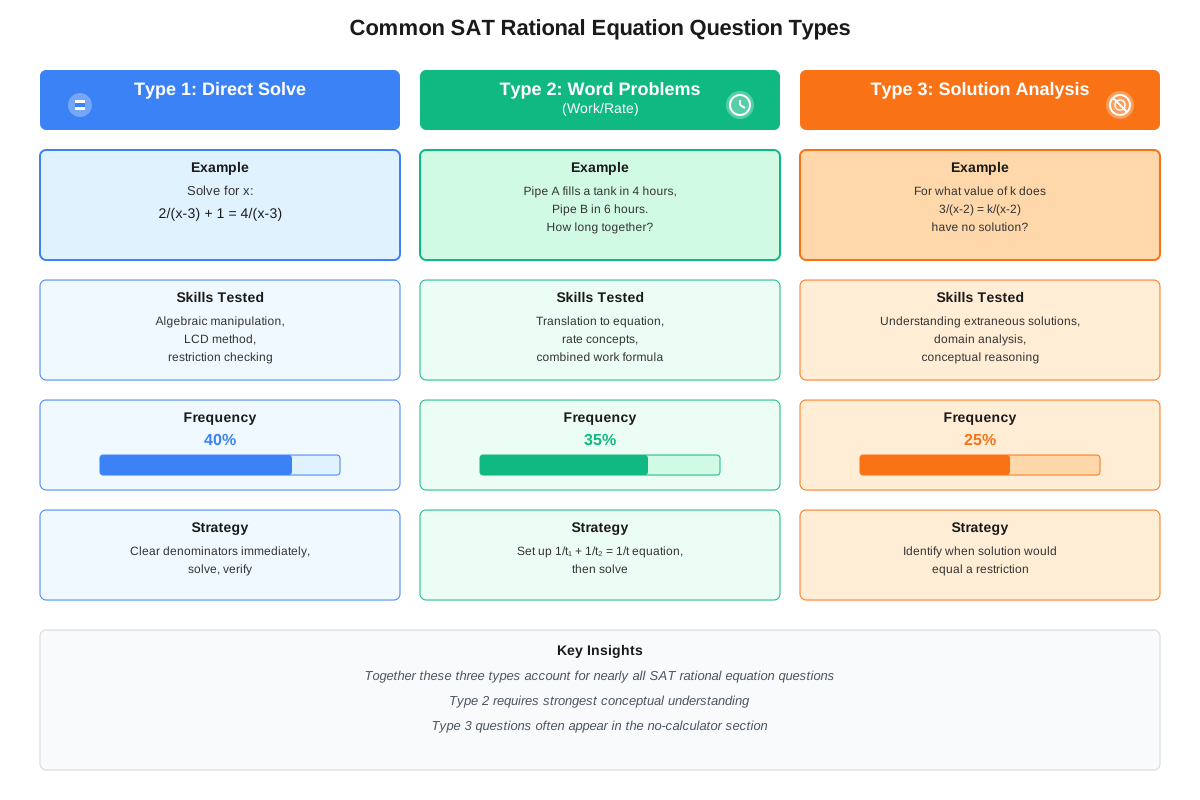
On the SAT, rational equations appear with notable frequency and variety. Approximately 2-4 questions per test directly involve solving or manipulating rational equations, representing roughly 5-7% of the total math section. These questions appear in multiple formats: straightforward "solve for x" problems, word problems requiring equation setup, and questions asking students to identify the number of solutions or determine when no solution exists. The College Board particularly favors questions that test whether students recognize extraneous solutions—values that satisfy the algebraic manipulation but violate the original equation's domain restrictions.
Common SAT presentations include: equations with a single rational expression equal to a constant, equations with rational expressions on both sides requiring cross-multiplication, equations requiring finding a common denominator, and application problems involving rates or proportions. Questions may ask for the solution itself, the sum of all solutions, conditions under which no solution exists, or the identification of restricted values. The topic's versatility makes it an efficient testing ground for multiple algebraic competencies within a single question.
Core Concepts
Definition and Structure of Rational Equations
A rational equation is any equation containing at least one rational expression—a fraction where both numerator and denominator are polynomials. The general form can be expressed as:
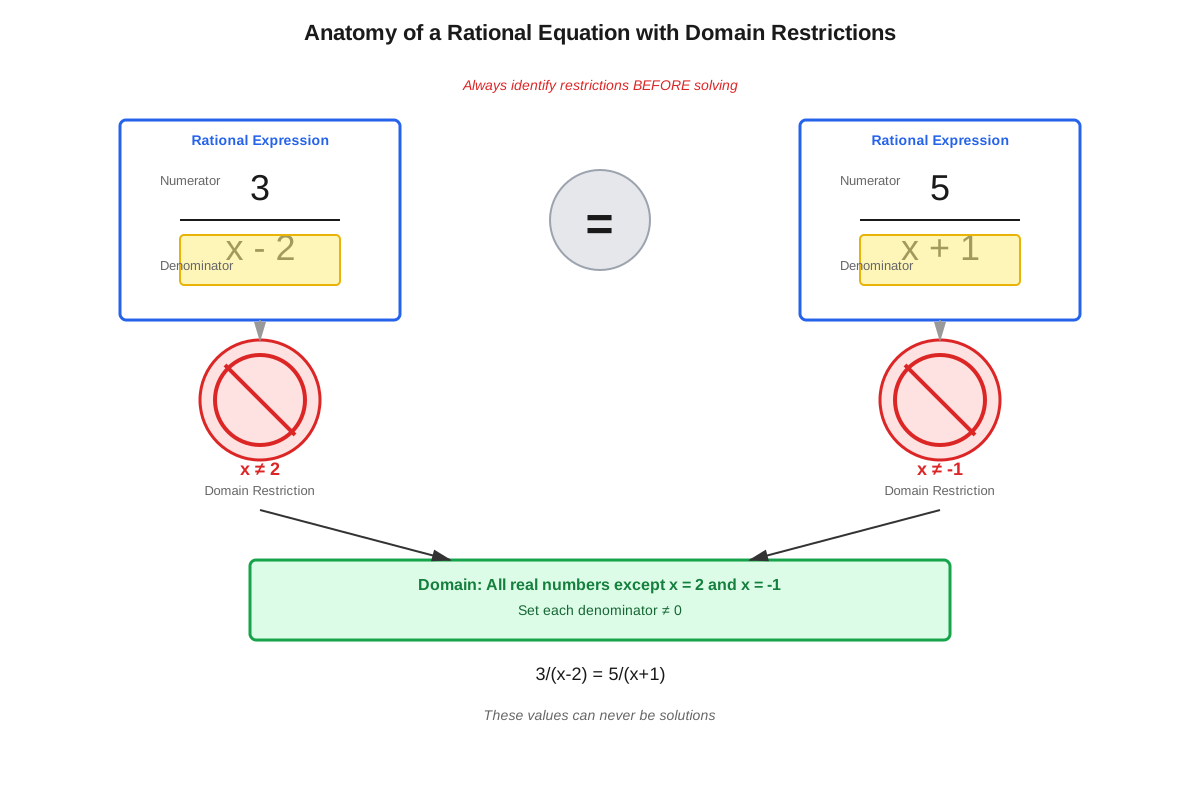
P(x)/Q(x) = R(x)/S(x)where P, Q, R, and S are polynomial expressions and Q(x) ≠ 0 and S(x) ≠ 0. The denominators create domain restrictions: values that make any denominator equal to zero are excluded from the solution set because division by zero is undefined.
For example, in the equation (x + 3)/(x - 2) = 5, the value x = 2 is restricted because it makes the denominator zero. Even if algebraic manipulation produces x = 2 as a solution, it must be rejected as extraneous—algebraically valid but contextually invalid.
Domain Restrictions and Extraneous Solutions
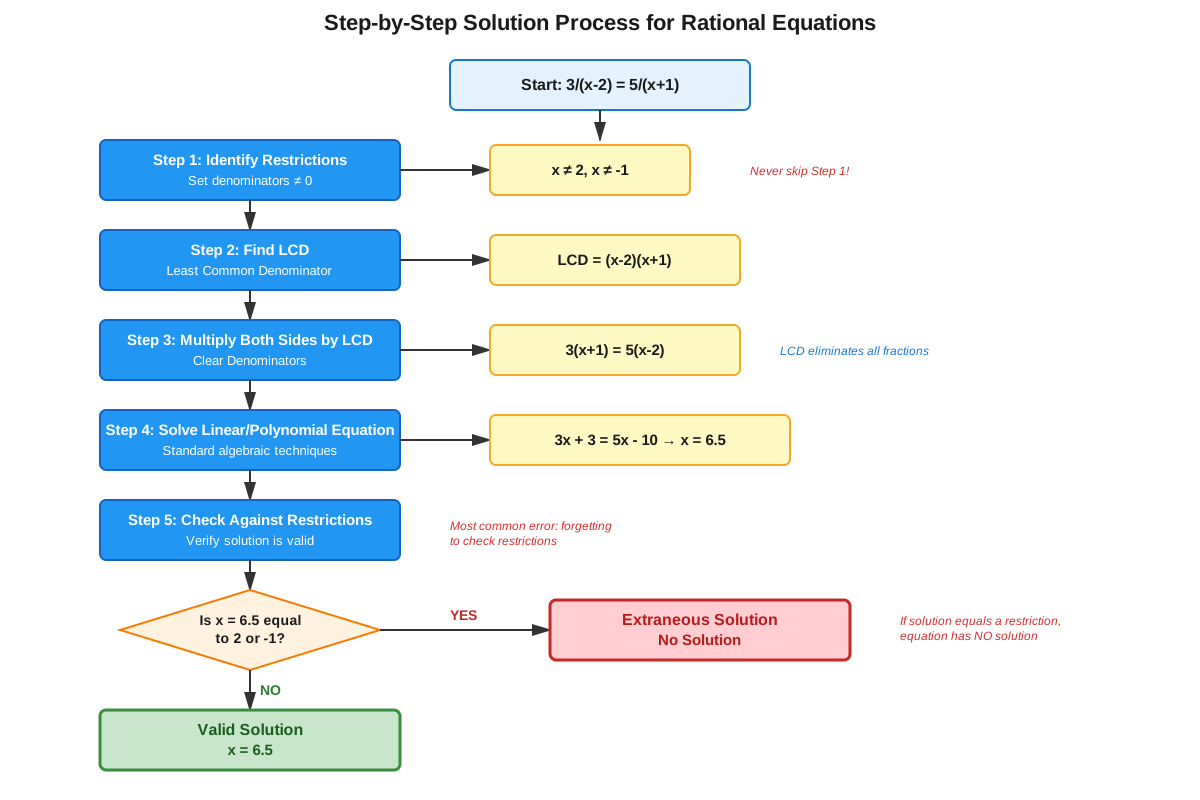
Before solving any rational equation, identify all domain restrictions by setting each denominator equal to zero and solving. These restricted values cannot be solutions to the original equation.
Steps to identify restrictions:
- Identify all denominators in the equation
- Set each denominator equal to zero
- Solve for the variable
- Exclude these values from the solution set
After solving a rational equation algebraically, always check proposed solutions against the original equation. An extraneous solution is a value that emerges from the solving process but makes one or more denominators zero in the original equation. These must be discarded.
Cross-Multiplication Method
When a rational equation has the form of one fraction equal to another fraction, cross-multiplication provides the most efficient solution method:
a/b = c/d → ad = bcThis technique eliminates fractions in a single step, producing a polynomial equation that's typically easier to solve.
Example: Solve (2x + 1)/(x - 3) = 4/5
Cross-multiply: 5(2x + 1) = 4(x - 3)
Expand: 10x + 5 = 4x - 12
Solve: 6x = -17, so x = -17/6
Check: x = -17/6 doesn't make the denominator zero (x - 3 ≠ 0), so it's valid.
Least Common Denominator (LCD) Method
When an equation contains multiple rational expressions or a combination of rational and polynomial terms, multiply every term by the LCD of all denominators. This clears all fractions simultaneously.
Steps for the LCD method:
- Factor all denominators completely
- Identify the LCD (product of all unique factors at their highest powers)
- Multiply every term in the equation by the LCD
- Simplify and solve the resulting polynomial equation
- Check all solutions against domain restrictions
Example: Solve 3/x + 2/(x-1) = 5
LCD = x(x - 1)
Multiply every term: x(x-1) · 3/x + x(x-1) · 2/(x-1) = x(x-1) · 5
Simplify: 3(x-1) + 2x = 5x(x-1)
Expand: 3x - 3 + 2x = 5x² - 5x
Rearrange: 5x² - 10x + 3 = 0
This quadratic requires the quadratic formula or factoring to complete.
Solving Rational Equations That Simplify to Quadratics
Many SAT rational equations reduce to quadratic equations after clearing denominators. Students must be proficient with all quadratic-solving methods: factoring, quadratic formula, and completing the square.
Example: Solve x/(x-2) + 3 = 8/(x-2)
Multiply by LCD (x - 2): x + 3(x-2) = 8
Simplify: x + 3x - 6 = 8
Combine: 4x = 14
Solution: x = 7/2
Check: x = 7/2 ≠ 2, so the solution is valid.
Special Cases: No Solution and Infinite Solutions
Some rational equations have no solution when all algebraic solutions are extraneous (make denominators zero). Others may have infinite solutions when the equation simplifies to an identity like 0 = 0, though this is rare on the SAT.
Example of no solution: 1/(x-3) = 1/(x-3) + 2
Multiply by (x - 3): 1 = 1 + 2(x-3)
Simplify: 1 = 1 + 2x - 6
Solve: 2x = 6, so x = 3
But x = 3 makes the original denominators zero, so there is no solution.
Application Problems
SAT rational equations frequently appear in word problems involving:
- Work rates: If person A completes a job in a hours and person B in b hours, together they complete 1/a + 1/b of the job per hour
- Distance-rate-time: Using d = rt, where rates or times involve fractions
- Mixture problems: Combining substances with different concentrations
- Proportions: Direct and inverse variation relationships
Concept Relationships
Rational equations build directly upon foundational algebra skills, creating a hierarchical relationship: fraction operations → algebraic fractions → rational expressions → rational equations. Each level adds complexity while relying on previous skills.
Within the topic itself, concepts connect sequentially: identifying domain restrictions must occur before solving, as these restrictions determine which algebraic solutions are valid. The solving methods (cross-multiplication and LCD) both aim to eliminate fractions, transforming rational equations into polynomial equations (linear or quadratic). Finally, verification closes the loop by checking solutions against the original restrictions.
Rational equations connect to broader SAT math topics through multiple pathways. They require factoring skills to find LCDs and simplify expressions. They often reduce to quadratic equations, requiring those solution techniques. Function concepts appear when rational equations involve function notation or when students must determine input values that produce specific outputs. Systems of equations sometimes include rational equations as one component. Understanding domain and range from function analysis directly applies to identifying restrictions in rational equations.
The problem-solving framework developed here—identify restrictions, transform the equation, solve systematically, verify solutions—transfers to virtually every algebraic scenario on the SAT, making rational equations a cornerstone topic for overall math success.
Quick check — test yourself on Rational equations so far.
Try Flashcards →High-Yield Facts
- ⭐ Always identify domain restrictions BEFORE solving by setting each denominator equal to zero
- ⭐ Extraneous solutions are values that satisfy the algebraic manipulation but make a denominator zero in the original equation
- ⭐ Cross-multiplication works when one fraction equals another: a/b = c/d becomes ad = bc
- ⭐ The LCD method multiplies every term by the least common denominator to eliminate all fractions simultaneously
- ⭐ After solving, always substitute solutions back into the original equation to verify they don't violate domain restrictions
- The LCD is found by factoring all denominators and taking the product of all unique factors at their highest powers
- Rational equations with no valid solutions occur when all algebraic solutions are extraneous
- Work-rate problems use the formula: 1/time₁ + 1/time₂ = 1/time_together
- When solving rational equations, the resulting polynomial equation may be linear, quadratic, or higher degree
- If a rational equation simplifies to 0 = 0 after clearing denominators, it may have infinite solutions (check domain restrictions)
- SAT questions often ask for the sum or product of solutions, requiring you to find all valid solutions first
- Multiplying both sides by an expression containing the variable can introduce extraneous solutions
- Domain restrictions are permanent—they apply to the original equation and cannot be "solved away"
- The number of solutions to a rational equation depends on both the algebraic solutions and how many are extraneous
Common Misconceptions
Misconception: All algebraic solutions to a rational equation are valid solutions.
Correction: Solutions must be checked against domain restrictions. Any value that makes a denominator zero in the original equation is extraneous and must be rejected, even if it satisfies the algebraic manipulation.
Misconception: You can cancel terms across an equals sign the same way you cancel factors in a fraction.
Correction: Cancellation only works within a single fraction (numerator and denominator). Across an equals sign, you must add or subtract terms to both sides, or multiply/divide both sides by the same non-zero value.
Misconception: When multiplying both sides by the LCD, you only multiply the rational expressions, not the whole terms.
Correction: Every term in the equation must be multiplied by the LCD, including constants and polynomial terms. This ensures the equation remains balanced.
Misconception: If a rational equation has a quadratic after clearing denominators, it always has two solutions.
Correction: The quadratic may yield two, one, or zero real solutions algebraically, and some or all of these may be extraneous. The final answer depends on both the quadratic's solutions and the domain restrictions.
Misconception: Domain restrictions only matter if they appear in the final answer.
Correction: Domain restrictions must be identified at the beginning and applied throughout. Even if a restricted value doesn't emerge as an algebraic solution, knowing the restrictions helps you understand the equation's behavior and avoid errors.
Misconception: Cross-multiplication can be used on any rational equation.
Correction: Cross-multiplication is most efficient when you have exactly one fraction on each side of the equation. For equations with multiple terms or more complex structures, the LCD method is more appropriate.
Worked Examples
Example 1: Basic Rational Equation with Extraneous Solution
Problem: Solve 5/(x-1) = 3/(x+2)
Solution:
Step 1: Identify domain restrictions.
- Set denominators equal to zero: x - 1 = 0 gives x = 1; x + 2 = 0 gives x = -2
- Restrictions: x ≠ 1 and x ≠ -2
Step 2: Cross-multiply since we have one fraction equal to another.
5(x + 2) = 3(x - 1)
Step 3: Expand both sides.
5x + 10 = 3x - 3
Step 4: Solve for x.
5x - 3x = -3 - 102x = -13x = -13/2
Step 5: Check against restrictions.
- x = -13/2 = -6.5, which is neither 1 nor -2
- This solution is valid
Answer: x = -13/2
This example demonstrates the complete process: identify restrictions, use the appropriate method (cross-multiplication), solve systematically, and verify the solution is not extraneous.
Example 2: Rational Equation Requiring LCD Method
Problem: Solve 2/x + 3/(x-4) = 1
Solution:
Step 1: Identify domain restrictions.
- x = 0 and x = 4 make denominators zero
- Restrictions: x ≠ 0 and x ≠ 4
Step 2: Find the LCD.
- Denominators are x and (x - 4)
- LCD = x(x - 4)
Step 3: Multiply every term by the LCD.
x(x-4) · 2/x + x(x-4) · 3/(x-4) = x(x-4) · 1
Step 4: Simplify each term.
2(x-4) + 3x = x(x-4)2x - 8 + 3x = x² - 4x
Step 5: Rearrange to standard form.
0 = x² - 4x - 5x + 80 = x² - 9x + 8
Step 6: Factor the quadratic.
0 = (x - 1)(x - 8)
Step 7: Solve for x.
- x = 1 or x = 8
Step 8: Check both solutions against restrictions.
- x = 1: Not equal to 0 or 4, so valid
- x = 8: Not equal to 0 or 4, so valid
Answer: x = 1 or x = 8
This example shows how rational equations often reduce to quadratics, requiring multiple solution methods in sequence. Both solutions are valid because neither violates the domain restrictions.
Exam Strategy
When approaching sat rational equations questions, follow this systematic process to maximize accuracy and efficiency:
Initial Assessment (5-10 seconds):
- Quickly scan for denominators and identify the equation type
- Determine whether cross-multiplication or LCD method is more appropriate
- Note any obvious restrictions (denominators that could equal zero)
Trigger Words and Phrases:
- "Solve for x" or "Find all values" → Standard solving approach
- "How many solutions" → Solve completely, then count valid solutions
- "For what value of k does the equation have no solution" → Find when all solutions are extraneous
- "Working together" or "combined rate" → Work-rate problem requiring rational equation setup
- "Excluding" or "where x ≠" → Domain restrictions are being highlighted
Solution Process:
- Write down domain restrictions immediately (x ≠ values that make denominators zero)
- Choose your method: cross-multiplication for simple proportions, LCD for complex equations
- Clear denominators completely before attempting to solve
- Solve the resulting polynomial equation using appropriate techniques
- Check every solution against the restrictions you identified in step 1
Process of Elimination Tips:
- Eliminate answer choices that equal any domain restriction
- If the question asks "how many solutions," eliminate answers that exceed the degree of the polynomial you obtain after clearing denominators
- For word problems, eliminate answers that produce negative values for quantities that must be positive (time, distance, etc.)
- If you can quickly test answer choices by substitution, do so—this often saves time on complex equations
Time Allocation:
- Simple rational equations (cross-multiplication): 45-60 seconds
- Complex rational equations (LCD method, quadratic result): 90-120 seconds
- Word problems requiring setup: 120-150 seconds
- If you're spending more than 2 minutes, mark for review and move on
Common Traps to Avoid:
- Don't forget to check for extraneous solutions—the SAT frequently includes these as wrong answer choices
- Don't cancel terms across the equals sign
- Don't forget to multiply ALL terms by the LCD, including constants
- Don't assume a quadratic always has two valid solutions
Memory Techniques
RIDE Acronym for Solving Process:
- Restrictions: Identify domain restrictions first
- Isolate: Clear denominators using cross-multiplication or LCD
- Determine: Solve the resulting polynomial equation
- Evaluate: Check solutions against restrictions
"Zero Denominators = Zero Credit" Reminder:
Values that make denominators zero can never be solutions. Visualize a big red X through any value that creates division by zero.
Cross-Multiplication Visual:
Picture an X connecting the numerators and denominators diagonally:
  a     c
 --- = ---
  b     d
The X shows you multiply a×d and b×c.
LCD Mnemonic: "Factor First, Find Friends"
- Factor all denominators first
- Find the common factors (friends)
- Take each unique factor at its highest power
Extraneous Solution Memory Aid:
Think "EXTRA-neous" = EXTRA solution that doesn't belong. It's extra baggage you need to discard.
Work-Rate Formula Visualization:
Imagine two pipes filling a pool. If pipe A fills it in 'a' hours and pipe B in 'b' hours, together they contribute 1/a + 1/b of the pool per hour. The fractions represent "portion per time unit."
Summary
Rational equations are equations containing fractions with polynomial numerators and denominators, appearing regularly on the SAT as high-yield questions that test multiple algebraic skills simultaneously. Success requires a systematic approach: first identify domain restrictions by determining which values make denominators zero, then clear fractions using either cross-multiplication (for simple proportions) or the LCD method (for complex equations), solve the resulting polynomial equation, and finally verify that solutions don't violate the original restrictions. Extraneous solutions—values that emerge algebraically but make denominators zero—must be rejected. These equations frequently reduce to linear or quadratic forms, requiring fluency with those solution techniques. On the SAT, rational equations appear both as direct algebraic problems and as application questions involving work rates, proportions, and combined rates. Mastering this topic strengthens overall algebraic reasoning and directly impacts performance on 5-7% of math section questions.
Key Takeaways
- Rational equations contain fractions with polynomial numerators and denominators; domain restrictions exclude values that make denominators zero
- Always identify restrictions BEFORE solving, and check all algebraic solutions against these restrictions afterward
- Use cross-multiplication when one fraction equals another; use the LCD method for equations with multiple terms
- Extraneous solutions satisfy the algebraic manipulation but violate domain restrictions—these must be rejected
- Rational equations frequently reduce to quadratic equations, requiring proficiency with factoring, the quadratic formula, or completing the square
- Work-rate problems use the formula 1/time₁ + 1/time₂ = 1/time_together and are common SAT applications
- The systematic RIDE process (Restrictions, Isolate, Determine, Evaluate) ensures accuracy and efficiency on exam questions
Related Topics
Rational Expressions and Simplification: Before solving rational equations, students must understand how to simplify rational expressions by factoring and canceling common factors. This foundational skill makes identifying LCDs and domain restrictions more efficient.
Systems of Equations: Rational equations can appear as components of systems, where one equation is rational and another is linear or quadratic. Mastering rational equations enables solving these more complex systems.
Rational Functions: Understanding rational equations provides the foundation for analyzing rational functions, including finding zeros, vertical asymptotes (which occur at domain restrictions), and horizontal asymptotes.
Inverse Variation: Many real-world scenarios involving inverse relationships (y = k/x) lead to rational equations when solving for specific values, connecting algebraic techniques to function analysis.
Advanced Polynomial Equations: The techniques for clearing denominators and solving the resulting equations transfer directly to more complex polynomial scenarios, making rational equations a stepping stone to higher-level algebra.
Practice CTA
Now that you've mastered the core concepts, strategies, and common pitfalls of rational equations, it's time to solidify your understanding through active practice. Work through the practice questions to apply these techniques under test-like conditions, and use the flashcards to reinforce key facts and procedures until they become automatic. Remember: rational equations appear on virtually every SAT, and the systematic approach you've learned here will serve you across multiple question types. Your investment in mastering this high-yield topic will pay dividends on test day—so dive into the practice materials with confidence!
Sign up free to keep reading
Create a free AnvayaPrep account to finish this SAT guide on Rational equations — plus flashcards and practice questions.