Overview
One solution systems represent a fundamental concept in algebra that appears frequently on the SAT math section. When two linear equations intersect at exactly one point, the system has a unique solution—a single ordered pair (x, y) that satisfies both equations simultaneously. Understanding this concept is crucial because it forms the foundation for solving real-world problems involving two variables with specific constraints.
On the SAT, sat one solution systems questions test not only computational skills but also conceptual understanding of what makes a system have exactly one solution versus infinitely many solutions or no solution at all. These questions may ask students to solve for specific values, determine conditions that create one solution, or interpret the meaning of solutions in context. Mastery of this topic directly impacts performance on approximately 10-15% of SAT math questions, making it a high-yield area for focused study.
The concept of one solution systems connects to broader mathematical ideas including graphing linear equations, understanding slope and y-intercept, solving equations algebraically, and interpreting the geometric meaning of algebraic relationships. This topic serves as a bridge between basic equation-solving and more advanced concepts like systems of inequalities, matrices, and optimization problems that students will encounter in higher-level mathematics courses.
Learning Objectives
- [ ] Identify key features of one solution systems
- [ ] Explain how one solution systems appears on the SAT
- [ ] Apply one solution systems to answer SAT-style questions
- [ ] Determine whether a given system of equations has one solution by analyzing slopes and y-intercepts
- [ ] Solve systems with one solution using substitution, elimination, and graphical methods
- [ ] Interpret the meaning of the solution point in real-world contexts
- [ ] Recognize algebraic conditions that guarantee exactly one solution
Prerequisites
- Linear equations in two variables: Understanding how to write and manipulate equations in the form y = mx + b or ax + by = c is essential for working with systems
- Slope and y-intercept: Recognizing these features allows quick determination of whether lines will intersect at one point
- Basic algebraic manipulation: Skills in solving for variables, combining like terms, and distributing are necessary for solution methods
- Coordinate plane graphing: Visualizing equations as lines helps understand what "one solution" means geometrically
- Substitution and solving for variables: These techniques form the basis of algebraic solution methods
Why This Topic Matters
Systems of linear equations model countless real-world scenarios where two conditions must be satisfied simultaneously. Examples include determining break-even points in business (where cost equals revenue), finding optimal mixtures in chemistry, calculating intersection times in motion problems, and balancing budgets with multiple constraints. The ability to recognize and solve one solution systems is fundamental to quantitative reasoning across disciplines.
On the SAT, systems of equations appear in approximately 3-5 questions per test, with one solution systems being the most commonly tested type. These questions appear in both the calculator and no-calculator sections, with difficulty levels ranging from medium to hard. The College Board reports that questions involving systems consistently have lower accuracy rates than other algebra topics, making them excellent opportunities for prepared students to gain competitive advantage.
Common SAT question formats include: solving a system and finding the value of x + y or another expression; determining what value of a constant makes a system have one solution; interpreting the solution in a word problem context; and identifying which graph represents a system with one solution. Questions may present systems in standard form, slope-intercept form, or as word problems requiring equation setup.
Core Concepts
Definition of One Solution Systems
A system of linear equations consists of two or more equations involving the same variables. A system has one solution when there exists exactly one ordered pair (x, y) that satisfies all equations simultaneously. Geometrically, this occurs when two lines intersect at exactly one point on the coordinate plane.
For a system of two linear equations:
Equation 1: a₁x + b₁y = c₁
Equation 2: a₂x + b₂y = c₂
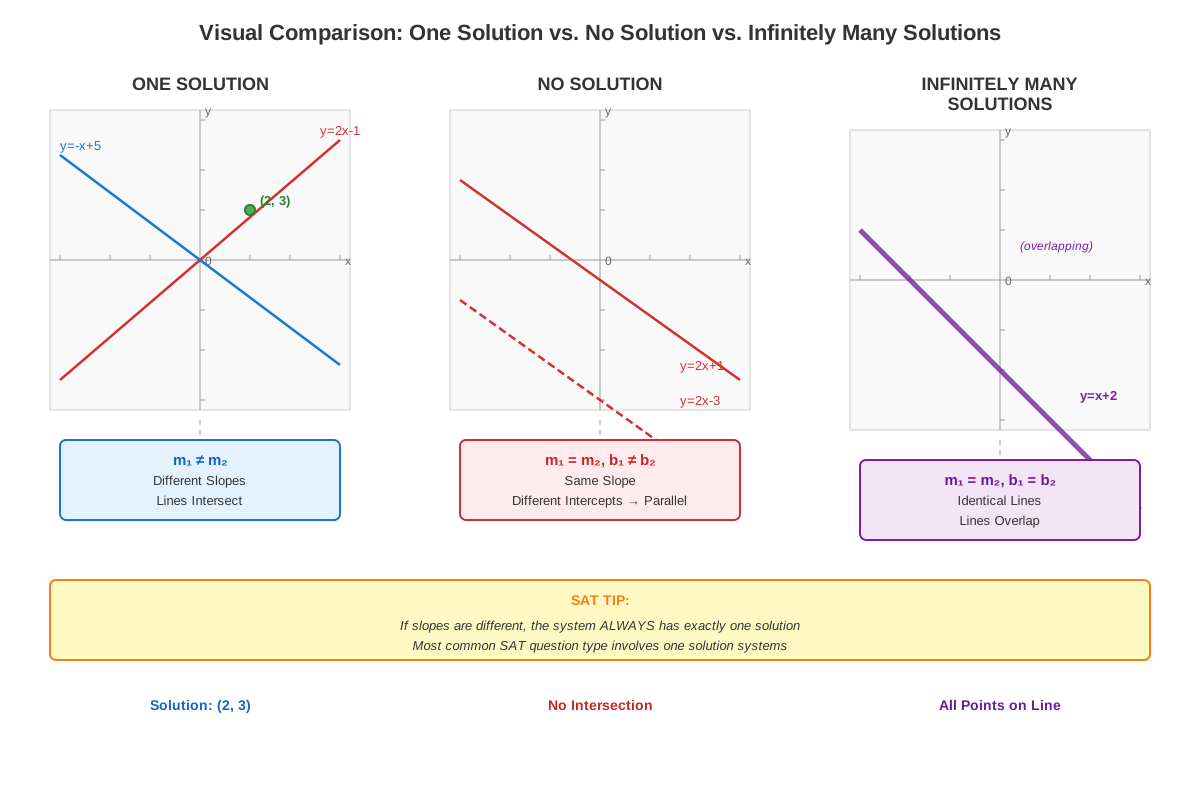
The system has one solution if and only if the lines have different slopes. When slopes differ, the lines must eventually cross at exactly one point, regardless of their y-intercepts.
Geometric Interpretation
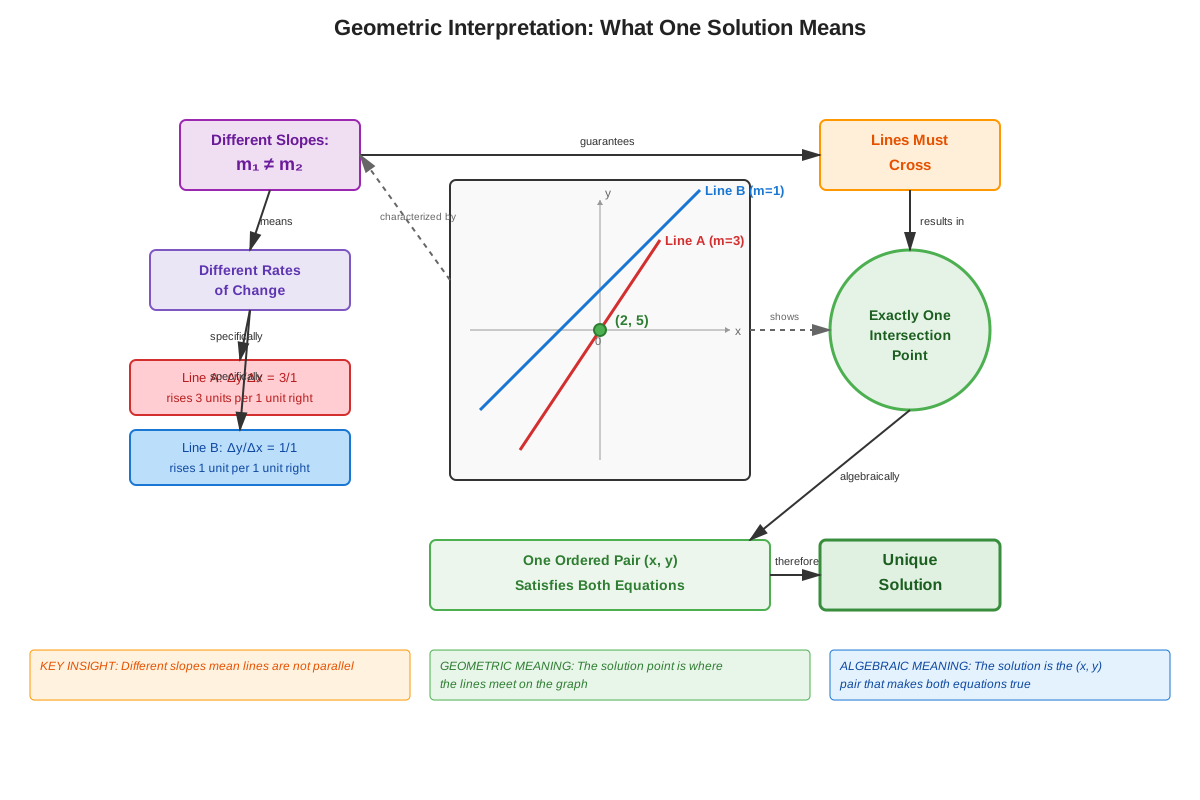
Understanding the visual representation of one solution systems provides crucial insight. When graphed on a coordinate plane, each linear equation appears as a straight line. The solution to the system is the point where these lines intersect. This intersection point has coordinates (x, y) where both x and y simultaneously satisfy both equations.
The key geometric principle: two non-parallel lines in a plane must intersect at exactly one point. This fundamental truth from geometry guarantees that when two lines have different slopes, they will cross once and only once. The location of this intersection depends on both the slopes and y-intercepts of the lines, but the existence of exactly one intersection depends solely on having different slopes.
Algebraic Conditions for One Solution
To determine whether a system has one solution without graphing, examine the equations in slope-intercept form (y = mx + b):
Line 1: y = m₁x + b₁
Line 2: y = m₂x + b₂
Condition for one solution: m₁ ≠ m₂ (the slopes must be different)
When equations are in standard form (ax + by = c), the condition becomes:
a₁/b₁ ≠ a₂/b₂This ratio comparison checks whether the coefficients of x and y are proportional. If they're not proportional, the lines have different slopes and will intersect once.
Solution Methods
Substitution Method
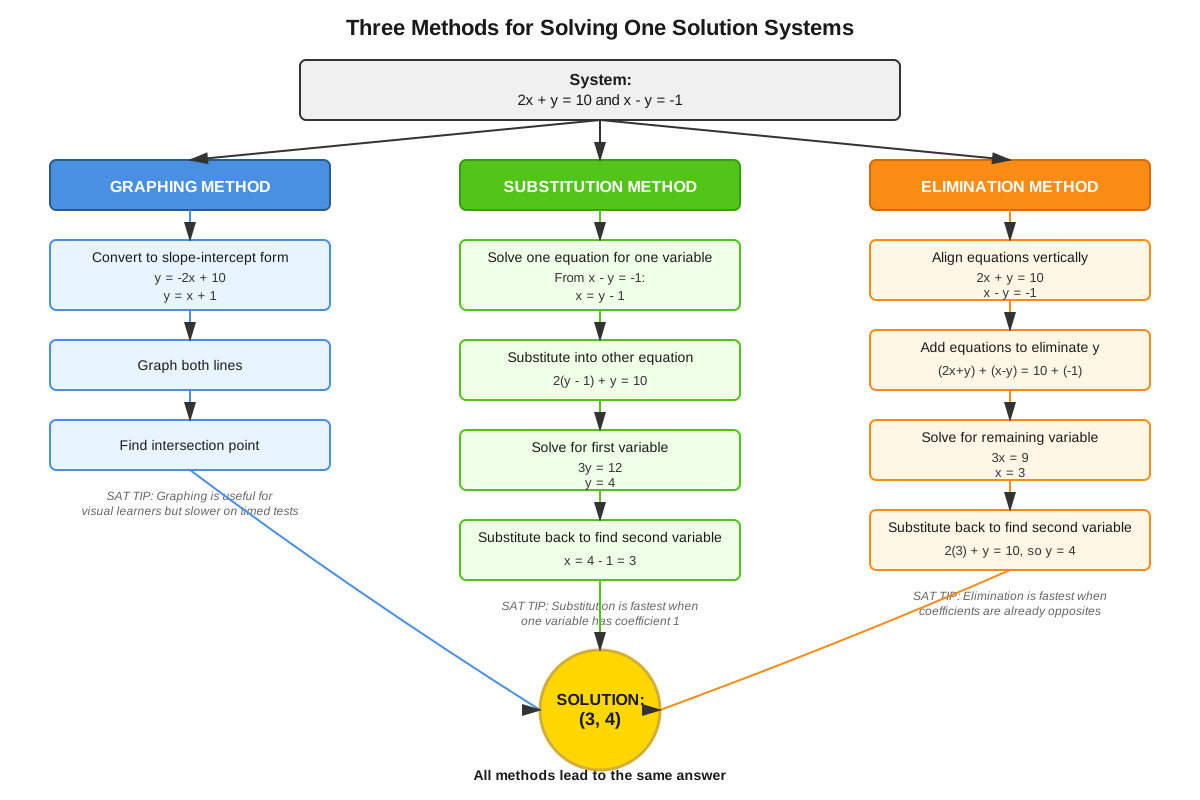
The substitution method involves solving one equation for one variable, then substituting that expression into the other equation. This reduces the system to a single equation with one variable.
Steps:
- Solve one equation for one variable (choose the easiest)
- Substitute this expression into the other equation
- Solve the resulting single-variable equation
- Substitute back to find the other variable
- Verify the solution in both original equations
Elimination Method
The elimination method (also called addition method) involves adding or subtracting equations to eliminate one variable, creating a single equation with one variable.
Steps:
- Multiply one or both equations by constants to make coefficients of one variable opposites
- Add the equations to eliminate that variable
- Solve for the remaining variable
- Substitute back into either original equation
- Verify the solution in both equations
Graphical Method
The graphical method involves plotting both lines and identifying their intersection point. While less precise for exact answers, this method provides excellent conceptual understanding and can quickly confirm whether a system has one solution.
Comparison of Solution Types
| System Type | Geometric Meaning | Algebraic Condition | Number of Solutions |
|---|---|---|---|
| One Solution | Lines intersect at one point | Different slopes (m₁ ≠ m₂) | Exactly 1 |
| Infinitely Many | Lines coincide (same line) | Same slope and y-intercept | Infinite |
| No Solution | Lines are parallel | Same slope, different y-intercepts | 0 |
Working with Parameters
SAT questions frequently include parameters (unknown constants) and ask what value makes a system have one solution. For example:
y = 3x + 5
y = kx - 2
For this system to have one solution, we need k ≠ 3. Any value of k except 3 will create different slopes, guaranteeing one intersection point.
Interpreting Solutions in Context
When systems arise from word problems, the solution point has real-world meaning. The x-coordinate and y-coordinate represent specific quantities in the problem context. For example, if x represents hours worked and y represents total earnings, the solution (4, 60) means working 4 hours results in $60 earned, and this is the point where two different payment scenarios yield the same result.
Concept Relationships
The concept of one solution systems builds directly on understanding individual linear equations. Linear equations → graphing lines → understanding slope → recognizing when lines intersect → one solution systems. Each step in this progression adds a layer of complexity while maintaining connection to prior knowledge.
Within systems of equations, one solution systems contrast with the other two possibilities: no solution (parallel lines) and infinitely many solutions (coincident lines). These three cases form a complete classification: different slopes → one solution; same slope, different y-intercepts → no solution; same slope, same y-intercept → infinitely many solutions.
The solution methods (substitution and elimination) connect to fundamental algebraic skills. Substitution relies on the transitive property of equality and variable manipulation. Elimination uses the addition property of equality. Both methods ultimately reduce a two-variable system to a one-variable equation, connecting systems back to basic equation-solving.
One solution systems also connect forward to more advanced topics. Understanding when systems have unique solutions prepares students for linear programming, matrix algebra, and systems of inequalities. The geometric interpretation of systems as intersecting lines extends to three dimensions (intersecting planes) and abstract vector spaces in higher mathematics.
High-Yield Facts
⭐ A system of two linear equations has exactly one solution if and only if the lines have different slopes
⭐ When given equations in the form y = mx + b, compare the m values; if m₁ ≠ m₂, the system has one solution
⭐ The solution to a system is an ordered pair (x, y) that satisfies both equations simultaneously
⭐ Both substitution and elimination methods will yield the same solution for any given system
⭐ On the SAT, questions about "how many solutions" often involve finding parameter values that create specific solution types
- The graphical representation of one solution is two lines crossing at exactly one point
- In standard form ax + by = c, check if a₁/b₁ ≠ a₂/b₂ to confirm one solution
- Verifying a solution requires substituting both x and y values into both original equations
- Systems with one solution are called "consistent and independent"
- The elimination method is often faster when coefficients are already convenient multiples
- Word problems involving "when will two quantities be equal" typically create one solution systems
- If solving a system yields a statement like "3 = 3" or "0 = 5," the system does NOT have one solution
Quick check — test yourself on One solution systems so far.
Try Flashcards →Common Misconceptions
Misconception: A system always has at least one solution → Correction: Systems can have no solution (parallel lines), one solution (intersecting lines), or infinitely many solutions (coincident lines). Not all systems are solvable.
Misconception: If two equations look different, they must have one solution → Correction: Equations can look different but represent parallel lines (no solution) or the same line (infinitely many solutions). Always check slopes, not just appearance.
Misconception: The solution is just the x-value → Correction: The solution to a system of two equations in two variables is an ordered pair (x, y). Both values are required and both must satisfy both equations.
Misconception: Substitution and elimination give different answers → Correction: Both methods, when executed correctly, yield the same solution. If results differ, an algebraic error occurred. The solution is unique and method-independent.
Misconception: When solving by elimination, you can add any two equations → Correction: To eliminate a variable, the coefficients must be opposites. Often, equations must first be multiplied by constants to create opposite coefficients before adding.
Misconception: The graphical method is always less accurate → Correction: While hand-drawn graphs may lack precision, the graphical method provides the exact solution when done carefully or with technology. It's particularly valuable for conceptual understanding and verification.
Misconception: If slopes are equal, the system has no solution → Correction: Equal slopes mean lines are parallel OR coincident. If slopes AND y-intercepts are equal, the lines are the same (infinitely many solutions). Only when slopes are equal but y-intercepts differ is there no solution.
Worked Examples
Example 1: Solving by Substitution
Problem: Solve the system and find the value of x + y:
y = 2x - 3
3x + 2y = 16Solution:
Step 1: The first equation is already solved for y, making substitution straightforward.
Step 2: Substitute y = 2x - 3 into the second equation:
3x + 2(2x - 3) = 16Step 3: Distribute and simplify:
3x + 4x - 6 = 16
7x - 6 = 16
7x = 22
x = 22/7
Step 4: Substitute x = 22/7 back into y = 2x - 3:
y = 2(22/7) - 3
y = 44/7 - 21/7
y = 23/7
Step 5: Find x + y:
x + y = 22/7 + 23/7 = 45/7Verification: Check that (22/7, 23/7) satisfies both equations:
- First equation: 23/7 = 2(22/7) - 3 = 44/7 - 21/7 = 23/7 ✓
- Second equation: 3(22/7) + 2(23/7) = 66/7 + 46/7 = 112/7 = 16 ✓
Answer: x + y = 45/7
This problem demonstrates the substitution method and connects to the learning objective of applying one solution systems to SAT-style questions, as finding expressions like x + y is common on the test.
Example 2: Determining Parameter Values
Problem: For what value of k does the following system have exactly one solution?
2x + 3y = 12
kx + 9y = 18Solution:
Step 1: Recognize that for one solution, the lines must have different slopes. Convert to slope-intercept form or compare coefficients.
Step 2: Using the coefficient comparison method, the system has one solution when:
a₁/b₁ ≠ a₂/b₂
2/3 ≠ k/9
Step 3: Solve the inequality:
2/3 ≠ k/9Cross-multiply:
2 · 9 ≠ 3 · k
18 ≠ 3k
6 ≠ k
Step 4: Interpret the result: The system has one solution for any value of k except k = 6.
Additional insight: When k = 6, the equations become:
2x + 3y = 12
6x + 9y = 18
The second equation is exactly 3 times the first (multiply first equation by 3), meaning they represent the same line (infinitely many solutions).
Answer: The system has one solution when k ≠ 6 (or for all real numbers except 6)
This example addresses the high-yield SAT skill of determining parameter values that create specific solution types, directly connecting to the learning objective of identifying key features of one solution systems.
Exam Strategy
When approaching SAT questions on one solution systems, follow this strategic framework:
Initial Assessment (5-10 seconds): Quickly identify what the question asks. Common formats include: "Solve for x," "Find x + y," "For what value of k does the system have one solution," or "Which point is the solution." This determines your solution approach.
Trigger Words to Watch For:
- "Exactly one solution" or "unique solution" → Check slope conditions
- "Intersect at" → Find the solution point
- "Simultaneously" → Both equations must be satisfied
- "For what value" with a parameter → Set up slope comparison
- "System of equations" → Identify solution type needed
Method Selection Strategy:
- If one equation is already solved for a variable → Use substitution
- If coefficients are convenient multiples → Use elimination
- If asked about "how many solutions" → Compare slopes without fully solving
- If answer choices are given → Consider testing values or elimination
Process of Elimination Tips:
- Eliminate answers that don't satisfy both equations (substitute to check)
- For parameter questions, eliminate values that make slopes equal (unless asking for no solution)
- If a question shows graphs, eliminate any showing parallel or coincident lines when one solution is specified
- For "find x + y" questions, solve for one variable first, then use that to find the other rather than solving completely
Time Allocation: Budget 1-2 minutes for straightforward solving problems, 2-3 minutes for parameter problems or word problems requiring equation setup. If a problem takes longer, mark it and return after completing easier questions.
Verification Strategy: On the SAT, time is precious, but for systems problems, a quick check prevents careless errors. Substitute your solution into one equation (preferably the simpler one). If it works, you likely have the correct answer. Full verification in both equations is ideal but not always time-efficient.
Memory Techniques
Slope Comparison Mnemonic: "Different Slopes, One Solution" (DSOS) - When slopes Differ, you get a Single intersection point.
Solution Type Memory Aid: Use the acronym "DIP":
- Different slopes → one solution (lines Do Intersect at a Point)
- Identical lines → infinitely many solutions
- Parallel lines → no solution
Substitution Steps Acronym: "SSSV" (Solve, Substitute, Solve, Verify)
- Solve one equation for one variable
- Substitute into the other equation
- Solve for the remaining variable
- Verify by substituting back
Elimination Steps Acronym: "MASV" (Multiply, Add, Solve, Verify)
- Multiply to create opposite coefficients
- Add equations to eliminate a variable
- Solve for the remaining variable
- Verify the solution
Visualization Strategy: Picture two pencils on a desk. When they're at different angles (different slopes), they must cross somewhere. When they're parallel (same slope), they never meet. This physical analogy reinforces the geometric meaning of one solution systems.
Parameter Problem Reminder: "Keep slopes Unequal" - When solving for a parameter k that creates one solution, remember that k must make slopes unequal.
Summary
One solution systems occur when two linear equations intersect at exactly one point, representing a unique ordered pair (x, y) that satisfies both equations simultaneously. The fundamental condition for one solution is that the two lines must have different slopes; geometrically, non-parallel lines in a plane must intersect exactly once. Students can solve these systems using substitution (solving one equation for a variable and substituting into the other), elimination (adding equations to cancel a variable), or graphing (plotting both lines and finding their intersection). On the SAT, questions test both computational ability to find solutions and conceptual understanding of what conditions create one solution versus no solution or infinitely many solutions. Parameter problems, which ask what value makes a system have one solution, are particularly common and require comparing slopes or coefficient ratios. The solution to a system represents the point where both conditions are met, and in word problems, this point has meaningful real-world interpretation. Mastery requires recognizing solution types quickly, executing solution methods accurately, and understanding the geometric and algebraic relationships that determine when exactly one solution exists.
Key Takeaways
- A system has exactly one solution when the two lines have different slopes (m₁ ≠ m₂), causing them to intersect at one point
- The solution is an ordered pair (x, y) that must satisfy both equations; always verify by substituting into both original equations
- Substitution works best when one equation is already solved for a variable; elimination is efficient when coefficients are convenient multiples
- For parameter problems asking "for what value of k does the system have one solution," set up the condition that slopes must be unequal
- SAT questions frequently ask for expressions like x + y rather than individual values, so plan your solution strategy accordingly
- The three possible solution types (one solution, no solution, infinitely many solutions) are determined entirely by comparing slopes and y-intercepts
- Geometric interpretation reinforces algebraic understanding: visualize intersecting lines to confirm that one solution makes sense
Related Topics
Systems with No Solution: Understanding parallel lines and the conditions (same slope, different y-intercepts) that create inconsistent systems builds on one solution concepts and completes the classification of linear systems.
Systems with Infinitely Many Solutions: Recognizing when two equations represent the same line (same slope and y-intercept) contrasts with one solution systems and develops deeper understanding of linear relationships.
Systems of Inequalities: After mastering systems of equations, students progress to systems of inequalities where solution regions replace solution points, extending the concept of simultaneous conditions.
Nonlinear Systems: Systems involving quadratic or other nonlinear equations can have different numbers of solutions, and understanding linear one solution systems provides the foundation for this more complex topic.
Matrices and Linear Algebra: The algebraic techniques for solving systems extend to matrix methods, where one solution corresponds to an invertible coefficient matrix—a preview of college-level mathematics.
Practice CTA
Now that you've mastered the core concepts of one solution systems, it's time to solidify your understanding through practice. Work through the practice questions to apply these strategies to SAT-style problems, and use the flashcards to reinforce key facts and conditions. Remember, systems of equations appear on every SAT, and students who can quickly identify solution types and execute solution methods efficiently gain a significant competitive advantage. Your investment in mastering this high-yield topic will pay dividends on test day—start practicing now to build the speed and accuracy that lead to top scores!
Sign up free to keep reading
Create a free AnvayaPrep account to finish this SAT guide on One solution systems — plus flashcards and practice questions.