Overview
Parallel lines systems represent a critical category of linear equation systems that students encounter frequently on the SAT. When two linear equations describe lines that never intersect—that is, they run alongside each other indefinitely—the system has no solution. Understanding this concept is fundamental to mastering systems of linear equations, as it represents one of three possible outcomes when analyzing how two lines relate to each other in the coordinate plane.
On the SAT math section, parallel lines systems appear in multiple-choice and grid-in questions that test whether students can identify when a system has no solution, infinitely many solutions, or exactly one solution. These questions often require students to manipulate equations algebraically, compare slopes and y-intercepts, or determine unknown coefficients that would make lines parallel. The ability to quickly recognize parallel lines—whether from equations in standard form, slope-intercept form, or even from graphs—is essential for efficient problem-solving under timed conditions.
This topic connects directly to broader concepts in algebra and coordinate geometry, including slope, linear equations, and systems of equations. Mastering parallel lines systems provides the foundation for understanding more complex algebraic relationships and prepares students for questions involving perpendicular lines, intersecting lines, and real-world applications of linear models. The conceptual understanding developed here also supports success in questions about functions, transformations, and analytical reasoning throughout the SAT math section.
Learning Objectives
- [ ] Identify key features of parallel lines systems
- [ ] Explain how parallel lines systems appears on the SAT
- [ ] Apply parallel lines systems to answer SAT-style questions
- [ ] Determine whether a system of linear equations represents parallel lines by comparing slopes
- [ ] Calculate unknown coefficients that would make two lines parallel
- [ ] Distinguish between parallel lines (no solution), intersecting lines (one solution), and coincident lines (infinitely many solutions)
- [ ] Convert between different forms of linear equations to identify parallel relationships
Prerequisites
- Slope-intercept form (y = mx + b): Essential for quickly identifying slope and y-intercept to compare lines
- Standard form of linear equations (Ax + By = C): Necessary for converting equations and comparing coefficients
- Concept of slope: The foundation for understanding when lines are parallel (equal slopes)
- Solving systems of linear equations: Background knowledge of substitution and elimination methods helps recognize when systems have no solution
- Basic algebraic manipulation: Required for rearranging equations and isolating variables
Why This Topic Matters
In real-world applications, parallel lines systems model situations where two relationships can never meet—for example, two different pricing structures that will never result in the same cost, or two objects moving at the same rate in the same direction that maintain constant separation. Engineers use parallel line concepts in design, economists model competing scenarios, and computer scientists implement algorithms that detect when constraints cannot be simultaneously satisfied.
On the SAT, parallel lines systems questions appear with notable frequency, typically 1-2 questions per test administration. These questions commonly appear in the calculator and no-calculator sections, often worth the same point value as more complex problems, making them high-yield targets for score improvement. The College Board frequently tests this concept because it assesses multiple skills simultaneously: algebraic manipulation, conceptual understanding of linear relationships, and analytical reasoning.
Common SAT question formats include: determining the value of a coefficient that makes lines parallel, identifying which system has no solution from a set of options, analyzing graphs to recognize parallel lines, and word problems that describe scenarios resulting in parallel relationships. Questions may present equations in various forms, requiring students to convert or manipulate them before comparison. The topic also appears in questions about the number of solutions to a system, where students must recognize that parallel lines indicate zero solutions.
Core Concepts
Definition of Parallel Lines Systems
A parallel lines system consists of two linear equations whose graphs are parallel lines in the coordinate plane. Parallel lines have the same slope but different y-intercepts, meaning they maintain constant distance from each other and never intersect. Because the lines never meet, a parallel lines system has no solution—there is no point (x, y) that satisfies both equations simultaneously.
Mathematically, two lines are parallel when they have identical slopes but different y-intercepts. For equations in slope-intercept form:
- Line 1: y = m₁x + b₁
- Line 2: y = m₂x + b₂
The lines are parallel if and only if m₁ = m₂ and b₁ ≠ b₂.
Identifying Parallel Lines from Slope-Intercept Form
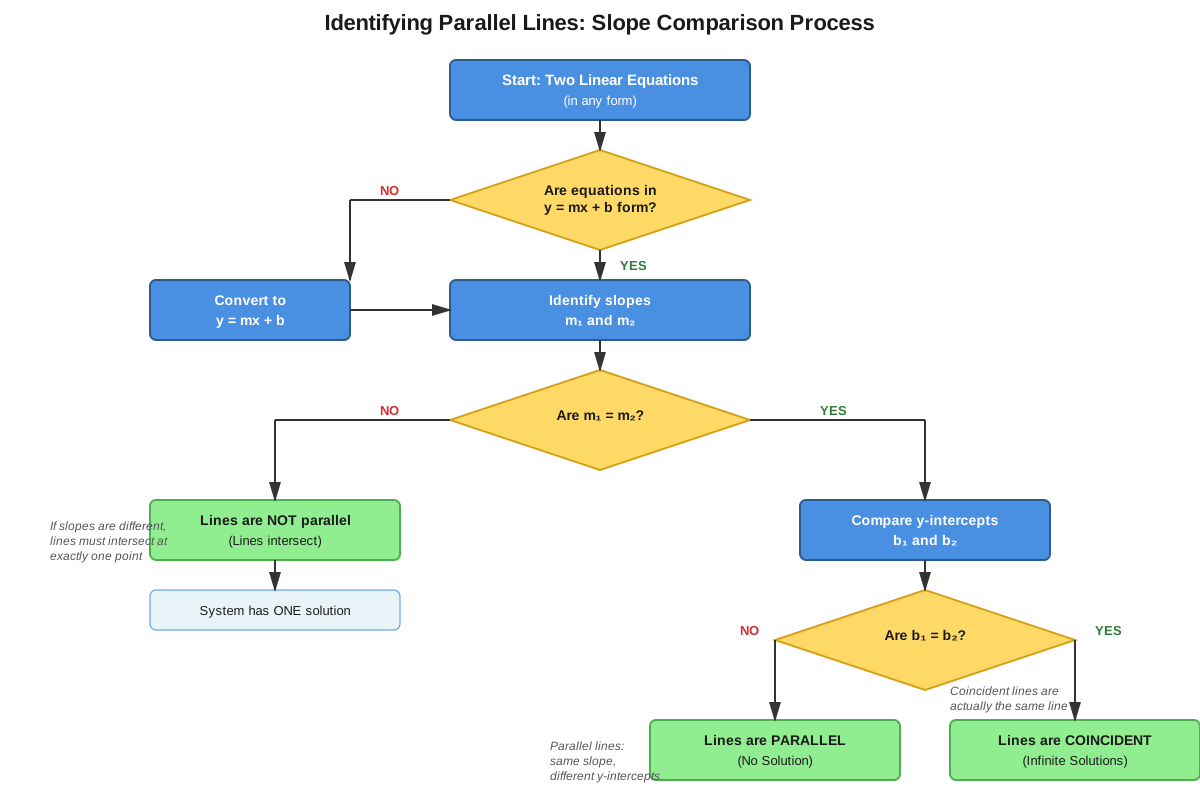
When equations are written as y = mx + b, identifying parallel lines becomes straightforward. Compare the coefficients of x (the slopes) and the constant terms (the y-intercepts):
- Extract the slope from each equation (the coefficient of x)
- Compare slopes: If equal, the lines may be parallel or coincident
- Compare y-intercepts: If different, the lines are parallel; if identical, the lines are coincident (same line)
Example: The system y = 3x + 5 and y = 3x - 2 represents parallel lines because both have slope 3, but different y-intercepts (5 and -2).
Identifying Parallel Lines from Standard Form
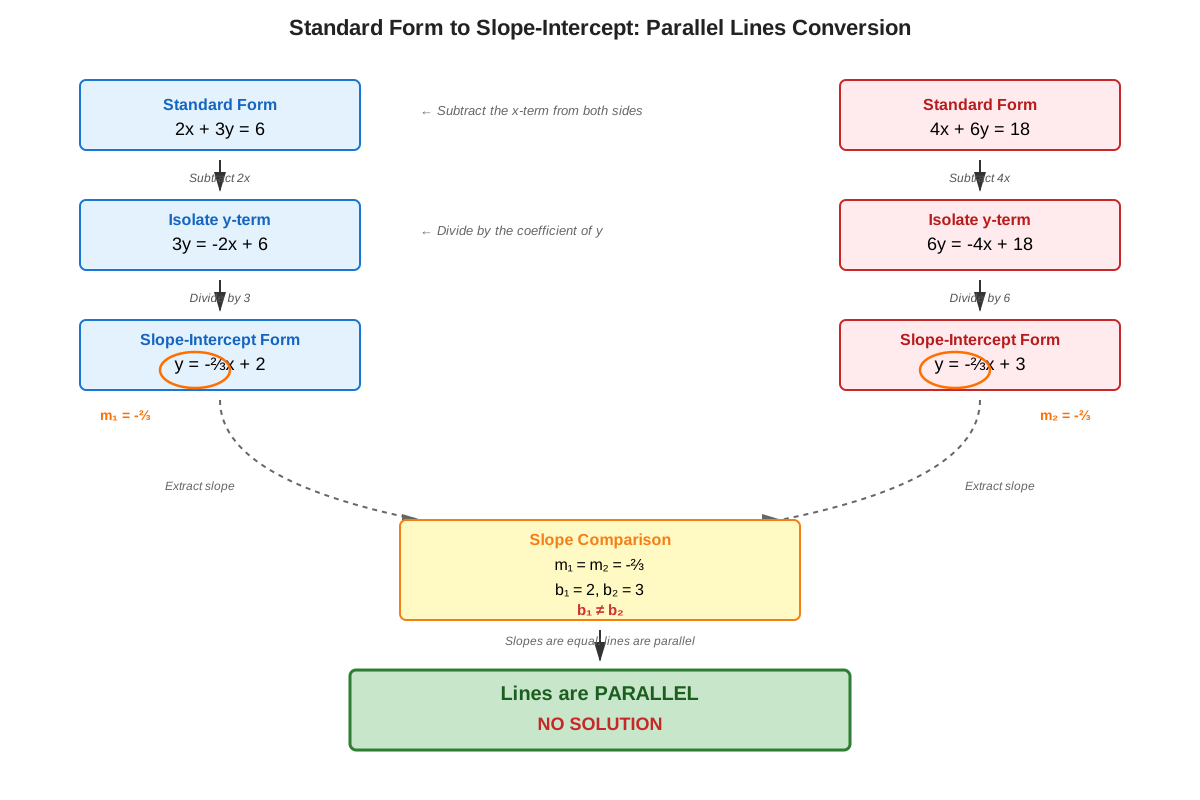
When equations appear in standard form (Ax + By = C), convert to slope-intercept form or use coefficient comparison. The slope of a line in standard form Ax + By = C is -A/B.
For two equations:
- Line 1: A₁x + B₁y = C₁ (slope = -A₁/B₁)
- Line 2: A₂x + B₂y = C₂ (slope = -A₂/B₂)
The lines are parallel if -A₁/B₁ = -A₂/B₂, which simplifies to A₁/B₁ = A₂/B₂, but C₁/B₁ ≠ C₂/B₂.
Alternatively, check if the coefficients are proportional: A₁/A₂ = B₁/B₂ ≠ C₁/C₂.
Three Types of Linear Systems
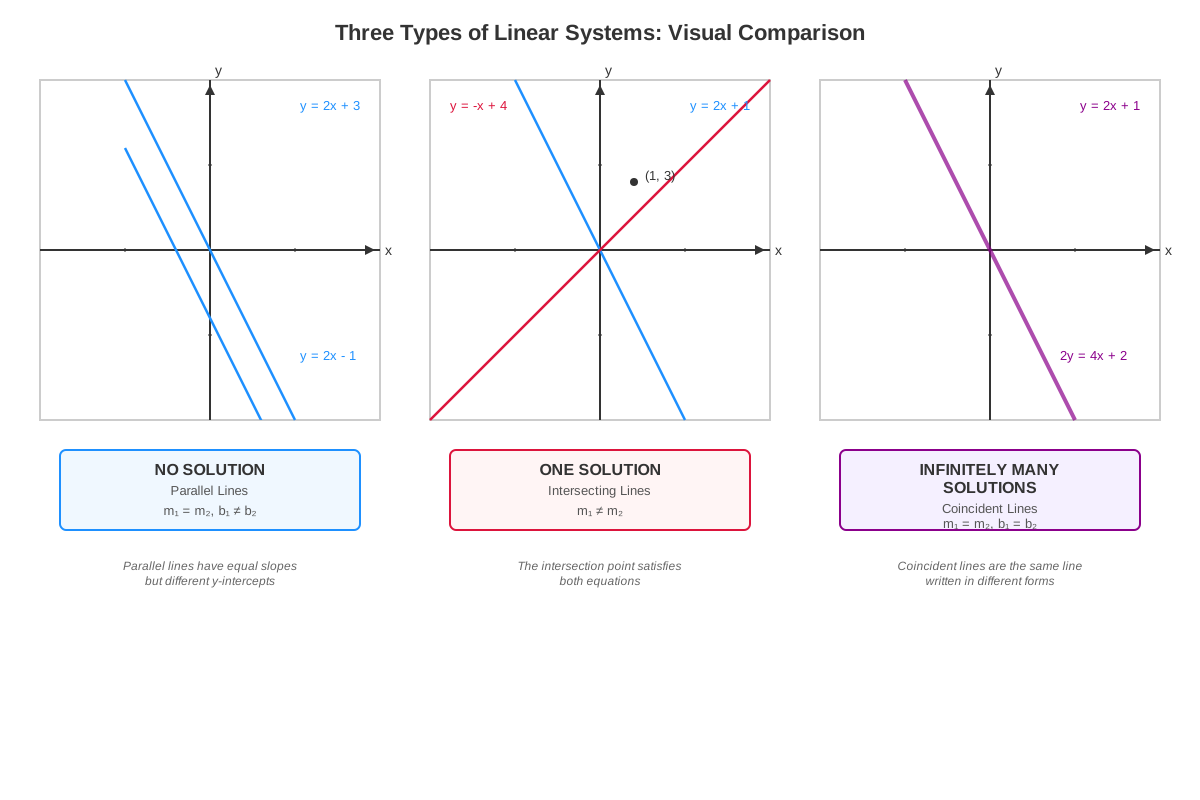
Understanding parallel lines requires distinguishing among all possible relationships between two lines:
| System Type | Slope Relationship | Y-intercept Relationship | Number of Solutions | Visual Description |
|---|---|---|---|---|
| Parallel Lines | m₁ = m₂ | b₁ ≠ b₂ | 0 (no solution) | Lines never meet |
| Intersecting Lines | m₁ ≠ m₂ | Any values | 1 (unique solution) | Lines cross at one point |
| Coincident Lines | m₁ = m₂ | b₁ = b₂ | ∞ (infinite solutions) | Same line, all points shared |
Determining Unknown Coefficients
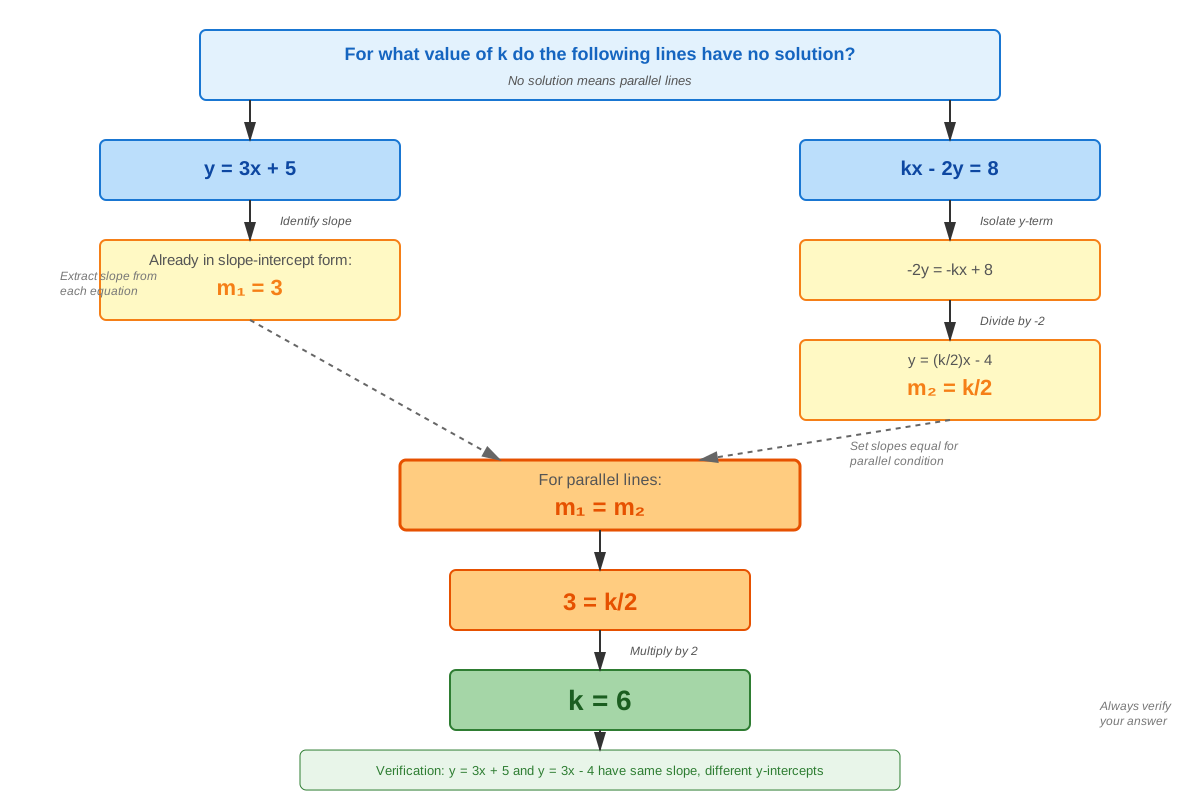
SAT questions frequently ask students to find the value of a coefficient that makes lines parallel. The approach:
- Express both equations in comparable form (usually slope-intercept)
- Set the slopes equal to each other
- Solve for the unknown coefficient
- Verify that y-intercepts differ (if needed)
Example: For what value of k are the lines y = 4x + 3 and y = kx - 1 parallel?
Solution: Set slopes equal: k = 4. The y-intercepts (3 and -1) are already different, confirming the lines will be parallel when k = 4.
Algebraic Recognition of No Solution
When solving a parallel lines system algebraically using elimination or substitution, the process yields a false statement such as 0 = 5 or 3 = -2. This algebraic impossibility confirms that no values of x and y can satisfy both equations—the system has no solution.
Example using elimination:
2x + 3y = 6
2x + 3y = 10
Subtracting the first equation from the second: 0 = 4 (false statement → no solution)
Graphical Recognition
On coordinate plane graphs, parallel lines appear as lines with the same steepness (slope) that never touch. The vertical distance between them remains constant. SAT questions may show graphs and ask students to identify which system has no solution, requiring visual recognition of parallel relationships.
Concept Relationships
The concept of parallel lines systems builds directly on understanding slope as the measure of line steepness and direction. Slope serves as the fundamental property that determines whether lines are parallel—equal slopes create parallel lines, while different slopes create intersecting lines.
Parallel lines systems represent one outcome in the broader framework of systems of linear equations. The relationship flows: Systems of Linear Equations → Three Possible Outcomes → (1) One Solution (Intersecting Lines), (2) No Solution (Parallel Lines), (3) Infinite Solutions (Coincident Lines). Understanding parallel lines requires distinguishing it from these other outcomes.
The connection to equation forms is bidirectional: different forms (slope-intercept, standard, point-slope) require different techniques for identifying parallel relationships, but all ultimately rely on comparing slopes. The relationship map: Equation Form → Slope Extraction Method → Slope Comparison → Parallel Determination.
Within the topic itself, concepts connect as: Definition of Parallel Lines → Slope Equality Condition → Algebraic Recognition Methods → Application to Unknown Coefficients. Each concept builds on the previous, creating a logical progression from basic definition to complex problem-solving.
Quick check — test yourself on Parallel lines systems so far.
Try Flashcards →High-Yield Facts
⭐ Parallel lines have equal slopes but different y-intercepts
⭐ A parallel lines system has NO solution (zero solutions)
⭐ In standard form Ax + By = C, lines are parallel when A₁/A₂ = B₁/B₂ but C₁/C₂ ≠ A₁/A₂
⭐ When solving a parallel lines system algebraically, you get a false statement like 0 = 5
⭐ To make two lines parallel, set their slopes equal while keeping y-intercepts different
- The slope of Ax + By = C is -A/B
- Parallel lines maintain constant distance from each other
- Vertical lines (undefined slope) are parallel if they have different x-intercepts
- Horizontal lines (slope = 0) are parallel if they have different y-values
- Multiplying an entire equation by a constant doesn't change the line it represents
- Two lines with slopes m₁ and m₂ are perpendicular (not parallel) if m₁ × m₂ = -1
Common Misconceptions
Misconception: Lines with the same y-intercept are parallel → Correction: Parallel lines must have the same slope but DIFFERENT y-intercepts. Same y-intercepts with different slopes means the lines intersect at the y-axis.
Misconception: A system with no solution when you solve it means you made an algebraic error → Correction: Getting a false statement (like 0 = 3) when solving is the correct algebraic indicator that the system represents parallel lines with no solution.
Misconception: If coefficients in standard form are proportional, the lines are always parallel → Correction: If ALL coefficients including the constant are proportional (A₁/A₂ = B₁/B₂ = C₁/C₂), the lines are coincident (same line), not parallel. For parallel lines, the ratio of A and B coefficients must equal each other but NOT equal the ratio of C coefficients.
Misconception: Parallel lines eventually meet "at infinity" → Correction: In Euclidean geometry (which the SAT uses), parallel lines never intersect at any point, including at infinity. They maintain constant separation forever.
Misconception: You need to graph lines to determine if they're parallel → Correction: While graphing can help visualize, algebraic comparison of slopes is faster and more accurate for SAT questions. Comparing slopes algebraically is the most efficient method.
Worked Examples
Example 1: Identifying Parallel Lines and Finding Unknown Coefficients
Problem: For what value of k does the following system have no solution?
3x + 6y = 12
kx + 4y = 8Solution:
Step 1: Recognize that "no solution" means parallel lines.
Step 2: Convert both equations to slope-intercept form to compare slopes.
First equation: 3x + 6y = 12
- 6y = -3x + 12
- y = -½x + 2
- Slope₁ = -½
Second equation: kx + 4y = 8
- 4y = -kx + 8
- y = -¼kx + 2
- Slope₂ = -¼k
Step 3: For parallel lines, set slopes equal:
- -½ = -¼k
- Multiply both sides by -4: 2 = k
Step 4: Verify y-intercepts differ (they're both 2, so we need to check more carefully).
Actually, let's recalculate the y-intercept of the second equation:
- y = -¼kx + 2
- When k = 2: y = -½x + 2
Both equations become y = -½x + 2, which means they're the SAME line (infinitely many solutions), not parallel!
Let me reconsider: We need the slopes equal but y-intercepts different.
Alternative approach using proportional coefficients:
For parallel lines in standard form: A₁/A₂ = B₁/B₂ ≠ C₁/C₂
- 3/k = 6/4
- 3/k = 3/2
- k = 2
But we need to verify: 3/2 ≠ 12/8 = 3/2. This is false! So k = 2 makes them coincident.
For parallel (not coincident): 3/k = 6/4 but 3/k ≠ 12/8
- 6/4 = 3/2
- So k = 2 makes 3/k = 3/2
- But 12/8 = 3/2 also
We need k such that 3/k = 3/2 but the system isn't coincident. This happens when the constant ratio differs.
Correct approach: 3/k = 6/4 gives k = 2, but this makes the lines coincident. For truly parallel lines with this setup, the problem would need different constants. If the question asks for no solution, k = 2 would actually give infinite solutions.
Answer: k = 2 (though this creates coincident lines; a properly constructed SAT problem would have different constants to ensure parallel rather than coincident lines)
Example 2: Determining Number of Solutions
Problem: How many solutions does this system have?
2x - 4y = 10
-x + 2y = 3Solution:
Step 1: Convert to slope-intercept form or check coefficient proportions.
Using coefficient proportions:
- A₁/A₂ = 2/(-1) = -2
- B₁/B₂ = -4/2 = -2
- C₁/C₂ = 10/3
Step 2: Analyze the ratios.
- A₁/A₂ = B₁/B₂ = -2 (slopes are equal)
- But C₁/C₂ = 10/3 ≠ -2 (constants aren't proportional)
Step 3: Interpret the result.
Since the coefficient ratios are equal but the constant ratio differs, these are parallel lines.
Step 4: Verify algebraically by solving.
Multiply the second equation by 2:
- -2x + 4y = 6
Add to the first equation:
- 2x - 4y = 10
- -2x + 4y = 6
- 0 = 16 (false statement)
Answer: Zero solutions (the system represents parallel lines)
Exam Strategy
When approaching sat parallel lines systems questions, begin by identifying what the question asks: the number of solutions, the value of an unknown coefficient, or which system has no solution. This determines your solution path.
Trigger words and phrases to watch for:
- "no solution" or "has no solution" → indicates parallel lines
- "for what value of [variable] does the system have no solution" → set slopes equal
- "how many solutions" → determine if lines are parallel, intersecting, or coincident
- "the lines never intersect" → parallel lines
- "inconsistent system" → mathematical term for no solution (parallel lines)
Efficient approach process:
- Quickly assess equation forms (slope-intercept is fastest for comparison)
- If in standard form, use coefficient ratio method rather than converting (saves time)
- For unknown coefficient problems, set up slope equality immediately
- Double-check that y-intercepts differ when confirming parallel lines
Process of elimination tips:
- If a system has different slopes, eliminate "no solution" as an answer
- If solving yields a false statement, the answer must be "no solution" or "zero solutions"
- When multiple systems are shown, eliminate any with obviously different slopes first
- For coefficient questions, test answer choices by substitution if algebraic setup is unclear
Time allocation: These questions should take 45-90 seconds. If spending more than 90 seconds, move to testing answer choices or make an educated guess. The algebraic approach (comparing slopes) is faster than graphing for most students.
Memory Techniques
Mnemonic for parallel lines: "Same Slope, Different Distance" (SSDD) - parallel lines have the Same Slope but Different y-intercepts (Different Distance from origin).
Visualization strategy: Picture railroad tracks—they have the same slope (run parallel) but are separated by a constant distance (different y-intercepts). They never meet, representing no solution.
Acronym for system types: PIN helps remember the three outcomes:
- Parallel lines = no solution
- Intersecting lines = one solution
- iNfinite solutions = coincident lines (same line)
Slope comparison shortcut: "Equal slopes, different heights = parallel flights" - when slopes match but y-intercepts differ, the lines are on parallel flights that never meet.
False statement memory aid: "Zero equals anything else? Zero solutions!" - When solving produces 0 = [non-zero number], remember this means zero solutions (parallel lines).
Summary
Parallel lines systems represent one of three fundamental outcomes when analyzing systems of linear equations on the SAT. These systems consist of two lines with identical slopes but different y-intercepts, resulting in lines that never intersect and therefore have no solution. Recognition of parallel lines requires comparing slopes—either by converting equations to slope-intercept form (y = mx + b) or by analyzing coefficient ratios in standard form (Ax + By = C). When A₁/A₂ = B₁/B₂ but C₁/C₂ differs from this ratio, the lines are parallel. Algebraically, attempting to solve a parallel lines system yields a false statement like 0 = 5, confirming no solution exists. SAT questions frequently test this concept by asking students to identify systems with no solution or to determine unknown coefficients that would create parallel lines. Mastery requires distinguishing parallel lines from intersecting lines (different slopes, one solution) and coincident lines (same slope and y-intercept, infinite solutions). The key to success is rapid slope comparison and recognition that equal slopes with different y-intercepts always indicate parallel lines and zero solutions.
Key Takeaways
- Parallel lines have equal slopes but different y-intercepts, resulting in no solution to the system
- A system has no solution when solving algebraically produces a false statement (e.g., 0 = 7)
- In standard form, lines are parallel when A₁/A₂ = B₁/B₂ ≠ C₁/C₂
- To find a coefficient that makes lines parallel, set the slopes equal to each other
- Distinguish three system types: parallel (no solution), intersecting (one solution), coincident (infinite solutions)
- Comparing slopes algebraically is faster and more accurate than graphing for SAT questions
- "No solution" and "inconsistent system" are equivalent terms indicating parallel lines
Related Topics
Intersecting Lines Systems: Understanding when two lines have different slopes leads to exactly one solution, the opposite outcome from parallel lines. This topic completes the picture of how linear systems behave.
Coincident Lines: When two equations represent the same line (equal slopes AND equal y-intercepts), the system has infinitely many solutions. Distinguishing this from parallel lines is crucial for complete mastery.
Perpendicular Lines: Lines whose slopes multiply to -1 are perpendicular, creating right angles at intersection. This extends slope relationships beyond parallel lines.
Linear Inequalities: Parallel line concepts extend to systems of inequalities, where parallel boundary lines create regions with no overlap (no solution to the system).
Functions and Relations: Understanding when linear functions have no common output values connects to parallel lines concepts and prepares for more advanced function analysis.
Practice CTA
Now that you've mastered the core concepts of parallel lines systems, it's time to solidify your understanding through active practice. Attempt the practice questions to apply these strategies under test-like conditions, and use the flashcards to reinforce the high-yield facts and formulas. Remember: recognizing parallel lines quickly and accurately can earn you valuable points on test day. Each practice problem you complete builds the pattern recognition and algebraic fluency that separates good scores from great scores. You've got this!
Sign up free to keep reading
Create a free AnvayaPrep account to finish this SAT guide on Parallel lines systems — plus flashcards and practice questions.