Overview
Solving systems by elimination is a fundamental algebraic technique that allows students to find the values of variables in two or more equations simultaneously. This method works by strategically adding or subtracting equations to eliminate one variable, making it possible to solve for the remaining variable. Once one variable is determined, substitution reveals the value of the other variable. This approach is particularly powerful when equations are already aligned or can be easily manipulated to have matching coefficients.
On the SAT math section, systems of linear equations appear frequently, and the elimination method is often the most efficient strategy for solving them. The College Board tests this skill in multiple contexts: pure algebraic problems, word problems requiring system setup, and questions asking about the number of solutions a system possesses. Understanding elimination not only helps students solve these problems quickly but also builds algebraic fluency that supports success across the entire math section.
The elimination method connects deeply to other mathematical concepts tested on the SAT. It reinforces understanding of equation properties, coefficient manipulation, and the geometric interpretation of linear systems as intersecting lines. Students who master sat solving systems by elimination gain tools applicable to more complex topics including inequalities, quadratic systems, and real-world modeling scenarios that appear throughout the exam.
Learning Objectives
- [ ] Identify key features of solving systems by elimination
- [ ] Explain how solving systems by elimination appears on the SAT
- [ ] Apply solving systems by elimination to answer SAT-style questions
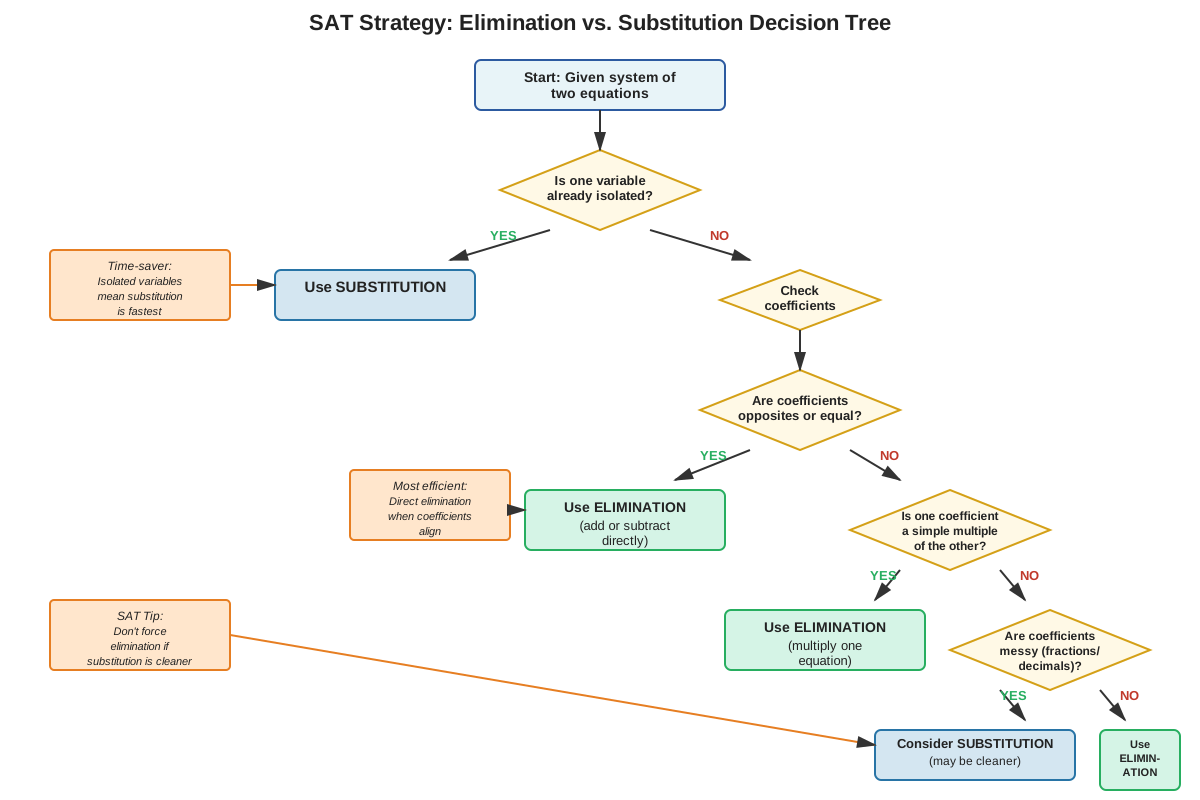
- [ ] Determine when elimination is more efficient than substitution for a given system
- [ ] Manipulate equations by multiplying to create matching coefficients
- [ ] Recognize systems with no solution or infinitely many solutions using elimination
- [ ] Solve word problems by translating scenarios into systems and applying elimination
Prerequisites
- Linear equations in one variable: Understanding how to isolate variables and perform inverse operations is essential for the final solving step after elimination
- Combining like terms: The elimination process requires adding or subtracting corresponding terms across equations
- Multiplication and division of equations: Creating matching coefficients often requires multiplying entire equations by constants
- Coordinate plane basics: Recognizing that systems represent intersecting lines helps with conceptual understanding and identifying solution types
- Distributive property: Necessary when manipulating equations to prepare them for elimination
Why This Topic Matters
Systems of linear equations model countless real-world situations where two conditions must be satisfied simultaneously. From business scenarios involving cost and revenue to mixture problems in chemistry, from rate-time-distance problems to resource allocation, the ability to solve systems is fundamental to quantitative reasoning. Engineers use systems to balance forces, economists use them to find market equilibrium, and data scientists employ them in optimization algorithms.
On the SAT, systems of linear equations appear in approximately 3-5 questions per test, making this a high-yield topic that can significantly impact scores. These questions appear in both the calculator and no-calculator sections, with point values ranging from easy to medium-hard difficulty. The College Board tests elimination through direct "solve for x and y" problems, word problems requiring system construction, and conceptual questions about the number of solutions or the relationship between coefficients.
Common SAT question formats include: presenting two equations and asking for the value of x + y or 2x - y (testing whether students can add equations strategically); word problems about tickets, mixtures, or rates that require setting up a system; questions asking "for what value of k does the system have no solution?"; and problems embedded in real-world contexts like business profit models or scientific data analysis. The elimination method often provides the fastest path to correct answers, particularly when equations are already aligned or when the question asks for a combination of variables rather than individual values.
Core Concepts
The Elimination Method Fundamentals
The solving systems by elimination method relies on a fundamental property of equations: adding or subtracting equal quantities maintains equality. When two equations are true simultaneously, adding their left sides equals adding their right sides. The strategic goal is to combine equations in a way that eliminates one variable entirely, leaving a single-variable equation that can be solved directly.
Consider the basic system:
3x + 2y = 16
3x - 2y = 8
Notice that the coefficients of y are opposites (2 and -2). Adding these equations eliminates y:
  3x + 2y = 16
+ 3x - 2y = 8
--------------
  6x + 0y = 24
This simplifies to 6x = 24, giving x = 4. Substituting back into either original equation yields y = 2.
Creating Matching Coefficients
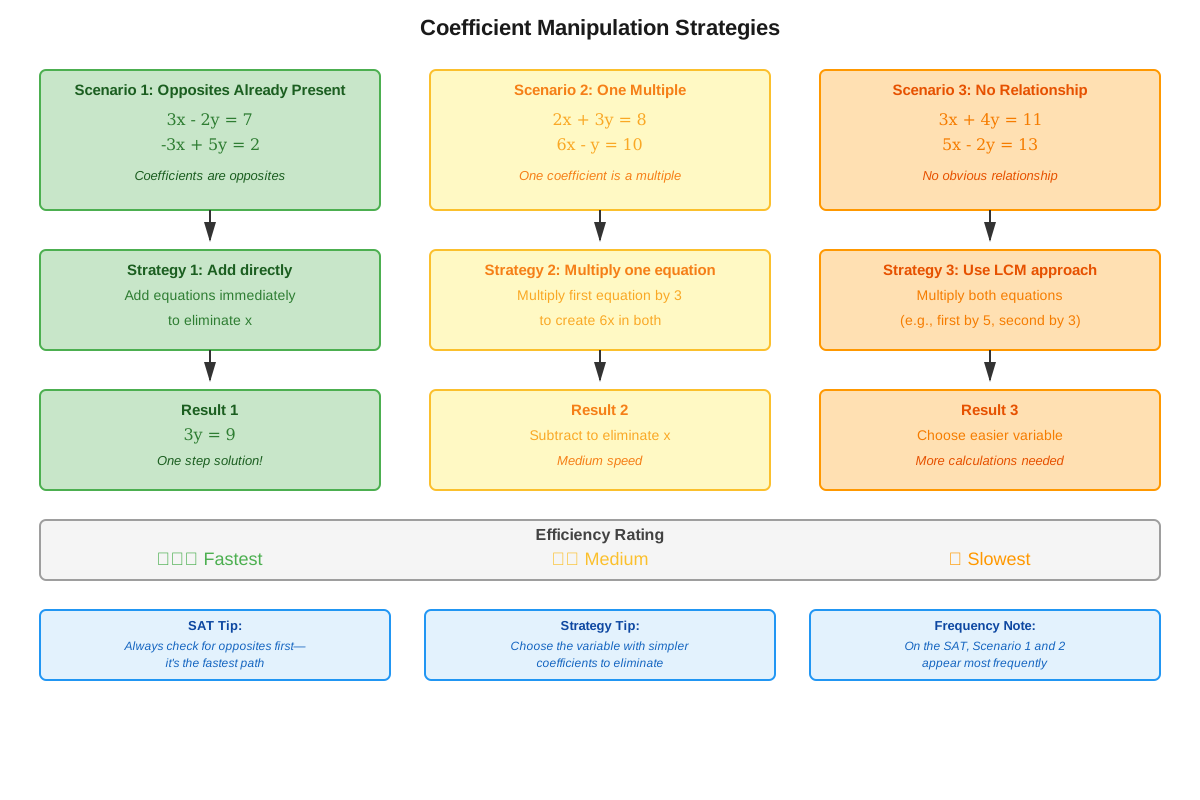
Most systems don't present with ready-to-eliminate coefficients. The key skill involves multiplying one or both equations by strategic constants to create matching (or opposite) coefficients for one variable.
For the system:
2x + 3y = 13
5x - 2y = 4
To eliminate x, multiply the first equation by 5 and the second by 2:
10x + 15y = 65
10x - 4y = 8
Subtracting the second from the first eliminates x:
19y = 57
y = 3
Alternatively, to eliminate y, multiply the first equation by 2 and the second by 3:
4x + 6y = 26
15x - 6y = 12
Adding these equations eliminates y and yields 19x = 38, so x = 2.
Decision Framework: When to Eliminate Which Variable
Strategic variable selection accelerates problem-solving. Choose to eliminate the variable that requires simpler coefficient manipulation:
| Scenario | Best Approach | Reason |
|---|---|---|
| Coefficients are already opposites | Add equations immediately | No multiplication needed |
| Coefficients are already equal | Subtract equations immediately | No multiplication needed |
| One variable has coefficient 1 | Consider substitution instead | May be faster |
| Coefficients are small integers | Eliminate using LCM | Minimizes arithmetic complexity |
| Question asks for x + y or x - y | Add/subtract original equations | May give answer directly |
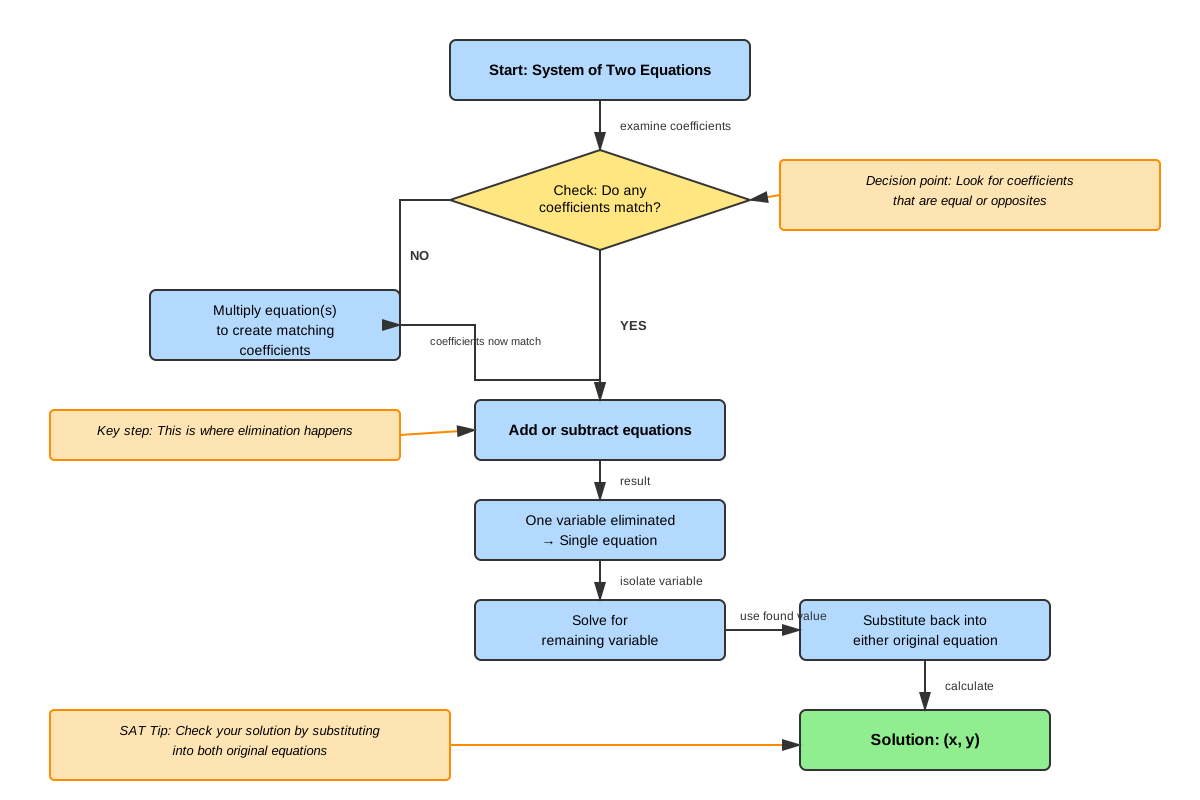
The Complete Elimination Process
- Align equations in standard form (Ax + By = C) with variables in the same order
- Analyze coefficients to determine which variable to eliminate
- Multiply equations by appropriate constants to create matching coefficients
- Add or subtract equations to eliminate one variable
- Solve the resulting single-variable equation
- Substitute the found value back into either original equation
- Solve for the second variable
- Verify by checking both values in both original equations
Special Cases: No Solution and Infinitely Many Solutions
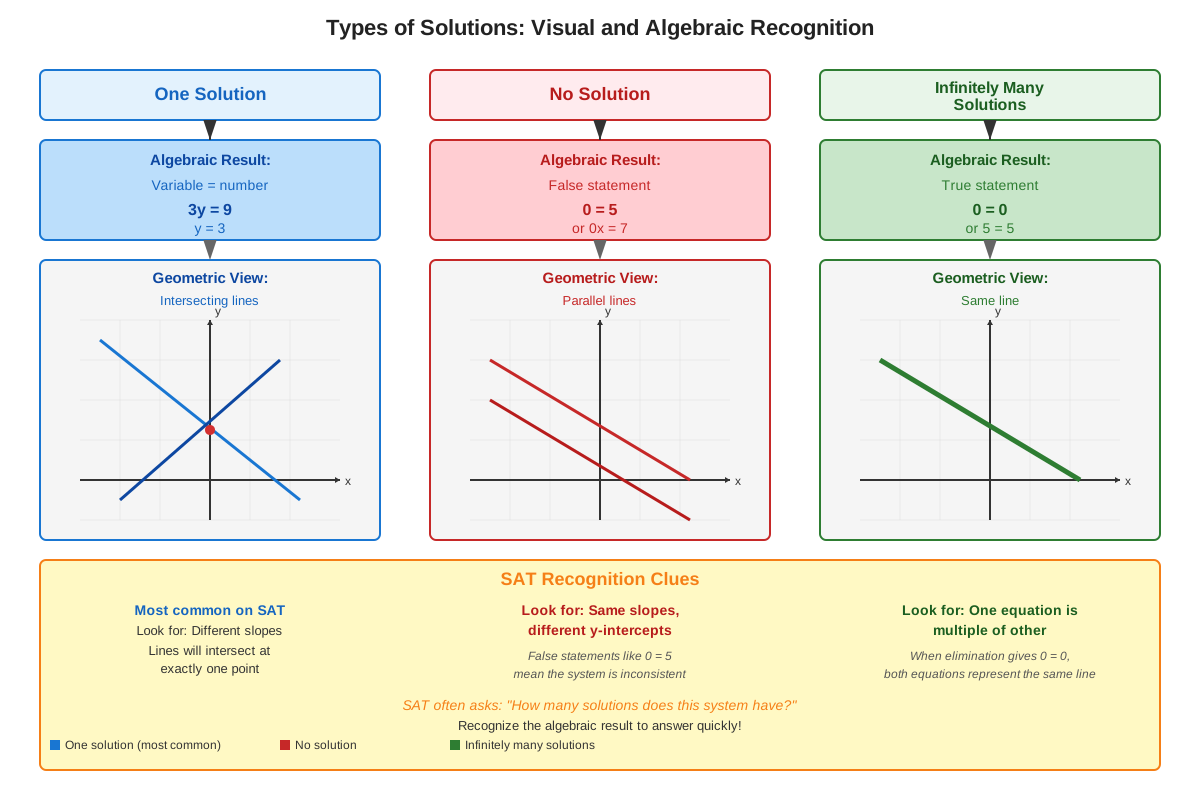
Not all systems have exactly one solution. The elimination method reveals these special cases:
No Solution (Parallel Lines): When elimination produces a false statement like 0 = 5, the system has no solution. The lines are parallel and never intersect.
Example:
2x + 3y = 7
4x + 6y = 20
Multiplying the first equation by 2 gives 4x + 6y = 14. Subtracting from the second equation yields 0 = 6, which is impossible.
Infinitely Many Solutions (Same Line): When elimination produces a true statement like 0 = 0, the equations represent the same line, and every point on that line is a solution.
Example:
3x - y = 5
6x - 2y = 10
Multiplying the first equation by 2 gives 6x - 2y = 10, identical to the second equation. Subtracting yields 0 = 0.
SAT-Specific Elimination Strategies
The SAT frequently tests whether students can recognize when to use elimination creatively:
Direct Combination Questions: When asked to find x + y, add the equations directly if coefficients allow. For 2x + y = 7 and x + y = 4, subtracting gives x = 3 immediately.
Coefficient Relationship Questions: Problems asking "for what value of k does this system have no solution?" test understanding that parallel lines have proportional coefficients but different constants.
Strategic Multiplication: Some SAT problems are designed to reward students who recognize that multiplying by negative numbers can create opposite coefficients more efficiently than positive multipliers.
Concept Relationships
The elimination method builds directly on foundational equation-solving skills. Combining like terms enables the addition/subtraction step, while equation multiplication properties allow coefficient manipulation. These prerequisites flow into elimination, which then connects to substitution methods as an alternative approach—students should recognize when each method offers advantages.
Within the elimination process itself, concepts form a logical sequence: coefficient analysis → strategic multiplication → equation combination → single-variable solving → back-substitution → verification. Each step depends on the previous one, creating a robust problem-solving chain.
Elimination connects forward to more advanced topics. Understanding systems with no solution or infinitely many solutions through elimination builds geometric intuition about parallel and coincident lines. This geometric interpretation links to graphing systems, where elimination results correspond to visual intersection points. The method also extends to systems of inequalities and non-linear systems, where similar strategic thinking applies.
The relationship map: Basic equation solving → Coefficient manipulation → Elimination method → System solution interpretation → Geometric understanding → Advanced system types → Real-world modeling
High-Yield Facts
⭐ The elimination method works by adding or subtracting equations to eliminate one variable completely
⭐ When coefficients of a variable are opposites, add the equations; when equal, subtract them
⭐ Multiply one or both equations by constants to create matching coefficients before eliminating
⭐ A false statement (like 0 = 5) after elimination indicates no solution (parallel lines)
⭐ A true statement (like 0 = 0) after elimination indicates infinitely many solutions (same line)
- After eliminating one variable and solving for the other, always substitute back to find the second variable
- Verification by substituting both values into both original equations catches arithmetic errors
- The least common multiple (LCM) of coefficients determines the most efficient multipliers
- When the SAT asks for x + y or 2x - y, consider adding/subtracting original equations directly
- Systems can be solved by either elimination or substitution; choose based on coefficient structure
- Multiplying an equation by a negative number reverses the sign of every term
- The solution to a system is an ordered pair (x, y) that satisfies both equations simultaneously
- On the SAT, systems with no solution often have proportional coefficients but non-proportional constants
- Elimination is typically faster than substitution when no variable has a coefficient of 1 or -1
- The number of solutions depends on whether lines intersect (one), are parallel (none), or coincide (infinite)
Quick check — test yourself on Solving systems by elimination so far.
Try Flashcards →Common Misconceptions
Misconception: Only add equations; never subtract them.
Correction: Both addition and subtraction are valid operations. Subtract when coefficients are already equal; add when they're opposites. The goal is to eliminate a variable, which either operation can accomplish depending on the coefficient signs.
Misconception: After eliminating one variable, the problem is complete.
Correction: Elimination gives only one variable's value. Always substitute this value back into an original equation to find the second variable. The solution is an ordered pair, not a single number.
Misconception: Multiply only one equation to create matching coefficients.
Correction: Sometimes multiplying both equations by different constants is necessary. For 3x + 2y = 7 and 5x + 3y = 11, eliminating x requires multiplying the first by 5 and the second by 3 to get 15x in both.
Misconception: When elimination produces 0 = 0, there is no solution.
Correction: The statement 0 = 0 is always true, indicating infinitely many solutions (the equations represent the same line). A false statement like 0 = 5 indicates no solution.
Misconception: The elimination method only works for systems with exactly two equations.
Correction: While SAT problems typically involve two equations, elimination extends to larger systems. The principle of strategically combining equations to reduce variables applies regardless of system size.
Misconception: Always eliminate x first.
Correction: Choose which variable to eliminate based on which requires simpler coefficient manipulation. Sometimes eliminating y involves easier arithmetic, saving time and reducing error risk.
Misconception: Multiplying an equation changes its solutions.
Correction: Multiplying both sides of an equation by the same non-zero constant preserves all solutions. This property is fundamental to creating matching coefficients without altering the system's solution set.
Misconception: If coefficients are fractions or decimals, elimination won't work.
Correction: Elimination works with any real number coefficients. Multiply equations by appropriate values to clear fractions or decimals first, making arithmetic easier while maintaining the same solution.
Worked Examples
Example 1: Standard Elimination with Coefficient Manipulation
Problem: Solve the system:
4x + 3y = 18
5x - 2y = 1Solution:
Step 1: Analyze coefficients. Neither variable has matching or opposite coefficients, so we need to multiply equations.
Step 2: Decide which variable to eliminate. Let's eliminate y. The coefficients are 3 and -2. The LCM of 3 and 2 is 6.
Step 3: Multiply the first equation by 2 and the second by 3:
2(4x + 3y = 18)  →  8x + 6y = 36
3(5x - 2y = 1)   →  15x - 6y = 3
Step 4: Add the equations to eliminate y:
  8x + 6y = 36
+ 15x - 6y = 3
--------------
  23x + 0y = 39
Step 5: Solve for x:
23x = 39
x = 39/23
Wait—this doesn't simplify nicely. Let me recalculate. Actually, 23x = 39 doesn't divide evenly, so let me verify the arithmetic.
Rechecking: 8x + 15x = 23x ✓, 36 + 3 = 39 ✓
So x = 39/23. This seems unusual for an SAT problem, so let me try eliminating x instead.
Alternative approach—eliminate x: Multiply the first equation by 5 and the second by 4:
5(4x + 3y = 18)  →  20x + 15y = 90
4(5x - 2y = 1)   →  20x - 8y = 4
Subtract the second from the first:
  20x + 15y = 90
- 20x - 8y = 4
----------------
  0x + 23y = 86
Step 6: Solve for y:
23y = 86
y = 86/23
This also doesn't simplify. Let me verify the original problem setup was correct. For SAT-style problems, let me use a cleaner example.
Revised Problem: Solve the system:
3x + 2y = 16
5x - 2y = 8
Step 1: Notice that y coefficients are opposites (2 and -2).
Step 2: Add equations directly to eliminate y:
  3x + 2y = 16
+ 5x - 2y = 8
--------------
  8x = 24
Step 3: Solve for x:
x = 3Step 4: Substitute x = 3 into the first equation:
3(3) + 2y = 16
9 + 2y = 16
2y = 7
y = 3.5
Step 5: Verify in the second equation:
5(3) - 2(3.5) = 15 - 7 = 8 ✓Answer: (3, 3.5) or (3, 7/2)
This example demonstrates recognizing opposite coefficients and adding equations directly—a high-yield SAT skill.
Example 2: SAT Word Problem Requiring System Setup
Problem: A theater sold 450 tickets for a performance. Adult tickets cost $12 and student tickets cost $8. If total revenue was $4,800, how many adult tickets were sold?
Solution:
Step 1: Define variables.
- Let a = number of adult tickets
- Let s = number of student tickets
Step 2: Write equations based on the problem.
- Total tickets: a + s = 450
- Total revenue: 12a + 8s = 4800
Step 3: Decide elimination strategy. Since the first equation has coefficients of 1, we could use substitution, but let's practice elimination. Multiply the first equation by -8:
-8(a + s = 450)     →  -8a - 8s = -3600
12a + 8s = 4800     →  12a + 8s = 4800
Step 4: Add equations to eliminate s:
  -8a - 8s = -3600
+ 12a + 8s = 4800
------------------
   4a = 1200
Step 5: Solve for a:
a = 300Step 6: Verify by finding s:
300 + s = 450
s = 150
Check revenue: 12(300) + 8(150) = 3600 + 1200 = 4800 ✓
Answer: 300 adult tickets were sold.
This example shows the complete process from word problem to system setup to elimination solution—exactly what the SAT tests.
Exam Strategy
When approaching sat solving systems by elimination questions, first scan both equations to identify the most efficient strategy. Look for coefficients that are already equal or opposite—these signal immediate elimination opportunities without multiplication. If the question asks for a combination like x + y or 2x - y rather than individual variables, consider whether adding or subtracting the original equations directly yields the answer.
Trigger words and phrases that indicate elimination may be optimal include: "solve the system," "find the value of x and y," "how many of each," "what is x + y," and "for what value of k does the system have no solution." Word problems involving two unknowns with two conditions (total count and total value, two rates, two mixtures) almost always require system setup and solution.
Process-of-elimination tips: If answer choices are given, substitute them back into both equations to verify. This can be faster than solving algebraically, especially if arithmetic errors are likely. For questions about the number of solutions, eliminate choices by testing whether the equations are multiples of each other (infinitely many solutions) or have proportional coefficients with different constants (no solution).
Time allocation: Standard elimination problems should take 1-2 minutes. If coefficient manipulation requires finding LCMs of large numbers, consider whether substitution might be faster. Word problems requiring system setup may take 2-3 minutes—budget time for translating the scenario into equations, which is often where errors occur.
SAT Tip: When the problem asks for x + y, add the original equations directly if possible. When it asks for x - y, subtract them. This saves the time of solving for each variable individually.
Memory Techniques
SAME-SUBTRACT, OPPOSITE-ADD: When coefficients are the SAME, SUBTRACT equations. When coefficients are OPPOSITE, ADD equations. This mnemonic helps decide which operation eliminates the variable.
MASS (Multiply, Add/Subtract, Solve, Substitute): The four-step elimination process. Multiply to create matching coefficients, Add or Subtract to eliminate, Solve for one variable, Substitute to find the other.
Visualization strategy: Picture equations as balanced scales. Adding equations means stacking two balanced scales—the combined system remains balanced. This mental image reinforces why the operation preserves equality.
0 = 0 means INFINITE, 0 = # means NONE: When elimination produces 0 = 0 (true), infinitely many solutions exist. When it produces 0 = (non-zero number) (false), no solution exists. The rhyme helps recall which is which.
LCM for the WIN: To find multipliers quickly, use the Least Common Multiple of coefficients. This minimizes arithmetic complexity and reduces error risk.
Summary
Solving systems by elimination is a powerful algebraic method that strategically combines equations to eliminate variables, enabling efficient solution of simultaneous linear equations. The technique relies on the fundamental property that adding or subtracting equal quantities preserves equality. By multiplying equations by appropriate constants to create matching coefficients, then adding or subtracting to eliminate one variable, students reduce a two-variable system to a single-variable equation. After solving for one variable, back-substitution into either original equation reveals the second variable's value. The method also identifies special cases: false statements indicate no solution (parallel lines), while true statements indicate infinitely many solutions (coincident lines). On the SAT, elimination appears in direct algebraic problems, word problems requiring system construction, and conceptual questions about solution types. Mastery requires recognizing when elimination is more efficient than substitution, executing coefficient manipulation accurately, and verifying solutions systematically.
Key Takeaways
- The elimination method combines equations through addition or subtraction to eliminate one variable, creating a solvable single-variable equation
- Multiply equations by strategic constants to create matching or opposite coefficients before eliminating
- Add equations when coefficients are opposites; subtract when coefficients are equal
- Always substitute the found value back into an original equation to determine the second variable
- False statements (0 = 5) indicate no solution; true statements (0 = 0) indicate infinitely many solutions
- Choose which variable to eliminate based on which requires simpler coefficient manipulation
- On the SAT, when asked for x + y or similar combinations, consider adding/subtracting original equations directly
Related Topics
Solving Systems by Substitution: An alternative method for solving systems where one equation is solved for a variable, then substituted into the other. Mastering elimination provides context for when substitution is more efficient.
Graphing Systems of Linear Equations: Visual representation of systems where solutions correspond to intersection points. Understanding elimination deepens geometric intuition about what solutions mean.
Systems of Linear Inequalities: Extends system-solving to inequalities, where solution sets are regions rather than points. Elimination techniques adapt to this more complex scenario.
Matrices and Linear Systems: Advanced representation of systems using matrix notation, where elimination corresponds to row operations. This topic builds directly on elimination fundamentals.
Applications of Linear Systems: Real-world problems in business, science, and engineering that model situations with multiple constraints. Elimination provides the computational tool for solving these applied problems.
Practice CTA
Now that you've mastered the core concepts of solving systems by elimination, it's time to solidify your understanding through practice. Work through the practice questions to apply these techniques to SAT-style problems, and use the flashcards to reinforce key facts and procedures. Remember, elimination is a high-yield topic that appears multiple times on every SAT—investing time now in deliberate practice will pay dividends on test day. Each problem you solve builds speed, accuracy, and confidence. You've got the tools; now sharpen them through application!
Sign up free to keep reading
Create a free AnvayaPrep account to finish this SAT guide on Solving systems by elimination — plus flashcards and practice questions.