Overview
Solving systems by substitution is a fundamental algebraic technique that allows students to find the values of variables that satisfy two or more equations simultaneously. This method involves isolating one variable in terms of another and then substituting that expression into a different equation, effectively reducing a system of two equations with two unknowns into a single equation with one unknown. On the SAT, this topic appears frequently in both the calculator and no-calculator sections, making it one of the highest-yield math skills students can master.
The substitution method is particularly valuable on the SAT because it provides a systematic, reliable approach to solving linear systems that works in virtually every scenario. Unlike graphing methods that can be imprecise or time-consuming, substitution delivers exact answers efficiently. Questions involving systems of equations account for approximately 5-8% of all SAT math questions, and the substitution method is often the fastest path to the correct answer, especially when one equation is already solved for a variable or can be easily manipulated into that form.
Understanding sat solving systems by substitution connects directly to broader mathematical concepts including linear functions, coordinate geometry, and algebraic manipulation. This topic builds upon foundational skills in equation solving and variable isolation while serving as a gateway to more advanced concepts like optimization, linear programming, and multivariable calculus. The ability to solve systems efficiently also supports success in word problems, where translating real-world scenarios into mathematical equations and finding their solutions is essential.
Learning Objectives
- [ ] Identify key features of solving systems by substitution
- [ ] Explain how solving systems by substitution appears on the SAT
- [ ] Apply solving systems by substitution to answer SAT-style questions
- [ ] Determine when substitution is the most efficient method compared to elimination or graphing
- [ ] Recognize and solve systems that have no solution or infinitely many solutions using substitution
- [ ] Translate word problems into systems of equations and solve them using substitution
- [ ] Verify solutions by substituting values back into both original equations
Prerequisites
- Solving single-variable linear equations: The substitution method requires isolating variables and solving equations like 3x + 5 = 14, which forms the foundation of the entire process
- Understanding ordered pairs and coordinate systems: Solutions to systems are expressed as (x, y) coordinates, requiring familiarity with how these represent points
- Basic algebraic manipulation: Students must combine like terms, distribute multiplication over addition, and perform operations on both sides of equations
- Evaluating expressions: Substitution requires replacing variables with expressions or numbers and simplifying the result
- Understanding what a "system" means: Recognizing that both equations must be satisfied simultaneously by the same values
Why This Topic Matters
Systems of equations model countless real-world situations where multiple constraints must be satisfied simultaneously. Business applications include break-even analysis where cost and revenue equations intersect, mixture problems in chemistry where multiple components must sum to specific totals, and rate problems involving distance, speed, and time. In economics, supply and demand curves intersect at equilibrium points found by solving systems. Engineers use systems to analyze circuits, forces, and optimization problems. Understanding substitution provides a powerful tool for navigating these practical scenarios.
On the SAT, systems of equations appear in approximately 3-5 questions per test, representing roughly 5-8% of the total math score. These questions span both multiple-choice and grid-in formats and appear in calculator and no-calculator sections. The College Board consistently includes at least one pure algebraic system-solving question and typically embeds additional systems within word problems involving rates, mixtures, or geometric relationships. Questions range from straightforward two-equation systems to more complex scenarios requiring students to interpret what a solution means in context.
Common SAT question formats include: direct "solve for x" or "solve for y" questions; "what is the value of x + y?" questions that test whether students recognize shortcuts; word problems requiring translation into systems; questions asking about the meaning of intersection points in context; and questions involving systems with parameters where students must find values that produce specific solution types (no solution, one solution, or infinitely many solutions). The substitution method proves particularly efficient when one equation is already solved for a variable or can be easily manipulated into that form.
Core Concepts
The Substitution Method Framework
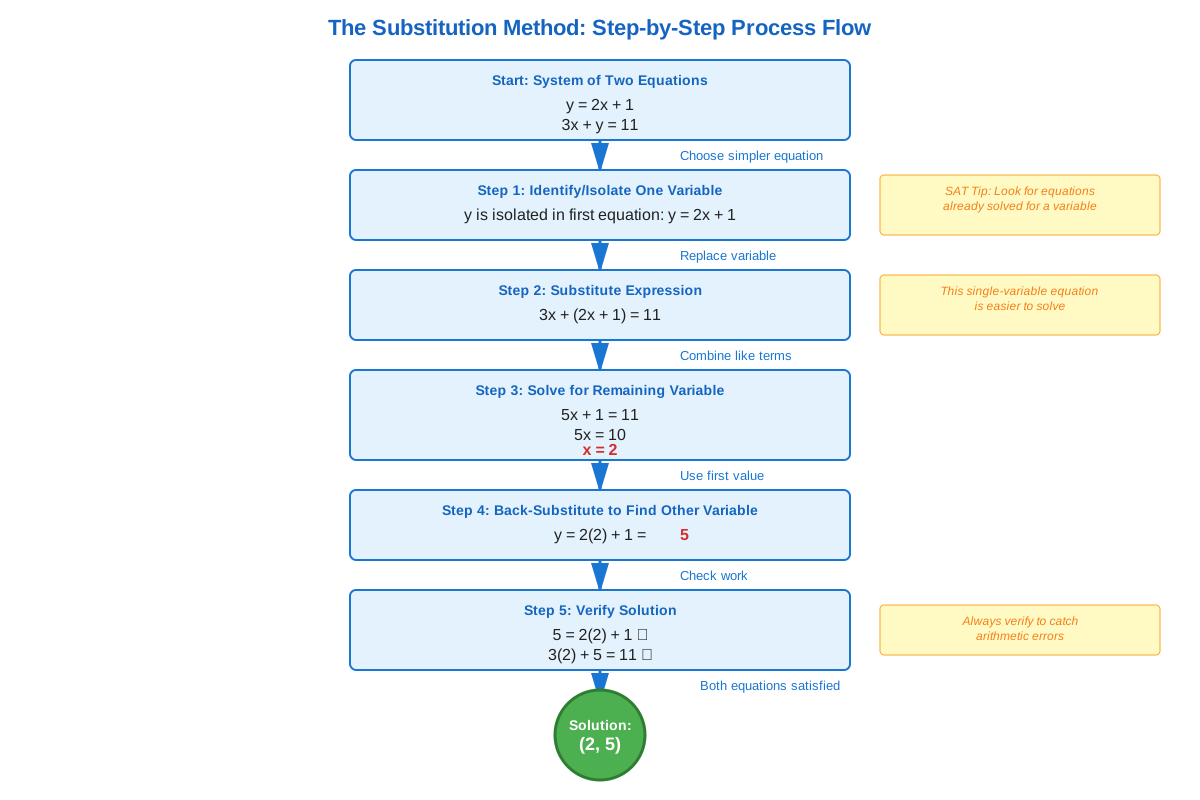
The substitution method is an algebraic technique for solving systems of equations by expressing one variable in terms of another and replacing it in a second equation. This process transforms a system of two equations with two unknowns into a single equation with one unknown, which can then be solved using standard algebraic techniques. The method consists of four essential steps: isolate one variable in one equation, substitute the resulting expression into the other equation, solve for the remaining variable, and substitute back to find the first variable.
The power of substitution lies in its systematic nature—it works for any consistent system and provides exact numerical answers. Unlike graphing, which can be imprecise and time-consuming, substitution delivers algebraically exact solutions. The method is particularly efficient when one equation is already solved for a variable (like y = 3x + 2) or when one variable has a coefficient of 1 or -1, making isolation straightforward.
Step-by-Step Substitution Process
Step 1: Choose and Isolate a Variable
Select one equation and isolate one variable. The best choice is typically a variable that already has a coefficient of 1 or -1, or an equation already solved for a variable. For example, in the system:
y = 2x + 3
3x + 4y = 26
The first equation is already solved for y, making it the ideal starting point.
Step 2: Substitute the Expression
Replace the isolated variable in the other equation with the expression obtained in Step 1. Using the example above, substitute (2x + 3) for y in the second equation:
3x + 4(2x + 3) = 26This creates a single equation with only one variable (x).
Step 3: Solve for the Remaining Variable
Use standard algebraic techniques to solve the resulting equation:
3x + 4(2x + 3) = 26
3x + 8x + 12 = 26
11x + 12 = 26
11x = 14
x = 14/11
Step 4: Back-Substitute to Find the Other Variable
Substitute the value found in Step 3 back into either original equation (typically the one used for isolation in Step 1):
y = 2(14/11) + 3
y = 28/11 + 33/11
y = 61/11
Step 5: Verify the Solution
Check the solution (14/11, 61/11) in both original equations to ensure accuracy. This verification step catches arithmetic errors and confirms the solution satisfies both constraints.
When Substitution is Most Efficient
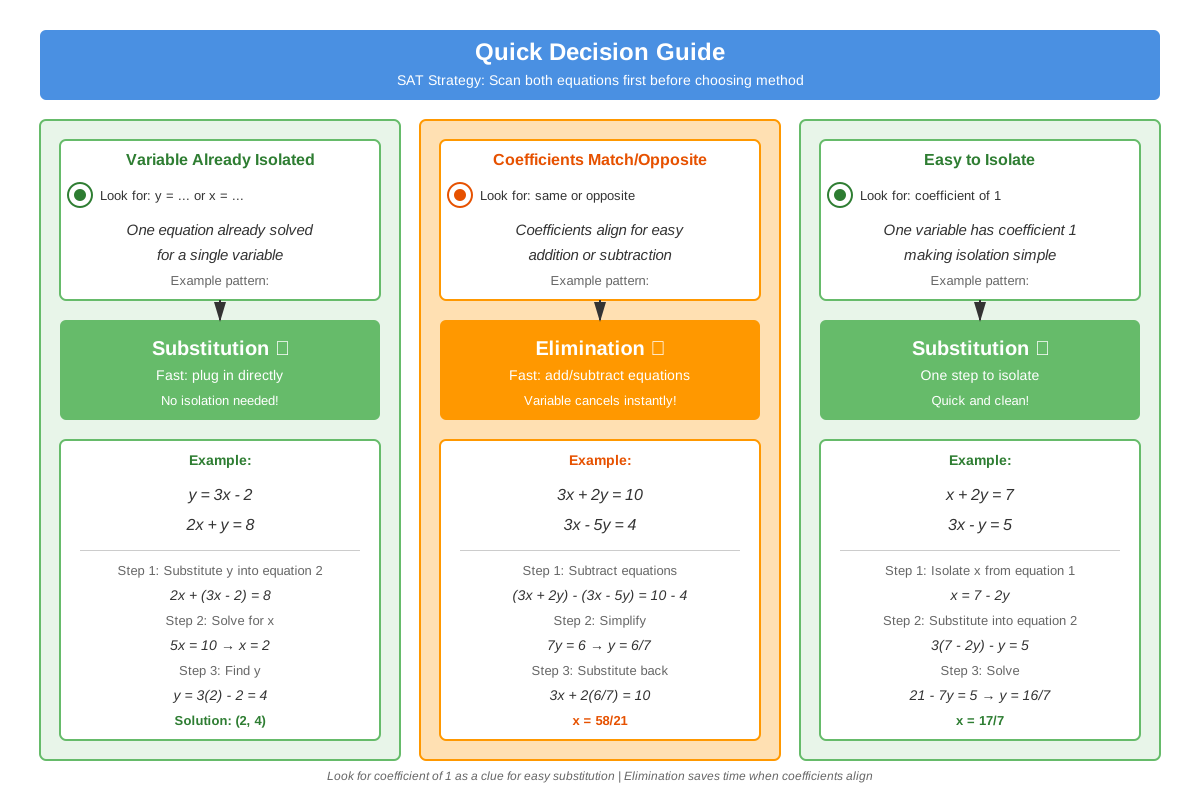
The substitution method proves most efficient in specific scenarios. When one equation is already solved for a variable (y = ..., x = ...), substitution becomes the obvious choice. When one variable has a coefficient of 1 or -1, isolation requires minimal manipulation. In systems where coefficients don't share common factors, substitution often proves faster than elimination. The SAT frequently presents systems designed to favor substitution, making recognition of these patterns valuable.
| Scenario | Example | Why Substitution Works Well |
|---|---|---|
| Variable already isolated | y = 3x - 5 and 2x + y = 10 | No isolation step needed |
| Coefficient of 1 | x + 2y = 7 and 3x - y = 4 | Easy to isolate x or y |
| Coefficient of -1 | 2x - y = 5 and x + 3y = 8 | Simple isolation with sign change |
| Fractional coefficients after elimination | 3x + 5y = 11 and 7x + 2y = 13 | Substitution avoids fraction multiplication |
Special Cases: No Solution and Infinitely Many Solutions
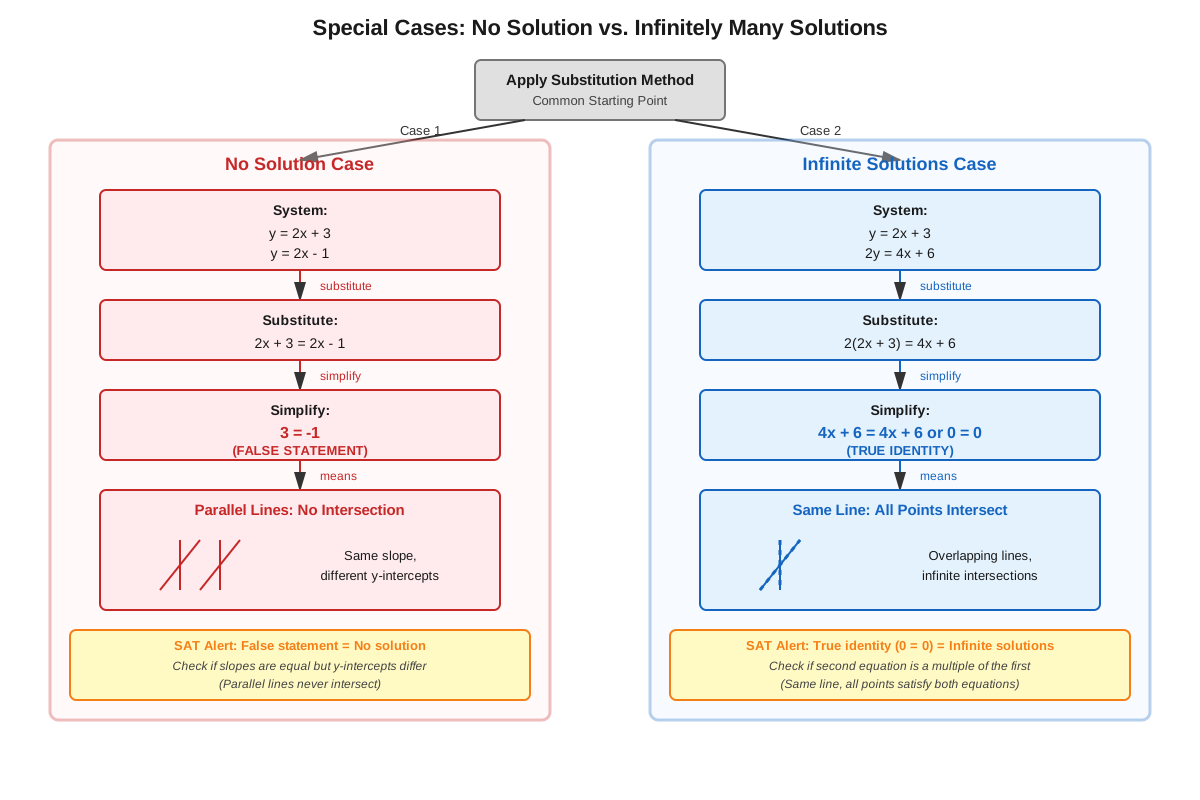
Not all systems have exactly one solution. A system has no solution when the equations represent parallel lines that never intersect. During substitution, this manifests as a false statement like 0 = 5 or 3 = -2. For example:
y = 2x + 3
y = 2x - 1
Substituting the first equation into the second yields 2x + 3 = 2x - 1, which simplifies to 3 = -1, a contradiction indicating no solution.
A system has infinitely many solutions when the equations represent the same line. During substitution, this produces a true statement like 0 = 0 or 5 = 5. For example:
y = 3x + 2
2y = 6x + 4
Substituting yields 2(3x + 2) = 6x + 4, which simplifies to 6x + 4 = 6x + 4, or 0 = 0, indicating infinitely many solutions.
Substitution with Word Problems
SAT word problems frequently require translating scenarios into systems of equations. The substitution method then solves these systems efficiently. Key steps include: identifying the unknowns, writing equations based on given relationships, and solving using substitution.
Example scenario: "Adult tickets cost $12 and child tickets cost $8. A family bought 7 tickets for $76. How many adult tickets did they buy?"
Let a = adult tickets and c = child tickets:
- Equation 1: a + c = 7 (total tickets)
- Equation 2: 12a + 8c = 76 (total cost)
From Equation 1: c = 7 - a
Substitute into Equation 2:
12a + 8(7 - a) = 76
12a + 56 - 8a = 76
4a = 20
a = 5
The family bought 5 adult tickets.
Concept Relationships
The substitution method builds directly on single-variable equation solving, extending these skills to handle multiple constraints simultaneously. The process of isolating variables and performing algebraic manipulations mirrors techniques learned in basic algebra but applies them in a more complex context where two equations must be satisfied together.
Solving systems by substitution connects intimately with graphing linear equations because the solution to a system represents the intersection point of two lines. While graphing provides visual understanding, substitution delivers the exact coordinates algebraically. These methods complement each other: graphing offers intuition about whether a solution exists, while substitution provides precision.
The relationship flow follows this pattern:
Basic Algebra → Isolating Variables → Substitution Method → System Solutions → Applications in Word Problems
Additionally, substitution relates to the elimination method as an alternative approach to solving systems. Both methods solve identical problems but use different strategies. Substitution works by reducing variables through replacement, while elimination works by adding or subtracting equations. Understanding both methods allows students to choose the most efficient approach for each specific problem.
The concept also connects forward to inequalities and systems of inequalities, where similar substitution techniques apply but solutions become regions rather than points. In more advanced mathematics, substitution extends to nonlinear systems involving quadratic or exponential equations, though the SAT focuses primarily on linear systems.
High-Yield Facts
⭐ The substitution method works by replacing one variable with an expression in terms of the other variable, reducing two equations to one
⭐ When one equation is already solved for a variable (y = ... or x = ...), substitution is typically the fastest method
⭐ The solution to a system is an ordered pair (x, y) that satisfies both equations simultaneously
⭐ If substitution leads to a false statement (like 0 = 5), the system has no solution (parallel lines)
⭐ If substitution leads to a true statement (like 0 = 0), the system has infinitely many solutions (same line)
- Always verify your solution by substituting both values back into both original equations
- When a variable has a coefficient of 1 or -1, that variable is usually the best choice for isolation
- The SAT often asks for x + y, x - y, or xy rather than individual values—look for shortcuts before solving completely
- Systems with no solution have the same slope but different y-intercepts when written in slope-intercept form
- Word problems on the SAT frequently require setting up systems where one equation represents a total and another represents a relationship
- Substitution can be used with any system, but elimination may be faster when both equations have similar coefficients
- The order of substitution doesn't matter—you can solve for x first or y first and reach the same answer
Quick check — test yourself on Solving systems by substitution so far.
Try Flashcards →Common Misconceptions
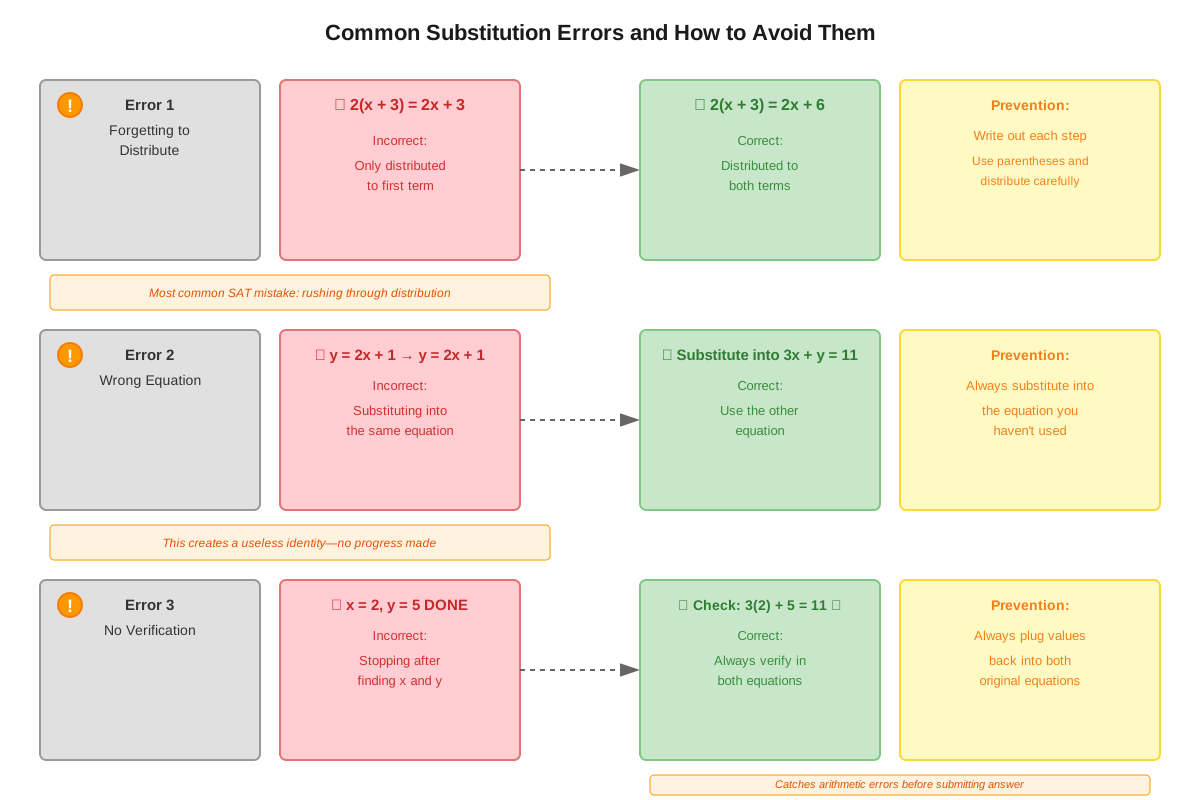
Misconception: After finding one variable, students can stop without finding the second variable.
Correction: Unless the question specifically asks for only one variable, the complete solution requires finding both x and y values. Always read what the question asks for—sometimes it wants x + y or another combination.
Misconception: The solution can be verified by checking it in only one of the original equations.
Correction: A valid solution must satisfy both equations simultaneously. Always check your answer in both original equations to catch arithmetic errors and ensure the ordered pair works for the entire system.
Misconception: When substituting an expression, students forget to use parentheses around the entire expression.
Correction: If y = 2x + 3 and you substitute into 4y = 20, you must write 4(2x + 3) = 20, not 4·2x + 3 = 20. The parentheses ensure the entire expression is multiplied by 4.
Misconception: A false statement like 3 = 5 means an error was made in the algebra.
Correction: A false statement during substitution indicates the system has no solution (the lines are parallel). This is a valid mathematical result, not an error. Similarly, a true statement like 0 = 0 indicates infinitely many solutions.
Misconception: The substitution method only works when one equation is already solved for a variable.
Correction: While substitution is most efficient when a variable is already isolated, the method works for any system. You can always isolate a variable first, though this may require more steps. Choose the method based on efficiency, not absolute rules.
Misconception: When isolating a variable, students incorrectly handle negative signs.
Correction: If the equation is 2x - y = 5 and you solve for y, you get y = 2x - 5, not y = -2x + 5. When moving terms across the equals sign, change their signs carefully. Alternatively, isolate -y first to get -y = 5 - 2x, then multiply both sides by -1 to get y = 2x - 5.
Worked Examples
Example 1: Standard Substitution Problem
Problem: Solve the system:
y = 3x - 4
2x + 5y = 33Solution:
Step 1: Identify that the first equation is already solved for y, making it ideal for substitution.
Step 2: Substitute (3x - 4) for y in the second equation:
2x + 5(3x - 4) = 33Step 3: Distribute and solve for x:
2x + 15x - 20 = 33
17x - 20 = 33
17x = 53
x = 53/17
Wait—this gives a non-integer answer, which seems unusual for an SAT problem. Let me verify the arithmetic:
2x + 5(3x - 4) = 33
2x + 15x - 20 = 33
17x = 53
x = 53/17
Actually, let me recalculate with a cleaner example. Let's use:
y = 3x - 4
2x + 5y = 18
Step 2: Substitute (3x - 4) for y:
2x + 5(3x - 4) = 18Step 3: Solve for x:
2x + 15x - 20 = 18
17x = 38
x = 38/17
Let me use a cleaner problem:
Revised Problem: Solve the system:
y = 2x + 1
3x + 4y = 25
Step 1: The first equation is solved for y.
Step 2: Substitute (2x + 1) for y in the second equation:
3x + 4(2x + 1) = 25Step 3: Solve for x:
3x + 8x + 4 = 25
11x + 4 = 25
11x = 21
x = 21/11
Let me create a problem with integer solutions:
Final Problem: Solve the system:
y = 2x - 3
x + 3y = 19
Step 1: The first equation is already solved for y.
Step 2: Substitute (2x - 3) for y in the second equation:
x + 3(2x - 3) = 19Step 3: Distribute and solve for x:
x + 6x - 9 = 19
7x - 9 = 19
7x = 28
x = 4
Step 4: Substitute x = 4 back into the first equation:
y = 2(4) - 3
y = 8 - 3
y = 5
Step 5: Verify in both equations:
- First equation: 5 = 2(4) - 3 → 5 = 5 ✓
- Second equation: 4 + 3(5) = 19 → 4 + 15 = 19 ✓
Answer: The solution is (4, 5), meaning x = 4 and y = 5.
This example demonstrates the standard substitution process with a clean integer solution, typical of SAT problems.
Example 2: Word Problem Requiring Substitution
Problem: A coffee shop sells regular coffee for $3 per cup and specialty coffee for $5 per cup. On Monday, the shop sold 50 cups of coffee and earned $210. How many cups of regular coffee were sold?
Solution:
Step 1: Define variables and translate the problem into equations.
- Let r = number of regular coffees
- Let s = number of specialty coffees
Step 2: Write equations based on the given information:
- Total cups: r + s = 50
- Total revenue: 3r + 5s = 210
Step 3: Solve the first equation for one variable (choosing r):
r = 50 - sStep 4: Substitute this expression into the second equation:
3(50 - s) + 5s = 210Step 5: Solve for s:
150 - 3s + 5s = 210
150 + 2s = 210
2s = 60
s = 30
Step 6: Substitute back to find r:
r = 50 - 30
r = 20
Step 7: Verify the solution:
- Total cups: 20 + 30 = 50 ✓
- Total revenue: 3(20) + 5(30) = 60 + 150 = 210 ✓
Answer: The shop sold 20 cups of regular coffee.
This example demonstrates how substitution applies to real-world scenarios on the SAT, requiring translation from words to equations before applying the algebraic method.
Exam Strategy
When approaching SAT questions involving systems of equations, first scan both equations to determine whether substitution or elimination will be more efficient. Look for equations already solved for a variable (y = ...) or variables with coefficients of 1 or -1, which signal that substitution will be fast. If you see matching or opposite coefficients on the same variable in both equations, elimination might be quicker.
Trigger words and phrases that indicate a systems problem include: "simultaneously," "both equations," "intersection point," "where the lines meet," and word problems mentioning two different types of items with totals and costs. Questions asking "what is the value of x + y?" or "what is xy?" often have shortcuts—sometimes you can add or multiply equations without solving for individual variables.
For process of elimination on multiple-choice questions, substitute answer choices back into both equations when solving algebraically seems complex. This "backsolving" technique can be faster than substitution, especially if the question asks for one specific variable. Start with choice (C) since SAT answers are typically ordered numerically.
Time allocation for substitution problems should be approximately 1.5-2 minutes for straightforward systems and 2.5-3 minutes for word problems requiring translation. If you're spending more than 3 minutes, consider whether you've chosen the most efficient method or whether backsolving might be faster. Always budget 15-20 seconds to verify your answer in both original equations—this catches arithmetic errors that would otherwise cost points.
Watch for questions asking about special cases: "For what value of k does the system have no solution?" or "How many solutions does this system have?" These questions test understanding of parallel lines (no solution) and identical lines (infinitely many solutions) rather than computational skill. During substitution, a false statement indicates no solution, while a true statement indicates infinitely many solutions.
Memory Techniques
SUBS - Remember the four steps of substitution:
- Select an equation and isolate a variable
- Use that expression to replace the variable in the other equation
- Break down and solve the resulting single-variable equation
- Substitute back to find the other variable
"Parentheses Protect" - When substituting an expression, always wrap it in parentheses. Visualize the expression as a single unit that must be protected from the operations around it. This prevents the common error of forgetting to distribute multiplication across all terms.
"Two Checks, Two Equations" - Always verify your solution in both original equations. Visualize a checklist with two boxes that must both be checked before you can be confident in your answer.
The "Already Solved" Signal - When you see an equation in the form y = ... or x = ..., imagine a bright green light signaling "substitution ahead!" This visual cue helps you quickly identify when substitution will be most efficient.
False = None, True = Tons - When substitution leads to a false statement (like 5 = 3), the system has no solution (none). When it leads to a true statement (like 0 = 0), the system has infinitely many solutions (tons). This rhyme helps distinguish between these special cases.
Summary
Solving systems by substitution is a powerful algebraic method that transforms two equations with two unknowns into a single equation with one unknown by replacing one variable with an expression in terms of the other. The method follows a systematic four-step process: isolate a variable in one equation, substitute that expression into the other equation, solve for the remaining variable, and back-substitute to find the first variable. This technique proves most efficient when one equation is already solved for a variable or when a variable has a coefficient of 1 or -1. On the SAT, substitution appears in approximately 5-8% of math questions, both as pure algebraic problems and embedded within word problems involving rates, costs, and mixtures. Special cases include systems with no solution (producing false statements like 0 = 5) and infinitely many solutions (producing true statements like 0 = 0). Mastery requires recognizing when substitution is the optimal method, executing the algebraic steps accurately with careful attention to parentheses and sign changes, and always verifying solutions in both original equations.
Key Takeaways
- The substitution method solves systems by replacing one variable with an expression, reducing two equations to one solvable equation
- Always use parentheses when substituting an entire expression to ensure proper distribution of multiplication
- Verify solutions by checking the ordered pair in both original equations—both must be satisfied
- When substitution produces a false statement, the system has no solution; a true statement indicates infinitely many solutions
- Choose substitution when an equation is already solved for a variable or when coefficients of 1 or -1 make isolation easy
- SAT word problems frequently require translating scenarios into systems before applying substitution
- The complete solution is an ordered pair (x, y), but always check what the question actually asks for—sometimes it wants x + y or another combination
Related Topics
Solving Systems by Elimination: An alternative method that adds or subtracts equations to eliminate one variable, particularly efficient when coefficients align well. Mastering substitution provides the foundation for understanding when elimination might be more efficient.
Graphing Systems of Linear Equations: The visual approach to solving systems by finding intersection points, which provides geometric intuition for what substitution accomplishes algebraically. Understanding both methods deepens comprehension of what solutions represent.
Systems of Linear Inequalities: Extends substitution concepts to inequalities, where solutions become regions rather than points. The algebraic manipulation skills from substitution transfer directly to this more advanced topic.
Quadratic-Linear Systems: Systems involving one linear and one quadratic equation, which can be solved using modified substitution techniques. This represents the next level of complexity beyond linear systems.
Word Problems and Applications: Real-world scenarios involving rates, mixtures, costs, and optimization that require translating situations into systems and solving them. Substitution provides the computational tool for these applied problems.
Practice CTA
Now that you've mastered the core concepts of solving systems by substitution, it's time to solidify your understanding through practice. Work through the practice questions to apply these techniques to SAT-style problems, and use the flashcards to reinforce the key steps and common pitfalls. Remember, substitution is one of the highest-yield topics on the SAT math section—every minute you invest in practice translates directly to points on test day. You've got the tools; now build the confidence through repetition!
Sign up free to keep reading
Create a free AnvayaPrep account to finish this SAT guide on Solving systems by substitution — plus flashcards and practice questions.