Overview
The substitution strategy is one of the most powerful and frequently tested methods for solving systems of linear equations on the SAT Math section. This algebraic technique involves solving one equation for a single variable and then replacing (substituting) that variable in another equation, effectively reducing a two-variable system to a single-variable equation that can be solved directly. Mastery of this approach is essential because systems of equations appear regularly on the SAT, and the substitution method often provides the fastest path to the correct answer, particularly when one equation is already solved for a variable or can be easily manipulated to isolate one.
Understanding the sat substitution strategy goes beyond mechanical computation—it requires recognizing when substitution is the optimal approach compared to other methods like elimination or graphing. On the SAT, time management is critical, and choosing the right strategy can mean the difference between completing a section comfortably and rushing through the final questions. The substitution strategy typically works best when one equation has a variable with a coefficient of 1 or -1, or when an equation is already in the form y = mx + b or x = some expression.
This topic connects directly to fundamental algebraic skills including equation manipulation, order of operations, and solving linear equations. It also serves as a foundation for more advanced math concepts tested on the SAT, such as systems of inequalities, quadratic systems, and word problems that translate real-world scenarios into algebraic relationships. The substitution strategy represents a bridge between basic equation-solving and the complex problem-solving required for higher-level SAT questions.
Learning Objectives
- [ ] Identify key features of Substitution strategy
- [ ] Explain how Substitution strategy appears on the SAT
- [ ] Apply Substitution strategy to answer SAT-style questions
- [ ] Determine when substitution is more efficient than elimination or graphing
- [ ] Recognize and avoid common algebraic errors during the substitution process
- [ ] Solve systems involving fractional coefficients and negative values using substitution
- [ ] Translate word problems into systems of equations and solve using substitution
Prerequisites
- Solving single-variable linear equations: The substitution method ultimately reduces to solving a one-variable equation, requiring fluency with isolation techniques and inverse operations
- Understanding variables and expressions: Students must be comfortable manipulating algebraic expressions and understanding that variables represent unknown quantities
- Combining like terms: After substitution, equations often require simplification through combining like terms before solving
- Order of operations: Proper application of PEMDAS is essential when substituting expressions containing multiple operations
- Basic equation manipulation: Skills like adding/subtracting terms from both sides and multiplying/dividing both sides by constants are fundamental to the substitution process
Why This Topic Matters
The substitution strategy appears on virtually every SAT Math section, making it one of the highest-yield topics for test preparation. According to College Board data, systems of equations questions appear 2-4 times per test across both the calculator and no-calculator sections, and substitution is often the intended solution method. These questions typically appear as medium-to-hard difficulty problems worth the same points as easier questions, making efficient solution methods crucial for score optimization.
In real-world applications, systems of equations model countless practical scenarios: business break-even analysis, mixture problems in chemistry, distance-rate-time relationships in physics, and economic supply-demand equilibrium. The substitution method mirrors how professionals approach complex problems—breaking them into simpler components and solving sequentially. This problem-solving framework extends far beyond mathematics into engineering, computer science, and data analysis.
On the SAT, substitution strategy questions commonly appear in several formats: pure algebraic systems presented as two equations with two unknowables, word problems requiring translation into mathematical form, and questions asking for the value of an expression rather than individual variables. The test makers frequently design problems where substitution is significantly faster than other methods, rewarding students who can quickly identify the optimal approach. Questions may also test whether students can recognize when a system has no solution or infinitely many solutions through the substitution process.
Core Concepts
The Fundamental Substitution Process
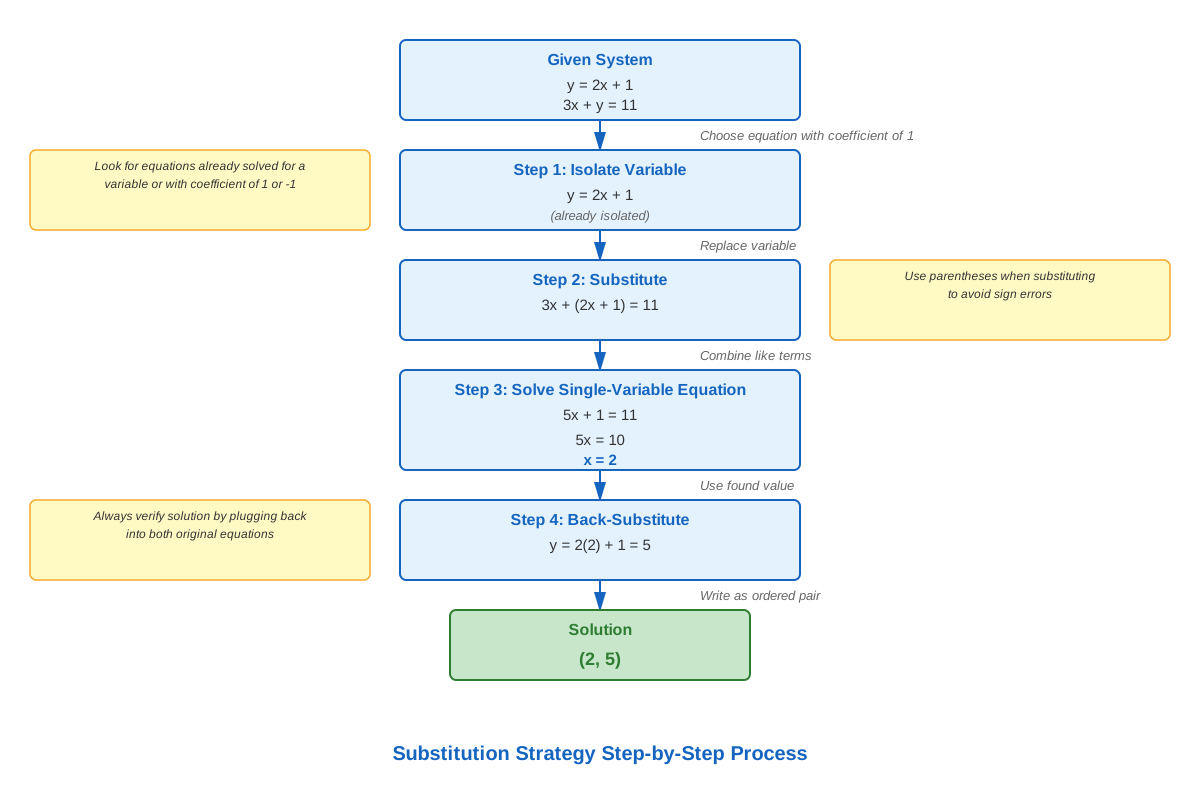
The substitution strategy follows a systematic four-step process that transforms a system of two equations with two variables into a single equation with one variable. First, choose one equation and solve it for one variable in terms of the other variable. Second, substitute this expression into the other equation, replacing the isolated variable everywhere it appears. Third, solve the resulting single-variable equation. Fourth, substitute the found value back into either original equation to find the remaining variable.
The key to successful substitution lies in the initial choice of which equation to manipulate and which variable to isolate. The optimal choice minimizes computational complexity—look for variables with coefficients of 1 or -1, or equations already partially solved. For example, if one equation is y = 3x - 5, this is ideal for substitution because y is already isolated.
When to Choose Substitution Over Other Methods
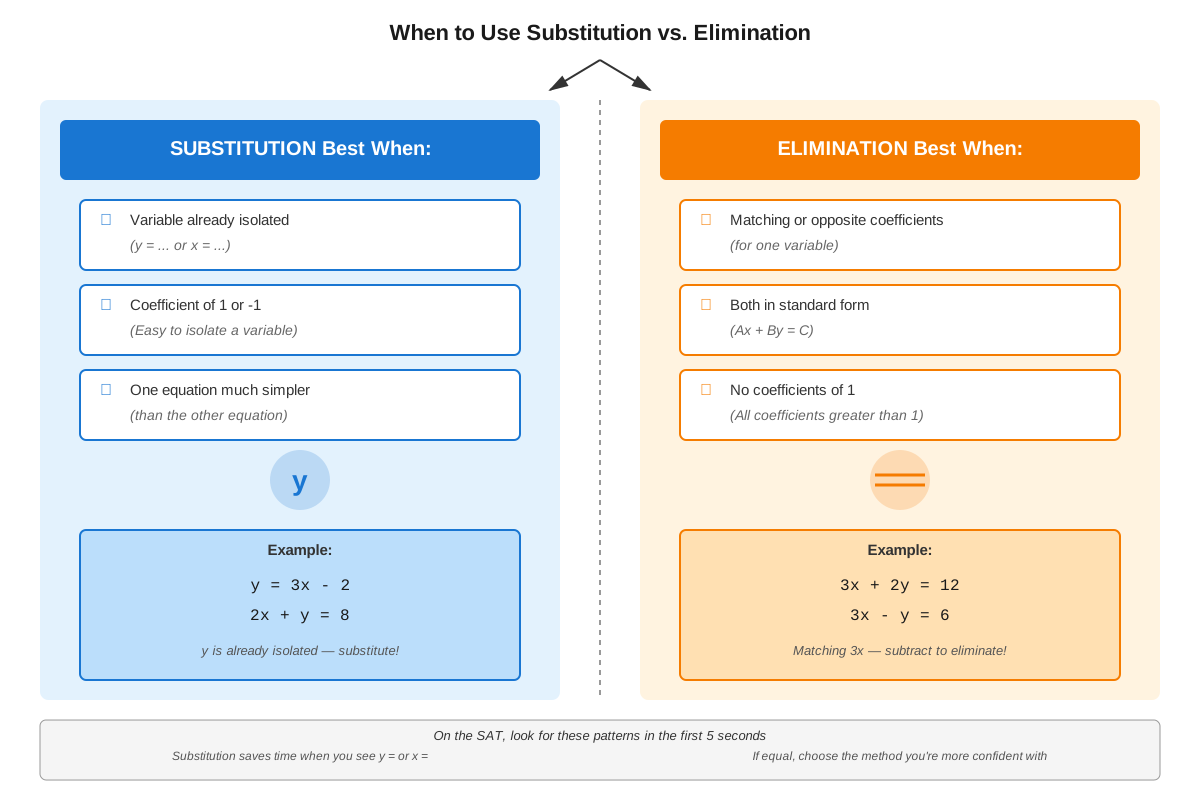
Substitution proves most efficient under specific conditions. When one equation is already solved for a variable (y = ..., x = ...), substitution becomes the obvious choice. When one variable has a coefficient of 1 or -1 in any equation, solving for that variable requires minimal manipulation. When dealing with fractional or decimal coefficients that would complicate elimination, substitution often provides cleaner arithmetic.
Conversely, elimination may be preferable when both equations have similar coefficients for one variable, or when both equations are in standard form (Ax + By = C) with no obvious variable to isolate easily. Recognizing these patterns quickly is a crucial SAT skill that comes with practice.
Algebraic Mechanics of Substitution
Consider the system:
Equation 1: y = 2x + 3
Equation 2: 3x + 4y = 26
Since Equation 1 already expresses y in terms of x, substitute (2x + 3) for every instance of y in Equation 2:
3x + 4(2x + 3) = 26The parentheses are critical—the entire expression (2x + 3) replaces y. Now solve:
3x + 8x + 12 = 26
11x + 12 = 26
11x = 14
x = 14/11
Substitute x = 14/11 back into Equation 1:
y = 2(14/11) + 3 = 28/11 + 33/11 = 61/11The solution is (14/11, 61/11).
Handling Complex Substitutions
When neither equation is pre-solved, choose strategically. Given:
Equation 1: 2x + 3y = 12
Equation 2: x - 2y = 5
Equation 2 has x with coefficient 1, making it easiest to isolate:
x = 2y + 5Substitute into Equation 1:
2(2y + 5) + 3y = 12
4y + 10 + 3y = 12
7y = 2
y = 2/7
Then find x:
x = 2(2/7) + 5 = 4/7 + 35/7 = 39/7Special Cases: No Solution and Infinite Solutions
Substitution reveals when systems have no solution or infinitely many solutions. If substitution leads to a false statement (like 0 = 5), the system has no solution—the lines are parallel. If substitution leads to a true identity (like 0 = 0 or 5 = 5), the system has infinitely many solutions—the equations represent the same line.
Example of no solution:
y = 2x + 3
y = 2x - 1
Substituting: 2x + 3 = 2x - 1 leads to 3 = -1 (false), indicating parallel lines.
Substitution in Word Problems
SAT word problems often require translating scenarios into systems before applying substitution. The key is defining variables clearly, writing two independent equations from the given information, and then applying substitution systematically.
For instance: "The sum of two numbers is 15, and their difference is 3. Find the larger number." Define x as the larger number and y as the smaller. This gives:
x + y = 15
x - y = 3
From the second equation: x = y + 3. Substitute into the first:
(y + 3) + y = 15
2y = 12
y = 6
Therefore x = 9.
Concept Relationships
The substitution strategy builds directly on single-variable equation solving—every substitution problem ultimately reduces to this foundational skill. The relationship flows: Equation manipulation → Variable isolation → Expression substitution → Single-variable solving → Back-substitution → Solution verification.
Substitution connects horizontally to the elimination method (both solve systems but through different mechanisms) and to graphing (substitution finds the algebraic coordinates of intersection points that graphing shows visually). Understanding when each method is optimal requires comparing their relative efficiencies for different equation structures.
The topic also connects forward to more advanced SAT concepts. Systems of linear inequalities use similar substitution logic but with inequality symbols. Quadratic-linear systems (pairing a line with a parabola) often require substitution to create a quadratic equation in one variable. Function composition problems mirror substitution's logic of replacing one expression with another.
Within the substitution process itself, concepts nest hierarchically: choosing the optimal equation and variable (strategic thinking) → isolating that variable (algebraic manipulation) → substituting correctly with parentheses (attention to detail) → simplifying and solving (computational accuracy) → back-substituting (completing the solution) → checking the answer (verification).
Quick check — test yourself on Substitution strategy so far.
Try Flashcards →High-Yield Facts
- ⭐ Substitution is most efficient when one equation is already solved for a variable or when a variable has a coefficient of 1 or -1
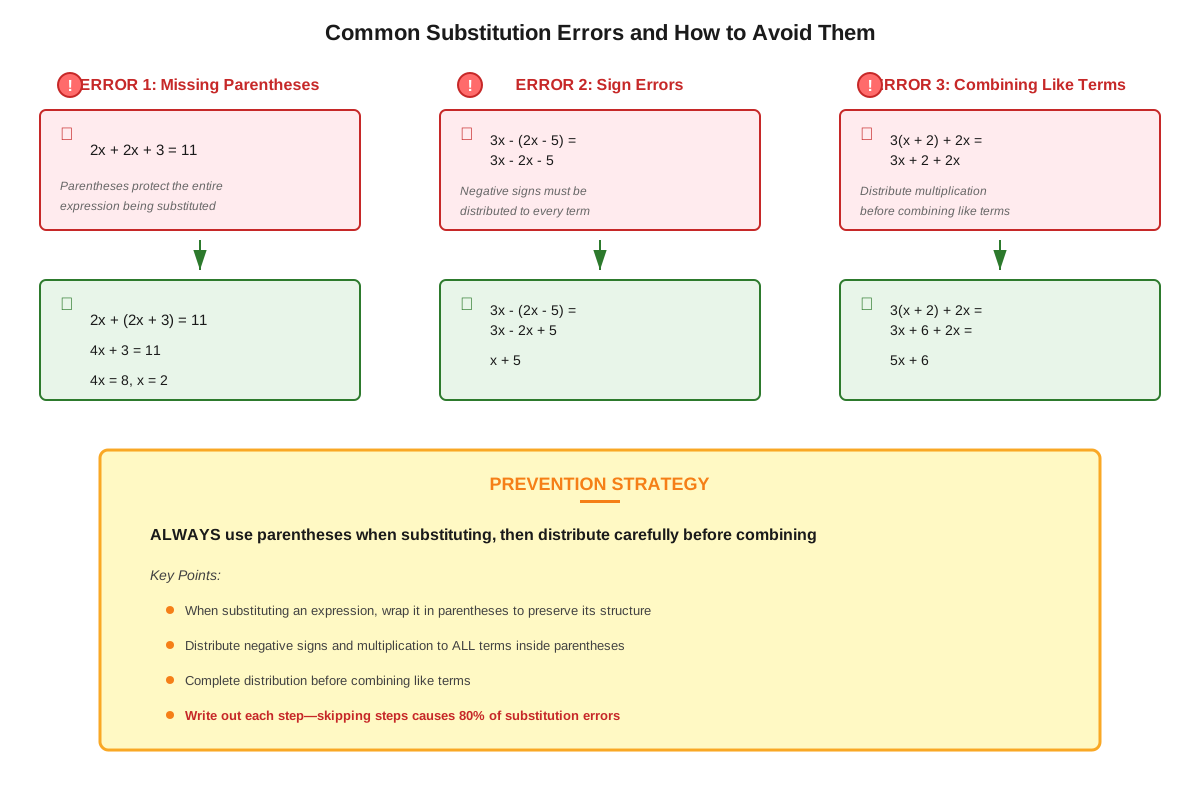
- ⭐ Always use parentheses when substituting an expression containing multiple terms to avoid sign errors
- ⭐ After finding the first variable, you must substitute back to find the second variable—the SAT often asks for the sum, difference, or product of both variables
- ⭐ If substitution leads to a false statement (like 0 = 7), the system has no solution; if it leads to an identity (like 0 = 0), there are infinitely many solutions
- ⭐ The SAT frequently asks for the value of an expression like 2x + y rather than individual variables—sometimes you can find this directly without solving for x and y separately
- When both equations are in standard form (Ax + By = C), check if elimination might be faster before committing to substitution
- Fractional solutions are common and correct on the SAT—don't assume you made an error if you get x = 7/3
- The substitution method works identically whether dealing with positive or negative coefficients, but extra care with signs prevents most errors
- Word problems requiring substitution always provide exactly two independent pieces of information to create two equations
- Checking your solution by substituting both values into both original equations catches computational errors and confirms correctness
Common Misconceptions
Misconception: When substituting an expression, you can drop the parentheses if it seems simpler.
Correction: Parentheses are mandatory when substituting expressions with multiple terms. Substituting 2x + 3 for y in 4y requires writing 4(2x + 3), not 4·2x + 3. The latter violates order of operations and produces incorrect results.
Misconception: After finding one variable, the problem is complete.
Correction: Unless the question specifically asks for only one variable, you must find both values. Moreover, SAT questions often ask for expressions involving both variables (like x + y or 3x - 2y), requiring both solutions.
Misconception: If you get a fractional answer, you probably made a mistake.
Correction: Fractional solutions are perfectly valid and common on the SAT. The test makers intentionally design problems with non-integer solutions to test computational accuracy. Always simplify fractions but don't assume they're wrong.
Misconception: Substitution and elimination always give different answers.
Correction: Both methods solve the same system and must yield identical solutions if performed correctly. They're different paths to the same destination. If they give different answers, an error occurred in one method.
Misconception: You should always solve for y first because that's the dependent variable.
Correction: Choose the variable that's easiest to isolate based on coefficients, not on convention. If x has a coefficient of 1 and y has a coefficient of 5, solve for x first regardless of variable names.
Misconception: When a system has no solution, you must have made an algebraic error.
Correction: Some systems legitimately have no solution (parallel lines) or infinitely many solutions (identical lines). The SAT tests whether you recognize these special cases. A false statement like 0 = 5 after correct substitution indicates no solution, not an error.
Worked Examples
Example 1: Standard Substitution Problem
Problem: Solve the system:
y = 3x - 7
2x + 5y = 16Solution:
Step 1: Identify that the first equation is already solved for y, making it ideal for substitution.
Step 2: Substitute (3x - 7) for y in the second equation:
2x + 5(3x - 7) = 16Step 3: Distribute and simplify:
2x + 15x - 35 = 16
17x - 35 = 16
17x = 51
x = 3
Step 4: Substitute x = 3 back into the first equation:
y = 3(3) - 7 = 9 - 7 = 2Step 5: Verify by substituting both values into the second equation:
2(3) + 5(2) = 6 + 10 = 16 ✓Answer: The solution is (3, 2).
Connection to Learning Objectives: This example demonstrates identifying when substitution is optimal (equation already solved), applying the strategy systematically, and verifying the solution—core SAT skills.
Example 2: Word Problem Requiring Substitution
Problem: A theater sold 450 tickets for a performance. Adult tickets cost $12 and student tickets cost $8. If the total revenue was $4,800, how many adult tickets were sold?
Solution:
Step 1: Define variables. Let a = number of adult tickets and s = number of student tickets.
Step 2: Translate the problem into equations:
- Total tickets: a + s = 450
- Total revenue: 12a + 8s = 4800
Step 3: Solve the first equation for one variable (choosing s because it has coefficient 1):
s = 450 - aStep 4: Substitute into the second equation:
12a + 8(450 - a) = 4800Step 5: Distribute and solve:
12a + 3600 - 8a = 4800
4a + 3600 = 4800
4a = 1200
a = 300
Step 6: Find s (though not required for this question):
s = 450 - 300 = 150Step 7: Verify:
Total tickets: 300 + 150 = 450 ✓
Total revenue: 12(300) + 8(150) = 3600 + 1200 = 4800 ✓Answer: 300 adult tickets were sold.
Connection to Learning Objectives: This example shows how substitution applies to real-world SAT word problems, requiring translation from English to algebra before applying the mechanical process.
Exam Strategy
When approaching substitution problems on the SAT, invest 10-15 seconds in strategic planning before diving into calculations. Scan both equations to identify which variable in which equation is easiest to isolate. Look for these trigger patterns: equations already in y = or x = form, variables with coefficient 1 or -1, or equations that can be quickly rearranged with one operation.
Trigger words and phrases in SAT questions that signal substitution strategy include: "system of equations," "solve for x and y," "what is the value of x + y," "if the following equations are true," and word problems stating two different relationships between the same quantities. When you see "in terms of" in a question, substitution is almost always the intended method.
For process of elimination on multiple-choice questions, you can sometimes substitute answer choices directly into both equations rather than solving algebraically. This "plug and check" approach works when answer choices are simple integers, though it's typically slower than proper substitution. However, if you're stuck or running short on time, testing answers can secure points.
Time allocation for substitution problems should be approximately 1.5-2 minutes for straightforward systems and 2.5-3 minutes for word problems requiring translation. If you exceed these times, consider whether you've chosen the optimal method or if you should skip and return later. Remember that all SAT Math questions carry equal weight—don't sacrifice three easy questions by spending six minutes on one difficult system.
Always write out your substitution explicitly rather than doing it mentally. Writing "2x + 5(3x - 7) = 16" prevents the most common errors. On the digital SAT, use the scratch paper provided to show all work systematically. Finally, if time permits, verify your solution by substituting both values into both original equations—this catches computational errors before you submit.
Memory Techniques
SIPS - Remember the substitution process with this acronym:
- Solve one equation for one variable
- Insert (substitute) that expression into the other equation
- Process (solve) the resulting single-variable equation
- Substitute back to find the remaining variable
"Parentheses are your Protection" - Visualize wrapping the substituted expression in protective parentheses like a safety bubble. This prevents distribution errors and sign mistakes, the two most common substitution errors.
The "Easy First" Rule - When choosing which variable to isolate, remember: "Coefficient of one? That's the one!" This rhyme helps you quickly identify the optimal starting point.
"Two equations, two unknowns, two steps to solve" - This phrase reinforces that you need exactly two pieces of information to solve for two variables, and the process has two main phases: substitution and back-substitution.
Visual Substitution Map: Picture the substitution process as a funnel: two equations with two variables at the top, narrowing through substitution to one equation with one variable in the middle, then expanding back through back-substitution to find both values at the bottom. This mental image helps you track where you are in the process.
Summary
The substitution strategy is an essential algebraic method for solving systems of linear equations that appears frequently on the SAT Math section. The technique involves isolating one variable in one equation, substituting the resulting expression into the other equation, solving the simplified single-variable equation, and back-substituting to find the remaining variable. Success with substitution requires recognizing when it's the optimal method (particularly when equations are already solved for a variable or contain coefficients of 1 or -1), executing the algebraic steps carefully with proper use of parentheses, and completing the solution by finding both variables. The SAT tests substitution through pure algebraic systems, word problems requiring translation, and questions asking for expressions involving both variables. Mastery requires understanding not just the mechanical process but also strategic decision-making about method selection, recognition of special cases (no solution or infinite solutions), and efficient time management during the exam.
Key Takeaways
- Substitution transforms a two-variable system into a single-variable equation by replacing one variable with an expression from another equation
- Choose substitution when one equation is already solved for a variable or when a variable has a coefficient of 1 or -1
- Always use parentheses when substituting expressions with multiple terms to avoid distribution and sign errors
- After finding the first variable, you must substitute back to find the second variable unless the question asks for a specific expression
- False statements after substitution (0 = 5) indicate no solution; true identities (0 = 0) indicate infinitely many solutions
- SAT substitution problems appear as pure algebra, word problems, and questions asking for expressions rather than individual variables
- Verification by substituting both values into both original equations catches errors and confirms correctness
Related Topics
Elimination Method for Systems: An alternative strategy for solving systems of equations by adding or subtracting equations to eliminate one variable. Mastering substitution provides a foundation for understanding when elimination is more efficient and how both methods complement each other.
Graphing Systems of Equations: The visual representation of systems where solutions appear as intersection points. Understanding substitution algebraically deepens comprehension of what graphs show geometrically.
Systems of Inequalities: Extends substitution logic to inequality systems, requiring similar algebraic manipulation but with attention to inequality symbols and direction changes.
Quadratic-Linear Systems: More advanced systems pairing linear and quadratic equations, where substitution creates a quadratic equation in one variable. Mastery of linear substitution is prerequisite for this higher-level topic.
Function Composition: The process of substituting one function into another, which mirrors the substitution strategy's logic of replacing variables with expressions.
Practice CTA
Now that you've mastered the substitution strategy conceptually, it's time to solidify your understanding through practice. Attempt the practice questions provided to apply these techniques to SAT-style problems, and use the flashcards to reinforce key facts and procedures. Remember, substitution is a high-yield topic that appears on every SAT—your investment in practice now will pay dividends on test day. Focus on recognizing when substitution is optimal, executing the steps carefully, and building speed through repetition. You've got this!
Sign up free to keep reading
Create a free AnvayaPrep account to finish this SAT guide on Substitution strategy — plus flashcards and practice questions.