Overview
Understanding system solution meaning is a cornerstone skill for success on the SAT math section. When two or more linear equations are considered together, they form a system of equations, and the solution to that system represents the point or points where the equations intersect or share common values. On the SAT, questions about system solutions test whether students can interpret what a solution represents in both algebraic and graphical contexts, determine the number of solutions a system has, and understand what these solutions mean in real-world scenarios presented in word problems.
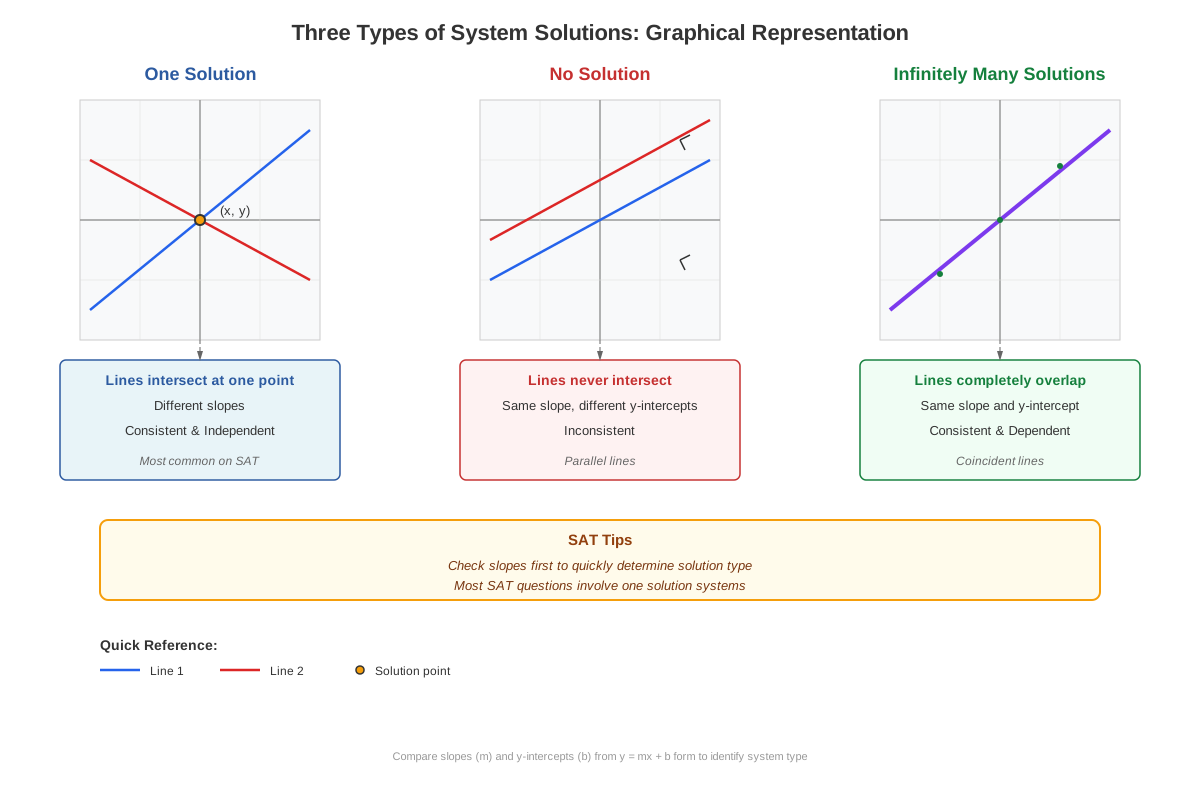
The sat system solution meaning concept appears frequently across multiple question types in the SAT math section. Students must recognize that a solution to a system isn't just a pair of numbers—it represents a specific relationship between variables that satisfies all equations simultaneously. This understanding extends beyond mechanical solving to conceptual interpretation: recognizing when a system has one solution (intersecting lines), no solution (parallel lines), or infinitely many solutions (coincident lines). These distinctions are critical for both multiple-choice and grid-in questions.
Mastery of system solution meaning connects directly to broader mathematical concepts including coordinate geometry, linear functions, and algebraic reasoning. This topic serves as a bridge between basic equation-solving and more complex applications involving constraints, optimization, and modeling real-world situations. Students who deeply understand what solutions represent—rather than just how to find them—gain significant advantages in tackling the SAT's increasingly context-rich math problems.
Learning Objectives
- [ ] Identify key features of system solution meaning
- [ ] Explain how system solution meaning appears on the SAT
- [ ] Apply system solution meaning to answer SAT-style questions
- [ ] Determine the number of solutions a system has by analyzing equations algebraically
- [ ] Interpret solutions to systems in the context of word problems and real-world scenarios
- [ ] Distinguish between consistent and inconsistent systems based on graphical and algebraic representations
Prerequisites
- Linear equations in two variables: Understanding how to write, manipulate, and graph linear equations is essential because systems consist of multiple linear equations that must be analyzed together
- Coordinate plane and graphing: Familiarity with plotting points and lines enables visualization of system solutions as intersection points
- Solving equations for a variable: The ability to isolate variables and perform algebraic manipulations is necessary for substitution and elimination methods
- Slope and y-intercept: Recognizing these features helps determine whether lines will intersect, be parallel, or coincide
Why This Topic Matters
In real-world applications, systems of equations model situations where multiple constraints or conditions must be satisfied simultaneously. Business decisions involving cost and revenue, mixture problems in chemistry, distance-rate-time scenarios with multiple moving objects, and resource allocation all require understanding system solutions. The ability to interpret what a solution means—not just calculate it—is crucial for making informed decisions based on mathematical models.
On the SAT, system solution meaning appears in approximately 3-5 questions per test, representing roughly 8-12% of the math section. These questions appear in both calculator and no-calculator portions, with varying difficulty levels. The College Board frequently tests this concept through:
- Direct interpretation questions: "What does the solution (x, y) represent in the context of the problem?"
- Number of solutions questions: "How many solutions does the system have?"
- Graphical analysis: Questions showing graphs of two lines asking about intersection points
- Word problems: Real-world scenarios requiring students to set up systems and interpret solutions
- Algebraic manipulation: Questions asking what must be true about coefficients for specific solution scenarios
The SAT particularly favors questions that combine algebraic and graphical reasoning, requiring students to move fluidly between representations. Understanding system solution meaning is classified as high importance because it appears consistently across test administrations and often serves as the foundation for multi-step problems worth significant points.
Core Concepts
What Is a System Solution?
A system solution meaning refers to the set of values that simultaneously satisfy all equations in a system. For a system of two linear equations in two variables (x and y), a solution is an ordered pair (x, y) that makes both equations true when substituted. This solution represents the point where the graphs of the two equations intersect on the coordinate plane.
Consider the system:
2x + y = 7
x - y = 2
The solution (3, 1) means that when x = 3 and y = 1, both equations are satisfied:
- First equation: 2(3) + 1 = 6 + 1 = 7 ✓
- Second equation: 3 - 1 = 2 ✓
Graphically, this solution represents the exact point where the two lines intersect. Understanding this dual representation—algebraic and geometric—is fundamental to mastering system solution meaning on the SAT.
Types of System Solutions
Systems of linear equations can have exactly three possible solution scenarios, each with distinct algebraic and graphical characteristics:
| Solution Type | Number of Solutions | Graphical Representation | Algebraic Characteristic | Example |
|---|---|---|---|---|
| Consistent and Independent | Exactly one | Lines intersect at one point | Different slopes | y = 2x + 1 and y = -x + 4 |
| Inconsistent | Zero (no solution) | Parallel lines (never intersect) | Same slope, different y-intercepts | y = 3x + 2 and y = 3x - 5 |
| Consistent and Dependent | Infinitely many | Coincident lines (same line) | Same slope, same y-intercept (equivalent equations) | 2x + y = 4 and 4x + 2y = 8 |
One Solution (Intersecting Lines): This is the most common scenario on the SAT. The two lines have different slopes, guaranteeing they will cross at exactly one point. This single solution represents the unique combination of x and y values that satisfies both constraints simultaneously.
No Solution (Parallel Lines): When two lines have identical slopes but different y-intercepts, they run parallel and never meet. Algebraically, attempting to solve such a system leads to a false statement like "0 = 5" or "3 = 7." This indicates the system is inconsistent—there is no ordered pair that can satisfy both equations.
Infinitely Many Solutions (Coincident Lines): When two equations represent the same line (one is a multiple of the other), every point on that line is a solution. Algebraically, solving such a system yields a true statement like "0 = 0" or "5 = 5," indicating the equations are dependent.
Interpreting Solutions in Context
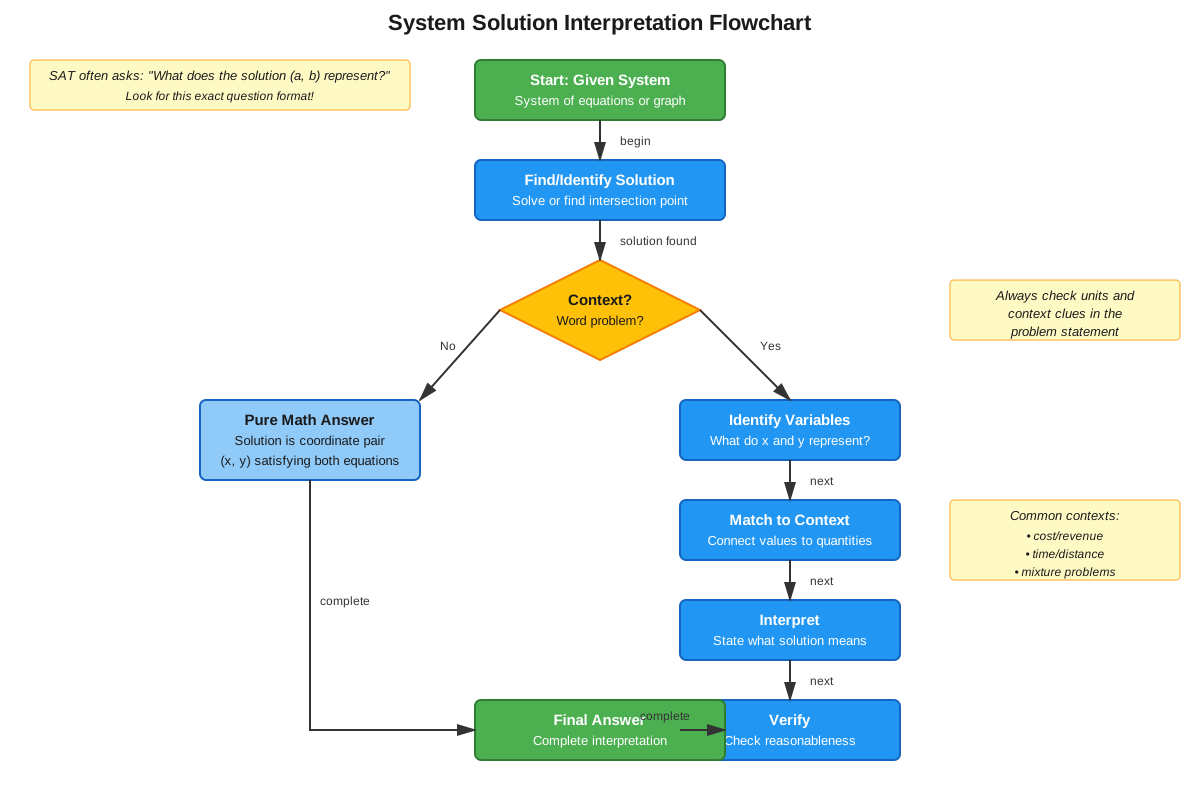
On the SAT, understanding what a solution represents in a word problem context is crucial. The variables in a system represent specific quantities, and the solution provides meaningful information about those quantities.
Example Context: A system where x represents hours worked and y represents total earnings. The solution (8, 120) means that working 8 hours results in earning $120. This solution must satisfy both equations in the system, which might represent different payment structures or constraints.
When interpreting solutions:
- Identify what each variable represents from the problem statement
- Translate the numerical solution into the context (include units)
- Verify the solution makes sense within the problem's constraints (e.g., time cannot be negative)
- Explain what the solution tells you about the relationship between the variables
Determining Number of Solutions Algebraically
Without graphing, students can determine how many solutions a system has by analyzing the equations:
Method 1: Compare Slopes and Y-Intercepts
Convert both equations to slope-intercept form (y = mx + b):
- If slopes differ (m₁ ≠ m₂): One solution
- If slopes are equal but y-intercepts differ (m₁ = m₂, b₁ ≠ b₂): No solution
- If slopes and y-intercepts are equal (m₁ = m₂, b₁ = b₂): Infinitely many solutions
Method 2: Solve and Analyze the Result
Begin solving the system using substitution or elimination:
- If you obtain a unique value for each variable: One solution
- If you obtain a false statement (e.g., 0 = 7): No solution
- If you obtain a true statement (e.g., 0 = 0): Infinitely many solutions
Graphical Interpretation of Solutions
The graphical representation provides immediate visual insight into system solutions. On the SAT, students may be shown graphs and asked to identify solutions or determine how many solutions exist.
Key graphical principles:
- Intersection points are solutions: Any point where two lines cross represents a solution
- Steeper lines have larger absolute slopes: This helps predict whether lines will intersect
- Parallel lines maintain constant distance: They never intersect regardless of how far extended
- Overlapping lines share all points: Every point on the line is a solution
When analyzing graphs on the SAT, carefully read the scale of both axes and identify exact coordinates of intersection points. The test may use non-standard scales (e.g., each grid mark represents 2 units) to test careful reading.
Concept Relationships
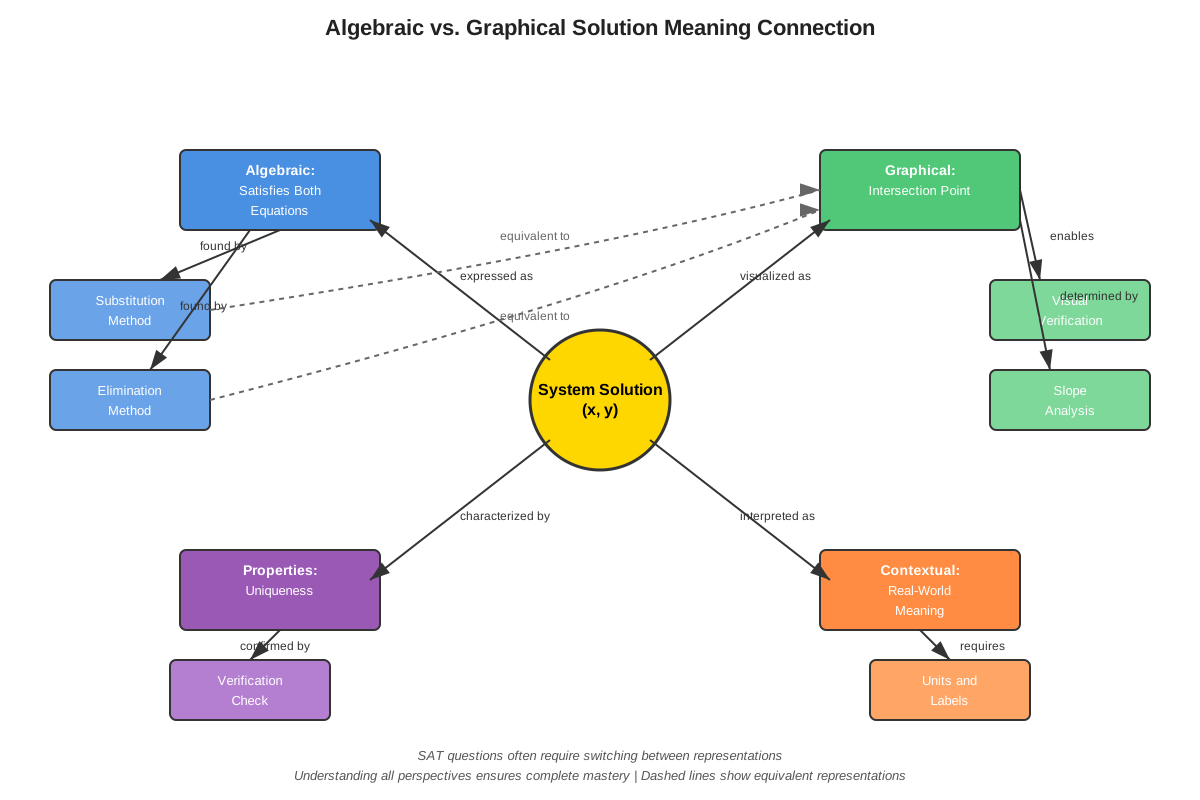
The concepts within system solution meaning are deeply interconnected. Understanding what a solution is (an ordered pair satisfying all equations) leads directly to recognizing types of solutions (one, none, or infinitely many). The type of solution depends on the relationship between the lines (intersecting, parallel, or coincident), which can be determined through algebraic analysis (comparing slopes and intercepts) or graphical interpretation (visualizing the lines).
This topic builds directly on prerequisite knowledge of linear equations and graphing. The slope-intercept form (y = mx + b) from basic linear functions becomes the tool for analyzing system solutions. Coordinate plane skills enable graphical interpretation, while equation-solving techniques facilitate algebraic approaches.
System solution meaning connects forward to more advanced topics including:
- Systems of inequalities: Solutions become regions rather than points
- Non-linear systems: Involving quadratic or exponential equations with different solution patterns
- Matrices and linear algebra: More sophisticated methods for solving larger systems
- Optimization problems: Finding maximum or minimum values subject to system constraints
Relationship Map:
Linear Equations → System of Equations → Solution Definition → Types of Solutions (One/None/Infinite) → Algebraic Determination (slope comparison) → Graphical Interpretation (intersection analysis) → Contextual Meaning (real-world application)
Quick check — test yourself on System solution meaning so far.
Try Flashcards →High-Yield Facts
⭐ A solution to a system of two equations is an ordered pair (x, y) that satisfies both equations simultaneously
⭐ Systems can have exactly three possible outcomes: one solution, no solution, or infinitely many solutions
⭐ Lines with different slopes always intersect at exactly one point (one solution)
⭐ Parallel lines (same slope, different y-intercepts) never intersect (no solution)
⭐ Coincident lines (equivalent equations) have infinitely many solutions
- When solving a system yields a false statement like "0 = 5," the system has no solution
- When solving a system yields a true statement like "0 = 0," the system has infinitely many solutions
- The solution to a system represents the intersection point of the lines when graphed
- In word problems, the solution's meaning depends on what the variables represent in context
- Two equations are equivalent (represent the same line) if one is a constant multiple of the other
- The SAT frequently asks "what does the solution represent" rather than "find the solution"
- Graphically, the number of intersection points equals the number of solutions
- Systems with no solution are called inconsistent; systems with at least one solution are consistent
- A system with infinitely many solutions is called dependent; a system with exactly one solution is independent
Common Misconceptions
Misconception: A solution is just the x-value or just the y-value separately.
Correction: A solution to a system of two equations in two variables is an ordered pair (x, y) where both values together satisfy both equations. Neither value alone constitutes the complete solution.
Misconception: If two lines look like they might intersect somewhere off the visible graph, the system has one solution.
Correction: Parallel lines never intersect no matter how far they are extended. If lines have the same slope but different y-intercepts, they are parallel and the system has no solution, even if the graph doesn't show enough to make this obvious.
Misconception: Infinitely many solutions means "any values of x and y will work."
Correction: Infinitely many solutions means the two equations represent the same line, so only the points on that specific line are solutions. Not all ordered pairs work—only those satisfying the equation of that line.
Misconception: When solving algebraically produces "0 = 0," there's something wrong with the work.
Correction: The statement "0 = 0" (or any true statement) indicates the system has infinitely many solutions. This is a valid result showing the equations are dependent.
Misconception: The solution to a system is always a positive number.
Correction: Solutions can be negative, zero, positive, fractions, or irrational numbers. The context of the problem determines whether certain solutions are reasonable (e.g., negative time might not make sense), but mathematically, solutions can be any real numbers.
Misconception: Systems of equations always have at least one solution.
Correction: Inconsistent systems (parallel lines) have no solution. Not every system can be solved—some represent contradictory constraints that cannot be satisfied simultaneously.
Misconception: If you can solve for x, the system must have exactly one solution.
Correction: You must solve for both variables and check that the result is consistent. A false statement during solving indicates no solution; a true statement indicates infinitely many solutions.
Worked Examples
Example 1: Interpreting Solution in Context
Problem: A coffee shop sells small coffees for $3 each and large coffees for $5 each. On Monday morning, the shop sold a total of 50 coffees and collected $210 in revenue. The system of equations below represents this situation, where s represents the number of small coffees sold and l represents the number of large coffees sold:
s + l = 50
3s + 5l = 210
What does the solution to this system represent?
Solution:
Step 1: Understand what we're asked. We need to interpret what the solution means, not necessarily find it (though finding it helps verify understanding).
Step 2: Identify what the variables represent:
- s = number of small coffees sold
- l = number of large coffees sold
Step 3: Understand what the equations represent:
- First equation: The total number of coffees (small plus large) equals 50
- Second equation: The total revenue (3 dollars per small plus 5 dollars per large) equals 210
Step 4: Interpret the solution. The solution (s, l) will be an ordered pair that tells us:
- The exact number of small coffees sold (s-value)
- The exact number of large coffees sold (l-value)
- These numbers simultaneously satisfy both the total count constraint and the total revenue constraint
Step 5: Solve to verify (using substitution):
From equation 1: s = 50 - l
Substitute into equation 2: 3(50 - l) + 5l = 210
150 - 3l + 5l = 210
150 + 2l = 210
2l = 60
l = 30
Therefore: s = 50 - 30 = 20
Answer: The solution (20, 30) represents that the coffee shop sold exactly 20 small coffees and 30 large coffees on Monday morning. This combination satisfies both the constraint that 50 total coffees were sold and that $210 in revenue was collected.
Connection to Learning Objectives: This example demonstrates how to interpret system solutions in context (Objective 3) and shows how system solution meaning appears in SAT word problems (Objective 2).
Example 2: Determining Number of Solutions
Problem: For what value of k does the following system have no solution?
2x + 3y = 12
4x + ky = 18Solution:
Step 1: Recall that a system has no solution when the lines are parallel (same slope, different y-intercepts).
Step 2: Convert both equations to slope-intercept form to compare slopes.
First equation:
2x + 3y = 12
3y = -2x + 12
y = (-2/3)x + 4
The slope is -2/3 and y-intercept is 4.
Second equation:
4x + ky = 18
ky = -4x + 18
y = (-4/k)x + (18/k)
The slope is -4/k and y-intercept is 18/k.
Step 3: For parallel lines (no solution), the slopes must be equal but y-intercepts must differ.
Set slopes equal:
-2/3 = -4/k
Step 4: Solve for k:
-2k = -12
k = 6
Step 5: Verify that y-intercepts differ when k = 6:
- First equation y-intercept: 4
- Second equation y-intercept: 18/6 = 3
Since 4 ≠ 3, the y-intercepts are different. ✓
Step 6: Double-check by considering if the equations could be equivalent (infinitely many solutions). For that, we'd need:
4x + 6y = 18 to be equivalent to 2x + 3y = 12
Dividing the first by 2: 2x + 3y = 9
This gives 2x + 3y = 9, not 2x + 3y = 12, so they're not equivalent. The system has no solution, not infinitely many.
Answer: k = 6
Connection to Learning Objectives: This example shows how to identify key features of system solution meaning (Objective 1) by analyzing when systems have no solution, and applies algebraic techniques to answer SAT-style questions (Objective 3).
Exam Strategy
When approaching SAT questions on system solution meaning, follow this strategic framework:
Step 1: Identify the Question Type
- Is it asking for the solution itself, the number of solutions, or what the solution represents?
- Does it provide equations, graphs, or a word problem context?
Step 2: Choose Your Approach
- For "what does the solution represent" questions: Focus on variable definitions and context, not necessarily solving
- For "how many solutions" questions: Compare slopes and y-intercepts or look for parallel/intersecting lines
- For graphical questions: Identify intersection points carefully, noting axis scales
Trigger Words and Phrases to Watch For:
- "What does the solution represent": Interpret in context, don't just solve
- "How many solutions": Analyze relationship between lines (parallel, intersecting, coincident)
- "For what value of k": Set up conditions for specific solution scenarios
- "The system has no solution when": Look for parallel lines (equal slopes, different intercepts)
- "Infinitely many solutions": Look for equivalent equations or coincident lines
- "Intersection point": The solution is where graphs meet
Process of Elimination Tips:
- Eliminate answers that confuse x and y values (check which variable is which)
- Eliminate answers that describe only one equation, not both
- For "number of solutions" questions, eliminate answers that aren't 0, 1, or infinitely many
- For context questions, eliminate answers with incorrect units or impossible values (negative quantities that must be positive)
Time Allocation:
- Simple interpretation questions: 30-45 seconds
- Algebraic determination of solution type: 60-90 seconds
- Complex word problems requiring setup and interpretation: 90-120 seconds
Quick Verification Strategy:
If time permits, plug your answer back into both original equations to verify it works. This catches arithmetic errors and confirms understanding.
Memory Techniques
Mnemonic for Solution Types: "ONE-ZERO-INFINITE"
- One solution: Different slopes (One-Different)
- Zero solutions: Same slope, Different intercepts (Zero-Same-Different)
- Infinite solutions: Same slope, Same intercepts (Infinite-Same-Same)
Visualization Strategy: The "Line Meeting" Mental Image
Picture two people walking along different paths (lines):
- Intersecting lines: They meet at one specific location (one solution)
- Parallel lines: They walk side-by-side but never meet (no solution)
- Coincident lines: They're walking the exact same path, meeting at every step (infinitely many solutions)
Acronym for Checking Solutions: SOLVE
- Substitute values into both equations
- Observe if both equations are satisfied
- Look for true statements (both sides equal)
- Verify the answer makes sense in context
- Eliminate if either equation isn't satisfied
Memory Hook for False/True Statements:
- False statement (0 = 5): "False means Failed to find a solution" → No solution
- True statement (0 = 0): "True means Tons of solutions" → Infinitely many solutions
Summary
System solution meaning is a fundamental SAT math concept that requires understanding what solutions represent, how many solutions exist, and how to interpret solutions in context. A solution to a system of two linear equations is an ordered pair that simultaneously satisfies both equations, representing the intersection point of the lines graphically. Systems can have exactly one solution (intersecting lines with different slopes), no solution (parallel lines with same slope but different y-intercepts), or infinitely many solutions (coincident lines that are equivalent equations). Success on SAT questions requires moving fluidly between algebraic and graphical representations, determining solution types by analyzing slopes and intercepts, and interpreting solutions within word problem contexts by understanding what variables represent. The key to mastery is recognizing that system solution meaning extends beyond mechanical solving to conceptual understanding of what solutions tell us about the relationships between variables and the constraints they must satisfy.
Key Takeaways
- A system solution is an ordered pair (x, y) that makes all equations in the system true simultaneously
- Systems of two linear equations have exactly three possible outcomes: one solution, no solution, or infinitely many solutions
- Different slopes guarantee one solution; same slope with different y-intercepts means no solution; same slope with same y-intercept means infinitely many solutions
- Graphically, solutions are intersection points; algebraically, they're values satisfying all equations
- On the SAT, interpreting what a solution represents in context is as important as finding the solution itself
- False statements during solving (0 = 5) indicate no solution; true statements (0 = 0) indicate infinitely many solutions
- Always identify what variables represent before interpreting solutions in word problems
Related Topics
Systems of Inequalities: Building on system solution meaning, systems of inequalities involve finding regions of solutions rather than specific points. Mastering linear systems prepares students for understanding how multiple constraints create feasible regions.
Quadratic-Linear Systems: These systems involve one linear and one quadratic equation, resulting in 0, 1, or 2 solutions. Understanding linear system solutions provides the foundation for analyzing more complex intersection scenarios.
Matrices and Determinants: Advanced methods for solving systems use matrix operations. The concepts of consistent/inconsistent systems and dependent/independent equations extend directly to matrix analysis.
Linear Programming: This optimization technique uses systems of inequalities to find maximum or minimum values. Understanding what system solutions represent is essential for interpreting optimal solutions in constrained scenarios.
Practice CTA
Now that you've mastered the core concepts of system solution meaning, it's time to solidify your understanding through practice! Attempt the practice questions to apply these concepts to SAT-style problems, and use the flashcards to reinforce key definitions and solution types. Remember, understanding what solutions represent—not just how to find them—is what separates good scores from great scores. You've built a strong foundation; now practice will make it automatic. You've got this!
Sign up free to keep reading
Create a free AnvayaPrep account to finish this SAT guide on System solution meaning — plus flashcards and practice questions.