Overview
Systems and intersections represent a fundamental concept in algebra that appears frequently on the SAT Math section. This topic explores how two or more linear equations relate to each other geometrically and algebraically, focusing on the points where their graphs meet—or don't meet. Understanding systems of equations means recognizing that each equation represents a line on the coordinate plane, and solving the system means finding the coordinates where these lines intersect.
The SAT tests this concept in multiple ways, from straightforward algebraic solutions to graphical interpretations and word problems that require translating real-world scenarios into mathematical systems. Students must be comfortable switching between different representations: equations, graphs, and contextual situations. The ability to visualize how lines interact—whether they intersect at one point, are parallel (no intersection), or are identical (infinite intersections)—is crucial for success on these questions.
This topic connects directly to broader math concepts including linear equations, coordinate geometry, and algebraic manipulation. Mastery of sat systems and intersections provides the foundation for understanding more complex mathematical relationships and serves as a gateway to higher-level algebra. The SAT dedicates approximately 10-15% of its Math section to questions involving systems of equations, making this a high-yield area that deserves focused attention and practice.
Learning Objectives
- [ ] Identify key features of systems and intersections
- [ ] Explain how systems and intersections appears on the SAT
- [ ] Apply systems and intersections to answer SAT-style questions
- [ ] Determine the number of solutions to a system by analyzing equations algebraically
- [ ] Interpret graphical representations of systems to identify intersection points
- [ ] Translate word problems into systems of equations and solve them efficiently
- [ ] Recognize when systems have no solution or infinitely many solutions based on coefficient relationships
Prerequisites
- Linear equations in slope-intercept form (y = mx + b): Understanding how slope and y-intercept define a line is essential for visualizing and solving systems
- Graphing linear equations on the coordinate plane: The ability to plot lines helps visualize where intersections occur
- Solving equations with one variable: This skill is necessary for the substitution and elimination methods
- Understanding ordered pairs (x, y): Solutions to systems are expressed as coordinate points
- Basic algebraic manipulation: Combining like terms, distributing, and isolating variables are fundamental to all solution methods
Why This Topic Matters
In real-world applications, systems of equations model countless scenarios where multiple constraints must be satisfied simultaneously. Businesses use them to determine break-even points where costs equal revenue. Engineers apply them to analyze forces in equilibrium. Economists employ them to find market equilibrium where supply meets demand. Even everyday decisions like comparing phone plans or determining optimal mixtures involve systems thinking.
On the SAT, systems of equations questions appear in both the calculator and no-calculator sections, typically accounting for 3-5 questions per test. These questions test multiple skills simultaneously: algebraic manipulation, graphical interpretation, and logical reasoning. The College Board frequently embeds systems within word problems, requiring students to first construct the system before solving it. Questions may ask for the solution itself, the value of a specific variable, the number of solutions, or interpretations of what the solution means in context.
Common SAT question formats include: identifying intersection points from graphs, determining which ordered pair satisfies both equations, finding the value of a constant that makes a system have no solution or infinitely many solutions, and solving application problems involving rates, mixtures, or cost comparisons. The topic also appears in questions about parallel and perpendicular lines, as these geometric relationships directly connect to the number of solutions a system possesses.
Core Concepts
What is a System of Linear Equations?
A system of linear equations consists of two or more linear equations involving the same variables. For the SAT, students primarily encounter systems with two equations and two variables (typically x and y). Each equation in the system represents a line on the coordinate plane, and solving the system means finding all points (x, y) that satisfy both equations simultaneously.
The standard forms encountered are:
- Slope-intercept form: y = mx + b
- Standard form: Ax + By = C
- Point-slope form: y - y₁ = m(x - x₁)
Types of Solutions and Geometric Interpretations
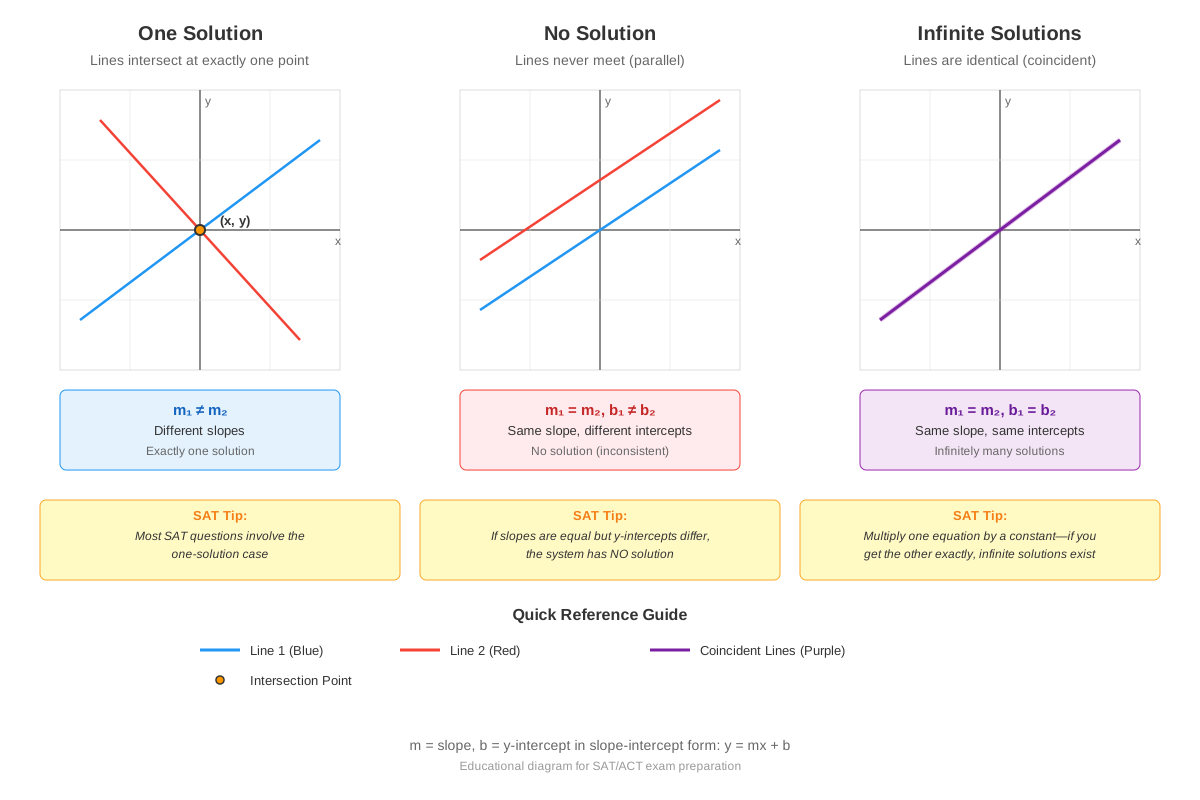
The number of solutions to a system corresponds directly to how the lines relate geometrically:
| Number of Solutions | Geometric Relationship | Algebraic Characteristic | Example |
|---|---|---|---|
| One solution | Lines intersect at exactly one point | Different slopes | y = 2x + 1 and y = -x + 4 |
| No solution | Lines are parallel | Same slope, different y-intercepts | y = 3x + 2 and y = 3x - 5 |
| Infinitely many solutions | Lines are identical (coincident) | Same slope, same y-intercept (equivalent equations) | y = 2x + 3 and 2y = 4x + 6 |
Understanding this relationship is crucial for SAT questions that ask about the number of solutions without requiring actual calculation.
Solution Method 1: Substitution
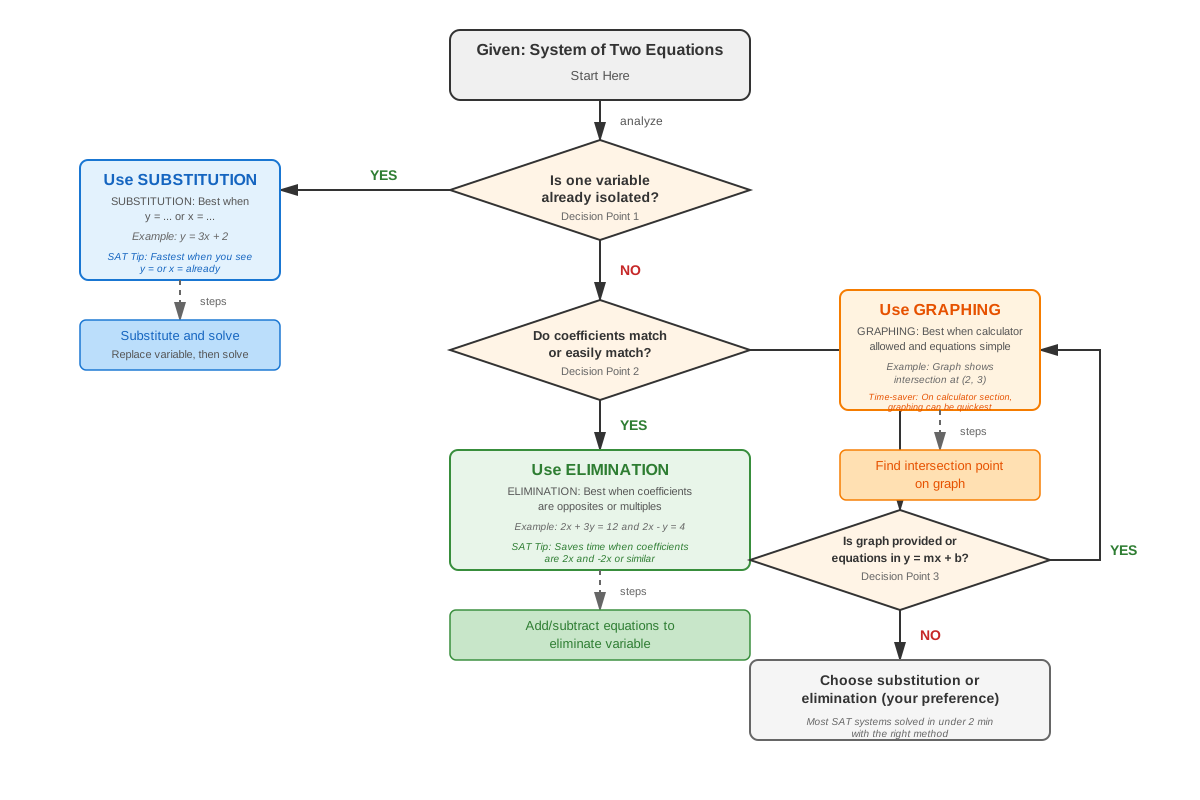
The substitution method works by solving one equation for one variable, then substituting that expression into the other equation. This method is particularly efficient when one equation is already solved for a variable or can be easily manipulated to isolate a variable.
Steps for substitution:
- Solve one equation for one variable (choose the easiest)
- Substitute this expression into the other equation
- Solve the resulting single-variable equation
- Substitute back to find the other variable
- Check the solution in both original equations
This method is especially useful on the SAT when equations are given in slope-intercept form or when one coefficient is 1 or -1.
Solution Method 2: Elimination (Linear Combination)
The elimination method involves adding or subtracting equations to eliminate one variable. This method is often faster when coefficients align well or can be easily manipulated through multiplication.
Steps for elimination:
- Arrange both equations in standard form (Ax + By = C)
- Multiply one or both equations by constants to make coefficients of one variable opposites
- Add the equations to eliminate that variable
- Solve for the remaining variable
- Substitute back into either original equation to find the other variable
The SAT frequently presents systems where elimination is more efficient than substitution, particularly when both equations are in standard form.
Solution Method 3: Graphical Analysis
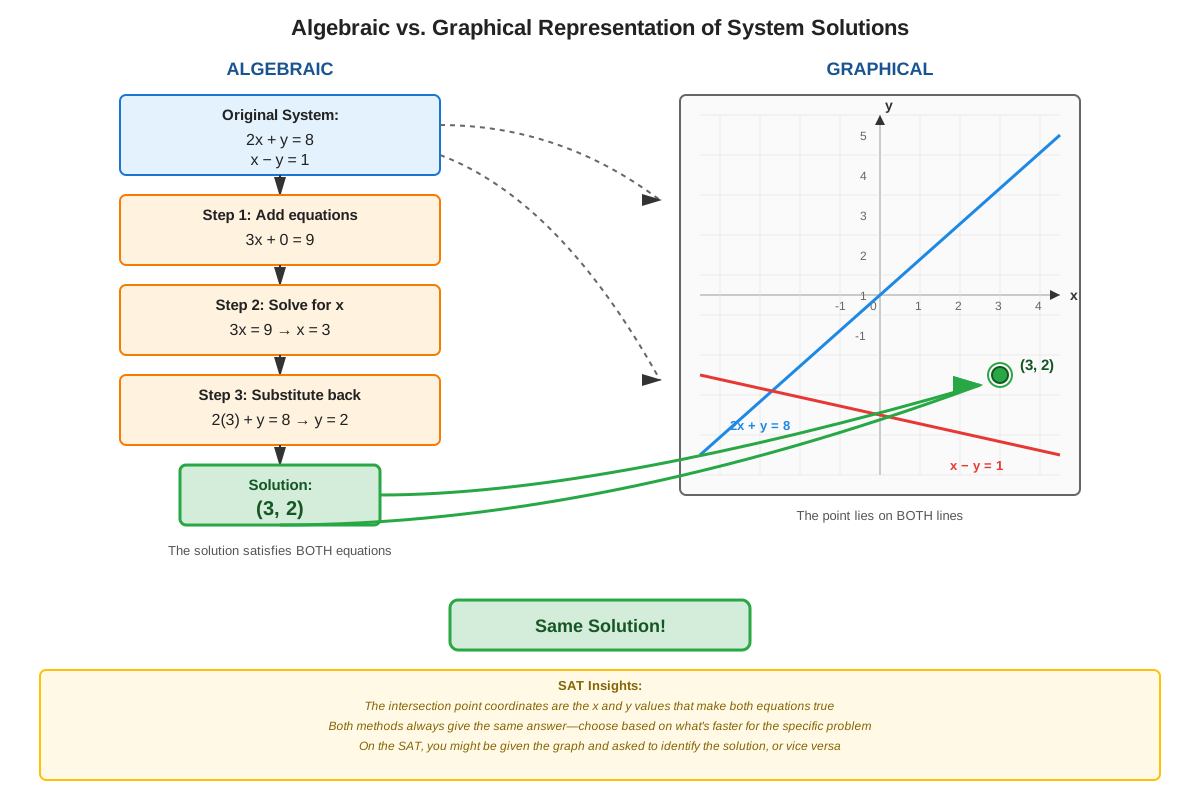
For questions presenting graphs or asking for graphical interpretations, students must identify the intersection point visually. The coordinates of the intersection represent the solution to the system. This method requires careful reading of graph scales and accurate identification of coordinate values.
Key skills for graphical analysis:
- Reading coordinates accurately from a graph
- Understanding that the intersection point satisfies both equations
- Recognizing parallel lines (no intersection) versus intersecting lines
- Identifying when lines are identical (overlap completely)
Determining Number of Solutions Without Solving
The SAT often asks students to determine how many solutions exist without finding the actual solution. This requires analyzing the relationship between slopes and y-intercepts:
For equations in y = mx + b form:
- If m₁ ≠ m₂ (different slopes) → one solution
- If m₁ = m₂ and b₁ ≠ b₂ (same slope, different y-intercepts) → no solution
- If m₁ = m₂ and b₁ = b₂ (identical lines) → infinitely many solutions
For equations in standard form Ax + By = C:
- Compare the ratios A₁/A₂, B₁/B₂, and C₁/C₂
- If A₁/A₂ ≠ B₁/B₂ → one solution
- If A₁/A₂ = B₁/B₂ ≠ C₁/C₂ → no solution
- If A₁/A₂ = B₁/B₂ = C₁/C₂ → infinitely many solutions
Systems in Context: Word Problems
The SAT frequently embeds systems within real-world scenarios. Success requires translating verbal descriptions into mathematical equations. Common contexts include:
- Cost problems: Total cost equals fixed cost plus variable cost
- Mixture problems: Combining quantities with different properties
- Rate problems: Distance = rate × time for multiple objects
- Age problems: Relationships between ages at different times
- Number problems: Relationships between unknown quantities
The key is identifying what each variable represents and carefully translating each constraint into an equation.
Concept Relationships
The foundation of systems and intersections rests on understanding individual linear equations. Linear equations → define lines on the coordinate plane → which can intersect, be parallel, or coincide → determining the number of solutions to the system.
The choice of solution method connects to equation form: Slope-intercept form → suggests substitution or graphical analysis, while standard form → often indicates elimination is more efficient. Both methods ultimately lead to the same solution, demonstrating the interconnected nature of algebraic techniques.
Understanding slopes and y-intercepts → enables prediction of intersection behavior → without complete solution. This connects to the broader concept of parallel and perpendicular lines, where parallel lines (equal slopes) correspond to systems with no solution.
The graphical representation connects abstract algebra to visual geometry: Algebraic solution ↔ Geometric intersection point. This dual representation reinforces that mathematics can be understood through multiple lenses, each providing different insights.
Systems also connect forward to more advanced topics: Systems of linear equations → foundation for systems of inequalities → which extend to linear programming → used in optimization problems. Additionally, the concept generalizes to systems of nonlinear equations, where curves rather than lines intersect.
High-Yield Facts
⭐ A system of two linear equations can have exactly 0, 1, or infinitely many solutions—never 2, 3, or any other finite number greater than 1
⭐ Two lines with the same slope are either parallel (no solution) or identical (infinite solutions)
⭐ The solution to a system is the ordered pair (x, y) that satisfies both equations simultaneously
⭐ When using elimination, multiplying an entire equation by a constant does not change its solutions
⭐ If two equations in a system are equivalent (one is a multiple of the other), the system has infinitely many solutions
- The intersection point of two lines can be found by setting their equations equal when both are solved for y
- Substitution is most efficient when one equation is already solved for a variable or has a coefficient of 1 or -1
- Elimination is most efficient when coefficients are already opposites or can easily be made opposites
- A system with no solution is called inconsistent; a system with at least one solution is called consistent
- When graphing, the x-coordinate of the intersection is where both lines have the same y-value
- In word problems, the solution must make sense in the real-world context (e.g., negative time or negative quantity may be mathematically correct but contextually invalid)
- Systems can be verified by substituting the solution back into both original equations
Quick check — test yourself on Systems and intersections so far.
Try Flashcards →Common Misconceptions
Misconception: A system always has exactly one solution.
Correction: Systems can have one solution (intersecting lines), no solution (parallel lines), or infinitely many solutions (identical lines). The number of solutions depends on the relationship between the slopes and y-intercepts.
Misconception: When using elimination, you can add or subtract any two equations regardless of their form.
Correction: While you can technically add any equations, strategic multiplication is often necessary first to create opposite coefficients for one variable. Simply adding without planning rarely eliminates a variable efficiently.
Misconception: The solution to a system is just the x-value or just the y-value.
Correction: The solution is an ordered pair (x, y) that includes both values. Both coordinates are necessary to identify the intersection point completely.
Misconception: If you get different solutions using substitution versus elimination, one method is wrong.
Correction: Both methods, when executed correctly, must yield the same solution. Different results indicate an algebraic error in one approach, not a flaw in the method itself.
Misconception: Parallel lines are the same as identical lines.
Correction: Parallel lines never intersect (no solution) because they have the same slope but different y-intercepts. Identical lines overlap completely (infinitely many solutions) because they have the same slope AND the same y-intercept—they're the exact same line.
Misconception: When a system has no solution, something went wrong in the solving process.
Correction: No solution is a valid answer. When elimination or substitution leads to a false statement like 0 = 5 or 3 = -2, this correctly indicates the system has no solution because the lines are parallel.
Misconception: The intersection point must have integer coordinates.
Correction: Intersection points can have any real number coordinates, including fractions, decimals, or irrational numbers. The SAT may test non-integer solutions to ensure students understand the concept beyond simple cases.
Worked Examples
Example 1: Solving by Substitution
Problem: Solve the system:
y = 3x - 5
2x + y = 10Solution:
Step 1: Notice the first equation is already solved for y, making substitution the natural choice.
Step 2: Substitute (3x - 5) for y in the second equation:
2x + (3x - 5) = 10Step 3: Solve for x:
2x + 3x - 5 = 10
5x - 5 = 10
5x = 15
x = 3
Step 4: Substitute x = 3 back into the first equation to find y:
y = 3(3) - 5
y = 9 - 5
y = 4
Step 5: Verify by checking in both original equations:
- First equation: 4 = 3(3) - 5 → 4 = 4 ✓
- Second equation: 2(3) + 4 = 10 → 10 = 10 ✓
Answer: The solution is (3, 4), meaning the lines intersect at the point where x = 3 and y = 4.
Connection to learning objectives: This example demonstrates applying systems and intersections to solve SAT-style questions using the substitution method, a key feature of this topic.
Example 2: Determining Number of Solutions
Problem: For what value of k does the following system have no solution?
y = 4x + 7
y = kx - 2Solution:
Step 1: Recognize that "no solution" means the lines are parallel, which occurs when slopes are equal but y-intercepts are different.
Step 2: Identify the slopes from the slope-intercept form:
- First equation: slope = 4
- Second equation: slope = k
Step 3: For parallel lines, the slopes must be equal:
k = 4Step 4: Verify that y-intercepts are different:
- First equation: y-intercept = 7
- Second equation: y-intercept = -2
- Since 7 ≠ -2, the lines will indeed be parallel (not identical) when k = 4
Answer: k = 4
Connection to learning objectives: This example shows how to identify key features of systems (number of solutions) and explains how this concept appears on the SAT through questions about parameters that affect solution types.
Example 3: Word Problem Application
Problem: A movie theater charges $12 for adult tickets and $8 for child tickets. One evening, the theater sold 150 tickets and collected $1,520 in revenue. How many adult tickets were sold?
Solution:
Step 1: Define variables:
- Let a = number of adult tickets
- Let c = number of child tickets
Step 2: Translate constraints into equations:
- Total tickets: a + c = 150
- Total revenue: 12a + 8c = 1,520
Step 3: Solve using substitution. From the first equation:
c = 150 - aStep 4: Substitute into the second equation:
12a + 8(150 - a) = 1,520
12a + 1,200 - 8a = 1,520
4a + 1,200 = 1,520
4a = 320
a = 80
Step 5: Find c (though not asked for, this helps verify):
c = 150 - 80 = 70Step 6: Verify:
- Total tickets: 80 + 70 = 150 ✓
- Total revenue: 12(80) + 8(70) = 960 + 560 = 1,520 ✓
Answer: 80 adult tickets were sold.
Connection to learning objectives: This example demonstrates translating real-world scenarios into systems of equations and applying solution methods to answer SAT-style contextual questions.
Exam Strategy
Trigger Words: Watch for phrases like "system of equations," "both equations," "intersection point," "where the lines meet," "simultaneously," "at the same time," and "satisfy both conditions."
Approach Strategy:
- Identify the question type first: Is it asking for the solution, the number of solutions, a specific variable value, or an interpretation in context?
- Choose your method strategically:
- Use substitution when one equation is solved for a variable
- Use elimination when both equations are in standard form
- Use graphical analysis when a graph is provided
- Use slope comparison when asked about number of solutions
- For word problems: Write down what each variable represents before creating equations. This prevents confusion and helps with interpretation.
- Check answer choices: If given multiple choice options, sometimes substituting answer choices back into the equations is faster than solving algebraically.
Process of Elimination Tips:
- Eliminate answers that don't satisfy even one of the equations when substituted
- For "number of solutions" questions, eliminate options that aren't 0, 1, or infinity
- If asked for a specific variable and you solve for the other one first, don't accidentally select the wrong variable's value
- For word problems, eliminate answers that don't make contextual sense (negative quantities, non-integer people, etc.)
Time Allocation:
- Simple substitution or elimination: 1-2 minutes
- Graphical interpretation: 30-60 seconds
- Word problems requiring system setup: 2-3 minutes
- Questions about number of solutions: 1 minute
Pro Tip: If you're stuck on a system, try converting both equations to slope-intercept form. This often reveals the relationship between the lines more clearly and can guide your solution method.
Memory Techniques
Mnemonic for Number of Solutions: "SIP"
- Same slope, Same intercept = Same line = Infinite solutions
- Same slope, different Intercept = Parallel = zero solutions
- Different slopes = Intersecting = one solution
Visualization Strategy: Picture two pencils on a desk:
- Crossing pencils = one intersection point = one solution
- Parallel pencils = never meet = no solution
- One pencil on top of another = overlap completely = infinite solutions
Acronym for Substitution Steps: "SSSVC"
- Solve for one variable
- Substitute into other equation
- Solve the resulting equation
- Value substitute back
- Check your answer
Elimination Memory Aid: "Make them OPPOSITES to make them DISAPPEAR"
- Multiply equations to create opposite coefficients
- Add equations to eliminate that variable
Word Problem Framework: "DEWS"
- Define your variables clearly
- Equations from each constraint
- Work through the solution
- Sense-check in context
Summary
Systems and intersections represent a critical SAT Math topic that combines algebraic manipulation with geometric visualization. A system of linear equations consists of two or more equations that must be satisfied simultaneously, with the solution representing the point(s) where the lines intersect on the coordinate plane. The number of solutions—zero, one, or infinitely many—depends on whether the lines are parallel, intersecting, or identical, which can be determined by comparing slopes and y-intercepts. Students must master three solution approaches: substitution (replacing one variable with an expression), elimination (adding equations to cancel a variable), and graphical analysis (reading intersection points from graphs). The SAT tests this concept through direct algebraic questions, graphical interpretations, and contextual word problems requiring translation of real-world scenarios into mathematical systems. Success requires recognizing which method is most efficient for each problem type, understanding the geometric meaning of algebraic results, and verifying that solutions make sense both mathematically and contextually.
Key Takeaways
- A system of two linear equations has exactly 0, 1, or infinitely many solutions based on whether lines are parallel, intersecting, or identical
- The solution to a system is an ordered pair (x, y) that satisfies both equations simultaneously and represents the intersection point graphically
- Substitution works best when an equation is already solved for a variable; elimination works best when equations are in standard form
- Lines with equal slopes are either parallel (no solution) or identical (infinite solutions); different slopes guarantee one solution
- Word problems require careful translation of constraints into equations before applying solution methods
- Always verify solutions by substituting back into both original equations
- The geometric and algebraic representations of systems are equivalent—understanding both perspectives strengthens problem-solving ability
Related Topics
Systems of Inequalities: Building on systems of equations, this topic explores regions of the coordinate plane that satisfy multiple inequality constraints simultaneously, introducing shading and boundary line concepts.
Linear Programming: An advanced application of systems of inequalities where students optimize a quantity subject to multiple constraints, commonly appearing in real-world business and resource allocation problems.
Quadratic-Linear Systems: Systems where one equation is linear and the other is quadratic, resulting in 0, 1, or 2 solutions and introducing parabola-line intersections.
Matrices and Systems: An alternative method for solving systems using matrix operations, providing a more efficient approach for larger systems and connecting algebra to linear algebra.
Parametric Equations: A different way to represent lines and curves where both x and y are expressed in terms of a third parameter, extending the concept of systems to more complex scenarios.
Practice CTA
Now that you've mastered the core concepts of systems and intersections, it's time to solidify your understanding through practice! Work through the practice questions to apply these strategies to SAT-style problems, and use the flashcards to reinforce the high-yield facts and formulas. Remember, the difference between understanding a concept and mastering it for test day lies in deliberate practice. Each problem you solve builds the pattern recognition and problem-solving speed essential for SAT success. You've got this—start practicing now!
Sign up free to keep reading
Create a free AnvayaPrep account to finish this SAT guide on Systems and intersections — plus flashcards and practice questions.