Overview
Systems from graphs is a critical topic in SAT Math that tests a student's ability to interpret and analyze visual representations of linear equations. Rather than solving systems algebraically, this skill requires reading coordinate pairs directly from graphed lines and understanding what their intersection points represent. The SAT frequently presents two or more lines on a coordinate plane and asks students to identify solutions, verify ordered pairs, or determine relationships between the equations represented.
This topic bridges multiple mathematical competencies: coordinate geometry, linear equations, and visual-spatial reasoning. Success with sat systems from graphs demonstrates that students can move fluidly between algebraic and graphical representations—a fundamental skill in higher math. Questions on this topic typically appear 2-3 times per SAT administration and often combine with other concepts like slope, intercepts, or function notation.
Understanding systems from graphs provides the foundation for more advanced topics including inequalities, quadratic systems, and optimization problems. The visual nature of these problems makes them excellent opportunities for quick point gains when students recognize key patterns, but they also contain subtle traps for those who misread scales, confuse coordinates, or misinterpret what the question asks. Mastering this topic requires both conceptual understanding and careful attention to graphical details.
Learning Objectives
- [ ] Identify key features of Systems from graphs
- [ ] Explain how Systems from graphs appears on the SAT
- [ ] Apply Systems from graphs to answer SAT-style questions
- [ ] Determine the solution to a system of linear equations by locating intersection points on a coordinate plane
- [ ] Distinguish between systems with one solution, no solution, and infinitely many solutions based on graphical representations
- [ ] Verify whether a given ordered pair satisfies both equations in a graphed system
Prerequisites
- Coordinate plane fundamentals: Understanding x and y axes, quadrants, and how to plot points is essential for reading any graphical information
- Linear equations and their graphs: Recognizing that lines represent equations and that every point on a line satisfies that equation enables interpretation of systems
- Ordered pair notation: Knowing that (x, y) represents a specific location where x is the horizontal coordinate and y is the vertical coordinate prevents coordinate reversal errors
- Basic algebraic substitution: The ability to substitute values into equations helps verify solutions found graphically
Why This Topic Matters
In real-world applications, graphical systems appear everywhere from business break-even analysis to physics motion problems. When two companies' profit models intersect on a graph, that point represents equal profitability. When two vehicles' distance-time graphs cross, that intersection shows when and where they meet. Engineers, economists, and scientists routinely use graphical analysis to find optimal solutions and understand relationships between variables.
On the SAT, systems from graphs questions appear with high frequency—typically 2-4 questions per test administration. These questions often appear in both the calculator and no-calculator sections, with point values ranging from 1 to 4 points depending on complexity. The College Board favors this topic because it assesses multiple skills simultaneously: graph reading, coordinate understanding, and logical reasoning about solutions.
Common question formats include: identifying the solution from a graph, determining which ordered pair satisfies both equations, recognizing when systems have no solution (parallel lines) or infinitely many solutions (identical lines), and connecting graphical features to algebraic properties. Some questions present partial graphs where students must extrapolate or use given information to determine intersection points beyond the visible window.
Core Concepts
Understanding Solutions to Systems Graphically
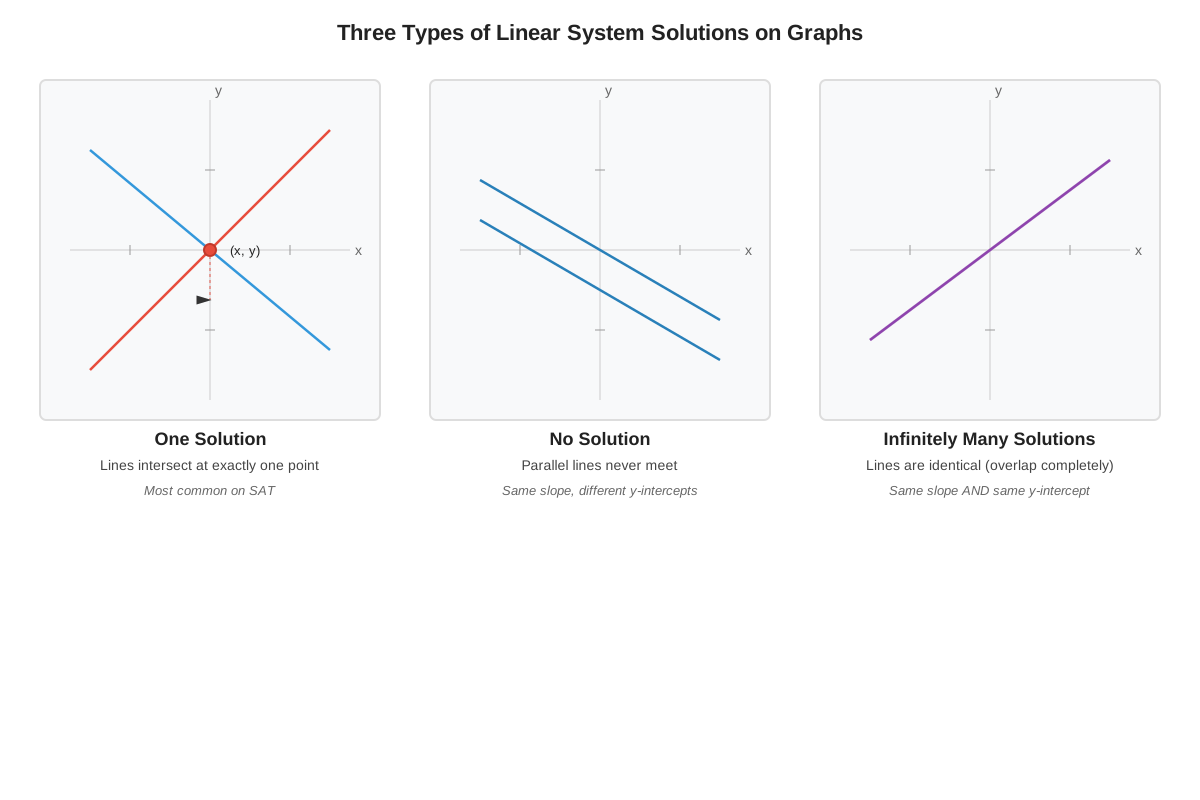
A system of linear equations consists of two or more equations that share the same variables. When these equations are graphed on the same coordinate plane, their solution is any point that satisfies all equations simultaneously. Graphically, this solution appears as the intersection point where the lines cross.
For a system of two linear equations, three scenarios exist:
| Scenario | Graphical Appearance | Number of Solutions | Algebraic Relationship |
|---|---|---|---|
| Intersecting lines | Lines cross at exactly one point | One unique solution | Different slopes |
| Parallel lines | Lines never intersect | No solution | Same slope, different y-intercepts |
| Coincident lines | Lines overlap completely | Infinitely many solutions | Identical equations (same slope and y-intercept) |
The most common SAT questions focus on the first scenario: finding the unique solution where two lines with different slopes intersect.
Reading Intersection Points
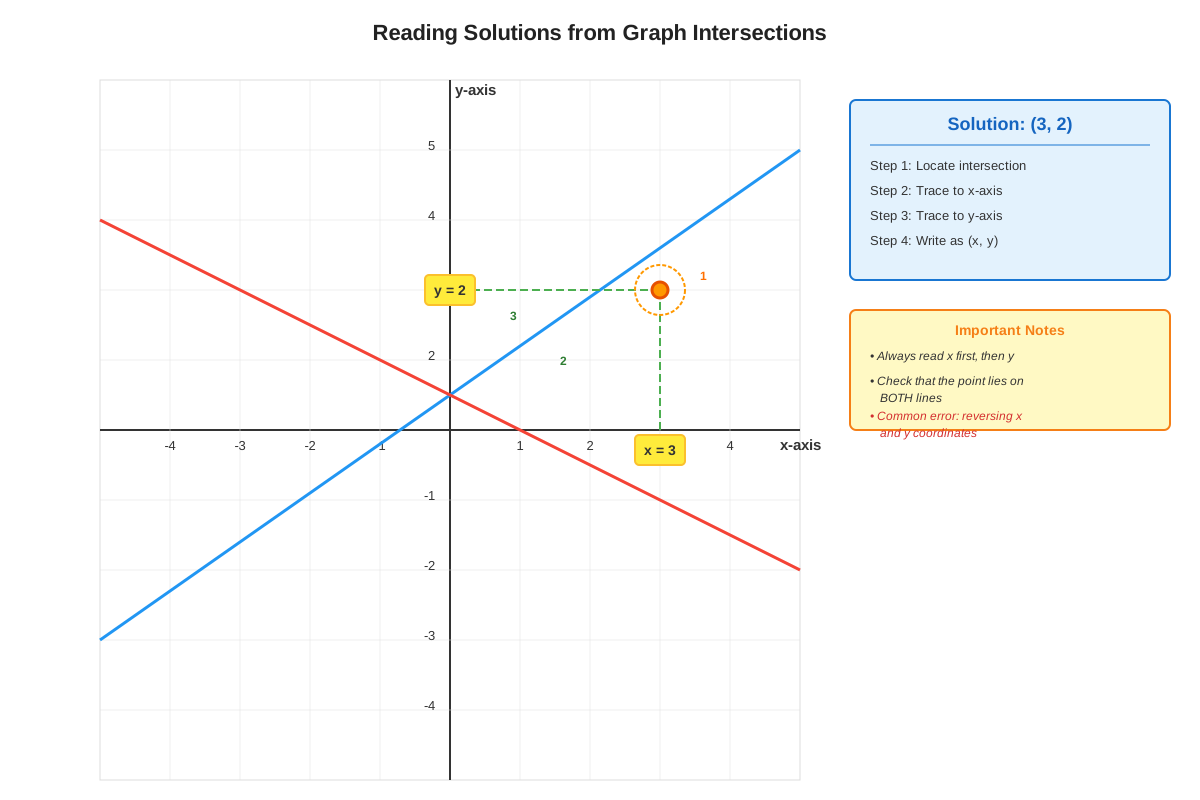
When two lines intersect on a coordinate plane, the coordinates of that intersection point represent the values of x and y that satisfy both equations. To read an intersection point correctly:
- Locate where the two lines cross
- Draw or visualize a vertical line down to the x-axis to find the x-coordinate
- Draw or visualize a horizontal line to the y-axis to find the y-coordinate
- Express the solution as an ordered pair (x, y)
Critical detail: Always verify the scale of each axis. SAT graphs may use scales other than 1 unit per grid line. A graph might show that each grid square represents 2 units, 5 units, or even 0.5 units. Misreading the scale is one of the most common errors on these questions.
Verifying Solutions
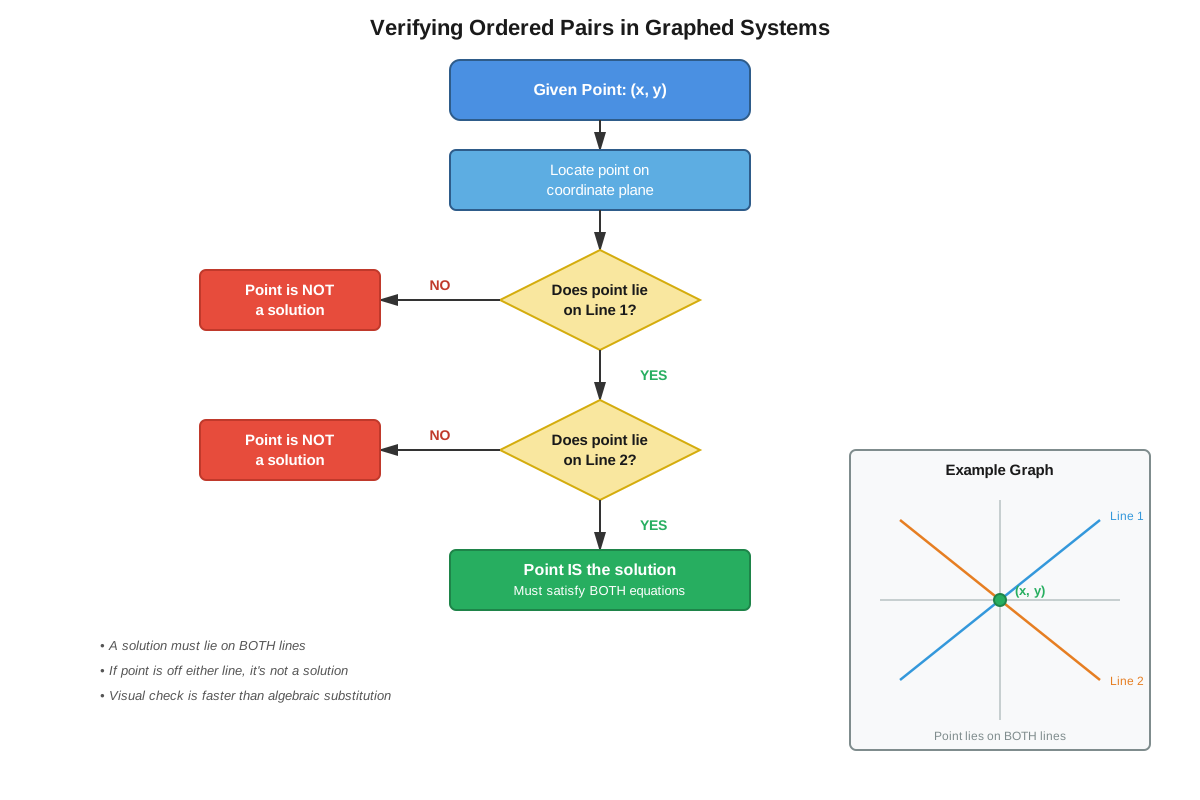
Given a graphed system and several ordered pairs, students must often determine which pair is the solution. The correct answer must:
- Lie exactly on both lines (not just near them)
- Have coordinates that align with the grid when accounting for scale
- Satisfy both equations if substituted algebraically (though this verification is usually unnecessary when the graph is clear)
When the intersection point falls between grid lines, estimate carefully or use the answer choices to eliminate impossible options. The SAT typically designs questions so that solutions fall on clear grid intersections or can be determined through process of elimination.
Parallel Lines and No Solution
When two lines are parallel, they have the same slope but different y-intercepts. Graphically, parallel lines never intersect, meaning there is no point that satisfies both equations simultaneously. The system has no solution.
On the SAT, questions about parallel lines might ask:
- "How many solutions does this system have?" (Answer: zero)
- "Which statement is true about this system?" (Answer: "The system has no solution" or "The lines never intersect")
- "For what value of k would the system have no solution?" (requiring students to recognize that making slopes equal creates parallel lines)
Coincident Lines and Infinitely Many Solutions
When two equations represent the same line (perhaps written in different forms), every point on that line satisfies both equations. This creates infinitely many solutions. Graphically, the lines appear as a single line because they overlap completely.
This scenario appears less frequently on the SAT but tests deeper understanding. Students must recognize that what appears to be a single line might actually represent two identical equations.
Estimating Solutions from Graphs
Not all SAT graphs show intersection points at neat integer coordinates. When the intersection falls between grid lines:
- Identify the nearest grid lines on both axes
- Estimate the fractional position between them
- Compare your estimate to the answer choices
- Eliminate answers that are clearly too far from the intersection
- Select the answer closest to your visual estimate
For example, if an intersection appears to occur at approximately x = 2.3 and y = -1.7, and the answer choices include (2, -2), (2.5, -1.5), (3, -1), and (2.5, -2), the second option (2.5, -1.5) is closest to the visual estimate.
Concept Relationships
The core concepts within systems from graphs build upon each other hierarchically. Understanding solutions graphically serves as the foundation → which enables reading intersection points accurately → which allows verifying solutions from multiple choices → while recognizing special cases like parallel lines (no solution) and coincident lines (infinitely many solutions) → all of which require estimating solutions when exact values aren't immediately clear.
This topic connects directly to prerequisite knowledge of coordinate planes and linear equations. Every point on a graphed line represents a solution to that individual equation, and the intersection represents the simultaneous solution to both. The concept extends forward to systems of inequalities (where solutions become regions rather than points) and to non-linear systems (where curves might intersect at multiple points).
The relationship to algebraic solution methods (substitution and elimination) is complementary: graphical methods provide visual intuition and quick approximations, while algebraic methods provide exact answers. Strong students can move between representations, using graphs to check algebraic work or using algebra to verify graphical readings.
High-Yield Facts
⭐ The solution to a system of two linear equations is the ordered pair (x, y) where the lines intersect on a coordinate plane
⭐ Always check the scale of both axes before reading coordinates—each grid line may represent more or less than 1 unit
⭐ Parallel lines (same slope, different y-intercepts) create systems with no solution
⭐ If two lines appear as one line on a graph, the system has infinitely many solutions
⭐ The x-coordinate of an intersection point is found by looking straight down to the x-axis; the y-coordinate by looking straight across to the y-axis
- When estimating intersection points between grid lines, eliminate answer choices that are clearly too far away before making a final selection
- A point that lies on one line but not the other is NOT a solution to the system—it must satisfy both equations
- The SAT may present systems where lines intersect outside the visible portion of the graph, requiring extrapolation or algebraic verification
- Questions asking "how many solutions" are testing whether students recognize parallel lines (0), intersecting lines (1), or coincident lines (infinitely many)
- If a question provides a system graphically and asks for a specific coordinate (like "What is the x-coordinate of the solution?"), only one coordinate needs to be determined
- Horizontal lines have the form y = k and vertical lines have the form x = k; their intersection is simply (k₁, k₂) where k₁ is the x-value and k₂ is the y-value
Quick check — test yourself on Systems from graphs so far.
Try Flashcards →Common Misconceptions
Misconception: The solution is where the lines are closest together, even if they don't actually touch → Correction: The solution exists only where lines intersect exactly. Parallel lines have no solution regardless of how close they appear.
Misconception: Reading coordinates as (y, x) instead of (x, y) → Correction: Ordered pairs are always written (x, y), where x is the horizontal coordinate (found on the x-axis) and y is the vertical coordinate (found on the y-axis). Always read x first.
Misconception: Assuming each grid line represents 1 unit without checking the scale → Correction: SAT graphs frequently use scales where each grid line represents 2, 5, 10, or even fractional units. Always check axis labels before reading coordinates.
Misconception: Believing that if two lines look parallel, they must be parallel → Correction: Visual appearance can be deceiving, especially when axes have different scales. Lines that appear nearly parallel might actually intersect far outside the visible window. Check slopes algebraically if equations are provided.
Misconception: Thinking that a point near the intersection is "close enough" to be the solution → Correction: Only the exact intersection point is the solution. A point that's close but doesn't lie on both lines satisfies neither equation or only one equation, making it incorrect.
Misconception: Assuming all systems have exactly one solution → Correction: Systems can have one solution (intersecting lines), no solution (parallel lines), or infinitely many solutions (coincident lines). The number of solutions depends on the relationship between the lines.
Worked Examples
Example 1: Finding the Solution from a Graph
Problem: The graph below shows two lines representing the equations y = 2x - 3 and y = -x + 3. What is the solution to this system?
[Graph description: A coordinate plane with x-axis from -2 to 6 and y-axis from -4 to 6. One line passes through points (0, -3) and (2, 1). Another line passes through points (0, 3) and (3, 0). The lines intersect at point (2, 1).]
Solution:
Step 1: Locate the intersection point where both lines cross. Visually, this occurs at a point in the first quadrant.
Step 2: From the intersection point, trace straight down to the x-axis. The vertical line hits the x-axis at x = 2.
Step 3: From the intersection point, trace straight across to the y-axis. The horizontal line hits the y-axis at y = 1.
Step 4: Express the solution as an ordered pair: (2, 1)
Step 5: Verify (optional but recommended):
- For y = 2x - 3: Does 1 = 2(2) - 3? Yes, 1 = 4 - 3 ✓
- For y = -x + 3: Does 1 = -(2) + 3? Yes, 1 = -2 + 3 ✓
Answer: The solution to the system is (2, 1).
This example demonstrates the core skill of reading intersection points and connects to the learning objective of applying systems from graphs to answer SAT-style questions.
Example 2: Determining Number of Solutions
Problem: A system of two linear equations is graphed on a coordinate plane. Line m has a slope of 3 and passes through the point (0, -2). Line n has a slope of 3 and passes through the point (0, 4). How many solutions does this system have?
Solution:
Step 1: Identify the key information about each line:
- Line m: slope = 3, y-intercept = -2
- Line n: slope = 3, y-intercept = 4
Step 2: Compare the slopes. Both lines have a slope of 3, meaning they rise at the same rate.
Step 3: Compare the y-intercepts. Line m crosses the y-axis at -2, while line n crosses at 4. These are different points.
Step 4: Apply the relationship between slopes and intersections:
- Same slope + different y-intercepts = parallel lines
- Parallel lines never intersect
Step 5: Conclude that the system has no solution.
Answer: The system has 0 solutions (no solution).
Alternative approach: If you were to graph these lines, you would see two parallel lines that never meet. Line m would be the equation y = 3x - 2, and line n would be y = 3x + 4. Since they have identical slopes but different y-intercepts, they maintain a constant vertical distance apart and never intersect.
This example addresses the learning objective of distinguishing between systems with different numbers of solutions and demonstrates how to identify parallel lines from their properties.
Exam Strategy
When approaching SAT questions on systems from graphs, follow this systematic process:
Step 1: Identify what the question asks. Are you finding the solution, verifying a given point, determining the number of solutions, or finding just one coordinate? Many students lose points by finding the correct intersection but reporting the wrong coordinate.
Step 2: Check the scale immediately. Before reading any coordinates, look at the axis labels. Note whether each grid line represents 1, 2, 5, or another value. Mark this mentally or on your test booklet.
Step 3: Locate the intersection point carefully. Use your pencil or finger to trace from the intersection to both axes. Don't estimate until you've eliminated impossible answers.
Trigger words and phrases to watch for:
- "Solution to the system" → find the intersection point
- "How many solutions" → determine if lines are parallel, intersecting, or coincident
- "Which ordered pair" → verify which point lies on both lines
- "x-coordinate of the solution" → only find the x-value
- "y-coordinate of the solution" → only find the y-value
Process of elimination tips:
- Eliminate any answer choice where the x-coordinate is clearly on the wrong side of the y-axis
- Eliminate any answer choice where the y-coordinate is clearly on the wrong side of the x-axis
- If the intersection is in Quadrant I (both positive), eliminate any answers with negative coordinates
- If the intersection appears to be at approximately x = 3, eliminate answers like x = 7 or x = -2
Time allocation: These questions should take 30-60 seconds each. If you're spending more than 90 seconds, you may be overthinking. Trust your visual reading and use process of elimination. Don't waste time verifying algebraically unless you're genuinely uncertain about your graphical reading.
Exam Tip: If the intersection point falls exactly on a grid intersection, you can be confident in your answer. If it falls between grid lines, use the answer choices to guide your estimate—the correct answer will be closest to what you see.
Memory Techniques
Mnemonic for reading coordinates: "X marks the spot, then Y fly high"
- First read the X-coordinate (horizontal position)
- Then read the Y-coordinate (vertical position)
- This prevents the common error of reversing coordinates
Visualization for number of solutions: "The Three Line Stories"
- One solution: Lines CROSS (like an X) → one intersection point
- No solution: Lines are PARALLEL (like railroad tracks) → never meet
- Infinite solutions: Lines are IDENTICAL (like twins) → every point matches
Acronym for checking graphs: SAIL
- Scale: Check what each grid line represents
- Axes: Identify which is x and which is y
- Intersection: Locate where lines cross
- Label: Write the ordered pair (x, y)
Mental image for parallel lines: Picture railroad tracks extending forever. No matter how far they go, they never meet. Same with parallel lines—same slope means they maintain constant distance.
Finger technique: When reading coordinates from a graph, physically place one finger on the intersection point, then slide it straight down to the x-axis (keeping it vertical) to find x, then return to the intersection and slide straight across to the y-axis (keeping it horizontal) to find y. This physical motion prevents diagonal reading errors.
Summary
Systems from graphs is a high-yield SAT Math topic that tests the ability to interpret visual representations of linear equations and identify their solutions. The fundamental principle is that the solution to a system of two linear equations is the ordered pair (x, y) where the lines intersect on a coordinate plane. Students must master reading intersection points accurately by checking axis scales, tracing coordinates carefully, and distinguishing between the three possible scenarios: one solution (intersecting lines with different slopes), no solution (parallel lines with the same slope but different y-intercepts), and infinitely many solutions (coincident lines that overlap completely). Success requires both conceptual understanding of what solutions represent and practical skills in reading graphs precisely, estimating when necessary, and avoiding common errors like reversing coordinates or misreading scales. These questions appear frequently on the SAT and offer opportunities for quick points when approached systematically.
Key Takeaways
- The solution to a graphed system is the (x, y) coordinate where the lines intersect; always read x first (horizontal), then y (vertical)
- Check the scale of both axes before reading any coordinates—each grid line may represent a value other than 1
- Parallel lines (same slope, different intercepts) mean no solution; coincident lines (identical equations) mean infinitely many solutions; intersecting lines mean exactly one solution
- Use process of elimination by checking which quadrant the intersection falls in and eliminating answers with impossible signs
- When intersection points fall between grid lines, estimate carefully and choose the answer closest to your visual reading
- Verify your answer makes sense: if the intersection appears to be at approximately (3, 2), an answer of (8, -5) is clearly wrong
- These questions should take 30-60 seconds; trust your visual reading and don't overthink
Related Topics
Systems of Linear Inequalities: After mastering systems from graphs with equations, the next step is understanding how inequalities create solution regions rather than single points. Shaded regions replace intersection points, and students must determine which areas satisfy all inequalities simultaneously.
Algebraic Methods for Solving Systems: While this topic focuses on graphical solutions, learning substitution and elimination methods provides algebraic tools to find exact solutions and verify graphical readings, especially when graphs show approximate intersections.
Slope and Linear Equations: Deeper understanding of slope enables students to quickly identify parallel lines (equal slopes) and perpendicular lines (negative reciprocal slopes), which frequently appear in systems questions.
Quadratic and Non-Linear Systems: Once linear systems are mastered, students can extend these graphical interpretation skills to systems involving parabolas, circles, and other curves, where multiple intersection points may exist.
Practice CTA
Now that you've mastered the core concepts of systems from graphs, it's time to solidify your understanding through practice. Attempt the practice questions to apply these strategies to real SAT-style problems, and use the flashcards to reinforce key facts and definitions. Remember: graphical systems questions are high-yield opportunities for quick points when you approach them systematically. The more you practice reading graphs accurately and identifying intersection points, the faster and more confident you'll become. You've got this!
Sign up free to keep reading
Create a free AnvayaPrep account to finish this SAT guide on Systems from graphs — plus flashcards and practice questions.