Overview
Systems with constants represent a critical category of algebraic problems on the SAT Math section where students must work with systems of linear equations that contain unknown constant values. Unlike standard systems where all coefficients and constants are known numbers, these problems introduce variables (typically represented by letters like a, b, c, or k) that act as constants within the equations. Students must determine relationships between these constants, solve for their values, or use them to find solutions to the system.
This topic appears frequently on the SAT because it tests multiple mathematical competencies simultaneously: algebraic manipulation, systems of equations, abstract reasoning, and the ability to work with parameters rather than concrete numbers. The College Board uses these problems to distinguish between students who have merely memorized procedures and those who genuinely understand the underlying mathematical structures. Questions involving sat systems with constants typically appear in both the calculator and no-calculator sections, often as medium-to-hard difficulty problems worth crucial points.
Understanding systems with constants builds directly upon foundational knowledge of solving standard linear systems while preparing students for more advanced math concepts they'll encounter in college coursework. This topic connects systems of equations to concepts like parametric equations, families of functions, and conditions for special solution types (no solution, infinitely many solutions). Mastery of this material demonstrates mathematical maturity and flexible thinking—qualities that correlate strongly with overall SAT Math performance.
Learning Objectives
- [ ] Identify key features of systems with constants, including which values are variables and which are parameters
- [ ] Explain how systems with constants appears on the SAT, including common question formats and difficulty patterns
- [ ] Apply systems with constants to answer SAT-style questions using substitution, elimination, and strategic reasoning
- [ ] Determine the conditions under which a system with constants has no solution, one solution, or infinitely many solutions
- [ ] Manipulate equations containing constants to isolate specific parameters or express relationships between them
- [ ] Recognize when to treat constants as fixed values versus when to solve for them directly
Prerequisites
- Solving standard systems of linear equations: Systems with constants extend this foundational skill by introducing parameters that must be manipulated algebraically
- Substitution and elimination methods: These techniques remain the primary tools for working with systems containing constants
- Understanding slope-intercept form (y = mx + b): Recognizing how constants affect slope and y-intercept helps identify solution conditions
- Basic algebraic manipulation: Distributing, combining like terms, and isolating variables are essential for working with parametric expressions
- Concept of variables versus constants: Distinguishing between unknowns to solve for and fixed (but unknown) parameters is crucial
Why This Topic Matters
In real-world applications, systems with constants model situations where certain parameters remain fixed but unknown—such as pricing structures with unknown markup rates, physics problems with unknown coefficients, or economic models with variable constants. Engineers use parametric systems to design flexible solutions that work across ranges of specifications. Data scientists employ similar reasoning when working with models containing hyperparameters.
On the SAT, systems with constants appear in approximately 10-15% of algebra questions, making them a high-yield topic for score improvement. These problems typically appear as:
- Multiple-choice questions asking for the value of a constant given solution conditions
- Grid-in questions requiring calculation of specific parameter values
- Questions about the number of solutions based on constant relationships
- Problems requiring students to express one constant in terms of another
The College Board strategically places these questions in positions 10-20 (medium-hard range) on both calculator and no-calculator sections. Students who master this topic gain significant competitive advantage, as these questions often separate score ranges in the 650-750 band. The abstract reasoning required mirrors the mathematical thinking tested on the most challenging SAT problems, making this topic an excellent indicator of readiness for college-level mathematics.
Core Concepts
Understanding Constants as Parameters
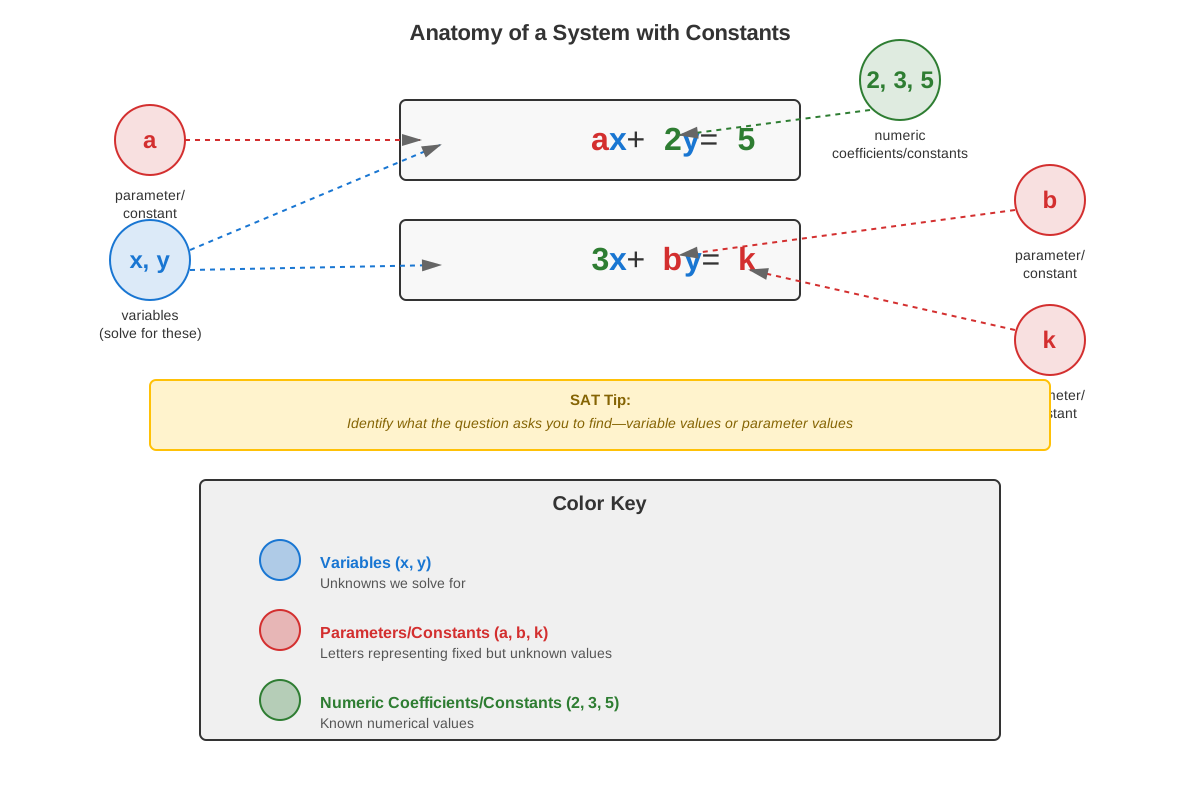
In systems with constants, certain letters represent fixed but unknown values rather than variables to solve for. For example, in the system:
ax + 2y = 10
3x + by = 15
The letters a and b are constants (parameters), while x and y are the variables. The key distinction: we're typically asked to find values of a or b that produce specific solution conditions, or to find x and y in terms of the constants.
This differs fundamentally from standard systems where all coefficients are known numbers. The presence of constants requires students to think more abstractly and often work backward from desired solution properties.
Types of Questions Involving Constants
Type 1: Finding Constant Values Given a Solution
When a problem states that a specific point (x, y) is a solution to a system containing constants, substitute those values and solve for the constants.
Example: If (2, 3) is a solution to the system above:
- Substitute into first equation: a(2) + 2(3) = 10 → 2a + 6 = 10 → a = 2
- Substitute into second equation: 3(2) + b(3) = 15 → 6 + 3b = 15 → b = 3
Type 2: Determining Solution Conditions
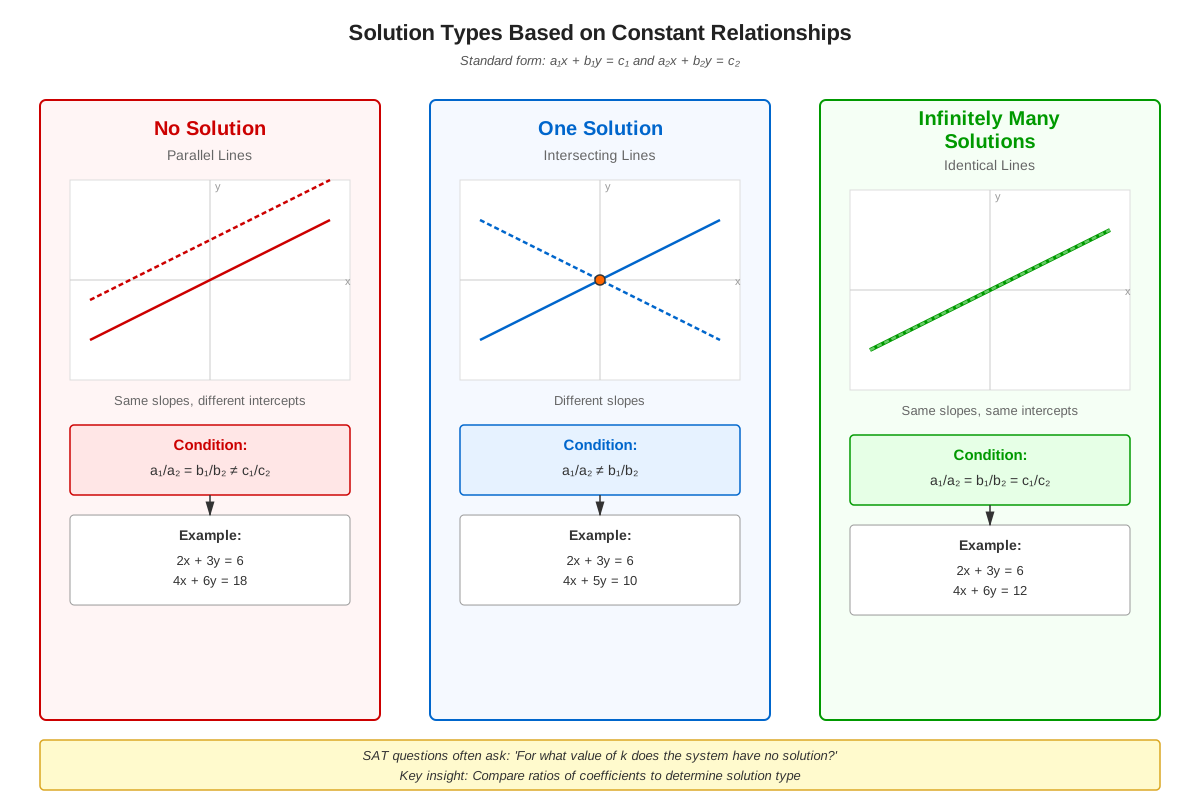
Systems can have:
- One unique solution: Lines intersect at one point (different slopes)
- No solution: Lines are parallel (same slope, different y-intercepts)
- Infinitely many solutions: Lines are identical (same slope and y-intercept)
For a system in standard form:
a₁x + b₁y = c₁
a₂x + b₂y = c₂| Solution Type | Condition |
|---|---|
| One solution | a₁/a₂ ≠ b₁/b₂ |
| No solution | a₁/a₂ = b₁/b₂ ≠ c₁/c₂ |
| Infinitely many | a₁/a₂ = b₁/b₂ = c₁/c₂ |
Type 3: Expressing Variables in Terms of Constants
Sometimes the SAT asks for the solution to a system where the answer contains the constants.
Example: Solve for x and y:
x + ky = 5
2x - y = 3
Using elimination or substitution yields expressions like x = (5 + 3k)/(1 + 2k), where the answer is written in terms of k.
Working with Elimination Method
When using elimination with constants, the process remains the same but requires careful algebraic manipulation:
- Align equations in standard form
- Multiply equations by appropriate factors (which may include constants)
- Add or subtract to eliminate one variable
- Solve for the remaining variable in terms of constants if needed
Working with Substitution Method
Substitution often proves more efficient when one equation can be easily solved for a variable:
- Isolate one variable in terms of the other (and possibly constants)
- Substitute this expression into the second equation
- Solve for the remaining variable
- Back-substitute to find the other variable
Special Cases and Constraints
When problems ask "for what value of k does the system have no solution?", convert both equations to slope-intercept form and set slopes equal while ensuring y-intercepts differ:
y = m₁x + b₁
y = m₂x + b₂
For no solution: m₁ = m₂ and b₁ ≠ b₂
For infinitely many solutions: m₁ = m₂ and b₁ = b₂
Ratio and Proportion Relationships
Many SAT problems with constants involve recognizing proportional relationships between coefficients. If:
ax + by = c
dx + ey = f
And the system has infinitely many solutions, then a/d = b/e = c/f (all coefficients are proportional).
Concept Relationships
The core concepts within systems with constants build upon each other hierarchically. Understanding constants as parameters forms the foundation → this enables identifying solution types based on coefficient relationships → which leads to determining specific constant values that produce desired solution conditions → ultimately allowing students to solve systems symbolically with answers expressed in terms of parameters.
Systems with constants connect backward to prerequisite topics: standard systems of equations provide the solution methods (substitution and elimination), while slope-intercept form offers the framework for analyzing parallel and coincident lines. The concept of variables versus constants from basic algebra becomes crucial for proper problem setup.
Forward connections include: parametric equations in precalculus, families of functions in advanced algebra, and partial derivatives in calculus. The abstract reasoning developed here transfers directly to optimization problems and modeling with constraints—both common on the SAT Math section.
Horizontally, this topic relates to linear functions, graphing systems, and word problems with unknown quantities. The skill of working with parameters appears across multiple SAT domains, making this a high-leverage topic for overall score improvement.
High-Yield Facts
⭐ When a specific point (x, y) is given as a solution, substitute those values into both equations to create a system you can solve for the constants
⭐ For no solution: coefficients of x and y must be proportional, but constant terms must not be proportional
⭐ For infinitely many solutions: all coefficients including constant terms must be proportional (one equation is a multiple of the other)
⭐ Converting to slope-intercept form (y = mx + b) makes it easier to compare slopes and identify solution types
⭐ The ratio test: if a₁/a₂ = b₁/b₂ = c₁/c₂, the system has infinitely many solutions
- When solving for a constant, treat it as the variable and treat the actual variables as if they were numbers
- Systems with constants often appear in questions 15-20 on each Math section, indicating medium-high difficulty
- If asked "for what value of k does the system have exactly one solution?", find values that make slopes different
- Grid-in questions with constants typically have integer or simple fraction answers
- When multiple constants appear, look for relationships between them rather than individual values
Quick check — test yourself on Systems with constants so far.
Try Flashcards →Common Misconceptions
Misconception: All letters in an equation are variables that need to be solved for → Correction: In systems with constants, some letters represent fixed parameters while others are true variables. The problem context determines which is which—typically x and y are variables, while a, b, c, k are constants.
Misconception: If two equations look different, they can't have infinitely many solutions → Correction: Equations can be identical even when they appear different. For example, 2x + 4y = 6 and x + 2y = 3 represent the same line (the first is just double the second), so they have infinitely many solutions.
Misconception: To find a constant's value, you need to solve the entire system first → Correction: Often you can find constant values directly by substituting a given solution point, without fully solving the system. This is faster and less error-prone.
Misconception: Parallel lines have the same equation → Correction: Parallel lines have the same slope but different y-intercepts. Identical lines (infinitely many solutions) have both the same slope and y-intercept.
Misconception: When a problem asks for "the value of k," there's always exactly one answer → Correction: Sometimes the question asks for k values that produce specific conditions. There might be one value, multiple values, or even restrictions (like k ≠ some value).
Misconception: You can't use elimination when constants are present → Correction: Elimination works perfectly with constants—you just need to be careful with algebraic manipulation. Multiply equations by factors that may include constants, then combine as usual.
Worked Examples
Example 1: Finding a Constant Given a Solution Point
Problem: The point (4, -1) is a solution to the system:
kx + 3y = 7
2x - y = 9
What is the value of k?
Solution:
Step 1: Verify the point satisfies the second equation (this confirms the given information is consistent):
2(4) - (-1) = 8 + 1 = 9 ✓Step 2: Substitute x = 4 and y = -1 into the first equation:
k(4) + 3(-1) = 7
4k - 3 = 7
Step 3: Solve for k:
4k = 10
k = 10/4 = 5/2Answer: k = 5/2 or 2.5
Connection to Learning Objectives: This demonstrates applying systems with constants to SAT-style questions by using substitution of known solution points—a high-frequency question type.
Example 2: Determining Conditions for No Solution
Problem: For what value of a does the following system have no solution?
3x + 6y = 12
ax + 4y = 10Solution:
Step 1: Convert both equations to slope-intercept form to compare slopes.
First equation:
6y = -3x + 12
y = -1/2 x + 2
Slope₁ = -1/2, y-intercept₁ = 2
Second equation:
4y = -ax + 10
y = -a/4 x + 10/4
Slope₂ = -a/4, y-intercept₂ = 5/2
Step 2: For no solution, slopes must be equal but y-intercepts must differ.
Set slopes equal:
-1/2 = -a/4Multiply both sides by -4:
2 = aStep 3: Verify y-intercepts differ when a = 2:
y-intercept₁ = 2
y-intercept₂ = 5/2 = 2.5
Since 2 ≠ 2.5, the lines are parallel (no solution) ✓
Answer: a = 2
Connection to Learning Objectives: This exemplifies identifying key features of systems with constants (specifically, the relationship between coefficients that determines solution type) and explains how this concept appears on the SAT through condition-based questions.
Exam Strategy
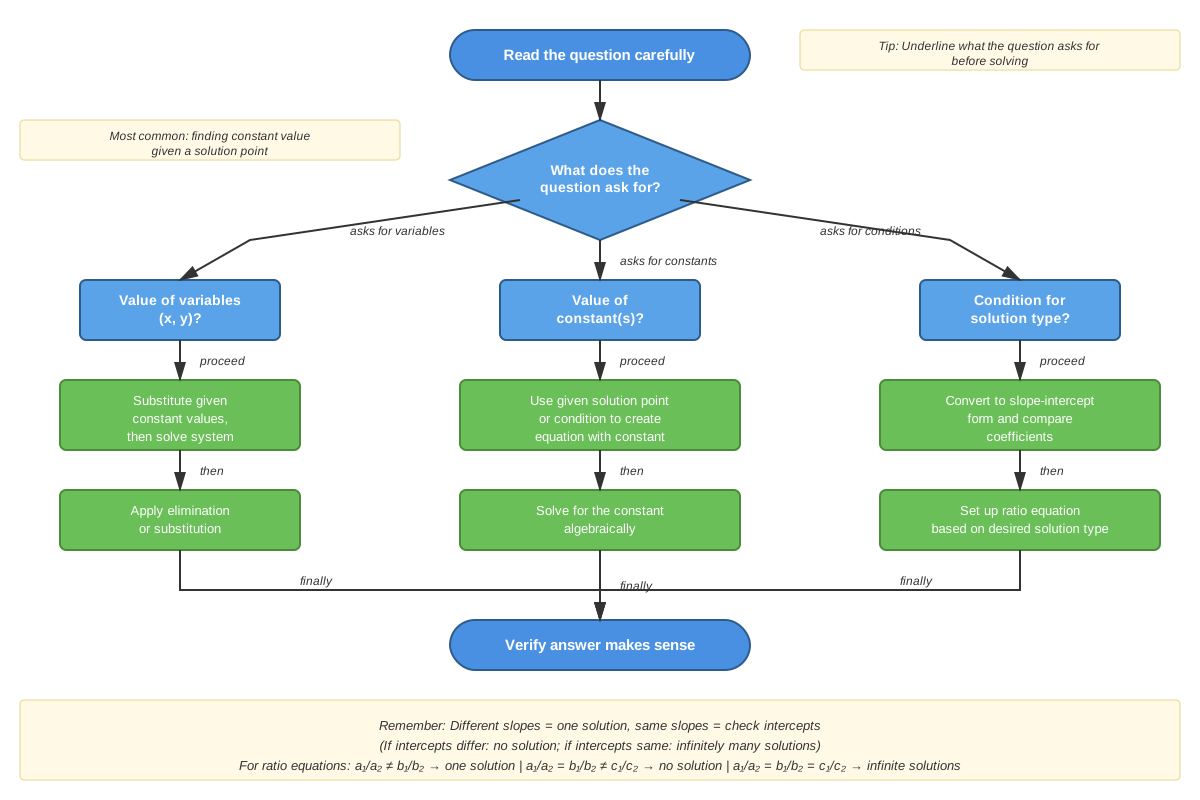
Approach Sequence for SAT Questions:
- Identify what's being asked: Are you finding a constant value, determining solution conditions, or solving for variables in terms of constants?
- Classify the constants: Determine which letters are parameters (constants) and which are variables to solve for
- Choose your method:
- If given a solution point → substitute directly
- If asked about solution type → compare slopes/coefficients
- If solving the system → use substitution or elimination
- Work algebraically: Treat constants like numbers during manipulation, being careful with division (constants might be zero)
Trigger Words and Phrases:
- "For what value of [constant]..." → You're finding the constant's value
- "...has no solution" → Set slopes equal, y-intercepts different
- "...has infinitely many solutions" → All coefficients must be proportional
- "If (a, b) is a solution..." → Substitute these values immediately
- "In terms of k..." → Your answer will contain the constant
Process of Elimination Tips:
- Eliminate answer choices that would make denominators zero (unless the problem specifically addresses this)
- If asked for a constant that produces "no solution," eliminate any value that makes the equations identical
- For "infinitely many solutions," only one answer choice will make all coefficient ratios equal
- Check extreme values: if k = 0 or k = 1 seems too simple, verify it actually works
Time Allocation:
- Spend 15-20 seconds reading and classifying the problem type
- Allow 45-60 seconds for algebraic work
- Reserve 15 seconds to verify your answer makes sense
- If stuck after 90 seconds, mark for review and move on—these problems can be time traps
Exam Tip: When converting to slope-intercept form, write out each step clearly. Small algebraic errors in sign or coefficient manipulation are the most common mistakes on these problems.
Memory Techniques
Mnemonic for Solution Types - "NIP":
- No solution: Not proportional constants (slopes equal, y-intercepts not)
- Infinitely many: Identical ratios (all coefficients proportional)
- Precisely one: Proportions don't match (slopes different)
Visualization Strategy:
Picture three scenarios with two pencils:
- One solution: Pencils cross (X shape)
- No solution: Pencils parallel (= shape)
- Infinitely many: Pencils overlapping (one pencil)
Acronym for Problem-Solving Steps - "SCAV":
- Substitute if given a point
- Convert to slope-intercept form for comparison
- Align coefficients for elimination
- Verify your answer makes sense
Ratio Memory Device:
For infinitely many solutions, remember "All or Nothing": ALL coefficient ratios must equal, or you have NOTHING (not infinitely many solutions).
Constant vs. Variable Reminder:
"XY marks the spot" → x and y are almost always the variables; other letters are constants.
Summary
Systems with constants represent a sophisticated extension of standard linear systems where unknown parameters appear as coefficients or constant terms. These problems require students to work abstractly with letters representing fixed values while solving for variables or determining relationships between parameters. The three critical solution types—one solution, no solution, and infinitely many solutions—depend on proportional relationships between coefficients. When lines have equal slopes but different y-intercepts, no solution exists; when all coefficients are proportional, infinitely many solutions exist; otherwise, exactly one solution exists. SAT questions typically ask students to find constant values given solution points (substitute and solve), determine which constant values produce specific solution conditions (compare slopes and intercepts), or solve systems symbolically with answers expressed in terms of parameters. Success requires fluency with both substitution and elimination methods, comfort converting between standard and slope-intercept forms, and the ability to distinguish between variables and parameters. This high-yield topic appears regularly in medium-to-hard SAT questions and serves as an excellent indicator of mathematical maturity and readiness for college-level mathematics.
Key Takeaways
- Systems with constants contain parameters (like a, b, k) that are fixed but unknown, distinct from variables (x, y) that you solve for
- Substitute given solution points directly into equations to create solvable systems for finding constant values—this is the most common SAT question type
- For no solution, slopes must be equal but y-intercepts must differ; for infinitely many solutions, all coefficient ratios must be equal
- Converting to slope-intercept form (y = mx + b) simplifies comparison of slopes and identification of solution types
- The ratio test provides a quick check: if a₁/a₂ = b₁/b₂ = c₁/c₂, the system has infinitely many solutions
- Treat constants like numbers during algebraic manipulation, but remember they represent unknown fixed values
- These problems appear in 10-15% of SAT algebra questions, typically in positions 15-20, making them high-yield for score improvement
Related Topics
Systems of Linear Inequalities: Extends systems with constants to inequality relationships, requiring understanding of solution regions rather than points. Mastering systems with constants provides the algebraic foundation for working with parametric inequalities.
Quadratic Systems: Involves systems where at least one equation is quadratic, often containing constants that affect the number and nature of solutions. The reasoning about solution types transfers directly from linear systems with constants.
Parametric Equations: Uses parameters to express coordinates as functions of a third variable, building on the concept of treating certain letters as fixed values. Understanding constants as parameters is essential preparation.
Functions with Parameters: Explores families of functions where constants determine specific function behavior, directly applying the abstract reasoning developed through systems with constants.
Matrix Methods for Systems: Provides alternative solution techniques using matrices and determinants, where constants appear as matrix entries. The conceptual understanding of systems with constants makes matrix methods more intuitive.
Practice CTA
Now that you've mastered the core concepts of systems with constants, it's time to solidify your understanding through active practice. The practice questions have been specifically designed to mirror actual SAT problem types and difficulty levels, giving you the opportunity to apply substitution techniques, analyze solution conditions, and work with parameters confidently. Each problem you solve strengthens your pattern recognition and builds the speed you'll need on test day. The flashcards will help you internalize the key facts and relationships, making them instantly accessible during the exam. Remember: systems with constants separate good scores from great scores—your investment in mastering this topic will pay dividends across the entire Math section. You've got this!
Sign up free to keep reading
Create a free AnvayaPrep account to finish this SAT guide on Systems with constants — plus flashcards and practice questions.