Overview
Systems with parameters represent a sophisticated category of linear equation problems that frequently appear on the SAT Math section. In these problems, one or more coefficients or constants in a system of equations are represented by variables (called parameters) rather than specific numbers. Students must analyze how these parameters affect the solution set—whether the system has no solution, exactly one solution, or infinitely many solutions. This topic tests algebraic reasoning, conceptual understanding of linear systems, and the ability to work abstractly with variables representing unknown values.
Mastering sat systems with parameters is essential because these questions assess higher-order thinking skills that distinguish top scorers from average performers. Rather than simply solving for x and y, students must reason about relationships between equations, understand when lines are parallel versus coincident, and manipulate algebraic expressions symbolically. These problems typically appear 1-2 times per SAT administration and are often positioned in the later, more challenging portions of the math section.
This topic builds directly on foundational knowledge of solving systems of linear equations and extends into abstract algebraic reasoning. Understanding systems with parameters strengthens overall algebraic fluency and prepares students for more advanced mathematical thinking. The skills developed here—analyzing relationships between equations, determining conditions for specific solution types, and working with symbolic representations—transfer to numerous other SAT math topics including functions, quadratic equations, and data analysis.
Learning Objectives
- [ ] Identify key features of systems with parameters
- [ ] Explain how systems with parameters appears on the SAT
- [ ] Apply systems with parameters to answer SAT-style questions
- [ ] Determine the conditions under which a system with parameters has no solution, one solution, or infinitely many solutions
- [ ] Manipulate equations containing parameters to isolate the parameter value that produces a desired solution type
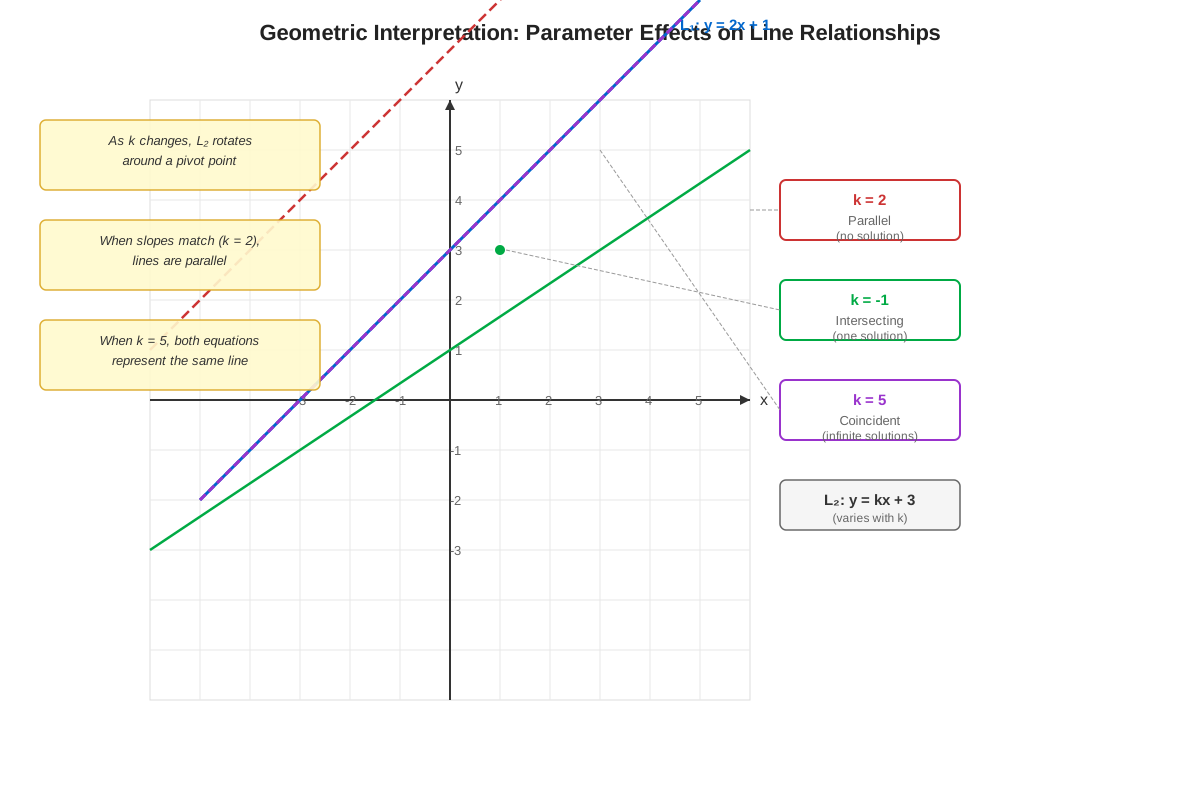
- [ ] Recognize the geometric interpretation of parameter conditions (parallel lines, intersecting lines, coincident lines)
Prerequisites
- Solving systems of linear equations: Students must be proficient with substitution and elimination methods, as these techniques form the foundation for analyzing parametric systems
- Understanding slope-intercept form (y = mx + b): Recognizing how coefficients relate to slope and y-intercept is crucial for determining when lines are parallel or coincident
- Basic algebraic manipulation: Facility with distributing, combining like terms, and isolating variables enables students to work with parameter expressions
- Concept of solution sets: Understanding what it means for a system to have zero, one, or infinite solutions provides the conceptual framework for parameter analysis
Why This Topic Matters
Systems with parameters appear in real-world applications whenever relationships between quantities depend on unknown or variable conditions. Engineers use parametric systems to model scenarios where design specifications aren't yet finalized. Economists employ them to analyze market equilibrium under varying policy conditions. Computer scientists use parametric equations in graphics programming and algorithm design.
On the SAT, systems with parameters typically appear 1-2 times per test administration, most commonly in the calculator-permitted section. These questions usually appear as multiple-choice problems worth 1 point each, though they occasionally surface as student-produced response (grid-in) questions. According to College Board data, these problems have among the lowest correct response rates in the linear equations category, making them high-value targets for score improvement.
Common SAT presentations include: asking for the parameter value that makes a system have no solution (parallel lines), determining the parameter that creates infinitely many solutions (coincident lines), or finding parameter values that produce a specific solution point. Questions may present systems in standard form, slope-intercept form, or mixed formats, requiring students to convert between representations to analyze the parameter's effect.
Core Concepts
Understanding Parameters in Linear Systems
A parameter is a variable (often represented by letters like k, a, b, or c) that appears in the coefficients or constants of a system of equations. Unlike the variables we solve for (typically x and y), parameters represent unknown values that determine the characteristics of the system itself. For example, in the system:
2x + 3y = 6
kx + 9y = 18
The letter k is a parameter. The solution behavior of this system depends entirely on what value k takes.
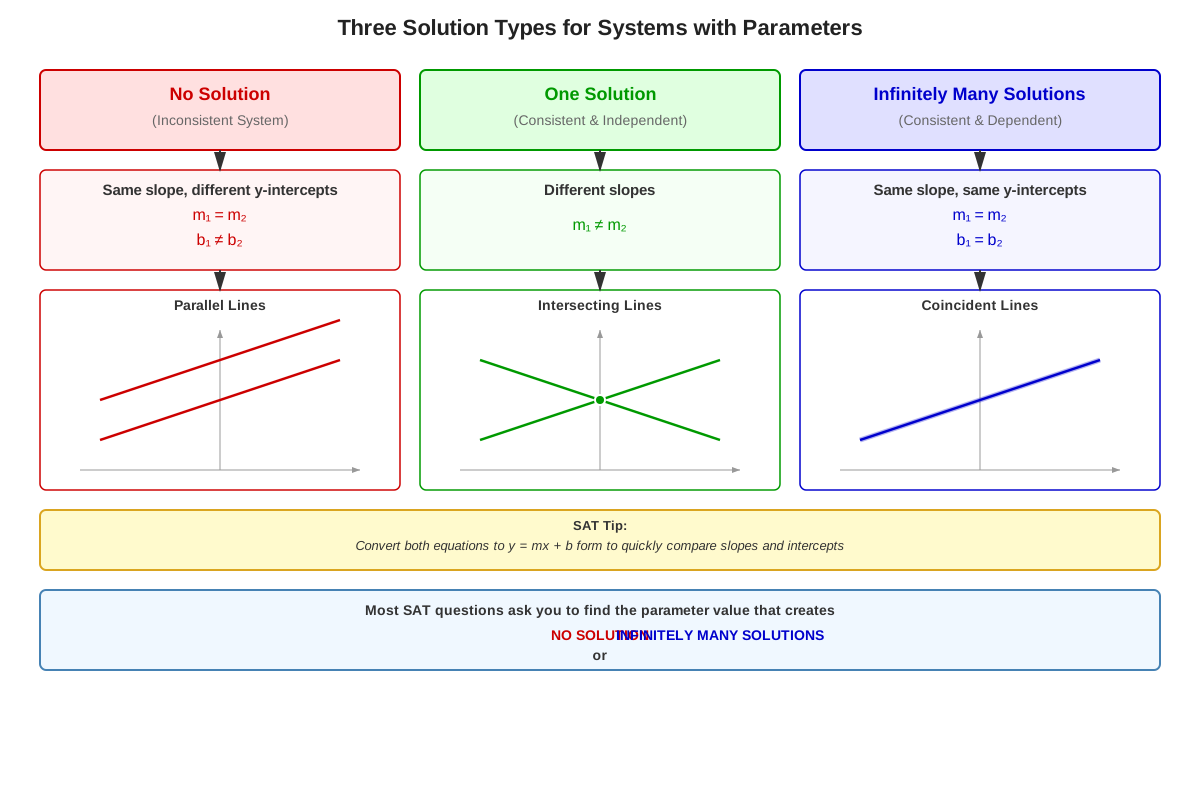
The Three Solution Types
Every system of two linear equations in two variables falls into exactly one of three categories:
- No solution (inconsistent system): The lines are parallel but not coincident
- Exactly one solution (independent system): The lines intersect at a single point
- Infinitely many solutions (dependent system): The lines are coincident (the same line)
The parameter value determines which category applies. Understanding the algebraic and geometric conditions for each type is fundamental to solving these problems.
Conditions for No Solution (Parallel Lines)
Two lines are parallel when they have the same slope but different y-intercepts. For a system to have no solution, the equations must be inconsistent—they describe parallel lines that never intersect.
Algebraic condition: When using elimination or substitution, the variables cancel out completely, leaving a false statement (like 0 = 5).
Slope-intercept condition: For equations in the form y = m₁x + b₁ and y = m₂x + b₂, the system has no solution when m₁ = m₂ but b₁ ≠ b₂.
Standard form condition: For equations Ax + By = C and Dx + Ey = F, the system has no solution when A/D = B/E but A/D ≠ C/F (assuming D, E, F ≠ 0).
Conditions for Infinitely Many Solutions (Coincident Lines)
Two equations represent the same line when one equation is a scalar multiple of the other. Every point on the line satisfies both equations, creating infinitely many solutions.
Algebraic condition: When solving, all variables cancel out, leaving a true statement (like 0 = 0 or 5 = 5).
Slope-intercept condition: For y = m₁x + b₁ and y = m₂x + b₂, infinitely many solutions exist when m₁ = m₂ AND b₁ = b₂.
Standard form condition: For Ax + By = C and Dx + Ey = F, infinitely many solutions exist when A/D = B/E = C/F (the equations are proportional).
Conditions for Exactly One Solution
When lines have different slopes, they must intersect at exactly one point. This is the "normal" case for systems of linear equations.
Algebraic condition: The system can be solved to yield unique values for both variables.
Slope-intercept condition: m₁ ≠ m₂
Standard form condition: A/D ≠ B/E
Working with Parameters: The Systematic Approach
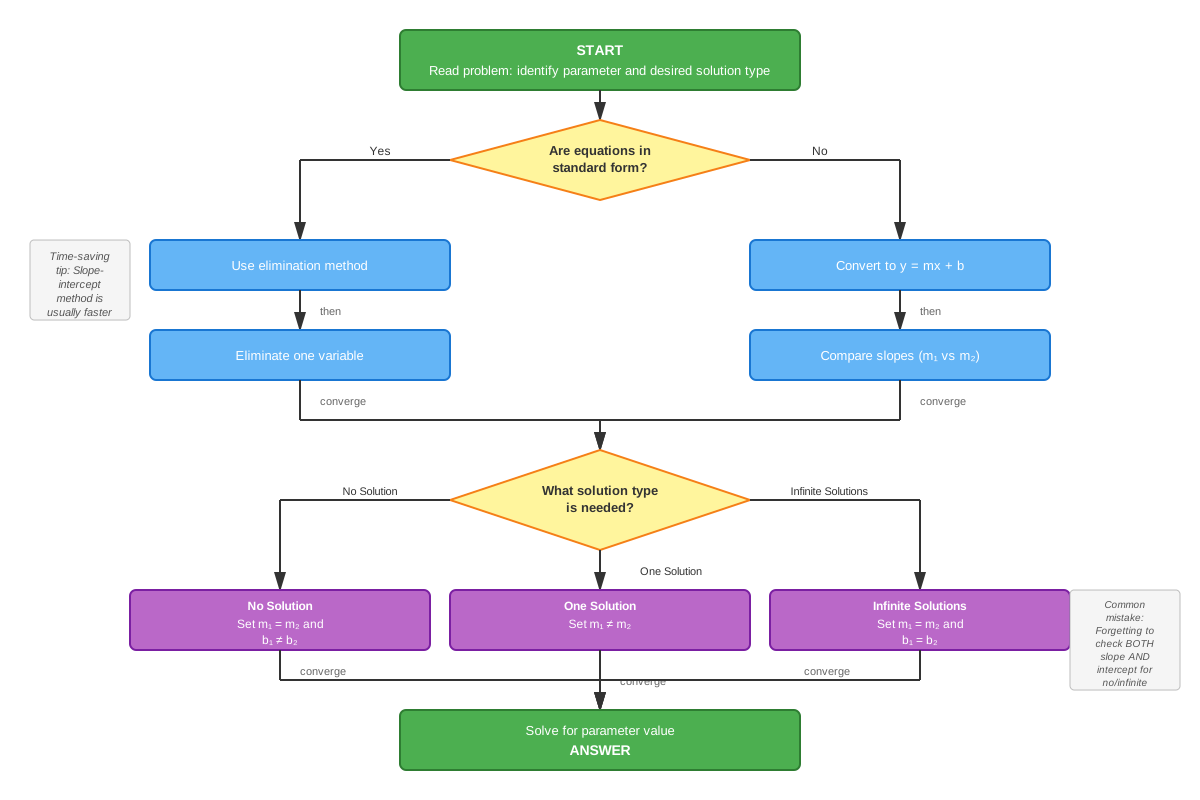
To determine parameter values that produce specific solution types:
- Convert to comparable form: Put both equations in the same form (usually slope-intercept or standard form)
- Identify the relevant ratios: Compare slopes (or coefficient ratios) and y-intercepts (or constant ratios)
- Set up equations: Create equations based on the conditions for the desired solution type
- Solve for the parameter: Isolate the parameter algebraically
- Verify: Check that your parameter value produces the intended result
The Proportionality Principle
For standard form equations Ax + By = C and Dx + Ey = F, the relationship between coefficient ratios determines solution type:
| Condition | A/D vs B/E vs C/F | Solution Type | Geometric Interpretation |
|---|---|---|---|
| A/D ≠ B/E | Ratios differ | One solution | Lines intersect |
| A/D = B/E ≠ C/F | First two equal, third different | No solution | Parallel lines |
| A/D = B/E = C/F | All three equal | Infinite solutions | Coincident lines |
This principle provides a powerful shortcut for analyzing systems with parameters without fully solving them.
Concept Relationships
The core concepts in systems with parameters build hierarchically. Understanding parameters as variables forms the foundation, leading to recognition of the three solution types. Each solution type connects to specific algebraic conditions (what happens when you solve) and geometric interpretations (how the lines relate visually).
The proportionality principle synthesizes these ideas into a unified framework, connecting coefficient ratios to solution types. This principle links back to prerequisite knowledge of slope (from slope-intercept form) and forward to the systematic approach for solving parameter problems.
Relationship map:
- Parameters in equations → Three possible solution types
- Solution types → Algebraic conditions (true/false statements, unique solutions)
- Solution types → Geometric interpretations (parallel, intersecting, coincident)
- Algebraic conditions ↔ Geometric interpretations (two perspectives on same phenomenon)
- All concepts → Proportionality principle (unifying framework)
- Proportionality principle → Systematic approach (problem-solving method)
Quick check — test yourself on Systems with parameters so far.
Try Flashcards →High-Yield Facts
⭐ A system has no solution when the lines are parallel but not coincident (same slope, different y-intercepts)
⭐ A system has infinitely many solutions when the equations represent the same line (one equation is a scalar multiple of the other)
⭐ For standard form equations, compare the ratios A/D, B/E, and C/F to determine solution type
⭐ When solving leads to a false statement like 0 = 5, the system has no solution
⭐ When solving leads to a true statement like 0 = 0, the system has infinitely many solutions
- A system has exactly one solution when the lines have different slopes
- Parameters typically appear as coefficients of x or y, or as constant terms
- Converting both equations to slope-intercept form often simplifies parameter analysis
- The parameter value that creates parallel lines can be found by setting slopes equal
- For infinitely many solutions, all corresponding coefficients and constants must be proportional
- SAT questions most commonly ask for parameter values that create no solution or infinitely many solutions
- Multiplying an entire equation by a constant doesn't change its solution set but does change how it appears
- The same parameter value rarely produces both no solution and infinitely many solutions (these are mutually exclusive conditions)
- Grid-in questions about parameters typically have integer or simple fraction answers
- Checking your parameter value by substituting back into the original system prevents careless errors
Common Misconceptions
Misconception: If two equations look different, they can't represent the same line.
Correction: Equations can be scalar multiples of each other and still represent the same line. For example, 2x + 4y = 6 and x + 2y = 3 are the same line (the second is the first divided by 2).
Misconception: A system with a parameter always has a special solution type (no solution or infinitely many solutions).
Correction: Most parameter values produce systems with exactly one solution. Only specific parameter values create the special cases of no solution or infinitely many solutions.
Misconception: When variables cancel during solving, the system always has no solution.
Correction: When variables cancel, check the resulting statement. If it's false (0 = 5), there's no solution. If it's true (0 = 0), there are infinitely many solutions.
Misconception: The parameter must appear in both equations.
Correction: A parameter can appear in just one equation. The relationship between that equation and the other still determines the solution type.
Misconception: Setting the slopes equal is sufficient to guarantee infinitely many solutions.
Correction: For infinitely many solutions, slopes must be equal AND y-intercepts must be equal (or equivalently, all coefficient ratios must be equal). Equal slopes with different y-intercepts means no solution.
Misconception: You must fully solve the system to determine the parameter value.
Correction: Using coefficient ratios and the proportionality principle is often faster and less error-prone than attempting to solve the system completely.
Worked Examples
Example 1: Finding the Parameter for No Solution
Problem: For what value of k does the following system have no solution?
3x + 2y = 7
kx + 4y = 10Solution:
Step 1: Identify what "no solution" means geometrically and algebraically.
- Geometrically: parallel lines (same slope, different y-intercepts)
- Algebraically: coefficient ratios of x and y are equal, but ratio to constants differs
Step 2: Set up the proportion for parallel lines using the standard form condition.
For no solution: A/D = B/E but A/D ≠ C/F
From our equations: A = 3, B = 2, C = 7, D = k, E = 4, F = 10
Step 3: Set the coefficient ratios equal.
3/k = 2/4
3/k = 1/2
Step 4: Solve for k.
3/k = 1/2
6 = k
k = 6
Step 5: Verify this creates parallel but not coincident lines.
Check if 3/6 = 2/4 = 7/10:
- 3/6 = 1/2 ✓
- 2/4 = 1/2 ✓
- 7/10 = 0.7 ✗
Since the first two ratios equal 1/2 but the third doesn't, the lines are parallel but not coincident.
Answer: k = 6
Connection to learning objectives: This problem requires identifying the key feature of no solution (parallel lines), applying the proportionality principle, and manipulating the parameter equation to find the specific value.
Example 2: Finding the Parameter for Infinitely Many Solutions
Problem: The system below has infinitely many solutions. What is the value of a?
6x - 9y = 12
2x - 3y = aSolution:
Step 1: Recognize that infinitely many solutions means the equations represent the same line.
One equation must be a scalar multiple of the other.
Step 2: Determine the relationship between the equations.
Notice that the first equation's coefficients (6 and -9) are exactly 3 times the second equation's coefficients (2 and -3):
- 6 = 3 × 2 ✓
- -9 = 3 × (-3) ✓
Step 3: Apply the same scalar relationship to the constant term.
For the equations to be identical, the constant term must also follow this pattern:
12 = 3 × a
a = 12/3
a = 4
Step 4: Verify by checking all ratios.
6/2 = 3
-9/(-3) = 3
12/4 = 3
All ratios equal 3, confirming the equations are scalar multiples.
Alternative approach using slope-intercept form:
Step 1: Convert both equations to slope-intercept form.
6x - 9y = 12
-9y = -6x + 12
y = (2/3)x - 4/3

2x - 3y = a
-3y = -2x + a
y = (2/3)x - a/3
Step 2: For infinitely many solutions, slopes and y-intercepts must be equal.
Slopes are already equal (both 2/3).
Set y-intercepts equal:
-4/3 = -a/3
-4 = -a
a = 4Answer: a = 4
Connection to learning objectives: This demonstrates identifying the key feature of infinitely many solutions (coincident lines), explaining how this appears on the SAT (finding parameter values), and applying multiple solution strategies.
Exam Strategy
Approach SAT questions systematically: First, identify what solution type the question asks about (no solution, one solution, or infinitely many solutions). Then determine which condition applies (coefficient ratios for standard form, or slope/y-intercept relationships for slope-intercept form).
Trigger words to watch for:
- "no solution" → parallel lines, equal slopes, A/D = B/E ≠ C/F
- "infinitely many solutions" → coincident lines, proportional equations, A/D = B/E = C/F
- "exactly one solution" → intersecting lines, different slopes, A/D ≠ B/E
- "the system is inconsistent" → no solution
- "the system is dependent" → infinitely many solutions
Process of elimination tips:
- If a question asks for the parameter value creating no solution, eliminate any answer choice that makes the coefficient ratios unequal (these would give one solution)
- If asked about infinitely many solutions, the correct answer must make ALL ratios equal, not just some
- Extreme values (very large or very small numbers) are rarely correct for parameter problems on the SAT
- Zero is a common trap answer; verify it actually produces the desired solution type
Time allocation: Spend 1-2 minutes on parameter problems. If you're stuck after 90 seconds, use the coefficient ratio method rather than trying to solve completely. These problems reward strategic thinking over computational grinding.
Calculator usage: While these problems don't require a calculator, use it to verify ratio calculations if you're uncertain. Decimal equivalents can help confirm that ratios are equal or unequal.
Memory Techniques
Mnemonic for solution types - "PIN":
- Parallel → No solution
- Intersecting → One solution
- Nested (coincident) → iNfinitely many solutions
Ratio Rule of Threes: For standard form equations, remember "1-2-3":
- 1 ratio equal (A/D = B/E) but not the third → No solution
- 2 ratios equal (A/D = B/E = C/F) → Infinitely many solutions
- 3 ratios all different → One solution (though actually just need first two different)
Visual memory aid: Picture three scenarios:
- Parallel railroad tracks (never meet) → No solution
- Crossing streets (meet at one point) → One solution
- Overlapping shadows (completely coincide) → Infinite solutions
Acronym for checking work - SOLVE:
- Set up the ratio equations
- Obtain the parameter value
- Look at all three ratios
- Verify the solution type
- Eliminate wrong answers
Summary
Systems with parameters represent a sophisticated SAT math topic where one or more coefficients or constants in a system of linear equations are represented by variables rather than specific numbers. The fundamental challenge is determining what parameter value produces a desired solution type: no solution (parallel lines), exactly one solution (intersecting lines), or infinitely many solutions (coincident lines). The key analytical tool is the proportionality principle—comparing ratios of corresponding coefficients and constants. For standard form equations Ax + By = C and Dx + Ey = F, when A/D = B/E but A/D ≠ C/F, the system has no solution; when A/D = B/E = C/F, infinitely many solutions exist; when A/D ≠ B/E, exactly one solution exists. Success on these problems requires converting equations to comparable forms, setting up appropriate ratio equations, solving for the parameter algebraically, and verifying the result. These questions test abstract reasoning and conceptual understanding rather than computational skill, making them high-value targets for score improvement through strategic preparation.
Key Takeaways
- Parameters are variables in equation coefficients or constants that determine the solution behavior of a system
- Every system of two linear equations has exactly one of three solution types: no solution, one solution, or infinitely many solutions
- Use coefficient ratios (A/D, B/E, C/F) to quickly determine solution type without fully solving the system
- No solution occurs when lines are parallel: same slope but different y-intercepts (A/D = B/E ≠ C/F)
- Infinitely many solutions occur when equations represent the same line: all ratios equal (A/D = B/E = C/F)
- Convert equations to the same form before comparing to avoid errors
- Verify your parameter value by checking that it produces the intended solution type
Related Topics
Systems of linear inequalities: After mastering systems with parameters, students can extend these concepts to inequality systems where parameters affect solution regions rather than solution points.
Quadratic systems: Understanding how parameters affect linear systems provides foundation for analyzing systems involving quadratic equations, where parameters can determine the number of intersection points between parabolas and lines.
Functions and their graphs: The geometric interpretation of systems with parameters (parallel, intersecting, coincident lines) connects directly to understanding function transformations and how parameters affect graph behavior.
Absolute value equations: Parameters in absolute value equations create similar analytical challenges, requiring students to consider multiple cases and determine conditions for specific solution types.
Practice CTA
Now that you've mastered the core concepts of systems with parameters, it's time to cement your understanding through active practice. Attempt the practice questions to apply these strategies under test-like conditions, and use the flashcards to reinforce the key facts and conditions you'll need to recall quickly on test day. Remember: these problems have among the lowest correct response rates on the SAT, which means mastering them gives you a significant competitive advantage. Every parameter problem you solve correctly is a point that many other test-takers will miss—make these questions your strength!
Sign up free to keep reading
Create a free AnvayaPrep account to finish this SAT guide on Systems with parameters — plus flashcards and practice questions.