Overview
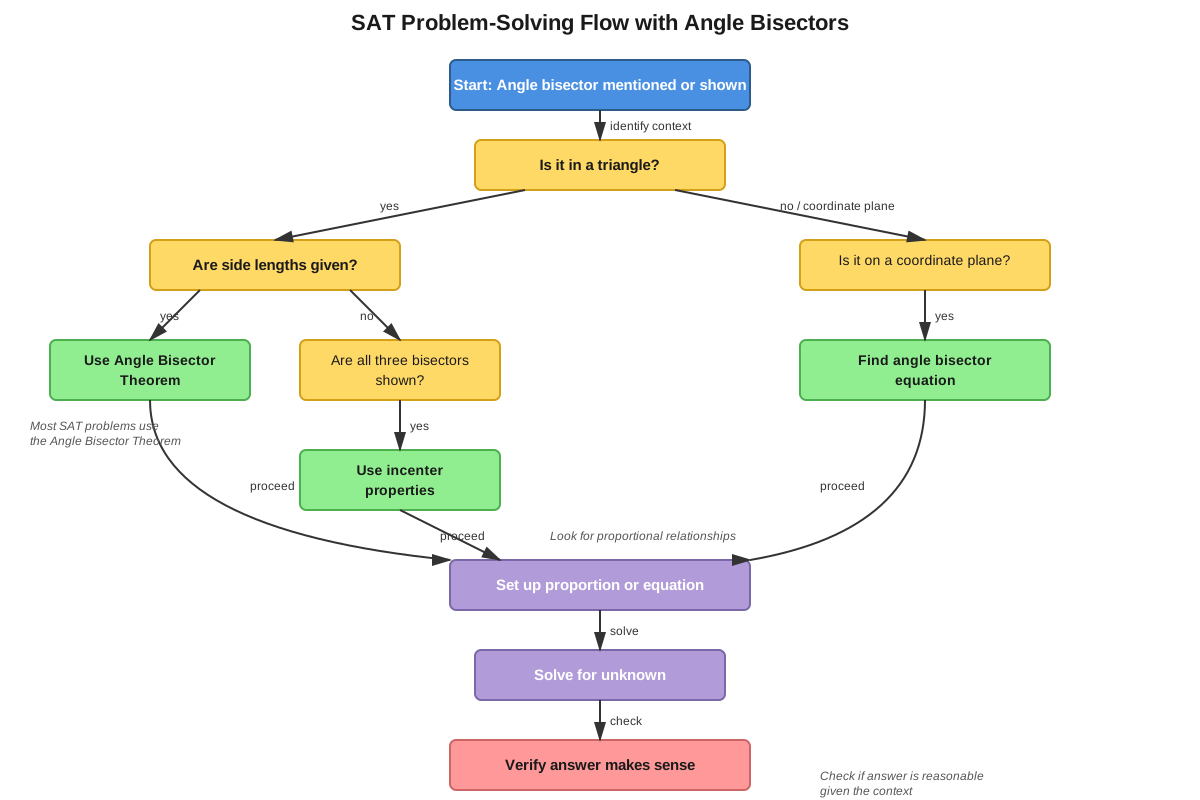
Angle bisectors are fundamental geometric constructs that divide an angle into two equal parts. In the context of triangles, an angle bisector is a line segment, ray, or line that originates from a vertex and divides the angle at that vertex into two congruent angles. Understanding angle bisectors is crucial for success on the SAT because they appear frequently in geometry problems involving triangles, proportional reasoning, and coordinate geometry. These problems often test multiple concepts simultaneously, making angle bisectors a high-yield topic that connects various areas of math.
On the SAT, angle bisector problems typically appear in two main forms: questions involving the Angle Bisector Theorem (which relates side lengths to the segments created by the bisector) and questions requiring students to identify or construct angle bisectors in coordinate plane settings. The College Board frequently embeds angle bisector concepts within more complex multi-step problems, testing not just knowledge of the definition but also the ability to apply properties and theorems strategically. Students who master angle bisectors gain a significant advantage because these concepts often unlock solutions to problems that initially appear unrelated to bisectors.
The relationship between angle bisectors and other geometric concepts is extensive. Angle bisectors connect to triangle congruence theorems, similarity, proportional reasoning, the Pythagorean theorem, and coordinate geometry. They also relate to special points in triangles (the incenter is where all three angle bisectors meet) and provide a foundation for understanding more advanced geometric relationships. This interconnectedness makes angle bisectors an essential building block for comprehensive geometric reasoning on the SAT.
Learning Objectives
- [ ] Identify key features of angle bisectors in triangles and other geometric figures
- [ ] Explain how angle bisectors appears on the SAT in various question formats
- [ ] Apply angle bisectors to answer SAT-style questions involving proportions and measurements
- [ ] Calculate unknown side lengths using the Angle Bisector Theorem
- [ ] Determine the equation of an angle bisector in the coordinate plane
- [ ] Recognize the relationship between angle bisectors and the incenter of a triangle
- [ ] Solve multi-step problems that combine angle bisectors with other geometric properties
Prerequisites
- Basic angle properties: Understanding angle measurement, complementary and supplementary angles, and vertical angles is essential for recognizing when an angle has been bisected
- Triangle fundamentals: Knowledge of triangle side and angle relationships provides the foundation for applying the Angle Bisector Theorem
- Proportions and ratios: The Angle Bisector Theorem creates proportional relationships that require facility with setting up and solving proportions
- Coordinate geometry basics: Finding angle bisectors in the coordinate plane requires understanding slope, distance, and linear equations
- Similar triangles: Many angle bisector proofs and applications rely on identifying similar triangles within larger figures
Why This Topic Matters
Angle bisectors have practical applications in numerous real-world contexts, from architecture and engineering to computer graphics and navigation. Architects use angle bisector principles when designing symmetrical structures and determining optimal load distribution. Engineers apply these concepts when calculating force vectors and designing mechanical systems with balanced components. In computer graphics, angle bisectors help create realistic lighting effects and determine reflection angles.
On the SAT, angle bisector questions appear with moderate frequency, typically showing up in 1-3 questions per test administration. These questions most commonly appear in the calculator-permitted section and are often rated as medium to hard difficulty. The College Board particularly favors questions that combine angle bisectors with other concepts such as similar triangles, the Pythagorean theorem, or algebraic reasoning. Approximately 60% of angle bisector questions on recent SAT administrations have involved the Angle Bisector Theorem, while 30% have required coordinate geometry applications, and 10% have tested conceptual understanding of bisector properties.
Common question formats include: providing a triangle with an angle bisector and asking students to find unknown side lengths; presenting a coordinate plane scenario where students must identify or construct an angle bisector; and multi-step problems where recognizing an angle bisector is the key to unlocking the solution. The SAT also frequently embeds angle bisector concepts within word problems involving real-world scenarios, requiring students to translate verbal descriptions into geometric diagrams.
Core Concepts
Definition and Basic Properties
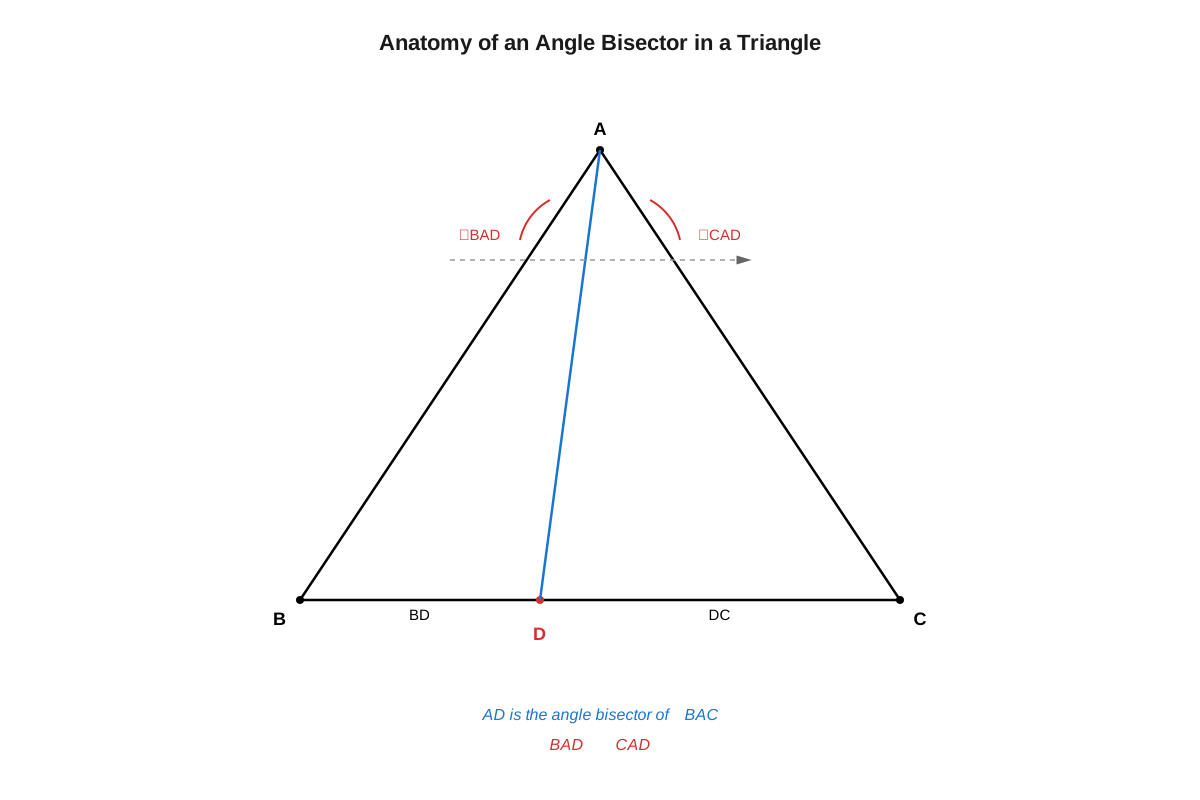
An angle bisector is a ray, line segment, or line that divides an angle into two congruent angles. When an angle measures x degrees, its bisector creates two angles that each measure x/2 degrees. In triangle geometry, we typically focus on angle bisectors that originate from a vertex and extend to the opposite side, creating an angle bisector segment.
Key properties of angle bisectors include:
- Every angle has exactly one angle bisector (though it can be extended infinitely as a line)
- The angle bisector is the locus of all points equidistant from the two sides of the angle
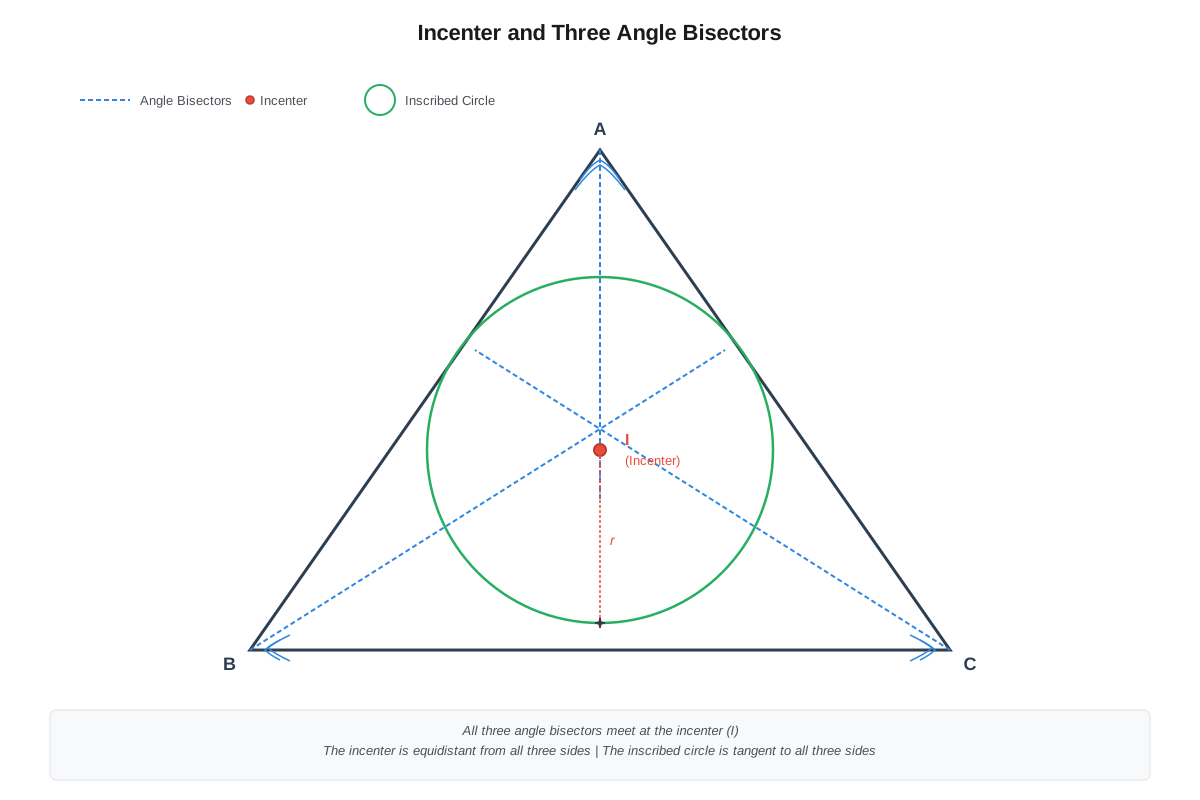
- In a triangle, the three angle bisectors always meet at a single point called the incenter
- The incenter is equidistant from all three sides of the triangle and is the center of the inscribed circle
The Angle Bisector Theorem
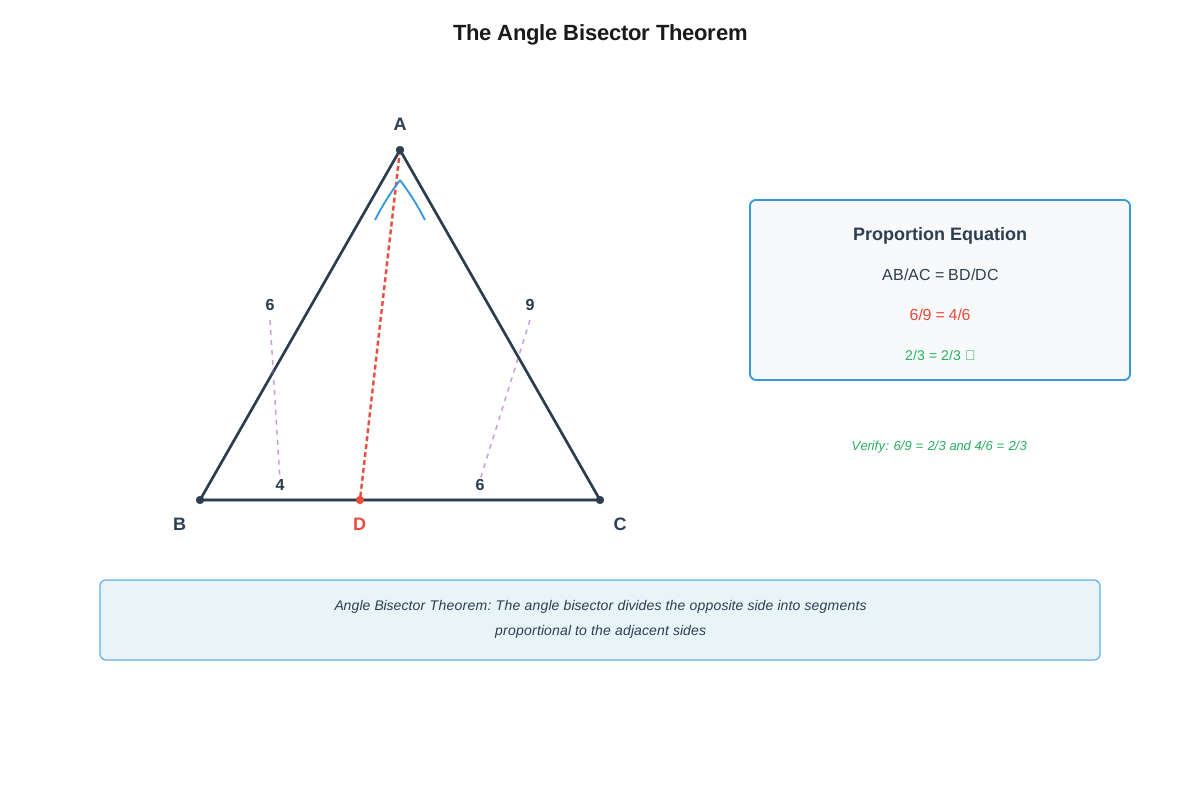
The Angle Bisector Theorem is the most frequently tested concept involving angle bisectors on the SAT. This theorem states: If a ray bisects an angle of a triangle, then it divides the opposite side into segments that are proportional to the other two sides of the triangle.
Mathematically, if triangle ABC has angle bisector AD (where D lies on side BC), then:
BD/DC = AB/ACThis proportion can be rearranged in several equivalent forms:
- BD/AB = DC/AC
- AB/BD = AC/DC
- (BD + DC)/BD = (AB + AC)/AB
Understanding these equivalent forms is crucial because SAT questions may present the information in any of these configurations, and recognizing the relationship quickly saves valuable time.
Applying the Angle Bisector Theorem
To apply the Angle Bisector Theorem effectively:
- Identify the angle bisector: Look for notation indicating equal angles or explicit statements that a segment bisects an angle
- Label the relevant segments: Mark the two sides adjacent to the bisected angle and the two segments created on the opposite side
- Set up the proportion: Write the ratio of the segments on the opposite side equal to the ratio of the adjacent sides
- Solve algebraically: Use cross-multiplication or other algebraic techniques to find unknown values
Angle Bisectors in Coordinate Geometry
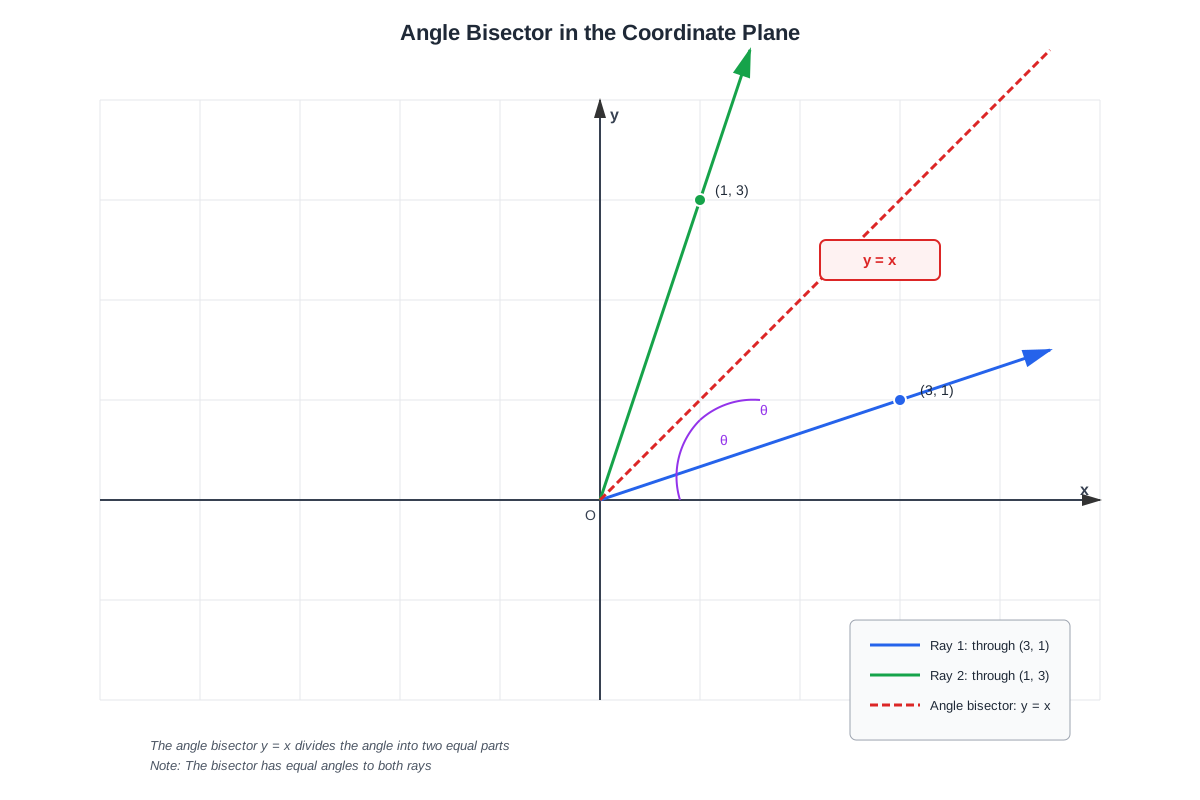
In the coordinate plane, finding the angle bisector of an angle formed by two lines requires a different approach. The angle bisector can be found using the angle bisector formula or by recognizing that points on the angle bisector are equidistant from both lines.
For two lines with equations in standard form:
- Line 1: A₁x + B₁y + C₁ = 0
- Line 2: A₂x + B₂y + C₂ = 0
The angle bisectors are given by:
(A₁x + B₁y + C₁)/√(A₁² + B₁²) = ±(A₂x + B₂y + C₂)/√(A₂² + B₂²)While this formula is rarely required on the SAT, understanding that angle bisectors in the coordinate plane can be found using distance relationships is important.
The Incenter and Its Properties
The incenter is the point where all three angle bisectors of a triangle intersect. This point has several important properties:
- It is always located inside the triangle (for all triangle types)
- It is equidistant from all three sides of the triangle
- It is the center of the inscribed circle (incircle) that touches all three sides
- The radius of the incircle is perpendicular to each side at the point of tangency
While direct questions about the incenter are less common on the SAT, understanding this concept helps solve problems involving inscribed circles and provides insight into triangle symmetry.
Special Cases and Considerations
| Triangle Type | Angle Bisector Behavior | Special Properties |
|---|---|---|
| Equilateral | All angle bisectors are also medians, altitudes, and perpendicular bisectors | Each bisector divides the opposite side in ratio 1:1 |
| Isosceles | The angle bisector from the vertex angle is also the median and altitude to the base | Creates two congruent right triangles |
| Right Triangle | Angle bisector from right angle creates specific proportional relationships | Often combined with Pythagorean theorem problems |
| Scalene | Angle bisectors have no additional special properties | Pure application of Angle Bisector Theorem |
Concept Relationships
The concepts within angle bisectors form a hierarchical structure. The basic definition of an angle bisector → leads to → understanding that it creates two equal angles → which enables → recognition of angle bisector segments in triangles → which provides the foundation for → the Angle Bisector Theorem → which connects to → proportional reasoning and similar triangles.
Angle bisectors connect to prerequisite topics in multiple ways. The concept builds directly on basic angle properties, as students must recognize when two angles are congruent. The Angle Bisector Theorem relies heavily on proportions and ratios, requiring students to apply their algebraic skills to geometric contexts. When angle bisectors appear in coordinate geometry problems, students must integrate their knowledge of linear equations, slope, and distance formulas.
Related topics that extend from angle bisectors include: other triangle centers (centroid, circumcenter, orthocenter), inscribed and circumscribed circles, triangle congruence and similarity, and advanced proportional reasoning. Mastering angle bisectors also strengthens problem-solving skills for questions involving medians, altitudes, and perpendicular bisectors, as these concepts share similar structural approaches.
The relationship map: Basic Angles → Angle Bisector Definition → Angle Bisector Theorem → Proportional Relationships → Similar Triangles → Advanced Triangle Properties → Incenter and Inscribed Circles
Quick check — test yourself on Angle bisectors so far.
Try Flashcards →High-Yield Facts
⭐ The Angle Bisector Theorem states that an angle bisector divides the opposite side into segments proportional to the adjacent sides: BD/DC = AB/AC
⭐ An angle bisector divides an angle into two congruent angles: If AD bisects angle BAC, then angle BAD = angle CAD
⭐ All three angle bisectors of a triangle meet at the incenter, which is equidistant from all three sides
⭐ The incenter is always located inside the triangle, regardless of whether the triangle is acute, right, or obtuse
⭐ In an isosceles triangle, the angle bisector from the vertex angle is also the median and altitude to the base
- The angle bisector is the locus of points equidistant from the two sides of an angle
- In an equilateral triangle, angle bisectors, medians, altitudes, and perpendicular bisectors are all the same segments
- The Angle Bisector Theorem can be applied in reverse: if a segment divides a side proportionally to the other two sides, it bisects the angle
- The radius of the inscribed circle (incircle) is perpendicular to each side of the triangle at the point of tangency
- When solving for unknown lengths using the Angle Bisector Theorem, setting up the proportion correctly is more important than memorizing a specific form
Common Misconceptions
Misconception: An angle bisector always divides the opposite side into two equal segments → Correction: An angle bisector divides the opposite side into segments proportional to the adjacent sides, not necessarily equal segments. Equal segments only occur when the two adjacent sides are equal (as in an isosceles triangle).
Misconception: The angle bisector is the same as the median → Correction: A median connects a vertex to the midpoint of the opposite side, while an angle bisector divides the angle at the vertex into two equal angles. These are only the same in isosceles triangles (from the vertex angle) and equilateral triangles.
Misconception: The Angle Bisector Theorem proportion can be set up in any order without affecting the answer → Correction: While the proportion can be written in equivalent forms, the corresponding parts must match correctly. BD/DC = AB/AC is correct, but BD/DC = AC/AB is incorrect and will yield wrong answers.
Misconception: All three angle bisectors divide their opposite sides into equal parts → Correction: Each angle bisector creates a proportion specific to that angle and the adjacent sides. The three bisectors generally create different ratios unless the triangle has special properties (like being equilateral).
Misconception: The incenter is the same as the centroid or circumcenter → Correction: The incenter (intersection of angle bisectors) is distinct from the centroid (intersection of medians) and circumcenter (intersection of perpendicular bisectors). These points only coincide in equilateral triangles.
Misconception: If a segment looks like it bisects an angle in a diagram, it does → Correction: On the SAT, never assume an angle is bisected unless explicitly stated or marked with congruent angle notation. Diagrams are not always drawn to scale.
Worked Examples
Example 1: Applying the Angle Bisector Theorem
Problem: In triangle ABC, segment AD bisects angle BAC, with D on side BC. If AB = 12, AC = 18, and BC = 20, find the length of BD.
Solution:
Step 1: Identify the given information and what we need to find.
- AD is an angle bisector from vertex A
- AB = 12, AC = 18, BC = 20
- We need to find BD
Step 2: Apply the Angle Bisector Theorem.
Since AD bisects angle BAC, we know:
BD/DC = AB/AC
Step 3: Express DC in terms of BD.
Since D lies on BC, we know: BD + DC = BC
Therefore: DC = BC - BD = 20 - BD
Step 4: Substitute into the proportion.
BD/(20 - BD) = 12/18
Step 5: Simplify the right side.
BD/(20 - BD) = 2/3
Step 6: Cross-multiply and solve.
3(BD) = 2(20 - BD)
3BD = 40 - 2BD
5BD = 40
BD = 8
Step 7: Verify the answer.
If BD = 8, then DC = 12
Check: 8/12 = 2/3 and 12/18 = 2/3 ✓
Answer: BD = 8
This example demonstrates the standard application of the Angle Bisector Theorem and connects to the learning objective of applying angle bisectors to solve SAT-style questions.
Example 2: Multi-Step Problem with Angle Bisector
Problem: In right triangle PQR with right angle at Q, segment QS bisects angle PQR, with S on hypotenuse PR. If PQ = 9 and QR = 12, find the length of PS.
Solution:
Step 1: Draw and label the diagram mentally or on paper.
- Right triangle with right angle at Q
- QS bisects the right angle, so angle PQS = angle SQR = 45°
- PQ = 9, QR = 12
Step 2: Find the length of the hypotenuse PR using the Pythagorean theorem.
PR² = PQ² + QR²
PR² = 9² + 12²
PR² = 81 + 144 = 225
PR = 15
Step 3: Apply the Angle Bisector Theorem.
Since QS bisects angle PQR:
PS/SR = PQ/QR
Step 4: Express SR in terms of PS.
PS + SR = PR = 15
SR = 15 - PS
Step 5: Substitute and solve.
PS/(15 - PS) = 9/12 = 3/4
Cross-multiply:
4(PS) = 3(15 - PS)
4PS = 45 - 3PS
7PS = 45
PS = 45/7
Answer: PS = 45/7 or approximately 6.43
This example combines the Pythagorean theorem with the Angle Bisector Theorem, demonstrating how angle bisector problems often integrate multiple concepts—a common SAT strategy.
Exam Strategy
When approaching angle bisector questions on the SAT, follow this systematic process:
Step 1: Identify the angle bisector
Look for explicit statements like "bisects angle" or notation showing two equal angles. Watch for trigger words such as "divides the angle equally," "splits the angle in half," or "creates two congruent angles."
Step 2: Determine what the question is asking
SAT questions may ask for side lengths, ratios, angle measures, or require you to identify which statement must be true. Clarify the target before beginning calculations.
Step 3: Apply the appropriate theorem or property
- For side length problems: Use the Angle Bisector Theorem
- For angle measure problems: Use the definition (two equal angles)
- For coordinate geometry: Consider distance relationships or slope
Step 4: Set up equations carefully
Write out the proportion explicitly, labeling each part. Double-check that corresponding parts are in the correct positions.
Exam Tip: When using the Angle Bisector Theorem, always write the proportion with the segments on the opposite side on the left and the adjacent sides on the right: (opposite segments)/(opposite segments) = (adjacent sides)/(adjacent sides)
Process of elimination strategies:
- Eliminate answers that violate the proportional relationship
- If the adjacent sides are equal, the opposite segments must be equal
- If one adjacent side is twice the other, one opposite segment must be twice the other
- Check extreme cases: if answer choices vary widely, plug in the extremes to eliminate impossible values
Time allocation:
- Simple angle bisector identification: 30-45 seconds
- Angle Bisector Theorem application: 1-2 minutes
- Multi-step problems combining concepts: 2-3 minutes
If a problem seems to require more than 3 minutes, mark it and return later. Often, recognizing the angle bisector is the key insight that makes a complex problem simple.
Memory Techniques
Mnemonic for the Angle Bisector Theorem: "Opposite Segments match Adjacent Sides" (OSAS)
- Opposite: The segments on the side opposite the bisected angle
- Segments: Are in proportion to
- Adjacent: The sides adjacent to
- Sides: The bisected angle
Visualization strategy: Picture a triangle as a slice of pizza. The angle bisector is like cutting the angle at the crust into two equal pieces. The Angle Bisector Theorem tells you that the cut through the opposite side (the outer edge) divides it in the same ratio as the two sides of the slice.
Acronym for triangle centers: "In Comes An Orange" helps remember the four main triangle centers:
- Incenter (angle bisectors)
- Centroid (medians)
- Altitude intersection (orthocenter)
- Outer circle center (circumcenter)
Memory hook for the incenter: "The INcenter is always INside the triangle" - this distinguishes it from the circumcenter and orthocenter, which can be outside.
Proportion setup reminder: Think "Big Dog, Big Appetite" for BD/DC = BA/AC - the first letters match up to help you remember which segments correspond.
Summary
Angle bisectors are essential geometric constructs that divide angles into two congruent parts and create proportional relationships in triangles. The Angle Bisector Theorem, which states that an angle bisector divides the opposite side into segments proportional to the adjacent sides, is the most critical concept for SAT success. Students must be able to identify angle bisectors from diagrams and verbal descriptions, set up proportions correctly using the theorem, and solve for unknown lengths algebraically. The three angle bisectors of any triangle meet at the incenter, which is always located inside the triangle and serves as the center of the inscribed circle. On the SAT, angle bisector questions frequently combine with other geometric concepts such as the Pythagorean theorem, similar triangles, and coordinate geometry, requiring integrated problem-solving skills. Success with angle bisector problems depends on careful diagram analysis, precise proportion setup, and systematic algebraic manipulation. Understanding both the theoretical foundations and practical applications of angle bisectors provides students with powerful tools for solving a wide range of geometry problems efficiently.
Key Takeaways
- An angle bisector divides an angle into two congruent angles, each measuring half the original angle
- The Angle Bisector Theorem creates a proportion: the segments on the opposite side are proportional to the adjacent sides (BD/DC = AB/AC)
- All three angle bisectors of a triangle intersect at the incenter, which is always inside the triangle and equidistant from all three sides
- In isosceles triangles, the angle bisector from the vertex angle is also the median and altitude, creating additional problem-solving opportunities
- SAT angle bisector questions often combine multiple concepts, requiring students to integrate proportional reasoning with other geometric properties
- Setting up the proportion correctly is crucial—always match corresponding parts and double-check before cross-multiplying
- Never assume an angle is bisected from a diagram alone; look for explicit statements or congruent angle notation
Related Topics
Similar Triangles: Mastering angle bisectors provides a foundation for understanding similar triangles, as the Angle Bisector Theorem relies on proportional relationships that are central to similarity. Many angle bisector problems can also be solved using similar triangle techniques.
Triangle Centers: The incenter is one of four major triangle centers. Understanding angle bisectors enables progression to studying the centroid (medians), circumcenter (perpendicular bisectors), and orthocenter (altitudes), each with unique properties and applications.
Inscribed and Circumscribed Circles: The incenter serves as the center of the inscribed circle, while understanding angle bisectors helps with problems involving tangent lines and circle-triangle relationships.
Coordinate Geometry: Angle bisectors in the coordinate plane connect to finding equations of lines, calculating distances, and working with slopes, extending geometric concepts into algebraic contexts.
Advanced Proportional Reasoning: The proportional relationships in the Angle Bisector Theorem provide practice for more complex ratio problems involving similar figures, scale factors, and geometric mean.
Practice CTA
Now that you've mastered the core concepts of angle bisectors, it's time to solidify your understanding through practice! Work through the practice questions to test your ability to identify angle bisectors, apply the Angle Bisector Theorem, and solve multi-step problems. Use the flashcards to reinforce key definitions and properties until they become automatic. Remember, the SAT rewards both conceptual understanding and efficient problem-solving—practice will help you develop both. Each problem you solve strengthens your geometric reasoning and builds confidence for test day. You've got this!
Sign up free to keep reading
Create a free AnvayaPrep account to finish this SAT guide on Angle bisectors — plus flashcards and practice questions.