Overview
The cosine function is one of the three fundamental trigonometric ratios that appears regularly on the SAT exam, particularly within questions involving right triangles, the unit circle, and geometric problem-solving. Understanding cosine is essential for success on the math section, as it forms the foundation for solving problems involving angle relationships, triangle side lengths, and coordinate geometry applications. The SAT typically includes 2-4 questions per test that either directly test cosine or require its application as part of a multi-step problem.
Cosine represents the ratio between the adjacent side and the hypotenuse in a right triangle, and this relationship extends to numerous geometric and algebraic contexts on the exam. Students who master cosine gain access to powerful problem-solving tools that connect trigonometry with algebra, geometry, and even some coordinate plane questions. The topic bridges multiple mathematical domains, making it a high-yield area of study that rewards thorough understanding.
Beyond isolated trigonometric calculations, cosine appears in SAT questions involving the Law of Cosines, complementary angle relationships, and real-world modeling scenarios. The exam tests not just computational ability but also conceptual understanding of when and how to apply cosine in various contexts. This makes cosine knowledge essential for achieving competitive scores, particularly for students targeting scores above 650 on the math section.
Learning Objectives
- [ ] Identify key features of cosine including its definition, range, and domain
- [ ] Explain how cosine appears on the SAT in various question formats and contexts
- [ ] Apply cosine to answer SAT-style questions involving right triangles and angle measurements
- [ ] Calculate cosine values for special angles (30°, 45°, 60°) without a calculator
- [ ] Recognize and apply the relationship between cosine and complementary angles
- [ ] Use the Law of Cosines to solve non-right triangle problems
- [ ] Connect cosine to coordinate geometry and the unit circle representation
Prerequisites
- Basic right triangle properties: Understanding the relationship between sides and angles in right triangles is fundamental to defining cosine as a ratio
- Pythagorean Theorem: This theorem enables calculation of missing sides needed to determine cosine values
- Angle measurement in degrees: Cosine is defined in terms of angles, requiring comfort with degree measurements and angle relationships
- Basic algebraic manipulation: Solving equations involving cosine requires facility with algebraic operations and equation solving
- Fraction and ratio operations: Since cosine is a ratio, students must be comfortable simplifying and comparing fractional values
Why This Topic Matters
Cosine has extensive real-world applications in fields ranging from engineering and architecture to physics and computer graphics. Architects use cosine to calculate structural angles and load distributions, while navigators employ it to determine distances and bearings. In physics, cosine describes the relationship between force vectors and their components, making it essential for understanding motion and energy. These practical applications demonstrate why cosine remains a core component of mathematical literacy.
On the SAT, cosine appears in approximately 10-15% of geometry and trigonometry questions, making it a high-frequency topic that directly impacts scores. The exam tests cosine through multiple question types: direct calculation problems asking for specific cosine values, word problems requiring students to set up and solve trigonometric equations, and multi-step problems where cosine is one tool among several needed to reach the solution. Questions may appear in both the calculator and no-calculator sections, emphasizing the importance of knowing special angle values from memory.
Common SAT question formats include: finding missing side lengths in right triangles when given an angle and one side, determining angle measures when given side ratios, applying the Law of Cosines to non-right triangles, and solving real-world modeling problems involving angles of elevation or depression. The exam also tests conceptual understanding through questions about complementary angles, where students must recognize that cos(θ) = sin(90° - θ). Understanding these patterns helps students quickly identify when cosine is the appropriate tool and execute solutions efficiently under time pressure.
Core Concepts
Definition of Cosine in Right Triangles
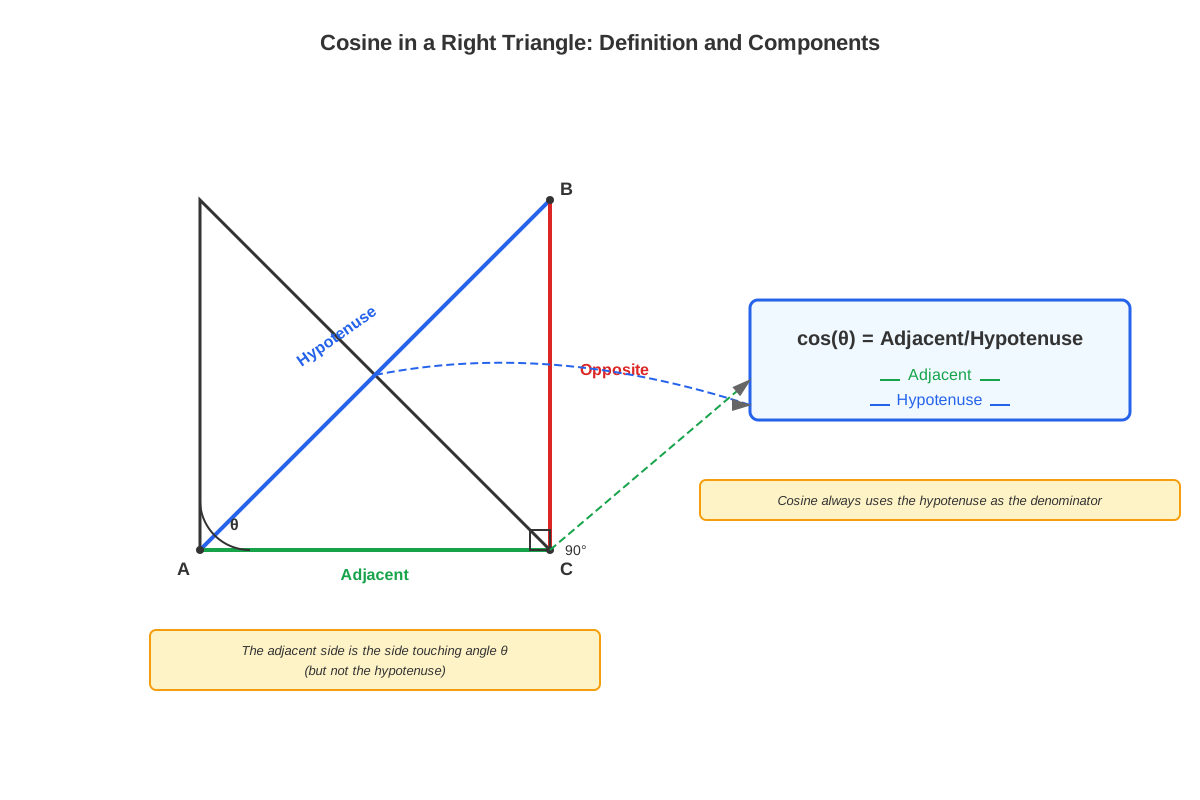
The cosine of an angle in a right triangle is defined as the ratio of the length of the adjacent side to the length of the hypotenuse. This fundamental definition can be expressed as:
cos(θ) = adjacent/hypotenuseIn any right triangle, when focusing on a specific acute angle θ, the adjacent side is the side that forms part of the angle (excluding the hypotenuse), while the hypotenuse is always the longest side opposite the right angle. This ratio remains constant for any given angle measure, regardless of the triangle's size, which is why cosine values are properties of angles themselves rather than specific triangles.
For example, in a right triangle where the angle of interest measures 60°, the adjacent side measures 5 units, and the hypotenuse measures 10 units, the cosine of 60° equals 5/10 = 0.5. This value of 0.5 will be the cosine of 60° in every right triangle, demonstrating the universal nature of trigonometric ratios.
Special Angle Values
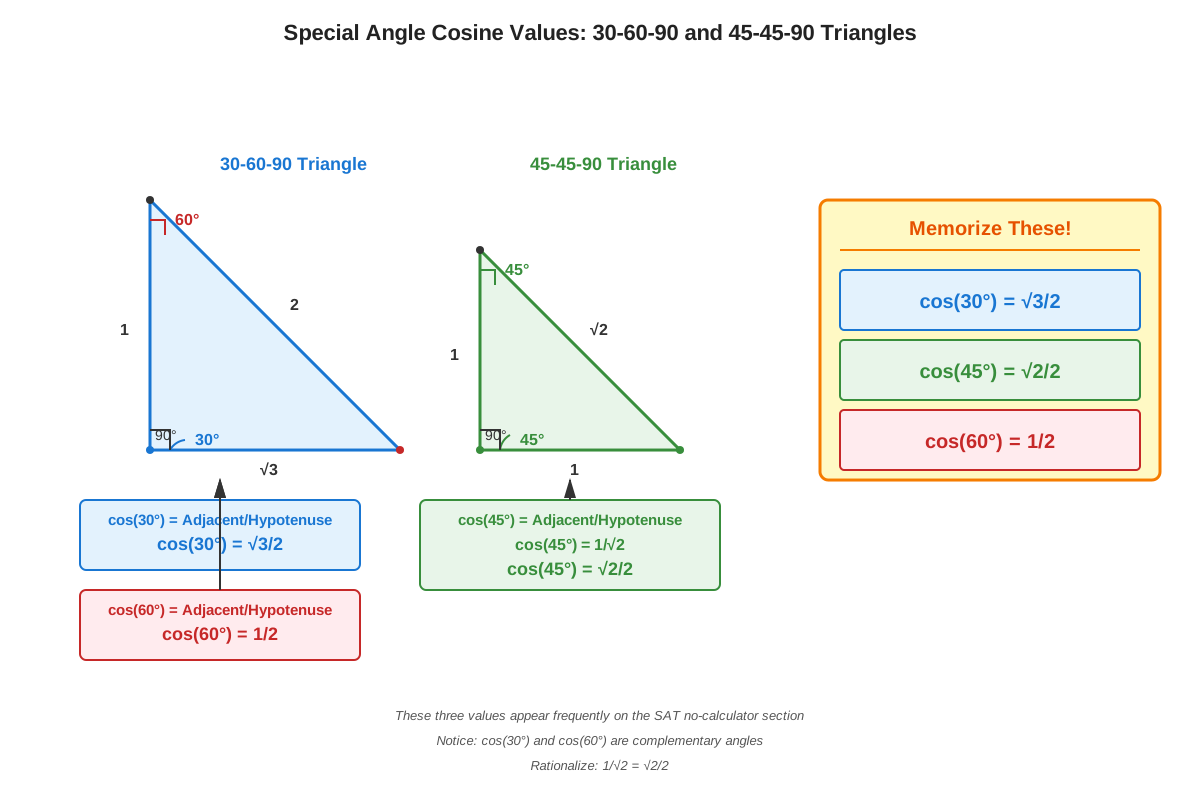
The SAT frequently tests knowledge of cosine values for special angles: 30°, 45°, and 60°. These values must be memorized for efficient problem-solving, particularly in the no-calculator section:
| Angle | Cosine Value | Exact Form | Decimal Approximation |
|---|---|---|---|
| 0° | 1 | 1 | 1.000 |
| 30° | √3/2 | √3/2 | 0.866 |
| 45° | √2/2 | 1/√2 | 0.707 |
| 60° | 1/2 | 1/2 | 0.500 |
| 90° | 0 | 0 | 0.000 |
These values derive from the properties of two special right triangles: the 30-60-90 triangle (with side ratios 1:√3:2) and the 45-45-90 triangle (with side ratios 1:1:√2). Understanding these triangles allows students to reconstruct cosine values even if momentarily forgotten during the exam.
Cosine and Complementary Angles
A critical relationship tested on the SAT is the complementary angle identity: cos(θ) = sin(90° - θ). This means the cosine of any angle equals the sine of its complement. For instance, cos(30°) = sin(60°) = √3/2, and cos(60°) = sin(30°) = 1/2. This relationship stems from the fact that in a right triangle, the two acute angles are complementary (they sum to 90°), and what is "adjacent" relative to one angle becomes "opposite" relative to the other.
This identity enables problem-solving flexibility and appears in SAT questions that test conceptual understanding rather than just computation. Students might be asked to identify equivalent expressions or to simplify trigonometric expressions using this relationship.
The Law of Cosines
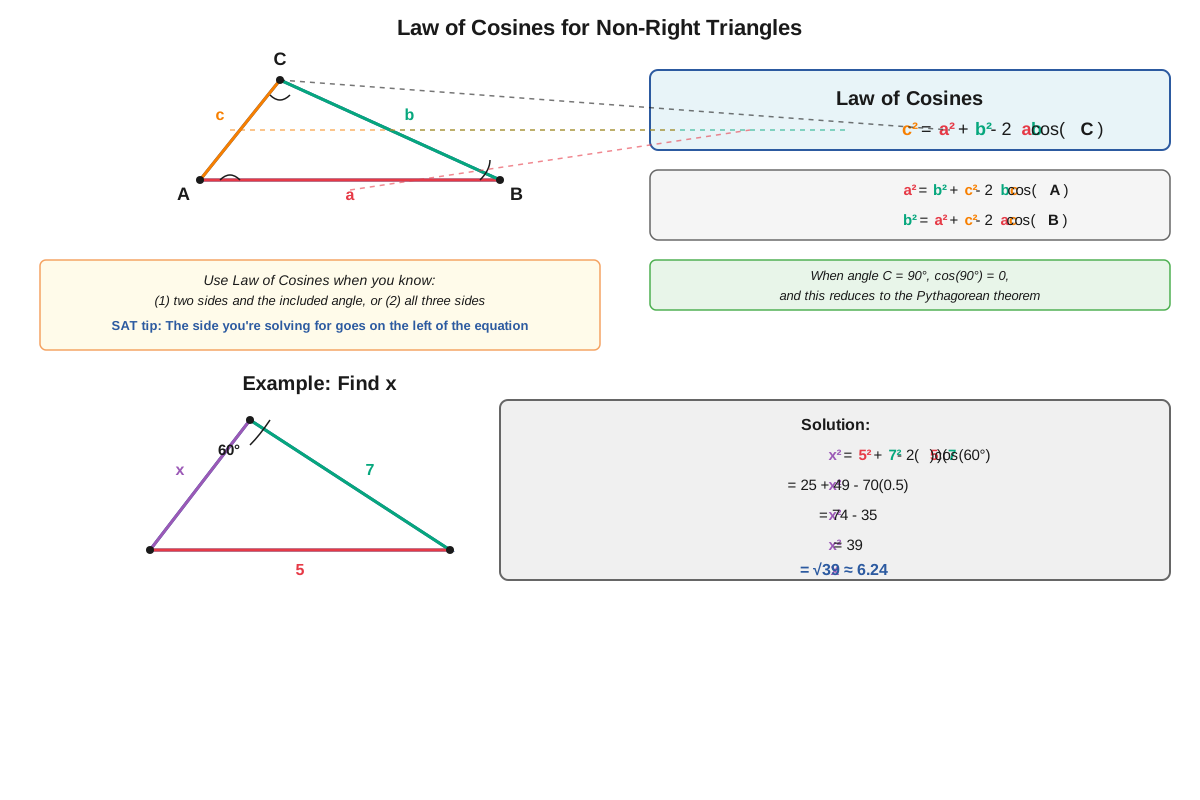
For triangles that are not right triangles, the Law of Cosines extends the Pythagorean Theorem by incorporating angle information:
c² = a² + b² - 2ab·cos(C)In this formula, c represents the side opposite angle C, while a and b are the other two sides. When angle C equals 90°, cos(C) = 0, and the formula reduces to the Pythagorean Theorem (c² = a² + b²). The Law of Cosines allows calculation of unknown sides when two sides and the included angle are known, or calculation of unknown angles when all three sides are known.
SAT questions using the Law of Cosines typically provide two sides and the included angle, asking students to find the third side. Less commonly, questions might provide all three sides and ask for an angle measure, requiring algebraic manipulation to solve for the cosine value first, then determining the angle.
Cosine in the Coordinate Plane
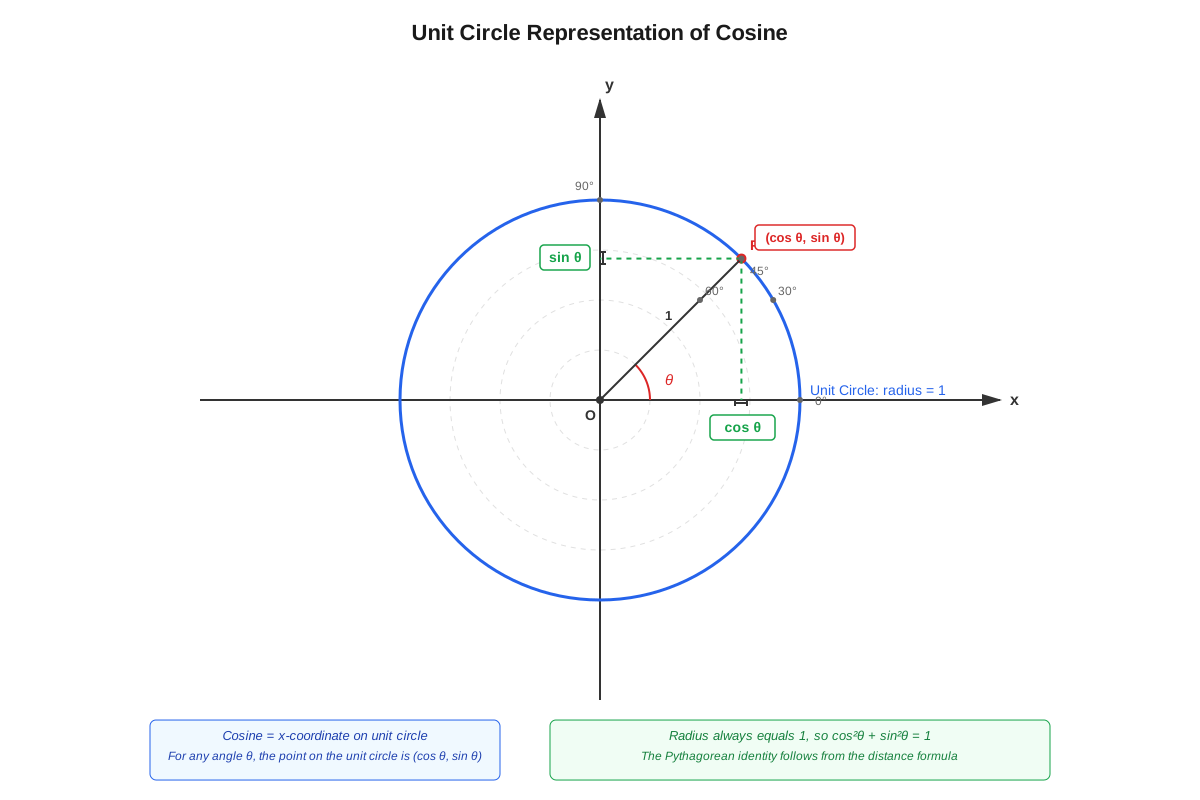
On the unit circle (a circle with radius 1 centered at the origin), the cosine of an angle represents the x-coordinate of the point where the terminal side of the angle intersects the circle. This geometric interpretation connects trigonometry to coordinate geometry and explains why cosine values range from -1 to 1.
For angles in standard position (measured counterclockwise from the positive x-axis), the cosine value indicates horizontal displacement. This interpretation occasionally appears in SAT questions involving circular motion, periodic functions, or coordinate geometry problems with trigonometric elements.
Range and Domain of Cosine
The domain of the cosine function includes all real angle measures (though SAT questions typically use angles between 0° and 180°). The range of cosine is the interval [-1, 1], meaning cosine values cannot exceed 1 or fall below -1. This constraint helps students identify impossible answer choices in multiple-choice questions.
Understanding that cosine decreases from 1 to -1 as angles increase from 0° to 180° helps with estimation and reasonableness checking. For acute angles (0° to 90°), cosine values are positive; for obtuse angles (90° to 180°), cosine values are negative.
Concept Relationships
The cosine function connects intimately with other trigonometric ratios through the fundamental identity: sin²(θ) + cos²(θ) = 1. This relationship, derived from the Pythagorean Theorem, allows calculation of one trigonometric ratio when another is known. For example, if cos(θ) = 3/5 and θ is acute, then sin(θ) = 4/5 (since 9/25 + 16/25 = 1).
The complementary angle relationship creates a bridge between cosine and sine: cos(θ) = sin(90° - θ). This connection means that mastering cosine simultaneously builds understanding of sine, and vice versa. The tangent function relates to cosine through the identity tan(θ) = sin(θ)/cos(θ), making cosine foundational to understanding all three primary trigonometric ratios.
Within triangle geometry, cosine connects to the Pythagorean Theorem (as a generalization through the Law of Cosines) and to basic ratio concepts from similar triangles. The relationship map flows as follows:
Right Triangle Properties → Trigonometric Ratios (including cosine) → Special Angle Values → Complementary Angle Relationships → Law of Cosines → Non-Right Triangle Problem Solving
Additionally, cosine connects to coordinate geometry through the unit circle representation, where cosine = x-coordinate on the unit circle. This relationship bridges pure trigonometry with algebraic and geometric problem-solving on the coordinate plane.
Quick check — test yourself on Cosine so far.
Try Flashcards →High-Yield Facts
⭐ Cosine is defined as adjacent/hypotenuse in a right triangle
⭐ cos(30°) = √3/2, cos(45°) = √2/2, cos(60°) = 1/2
⭐ cos(θ) = sin(90° - θ) for all angles θ
⭐ The Law of Cosines is c² = a² + b² - 2ab·cos(C)
⭐ Cosine values range from -1 to 1, inclusive
- cos(0°) = 1 and cos(90°) = 0
- For acute angles (0° < θ < 90°), cosine values are positive
- For obtuse angles (90° < θ < 180°), cosine values are negative
- The Pythagorean identity: sin²(θ) + cos²(θ) = 1
- On the unit circle, cosine represents the x-coordinate
- When the included angle in the Law of Cosines is 90°, the formula reduces to the Pythagorean Theorem
- Cosine is an even function: cos(-θ) = cos(θ)
- In a 30-60-90 triangle, the sides are in ratio 1:√3:2
- In a 45-45-90 triangle, the sides are in ratio 1:1:√2
- The cosine of an angle decreases as the angle increases from 0° to 180°
Common Misconceptions
Misconception: Cosine is always calculated as opposite/hypotenuse → Correction: Cosine is adjacent/hypotenuse; sine is opposite/hypotenuse. The confusion arises from mixing up the trigonometric ratios. A helpful mnemonic is SOH-CAH-TOA, where CAH reminds us that Cosine = Adjacent/Hypotenuse.
Misconception: cos(30°) = 1/2 → Correction: cos(30°) = √3/2 ≈ 0.866, while cos(60°) = 1/2. Students frequently reverse these special angle values. The pattern to remember is that cosine decreases as angles increase, so the larger angle (60°) has the smaller cosine value (1/2).
Misconception: The Law of Cosines can only be used when you know all three sides → Correction: The Law of Cosines is most commonly used when you know two sides and the included angle (SAS configuration) to find the third side. It can also be used when all three sides are known to find an angle, but this requires algebraic manipulation.
Misconception: Cosine values can be greater than 1 or less than -1 → Correction: The range of cosine is [-1, 1]. Any calculation yielding a cosine value outside this range indicates an error. This constraint comes from the geometric definition: the adjacent side can never be longer than the hypotenuse in a right triangle.
Misconception: cos(A + B) = cos(A) + cos(B) → Correction: Cosine is not distributive over addition. The actual angle addition formula is cos(A + B) = cos(A)cos(B) - sin(A)sin(B), though this formula rarely appears on the SAT. Students should avoid assuming trigonometric functions behave like algebraic terms.
Misconception: You need a calculator to find cosine values → Correction: For special angles (30°, 45°, 60°), exact cosine values should be memorized and can be derived from special right triangles. The SAT no-calculator section specifically tests this knowledge, and even in the calculator section, knowing these values saves time.
Misconception: The adjacent side is always the horizontal side → Correction: The adjacent side is determined by which angle you're examining, not by the triangle's orientation. When analyzing an angle, the adjacent side is the one that forms part of that angle (excluding the hypotenuse), regardless of whether the triangle is rotated or flipped.
Worked Examples
Example 1: Finding a Side Length Using Cosine
Problem: In right triangle ABC, angle A measures 60°, and the hypotenuse AC measures 20 units. What is the length of side AB (adjacent to angle A)?
Solution:
Step 1: Identify the given information and what we need to find.
- Given: angle A = 60°, hypotenuse AC = 20
- Find: adjacent side AB
Step 2: Recognize that we have an angle and the hypotenuse, and we need the adjacent side. This is a direct application of cosine.
Step 3: Set up the cosine equation:
cos(60°) = AB/AC
cos(60°) = AB/20
Step 4: Substitute the known value of cos(60°) = 1/2:
1/2 = AB/20Step 5: Solve for AB:
AB = 20 × (1/2) = 10Answer: The length of side AB is 10 units.
Connection to Learning Objectives: This problem demonstrates the direct application of cosine definition (adjacent/hypotenuse) and requires knowledge of special angle values, both core SAT skills.
Example 2: Using the Law of Cosines
Problem: Triangle DEF has sides DE = 8, EF = 10, and the angle at E measures 60°. What is the length of side DF?
Solution:
Step 1: Recognize this is not a right triangle, so we need the Law of Cosines. We have two sides and the included angle (SAS configuration).
Step 2: Identify the variables in the Law of Cosines formula:
- a = DE = 8
- b = EF = 10
- C = angle E = 60°
- c = DF = unknown
Step 3: Write the Law of Cosines:
c² = a² + b² - 2ab·cos(C)Step 4: Substitute the known values:
DF² = 8² + 10² - 2(8)(10)·cos(60°)
DF² = 64 + 100 - 160·cos(60°)
Step 5: Substitute cos(60°) = 1/2:
DF² = 64 + 100 - 160(1/2)
DF² = 164 - 80
DF² = 84
Step 6: Take the square root:
DF = √84 = √(4 × 21) = 2√21 ≈ 9.17Answer: The length of side DF is 2√21 units (or approximately 9.17 units).
Connection to Learning Objectives: This problem demonstrates application of the Law of Cosines for non-right triangles and reinforces the importance of knowing special angle cosine values for efficient calculation.
Exam Strategy
When approaching SAT questions involving cosine, first determine whether the triangle is a right triangle. If it is, use the basic definition (adjacent/hypotenuse). If not, consider whether the Law of Cosines applies. Look for these trigger words and phrases: "right triangle," "adjacent to," "hypotenuse," "angle measures," and "find the length of."
For multiple-choice questions, use the range constraint (cosine values between -1 and 1) to eliminate impossible answers immediately. If a calculation yields cos(θ) = 1.3 or cos(θ) = -2, you've made an error and should recalculate. Similarly, if answer choices include values outside this range, eliminate them.
Time allocation strategy: Straightforward cosine problems using special angles should take 30-45 seconds. Law of Cosines problems typically require 90-120 seconds due to more complex calculations. If a problem seems to require more than 2 minutes, consider whether you've identified the most efficient approach or whether you should mark it for review and return later.
Watch for complementary angle relationships in answer choices. If you calculate cos(35°) and see sin(55°) as an answer choice, recognize these are equivalent. The SAT often tests conceptual understanding through such equivalent expressions.
In the no-calculator section, questions will focus on special angles (30°, 45°, 60°) or algebraic manipulation. Don't waste time trying to calculate cos(37°) without a calculator—the question must be solvable using special angles or algebraic relationships. In the calculator section, ensure your calculator is in degree mode (not radian mode) unless the problem specifically uses radians.
For word problems, draw a diagram even if one isn't provided. Label the known values and identify which angle's cosine you need. This visualization prevents confusion about which side is adjacent and which is opposite.
Memory Techniques
SOH-CAH-TOA is the classic mnemonic for trigonometric ratios:
- Sine = Opposite/Hypotenuse
- Cosine = Adjacent/Hypotenuse
- Tangent = Opposite/Adjacent
For special angle values, visualize the special right triangles:
- 30-60-90 triangle: sides in ratio 1:√3:2 (think "1, 2, 3" but with √3 in the middle)
- 45-45-90 triangle: sides in ratio 1:1:√2 (the two legs are equal)
To remember which angle has which cosine value, use the decreasing pattern: As angles increase from 0° to 90°, cosine values decrease from 1 to 0. Therefore:
- cos(30°) = √3/2 (larger value, smaller angle)
- cos(60°) = 1/2 (smaller value, larger angle)
For the complementary angle relationship, remember "Co-functions of Complementary angles are equal": Cosine and sine are co-functions, so cos(θ) = sin(90° - θ).
The Law of Cosines can be remembered as "Pythagorean Theorem plus a correction term": Start with a² + b², then subtract 2ab·cos(C) to account for the angle not being 90°.
Summary
Cosine is a fundamental trigonometric ratio defined as the adjacent side divided by the hypotenuse in right triangles, with values ranging from -1 to 1. The SAT tests cosine through direct calculation problems, special angle recognition (particularly 30°, 45°, and 60°), and application of the Law of Cosines to non-right triangles. Understanding the complementary angle relationship (cos(θ) = sin(90° - θ)) provides additional problem-solving flexibility. Mastery requires memorizing special angle values, recognizing when to apply cosine versus other trigonometric ratios, and efficiently using the Law of Cosines for SAS triangle configurations. Success on SAT cosine questions depends on quick pattern recognition, accurate recall of special values, and systematic problem-solving approaches that leverage both computational skills and conceptual understanding of angle-side relationships in triangles.
Key Takeaways
- Cosine equals adjacent/hypotenuse in right triangles and must not be confused with sine (opposite/hypotenuse)
- Memorize special angle values: cos(30°) = √3/2, cos(45°) = √2/2, cos(60°) = 1/2
- The complementary angle identity cos(θ) = sin(90° - θ) frequently appears in SAT questions
- The Law of Cosines (c² = a² + b² - 2ab·cos(C)) extends the Pythagorean Theorem to non-right triangles
- Cosine values are always between -1 and 1, inclusive—use this to eliminate impossible answers
- Draw diagrams for word problems to correctly identify adjacent sides and avoid confusion
- In the no-calculator section, all cosine problems involve special angles or algebraic manipulation
Related Topics
Sine and Tangent Functions: The other primary trigonometric ratios that work alongside cosine to solve triangle problems. Mastering cosine provides the foundation for understanding these related functions and their applications.
Law of Sines: An alternative method for solving non-right triangles when different information is given (such as two angles and a side). Understanding when to use Law of Cosines versus Law of Sines is an important problem-solving skill.
Unit Circle and Radian Measure: While the SAT primarily uses degrees, understanding the unit circle representation of cosine deepens conceptual knowledge and connects trigonometry to coordinate geometry.
Trigonometric Identities: More advanced relationships between trigonometric functions, including Pythagorean identities and angle addition formulas, build on the foundational understanding of cosine.
Applications to Physics and Engineering: Real-world problems involving vectors, forces, and periodic motion rely heavily on cosine, demonstrating the practical importance of this mathematical concept.
Practice CTA
Now that you've mastered the core concepts of cosine, it's time to reinforce your learning through active practice. Attempt the practice questions to test your understanding of special angle values, the Law of Cosines, and problem-solving strategies. Use the flashcards to drill special angle values until they become automatic—this speed and accuracy will be invaluable during the actual exam. Remember, consistent practice with immediate feedback is the most effective way to transform understanding into test-day performance. You've built a strong foundation; now strengthen it through application!
Sign up free to keep reading
Create a free AnvayaPrep account to finish this SAT guide on Cosine — plus flashcards and practice questions.