Overview
The sine function is one of the fundamental trigonometric ratios that appears consistently on the SAT math section, particularly within questions involving right triangles, the unit circle, and real-world applications. Understanding sine is essential not only for direct trigonometry questions but also for problems involving angles, heights, distances, and periodic phenomena. On the SAT, sine questions typically test a student's ability to identify the correct ratio in a right triangle, apply the sine function to solve for unknown sides or angles, and recognize relationships between sine and other trigonometric functions.
Mastering sine provides students with a powerful tool for solving a wide variety of geometry and trigonometry problems. The sine ratio connects an angle in a right triangle to the relationship between the opposite side and the hypotenuse, creating a consistent mathematical relationship that can be applied across countless problem types. This concept bridges basic geometry with more advanced trigonometric applications, making it a cornerstone topic for SAT success.
The importance of sine extends beyond isolated trigonometry questions. It frequently appears in combination with other mathematical concepts such as the Pythagorean theorem, similar triangles, and coordinate geometry. Students who develop fluency with sine ratios gain confidence in tackling multi-step problems that integrate several mathematical principles, which is precisely the type of higher-difficulty question that distinguishes top scorers on the SAT.
Learning Objectives
- [ ] Identify key features of Sine
- [ ] Explain how Sine appears on the SAT
- [ ] Apply Sine to answer SAT-style questions
- [ ] Calculate sine values for common angles (30°, 45°, 60°) without a calculator
- [ ] Determine unknown side lengths in right triangles using the sine ratio
- [ ] Recognize when to apply sine versus other trigonometric ratios in problem-solving contexts
- [ ] Interpret sine in both degree and radian measure as appropriate for SAT questions
Prerequisites
- Right triangle properties: Understanding the relationship between legs, hypotenuse, and right angles is fundamental to applying sine ratios correctly
- Basic angle measurement: Familiarity with degrees and the concept of angle size enables proper identification of which angle's sine to calculate
- Fraction and decimal operations: Sine calculations often produce fractional or decimal results that require manipulation
- Square roots: Many sine values involve radical expressions, particularly for special angles
- Pythagorean theorem: This theorem frequently works in tandem with sine to solve for multiple unknowns in triangle problems
Why This Topic Matters
In real-world applications, sine functions model countless phenomena including sound waves, light waves, seasonal temperature variations, and engineering calculations involving forces and angles. Architects use sine to calculate structural loads, surveyors apply it to determine distances and elevations, and physicists rely on it to describe oscillating systems. Understanding sine provides students with mathematical literacy that extends far beyond the classroom.
On the SAT, sine appears in approximately 2-4 questions per test, making it a high-yield topic for focused study. These questions typically fall into several categories: direct application of the sine ratio in right triangles, word problems requiring students to set up and solve sine equations, questions involving special angle values, and problems that combine sine with other geometric concepts. The College Board consistently includes at least one question that requires students to recognize the sine ratio as the appropriate tool among multiple trigonometric options.
Sine questions on the SAT commonly appear as: right triangle problems where students must identify the opposite side and hypotenuse; real-world scenarios involving angles of elevation or depression; questions asking students to match trigonometric expressions to geometric diagrams; and problems requiring calculation of specific sine values. The test may present these in both calculator and no-calculator sections, emphasizing the importance of knowing special angle values from memory.
Core Concepts
Definition of Sine
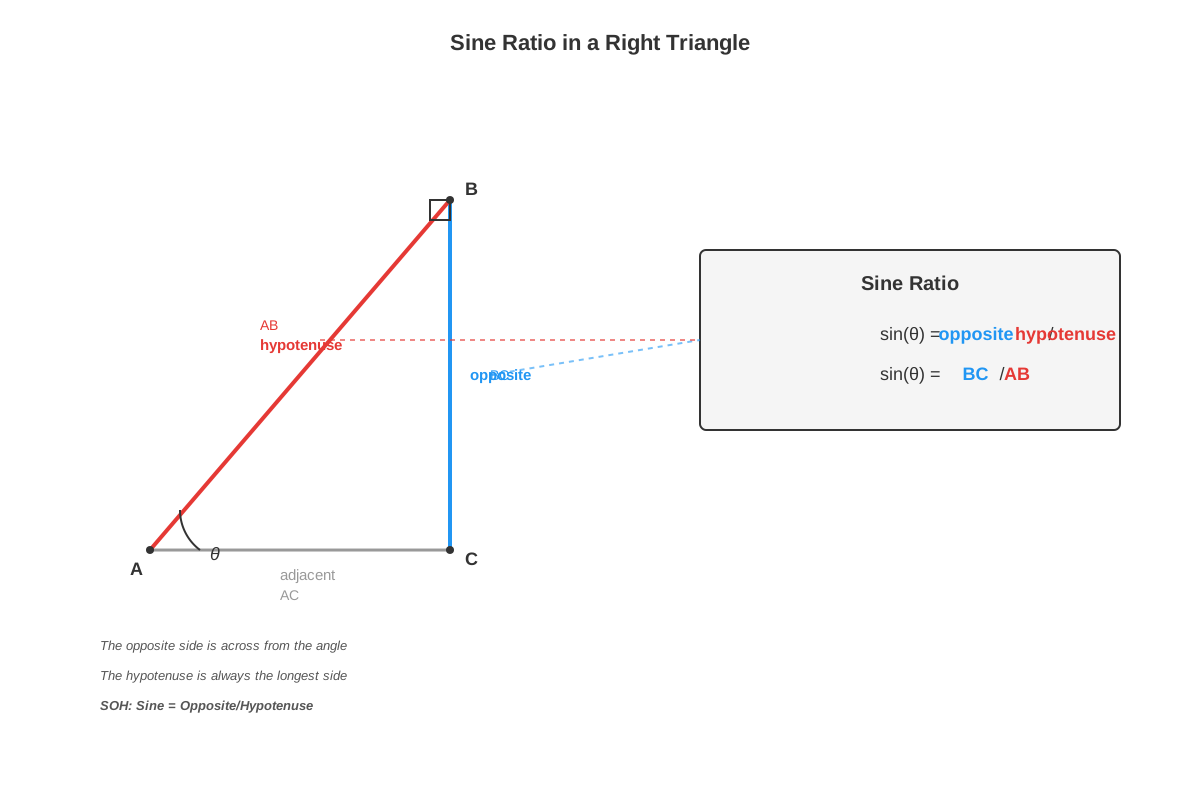
The sine of an angle in a right triangle is defined as the ratio of the length of the side opposite to that angle divided by the length of the hypotenuse. This can be expressed as:
sin(θ) = opposite/hypotenuseWhere θ (theta) represents the angle in question. This ratio remains constant for any given angle regardless of the triangle's size, which is why sine values are universal for specific angles. The sine function always produces values between -1 and 1, though in the context of right triangles (where all angles are between 0° and 90°), sine values range from 0 to 1.
The SOH-CAH-TOA Mnemonic
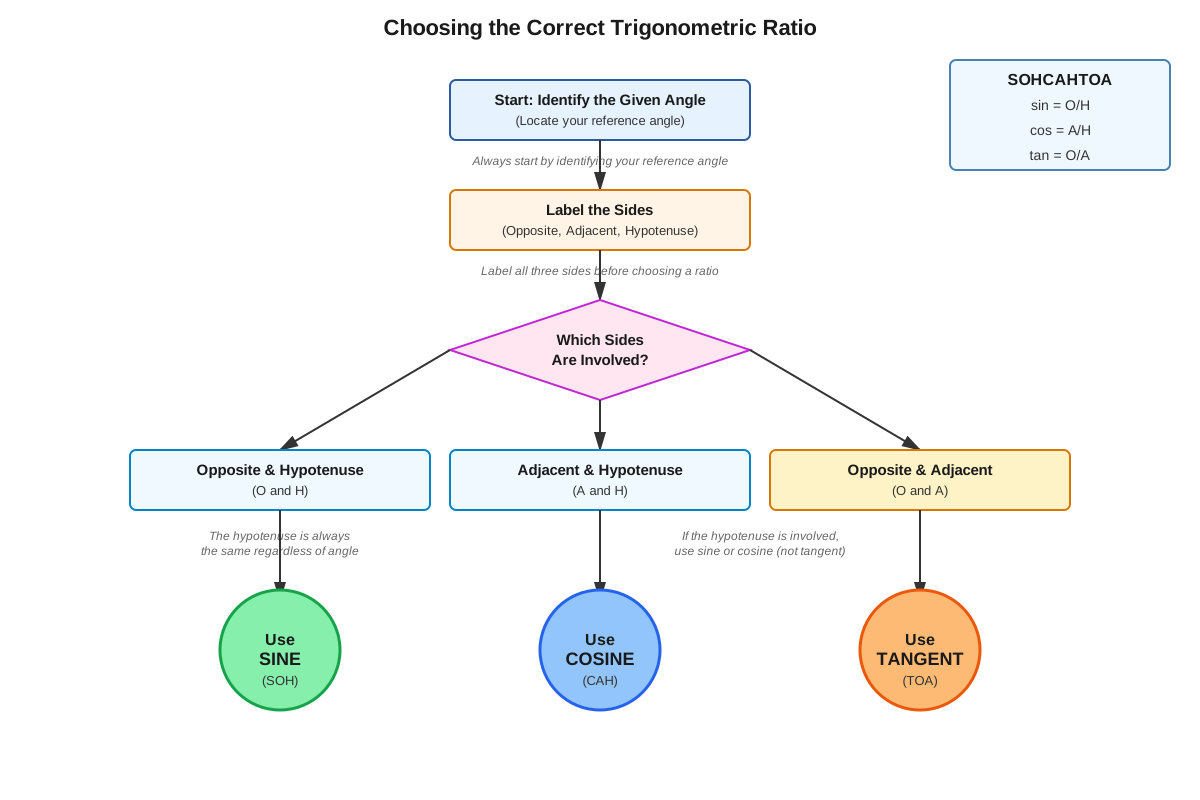
The most widely used memory device for trigonometric ratios is SOH-CAH-TOA, where the "SOH" portion specifically relates to sine:
- Sine = Opposite / Hypotenuse
- Cosine = Adjacent / Hypotenuse
- Tangent = Opposite / Adjacent
This mnemonic helps students quickly recall which sides of a right triangle to use when calculating sine. The key is correctly identifying which side is "opposite" the angle in question and which side is the hypotenuse (always the longest side, opposite the right angle).
Special Angle Values
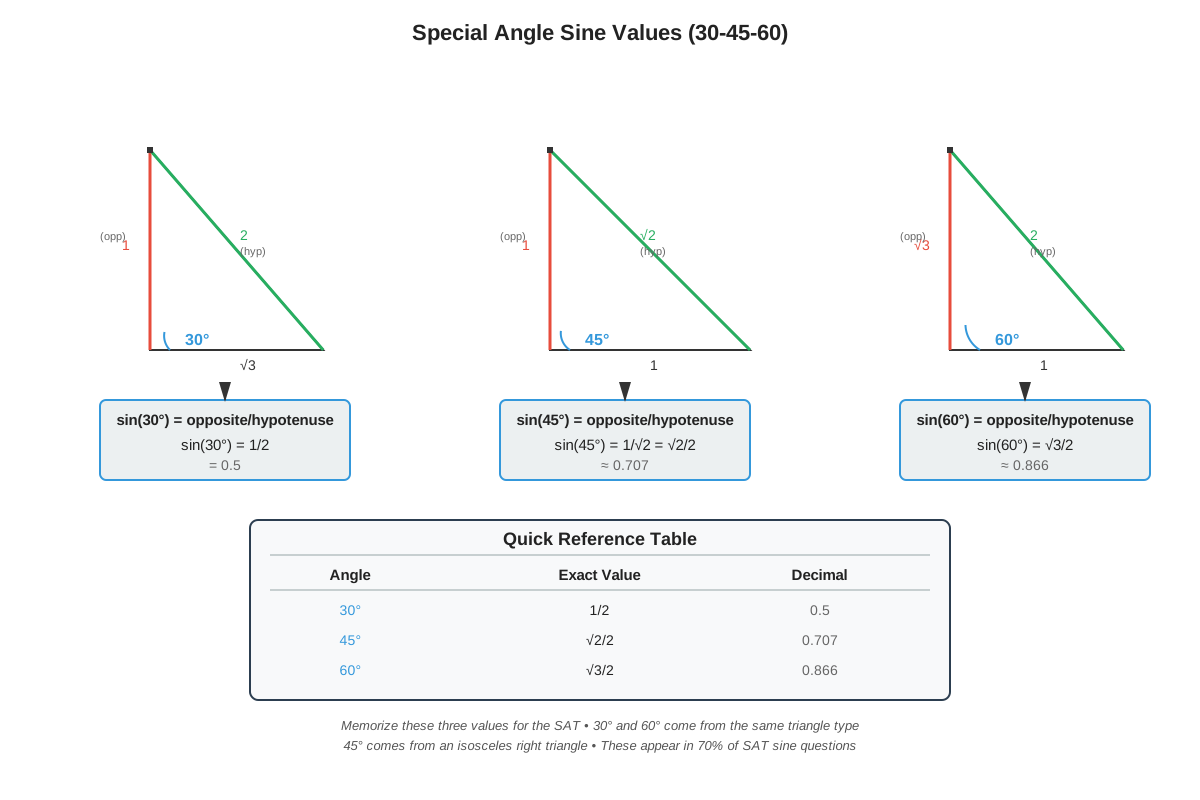
Certain angles appear so frequently on the SAT that their sine values should be memorized. These special angles include:
| Angle (degrees) | Angle (radians) | Sine Value |
|---|---|---|
| 0° | 0 | 0 |
| 30° | π/6 | 1/2 |
| 45° | π/4 | √2/2 |
| 60° | π/3 | √3/2 |
| 90° | π/2 | 1 |
These values derive from the properties of two special right triangles: the 30-60-90 triangle (with side ratios 1 : √3 : 2) and the 45-45-90 triangle (with side ratios 1 : 1 : √2). Understanding these triangles allows students to reconstruct sine values even if they momentarily forget the exact numbers.
Sine in Right Triangle Problem-Solving
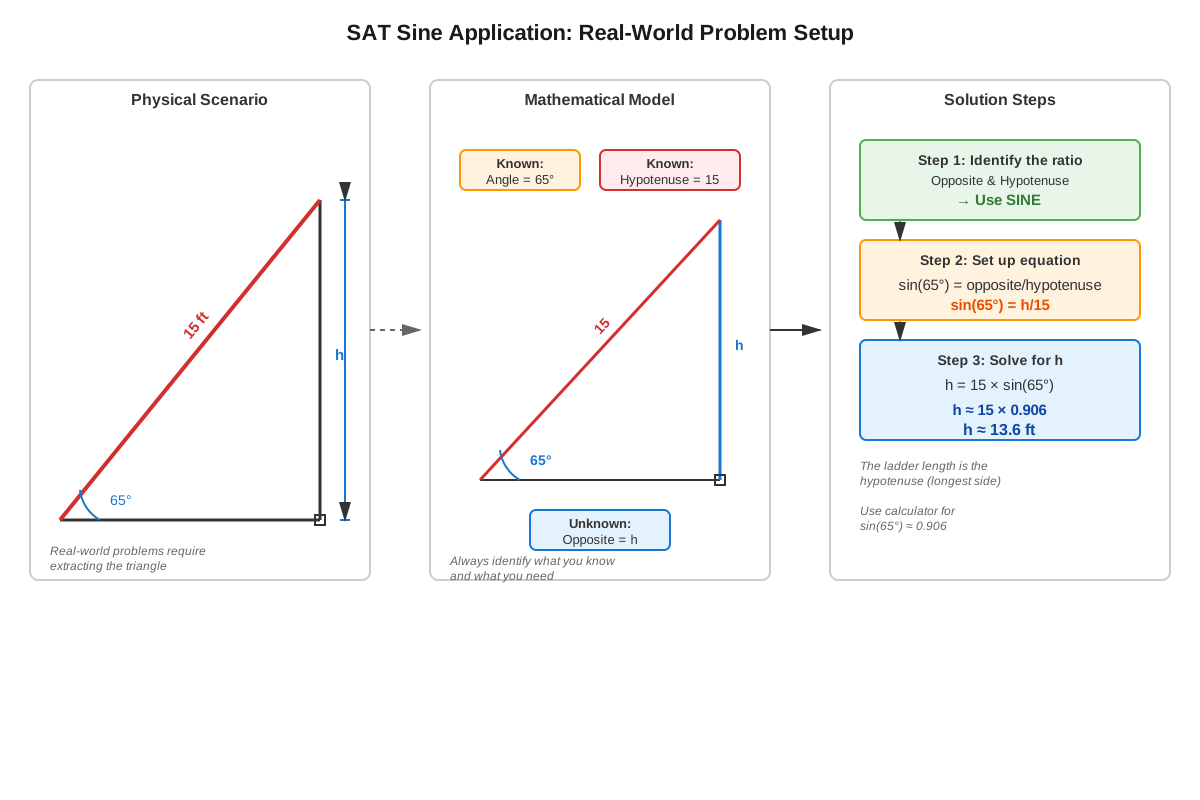
When applying sine to solve SAT problems, students should follow this systematic approach:
- Identify the right triangle in the problem (it may be explicitly drawn or implied by the context)
- Label the angle whose sine will be used
- Identify the opposite side (the side across from the chosen angle)
- Identify the hypotenuse (the side opposite the right angle)
- Set up the ratio: sin(angle) = opposite/hypotenuse
- Solve for the unknown using algebraic manipulation
This process ensures students don't confuse which sides to use, a common source of errors on timed exams.
Sine in Word Problems
The SAT frequently embeds sine calculations within real-world contexts. Common scenarios include:
- Angles of elevation: Looking up at an object from ground level
- Angles of depression: Looking down at an object from a height
- Ramp and incline problems: Calculating heights or distances along slopes
- Shadow problems: Using the sun's angle to determine heights
In these problems, students must translate the verbal description into a mathematical diagram, identify the right triangle, and then apply the sine ratio appropriately.
Relationship Between Sine and the Unit Circle
While the SAT primarily tests sine in the context of right triangles, understanding the unit circle connection provides deeper insight. On the unit circle (a circle with radius 1 centered at the origin), the sine of an angle equals the y-coordinate of the point where the terminal side of the angle intersects the circle. This geometric interpretation explains why sine values range from -1 to 1 and helps visualize how sine behaves as angles increase.
Inverse Sine Function
The inverse sine function (written as sin⁻¹ or arcsin) allows students to find an angle when they know the sine value. If sin(θ) = x, then θ = sin⁻¹(x). On the SAT, this appears when students must calculate an angle measure given side lengths. Most calculators have an inverse sine function, typically accessed by pressing a "2nd" or "shift" button followed by the sine button.
Concept Relationships
The sine function sits at the intersection of multiple mathematical domains. It directly builds upon right triangle geometry, using the fundamental properties of triangles where one angle measures 90°. The definition of sine as a ratio connects to proportional reasoning, since the relationship between opposite side and hypotenuse remains constant for similar triangles.
Sine relates closely to the other trigonometric ratios: cosine and tangent. These three functions form a complete system for relating angles to side lengths in right triangles. Specifically, the sine of an angle equals the cosine of its complement (sin(θ) = cos(90° - θ)), a relationship called the cofunction identity. Additionally, tangent can be expressed as sine divided by cosine (tan(θ) = sin(θ)/cos(θ)).
The Pythagorean theorem frequently works alongside sine in SAT problems. Students might use sine to find one side length, then apply the Pythagorean theorem to find another. Conversely, they might use the Pythagorean theorem first to establish side lengths, then calculate a sine value.
The relationship map flows as follows: Basic angle concepts → Right triangle properties → Sine ratio definition → Special angle values → Problem-solving applications → Integration with other trigonometric functions → Advanced applications in coordinate geometry and periodic functions.
High-Yield Facts
⭐ The sine of an angle in a right triangle equals the opposite side divided by the hypotenuse
⭐ sin(30°) = 1/2, sin(45°) = √2/2, sin(60°) = √3/2 — these three values account for the majority of no-calculator sine questions
⭐ The sine function only applies to angles, not to sides — students must identify the angle first
⭐ The hypotenuse is always the longest side in a right triangle and is always opposite the right angle
⭐ SOH-CAH-TOA helps recall that Sine = Opposite/Hypotenuse
- Sine values for acute angles (0° to 90°) always fall between 0 and 1
- The sine of 0° equals 0, and the sine of 90° equals 1
- Complementary angles have sine and cosine values that are equal: sin(θ) = cos(90° - θ)
- When using a calculator in degree mode, ensure the calculator is set to degrees (not radians) unless the problem specifies radians
- The inverse sine function (sin⁻¹) returns an angle measure when given a ratio
- In word problems involving angles of elevation or depression, the angle is typically measured from the horizontal
- Sine can be used to find either a side length (when the angle and one side are known) or an angle measure (when two sides are known)
Quick check — test yourself on Sine so far.
Try Flashcards →Common Misconceptions
Misconception: Sine can be applied to any triangle, not just right triangles → Correction: The basic sine ratio (opposite/hypotenuse) only applies to right triangles. While the Law of Sines extends to non-right triangles, this is beyond the typical SAT scope and uses a different formula.
Misconception: The opposite side is always the vertical side in a diagram → Correction: The "opposite" side is determined by which angle you're examining, not by the triangle's orientation on the page. Students must identify the angle first, then find the side across from it.
Misconception: Sine values can be greater than 1 → Correction: For real angles, sine values always fall between -1 and 1. In right triangle contexts (acute angles), sine values range from 0 to 1. If a calculation produces a sine value greater than 1, an error has occurred.
Misconception: sin(A + B) = sin(A) + sin(B) → Correction: Sine is not a linear function. The sine of a sum requires a specific formula: sin(A + B) = sin(A)cos(B) + cos(A)sin(B). However, this formula rarely appears on the SAT.
Misconception: The calculator will always give the correct answer for sine problems → Correction: Calculators must be in the correct mode (degrees vs. radians). Additionally, some SAT questions appear in the no-calculator section, requiring knowledge of special angle values.
Misconception: Sine and cosine are completely unrelated functions → Correction: Sine and cosine are complementary functions. The sine of an angle equals the cosine of its complement, and they're related through the Pythagorean identity: sin²(θ) + cos²(θ) = 1.
Misconception: The hypotenuse can be any of the three sides → Correction: The hypotenuse is specifically the side opposite the right angle and is always the longest side in a right triangle.
Worked Examples
Example 1: Direct Application of Sine
Problem: In right triangle ABC, angle A measures 30°, and the hypotenuse AC measures 20 units. What is the length of side BC (the side opposite angle A)?
Solution:
Step 1: Identify the given information
- Right triangle ABC
- Angle A = 30°
- Hypotenuse AC = 20 units
- Need to find: BC (opposite to angle A)
Step 2: Recognize that we have an angle and the hypotenuse, and need the opposite side — this is a sine problem
Step 3: Set up the sine ratio
sin(30°) = BC/AC
sin(30°) = BC/20
Step 4: Substitute the known value of sin(30°)
1/2 = BC/20Step 5: Solve for BC
BC = 20 × (1/2)
BC = 10 unitsAnswer: The length of side BC is 10 units.
This problem directly tests the learning objective of applying sine to answer SAT-style questions and demonstrates the importance of memorizing special angle values for the no-calculator section.
Example 2: Word Problem with Angle of Elevation
Problem: A person standing 50 feet from the base of a building looks up at the top of the building at an angle of elevation of 60°. What is the height of the building? (Round to the nearest foot.)
Solution:
Step 1: Draw and label a diagram
- The ground distance (adjacent to the angle) = 50 feet
- The angle of elevation = 60°
- The height of the building (opposite to the angle) = unknown
Step 2: Identify the right triangle
- The building forms a vertical side (opposite)
- The ground distance forms a horizontal side (adjacent)
- The line of sight forms the hypotenuse
Step 3: Determine which trigonometric ratio to use
- We have the adjacent side (50 feet)
- We need the opposite side (height)
- We have the angle (60°)
- This suggests using tangent, but let's verify if we can use sine
Step 4: Actually, we need tangent here, not sine, because we have adjacent and need opposite. However, if the problem gave us the line-of-sight distance instead, we would use sine.
Let's modify the problem to make it a sine problem:
Modified Problem: A person standing some distance from a building looks up at the top at an angle of elevation of 60°. If the line-of-sight distance to the top of the building is 100 feet, what is the height of the building?
Modified Solution:
Step 1: Identify given information
- Angle of elevation = 60°
- Hypotenuse (line of sight) = 100 feet
- Need: opposite side (height)
Step 2: Set up sine ratio
sin(60°) = height/100Step 3: Substitute sin(60°) = √3/2
√3/2 = height/100Step 4: Solve for height
height = 100 × (√3/2)
height = 50√3
height ≈ 50 × 1.732
height ≈ 86.6 feetAnswer: The height of the building is approximately 87 feet.
This example demonstrates how sine appears in real-world contexts and emphasizes the importance of correctly identifying which sides are known and unknown.
Exam Strategy
When approaching sine questions on the SAT, begin by quickly scanning for the presence of a right triangle. If the problem mentions angles and sides but doesn't explicitly show a right triangle, consider whether the context implies one (such as problems involving heights, shadows, or angles of elevation/depression).
Trigger words and phrases that signal sine problems include:
- "Angle of elevation" or "angle of depression"
- "Looking up at" or "looking down at"
- "Opposite side" when discussing triangles
- Problems that give an angle and ask for a side, or vice versa
- Questions mentioning "trigonometric ratio" or "trigonometric function"
For process of elimination, remember these principles:
- Eliminate any answer choice that would make sine greater than 1 or less than -1
- If the problem involves a 30-60-90 or 45-45-90 triangle, eliminate answers that don't match the special ratios
- For word problems, eliminate answers that don't make physical sense (negative lengths, heights greater than the hypotenuse, etc.)
Time allocation for sine problems should typically be 60-90 seconds for straightforward ratio applications and up to 2 minutes for complex word problems. If a problem requires both sine and additional steps (like the Pythagorean theorem), budget up to 2.5 minutes. If you're stuck after 30 seconds of reading, mark the question and return to it later rather than losing momentum.
Exam Tip: Always write down "SOH-CAH-TOA" at the top of your scratch paper at the beginning of the test. This external memory aid prevents confusion under pressure and takes only 2 seconds.
In the calculator section, verify that your calculator is in degree mode unless the problem specifically uses radians (rare on the SAT). A quick check: sin(30) should equal 0.5 in degree mode, not -0.988 (which is sin(30 radians)).
In the no-calculator section, sine questions will almost always involve the special angles (30°, 45°, 60°). If you encounter an unusual angle, the problem likely provides enough information to solve it without calculating the actual sine value, or it may be testing your understanding of the sine ratio conceptually rather than numerically.
Memory Techniques
SOH-CAH-TOA remains the gold standard mnemonic for remembering trigonometric ratios. To make it more memorable, create a phrase: "Some Old Hippie Caught Another Hippie Tripping On Acid" (or create your own age-appropriate version).
For special angle values, visualize the two special right triangles:
30-60-90 Triangle: Picture a half of an equilateral triangle. If the equilateral triangle has sides of 2, cutting it in half creates a right triangle with sides 1 (opposite 30°), √3 (opposite 60°), and 2 (hypotenuse). This gives sin(30°) = 1/2 and sin(60°) = √3/2.
45-45-90 Triangle: Picture a square cut diagonally. If the square has sides of 1, the diagonal is √2. This gives sin(45°) = 1/√2 = √2/2.
The "Finger Trick" for sine values of special angles:
- Hold up your left hand, fingers spread
- Number your fingers 0 through 4 (thumb = 0, pinkie = 4)
- For sin(0°), sin(30°), sin(45°), sin(60°), sin(90°), the value equals √(n/4) where n is the finger number
- sin(0°) = √(0/4) = 0
- sin(30°) = √(1/4) = 1/2
- sin(45°) = √(2/4) = √2/2
- sin(60°) = √(3/4) = √3/2
- sin(90°) = √(4/4) = 1
Acronym for problem-solving steps: LIARS
- Label the triangle (mark the right angle, known sides, known angles)
- Identify which sides you have and need
- Apply the appropriate ratio (SOH for sine)
- Rearrange the equation to solve for the unknown
- Solve and check reasonableness
Summary
Sine is a fundamental trigonometric ratio that relates an angle in a right triangle to the quotient of the opposite side and the hypotenuse. Mastery of sine requires understanding its definition, memorizing special angle values (particularly sin(30°) = 1/2, sin(45°) = √2/2, and sin(60°) = √3/2), and developing fluency in applying the ratio to solve for unknown sides or angles. On the SAT, sine appears in both direct calculation problems and real-world contexts such as angles of elevation, making it a high-yield topic that bridges geometry and trigonometry. Success with sine questions depends on correctly identifying right triangles, distinguishing between opposite and adjacent sides relative to a given angle, and systematically applying the SOH-CAH-TOA framework. Students who internalize these concepts and practice recognizing when sine is the appropriate tool will confidently tackle the 2-4 sine questions that typically appear on each SAT administration.
Key Takeaways
- Sine equals opposite divided by hypotenuse in a right triangle — this is the foundational definition that underlies all applications
- Memorize the three critical values: sin(30°) = 1/2, sin(45°) = √2/2, sin(60°) = √3/2 for no-calculator section success
- SOH-CAH-TOA is the essential mnemonic for remembering which ratio corresponds to sine
- Always identify the angle first, then determine which side is opposite to it and which is the hypotenuse
- Sine values for acute angles range from 0 to 1 — any result outside this range indicates an error
- Word problems often disguise sine applications through angles of elevation, depression, or real-world scenarios requiring diagram translation
- The inverse sine function (sin⁻¹) allows calculation of angle measures from known ratios, expanding problem-solving capabilities
Related Topics
Cosine and Tangent: These companion trigonometric ratios complete the SOH-CAH-TOA system, with cosine relating adjacent side to hypotenuse and tangent relating opposite to adjacent. Mastering sine provides the foundation for understanding these related functions.
Law of Sines: This advanced principle extends sine to non-right triangles, stating that the ratio of each side to the sine of its opposite angle is constant. While less common on the SAT, it represents the next level of trigonometric problem-solving.
Unit Circle: This geometric representation of trigonometric functions provides deeper insight into how sine behaves across all angle measures, not just acute angles in right triangles.
Pythagorean Theorem: This fundamental relationship between the sides of right triangles frequently combines with sine in multi-step SAT problems, making it an essential companion topic.
Special Right Triangles (30-60-90 and 45-45-90): These triangles provide the geometric foundation for special angle sine values and appear frequently alongside sine problems on the SAT.
Practice CTA
Now that you've mastered the core concepts of sine, it's time to solidify your understanding through active practice. Attempt the practice questions associated with this topic, focusing on applying the systematic problem-solving approach outlined in this guide. Use the flashcards to drill special angle values until they become automatic — this fluency will save you valuable time on test day. Remember, confidence with sine comes from repeated application, so embrace each practice problem as an opportunity to refine your skills. You've built a strong foundation; now transform that knowledge into test-day success!
Sign up free to keep reading
Create a free AnvayaPrep account to finish this SAT guide on Sine — plus flashcards and practice questions.