Overview
The Pythagorean theorem stands as one of the most fundamental and frequently tested concepts in SAT math. This ancient mathematical principle, discovered over 2,500 years ago, provides the essential relationship between the sides of a right triangle. On the SAT, the Pythagorean theorem appears in approximately 10-15% of all math questions, making it a high-yield topic that demands complete mastery. Students will encounter this theorem both directly—where they must calculate a missing side length—and indirectly, where it serves as a stepping stone to solve more complex geometric problems involving coordinate geometry, circles, or three-dimensional figures.
Understanding the sat pythagorean theorem applications extends far beyond simple triangle calculations. This theorem serves as the foundation for distance formulas, trigonometric relationships, and coordinate plane problems. Many SAT questions cleverly disguise Pythagorean theorem applications within word problems, geometric diagrams, or algebraic contexts. Students who can quickly recognize when to apply this theorem gain a significant advantage in both speed and accuracy on test day.
The Pythagorean theorem connects intimately with other critical SAT math concepts including special right triangles (30-60-90 and 45-45-90), the distance formula, circles, and coordinate geometry. Mastering this topic creates a strong foundation for tackling advanced geometry problems and enables students to approach multi-step problems with confidence. The theorem's versatility makes it an indispensable tool in every test-taker's mathematical arsenal.
Learning Objectives
- [ ] Identify key features of Pythagorean theorem
- [ ] Explain how Pythagorean theorem appears on the SAT
- [ ] Apply Pythagorean theorem to answer SAT-style questions
- [ ] Recognize disguised Pythagorean theorem applications in coordinate geometry and word problems
- [ ] Determine when to use the Pythagorean theorem versus alternative methods
- [ ] Calculate distances and diagonal measurements in two and three dimensions using the theorem
- [ ] Verify whether a triangle is a right triangle using the converse of the Pythagorean theorem
Prerequisites
- Basic algebra skills: Ability to solve equations with one variable, square numbers, and find square roots—essential for manipulating the Pythagorean equation
- Understanding of right triangles: Knowledge of what constitutes a right angle (90°) and the terminology for triangle sides (legs and hypotenuse)
- Exponent rules: Familiarity with squaring numbers and taking square roots, as these operations form the core of the theorem
- Coordinate plane basics: Understanding of x and y coordinates, as many SAT applications involve finding distances between points
Why This Topic Matters
The Pythagorean theorem represents one of the most practical mathematical concepts students will ever learn. In real-world applications, architects use it to ensure buildings have square corners, surveyors employ it to measure distances across obstacles, and engineers apply it in countless design calculations. Navigation systems, computer graphics, and construction projects all rely on this fundamental relationship. The theorem's utility extends from determining the shortest path between two points to calculating the height of a ladder against a wall.
On the SAT, Pythagorean theorem questions appear with remarkable frequency across both the calculator and no-calculator sections. Statistical analysis of recent SAT exams reveals that 2-4 questions per test directly require the Pythagorean theorem, while an additional 3-5 questions benefit from its application as part of a multi-step solution. These questions typically appear in the medium to hard difficulty range, making them crucial for students aiming for scores above 600 in the math section. The College Board particularly favors questions that combine the Pythagorean theorem with coordinate geometry, word problems involving real-world scenarios, and three-dimensional figures.
Common SAT question formats include: finding the distance between two points on a coordinate plane, determining whether three side lengths can form a right triangle, calculating diagonal measurements in rectangles or rectangular prisms, solving for unknown dimensions in applied contexts (like ladder problems or ramp designs), and identifying Pythagorean triples. The theorem also appears implicitly in questions about circles, where radii form right triangles with tangent lines, and in problems involving special right triangles where the Pythagorean theorem can verify relationships.
Core Concepts
The Fundamental Formula
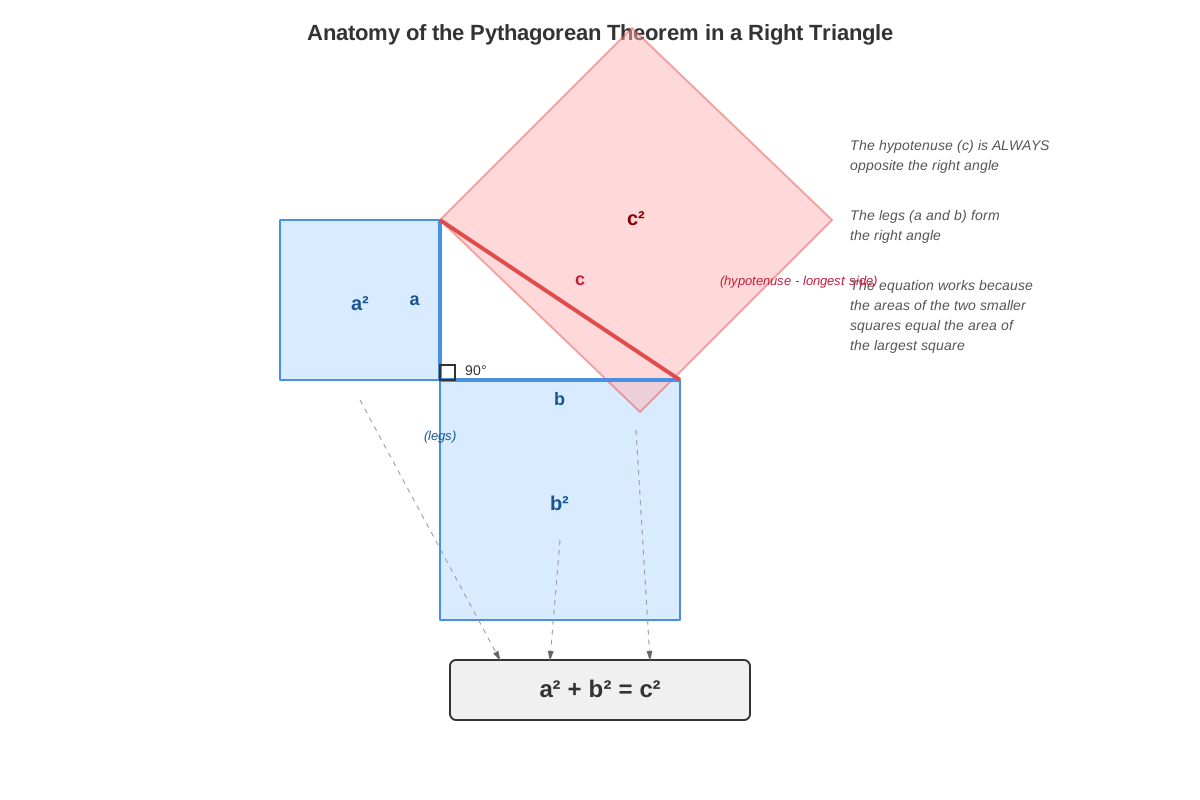
The Pythagorean theorem states that in any right triangle, the square of the length of the hypotenuse (the side opposite the right angle) equals the sum of the squares of the lengths of the other two sides (called legs). Mathematically, this relationship is expressed as:
a² + b² = c²Where:
- a and b represent the lengths of the two legs (the sides that form the right angle)
- c represents the length of the hypotenuse (the longest side, opposite the right angle)
This formula works exclusively for right triangles—triangles containing exactly one 90-degree angle. The hypotenuse is always the longest side and always sits opposite the right angle. A critical point for SAT success: the variables a and b are interchangeable (either leg can be a or b), but c must always represent the hypotenuse.
Identifying Right Triangles
Before applying the Pythagorean theorem, students must confirm they're working with a right triangle. On the SAT, right angles are typically indicated by:
- A small square symbol in the corner of the triangle
- Explicit statement in the problem ("right triangle" or "perpendicular")
- Context clues (corners of rectangles, coordinate axes, radius perpendicular to tangent)
- Implicit information requiring recognition (opposite corners of a rectangle connected by a diagonal)
Solving for Missing Sides
The Pythagorean theorem enables calculation of any missing side when two sides are known:
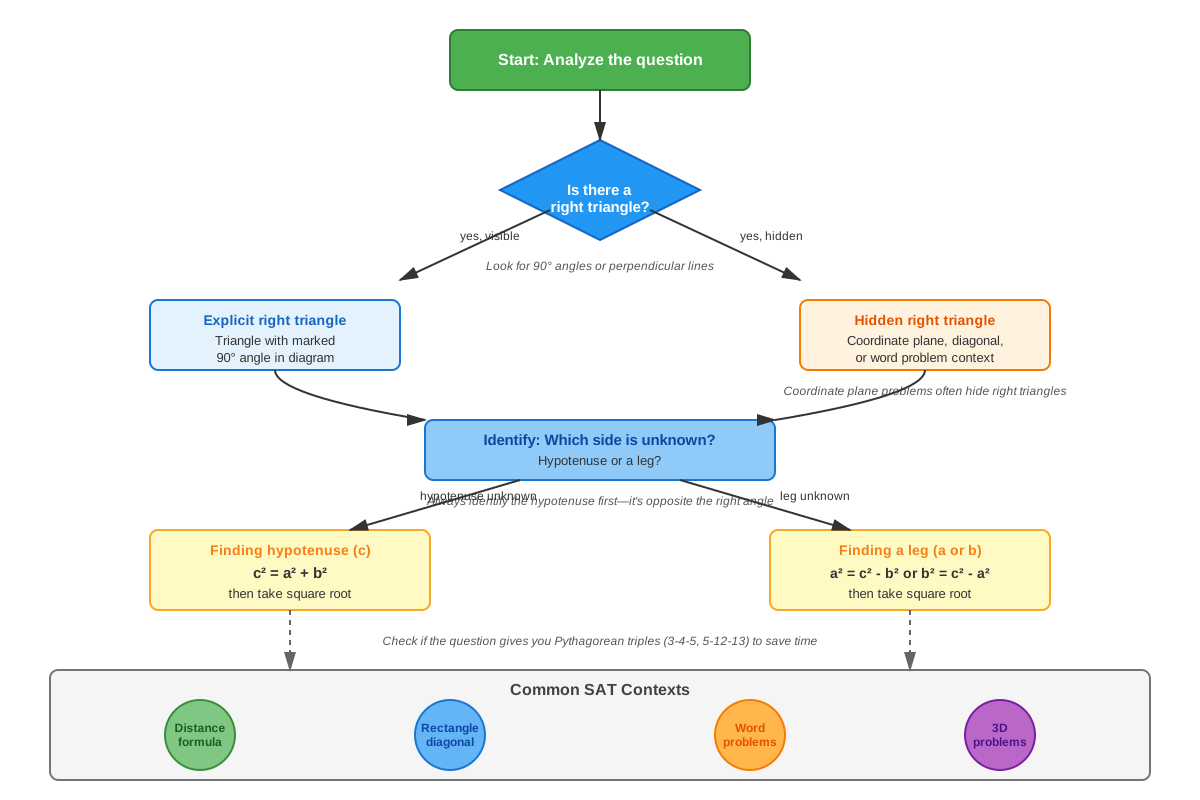
Finding the hypotenuse: When both legs are known, add their squares and take the square root:
c = √(a² + b²)Finding a leg: When the hypotenuse and one leg are known, subtract the known leg squared from the hypotenuse squared, then take the square root:
a = √(c² - b²)This second application frequently appears on the SAT and causes more errors because students sometimes forget to subtract before taking the square root.
Pythagorean Triples
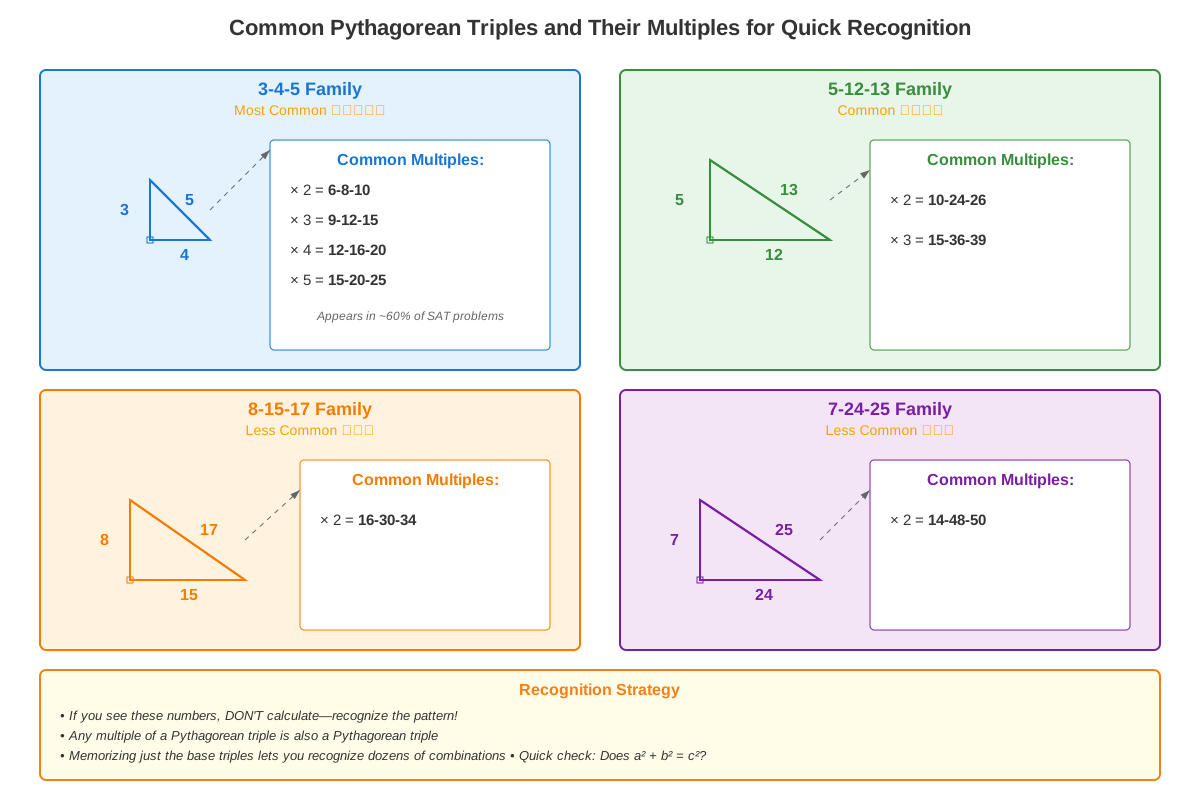
Pythagorean triples are sets of three positive integers that satisfy the Pythagorean theorem. Recognizing these common patterns saves valuable time on the SAT:
| Triple | Scaled Versions | Example |
|---|---|---|
| 3-4-5 | 6-8-10, 9-12-15, 15-20-25 | If legs are 3 and 4, hypotenuse is 5 |
| 5-12-13 | 10-24-26, 15-36-39 | If legs are 5 and 12, hypotenuse is 13 |
| 8-15-17 | 16-30-34 | If legs are 8 and 15, hypotenuse is 17 |
| 7-24-25 | 14-48-50 | If legs are 7 and 24, hypotenuse is 25 |
When an SAT problem involves these numbers, students can often identify the missing side without calculation. For instance, if a right triangle has legs of 6 and 8, recognizing this as 2(3-4-5) immediately reveals the hypotenuse as 10.
The Converse of the Pythagorean Theorem
The converse states that if three side lengths satisfy the equation a² + b² = c² (where c is the longest side), then the triangle must be a right triangle. This powerful tool allows students to verify whether a triangle is right-angled when given all three sides. On the SAT, this appears in questions asking "Which of the following could be the side lengths of a right triangle?" or "Is triangle ABC a right triangle?"
To apply the converse:
- Identify the longest side (this would be the hypotenuse if it's a right triangle)
- Square all three sides
- Check if the sum of the two smaller squares equals the largest square
- If yes, it's a right triangle; if no, it's not
Three-Dimensional Applications
The Pythagorean theorem extends to three-dimensional problems through sequential application. To find the space diagonal of a rectangular prism (the distance from one corner to the opposite corner through the interior):
- First, find the diagonal of the base using the Pythagorean theorem
- Then, use that diagonal as one leg and the height as the other leg to find the space diagonal
The formula becomes:
d = √(l² + w² + h²)Where l, w, and h represent length, width, and height. SAT questions might ask about the longest rod that fits in a box or the distance a fly travels from one corner to the opposite corner.
Coordinate Plane Applications
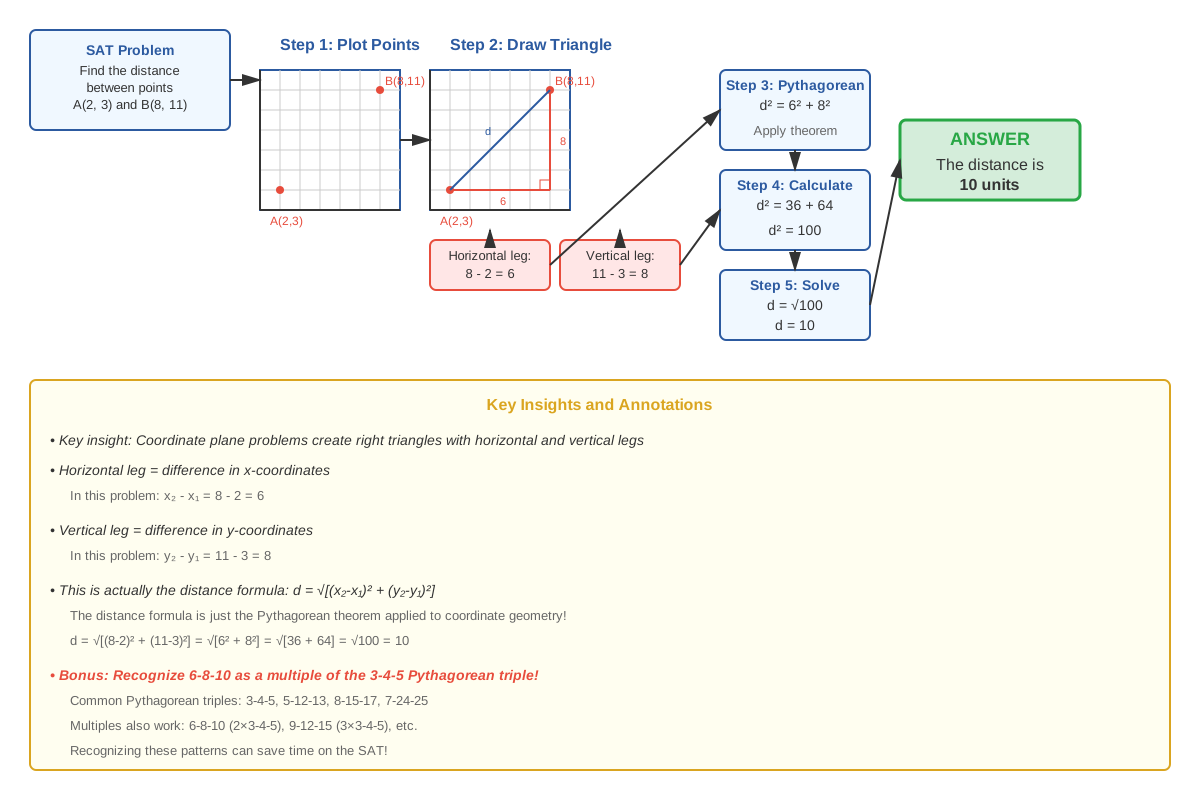
The distance formula derives directly from the Pythagorean theorem. To find the distance between points (x₁, y₁) and (x₂, y₂):
d = √[(x₂ - x₁)² + (y₂ - y₁)²]This formula treats the horizontal distance (x₂ - x₁) and vertical distance (y₂ - y₁) as the legs of a right triangle, with the distance between points as the hypotenuse. Many SAT problems present coordinate geometry questions that fundamentally test Pythagorean theorem understanding without explicitly mentioning triangles.
Concept Relationships
The Pythagorean theorem serves as a central hub connecting multiple geometric concepts. Right triangles → provide the foundation → Pythagorean theorem → extends to → distance formula → enables → coordinate geometry problems. Similarly, the theorem connects to special right triangles (45-45-90 and 30-60-90), where the Pythagorean theorem can verify the side ratios students memorize.
The relationship between the Pythagorean theorem and Pythagorean triples creates efficiency: recognizing triples eliminates calculation, while the theorem itself generates these triples. The converse relationship flows bidirectionally: the theorem proves right triangles have the a² + b² = c² relationship, while the converse proves that any triangle with this relationship must be right-angled.
In three-dimensional geometry, the theorem applies twice in sequence: base diagonal (first application) → becomes a leg → space diagonal (second application). For coordinate geometry, the theorem transforms into the distance formula: horizontal distance and vertical distance (legs) → Pythagorean theorem → distance between points (hypotenuse).
The theorem also connects to circles through the relationship between radii, tangent lines, and chords. A radius drawn to a point of tangency creates a right angle with the tangent line, enabling Pythagorean theorem applications. These interconnections mean that mastering the Pythagorean theorem unlocks solutions to dozens of different SAT question types.
High-Yield Facts
⭐ The Pythagorean theorem applies exclusively to right triangles: a² + b² = c², where c is always the hypotenuse
⭐ The hypotenuse is always the longest side of a right triangle and always sits opposite the right angle
⭐ Common Pythagorean triples include 3-4-5, 5-12-13, 8-15-17, and 7-24-25, along with their multiples
⭐ The distance formula is the Pythagorean theorem applied to coordinate geometry: d = √[(x₂ - x₁)² + (y₂ - y₁)²]
⭐ To find a leg when given the hypotenuse and other leg, use a = √(c² - b²), not a = √(c² + b²)
- The converse of the Pythagorean theorem determines if a triangle is right-angled: if a² + b² = c² (with c as the longest side), the triangle is right
- In three-dimensional problems, apply the theorem twice: once for the base diagonal, then again using that diagonal and the height
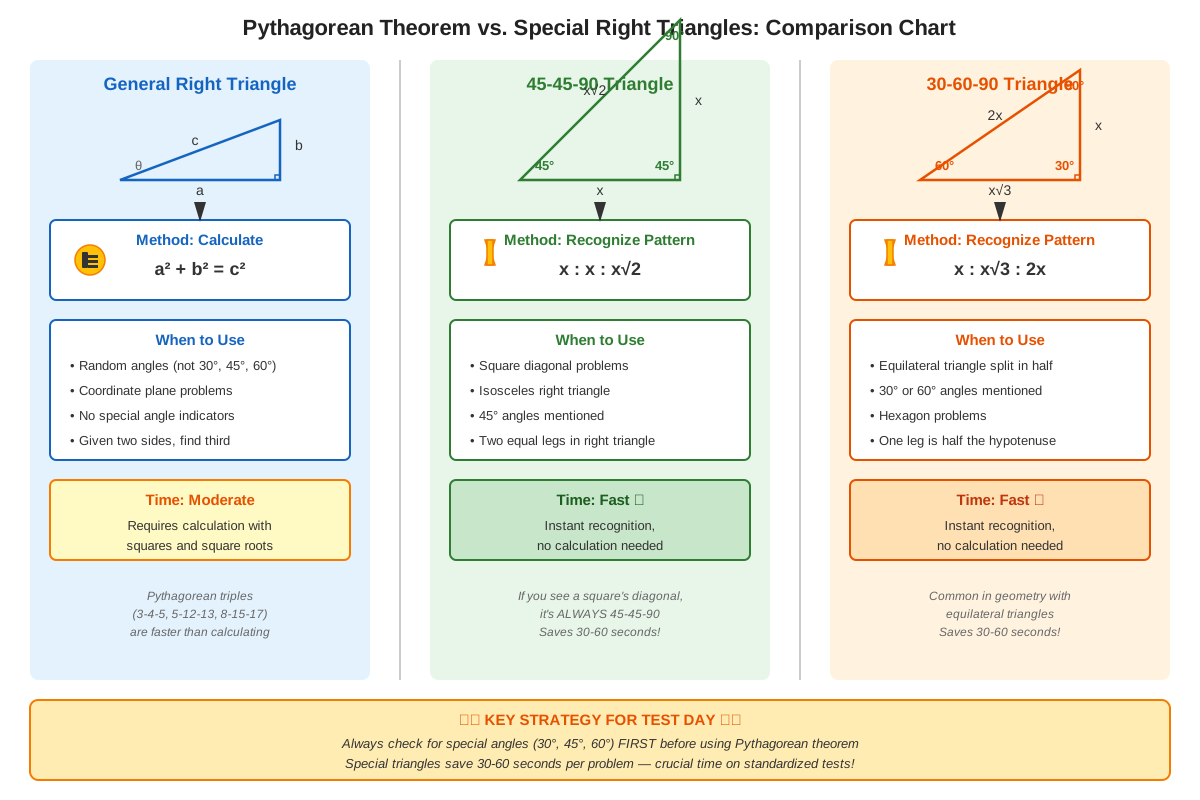
- When both legs of a right triangle are equal, the triangle is a 45-45-90 triangle with sides in ratio 1:1:√2
- The Pythagorean theorem can verify special right triangle ratios: a 30-60-90 triangle with sides 1:√3:2 satisfies 1² + (√3)² = 2²
- A radius drawn to a tangent point on a circle creates a right angle, enabling Pythagorean theorem applications
- Diagonal of a rectangle with sides a and b equals √(a² + b²)
- If a² + b² < c², the triangle is obtuse; if a² + b² > c², the triangle is acute
Quick check — test yourself on Pythagorean theorem so far.
Try Flashcards →Common Misconceptions
Misconception: The Pythagorean theorem works for all triangles, not just right triangles. → Correction: The theorem applies exclusively to right triangles. Using it on acute or obtuse triangles produces incorrect results. Always verify the presence of a right angle before applying the formula.
Misconception: Any side can be labeled as c in the Pythagorean theorem equation. → Correction: The variable c must always represent the hypotenuse (the longest side opposite the right angle). The legs a and b are interchangeable, but misidentifying the hypotenuse leads to incorrect answers.
Misconception: To find a missing leg, use a = √(c² + b²). → Correction: When finding a leg, subtract the known leg squared from the hypotenuse squared before taking the square root: a = √(c² - b²). Adding instead of subtracting is one of the most common errors on the SAT.
Misconception: If a triangle has sides 3, 4, and 6, it must be a right triangle because it contains the numbers 3 and 4 from the 3-4-5 triple. → Correction: All three numbers must match a Pythagorean triple or its multiple. Check by calculation: 3² + 4² = 9 + 16 = 25, but 6² = 36. Since 25 ≠ 36, this is not a right triangle.
Misconception: The distance formula is completely separate from the Pythagorean theorem. → Correction: The distance formula is simply the Pythagorean theorem applied to coordinate geometry. The horizontal distance (x₂ - x₁) and vertical distance (y₂ - y₁) serve as the legs, while the distance between points is the hypotenuse.
Misconception: When given a right triangle with legs 1 and 1, the hypotenuse must be 2. → Correction: Using the Pythagorean theorem: c = √(1² + 1²) = √2 ≈ 1.414, not 2. Students sometimes add the legs instead of following the proper formula.
Misconception: Pythagorean triples only include the basic sets like 3-4-5. → Correction: Any multiple of a Pythagorean triple is also a Pythagorean triple. For example, 6-8-10, 9-12-15, and 300-400-500 are all valid triples derived from 3-4-5.
Worked Examples
Example 1: Finding a Missing Hypotenuse
Problem: A right triangle has legs measuring 9 cm and 12 cm. What is the length of the hypotenuse?
Solution:
Step 1: Identify the given information. We have both legs: a = 9 and b = 12. We need to find the hypotenuse c.
Step 2: Recognize this as a Pythagorean triple. The numbers 9 and 12 are multiples of 3 and 4 (specifically, 3 × 3 and 3 × 4), suggesting this is a scaled version of the 3-4-5 triple. The hypotenuse should be 3 × 5 = 15.
Step 3: Verify using the Pythagorean theorem:
c² = a² + b²
c² = 9² + 12²
c² = 81 + 144
c² = 225
c = √225
c = 15Answer: The hypotenuse measures 15 cm.
Connection to learning objectives: This example demonstrates identifying key features of the Pythagorean theorem (the formula structure) and applying it to solve for a missing side. It also shows the time-saving benefit of recognizing Pythagorean triples.
Example 2: Coordinate Plane Distance
Problem: On the coordinate plane, point A is located at (2, 3) and point B is located at (10, 9). What is the distance between points A and B?
Solution:
Step 1: Recognize this as a Pythagorean theorem application in disguise. The distance between two points forms the hypotenuse of a right triangle.
Step 2: Calculate the horizontal distance (change in x):
Δx = 10 - 2 = 8Step 3: Calculate the vertical distance (change in y):
Δy = 9 - 3 = 6Step 4: These distances form the legs of a right triangle. Apply the Pythagorean theorem:
d² = (Δx)² + (Δy)²
d² = 8² + 6²
d² = 64 + 36
d² = 100
d = √100
d = 10
Alternatively, recognize 6-8-? as a multiple of the 3-4-5 triple (specifically 2 × 3-4-5), making the distance 2 × 5 = 10.
Step 5: Verify using the distance formula:
d = √[(x₂ - x₁)² + (y₂ - y₁)²]
d = √[(10 - 2)² + (9 - 3)²]
d = √[8² + 6²]
d = √[64 + 36]
d = √100
d = 10Answer: The distance between points A and B is 10 units.
Connection to learning objectives: This example shows how the Pythagorean theorem appears on the SAT in coordinate geometry contexts, demonstrating the relationship between the theorem and the distance formula. It also reinforces the value of recognizing Pythagorean triples for faster problem-solving.
Exam Strategy
When approaching SAT questions involving the Pythagorean theorem, begin by scanning the problem for trigger words and phrases: "right triangle," "perpendicular," "distance between points," "diagonal," "shortest path," or visual indicators like the small square symbol denoting a right angle. Questions about rectangles, coordinate planes, or ladders against walls often require the Pythagorean theorem even without explicit mention.
Strategic approach sequence:
- Identify the right triangle: Sometimes it's obvious; other times, you must visualize or draw it. In coordinate geometry, imagine connecting two points and dropping perpendicular lines to the axes.
- Label what you know: Mark the two known sides and identify which side you're solving for. Critically, determine which side is the hypotenuse.
- Check for Pythagorean triples: Before calculating, see if the numbers match or are multiples of 3-4-5, 5-12-13, 8-15-17, or 7-24-25. This can save 30-45 seconds per problem.
- Set up the equation carefully: If finding the hypotenuse, use c² = a² + b². If finding a leg, use a² = c² - b². Double-check that you're subtracting, not adding, when finding a leg.
- Simplify before taking square roots: Calculate the sum or difference completely before applying the square root. This reduces arithmetic errors.
Process of elimination tips: When answer choices are given, you can often eliminate options without full calculation. If finding a hypotenuse, eliminate any answer smaller than either given leg (the hypotenuse must be longest). If finding a leg, eliminate any answer larger than the hypotenuse. For coordinate geometry problems, estimate the distance visually—if points are roughly 10 units apart horizontally and 5 units vertically, the distance should be slightly more than 10, allowing elimination of answers like 7 or 15.
Time allocation: Simple Pythagorean theorem problems should take 30-60 seconds. If you recognize a Pythagorean triple, aim for 20-30 seconds. Multi-step problems combining the theorem with other concepts might require 90-120 seconds. If a problem takes longer, mark it and return after completing easier questions.
Calculator usage: On calculator-permitted sections, use the calculator for squaring numbers and finding square roots, but still check for Pythagorean triples first—mental math is faster than calculator work. On no-calculator sections, the SAT typically uses Pythagorean triples or perfect squares, so extensive calculation shouldn't be necessary.
Memory Techniques
Mnemonic for the formula: "A squared plus B squared equals C squared—C is the Chief (longest) side." This reminds students that c represents the hypotenuse.
Pythagorean triple memory aid: Create a visual memory palace with three rooms:
- Room 3-4-5: Picture 3 cats, 4 dogs, and 5 birds (most common, easiest to remember)
- Room 5-12-13: Imagine 5 basketballs, 12 soccer balls, and 13 footballs
- Room 8-15-17: Visualize 8 red cars, 15 blue cars, and 17 green cars
Leg versus hypotenuse: Remember "Hypotenuse is Huge"—it's always the longest side. The legs are shorter and form the right angle, like the legs of a person standing at attention (forming a right angle with the ground).
Finding a leg formula: Use the phrase "Cut Back" to remember c² - b² when finding leg a. You're "cutting back" from the hypotenuse squared.
Distance formula connection: Visualize the coordinate plane as a city grid. The horizontal distance is how many blocks east/west you walk, the vertical distance is how many blocks north/south, and the distance formula gives you the shortcut diagonal path—the hypotenuse of the triangle formed by your walking route.
Right angle recognition: Remember "Right angles are Rectangular"—they look like the corner of a rectangle or square. Any time you see perpendicular lines, corners of rectangles, or the small square symbol, think Pythagorean theorem.
Summary
The Pythagorean theorem represents an essential SAT math concept that appears in 10-15% of test questions, both directly and as a component of multi-step problems. The fundamental relationship a² + b² = c² applies exclusively to right triangles, where c always represents the hypotenuse (the longest side opposite the right angle) and a and b represent the legs. Mastery requires recognizing common Pythagorean triples (3-4-5, 5-12-13, 8-15-17, 7-24-25 and their multiples) for rapid problem-solving, understanding the converse to verify right triangles, and applying the theorem in disguised contexts like coordinate geometry (distance formula) and three-dimensional problems. Critical skills include correctly identifying which side is the hypotenuse, remembering to subtract when finding a leg (a² = c² - b²), and recognizing when SAT questions require the theorem even without explicit mention. Success on test day depends on pattern recognition, careful equation setup, and connecting the theorem to related concepts like special right triangles, rectangles, and coordinate planes.
Key Takeaways
- The Pythagorean theorem (a² + b² = c²) works only for right triangles, with c always representing the hypotenuse opposite the right angle
- Memorize common Pythagorean triples (3-4-5, 5-12-13, 8-15-17, 7-24-25) and recognize their multiples to solve problems in seconds
- When finding a missing leg, subtract before taking the square root: a = √(c² - b²), not √(c² + b²)
- The distance formula is the Pythagorean theorem applied to coordinate geometry, treating horizontal and vertical distances as legs
- The converse allows verification of right triangles: if a² + b² = c² (with c as the longest side), the triangle must be right-angled
- SAT questions often disguise Pythagorean theorem applications in coordinate geometry, word problems, rectangles, and three-dimensional contexts
- Always identify the hypotenuse correctly—it's the longest side and sits opposite the right angle—before setting up your equation
Related Topics
Special Right Triangles (45-45-90 and 30-60-90): These triangles have fixed side ratios that can be verified using the Pythagorean theorem. Mastering the Pythagorean theorem provides the foundation for understanding why these ratios work and offers an alternative solution method when the ratios are forgotten.
Trigonometry Basics: The Pythagorean theorem underlies trigonometric functions. Understanding how sine, cosine, and tangent relate to right triangle sides builds naturally from Pythagorean theorem mastery.
Circle Geometry: Many circle problems involve right triangles formed by radii, tangent lines, and chords. The Pythagorean theorem becomes essential for calculating distances and verifying perpendicular relationships in circle contexts.
Three-Dimensional Geometry: Calculating surface diagonals, space diagonals, and distances in rectangular prisms requires sequential application of the Pythagorean theorem, extending two-dimensional skills into three dimensions.
Coordinate Geometry Advanced Topics: Finding equations of circles, determining if points lie on circles, and calculating perpendicular distances all build on the distance formula foundation derived from the Pythagorean theorem.
Practice CTA
Now that you've mastered the core concepts of the Pythagorean theorem, it's time to solidify your understanding through active practice. Complete the practice questions to test your ability to recognize when and how to apply the theorem in various SAT contexts. Use the flashcards to reinforce Pythagorean triples and key formulas until they become automatic. Remember: the difference between knowing the Pythagorean theorem and mastering it lies in repeated application. Every practice problem you solve builds the pattern recognition and speed essential for test-day success. You've invested the time to learn—now invest the time to practice, and watch your confidence and accuracy soar!
Sign up free to keep reading
Create a free AnvayaPrep account to finish this SAT guide on Pythagorean theorem — plus flashcards and practice questions.