Overview
Special right triangles are among the most powerful tools in the SAT math arsenal, appearing consistently across multiple questions in every test administration. These triangles—specifically the 45-45-90 and 30-60-90 triangles—possess predictable side-length relationships that allow students to solve complex geometric problems in seconds rather than minutes. Unlike general triangles that require the Pythagorean theorem or trigonometric functions, special right triangles follow elegant ratio patterns that, once memorized, become automatic shortcuts for test-takers. Mastering these patterns transforms seemingly difficult geometry problems into straightforward arithmetic exercises.
The importance of sat special right triangles extends far beyond isolated geometry questions. These triangles appear in coordinate geometry problems, three-dimensional figure questions, word problems involving real-world scenarios, and even in some algebraic contexts where geometric reasoning provides the fastest solution path. The College Board consistently tests whether students can recognize when a special right triangle is present (even when not explicitly stated), apply the correct ratio, and manipulate the relationships to find missing measurements. Students who internalize these patterns gain significant time advantages on the SAT, often solving questions in 30 seconds that might take other students two or three minutes using alternative methods.
Special right triangles connect to broader mathematical concepts including the Pythagorean theorem (which they exemplify in specific cases), similarity and proportional reasoning, and coordinate geometry. They serve as building blocks for understanding more complex geometric figures, including regular polygons, circles with inscribed triangles, and three-dimensional solids. The ability to decompose complex figures into special right triangles represents a critical problem-solving skill that distinguishes high-scoring students from average performers on the SAT Math section.
Learning Objectives
- [ ] Identify key features of special right triangles
- [ ] Explain how special right triangles appear on the SAT
- [ ] Apply special right triangles to answer SAT-style questions
- [ ] Recognize when a problem situation creates a special right triangle, even when not explicitly stated
- [ ] Convert between different representations of special right triangle side lengths (exact vs. decimal, rationalized vs. non-rationalized)
- [ ] Decompose complex geometric figures into component special right triangles
- [ ] Determine which special right triangle pattern applies based on given angle measures or side ratios
Prerequisites
- Right triangle basics: Understanding that one angle measures 90° is essential for recognizing when special right triangle rules apply
- Pythagorean theorem: Provides the foundation for understanding why the side ratios work and serves as a verification method
- Basic angle relationships: Knowledge that triangle angles sum to 180° helps identify the third angle when two are given
- Ratio and proportion: Special right triangles are fundamentally about proportional relationships between sides
- Square roots and radical simplification: Side lengths often involve expressions like √2 and √3 that must be manipulated algebraically
Why This Topic Matters
Special right triangles represent one of the highest-yield topics for SAT preparation relative to study time invested. According to test analysis data, approximately 3-5 questions per SAT Math section directly or indirectly involve special right triangle relationships. These questions span both the calculator and no-calculator portions, appearing in multiple-choice and grid-in formats. The predictable nature of these triangles means that students who master the patterns can answer these questions with near-perfect accuracy and exceptional speed.
In real-world applications, special right triangles appear in architecture, engineering, navigation, and design. The 45-45-90 triangle naturally occurs when drawing diagonals of squares or when creating isosceles right triangles. The 30-60-90 triangle appears in equilateral triangles (when an altitude is drawn), hexagonal structures, and various engineering applications where specific angle relationships are required. Understanding these triangles helps in fields ranging from construction to computer graphics.
On the SAT, special right triangles commonly appear in several contexts: coordinate geometry problems where a point's distance from the origin must be calculated; area and perimeter problems involving squares with diagonals; three-dimensional geometry questions about pyramids, cones, or rectangular solids; and word problems involving ladders, ramps, or other real-world scenarios. The College Board often embeds special right triangles within more complex figures, testing whether students can recognize the pattern amid visual complexity. Questions may provide one side length and ask for another, give the perimeter and ask for area, or present the triangle in an unconventional orientation to test true conceptual understanding rather than mere pattern recognition.
Core Concepts
The 45-45-90 Triangle
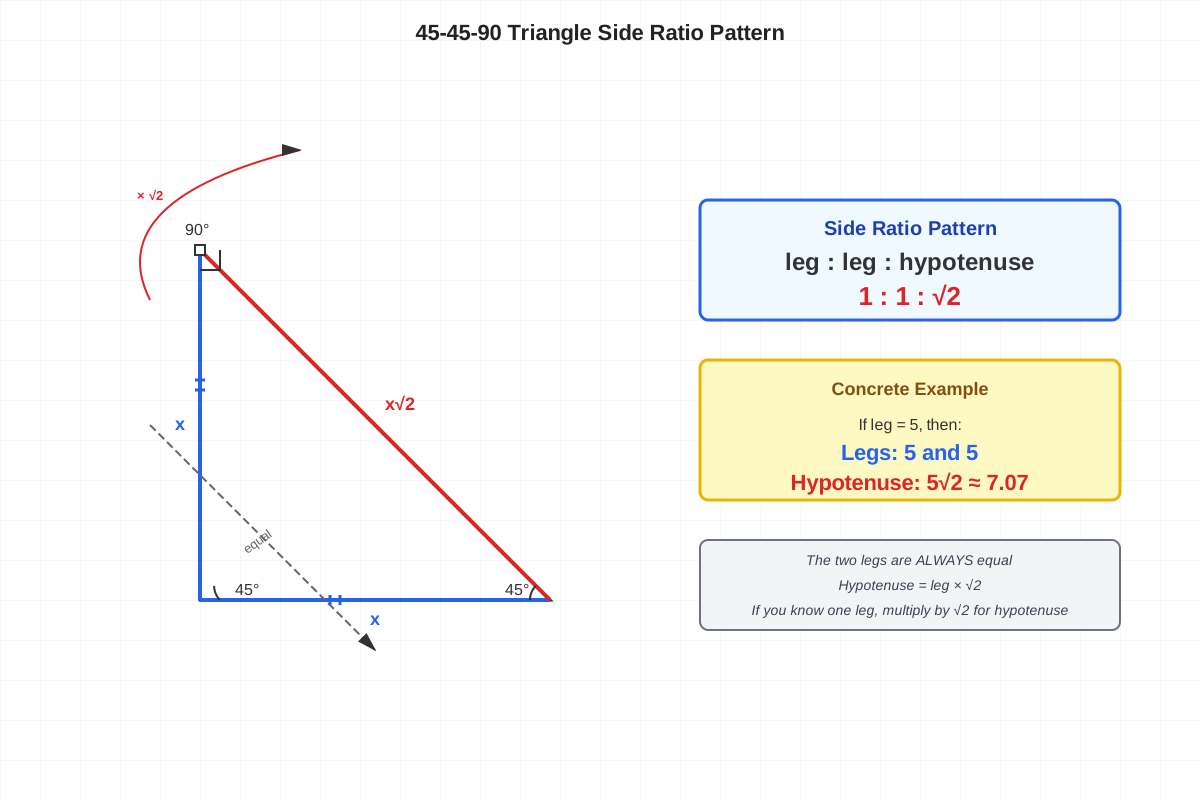
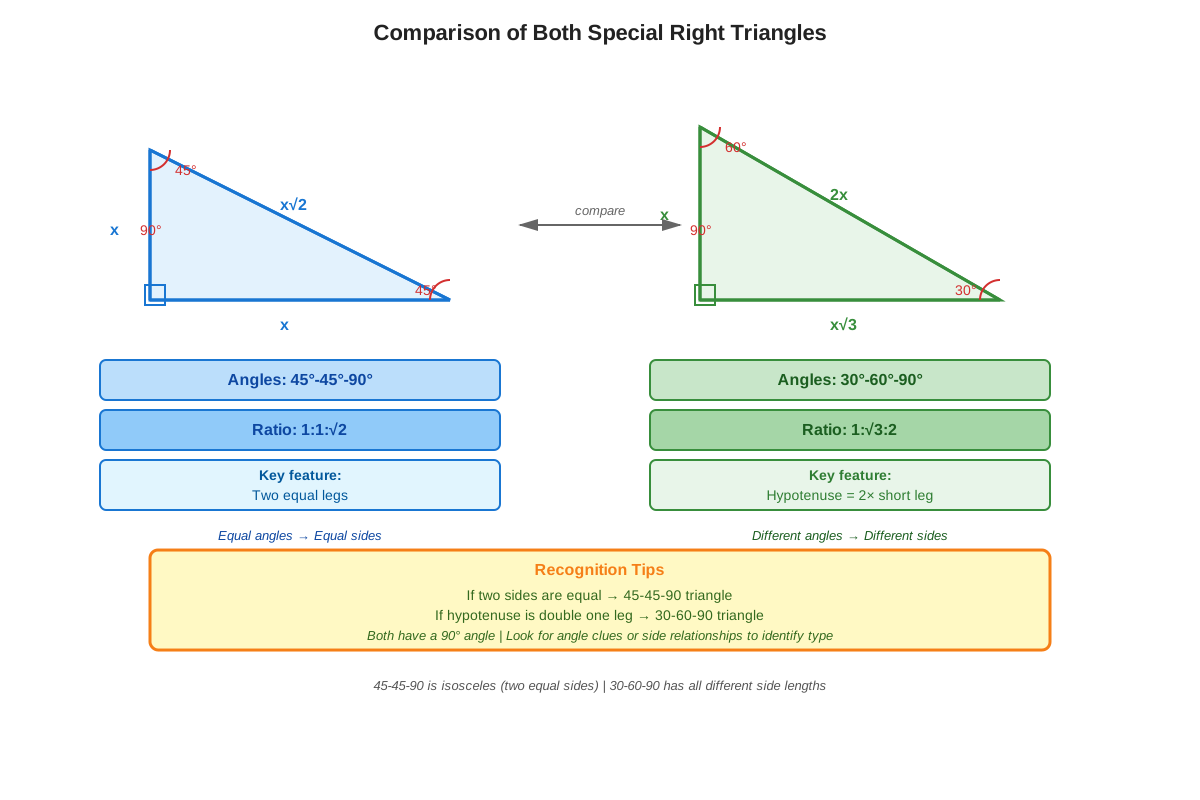
The 45-45-90 triangle is an isosceles right triangle with two 45° angles and one 90° angle. Because two angles are equal, the two legs (the sides adjacent to the right angle) must also be equal in length. This triangle appears whenever a square is divided by its diagonal or when an isosceles right triangle is formed.
The side ratio for a 45-45-90 triangle follows the pattern:
leg : leg : hypotenuse = x : x : x√2If each leg has length x, the hypotenuse has length x√2. This relationship derives directly from the Pythagorean theorem: if both legs equal x, then x² + x² = hypotenuse², which simplifies to 2x² = hypotenuse², and therefore hypotenuse = x√2.
Key properties of 45-45-90 triangles:
- Both legs are always equal in length
- The hypotenuse is always √2 times the length of a leg
- If given the hypotenuse, divide by √2 (or multiply by √2/2) to find each leg
- The triangle is always isosceles
- The altitude to the hypotenuse creates two smaller 45-45-90 triangles
The 30-60-90 Triangle
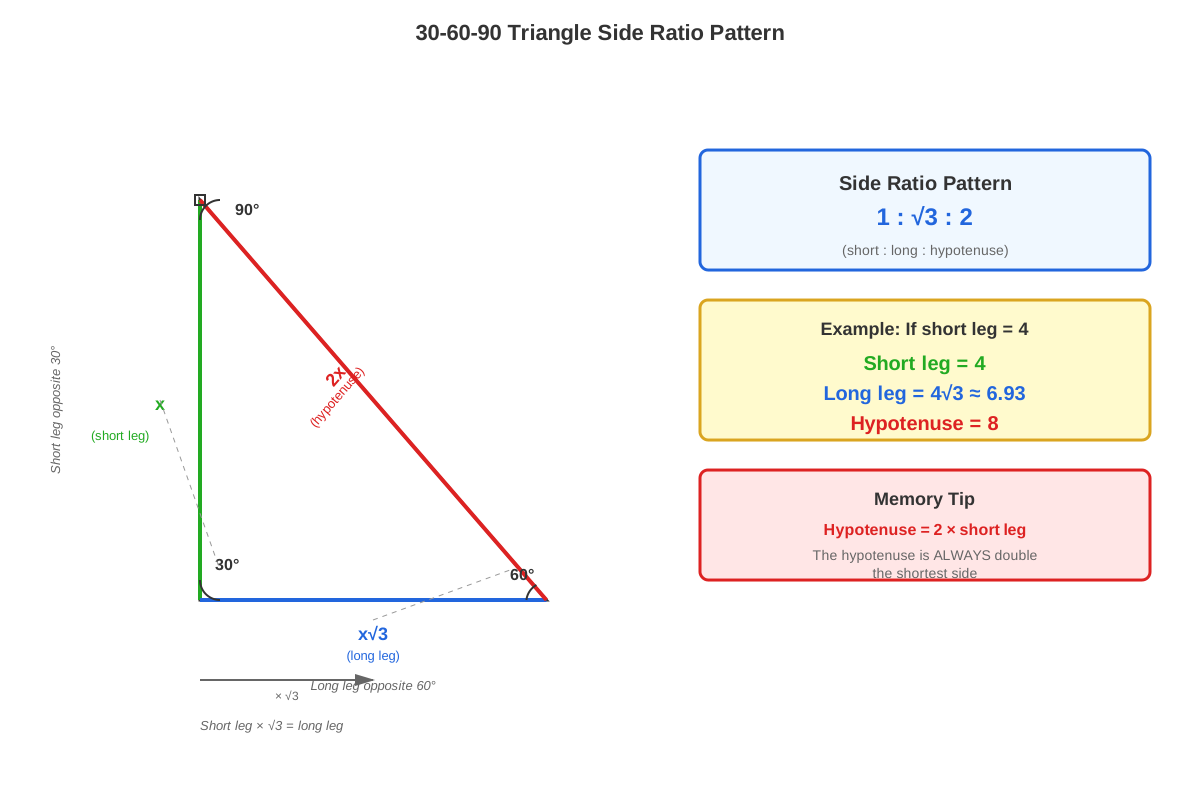
The 30-60-90 triangle contains angles measuring 30°, 60°, and 90°. This triangle appears when an altitude is drawn in an equilateral triangle, creating two congruent 30-60-90 triangles. It also appears in various geometric constructions involving hexagons and in many real-world applications.
The side ratio for a 30-60-90 triangle follows the pattern:
short leg : long leg : hypotenuse = x : x√3 : 2xThe short leg (opposite the 30° angle) has length x, the long leg (opposite the 60° angle) has length x√3, and the hypotenuse (opposite the 90° angle) has length 2x. This ratio can be verified using the Pythagorean theorem: x² + (x√3)² = x² + 3x² = 4x² = (2x)².
Key properties of 30-60-90 triangles:
- The hypotenuse is always twice the length of the short leg
- The long leg is always √3 times the length of the short leg
- The short leg is always half the hypotenuse
- The long leg is always (√3/2) times the hypotenuse
- These triangles are not isosceles
Identifying Special Right Triangles
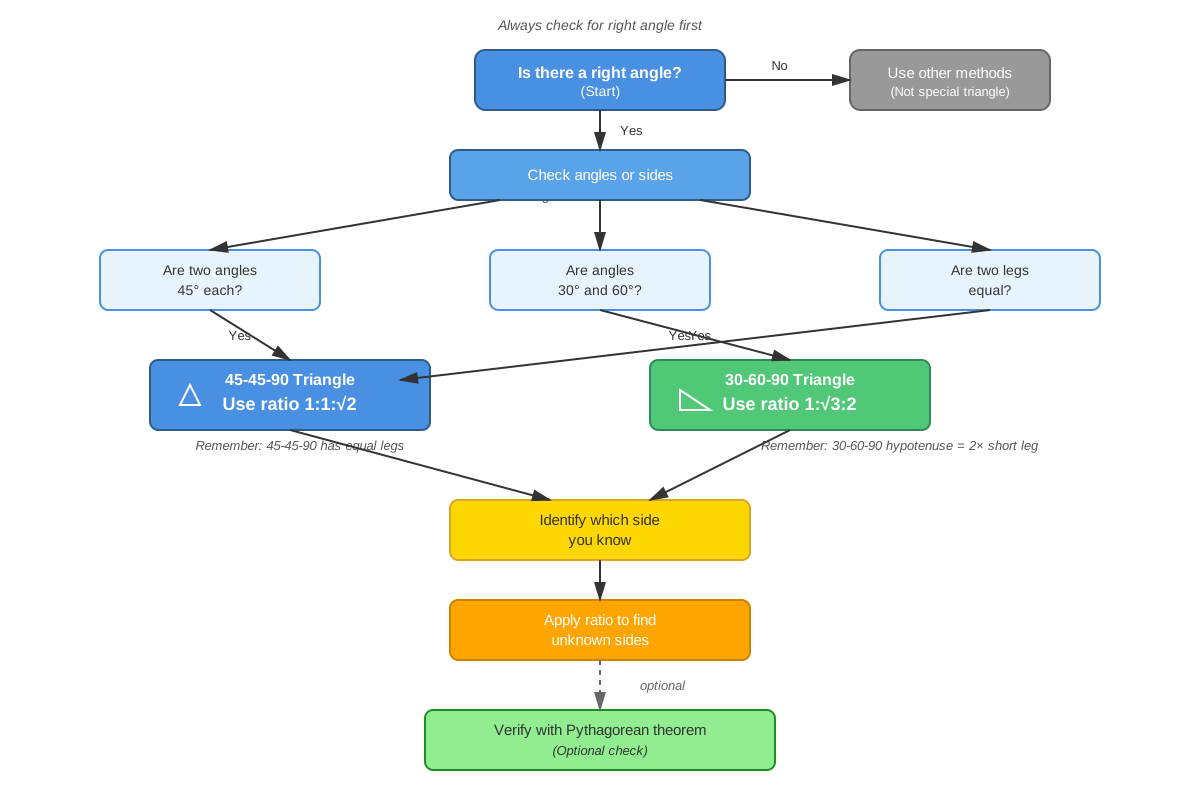
Recognition is often the most challenging aspect of applying special right triangles on the SAT. The test rarely presents these triangles in isolation with all angles clearly labeled. Instead, students must identify them within complex figures or deduce their presence from given information.
Recognition strategies:
- Angle identification: If two angles of a right triangle are given or can be determined, check if they are 45-45 or 30-60
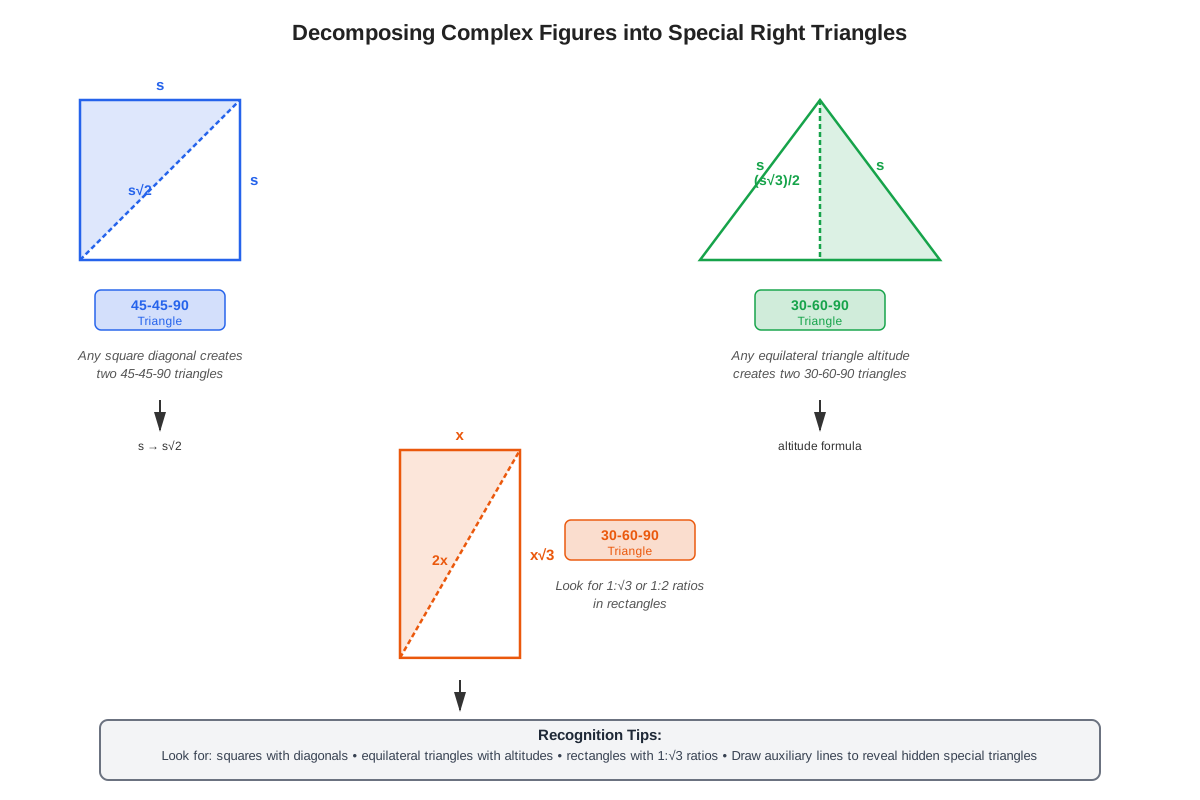
- Square diagonals: Any diagonal of a square creates two 45-45-90 triangles
- Equilateral triangle altitudes: Any altitude, median, or angle bisector in an equilateral triangle creates two 30-60-90 triangles
- Isosceles right triangles: Any right triangle described as isosceles must be 45-45-90
- Side ratio recognition: If sides are in ratio 1:1:√2, it's 45-45-90; if in ratio 1:√3:2, it's 30-60-90
Working with Radical Expressions
Special right triangle problems frequently require manipulation of expressions involving √2 and √3. Students must be comfortable with these operations:
Rationalizing denominators: When a radical appears in the denominator, multiply both numerator and denominator by that radical. For example, 10/√2 becomes (10√2)/2 = 5√2.
Simplifying products: When multiplying a number by √2 or √3, leave the answer in radical form unless specifically asked for a decimal approximation. For example, 7√3 is preferable to 12.124...
Common conversions to memorize:
| Expression | Simplified Form |
|---|---|
| x/√2 | (x√2)/2 |
| x/√3 | (x√3)/3 |
| x√2 · √2 | 2x |
| x√3 · √3 | 3x |
Scaling Special Right Triangles
All special right triangles are similar to each other within their type (all 45-45-90 triangles are similar to each other; all 30-60-90 triangles are similar to each other). This means the ratios remain constant regardless of the actual size of the triangle.
If a 45-45-90 triangle has legs of length 5, the hypotenuse is 5√2. If the legs are 12, the hypotenuse is 12√2. The multiplier (x in the ratio) can be any positive number, but the relationship between sides remains proportional.
For 30-60-90 triangles, if the short leg is 4, the long leg is 4√3 and the hypotenuse is 8. If the hypotenuse is 20, the short leg is 10 and the long leg is 10√3. Understanding this scaling principle allows students to work backward from any given side to find the others.
Concept Relationships
The two types of special right triangles connect to each other through their shared property of having predictable, ratio-based side relationships. Both derive from the Pythagorean theorem, which serves as the underlying principle explaining why these specific ratios exist. The Pythagorean theorem (a² + b² = c²) → when applied to isosceles right triangles → produces the 45-45-90 ratio, and when applied to half of an equilateral triangle → produces the 30-60-90 ratio.
Special right triangles connect to similarity and proportional reasoning because all triangles of the same type are similar to each other, maintaining constant ratios regardless of size. This relationship enables students to scale solutions up or down based on given information.
The concept extends to coordinate geometry through distance calculations. When finding the distance between two points, if the horizontal and vertical distances are equal, a 45-45-90 triangle forms. If the distances are in a 1:√3 ratio, a 30-60-90 triangle exists.
Special right triangles also connect to area calculations because knowing all three sides allows immediate computation of area using the formula A = (1/2) × base × height. For 45-45-90 triangles: A = (1/2)x² where x is the leg length. For 30-60-90 triangles: A = (1/2) × x × x√3 = (x²√3)/2 where x is the short leg.
The relationship map: Pythagorean Theorem → Special Right Triangle Ratios → Side Length Calculations → Area and Perimeter → Complex Figure Decomposition → Three-Dimensional Applications
High-Yield Facts
⭐ The 45-45-90 triangle has sides in the ratio x : x : x√2, where x represents each leg and x√2 is the hypotenuse
⭐ The 30-60-90 triangle has sides in the ratio x : x√3 : 2x, where x is the short leg (opposite 30°), x√3 is the long leg (opposite 60°), and 2x is the hypotenuse
⭐ Any diagonal of a square creates two 45-45-90 triangles
⭐ Any altitude in an equilateral triangle creates two 30-60-90 triangles
⭐ In a 30-60-90 triangle, the hypotenuse is always exactly twice the length of the short leg
- The hypotenuse of a 45-45-90 triangle is always √2 ≈ 1.414 times the length of a leg
- In a 30-60-90 triangle, the long leg is always √3 ≈ 1.732 times the length of the short leg
- To find a leg of a 45-45-90 triangle when given the hypotenuse, divide the hypotenuse by √2 or multiply by √2/2
- To find the short leg of a 30-60-90 triangle when given the hypotenuse, divide the hypotenuse by 2
- Special right triangles can appear in any orientation; the angle measures, not the visual position, determine the triangle type
- The area of a 45-45-90 triangle with leg length x is x²/2
- The area of a 30-60-90 triangle with short leg x is (x²√3)/2
- When a problem mentions a 45° angle in a right triangle, the other acute angle must also be 45°
- When a problem mentions a 30° or 60° angle in a right triangle, the other acute angle is the complement (60° or 30°)
Quick check — test yourself on Special right triangles so far.
Try Flashcards →Common Misconceptions
Misconception: In a 45-45-90 triangle, if the leg is 5, the hypotenuse is 10.
Correction: The hypotenuse is 5√2, not 10. Students often confuse the 45-45-90 ratio with the 30-60-90 ratio where the hypotenuse is double the short leg. In 45-45-90 triangles, the hypotenuse is √2 times the leg, which is approximately 1.414 times, not 2 times.
Misconception: The long leg in a 30-60-90 triangle is opposite the 30° angle.
Correction: The long leg is opposite the 60° angle, and the short leg is opposite the 30° angle. In any triangle, longer sides are opposite larger angles. This is a fundamental property that applies to all triangles, not just special right triangles.
Misconception: You can use the 45-45-90 ratio when you have a right triangle with sides 3, 4, and 5.
Correction: The 3-4-5 triangle is a right triangle but not a special right triangle. Special right triangles must have the specific angle measures (45-45-90 or 30-60-90) and their corresponding side ratios. A 3-4-5 triangle has angles of approximately 37°, 53°, and 90°.
Misconception: When given the hypotenuse of a 45-45-90 triangle, divide by 2 to find the legs.
Correction: Divide by √2 (or multiply by √2/2), not by 2. If the hypotenuse is 10, each leg is 10/√2 = 5√2 ≈ 7.07, not 5. Dividing by 2 is the correct operation for finding the short leg of a 30-60-90 triangle when given the hypotenuse.
Misconception: Special right triangle ratios only work when the sides are whole numbers.
Correction: The ratios work for any positive real number. If a 45-45-90 triangle has legs of length 2.5, the hypotenuse is 2.5√2. If a 30-60-90 triangle has a short leg of π, the long leg is π√3 and the hypotenuse is 2π. The ratios are universal regardless of whether the multiplier is an integer, fraction, decimal, or irrational number.
Misconception: All isosceles triangles are 45-45-90 triangles.
Correction: Only isosceles right triangles are 45-45-90 triangles. An isosceles triangle must also have a 90° angle to be a special right triangle. Many isosceles triangles have two equal acute angles that are not 45° (for example, a triangle with angles 70-70-40 is isosceles but not a special right triangle).
Misconception: You need a calculator to work with special right triangles.
Correction: Special right triangles are designed to be solved without a calculator by using exact radical expressions. Answers should typically be left in forms like 5√2 or 8√3 rather than converted to decimals. The SAT often requires exact answers, and the no-calculator section frequently tests special right triangles precisely because they don't require decimal calculations.
Worked Examples
Example 1: Finding Multiple Sides in a 45-45-90 Triangle
Problem: A square has a diagonal of length 12. What is the perimeter of the square?
Solution:
Step 1: Recognize the special right triangle
When a diagonal is drawn in a square, it creates two congruent 45-45-90 triangles. The diagonal serves as the hypotenuse of these triangles, and the sides of the square serve as the legs.
Step 2: Identify what we know
We know the hypotenuse = 12. We need to find the length of each leg (which is the side length of the square).
Step 3: Apply the 45-45-90 ratio
In a 45-45-90 triangle, the ratio is leg : leg : hypotenuse = x : x : x√2
If the hypotenuse is 12, then:
x√2 = 12
Step 4: Solve for x
x = 12/√2
To rationalize: x = 12/√2 × √2/√2 = 12√2/2 = 6√2
Step 5: Find the perimeter
Each side of the square has length 6√2. Since a square has 4 sides:
Perimeter = 4 × 6√2 = 24√2
Answer: 24√2 (or approximately 33.94 if a decimal is required)
Connection to learning objectives: This problem demonstrates identifying a special right triangle within a square (a common SAT scenario), applying the correct ratio, and manipulating radical expressions to find the answer.
Example 2: Working with a 30-60-90 Triangle in Context
Problem: An equilateral triangle has a side length of 10. What is the area of the triangle?
Solution:
Step 1: Recognize the special right triangle
To find the area of an equilateral triangle, we need the height. When we draw an altitude from any vertex to the opposite side, it creates two congruent 30-60-90 triangles. The altitude bisects the base, creating two segments of length 5 each.
Step 2: Identify the components of the 30-60-90 triangle
- The hypotenuse is the side of the equilateral triangle = 10
- The short leg is half the base = 5
- The long leg is the altitude (height) we need to find
Step 3: Verify using the 30-60-90 ratio
In a 30-60-90 triangle, the ratio is short leg : long leg : hypotenuse = x : x√3 : 2x
We can verify: if x = 5, then 2x = 10 ✓ (this confirms our short leg is correct)
Step 4: Find the long leg (altitude)
Long leg = x√3 = 5√3
Step 5: Calculate the area
Area of triangle = (1/2) × base × height
Area = (1/2) × 10 × 5√3
Area = 25√3
Answer: 25√3 (or approximately 43.3 if a decimal is required)
Alternative approach: Students who memorize that the area of an equilateral triangle with side s is (s²√3)/4 can solve directly: (10²√3)/4 = 100√3/4 = 25√3. However, understanding the 30-60-90 triangle derivation provides deeper conceptual knowledge.
Connection to learning objectives: This problem shows how special right triangles appear embedded in other geometric figures, requires recognition of when to apply the 30-60-90 ratio, and demonstrates the connection between special right triangles and area calculations.
Exam Strategy
When approaching SAT questions involving special right triangles, follow this systematic process:
Step 1: Identify if a special right triangle is present
Look for explicit angle measures (45°, 30°, or 60° in a right triangle), squares with diagonals, equilateral triangles with altitudes, or isosceles right triangles. The SAT often hides these triangles within complex figures, so train yourself to decompose complicated diagrams into simpler components.
Step 2: Determine which type
Once you've identified a special right triangle, determine whether it's 45-45-90 or 30-60-90. Check angle measures or look for contextual clues (square → 45-45-90; equilateral triangle → 30-60-90).
Step 3: Write down the ratio
Physically write "x : x : x√2" or "x : x√3 : 2x" on your test booklet. This prevents ratio confusion and provides a reference as you work.
Step 4: Identify what you know and what you need
Match the given information to the appropriate position in the ratio, then solve for the unknown.
Trigger words and phrases to watch for:
- "diagonal of a square" → 45-45-90 triangle
- "equilateral triangle" → likely involves 30-60-90 triangles
- "isosceles right triangle" → 45-45-90 triangle
- "altitude of an equilateral triangle" → 30-60-90 triangle
- Angles of "45°," "30°," or "60°" in a right triangle
- "regular hexagon" → often decomposed into 30-60-90 triangles
Process of elimination tips:
- If answer choices include expressions with √2, the problem likely involves a 45-45-90 triangle
- If answer choices include expressions with √3, the problem likely involves a 30-60-90 triangle
- Eliminate answers that don't maintain the correct ratio relationships
- If you're given a leg of a 45-45-90 triangle, eliminate any answer for the hypotenuse that's exactly double the leg (it should be √2 times the leg)
- If you're given the hypotenuse of a 30-60-90 triangle, eliminate any answer for the long leg that's exactly equal to the hypotenuse (it should be (√3/2) times the hypotenuse)
Time allocation:
Special right triangle questions should take 30-60 seconds once you've mastered the ratios. If you find yourself spending more than 90 seconds, you may be overcomplicating the problem. Consider whether you've correctly identified the triangle type and whether you're applying the right ratio. These questions are designed to be quick wins for prepared students, so use them to bank time for more complex problems.
Calculator vs. no-calculator sections:
Special right triangles appear in both sections. On the no-calculator section, leave answers in exact radical form (like 5√3). On the calculator section, check whether the question asks for an exact answer or a decimal approximation. Even with a calculator available, working with the ratios is usually faster than using trigonometric functions.
Memory Techniques
For the 45-45-90 ratio (x : x : x√2):
Mnemonic: "Forty-Five Forty-Five, Legs are the Same Size" — reminds you that both legs are equal (both x), and only the hypotenuse is different (x√2).
Visual memory: Picture a square cut diagonally. The two sides you can see are equal (the legs), and the diagonal cutting across is longer by a factor of √2.
Number association: Think "1-1-√2" as the simplest form. The first two numbers are the same (the legs), and the last is √2 times larger.
For the 30-60-90 ratio (x : x√3 : 2x):
Mnemonic: "Small, Medium, Large" corresponding to "1, √3, 2" — the short leg is 1 unit, the long leg is √3 units (medium), and the hypotenuse is 2 units (largest).
Angle-side association: "30 is small, so its opposite side is small" (the short leg). "60 is bigger, so its opposite side is bigger" (the long leg with √3). "90 is biggest, so its opposite side is biggest" (the hypotenuse at 2x).
Visual memory: Picture an equilateral triangle with an altitude drawn. The altitude splits the base in half (creating the short leg), extends up to create the long leg, and the original side becomes the hypotenuse. The hypotenuse is clearly the longest, being the full original side.
For remembering which radical goes with which triangle:
"Two triangles, √2 for the one with TWO equal angles (45-45-90)"
"Three angles all different, √3 for the 30-60-90"
For rationalizing denominators:
"Multiply by the twin" — when you have a radical in the denominator, multiply top and bottom by that same radical (its "twin"). For example, 5/√2 becomes 5√2/2 by multiplying by √2/√2.
Summary
Special right triangles—the 45-45-90 and 30-60-90 triangles—represent essential pattern-recognition tools for SAT success. The 45-45-90 triangle, with its x : x : x√2 ratio, appears whenever squares are divided by diagonals or isosceles right triangles are formed. The 30-60-90 triangle, with its x : x√3 : 2x ratio, emerges from equilateral triangles and various geometric constructions. Mastery requires three competencies: recognition (identifying when these triangles are present, even within complex figures), ratio application (correctly matching given information to the appropriate position in the ratio), and algebraic manipulation (working confidently with radical expressions). These triangles connect to broader mathematical concepts including the Pythagorean theorem, similarity, coordinate geometry, and area calculations. Success on SAT questions depends on automatic recall of the ratios, systematic problem-solving approaches, and the ability to decompose complex figures into simpler special right triangle components. Students who internalize these patterns gain significant speed and accuracy advantages on test day.
Key Takeaways
- The 45-45-90 triangle has sides in ratio x : x : x√2 (equal legs, hypotenuse is √2 times each leg)
- The 30-60-90 triangle has sides in ratio x : x√3 : 2x (short leg opposite 30°, long leg opposite 60°, hypotenuse opposite 90°)
- Square diagonals always create 45-45-90 triangles; equilateral triangle altitudes always create 30-60-90 triangles
- Recognition is often more challenging than calculation—train yourself to spot these triangles within complex figures
- Leave answers in exact radical form unless specifically asked for decimal approximations
- The hypotenuse of a 30-60-90 triangle is always exactly twice the short leg (not true for 45-45-90)
- These patterns work for any size triangle; the ratios remain constant regardless of the actual measurements
Related Topics
Pythagorean Theorem and Pythagorean Triples: Understanding the general relationship a² + b² = c² provides the foundation for special right triangles and helps verify answers. Pythagorean triples like 3-4-5 and 5-12-13 complement special right triangles for solving right triangle problems.
Trigonometric Ratios: Sine, cosine, and tangent functions provide alternative methods for solving right triangle problems. Special right triangles offer exact values for common angles (sin 45° = √2/2, cos 30° = √3/2, etc.).
Coordinate Geometry and Distance Formula: The distance formula creates right triangles in the coordinate plane. When horizontal and vertical distances form special ratios, special right triangles provide shortcuts for distance calculations.
Similarity and Proportional Reasoning: All special right triangles of the same type are similar to each other, making this topic excellent practice for understanding similarity concepts that appear throughout SAT geometry.
Three-Dimensional Geometry: Special right triangles appear in problems involving pyramids, cones, and rectangular solids, where finding heights, slant heights, or space diagonals requires decomposing 3D figures into 2D triangular components.
Practice CTA
Now that you've mastered the core concepts of special right triangles, it's time to cement your knowledge through active practice. Attempt the practice questions to test your ability to recognize these triangles in various contexts and apply the ratios accurately under timed conditions. Use the flashcards to drill the fundamental ratios until they become automatic—this automaticity will save you precious minutes on test day. Remember, special right triangles are one of the highest-yield topics for SAT Math preparation; the time you invest now will pay dividends in both speed and accuracy when you encounter these questions on the actual exam. You've got this!
Sign up free to keep reading
Create a free AnvayaPrep account to finish this SAT guide on Special right triangles — plus flashcards and practice questions.