Overview
Triangle congruence is a foundational concept in geometry that appears regularly on the SAT and forms the basis for solving numerous geometric proof and calculation problems. When two triangles are congruent, they are identical in shape and size—every corresponding side has equal length, and every corresponding angle has equal measure. Understanding triangle congruence allows students to identify equal measurements, establish relationships between geometric figures, and solve complex problems involving multiple triangles within a single diagram.
On the SAT Math section, triangle congruence questions test both conceptual understanding and practical application. Students must recognize congruence criteria (such as Side-Side-Side, Side-Angle-Side, and Angle-Side-Angle), apply these criteria to determine whether triangles are congruent, and use congruence relationships to find missing measurements or prove geometric statements. These questions often appear integrated with other geometric concepts like similarity, coordinate geometry, and transformations, making triangle congruence a high-yield topic that connects multiple areas of the exam.
Mastering triangle congruence provides essential scaffolding for understanding more advanced geometric relationships. The logical reasoning skills developed through congruence proofs strengthen overall mathematical thinking, while the ability to identify congruent triangles within complex figures enables efficient problem-solving across various math domains. This topic bridges basic triangle properties with more sophisticated concepts like geometric transformations, making it indispensable for achieving a competitive SAT score.
Learning Objectives
- [ ] Identify key features of triangle congruence
- [ ] Explain how triangle congruence appears on the SAT
- [ ] Apply triangle congruence to answer SAT-style questions
- [ ] Distinguish between the five congruence postulates (SSS, SAS, ASA, AAS, HL) and determine which applies to a given situation
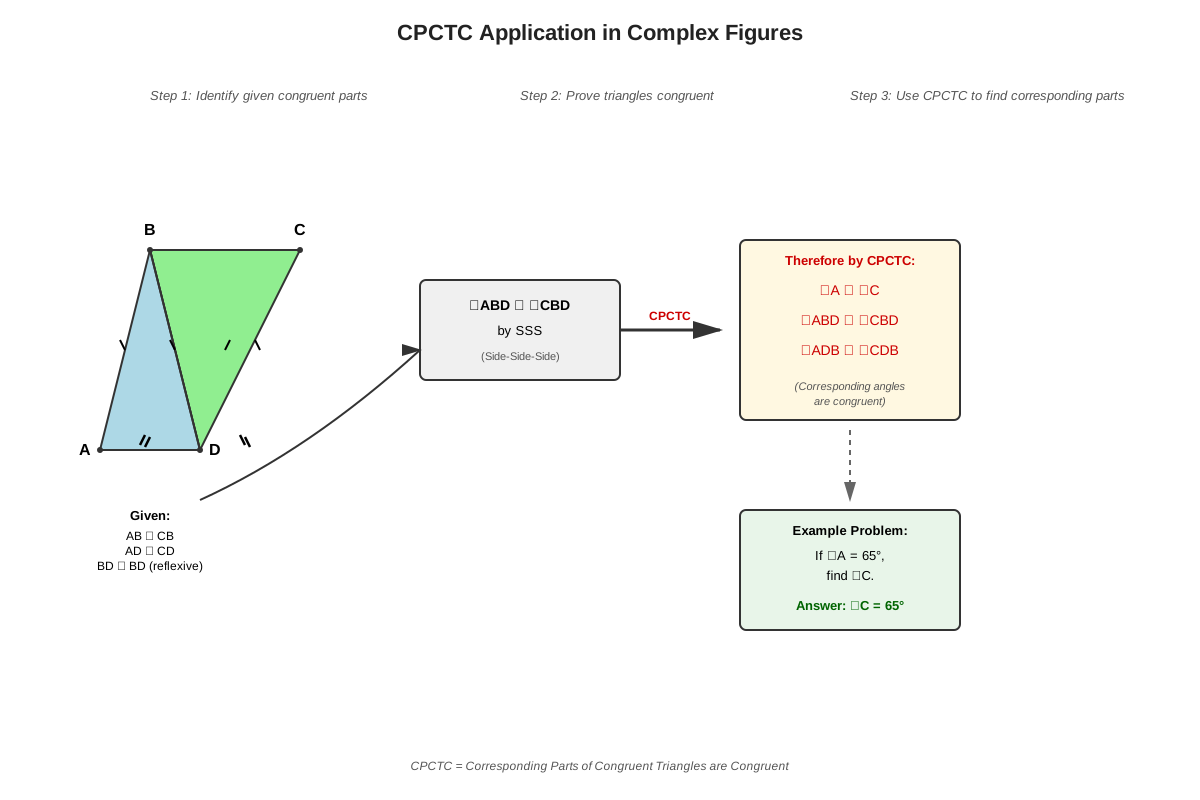
- [ ] Use CPCTC (Corresponding Parts of Congruent Triangles are Congruent) to find unknown measurements
- [ ] Recognize congruent triangles within complex geometric figures and overlapping triangle configurations
- [ ] Solve multi-step problems that combine triangle congruence with other geometric properties
Prerequisites
- Basic triangle properties: Understanding angle sum theorem (angles sum to 180°) and triangle inequality theorem is essential for verifying congruence conditions
- Angle relationships: Knowledge of vertical angles, corresponding angles, and alternate interior angles helps identify equal angles in congruence problems
- Basic algebraic manipulation: Solving equations and working with variables is necessary when finding unknown side lengths or angle measures
- Coordinate geometry fundamentals: Distance formula and midpoint concepts support congruence problems set on coordinate planes
- Geometric notation: Familiarity with symbols for congruence (≅), angle notation (∠ABC), and triangle notation (△ABC) ensures proper interpretation of problems
Why This Topic Matters
Triangle congruence has extensive real-world applications in engineering, architecture, construction, and design. Structural engineers use congruence principles to ensure that prefabricated components fit together perfectly. Architects rely on congruent triangles to create symmetrical designs and maintain structural integrity. In manufacturing, quality control depends on verifying that produced parts are congruent to specifications. GPS technology and surveying use triangulation methods based on congruence principles to determine distances and locations accurately.
On the SAT, triangle congruence appears in approximately 2-4 questions per test, representing roughly 5-8% of the geometry content. These questions typically appear in both the calculator and no-calculator sections, with difficulty levels ranging from medium to hard. The College Board frequently tests this concept because it assesses multiple mathematical competencies simultaneously: spatial reasoning, logical deduction, and the ability to apply abstract rules to concrete situations.
SAT triangle congruence questions commonly appear in several formats: direct identification problems asking which congruence postulate proves two triangles congruent; calculation problems requiring students to find missing side lengths or angle measures using CPCTC; proof-based questions where students must determine what additional information would prove congruence; and complex diagram problems featuring overlapping triangles or multiple congruent pairs. Questions often integrate coordinate geometry, requiring students to calculate distances or use transformations to establish congruence. The topic also appears in word problems involving real-world scenarios like construction, design, or navigation.
Core Concepts
Definition of Triangle Congruence
Two triangles are congruent if and only if all three corresponding sides are equal in length and all three corresponding angles are equal in measure. The symbol for congruence is ≅. When writing a congruence statement like △ABC ≅ △DEF, the order of vertices matters critically—it indicates which parts correspond. In this statement, ∠A corresponds to ∠D, ∠B corresponds to ∠E, ∠C corresponds to ∠F, side AB corresponds to side DE, side BC corresponds to side EF, and side AC corresponds to side DF.
Congruent triangles are essentially identical copies of each other, though they may be positioned differently through translations, rotations, or reflections. Unlike similar triangles (which have the same shape but different sizes), congruent triangles have both the same shape and the same size. This distinction is crucial for SAT problems that may present both concepts in the same question.
The Five Congruence Postulates
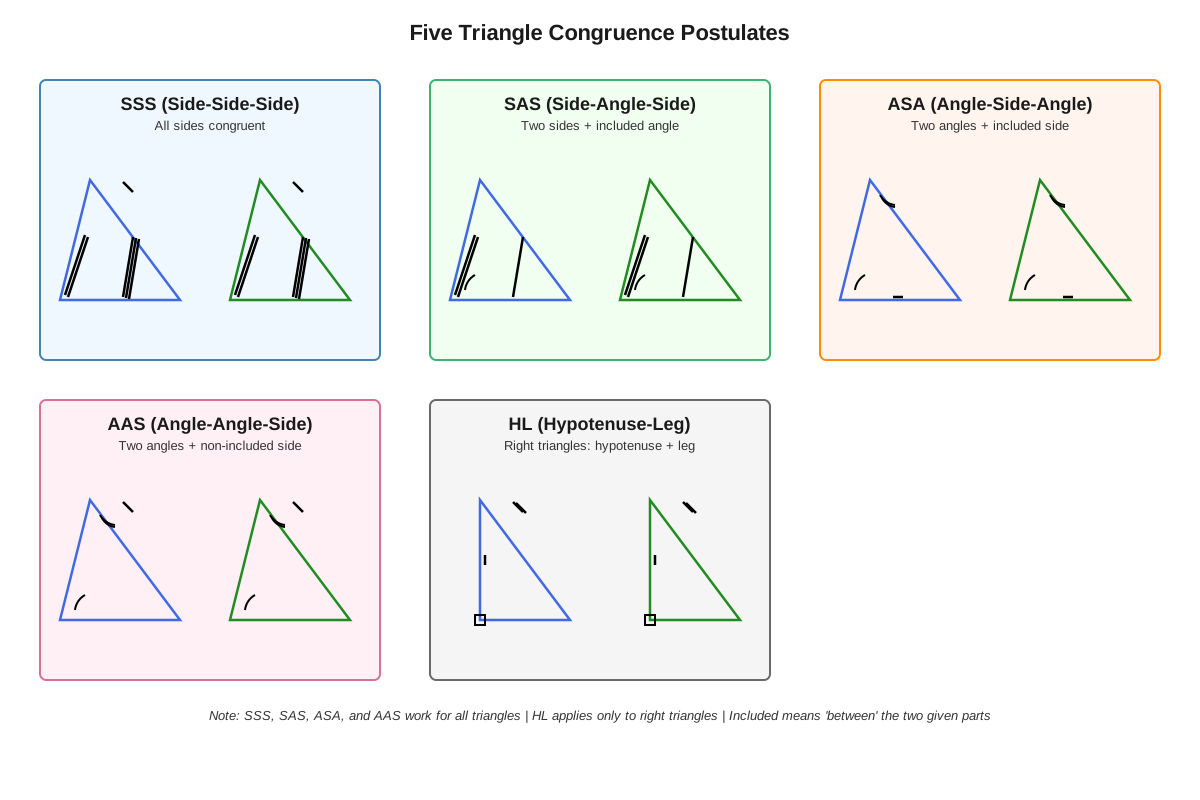
Rather than verifying all six measurements (three sides and three angles), mathematicians have established five sufficient conditions—called congruence postulates or criteria—that guarantee triangle congruence:
Side-Side-Side (SSS) Postulate
If three sides of one triangle are congruent to three sides of another triangle, then the triangles are congruent. This is often the most straightforward postulate to apply because it requires only side measurements. For example, if △ABC has sides of length 5, 7, and 9, and △DEF also has sides of length 5, 7, and 9, then △ABC ≅ △DEF by SSS. On the SAT, SSS problems often involve coordinate geometry where students must use the distance formula to calculate side lengths.
Side-Angle-Side (SAS) Postulate
If two sides and the included angle (the angle between those two sides) of one triangle are congruent to two sides and the included angle of another triangle, then the triangles are congruent. The word "included" is critical—the angle must be between the two sides. For instance, if AB = DE, AC = DF, and ∠A = ∠D, then △ABC ≅ △DEF by SAS. This postulate frequently appears in problems involving isosceles triangles or figures with perpendicular bisectors.
Angle-Side-Angle (ASA) Postulate
If two angles and the included side (the side between those two angles) of one triangle are congruent to two angles and the included side of another triangle, then the triangles are congruent. For example, if ∠A = ∠D, ∠B = ∠E, and AB = DE, then △ABC ≅ △DEF by ASA. SAT questions using ASA often involve parallel lines cut by transversals, where alternate interior angles or corresponding angles provide the angle congruences.
Angle-Angle-Side (AAS) Postulate
If two angles and a non-included side of one triangle are congruent to two angles and the corresponding non-included side of another triangle, then the triangles are congruent. This differs from ASA because the side is not between the two angles. For example, if ∠A = ∠D, ∠B = ∠E, and BC = EF, then △ABC ≅ △DEF by AAS. Since knowing two angles determines the third angle (due to the angle sum theorem), AAS is logically equivalent to ASA but requires different given information.
Hypotenuse-Leg (HL) Postulate
This postulate applies only to right triangles. If the hypotenuse and one leg of a right triangle are congruent to the hypotenuse and one leg of another right triangle, then the triangles are congruent. For example, if △ABC and △DEF are both right triangles, AB = DE (hypotenuses), and AC = DF (legs), then △ABC ≅ △DEF by HL. This postulate is particularly useful in problems involving squares, rectangles, or circles with inscribed right triangles.
Important Non-Congruence Conditions
Understanding what does not prove congruence is equally important. Angle-Angle-Angle (AAA) does not prove congruence—it only proves similarity. Three triangles can have identical angles but different sizes. Similarly, Side-Side-Angle (SSA) does not guarantee congruence except in the special case of HL for right triangles. SSA can produce two different triangles (the ambiguous case), making it insufficient for proving congruence.
CPCTC: Corresponding Parts of Congruent Triangles are Congruent
Once two triangles have been proven congruent using one of the five postulates, CPCTC allows us to conclude that all corresponding parts (all remaining sides and angles) are also congruent. This principle is fundamental for multi-step SAT problems where establishing congruence is just the first step toward finding a specific measurement. For example, after proving △ABC ≅ △DEF using SAS, CPCTC allows us to conclude that BC = EF, even if that wasn't part of the original given information.
Identifying Congruent Triangles in Complex Figures
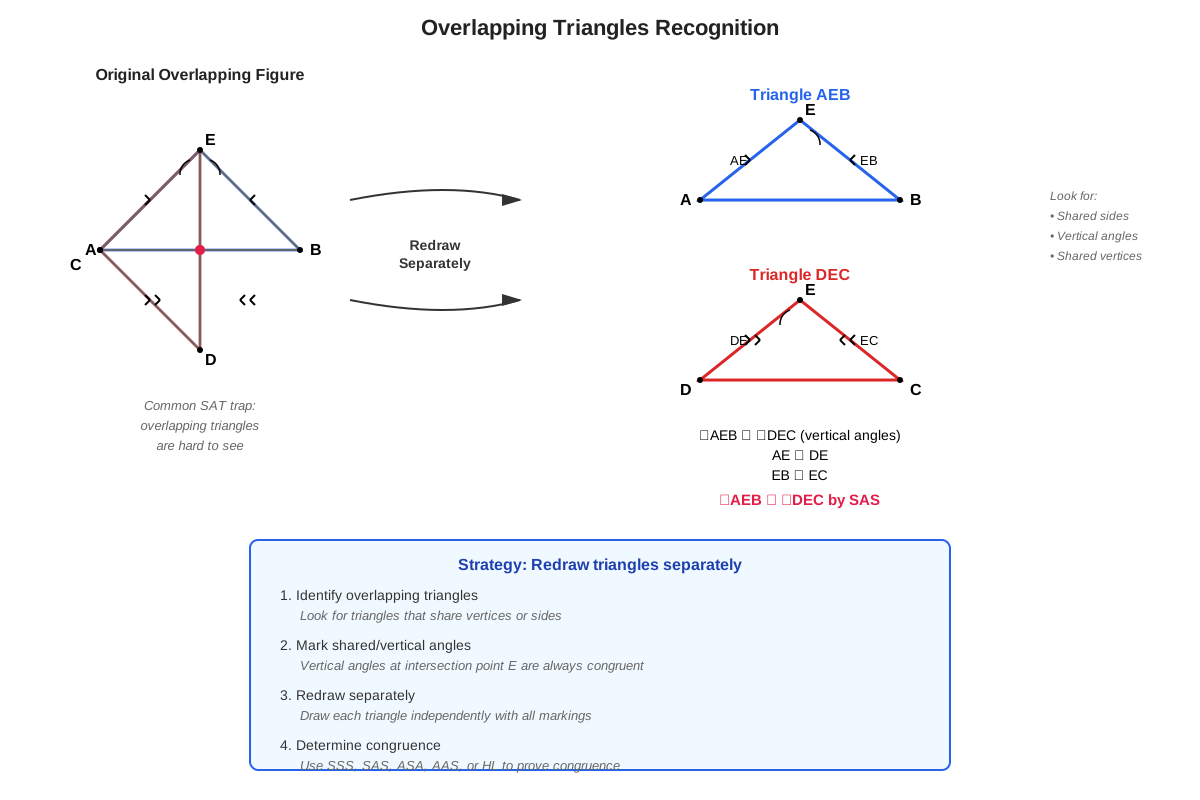
SAT problems frequently present complex diagrams containing multiple triangles, overlapping triangles, or triangles sharing common sides or angles. Success requires systematic analysis: identify all triangles present, mark known congruent parts, look for shared sides (which are congruent to themselves by the reflexive property), identify vertical angles, and search for angles formed by parallel lines or perpendicular lines. Overlapping triangles are particularly common—students must mentally separate the triangles and carefully track which parts correspond.
Concept Relationships
The five congruence postulates are interconnected through logical relationships. ASA and AAS are closely related because knowing two angles in a triangle determines the third angle through the angle sum theorem. This means AAS effectively provides information about all three angles plus one side. SAS and SSS both focus on side measurements but differ in whether angle information is included. HL is actually a special case of SSS or SAS applied specifically to right triangles, where the Pythagorean theorem guarantees the third side's length.
Triangle congruence builds directly on prerequisite knowledge of angle relationships. When parallel lines are cut by a transversal, the resulting corresponding angles and alternate interior angles provide the angle congruences needed for ASA or AAS. Vertical angles, formed when two lines intersect, frequently provide one of the angle pairs needed for congruence proofs. The reflexive property (a segment is congruent to itself) is essential when triangles share a common side.
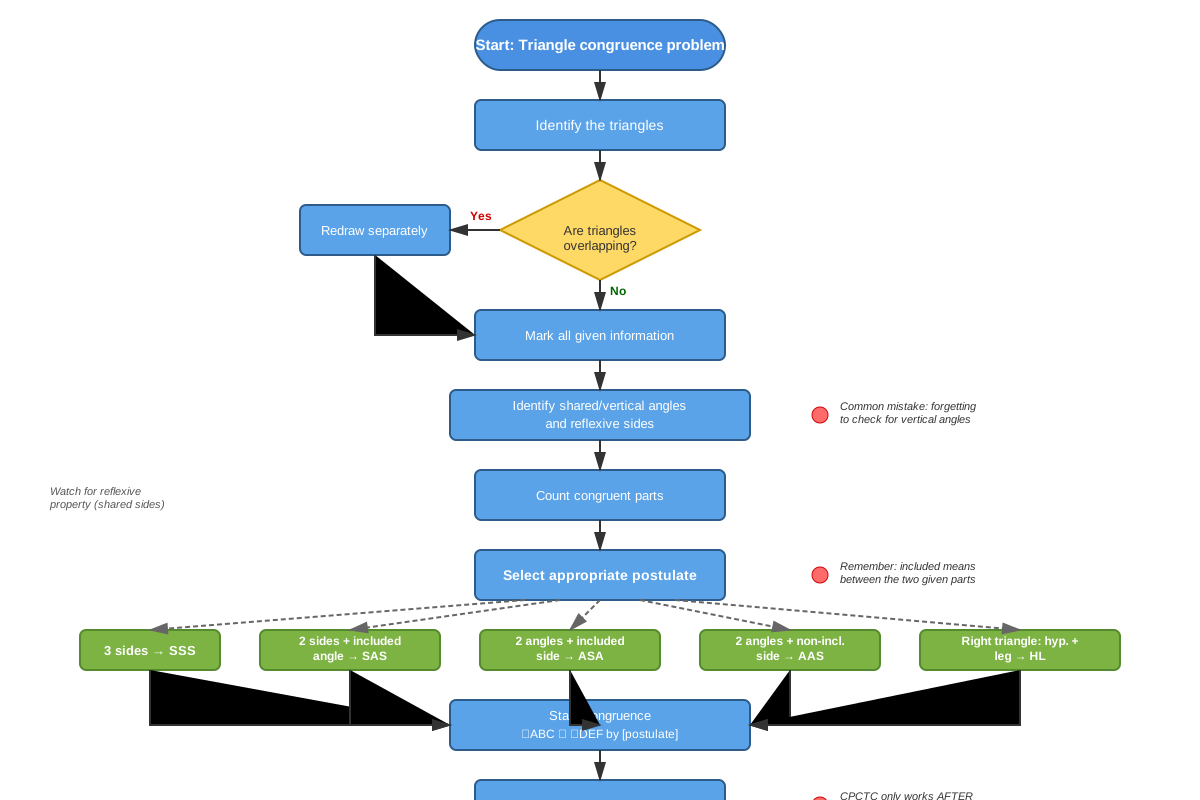
The relationship flow follows this pattern: Basic angle relationships → Identifying congruent parts → Applying congruence postulates → Proving triangle congruence → Using CPCTC → Finding unknown measurements. This sequence represents the typical problem-solving pathway for SAT triangle congruence questions.
Triangle congruence also connects forward to more advanced topics. It provides the foundation for understanding geometric transformations (translations, rotations, reflections), which preserve congruence. It relates to triangle similarity through the distinction between same shape (similarity) and same shape plus same size (congruence). Congruence principles extend to polygon congruence and are essential for understanding symmetry in geometric figures.
Quick check — test yourself on Triangle congruence so far.
Try Flashcards →High-Yield Facts
- ⭐ Two triangles are congruent if all three corresponding sides and all three corresponding angles are equal
- ⭐ The five congruence postulates are SSS, SAS, ASA, AAS, and HL (for right triangles only)
- ⭐ The included angle in SAS must be between the two given sides; the included side in ASA must be between the two given angles
- ⭐ CPCTC (Corresponding Parts of Congruent Triangles are Congruent) can only be used after congruence has been established
- ⭐ AAA (Angle-Angle-Angle) proves similarity but NOT congruence
- SSA (Side-Side-Angle) does not prove congruence except in the special case of HL for right triangles
- When writing congruence statements, vertex order indicates which parts correspond
- The reflexive property states that any segment or angle is congruent to itself—crucial for triangles sharing sides
- Vertical angles are always congruent and frequently appear in overlapping triangle problems
- In coordinate geometry, the distance formula is used to verify side congruence for SSS or SAS
- Congruent triangles have equal areas and equal perimeters
- Transformations (translations, rotations, reflections) preserve congruence but change position or orientation
- If two sides of a triangle are congruent to two sides of another triangle but the included angles are NOT congruent, the triangles are NOT necessarily congruent
Common Misconceptions
Misconception: If two triangles have three congruent angles (AAA), they must be congruent.
Correction: AAA only proves similarity, not congruence. Triangles can have identical angles but different sizes. For congruence, at least one side measurement must be known and equal.
Misconception: SSA (Side-Side-Angle) is a valid congruence postulate.
Correction: SSA does not guarantee congruence because it can produce two different triangles (the ambiguous case). The only exception is HL for right triangles, where the hypotenuse and one leg determine a unique triangle.
Misconception: In SAS, any two sides and any angle prove congruence.
Correction: The angle must be the included angle—the angle formed between the two given sides. If the angle is not between the two sides, SAS cannot be applied.
Misconception: CPCTC can be used to prove triangles are congruent.
Correction: CPCTC is a conclusion drawn after congruence has already been proven, not a method for proving congruence. First prove congruence using SSS, SAS, ASA, AAS, or HL, then use CPCTC to establish additional equal parts.
Misconception: The order of vertices in a congruence statement doesn't matter.
Correction: Vertex order is critical because it indicates correspondence. △ABC ≅ △DEF means A↔D, B↔E, C↔F, while △ABC ≅ △EDF would mean A↔E, B↔D, C↔F—completely different correspondences.
Misconception: Congruent triangles must have the same orientation or position.
Correction: Congruent triangles can be translated, rotated, or reflected. They may appear in different positions or orientations but remain congruent as long as corresponding measurements are equal.
Misconception: If two right triangles have congruent hypotenuses, they must be congruent.
Correction: Knowing only the hypotenuses are equal is insufficient. HL requires the hypotenuse and one leg to be congruent. Two right triangles with equal hypotenuses but different leg lengths are not congruent.
Worked Examples
Example 1: Identifying Congruence Postulates
Problem: In the figure, point M is the midpoint of segment QS, and segments QR and ST are perpendicular to QS. If QM = MS and ∠QMR and ∠SMT are right angles, which congruence postulate proves △QMR ≅ △SMT?
Solution:
Step 1: Identify what information is given.
- M is the midpoint of QS, so QM = MS (one pair of congruent sides)
- QR ⊥ QS and ST ⊥ QS, so ∠QMR and ∠SMT are both right angles (one pair of congruent angles)
- Both triangles are right triangles
Step 2: Look for additional congruent parts.
- ∠QMR and ∠SMT are vertical angles formed at point M
- Wait—actually, if M is on segment QS, these are not vertical angles
- Both angles are right angles (90°), so ∠QMR ≅ ∠SMT (both equal 90°)
Step 3: Determine which postulate applies.
We have:
- QM = MS (one pair of sides)
- ∠QMR ≅ ∠SMT (one pair of angles)
- Both are right triangles
This could be HL if we had the hypotenuses, but we don't have information about QR and ST.
Let me reconsider: We have one side (QM = MS) and one angle (the right angles). We need more information. Looking at the figure again, ∠MQR and ∠MST might be congruent if QR and ST are parallel (which they are, since both are perpendicular to the same line QS). If the lines are parallel and QS is a transversal, then ∠MQR ≅ ∠MST as alternate interior angles.
Now we have:
- QM = MS (sides)
- ∠QMR ≅ ∠SMT (included angles—both 90°)
- This gives us Side-Angle-Side (SAS)
Answer: △QMR ≅ △SMT by SAS postulate.
Connection to Learning Objectives: This problem requires identifying key features of triangle congruence (given information and angle relationships) and applying the appropriate congruence postulate—demonstrating mastery of distinguishing between the five postulates.
Example 2: Using CPCTC to Find Missing Measurements
Problem: Given that △ABC ≅ △DEF, AB = 2x + 3, DE = 5x - 9, BC = 15, and EF = y + 7. Find the values of x and y.
Solution:
Step 1: Use the congruence statement to identify corresponding parts.
From △ABC ≅ △DEF:
- A corresponds to D
- B corresponds to E
- C corresponds to F
Therefore:
- AB corresponds to DE
- BC corresponds to EF
- AC corresponds to DF
Step 2: Set up equations using corresponding congruent sides.
Since AB corresponds to DE and the triangles are congruent:
AB = DE
2x + 3 = 5x - 9
Since BC corresponds to EF:
BC = EF
15 = y + 7
Step 3: Solve for x.
2x + 3 = 5x - 9
3 + 9 = 5x - 2x
12 = 3x
x = 4
Step 4: Solve for y.
15 = y + 7
y = 15 - 7
y = 8
Step 5: Verify the answer makes sense.
AB = 2(4) + 3 = 11
DE = 5(4) - 9 = 11 ✓
BC = 15
EF = 8 + 7 = 15 ✓
Answer: x = 4 and y = 8
Connection to Learning Objectives: This problem demonstrates applying triangle congruence to answer SAT-style questions by using CPCTC to establish equations and solve for unknown values—a common question format on the exam.
Exam Strategy
When approaching SAT triangle congruence questions, begin by carefully reading the problem and marking all given information directly on the diagram. Use tick marks for congruent sides and arc marks for congruent angles. This visual organization prevents confusion and helps identify which postulate applies.
Trigger words and phrases to watch for include: "midpoint" (suggests two congruent segments), "bisects" (creates two congruent parts), "perpendicular" (creates right angles), "parallel lines" (suggests congruent corresponding or alternate interior angles), "isosceles triangle" (two congruent sides), and "shared side" or "common side" (reflexive property). When you see "prove" or "which additional information," the question is asking you to identify what's needed to establish congruence.
For process-of-elimination, immediately eliminate answer choices that suggest AAA or SSA (except HL for right triangles) as these don't prove congruence. If the problem involves right triangles, consider whether HL applies before checking other postulates. When multiple postulates seem possible, verify that angles are included (for SAS and ASA) or non-included (for AAS) as specified.
Time allocation for triangle congruence questions should be approximately 1-2 minutes for straightforward identification problems and 2-3 minutes for multi-step problems involving CPCTC or coordinate geometry. If a problem requires extensive calculation, ensure you're on the right track before investing significant time—check that your approach uses valid congruence reasoning.
Exam Tip: Always write out the congruence statement with vertices in corresponding order (△ABC ≅ △DEF). This prevents errors when identifying which parts correspond and is especially crucial for CPCTC problems.
For coordinate geometry problems, don't calculate all distances unless necessary. Sometimes you can determine congruence by recognizing transformations (reflections across axes, rotations around the origin) that preserve distance. This saves valuable time.
Memory Techniques
Mnemonic for the five congruence postulates: "Sally Sells Seashells, So Anna Sells Apples Sometimes, And Always Sells Honey Later"
- SSS (Sally Sells Seashells)
- SAS (So Anna Sells)
- ASA (Apples Sometimes, And)
- AAS (Always Sells)
- HL (Honey Later)
Visualization strategy for included vs. non-included: Picture a sandwich. In SAS, the angle is the filling "included" between two pieces of bread (sides). In ASA, the side is the filling "included" between two pieces of bread (angles). If the angle or side is outside the sandwich, it's non-included (AAS).
Acronym for CPCTC: "Can Prove Congruent Triangles Create" equal parts—reminding you that CPCTC comes after proving congruence, not before.
Memory aid for what doesn't work: "AAA is Almost Always Ambiguous" (proves similarity only) and "SSA is So Stupidly Ambiguous" (doesn't prove congruence except HL).
Reflexive property reminder: Think "Reflexive = Repeated" or "Reflexive = Reused"—when triangles share a side, that side appears in both triangles and is congruent to itself.
Summary
Triangle congruence is a high-yield SAT topic that requires understanding when two triangles are identical in both shape and size. Mastery involves recognizing the five valid congruence postulates—SSS, SAS, ASA, AAS, and HL—and distinguishing them from invalid conditions like AAA and SSA. The key to success is carefully identifying given information, marking congruent parts systematically, and determining which postulate applies based on whether angles are included or non-included. Once congruence is established, CPCTC enables finding additional equal measurements. SAT questions integrate triangle congruence with coordinate geometry, parallel lines, transformations, and multi-step reasoning. Students must pay careful attention to vertex order in congruence statements, recognize shared sides and vertical angles, and avoid common misconceptions about what proves congruence. Efficient problem-solving requires marking diagrams clearly, using trigger words to identify relevant information, and applying systematic approaches rather than relying on visual intuition alone.
Key Takeaways
- Triangle congruence means two triangles have identical corresponding sides and angles; use the symbol ≅
- Five postulates prove congruence: SSS, SAS, ASA, AAS, and HL (right triangles only)—memorize these and their requirements
- The included angle (SAS) or included side (ASA) must be between the two given parts; non-included means outside
- CPCTC is used after proving congruence to establish that all remaining corresponding parts are equal
- AAA proves only similarity, not congruence; SSA doesn't prove congruence except in the HL case
- Vertex order in congruence statements indicates which parts correspond—△ABC ≅ △DEF means A↔D, B↔E, C↔F
- Mark diagrams with tick marks and arc marks to track congruent parts and avoid confusion in complex figures
Related Topics
Triangle Similarity: After mastering congruence, similarity extends these concepts to triangles with the same shape but different sizes, using AA, SAS~, and SSS~ postulates. Understanding the distinction between congruence (same size and shape) and similarity (same shape only) is essential for comprehensive geometric reasoning.
Geometric Transformations: Translations, rotations, reflections, and dilations build on congruence concepts. Rigid transformations (translations, rotations, reflections) preserve congruence, while dilations preserve similarity. This topic deepens understanding of why congruent triangles can appear in different positions.
Coordinate Geometry with Triangles: Applying congruence concepts to triangles on the coordinate plane requires using the distance formula, slope, and midpoint formula. This integration strengthens both algebraic and geometric skills.
Quadrilateral Properties: Many quadrilateral proofs rely on dividing the figure into triangles and using congruence to establish properties. Mastering triangle congruence enables understanding of parallelogram, rectangle, rhombus, and trapezoid theorems.
Circle Theorems: Advanced circle problems often involve inscribed triangles where congruence relationships help solve for arc measures, chord lengths, and angle measures.
Practice CTA
Now that you've mastered the core concepts of triangle congruence, it's time to solidify your understanding through active practice. Complete the practice questions to test your ability to identify congruence postulates, apply CPCTC, and solve multi-step problems under timed conditions. Use the flashcards to reinforce the five postulates and common trigger words until you can recall them instantly. Remember, triangle congruence appears on virtually every SAT, and these practice materials will transform your theoretical knowledge into test-day confidence. The more problems you work through now, the faster and more accurate you'll be when it counts. You've got this—start practicing!
Sign up free to keep reading
Create a free AnvayaPrep account to finish this SAT guide on Triangle congruence — plus flashcards and practice questions.