Overview
Appositives are noun phrases that rename, define, or provide additional information about another noun or pronoun immediately adjacent to them. In SAT Reading and Writing (RW), appositives represent one of the most frequently tested punctuation and sentence structure concepts. Understanding how to properly punctuate appositives—and recognizing when punctuation is used incorrectly—is essential for success on the exam's Standard English Conventions questions.
The SAT tests appositives primarily through questions about comma usage, dash usage, and sentence boundaries. Students must identify whether an appositive is essential (restrictive) or nonessential (nonrestrictive) to determine correct punctuation. Essential appositives require no punctuation, while nonessential appositives must be set off with commas, dashes, or parentheses. This distinction appears in approximately 10-15% of all SAT Reading and Writing questions, making it a high-yield topic that directly impacts scores.
Mastering appositives connects to broader understanding of sentence structure, punctuation rules, and the relationship between clauses and phrases. This topic builds upon fundamental knowledge of nouns, noun phrases, and the concept of sentence boundaries. Strong appositive skills also support comprehension of complex academic prose, as appositives frequently appear in the sophisticated passages students encounter throughout the SAT.
Learning Objectives
- [ ] Identify key features of appositives in sentences
- [ ] Explain how appositives appears on the SAT
- [ ] Apply appositives to answer SAT-style questions
- [ ] Distinguish between essential and nonessential appositives
- [ ] Select appropriate punctuation marks (commas, dashes, parentheses) to set off nonessential appositives
- [ ] Recognize and correct common appositive punctuation errors
- [ ] Analyze sentence structure to determine whether a phrase functions as an appositive
Prerequisites
- Basic noun identification: Appositives rename nouns, so recognizing nouns and noun phrases is fundamental to identifying appositives
- Understanding of sentence structure: Students must distinguish between complete sentences and phrases to avoid creating fragments or run-ons when punctuating appositives
- Comma usage fundamentals: Since commas are the most common punctuation for appositives, basic comma knowledge provides the foundation for more advanced applications
- Concept of essential vs. nonessential information: This distinction determines whether punctuation is required, making it central to appositive rules
Why This Topic Matters
Appositives appear throughout academic and professional writing, making them essential for both test success and real-world literacy. In journalism, scientific writing, and formal communication, appositives provide efficient ways to add clarifying information without creating cumbersome sentence structures. Understanding appositives enables students to write more sophisticated prose and comprehend complex texts more effectively.
On the SAT, appositive questions appear with remarkable consistency. Approximately 2-3 questions per test directly assess appositive punctuation, and several additional questions involve sentence structures where appositive knowledge aids comprehension. These questions typically appear in the Standard English Conventions category and are considered medium difficulty, meaning they effectively differentiate between mid-range and high-scoring students.
The SAT presents appositive questions in several predictable formats: selecting correct punctuation from four options, identifying errors in underlined portions, and determining whether commas or dashes should be added or removed. Passages often contain biographical information, scientific explanations, or historical contexts where appositives naturally occur. For example, a passage might introduce "Marie Curie, the first woman to win a Nobel Prize," or describe "the mitochondria, the powerhouse of the cell." Recognizing these structures and applying correct punctuation rules translates directly into points on test day.
Core Concepts
Definition and Function of Appositives
An appositive is a noun or noun phrase that immediately follows another noun to rename, identify, or provide additional information about it. The appositive and the noun it modifies refer to the same person, place, thing, or idea. For example, in the sentence "My friend Sarah loves reading," the word "Sarah" is an appositive that identifies which friend is being discussed.
Appositives serve several important functions in writing. They allow writers to combine information efficiently, avoiding choppy sentences. Instead of writing "I have a dog. His name is Max. Max is a golden retriever," a writer can use an appositive: "My dog, Max, is a golden retriever." This construction creates smoother, more sophisticated prose while maintaining clarity.
Essential vs. Nonessential Appositives
The most critical distinction for SAT appositives involves determining whether an appositive is essential (restrictive) or nonessential (nonrestrictive). This classification determines punctuation requirements and represents the foundation of most SAT questions on this topic.
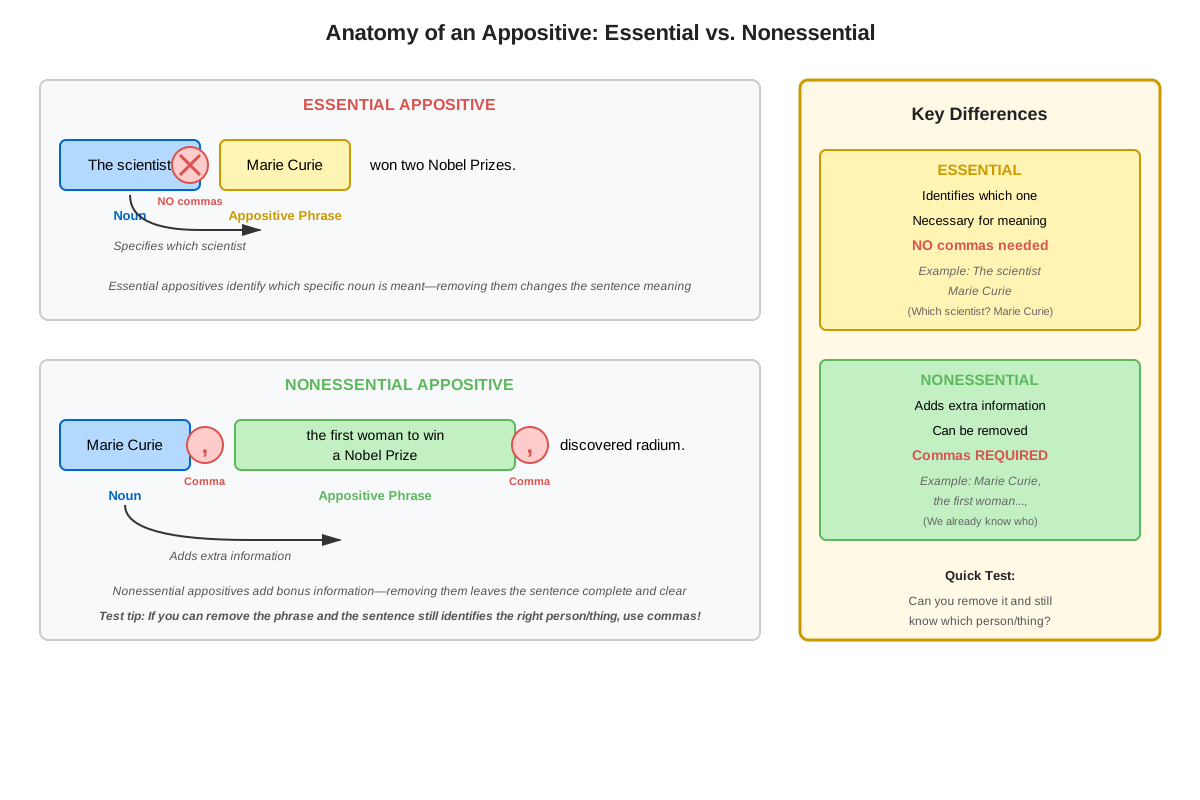
Essential appositives provide information necessary to identify the noun they modify. Without this information, the sentence's meaning becomes unclear or changes significantly. Essential appositives are NOT set off with punctuation. Consider: "The novel To Kill a Mockingbird explores themes of racial injustice." Here, "To Kill a Mockingbird" is essential because the author likely wrote many novels, and this appositive specifies which one is being discussed. No commas should appear around this appositive.
Nonessential appositives provide additional information that, while interesting or useful, is not required to identify the noun. These appositives MUST be set off with punctuation—typically commas, but sometimes dashes or parentheses. Example: "Harper Lee, the author of To Kill a Mockingbird, grew up in Alabama." Since Harper Lee is already fully identified by her name, the appositive "the author of To Kill a Mockingbird" adds supplementary information but isn't necessary for identification. This nonessential appositive requires commas.
| Feature | Essential Appositive | Nonessential Appositive |
|---|---|---|
| Punctuation | None | Commas, dashes, or parentheses |
| Function | Identifies/specifies which one | Adds extra information |
| Can be removed? | No—meaning becomes unclear | Yes—sentence remains clear |
| Example | My sister Maria is a doctor | My oldest sister, Maria, is a doctor |
Punctuation Options for Nonessential Appositives
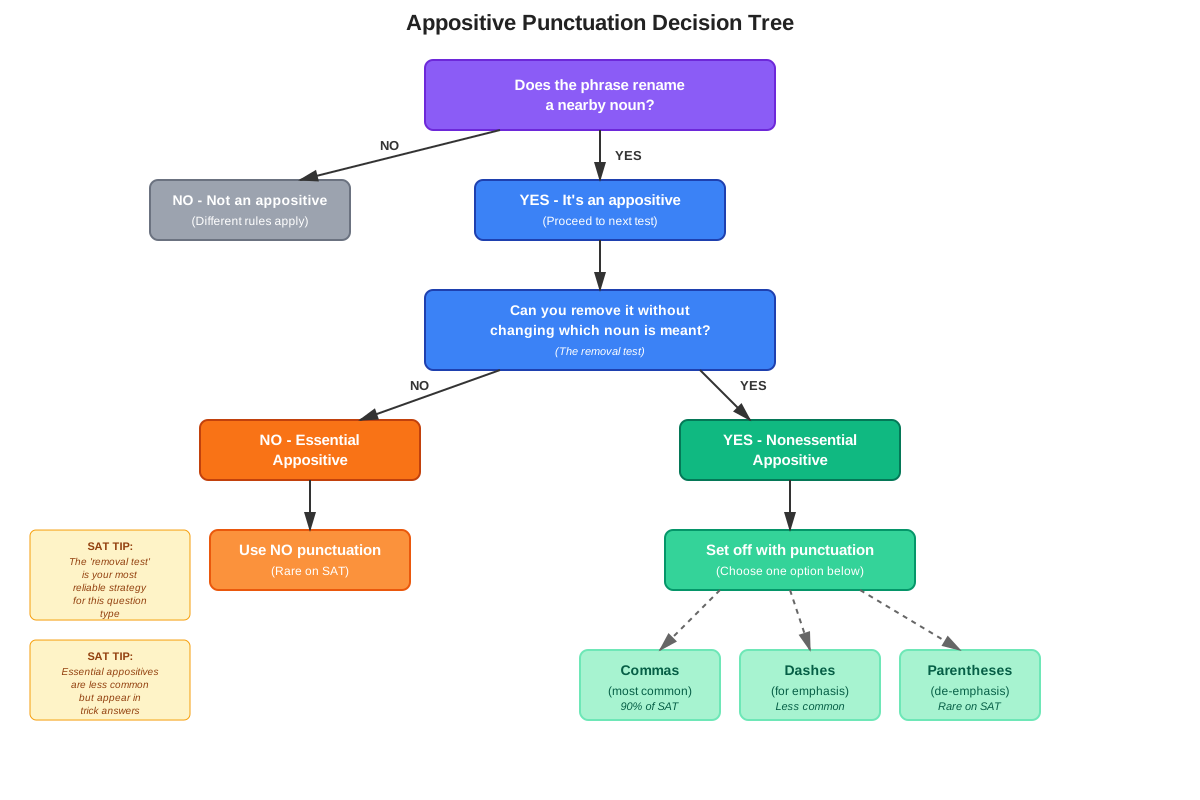
When an appositive is nonessential, three punctuation options exist: commas, dashes, and parentheses. Each creates a slightly different emphasis, though the SAT primarily tests commas and dashes.
Commas are the standard, most common choice for nonessential appositives. They integrate the additional information smoothly into the sentence flow: "The capital of France, Paris, attracts millions of tourists annually." Commas create neutral emphasis, neither highlighting nor downplaying the appositive.
Dashes (em dashes) provide stronger emphasis and create a more dramatic pause. They draw attention to the appositive: "The winner of the competition—a complete unknown—shocked the judges." Dashes work particularly well when the appositive itself contains commas or when the writer wants to emphasize the information.
Parentheses minimize the importance of the information, treating it as a quiet aside: "The scientist (a Nobel laureate) presented her findings." The SAT rarely tests parentheses with appositives, focusing instead on comma and dash usage.
Appositive Placement and Structure
Appositives typically appear immediately after the noun they modify, but they can also appear before it or at the end of a sentence. Understanding these variations helps students recognize appositives in all contexts.
Mid-sentence appositives are most common: "Dr. Johnson, a renowned cardiologist, will speak at the conference." The appositive interrupts the sentence flow and must be set off on both sides if nonessential.
Introductory appositives appear at the sentence beginning: "A renowned cardiologist, Dr. Johnson will speak at the conference." These require a comma after the appositive but not before (since there's no text before the sentence starts).
End-position appositives conclude the sentence: "The conference will feature Dr. Johnson, a renowned cardiologist." These require punctuation before the appositive but not after (since the sentence ends).
Common Appositive Errors on the SAT
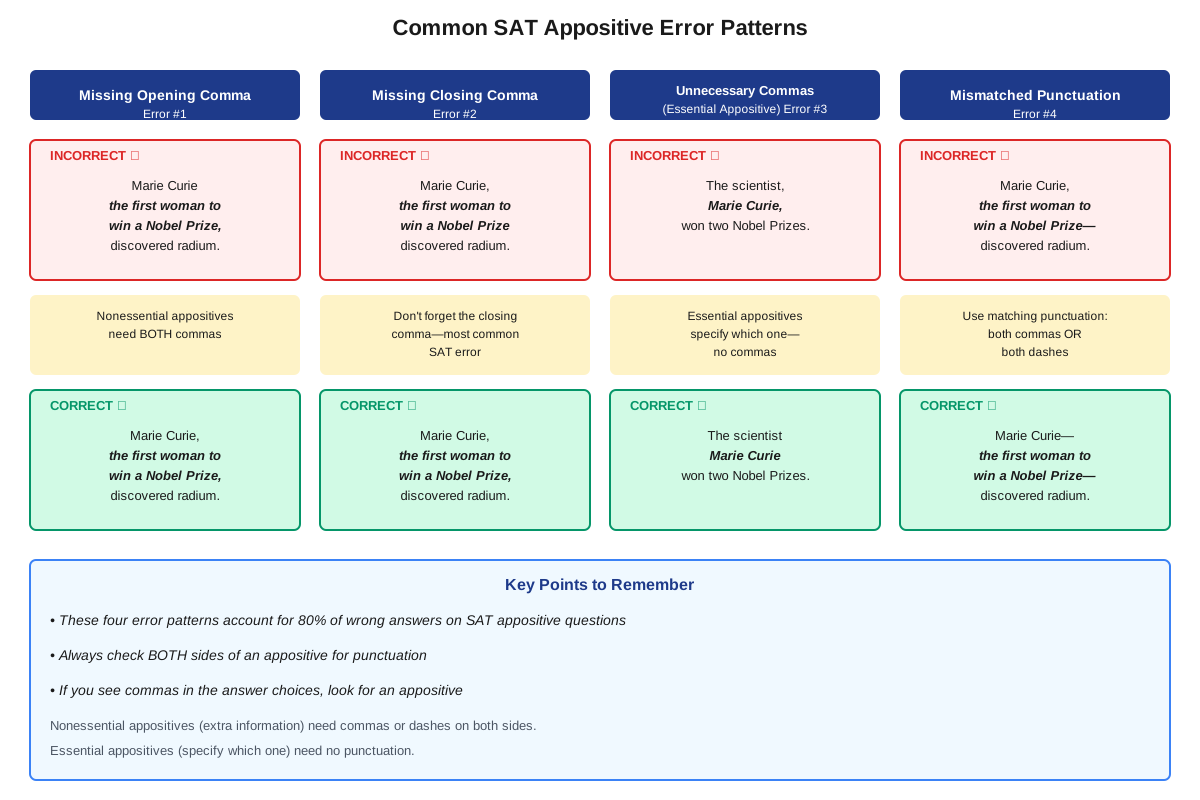
The SAT exploits several predictable error patterns related to appositives. Recognizing these patterns accelerates question-solving and improves accuracy.
Asymmetrical punctuation represents the most frequent error. Students might see: "My teacher, Mr. Rodriguez is retiring." This incorrectly places a comma before but not after the nonessential appositive. Both commas are required: "My teacher, Mr. Rodriguez, is retiring."
Unnecessary punctuation with essential appositives also appears regularly: "The poet, Maya Angelou, wrote 'Still I Rise.'" If the sentence context suggests the writer is discussing one specific poet (making the name essential for identification), no commas should appear: "The poet Maya Angelou wrote 'Still I Rise.'"
Mixing punctuation marks creates another error type: "The city—known for its architecture, attracts tourists." Nonessential appositives require matching punctuation on both sides. This should read: "The city—known for its architecture—attracts tourists" or "The city, known for its architecture, attracts tourists."
Concept Relationships
Appositives connect intimately with several other sentence structure concepts tested on the SAT. Understanding these relationships creates a comprehensive framework for approaching RW questions.
The distinction between essential and nonessential appositives → directly parallels → the distinction between essential and nonessential clauses (restrictive and nonrestrictive relative clauses). Both require students to determine whether information is necessary for identification, and both follow the same punctuation rules. Mastering appositives therefore reinforces understanding of clause punctuation.
Appositive punctuation → builds upon → fundamental comma rules, particularly the principle that nonessential elements must be set off from the main sentence. This principle extends to introductory phrases, parenthetical expressions, and other interrupters, creating a unified approach to comma usage.
Recognizing appositives → prevents → sentence boundary errors such as comma splices and fragments. Students who understand that appositives are phrases (not complete sentences) avoid incorrectly separating them with periods or failing to include necessary punctuation. This connects appositive knowledge to broader sentence structure competency.
The concept of noun phrases → underlies → appositive identification. Since appositives are noun phrases that rename other nouns, students must recognize noun phrase structure to identify appositives accurately. This relationship reinforces grammatical foundations while building advanced skills.
Quick check — test yourself on Appositives so far.
Try Flashcards →High-Yield Facts
⭐ Nonessential appositives must be set off with matching punctuation on both sides (commas, dashes, or parentheses)—asymmetrical punctuation is always incorrect
⭐ Essential appositives receive no punctuation—they are necessary to identify which person, place, or thing is being discussed
⭐ The SAT tests appositives in approximately 10-15% of Reading and Writing questions, making them one of the highest-yield punctuation topics
⭐ If you can remove the appositive and the sentence still clearly identifies the noun, the appositive is nonessential and requires punctuation
⭐ Proper nouns following common nouns are often essential appositives when they specify which particular person or thing: "my friend Sarah" (no commas if you have multiple friends)
- Appositives always function as nouns or noun phrases, never as adjectives or adverbs
- Dashes create stronger emphasis than commas when setting off nonessential appositives
- The SAT rarely tests parentheses with appositives, focusing on commas and dashes instead
- Appositive phrases can be quite long and complex, sometimes containing their own internal punctuation
- When an appositive appears at the beginning or end of a sentence, it only needs punctuation on one side (the side adjacent to the main sentence)
- The noun being renamed and the appositive must refer to the same entity—they are in apposition (side-by-side equivalence)
- Context determines whether an appositive is essential or nonessential; the same phrase might be essential in one sentence and nonessential in another
Common Misconceptions
Misconception: All appositives require commas. → Correction: Only nonessential appositives require punctuation. Essential appositives, which are necessary to identify the noun, should not be set off with commas or other punctuation.
Misconception: Proper names are always nonessential appositives that need commas. → Correction: Whether a name needs commas depends on context. "My sister Maria" needs no commas if you have multiple sisters (the name is essential to specify which one), but "my only sister, Maria," requires commas because "only" already identifies which sister.
Misconception: You can use a comma before an appositive and a dash after it (or vice versa). → Correction: Nonessential appositives require matching punctuation on both sides. Mixing punctuation marks (comma with dash, dash with comma) is always incorrect on the SAT.
Misconception: Appositives must be short phrases. → Correction: Appositives can be quite lengthy and may contain multiple words, prepositional phrases, or even their own internal commas. Length doesn't determine whether something is an appositive—function does.
Misconception: The word "or" always signals an appositive. → Correction: While "or" sometimes introduces an appositive that renames a noun ("photosynthesis, or the process by which plants make food"), it also appears in many non-appositive contexts. The key is whether the phrase renames a noun, not whether "or" is present.
Misconception: Appositives only appear in the middle of sentences. → Correction: Appositives can appear at the beginning, middle, or end of sentences. Their position doesn't change their function or the punctuation rules that apply to them.
Worked Examples
Example 1: Identifying Essential vs. Nonessential Appositives
Question: Which choice correctly punctuates the sentence?
The playwright William Shakespeare wrote 37 plays during his career.
A) NO CHANGE
B) The playwright, William Shakespeare, wrote
C) The playwright William Shakespeare, wrote
D) The playwright, William Shakespeare wrote
Solution:
Step 1: Identify the appositive. "William Shakespeare" renames "the playwright."
Step 2: Determine if the appositive is essential or nonessential. Ask: "Is the name necessary to identify which playwright?" Since many playwrights exist, and the sentence doesn't provide other context to identify which one, "William Shakespeare" is essential information. Without it, we wouldn't know which playwright wrote 37 plays.
Step 3: Apply the punctuation rule. Essential appositives receive no punctuation.
Step 4: Evaluate the choices:
- Choice A: No punctuation—correct for an essential appositive
- Choice B: Commas on both sides—incorrect; treats the name as nonessential
- Choice C: Comma only after—incorrect; creates asymmetrical punctuation
- Choice D: Comma only before—incorrect; creates asymmetrical punctuation
Answer: A
This question demonstrates the most common appositive trap on the SAT: adding unnecessary commas around essential information. The key insight is recognizing that "William Shakespeare" specifies which playwright, making it essential.
Example 2: Correcting Asymmetrical Punctuation
Question: Which choice provides the best punctuation?
Marie Curie the first woman to win a Nobel Prize conducted groundbreaking research on radioactivity.
A) NO CHANGE
B) Marie Curie, the first woman to win a Nobel Prize conducted
C) Marie Curie, the first woman to win a Nobel Prize, conducted
D) Marie Curie the first woman to win a Nobel Prize, conducted
Solution:
Step 1: Identify the appositive. "The first woman to win a Nobel Prize" renames "Marie Curie."
Step 2: Determine if the appositive is essential or nonessential. Marie Curie is already fully identified by her name—there's only one Marie Curie being discussed. The appositive adds interesting information but isn't necessary for identification. Therefore, it's nonessential.
Step 3: Apply the punctuation rule. Nonessential appositives must be set off with matching punctuation on both sides.
Step 4: Evaluate the choices:
- Choice A: No punctuation—incorrect; treats nonessential information as essential
- Choice B: Comma before only—incorrect; asymmetrical punctuation
- Choice C: Commas on both sides—correct; properly sets off the nonessential appositive
- Choice D: Comma after only—incorrect; asymmetrical punctuation
Answer: C
This example illustrates the critical importance of symmetrical punctuation. Many students recognize that some punctuation is needed but fail to include it on both sides of the appositive. The SAT frequently tests this specific error pattern.
Exam Strategy
When approaching appositive questions on the SAT, follow this systematic process:
Step 1: Identify potential appositives. Look for noun phrases that immediately follow other nouns and seem to rename or define them. Trigger phrases include "a [description]," proper names following common nouns, and phrases beginning with "or" that provide definitions.
Step 2: Apply the removal test. Mentally remove the potential appositive from the sentence. If the sentence still clearly identifies the noun being discussed, the appositive is nonessential and requires punctuation. If removing it makes the sentence unclear or changes its meaning significantly, the appositive is essential and should have no punctuation.
Step 3: Check for symmetry. If punctuation is needed, verify that it appears on BOTH sides of the appositive (unless the appositive is at the beginning or end of the sentence). Asymmetrical punctuation is always wrong.
Step 4: Eliminate obviously incorrect choices. Quickly eliminate any choices with asymmetrical punctuation or that mix punctuation marks (comma with dash). This often narrows options to two choices.
Exam Tip: When you see a proper name following a common noun, immediately ask: "How many of these exist in this context?" If multiple exist (my friend, my sister, the scientist), the name is likely essential. If only one exists (my mother, the president in a specific year), the name is likely nonessential.
Time allocation: Appositive questions should take 20-30 seconds once you've mastered the concept. They're highly mechanical—apply the essential/nonessential test, check symmetry, and select the answer. Don't overthink these questions; the rules are consistent and predictable.
Trigger words and phrases to watch for:
- "The [profession/role] [Name]" → Check if essential or nonessential
- "Or" introducing a definition → Usually signals a nonessential appositive
- Phrases between commas or dashes → Verify they're properly set off on both sides
- Biographical information (dates, achievements, descriptions) → Often nonessential appositives
Memory Techniques
RENAME mnemonic for identifying appositives:
- Rephrases the noun
- Equals the same person/thing
- Noun phrase structure
- Adjacent to the noun
- Modifies by identifying
- Extra or essential? (determines punctuation)
The "Whisper Test": When reading a sentence aloud, nonessential appositives sound like whispered asides—information you could say more quietly. Essential appositives sound like integral parts of the sentence that need normal volume. This auditory technique helps students internalize the distinction.
Symmetry visualization: Picture nonessential appositives as being in a box or between bookends. Just as a box needs both a left and right side, nonessential appositives need punctuation on both sides. If you see punctuation on one side, immediately look for matching punctuation on the other.
The "Only One" rule: If there's only one of something (my mother, the president, the capital of France), additional identifying information is nonessential and needs commas. If there are multiple (my friend, a scientist, the city), identifying information is essential and needs no commas.
Summary
Appositives are noun phrases that rename or provide additional information about adjacent nouns, and they represent a high-yield topic on the SAT Reading and Writing section. The fundamental skill students must master is distinguishing between essential appositives (which require no punctuation because they're necessary for identification) and nonessential appositives (which must be set off with matching punctuation on both sides). The SAT consistently tests this distinction through questions about comma and dash placement, making appositive mastery directly translatable to test points. Students should apply the removal test—if the sentence remains clear without the appositive, it's nonessential and needs punctuation—and always verify symmetrical punctuation. Understanding appositives also reinforces broader sentence structure skills and connects to other punctuation concepts tested throughout the exam.
Key Takeaways
- Appositives are noun phrases that rename adjacent nouns; they appear in 10-15% of SAT Reading and Writing questions
- Essential appositives (necessary for identification) receive NO punctuation; nonessential appositives (extra information) MUST be set off with matching punctuation
- The removal test determines appositive type: if the sentence remains clear without it, the appositive is nonessential
- Nonessential appositives require symmetrical punctuation on both sides—commas with commas, dashes with dashes
- Context determines whether an appositive is essential or nonessential; the same phrase might be essential in one sentence and nonessential in another
- Asymmetrical punctuation (comma on one side only, or mixing commas and dashes) is always incorrect on the SAT
- Mastering appositives improves performance on related topics including comma usage, sentence boundaries, and clause punctuation
Related Topics
Restrictive and Nonrestrictive Clauses: These follow the same essential/nonessential logic as appositives but involve complete clauses rather than phrases. Mastering appositives provides the conceptual foundation for understanding when to use "which" versus "that" and how to punctuate relative clauses.
Parenthetical Expressions: Like nonessential appositives, parenthetical expressions add extra information that must be set off with punctuation. Understanding appositive punctuation rules transfers directly to handling other interrupters in sentences.
Comma Usage in Complex Sentences: Appositives represent one specific application of comma rules. Comprehensive comma mastery requires understanding multiple contexts, but appositive skills provide a strong foundation for this broader competency.
Sentence Boundaries and Fragments: Recognizing that appositives are phrases (not complete sentences) helps students avoid creating fragments or comma splices. This topic builds upon appositive knowledge to address more complex sentence structure issues.
Practice CTA
Now that you've mastered the core concepts of appositives, it's time to reinforce your learning through active practice. Complete the practice questions to test your ability to identify essential versus nonessential appositives and apply correct punctuation rules. Use the flashcards to drill the key distinctions and punctuation patterns until they become automatic. Remember: appositive questions are highly predictable on the SAT, and consistent practice with these patterns translates directly into points on test day. You've built the knowledge foundation—now solidify it through application!
Sign up free to keep reading
Create a free AnvayaPrep account to finish this SAT guide on Appositives — plus flashcards and practice questions.