Overview
Nonessential clauses represent one of the most frequently tested punctuation and sentence structure concepts on the SAT Reading and Writing (RW) section. These clauses—also called nonrestrictive clauses or parenthetical elements—provide additional information that can be removed from a sentence without changing its core meaning or grammatical structure. Understanding how to identify and properly punctuate nonessential clauses is crucial for success on the SAT, as questions testing this concept appear in nearly every administration of the exam.
The SAT tests nonessential clauses primarily through questions about comma placement, dash usage, and sentence boundaries. Students must recognize when information is supplementary rather than essential to the sentence's meaning, then apply the correct punctuation rules. These questions often appear deceptively simple but require precise understanding of how clauses function within sentences. Mastering this topic directly impacts performance on 3-5 questions per test, making it a high-yield area for score improvement.
Within the broader context of SAT Reading and Writing, nonessential clauses connect to multiple foundational concepts including sentence boundaries, punctuation rules, and clause relationships. This topic bridges the gap between basic comma usage and more complex sentence structure analysis. Students who master nonessential clauses develop stronger skills in identifying sentence components, understanding logical relationships between ideas, and recognizing how punctuation affects meaning—all critical competencies for the entire RW section.
Learning Objectives
- [ ] Identify key features of nonessential clauses in sentences
- [ ] Explain how nonessential clauses appears on the SAT
- [ ] Apply nonessential clauses to answer SAT-style questions
- [ ] Distinguish between essential and nonessential clauses based on meaning and function
- [ ] Select appropriate punctuation marks (commas, dashes, parentheses) to set off nonessential information
- [ ] Recognize common patterns and trigger words that signal nonessential clauses
- [ ] Evaluate whether removing a clause changes the fundamental meaning of a sentence
Prerequisites
- Basic sentence structure: Understanding subjects, verbs, and objects is necessary to identify which parts of a sentence are core components versus supplementary information
- Comma rules fundamentals: Familiarity with basic comma usage provides the foundation for understanding when commas set off nonessential elements
- Clause identification: Recognizing the difference between independent and dependent clauses helps determine whether information is essential or supplementary
- Reading comprehension: The ability to understand sentence meaning is critical for determining whether a clause is necessary to the sentence's core message
Why This Topic Matters
Nonessential clauses appear in professional writing, academic texts, and everyday communication. Writers use these clauses to add descriptive details, provide context, or insert clarifying information without disrupting the main flow of ideas. In journalism, scientific writing, and literature, nonessential clauses allow authors to layer information efficiently while maintaining clear, grammatically correct sentences. Understanding this concept improves both reading comprehension and writing quality across all contexts.
On the SAT, sat nonessential clauses questions typically appear 3-5 times per test, representing approximately 10-15% of all punctuation and sentence structure questions. These questions most commonly test comma placement around nonessential clauses, but also assess understanding of dashes and parentheses as alternative punctuation marks. The College Board frequently embeds these questions within longer passages where students must read for meaning to determine whether information is essential or supplementary.
Common SAT question formats include: identifying correct comma placement around relative clauses beginning with "which" or "who"; determining whether dashes or commas should set off parenthetical information; recognizing when an appositive phrase requires punctuation; and evaluating whether a clause can be removed without changing sentence meaning. Questions often present four answer choices with different punctuation patterns, requiring students to apply both grammatical rules and meaning-based analysis.
Core Concepts
Definition and Function of Nonessential Clauses
A nonessential clause (also called a nonrestrictive clause) is a group of words that adds supplementary information to a sentence but can be removed without altering the sentence's fundamental meaning or grammatical completeness. These clauses provide extra details, descriptions, or context that enhance understanding but are not required to identify the noun being discussed or complete the sentence's core message.
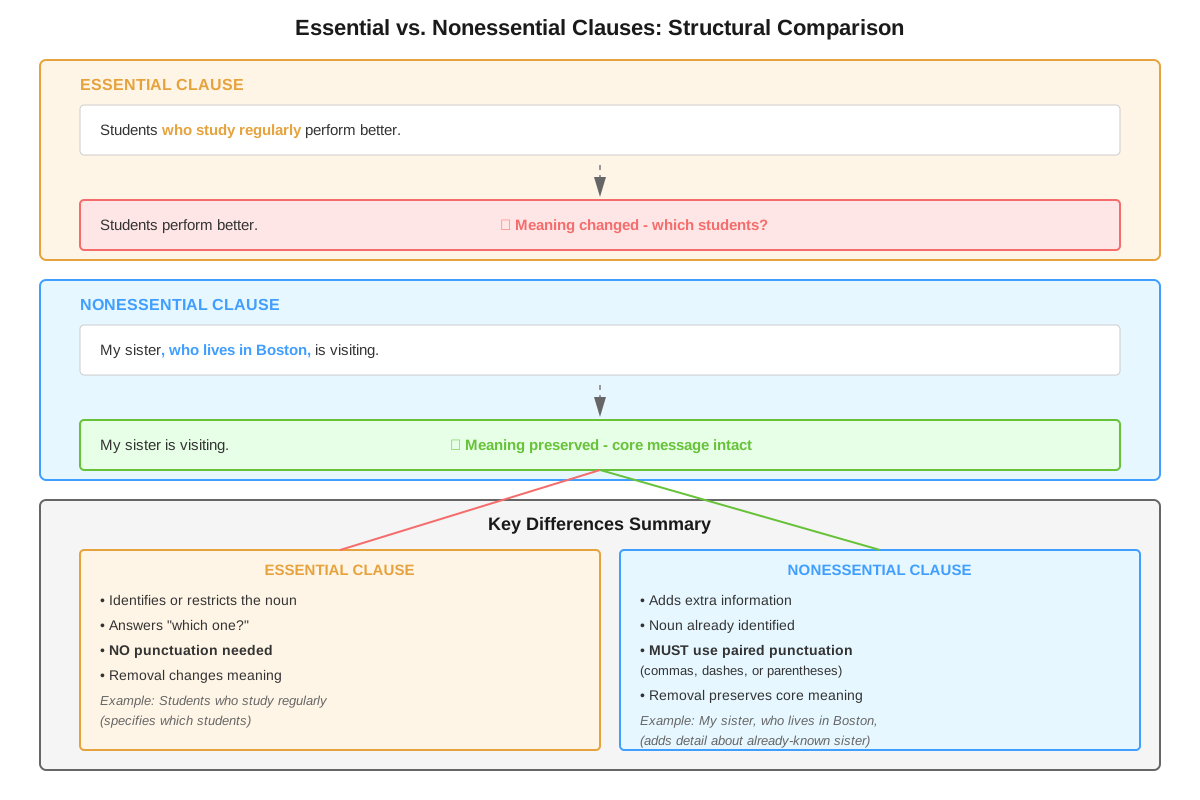
The key test for identifying nonessential clauses involves removal: if you can delete the clause and the sentence still makes complete sense with its essential meaning intact, the clause is nonessential. For example, in "My sister, who lives in Boston, is visiting tomorrow," the clause "who lives in Boston" is nonessential because "My sister is visiting tomorrow" remains a complete, meaningful sentence. The clause adds interesting information but doesn't restrict which sister is being discussed.
Nonessential clauses must be set off from the rest of the sentence using punctuation—typically commas, but sometimes dashes or parentheses. This punctuation signals to readers that the enclosed information is supplementary. The punctuation marks function like brackets, creating a clear boundary between the main sentence and the additional information.
Essential vs. Nonessential Clauses
Understanding the distinction between essential and nonessential clauses is fundamental to SAT success. Essential clauses (also called restrictive clauses) provide information that is necessary to identify which specific person, place, or thing is being discussed. These clauses restrict or limit the meaning of the noun they modify and cannot be removed without changing the sentence's meaning or making it unclear.
| Feature | Essential Clause | Nonessential Clause |
|---|---|---|
| Punctuation | No commas or dashes | Set off with commas, dashes, or parentheses |
| Removal test | Cannot be removed without changing meaning | Can be removed; sentence remains clear |
| Function | Identifies or restricts the noun | Adds extra information about an already-identified noun |
| Relative pronouns | Often uses "that" | Often uses "which" (with comma) or "who" |
| Example | Students who study regularly perform better. | My oldest student, who studies regularly, performs better. |
Consider these contrasting examples:
- Essential: "The teacher who teaches calculus is retiring." (Identifies which specific teacher)
- Nonessential: "Mrs. Johnson, who teaches calculus, is retiring." (Adds detail about an already-identified person)
In the essential example, removing "who teaches calculus" would leave "The teacher is retiring," which doesn't specify which teacher. In the nonessential example, "Mrs. Johnson" already identifies the specific person, so "who teaches calculus" merely provides additional information.
Punctuation Patterns for Nonessential Clauses
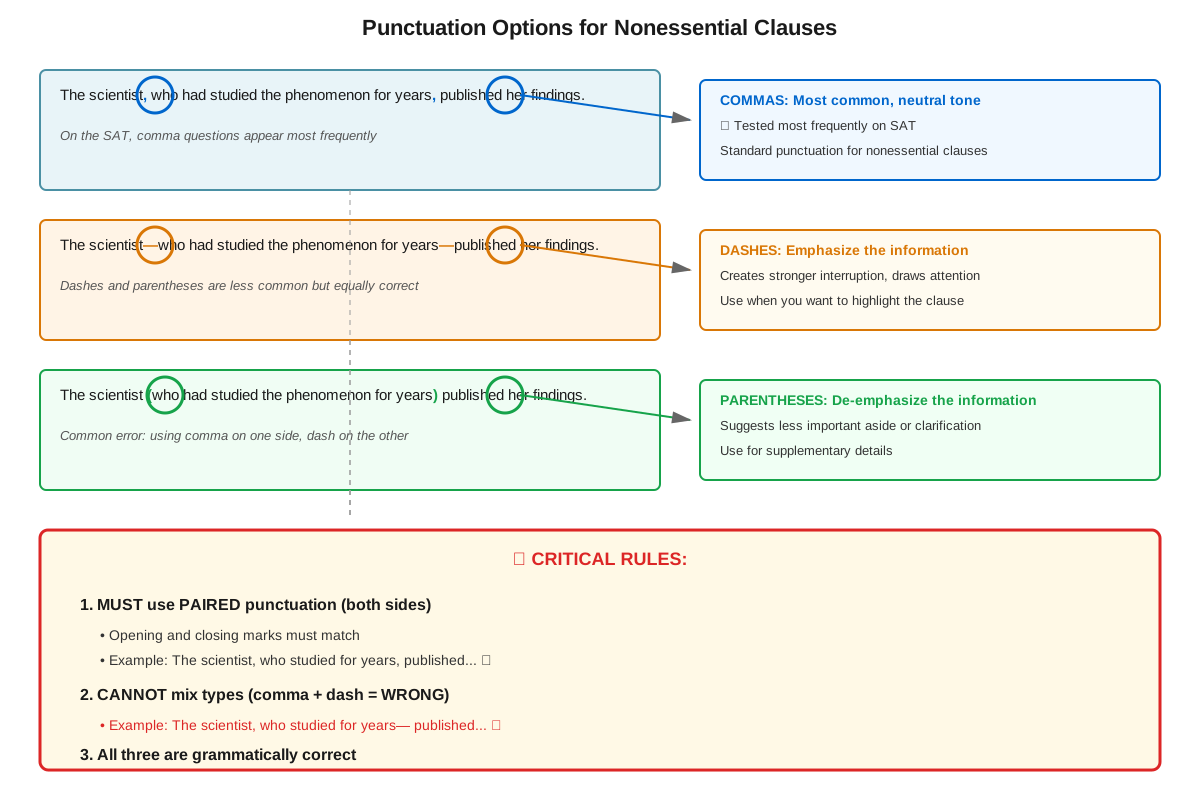
Nonessential clauses require punctuation on both sides—they must be "bracketed" to signal their supplementary nature. The SAT tests three main punctuation options:
Commas are the most common punctuation marks for nonessential clauses. They create a subtle pause and work well for information that flows naturally within the sentence:
- "The museum, which opened in 1995, houses ancient artifacts."
- "Dr. Martinez, a renowned physicist, will speak at the conference."
Dashes provide stronger emphasis and create a more dramatic break in the sentence. They're appropriate when the nonessential information deserves special attention or when the clause itself contains commas:
- "The results—surprising to even the most experienced researchers—challenged existing theories."
- "Three cities—Boston, New York, and Philadelphia—were included in the study."
Parentheses minimize the importance of the enclosed information, suggesting it's truly optional or tangential:
- "The experiment (conducted over six months) yielded unexpected results."
- "Shakespeare (1564-1616) wrote 37 plays."
A critical rule: punctuation marks must match. If a nonessential clause begins with a comma, it must end with a comma. If it begins with a dash, it must end with a dash. Mixing punctuation marks (comma on one side, dash on the other) is always incorrect on the SAT.
Common Types of Nonessential Clauses
Relative clauses beginning with "which," "who," or "whom" frequently appear as nonessential elements. When these pronouns follow a comma, they introduce nonessential information:
- "The research, which took three years to complete, was published in Nature."
- "Professor Chen, who has taught here for 20 years, received the teaching award."
Appositives are noun phrases that rename or provide additional information about another noun. They're often nonessential:
- "My friend Sarah, a talented musician, performed at Carnegie Hall."
- "The capital of France, Paris, attracts millions of tourists annually."
Participial phrases can function as nonessential clauses when they add descriptive information:
- "The students, exhausted from studying, celebrated after the exam."
- "The building, constructed in the 1920s, features Art Deco architecture."
Transitional expressions and interjections within sentences are treated as nonessential elements:
- "The results, however, contradicted the hypothesis."
- "This approach, in fact, proved most effective."
Context Clues for Identifying Nonessential Clauses
Several linguistic patterns signal nonessential clauses on the SAT. Proper nouns followed by descriptive clauses typically indicate nonessential information because the proper noun already identifies the specific person or place:
- "Mount Everest, which stands at 29,032 feet, is the world's highest peak."
Possessive pronouns ("my," "his," "our") or specific determiners ("the only," "the first") before nouns often mean subsequent clauses are nonessential because the noun is already sufficiently identified:
- "My brother, who graduated last year, now works in Seattle."
- "The only solution, which took months to develop, finally worked."
Clauses providing background information, dates, locations, or biographical details are typically nonessential:
- "The novel, published in 1851, remains widely read today."
- "The scientist, working in her laboratory, made the discovery."
Concept Relationships
Nonessential clauses connect directly to fundamental punctuation rules, particularly comma usage and dash application. Understanding when to use commas around clauses builds upon basic comma rules (separating items in lists, joining independent clauses) and extends them to more complex sentence structures. This concept → leads to → advanced sentence boundary recognition, where students must distinguish between complete sentences, fragments, and properly punctuated complex sentences.
The relationship between essential and nonessential clauses → connects to → relative pronoun usage and clause dependency. Students must understand how "that" versus "which" signals different relationships between clauses and main sentences. This distinction → influences → meaning interpretation, as incorrectly punctuating an essential clause as nonessential can change what the sentence communicates.
Nonessential clauses → relate to → sentence variety and style in writing. Writers use these clauses to combine ideas efficiently rather than writing multiple short sentences. This concept → supports → the SAT's emphasis on effective language use, where students must select the most concise and clear expression of ideas. Understanding nonessential clauses → enables → better analysis of sentence structure questions that test transitions, logical flow, and information placement within passages.
High-Yield Facts
⭐ Nonessential clauses can be completely removed from a sentence without changing its core meaning or grammatical completeness
⭐ Nonessential clauses must be set off with matching punctuation marks on both sides (two commas, two dashes, or two parentheses)
⭐ The relative pronoun "which" following a comma typically introduces a nonessential clause, while "that" without a comma introduces an essential clause
⭐ Proper nouns followed by descriptive clauses usually indicate nonessential information because the proper noun already identifies the specific referent
⭐ If removing a clause makes the sentence unclear about which specific person, place, or thing is being discussed, the clause is essential and should not be set off with punctuation
- Appositives that rename or provide additional information about an already-identified noun are typically nonessential
- Transitional words and phrases (however, therefore, in fact) within sentences function as nonessential elements requiring commas
- Dashes can replace commas around nonessential clauses but provide stronger emphasis or separation
- Parentheses minimize the importance of nonessential information, suggesting it's truly optional
- Essential clauses often begin with "that" or "who/which" without preceding punctuation
- Mixing punctuation marks (starting with a comma, ending with a dash) is always incorrect
- Biographical information, dates, and locations added to already-identified nouns are typically nonessential
Quick check — test yourself on Nonessential clauses so far.
Try Flashcards →Common Misconceptions
Misconception: All clauses beginning with "which" are nonessential and require commas.
Correction: While "which" often introduces nonessential clauses, context determines whether the clause is truly supplementary. The key is whether removing the clause changes the sentence's essential meaning, not simply which relative pronoun is used.
Misconception: Nonessential clauses are unimportant and can always be deleted without consequence.
Correction: Although nonessential clauses can be removed without destroying grammatical structure, they often provide valuable context, description, or clarification. "Nonessential" refers to grammatical function, not importance to the reader's understanding.
Misconception: Only one comma is needed to set off a nonessential clause if it appears at the end of a sentence.
Correction: Nonessential clauses in the middle of sentences require punctuation on both sides. However, if a nonessential clause appears at the sentence's end, only one comma (before the clause) is needed because the period serves as the closing punctuation.
Misconception: Dashes and commas can be mixed when punctuating nonessential clauses for variety.
Correction: Punctuation marks must match. If a nonessential clause begins with a comma, it must end with a comma. If it begins with a dash, it must end with a dash. Mixing creates a punctuation error that the SAT will mark as incorrect.
Misconception: Short clauses don't need to be set off as nonessential even if they add supplementary information.
Correction: Length doesn't determine whether a clause is nonessential. Even brief phrases like "however" or "in fact" must be set off with commas when they function as nonessential elements within sentences.
Misconception: The word "that" always indicates an essential clause while "which" always indicates a nonessential clause.
Correction: While this pattern is common in formal American English, the true test is meaning and function. Some writers use "which" for essential clauses, and context always determines whether information is truly necessary to identify the noun being discussed.
Worked Examples
Example 1: Identifying and Punctuating Nonessential Clauses
Question: Which choice correctly punctuates the sentence?
The scientist Marie Curie [BLANK] won two Nobel Prizes in different scientific fields.
A) who was born in Poland
B) who was born in Poland,
C) , who was born in Poland,
D) , who was born in Poland
Solution Process:
Step 1: Identify the core sentence by removing the clause in question.
- Core sentence: "The scientist Marie Curie won two Nobel Prizes in different scientific fields."
- This sentence is complete and clear without the clause about Poland.
Step 2: Determine if the clause is essential or nonessential.
- "Marie Curie" is a proper noun that already identifies the specific scientist.
- The information "who was born in Poland" adds biographical detail but isn't necessary to identify which scientist is being discussed.
- Therefore, this is a nonessential clause.
Step 3: Apply punctuation rules for nonessential clauses.
- Nonessential clauses must be set off with matching punctuation on both sides.
- Since this clause appears in the middle of the sentence, it needs commas before and after.
Step 4: Evaluate each answer choice.
- Choice A: No punctuation—incorrect because nonessential clauses require punctuation
- Choice B: Comma only after—incorrect because both sides need punctuation
- Choice C: Commas on both sides—correct
- Choice D: Comma before but not after—incorrect because punctuation must match on both sides
Answer: C) , who was born in Poland,
Connection to Learning Objectives: This example demonstrates how to identify nonessential clauses by testing whether the sentence remains clear without them, then apply the rule that nonessential clauses require matching punctuation on both sides.
Example 2: Essential vs. Nonessential Distinction
Question: Which choice is correctly punctuated?
A) Students, who complete all homework assignments, tend to perform better on exams.
B) Students who complete all homework assignments tend to perform better on exams.
C) Students who complete all homework assignments, tend to perform better on exams.
D) Students, who complete all homework assignments tend to perform better on exams.
Solution Process:
Step 1: Test whether the clause is essential or nonessential by removing it.
- Without the clause: "Students tend to perform better on exams."
- This statement is too broad and changes the meaning significantly.
- The original sentence isn't about all students—it's specifically about students who complete homework.
Step 2: Determine the clause's function.
- The clause "who complete all homework assignments" restricts which students are being discussed.
- It identifies a specific subset of students rather than adding extra information about already-identified students.
- This is an essential clause.
Step 3: Apply punctuation rules for essential clauses.
- Essential clauses should NOT be set off with commas because they're necessary to the sentence's meaning.
- The clause should flow directly from the noun it modifies without punctuation interruption.
Step 4: Evaluate each answer choice.
- Choice A: Commas on both sides—incorrect because this makes the clause nonessential, changing the meaning
- Choice B: No commas—correct because the clause is essential
- Choice C: Comma after but not before—incorrect punctuation pattern
- Choice D: Comma before but not after—incorrect punctuation pattern
Answer: B) Students who complete all homework assignments tend to perform better on exams.
Connection to Learning Objectives: This example illustrates the critical distinction between essential and nonessential clauses based on meaning. The clause restricts which students are being discussed, making it essential and requiring no punctuation.
Exam Strategy
When approaching sat nonessential clauses questions on the rw section, follow this systematic process:
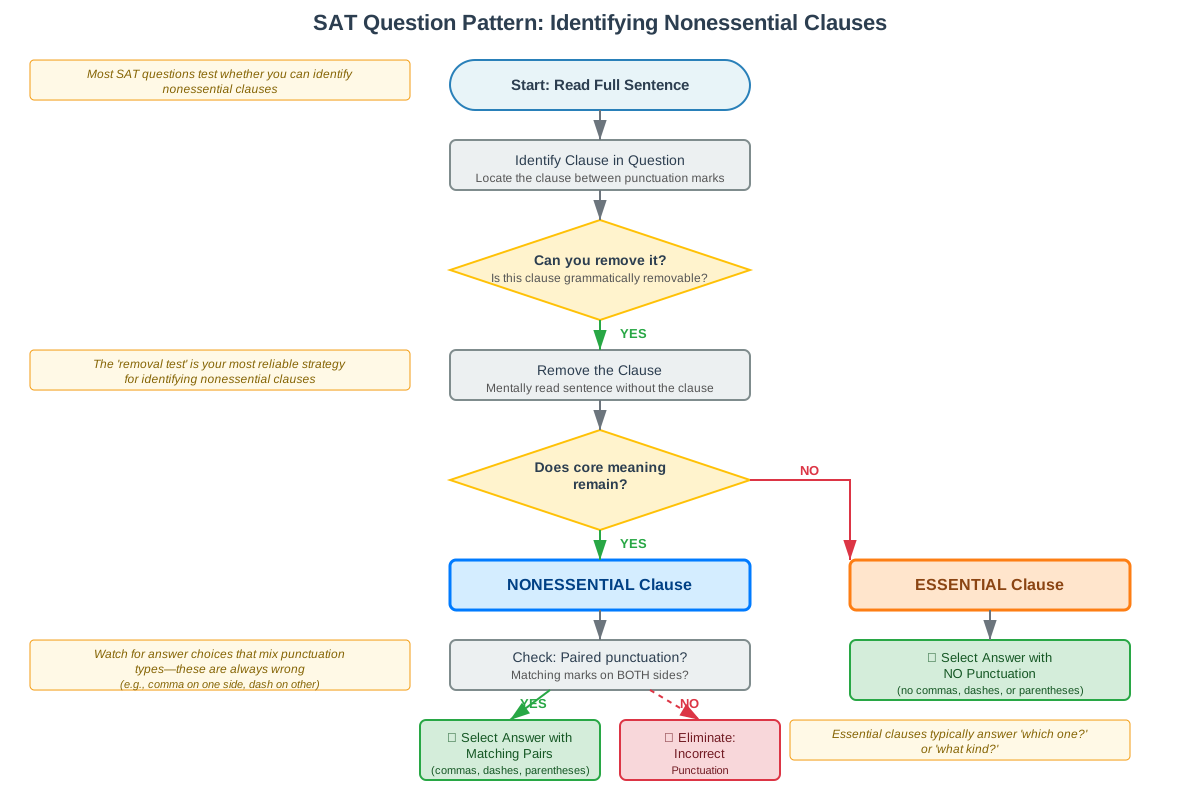
Step 1: Read for meaning first. Before looking at punctuation, understand what the sentence is communicating. Identify the main subject and verb, then determine what additional information is being provided.
Step 2: Apply the removal test. Mentally remove the clause in question and read the remaining sentence. If the sentence still makes complete sense and clearly identifies what's being discussed, the clause is likely nonessential. If removing it makes the sentence unclear or changes its essential meaning, the clause is essential.
Step 3: Check for identification clues. Look for proper nouns, possessive pronouns ("my," "his," "our"), or specific determiners ("the only," "the first") before the noun. These often signal that subsequent clauses are nonessential because the noun is already sufficiently identified.
Trigger words and phrases to watch for:
- Commas followed by "which" typically introduce nonessential clauses
- "That" without a comma usually introduces essential clauses
- Transitional expressions like "however," "therefore," "in fact" are nonessential elements
- Biographical details, dates, and locations added to proper nouns are typically nonessential
Process-of-elimination strategy:
- Immediately eliminate any answer choice that mixes punctuation marks (comma on one side, dash on the other)
- Eliminate choices that place only one comma around a mid-sentence nonessential clause
- If the clause is clearly nonessential, eliminate choices without punctuation
- If the clause is clearly essential, eliminate choices with commas or dashes
Time allocation: These questions should take 30-45 seconds each. If you're spending more than a minute, you're likely overthinking. Trust the removal test and move forward.
Exam Tip: When in doubt between essential and nonessential, ask yourself: "Does this clause tell me WHICH ONE, or does it tell me MORE ABOUT an already-identified noun?" The first indicates essential; the second indicates nonessential.
Memory Techniques
The REMOVE Mnemonic for identifying nonessential clauses:
- Read the sentence without the clause
- Evaluate if meaning stays clear
- Match punctuation on both sides
- Observe proper nouns as identification clues
- Verify the sentence is still complete
- Eliminate choices that mix punctuation
The "Bracket Test" Visualization: Imagine nonessential clauses as information inside brackets or parentheses. If you can put brackets around it and the sentence still works perfectly, it's nonessential. Visualize the punctuation marks as actual brackets holding supplementary information.
The "Which/That" Reminder:
- "Which with comma = Wonderful extra details (nonessential)"
- "That without comma = Totally necessary (essential)"
The "Proper Noun Rule" Acronym - PINE:
- Proper nouns
- Identify specifically
- No need for restrictive clauses
- Extra info needs commas
The "Matching Socks" Analogy: Just as you wouldn't wear one black sock and one white sock, you can't use mismatched punctuation around nonessential clauses. Commas match commas; dashes match dashes.
Summary
Nonessential clauses are supplementary elements that add information to sentences but can be removed without changing core meaning or grammatical structure. The fundamental skill tested on the SAT is distinguishing between essential clauses (which identify or restrict the noun and require no punctuation) and nonessential clauses (which provide extra details about already-identified nouns and must be set off with matching punctuation). Students must apply the removal test—reading the sentence without the clause to determine if meaning remains clear—and recognize that proper nouns, possessive pronouns, and specific determiners often signal nonessential clauses. Punctuation must match on both sides of nonessential clauses, with commas being most common, dashes providing emphasis, and parentheses minimizing importance. Success on these high-frequency SAT questions requires reading for meaning first, identifying whether information is necessary for noun identification, and applying consistent punctuation rules. Mastering this concept improves performance on 10-15% of sentence structure questions and strengthens overall understanding of how punctuation affects meaning in complex sentences.
Key Takeaways
- Nonessential clauses can be completely removed without changing a sentence's core meaning or grammatical completeness—use the removal test to identify them
- Essential clauses identify which specific noun is being discussed and should not be set off with punctuation; nonessential clauses add extra information about already-identified nouns and require punctuation
- Punctuation marks must match on both sides of nonessential clauses: two commas, two dashes, or two parentheses—never mix punctuation types
- Proper nouns followed by descriptive clauses typically indicate nonessential information because the proper noun already provides specific identification
- The relative pronoun "which" after a comma usually introduces a nonessential clause, while "that" without punctuation typically introduces an essential clause
- Read for meaning first on SAT questions—understanding what the sentence communicates is more important than memorizing punctuation rules
- These questions appear 3-5 times per SAT test, making them a high-yield topic that directly impacts scores in the Reading and Writing section
Related Topics
Comma Usage in Complex Sentences: Understanding nonessential clauses provides the foundation for mastering all comma rules in complex sentence structures, including how commas separate independent clauses, set off introductory elements, and clarify meaning in compound-complex sentences.
Dash and Parenthesis Usage: Building on nonessential clause punctuation, this topic explores when dashes and parentheses are preferable to commas, how they affect tone and emphasis, and how to use them correctly in various sentence contexts.
Relative Pronouns and Clause Types: Deeper study of "who," "whom," "which," "that," and "whose" reveals how these pronouns signal different clause relationships and determine punctuation needs, connecting directly to essential versus nonessential distinctions.
Sentence Boundaries and Run-ons: Mastering nonessential clauses enables better recognition of where sentences begin and end, helping students identify and correct run-on sentences and comma splices that often involve improperly punctuated clauses.
Appositive Phrases: This related topic examines noun phrases that rename or describe other nouns, building on the nonessential clause concept to understand when these phrases require punctuation and how they function within sentences.
Practice CTA
Now that you've mastered the core concepts of nonessential clauses, it's time to put your knowledge into action! Work through the practice questions to reinforce your understanding and build the pattern recognition skills essential for SAT success. Each practice question is designed to mirror actual SAT formats, helping you develop the speed and accuracy needed on test day. Review the flashcards to cement key definitions and rules in your memory. Remember: understanding the concept is just the first step—consistent practice transforms knowledge into automatic, confident performance. You've got this!
Sign up free to keep reading
Create a free AnvayaPrep account to finish this SAT guide on Nonessential clauses — plus flashcards and practice questions.