Overview
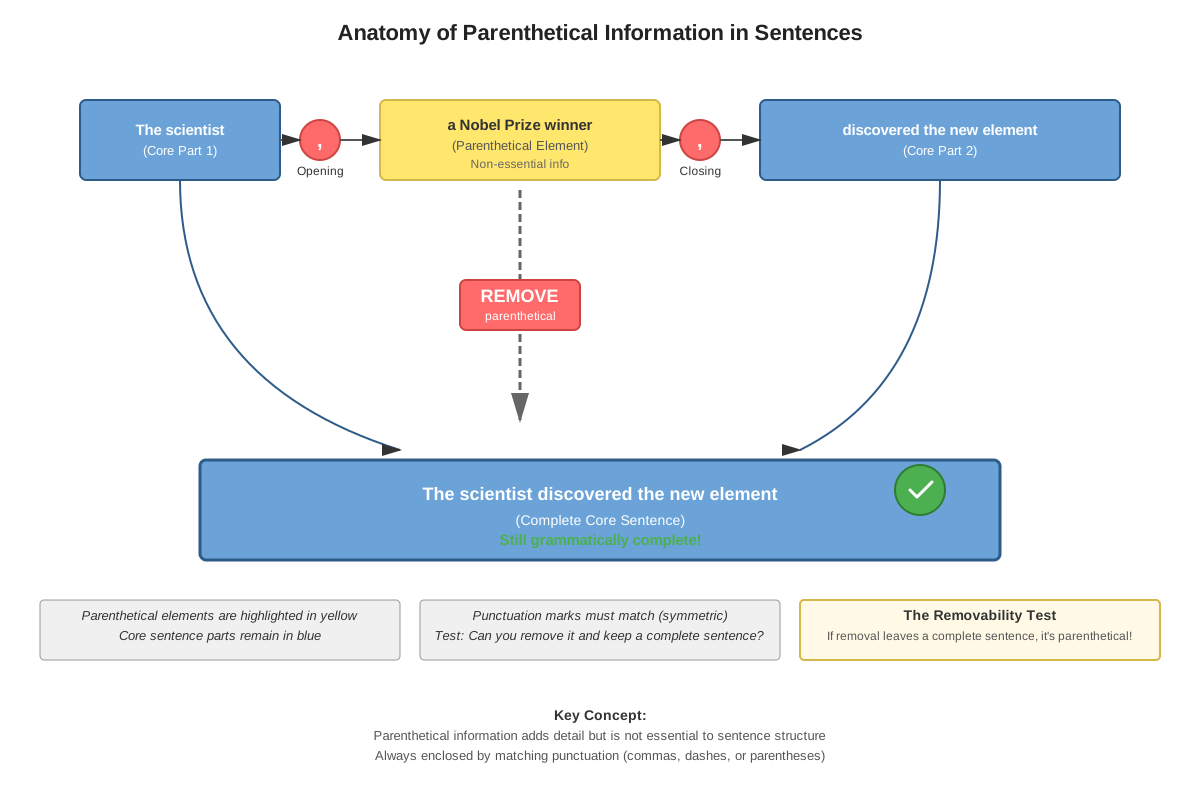
Parenthetical information represents one of the most frequently tested concepts in the SAT Reading and Writing (RW) section, appearing in questions that assess a student's ability to recognize and properly punctuate supplementary material within sentences. This concept involves understanding how additional, non-essential information can be inserted into a sentence without disrupting its grammatical structure or core meaning. When parenthetical elements are removed, the sentence must still be complete and grammatically correct—this is the fundamental test of whether information is truly parenthetical.
The SAT consistently tests parenthetical information through questions about comma placement, dash usage, and occasionally parentheses themselves. These questions require students to identify where supplementary information begins and ends, then apply the correct punctuation marks symmetrically. The College Board includes these questions because they assess both grammatical knowledge and reading comprehension: students must understand sentence structure well enough to distinguish essential from non-essential elements. Mastering this topic directly impacts performance on approximately 10-15% of all Reading and Writing questions, making it a high-yield area for score improvement.
Understanding parenthetical information connects directly to broader concepts of sentence boundaries and punctuation conventions. This topic builds upon foundational knowledge of independent clauses and extends into more complex areas like restrictive versus non-restrictive clauses. Students who master sat parenthetical information develop stronger editing skills and gain confidence in tackling the most challenging punctuation questions on test day. The ability to recognize parenthetical elements also improves reading comprehension, as students learn to identify the core message of complex sentences by mentally removing supplementary details.
Learning Objectives
- [ ] Identify key features of parenthetical information in sentences
- [ ] Explain how parenthetical information appears on the SAT
- [ ] Apply parenthetical information rules to answer SAT-style questions
- [ ] Distinguish between essential and non-essential information in complex sentences
- [ ] Demonstrate proper use of commas, dashes, and parentheses to set off parenthetical elements
- [ ] Evaluate whether punctuation marks are used symmetrically around parenthetical information
- [ ] Analyze sentences to determine if they remain grammatically complete when parenthetical elements are removed
Prerequisites
- Independent and dependent clauses: Understanding clause types is essential because parenthetical information can be inserted into or between clauses, and students must recognize when the main clause remains intact.
- Basic comma rules: Familiarity with comma usage provides the foundation for understanding when commas specifically mark parenthetical boundaries versus serving other grammatical functions.
- Subject-verb agreement: This knowledge helps students verify that removing parenthetical information doesn't affect the grammatical relationship between subjects and verbs.
- Complete sentence structure: Recognizing what constitutes a complete sentence enables students to test whether parenthetical elements are truly non-essential.
Why This Topic Matters
Parenthetical information questions appear with remarkable consistency on every SAT administration, typically comprising 2-4 questions per test. These questions assess Standard English Conventions, one of the four major testing categories in the RW section. The College Board values this skill because it reflects the kind of editing and revision work students encounter in academic writing throughout college. Professional and academic communication frequently requires writers to add clarifying details, examples, or asides without disrupting sentence flow—exactly what parenthetical punctuation accomplishes.
In real-world applications, mastering parenthetical information improves both writing clarity and reading efficiency. Writers who understand this concept can add nuance and detail to their prose without creating run-on sentences or confusing readers. Readers who recognize parenthetical elements can quickly identify the core message of complex sentences by mentally bracketing supplementary information. This skill proves invaluable when reading dense academic texts, legal documents, or technical writing where distinguishing essential from supplementary information is critical.
On the SAT, parenthetical information questions typically appear in two formats: students must either select the correct punctuation to set off a parenthetical element, or they must identify which version of a sentence correctly punctuates such information. These questions often feature answer choices that test whether students understand the symmetry requirement (using matching punctuation marks) and whether they can distinguish parenthetical elements from essential modifiers. The passages containing these questions span all subject areas—science, humanities, social studies, and literature—meaning students cannot predict when these questions will appear based on passage topic alone.
Core Concepts
Definition and Characteristics of Parenthetical Information
Parenthetical information refers to words, phrases, or clauses inserted into a sentence that provide additional detail but are not essential to the sentence's core meaning or grammatical completeness. The defining characteristic is removability: when parenthetical information is deleted, the remaining sentence must still be grammatically correct and convey a complete thought. This supplementary material might include examples, clarifications, asides, transitional phrases, or descriptive details that enhance but don't fundamentally alter the sentence's message.
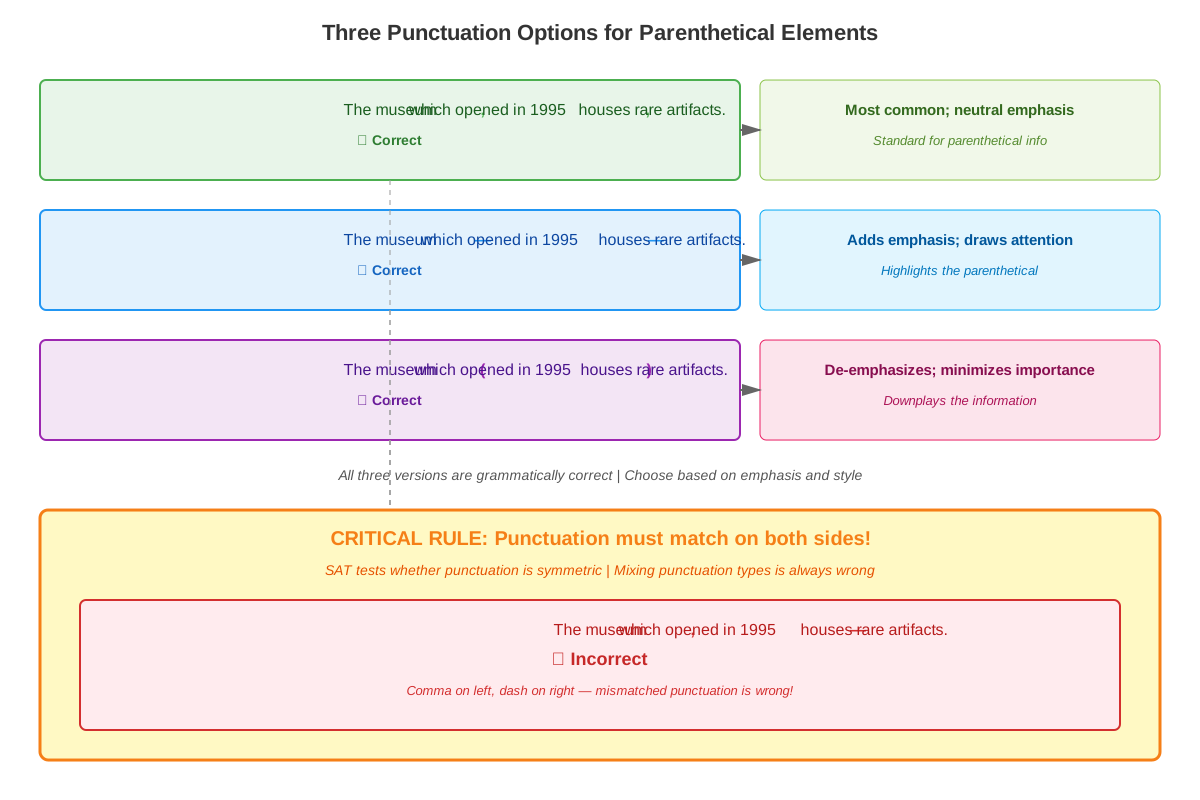
Three types of punctuation can set off parenthetical information: commas (the most common), dashes (for emphasis or longer interruptions), and parentheses (for truly tangential information). Regardless of which punctuation mark is used, the critical rule is symmetry: the same punctuation must appear at both the beginning and end of the parenthetical element. A sentence cannot begin a parenthetical element with a comma and end it with a dash, for example.
The Removal Test
The most reliable method for identifying parenthetical information is the removal test. Students should mentally or physically cross out the suspected parenthetical element and read the remaining sentence. If the sentence still makes complete grammatical sense and conveys a coherent message, the removed portion was indeed parenthetical. If the sentence becomes incomplete, ungrammatical, or loses essential meaning, the element was not parenthetical and should not be set off with punctuation.
Consider this example: "My sister, who lives in Boston, is visiting next week." Removing "who lives in Boston" leaves "My sister is visiting next week"—a complete, grammatically correct sentence. The information about Boston is supplementary. Contrast this with: "Students who study regularly perform better on exams." Removing "who study regularly" leaves "Students perform better on exams," which changes the meaning significantly. The original sentence specifies which students perform better; without the clause, it makes an overly broad claim. This clause is essential (restrictive) and should not be set off with commas.
Punctuation Options for Parenthetical Elements
| Punctuation Type | Usage Context | Example | Effect |
|---|---|---|---|
| Commas | Standard parenthetical elements; most common on SAT | The experiment, conducted over six months, yielded surprising results. | Neutral, integrates smoothly into sentence flow |
| Dashes | Emphasis or longer interruptions; dramatic effect | The results—which contradicted previous studies—sparked debate. | Draws attention; creates pause |
| Parentheses | Truly tangential or minor details | The study (published in 2019) examined climate patterns. | Minimizes importance; whispers to reader |
On the SAT, comma usage for parenthetical elements is tested most frequently, followed by dashes. Parentheses appear less often but follow the same fundamental rules. Students should note that while the three punctuation types are not always interchangeable in terms of stylistic effect, they are grammatically equivalent for setting off non-essential information. SAT questions typically focus on whether punctuation is used correctly and symmetrically, not on subtle stylistic preferences.
Common Parenthetical Elements
Several types of phrases and clauses frequently function as parenthetical information on the SAT:
- Appositives: Noun phrases that rename or describe another noun (e.g., "Dr. Martinez, a renowned physicist, led the research")
- Non-restrictive relative clauses: Clauses beginning with which, who, whom, whose, where, or when that add non-essential information (e.g., "The theory, which was proposed in 1905, revolutionized physics")
- Transitional phrases: Words like however, therefore, moreover, for example, in fact (e.g., "The results, however, were inconclusive")
- Dates and locations: Supplementary time or place information (e.g., "The conference, held in March, attracted hundreds of participants")
- Clarifying phrases: Additional explanations or specifications (e.g., "The process, known as photosynthesis, converts light to energy")
Symmetry and Consistency Rules
The symmetry requirement is non-negotiable in standard written English and on the SAT. If a parenthetical element begins with a comma, it must end with a comma (or a period if it concludes the sentence). If it begins with a dash, it must end with a dash. Mixing punctuation marks—such as starting with a comma and ending with a dash—is always incorrect.
This rule applies even when the parenthetical element appears at the beginning or end of a sentence. For example: "Having studied for weeks, Maria felt confident about the exam." The comma after "weeks" marks the end of the introductory (parenthetical) phrase. At the sentence's end: "The team won the championship, much to everyone's surprise." The comma before "much" marks the beginning of the parenthetical element; the period serves as the closing punctuation.
Distinguishing Essential from Non-Essential Information
The distinction between restrictive (essential) and non-restrictive (non-essential) elements is crucial for SAT success. Restrictive elements identify or limit the noun they modify and cannot be removed without changing the sentence's fundamental meaning. These should NOT be set off with commas. Non-restrictive elements add extra information about a noun that's already sufficiently identified and CAN be removed. These SHOULD be set off with commas.
Key indicator: "which" typically introduces non-restrictive clauses (use commas), while "that" introduces restrictive clauses (no commas). Example: "The book that changed my perspective is out of print" (restrictive—specifies which book) versus "The book, which I read last summer, changed my perspective" (non-restrictive—adds extra detail about an already-identified book).
Concept Relationships
Parenthetical information connects intimately with several other grammatical concepts tested on the SAT. Understanding sentence boundaries is prerequisite knowledge because students must recognize where sentences begin and end to determine if parenthetical elements are properly contained within sentence structures. The concept flows directly into comma usage rules, as commas serve multiple functions beyond marking parenthetical elements—students must distinguish between commas that set off non-essential information and those that separate items in a list or join independent clauses with coordinating conjunctions.
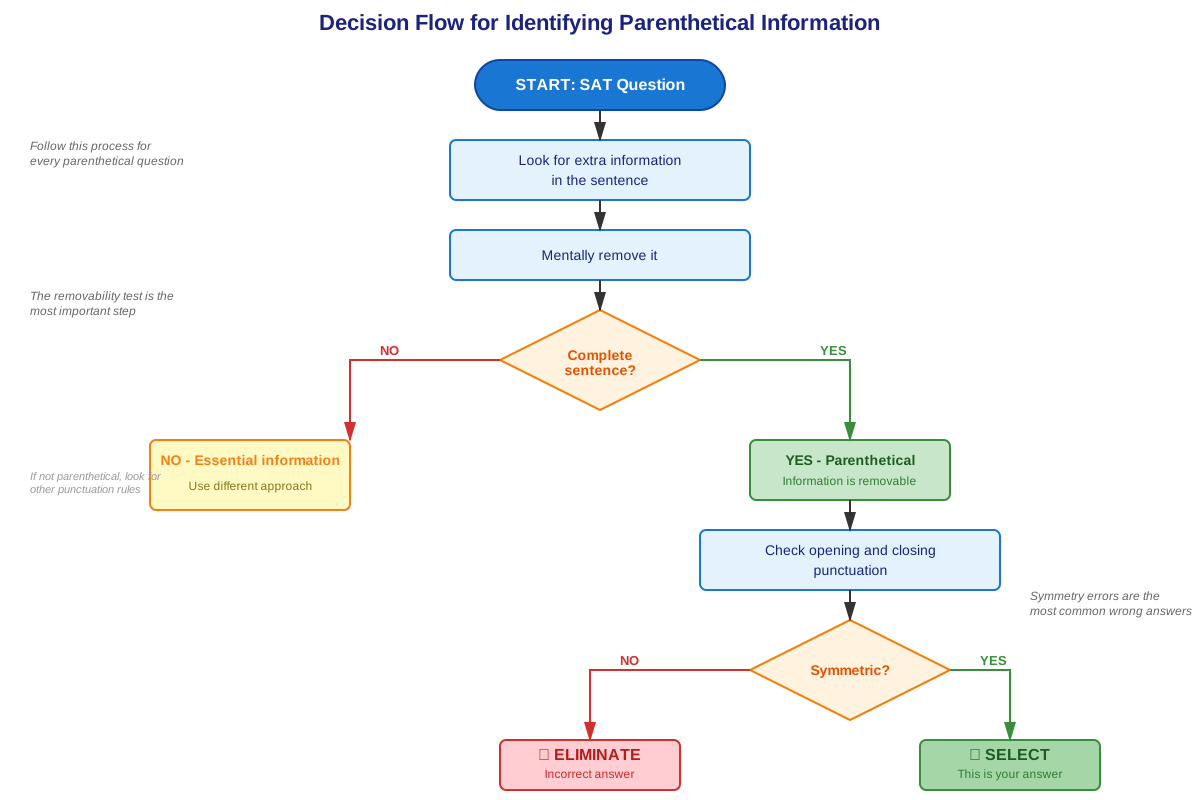
The relationship map follows this progression: Complete sentence recognition → Clause identification → Essential vs. non-essential distinction → Parenthetical information identification → Appropriate punctuation selection → Symmetry verification. Each step depends on the previous one, and weakness in any area compromises the entire process.
Parenthetical information also relates to appositive usage and relative clause construction. Many parenthetical elements are appositives or non-restrictive relative clauses, so understanding these grammatical structures helps students recognize when information is supplementary. Additionally, mastery of parenthetical punctuation supports understanding of dash usage beyond parenthetical contexts, as dashes can also indicate abrupt breaks in thought or introduce explanatory information.
The concept extends forward into more advanced punctuation topics like semicolon and colon usage, as students who understand how to properly separate and punctuate sentence elements can better grasp when semicolons (joining related independent clauses) or colons (introducing lists or explanations) are appropriate. Ultimately, all these concepts serve the broader goal of sentence clarity and correctness, which the SAT Reading and Writing section comprehensively assesses.
Quick check — test yourself on Parenthetical information so far.
Try Flashcards →High-Yield Facts
⭐ Parenthetical information must be removable: When deleted, the sentence must remain grammatically complete and convey a coherent message.
⭐ Symmetry is mandatory: The same punctuation mark must appear at both the beginning and end of a parenthetical element (comma-comma, dash-dash, or parenthesis-parenthesis).
⭐ Commas are the most frequently tested punctuation for parenthetical elements on the SAT, appearing in approximately 70% of these question types.
⭐ Non-restrictive relative clauses (usually beginning with "which," "who," "whom," "whose") are parenthetical and require commas; restrictive clauses (usually with "that") are essential and take no commas.
⭐ The removal test is the most reliable strategy: Mentally delete the suspected parenthetical element and verify the sentence still works.
- Transitional words like "however," "therefore," and "moreover" are typically parenthetical when they appear mid-sentence and require surrounding commas.
- Appositives (noun phrases that rename another noun) are usually parenthetical and require commas unless they're restrictive identifiers.
- Dashes create more emphasis than commas and are appropriate for longer parenthetical interruptions or when the writer wants to draw attention to the inserted information.
- Parentheses minimize the importance of information, suggesting it's truly tangential or optional for understanding the main point.
- A parenthetical element at the end of a sentence requires only one comma (before the element) because the period serves as the closing punctuation.
- Dates, locations, and ages are frequently parenthetical when they provide supplementary rather than identifying information.
- SAT wrong answers often feature asymmetrical punctuation (comma-dash combinations) or missing punctuation marks around parenthetical elements.
Common Misconceptions
Misconception: All information between commas is parenthetical and can be removed.
Correction: Not all comma-enclosed information is parenthetical. Commas serve many functions, including separating items in lists, joining independent clauses with coordinating conjunctions, and setting off introductory elements. Only non-essential, supplementary information qualifies as parenthetical. Always apply the removal test to verify.
Misconception: "That" and "which" are interchangeable in relative clauses.
Correction: "That" introduces restrictive (essential) clauses that should not be set off with commas, while "which" typically introduces non-restrictive (parenthetical) clauses that require commas. The choice between them affects both meaning and punctuation. Example: "Cars that run on electricity are becoming popular" (specifies which cars) versus "Electric cars, which are becoming popular, reduce emissions" (adds extra information).
Misconception: Dashes and commas can be mixed when setting off parenthetical information.
Correction: Symmetry is absolute. A parenthetical element that begins with a comma must end with a comma; one that begins with a dash must end with a dash. Mixing punctuation marks (comma-dash or dash-comma) is always incorrect in standard written English and will never be the right answer on the SAT.
Misconception: Longer phrases are always parenthetical while shorter ones are essential.
Correction: Length doesn't determine whether information is parenthetical. The deciding factor is whether the information is essential to the sentence's meaning and grammatical completeness. A single word can be parenthetical ("The results, however, were surprising"), and a long phrase can be essential ("Students who study consistently throughout the semester tend to perform better on final exams").
Misconception: Parenthetical information always appears in the middle of sentences.
Correction: While parenthetical elements often interrupt sentences, they can also appear at the beginning or end. Introductory phrases ("Having finished the experiment, the researchers analyzed the data") and concluding remarks ("The theory was revolutionary, changing how scientists understood the phenomenon") can both be parenthetical. The removal test still applies regardless of position.
Misconception: All appositives require commas.
Correction: Only non-restrictive appositives (those that provide extra information about an already-identified noun) require commas. Restrictive appositives that are necessary for identification do not. Compare: "My friend Sarah is visiting" (no commas if you have multiple friends and need to specify which one) versus "My best friend, Sarah, is visiting" (commas if Sarah's identity is already clear from "best friend").
Worked Examples
Example 1: Identifying and Punctuating Parenthetical Information
Question: Which choice correctly punctuates the sentence?
The experiment conducted by Dr. Chen in 2018 revealed surprising patterns in bird migration.
A) NO CHANGE
B) The experiment, conducted by Dr. Chen in 2018, revealed surprising patterns in bird migration.
C) The experiment conducted by Dr. Chen, in 2018, revealed surprising patterns in bird migration.
D) The experiment—conducted by Dr. Chen in 2018 revealed surprising patterns in bird migration.
Solution Process:
Step 1: Identify potential parenthetical elements. The phrase "conducted by Dr. Chen in 2018" provides additional information about the experiment. Is it essential or supplementary?
Step 2: Apply the removal test. Remove "conducted by Dr. Chen in 2018" and read: "The experiment revealed surprising patterns in bird migration." This sentence is grammatically complete and makes sense. The removed information is supplementary, making it parenthetical.
Step 3: Evaluate punctuation options. Since the information is parenthetical, it needs to be set off with punctuation. Check each answer choice:
- Choice A: No punctuation—incorrect because parenthetical information must be marked
- Choice B: Comma before and after the parenthetical element—correct symmetry
- Choice C: Only "in 2018" is set off, but "conducted by Dr. Chen" is part of the same parenthetical unit—incorrect because it breaks up the parenthetical element
- Choice D: Dash at the beginning but no closing dash—violates symmetry requirement
Step 4: Verify the answer. Choice B correctly identifies the entire parenthetical element and uses symmetrical commas to set it off.
Answer: B
Connection to Learning Objectives: This example demonstrates how to identify parenthetical information (Objective 1), apply the removal test (Objective 4), and select appropriate punctuation with proper symmetry (Objective 5).
Example 2: Distinguishing Essential from Non-Essential Information
Question: Which choice correctly punctuates the sentence?
Scientists who study climate change agree that immediate action is necessary.
A) NO CHANGE
B) Scientists, who study climate change, agree that immediate action is necessary.
C) Scientists who study climate change, agree that immediate action is necessary.
D) Scientists, who study climate change agree that immediate action is necessary.
Solution Process:
Step 1: Identify the clause in question. "Who study climate change" is a relative clause modifying "scientists."
Step 2: Determine if the clause is restrictive or non-restrictive. Ask: Does this clause identify which scientists, or does it add extra information about all scientists? The sentence is specifically about scientists who study climate change, not all scientists in general. The clause restricts the meaning to a specific group.
Step 3: Apply the removal test with meaning in mind. Remove "who study climate change" and read: "Scientists agree that immediate action is necessary." While grammatically complete, this changes the meaning significantly—it now claims ALL scientists agree, not just those who study climate change. This indicates the clause is essential (restrictive).
Step 4: Evaluate punctuation. Restrictive clauses should NOT be set off with commas. Choice A correctly uses no commas around the essential clause.
Step 5: Eliminate wrong answers:
- Choice B: Incorrectly treats the essential clause as parenthetical
- Choice C: Places a comma only after the clause, creating asymmetry and incorrectly separating subject from verb
- Choice D: Places a comma only before the clause, creating asymmetry
Answer: A
Connection to Learning Objectives: This example illustrates the critical distinction between essential and non-essential information (Objective 4) and demonstrates how meaning determines punctuation choices (Objective 2).
Exam Strategy
When approaching SAT questions about parenthetical information, follow this systematic process:
Step 1: Identify potential parenthetical elements. Look for phrases or clauses that seem to provide additional detail, especially those beginning with "which," "who," transitional words, or descriptive phrases. Watch for trigger words like "however," "for example," "in fact," "therefore," and "moreover"—these often signal parenthetical elements.
Step 2: Apply the removal test immediately. Cross out or mentally remove the suspected parenthetical information and read the remaining sentence. This single strategy eliminates most wrong answers. If the sentence becomes incomplete or loses essential meaning, the information is NOT parenthetical.
Step 3: Check for symmetry. Once you've confirmed information is parenthetical, verify that the same punctuation mark appears at both boundaries. On the SAT, asymmetrical punctuation (comma-dash combinations) is always wrong. This rule alone eliminates approximately 40% of incorrect answer choices in parenthetical information questions.
Step 4: Evaluate the scope of the parenthetical element. Ensure the punctuation marks encompass the entire parenthetical unit, not just part of it. Wrong answers often place punctuation that breaks up a single parenthetical element into fragments.
Time allocation: These questions should take 30-45 seconds each. If you're spending more than a minute, you're likely overthinking. Trust the removal test—it's faster and more reliable than trying to remember complex grammatical rules under time pressure.
Process of elimination tips specific to this topic:
- Immediately eliminate any answer choice with asymmetrical punctuation
- Eliminate choices that place punctuation separating a subject from its verb (unless there's a complete parenthetical element between them)
- Eliminate choices that use no punctuation when the removal test confirms information is parenthetical
- Be suspicious of answer choices that set off very short phrases (2-3 words) unless they're clearly transitional expressions
Common trap: The SAT often includes answer choices that correctly identify part of a parenthetical element but fail to encompass all of it. For example, if "conducted by Dr. Martinez in 2019" is parenthetical, a wrong answer might only set off "in 2019." Always consider whether multiple phrases or clauses function as a single parenthetical unit.
Memory Techniques
REMOVE mnemonic for testing parenthetical information:
- Read the sentence carefully
- Eliminate the suspected element
- Make sure the sentence is still complete
- Observe whether meaning stays intact
- Verify symmetry of punctuation
- Evaluate all answer choices
Symmetry reminder: "Parenthetical punctuation comes in pairs—like shoes, socks, and bookends." This visual helps students remember that opening punctuation must match closing punctuation.
Which vs. That rule: "WHICH needs a comma SWITCH" (the rhyme helps remember that "which" clauses are typically non-restrictive and need commas). Conversely, "THAT is FLAT" (no commas—flat against the rest of the sentence).
Visualization strategy: Imagine parenthetical information as a detachable Post-it note stuck onto a sentence. The sentence underneath (without the Post-it) must still be complete and make sense. The punctuation marks are the edges of the Post-it note—they must match on both sides.
Acronym for common parenthetical elements: ATTACH
- Appositives
- Transitional phrases
- Time/date references
- Asides and clarifications
- Clauses (non-restrictive relative)
- However-type words
Summary
Parenthetical information represents supplementary material inserted into sentences that can be removed without destroying grammatical completeness or essential meaning. The SAT tests this concept extensively through questions requiring students to identify non-essential elements and punctuate them correctly using commas, dashes, or parentheses. The fundamental principle is removability: applying the removal test by mentally deleting suspected parenthetical elements reveals whether they're truly supplementary. Equally critical is the symmetry requirement—matching punctuation marks must appear at both the beginning and end of parenthetical elements. Students must distinguish between restrictive (essential) and non-restrictive (parenthetical) information, particularly in relative clauses where "which" typically signals non-restrictive elements requiring commas, while "that" introduces restrictive elements that should not be set off. Common parenthetical elements include appositives, transitional phrases, non-restrictive relative clauses, and supplementary dates or locations. Mastering this topic requires understanding that punctuation serves meaning: it signals to readers which information is central and which is supplementary, enabling clear communication in academic writing.
Key Takeaways
- Parenthetical information must pass the removal test: the sentence remains grammatically complete and meaningful without it
- Symmetry is non-negotiable: use matching punctuation marks (comma-comma, dash-dash, or parenthesis-parenthesis) at both boundaries
- Commas are most frequently tested for parenthetical elements on the SAT, appearing in approximately 70% of these questions
- Restrictive clauses (essential) take no commas; non-restrictive clauses (parenthetical) require commas—this distinction is critical for "which" versus "that" usage
- Apply the removal test systematically on every suspected parenthetical element rather than relying on memorized rules
- Transitional words like "however," "therefore," and "for example" are typically parenthetical when appearing mid-sentence
- Check that punctuation encompasses the entire parenthetical unit, not just fragments of it—this eliminates many wrong answer choices
Related Topics
Comma Usage and Rules: Understanding all comma functions (separating list items, joining clauses with coordinating conjunctions, setting off introductory elements) provides context for when commas specifically mark parenthetical boundaries versus serving other purposes.
Restrictive and Non-Restrictive Clauses: Deeper exploration of relative clause types and their punctuation requirements builds directly on parenthetical information concepts and appears frequently on the SAT.
Dash and Semicolon Usage: Mastering parenthetical information with dashes leads naturally to understanding other dash functions (indicating abrupt breaks, introducing explanations) and distinguishing dashes from semicolons.
Appositive Construction: Since many appositives are parenthetical, studying appositive types and punctuation rules reinforces and extends parenthetical information knowledge.
Sentence Boundaries and Run-ons: Understanding where sentences properly begin and end helps students recognize when parenthetical elements are correctly contained within sentence structures versus creating fragments or run-ons.
Practice CTA
Now that you've mastered the core concepts of parenthetical information, it's time to cement your understanding through active practice. Attempt the practice questions designed specifically for this topic—they mirror actual SAT question formats and difficulty levels. As you work through them, apply the removal test systematically and verify punctuation symmetry on every question. The flashcards will help you internalize the distinction between essential and non-essential information, a skill that becomes automatic with repetition. Remember: parenthetical information questions are highly predictable on the SAT, meaning every practice question you complete directly translates to points on test day. You've built the foundation—now strengthen it through deliberate practice!
Sign up free to keep reading
Create a free AnvayaPrep account to finish this SAT guide on Parenthetical information — plus flashcards and practice questions.