Overview
Semicolons represent one of the most frequently tested punctuation marks in the SAT Reading and Writing (RW) section, appearing consistently across multiple questions in the Boundaries and Sentence Structure domain. Understanding semicolon usage is not merely about memorizing a punctuation rule—it requires recognizing the relationship between independent clauses and distinguishing when semicolons are appropriate versus when other punctuation marks should be used. The SAT tests semicolons in context, requiring students to evaluate sentence boundaries, identify grammatically complete thoughts, and select punctuation that creates clear, logical connections between ideas.
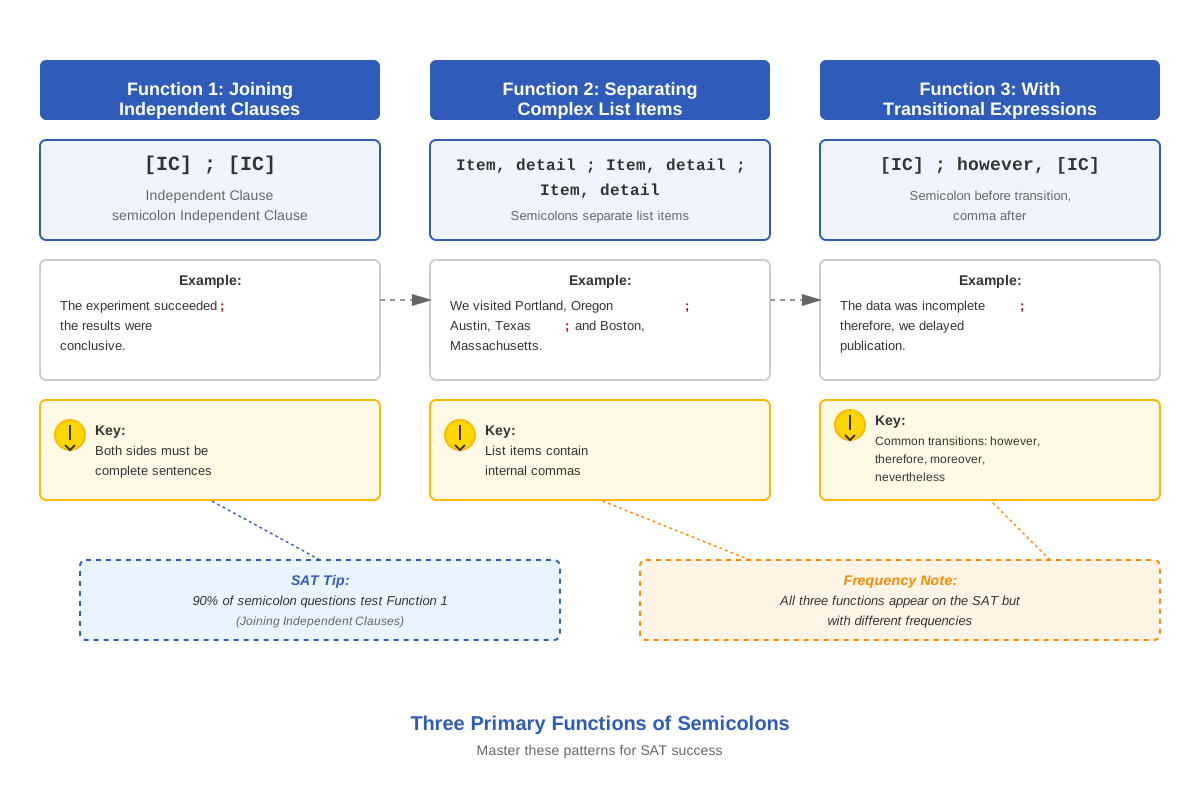
Mastering semicolons provides a significant advantage on test day because these questions are highly predictable and follow consistent patterns. Unlike some reading comprehension questions that require nuanced interpretation, semicolon questions have definitive right and wrong answers based on grammatical rules. Students who understand the three primary functions of semicolons—joining independent clauses, separating complex list items, and connecting clauses with transitional expressions—can quickly and confidently answer these questions, often in under 30 seconds per question.
Within the broader context of Reading and Writing concepts, semicolons connect directly to understanding sentence structure, independent versus dependent clauses, and the hierarchy of punctuation marks. This topic builds upon foundational grammar knowledge while preparing students for more advanced concepts like parallel structure and complex sentence construction. The ability to recognize proper semicolon usage also strengthens overall editing skills, helping students identify run-on sentences, comma splices, and other boundary errors that frequently appear throughout the SAT.
Learning Objectives
- [ ] Identify key features of semicolons and their grammatical functions
- [ ] Explain how semicolons appears on the SAT and the question formats used to test this concept
- [ ] Apply semicolons to answer SAT-style questions with accuracy and efficiency
- [ ] Distinguish between situations requiring semicolons versus other punctuation marks (periods, commas, colons)
- [ ] Recognize independent clauses and evaluate whether they can be joined with semicolons
- [ ] Identify transitional expressions that work with semicolons and understand their proper placement
- [ ] Analyze complex lists to determine when semicolons are necessary for clarity
Prerequisites
- Independent clauses: Understanding what constitutes a complete sentence with a subject and predicate is essential because semicolons primarily join two independent clauses
- Dependent clauses: Recognizing clauses that cannot stand alone helps students avoid incorrectly using semicolons where they don't belong
- Basic comma usage: Familiarity with comma rules provides context for understanding when semicolons are necessary instead of commas
- Subject-verb agreement: Identifying subjects and verbs enables students to quickly determine whether a clause is independent
- Coordinating conjunctions (FANBOYS): Knowing these conjunctions helps distinguish between comma + conjunction constructions and semicolon usage
Why This Topic Matters
Semicolons appear with remarkable consistency on the SAT, typically showing up in 2-4 questions per test administration. These questions fall primarily within the Standard English Conventions domain, specifically testing boundaries and sentence structure. The predictability of semicolon questions makes them high-value targets for score improvement—students who master this topic can reliably secure these points on every practice test and the actual exam.
In real-world writing, semicolons serve crucial functions in academic, professional, and technical communication. They allow writers to show close relationships between ideas without creating separate sentences, maintain clarity in complex lists, and create sophisticated sentence variety. College-level writing across disciplines—from scientific research papers to humanities essays—frequently employs semicolons to connect related thoughts and demonstrate nuanced thinking. Understanding semicolons also improves reading comprehension, as students encounter them regularly in challenging texts.
On the SAT, semicolon questions typically appear in two formats: standalone editing questions where students must choose the correct punctuation from four options, and questions embedded within longer passages where punctuation affects meaning and clarity. The test commonly presents scenarios where students must choose between a semicolon, a period, a comma, or a colon. Wrong answer choices often include comma splices (using only a comma to join independent clauses) or inappropriate semicolons placed between dependent and independent clauses. Recognizing these patterns allows students to eliminate incorrect options quickly and select the grammatically correct answer with confidence.
Core Concepts
The Primary Function: Joining Independent Clauses
The most fundamental use of semicolons involves connecting two independent clauses that are closely related in meaning. An independent clause contains a subject and a verb and expresses a complete thought that could stand alone as a sentence. When two such clauses share a close logical relationship, a semicolon can join them without requiring a coordinating conjunction.
Consider this example: "The experiment yielded unexpected results; the research team decided to replicate the study." Both clauses before and after the semicolon are independent—each could function as a complete sentence. The semicolon indicates that these thoughts are closely connected, with the second clause flowing naturally from the first.
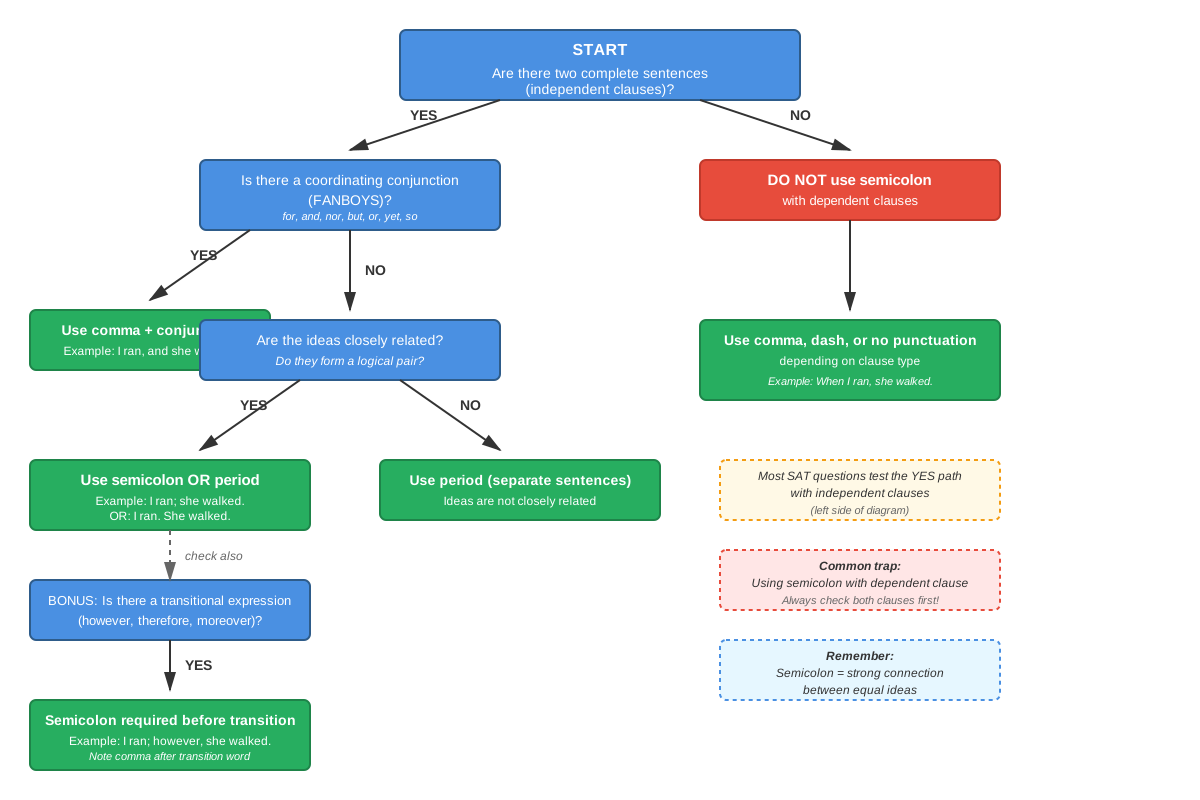
The key test for semicolon usage is the independence test: Can the words before the semicolon stand alone as a complete sentence? Can the words after the semicolon stand alone as a complete sentence? If the answer to both questions is "yes," then a semicolon is grammatically acceptable (though not always the only correct option).
Semicolons with Transitional Expressions
Semicolons frequently appear before transitional expressions (also called conjunctive adverbs) that connect independent clauses. Common transitional expressions include: however, therefore, moreover, nevertheless, consequently, furthermore, meanwhile, and thus. When these words connect two independent clauses, the proper punctuation pattern is: semicolon + transitional expression + comma.
Example: "The data supported the hypothesis; however, additional research was necessary to confirm the findings."
This construction differs from using coordinating conjunctions (for, and, nor, but, or, yet, so), which require only a comma before them when joining independent clauses. The distinction is crucial for SAT questions:
| Punctuation Pattern | Example | When to Use |
|---|---|---|
| Comma + coordinating conjunction | "The study was comprehensive, but the results were inconclusive." | Joining independent clauses with FANBOYS |
| Semicolon + transitional expression + comma | "The study was comprehensive; however, the results were inconclusive." | Joining independent clauses with conjunctive adverbs |
| Semicolon alone | "The study was comprehensive; the results were inconclusive." | Joining closely related independent clauses without a connector |
Semicolons in Complex Lists
When list items themselves contain commas, semicolons serve as super-commas to separate the major list elements and prevent confusion. This usage appears less frequently on the SAT than the independent clause function but remains testable.
Example: "The research team included Dr. Sarah Chen, a biochemist from Stanford; Dr. James Morrison, a geneticist from MIT; and Dr. Elena Rodriguez, a molecular biologist from Harvard."
Without semicolons, this sentence would be difficult to parse: "The research team included Dr. Sarah Chen, a biochemist from Stanford, Dr. James Morrison, a geneticist from MIT, and Dr. Elena Rodriguez, a molecular biologist from Harvard." The semicolons clarify that there are three team members, each with their own descriptive information.
What Semicolons Cannot Do
Understanding the limitations of semicolons is equally important for SAT success. Semicolons cannot be used in these situations:
- Between an independent clause and a dependent clause: "The experiment failed; because the equipment malfunctioned." (Incorrect—the second clause is dependent)
- To introduce a list after a complete sentence: While colons serve this function, semicolons do not. "The study examined three variables; temperature, pressure, and humidity." (Incorrect—use a colon instead)
- Between an independent clause and a phrase: "The researchers celebrated; having finally completed the project." (Incorrect—"having finally completed the project" is a phrase, not an independent clause)
- After a dependent clause at the beginning of a sentence: "Although the results were promising; the team remained cautious." (Incorrect—use a comma instead)
The Semicolon vs. Period Decision
A common SAT scenario presents students with a choice between a semicolon and a period. Both are grammatically correct when separating two independent clauses, so the decision often depends on meaning and style. The semicolon suggests a closer relationship between the ideas, while a period creates more separation.
However, on the SAT, when both options appear as answer choices, consider these factors:
- If the clauses are very closely related in meaning (cause and effect, contrast, elaboration), the semicolon is often preferred
- If the second clause begins with a transitional expression, the semicolon is typically correct
- If the clauses represent distinct, separate thoughts, the period may be better
The SAT rarely makes this a pure style choice—usually, one option will be clearly superior based on the relationship between the clauses or the presence of transitional words.
Concept Relationships
The concepts within semicolon usage form a hierarchical relationship: Independent clause recognition serves as the foundation → this enables proper semicolon placement between clauses → which then extends to semicolons with transitional expressions → and finally to the specialized application of semicolons in complex lists.
Semicolons connect directly to prerequisite knowledge of sentence structure. Understanding independent versus dependent clauses is essential before attempting to use semicolons correctly. The concept also relates to comma usage, as students must distinguish between situations requiring commas (with coordinating conjunctions, after introductory elements) versus semicolons (between independent clauses without coordinating conjunctions).
Looking forward, mastering semicolons prepares students for more advanced punctuation topics, including colon usage (which shares some similarities but serves different functions) and dash usage (which can sometimes substitute for semicolons but creates different emphasis). Semicolon mastery also supports understanding of run-on sentences and comma splices, as these errors often occur when writers incorrectly punctuate independent clauses.
The relationship map: Clause identification → Semicolon between independent clauses → Semicolon + transitional expression → Semicolons in lists → Advanced sentence structure and style
Quick check — test yourself on Semicolons so far.
Try Flashcards →High-Yield Facts
⭐ Semicolons can only join two independent clauses—both the clause before and after the semicolon must be able to stand alone as complete sentences.
⭐ When a transitional expression (however, therefore, moreover, etc.) connects two independent clauses, use a semicolon before it and a comma after it.
⭐ Semicolons and periods are interchangeable when separating independent clauses—both are grammatically correct, though semicolons suggest closer relationships.
⭐ A comma alone cannot join two independent clauses—doing so creates a comma splice, one of the most common errors tested on the SAT.
⭐ Semicolons cannot introduce lists—that function belongs to colons, not semicolons.
- Coordinating conjunctions (FANBOYS) require commas before them, not semicolons, when joining independent clauses.
- Semicolons separate major elements in complex lists where the list items themselves contain commas.
- A semicolon cannot appear between an independent clause and a dependent clause—this creates a sentence boundary error.
- The word after a semicolon should not be capitalized unless it's a proper noun.
- Semicolons create a stronger pause than commas but a weaker pause than periods.
- When "however" appears in the middle of a single independent clause (not connecting two clauses), it should be set off with commas, not preceded by a semicolon.
- Semicolons never appear with coordinating conjunctions—it's either "comma + FANBOYS" or "semicolon alone" (or "semicolon + transitional expression").
Common Misconceptions
Misconception: Semicolons and commas are interchangeable when joining sentences. → Correction: Semicolons join independent clauses without coordinating conjunctions; commas alone cannot join independent clauses (that creates a comma splice). Commas can join independent clauses only when accompanied by coordinating conjunctions (FANBOYS).
Misconception: Any long sentence needs a semicolon somewhere. → Correction: Sentence length doesn't determine semicolon usage; grammatical structure does. A semicolon is appropriate only when joining independent clauses or separating complex list items, regardless of sentence length.
Misconception: Semicolons can introduce examples or explanations. → Correction: Colons, not semicolons, introduce examples, explanations, or lists. "The experiment required three materials; beakers, chemicals, and heat sources" is incorrect; use a colon instead.
Misconception: The word "however" always requires a semicolon before it. → Correction: "However" needs a semicolon before it only when it connects two independent clauses. When "however" appears within a single clause as an interrupter, use commas: "The results, however, were inconclusive."
Misconception: Semicolons make writing sound more sophisticated, so they should be used frequently. → Correction: Semicolons serve specific grammatical functions and should be used only when those functions are needed. Overusing semicolons or using them incorrectly makes writing less clear, not more sophisticated.
Misconception: A semicolon can connect an independent clause to a dependent clause if they're closely related. → Correction: Semicolons can only join two independent clauses. Connecting an independent clause to a dependent clause requires different punctuation (usually a comma or no punctuation, depending on the clause order).
Misconception: "Therefore," "thus," and similar words are coordinating conjunctions that work like FANBOYS. → Correction: These are transitional expressions (conjunctive adverbs), not coordinating conjunctions. They require semicolons before them when connecting independent clauses, not commas.
Worked Examples
Example 1: Choosing Between Semicolon, Comma, and Period
Question: Which choice completes the text with the most logical and precise punctuation?
"The archaeological team discovered several artifacts at the site_____ the most significant find was a ceramic vessel dating to 3000 BCE."
A) site,
B) site;
C) site:
D) site, and
Step 1: Identify the clauses
- Before the blank: "The archaeological team discovered several artifacts at the site" — This is an independent clause (subject: team, verb: discovered)
- After the blank: "the most significant find was a ceramic vessel dating to 3000 BCE" — This is also an independent clause (subject: find, verb: was)
Step 2: Evaluate each option
- Option A (comma alone): This creates a comma splice, joining two independent clauses with only a comma. Grammatically incorrect.
- Option B (semicolon): This correctly joins two independent clauses. The clauses are closely related—the second provides specific information about the first.
- Option C (colon): Colons can introduce explanations, but the second clause doesn't explain what "several artifacts" means; it identifies one particular artifact as most significant. Less precise than the semicolon.
- Option D (comma + and): Grammatically correct, but "and" suggests the clauses are equal in importance rather than showing that the second clause specifies which artifact was most important.
Step 3: Select the best answer
Answer: B (semicolon). The semicolon correctly joins the independent clauses and shows their close relationship, with the second clause elaborating on the first.
Connection to learning objectives: This example demonstrates identifying independent clauses, distinguishing between punctuation options, and applying semicolon rules to SAT-style questions.
Example 2: Semicolons with Transitional Expressions
Question: Which choice completes the text with the most logical and precise punctuation?
"The initial hypothesis predicted a positive correlation between the variables_____ the experimental data revealed a negative correlation instead."
A) variables, however,
B) variables; however,
C) variables however,
D) variables, however
Step 1: Identify the clauses and the connector
- First clause: "The initial hypothesis predicted a positive correlation between the variables" (independent)
- Connector: "however" (transitional expression showing contrast)
- Second clause: "the experimental data revealed a negative correlation instead" (independent)
Step 2: Recall the rule for transitional expressions
When a transitional expression connects two independent clauses, the pattern is: semicolon + transitional expression + comma.
Step 3: Evaluate each option
- Option A: Uses comma before "however" and comma after—this creates a comma splice (two independent clauses joined by only a comma)
- Option B: Uses semicolon before "however" and comma after—this follows the correct pattern
- Option C: No punctuation before "however"—creates a run-on sentence
- Option D: Comma before "however" but no comma after—incorrect punctuation pattern and still creates a comma splice
Step 4: Select the best answer
Answer: B. This correctly uses the semicolon + transitional expression + comma pattern to join two independent clauses with a contrasting relationship.
Connection to learning objectives: This example shows how to identify transitional expressions, apply the specific punctuation pattern they require, and distinguish correct semicolon usage from comma splices.
Exam Strategy
When approaching semicolon questions on the SAT, follow this systematic process:
Step 1: Identify what comes before and after the punctuation mark. Read the sentence carefully and determine whether each side contains an independent clause, a dependent clause, or a phrase. This is the most critical step—most semicolon questions can be answered by simply checking whether both sides are independent clauses.
Step 2: Apply the independence test. Ask yourself: "Can the words before the punctuation stand alone as a complete sentence? Can the words after the punctuation stand alone as a complete sentence?" If both answers are "yes," a semicolon is grammatically possible. If either answer is "no," eliminate semicolon options.
Step 3: Watch for trigger words. Transitional expressions like "however," "therefore," "moreover," and "nevertheless" are strong signals that a semicolon should precede them when they connect independent clauses. Coordinating conjunctions (FANBOYS) signal that a comma, not a semicolon, should precede them.
Step 4: Eliminate comma splices immediately. If you see two independent clauses joined by only a comma (no coordinating conjunction), that option is always wrong. This elimination strategy quickly narrows your choices.
Step 5: Consider meaning and relationship. When multiple punctuation marks are grammatically correct (e.g., both semicolon and period), choose based on how closely related the ideas are. Semicolons suggest tighter connections; periods create more separation.
Time allocation: Semicolon questions should take 20-30 seconds once you've mastered the concepts. They're among the fastest questions to answer because they follow predictable rules. Don't overthink these questions—if both sides are independent clauses and there's no coordinating conjunction, the semicolon is likely correct.
Process of elimination tips specific to semicolons:
- Eliminate any option that creates a comma splice (comma alone between independent clauses)
- Eliminate semicolons that appear before or after dependent clauses
- Eliminate options where semicolons introduce lists (colons do this, not semicolons)
- When "however" or similar transitional words appear, eliminate options without semicolons before them
Memory Techniques
The "Two Sentences" Test: Before using a semicolon, imagine replacing it with a period and capital letter. If both resulting sentences would be complete and grammatically correct, the semicolon works. If either side would be a fragment, the semicolon is wrong.
The FANBOYS vs. Transitional Expression Distinction: Remember "FANBOYS get commas; transitions get semicolons." Coordinating conjunctions (For, And, Nor, But, Or, Yet, So) require commas before them. Transitional expressions (however, therefore, moreover, etc.) require semicolons before them.
The "Super-Comma" Visualization: For complex lists, visualize semicolons as "super-powered commas" that separate major list items when regular commas already appear within those items. This helps remember their list-separating function.
The Independence Acronym - BOTH: Before using a semicolon, check that Both sides are Obviously Thoughtfully Healthy sentences (complete and independent). If BOTH sides pass this test, the semicolon works.
The "However" Rule Rhyme: "However between two thoughts complete, needs semicolon to make it neat; however within a single clause, gets commas for a little pause."
Summary
Semicolons serve three primary functions on the SAT: joining independent clauses, connecting independent clauses with transitional expressions, and separating complex list items. The most frequently tested function involves joining two independent clauses that are closely related in meaning. To use semicolons correctly, students must first identify independent clauses—complete thoughts with subjects and verbs that could stand alone as sentences. The critical rule is that both the clause before and the clause after the semicolon must be independent. When transitional expressions like "however," "therefore," or "moreover" connect two independent clauses, the proper pattern is semicolon + transitional expression + comma. Semicolons cannot introduce lists (that's a colon's job), cannot join independent and dependent clauses, and cannot replace commas before coordinating conjunctions. Understanding these rules and limitations allows students to quickly identify correct semicolon usage and eliminate common errors like comma splices. Mastering semicolons provides reliable points on the SAT because these questions follow predictable patterns and have definitive correct answers based on grammatical structure rather than subjective interpretation.
Key Takeaways
- Semicolons join two independent clauses—both sides must be complete sentences that could stand alone
- The "independence test" is the fastest way to verify semicolon usage: Can each side stand alone as a complete sentence?
- Transitional expressions (however, therefore, moreover, etc.) require semicolons before them and commas after them when connecting independent clauses
- Comma splices (two independent clauses joined by only a comma) are always incorrect and should be eliminated immediately
- Semicolons and periods are both grammatically correct between independent clauses, but semicolons suggest closer relationships between ideas
- Coordinating conjunctions (FANBOYS) take commas before them, not semicolons
- Semicolons cannot introduce lists, join independent and dependent clauses, or appear with coordinating conjunctions
Related Topics
Colon Usage: Colons introduce lists, explanations, and elaborations after independent clauses. Understanding the distinction between semicolons (which join independent clauses) and colons (which introduce information) is essential for SAT punctuation questions.
Comma Splices and Run-On Sentences: These common errors occur when independent clauses are improperly joined. Mastering semicolons helps students recognize and correct these boundary errors.
Coordinating Conjunctions and Compound Sentences: Understanding how FANBOYS work with commas to join independent clauses provides important contrast to semicolon usage and helps students choose appropriate punctuation.
Transitional Expressions and Conjunctive Adverbs: Deeper study of words like "however," "therefore," and "moreover" strengthens understanding of how these expressions work with semicolons and how they differ from coordinating conjunctions.
Advanced Sentence Structure: Semicolon mastery enables students to construct and analyze complex sentences with multiple clauses, supporting both writing skills and reading comprehension of sophisticated texts.
Practice CTA
Now that you understand the rules and strategies for semicolon usage, it's time to reinforce your learning through practice. Attempt the practice questions to apply these concepts to SAT-style scenarios, and use the flashcards to memorize key rules and patterns. Remember, semicolon questions are among the most predictable on the SAT—with focused practice, you can master this topic and confidently secure these points on test day. Each practice question you complete strengthens your ability to quickly identify independent clauses and select correct punctuation, building the automaticity you need for efficient, accurate performance on the actual exam.
Sign up free to keep reading
Create a free AnvayaPrep account to finish this SAT guide on Semicolons — plus flashcards and practice questions.