Overview
Coordinating conjunctions are among the most frequently tested grammatical elements in the SAT Reading and Writing (RW) section. These seven small but powerful words—for, and, nor, but, or, yet, so—serve as the glue that connects independent clauses, creating compound sentences that express complex relationships between ideas. Understanding how to properly use coordinating conjunctions is essential not only for identifying grammatically correct sentences but also for recognizing common punctuation errors that appear throughout the exam.
On the SAT, sat coordinating conjunctions questions typically test whether students can identify proper sentence boundaries, recognize run-on sentences and comma splices, and determine when a comma should or should not precede a coordinating conjunction. These questions appear in the Standard English Conventions domain and account for a significant portion of sentence structure questions. Mastering this topic directly impacts performance on approximately 15-20% of the grammar-focused questions on the test, making it a high-yield area for score improvement.
The relationship between coordinating conjunctions and other rw concepts is fundamental to understanding sentence boundaries. Coordinating conjunctions work in tandem with punctuation rules, independent and dependent clause recognition, and parallel structure principles. They represent a critical junction point where multiple grammar concepts converge, making them an ideal topic for building comprehensive sentence structure knowledge that will serve students throughout the entire Reading and Writing section.
Learning Objectives
- [ ] Identify key features of coordinating conjunctions
- [ ] Explain how coordinating conjunctions appears on the SAT
- [ ] Apply coordinating conjunctions to answer SAT-style questions
- [ ] Distinguish between proper and improper use of commas with coordinating conjunctions
- [ ] Recognize the difference between coordinating conjunctions joining independent clauses versus other sentence elements
- [ ] Evaluate whether a coordinating conjunction creates a logical relationship between ideas in context
Prerequisites
- Independent and dependent clauses: Understanding clause types is essential because coordinating conjunctions specifically join independent clauses, and recognizing clause independence determines proper punctuation.
- Basic punctuation rules: Knowledge of comma usage and period placement provides the foundation for understanding how coordinating conjunctions interact with punctuation marks.
- Subject-verb agreement: Identifying subjects and verbs helps determine where one clause ends and another begins, which is crucial for applying coordinating conjunction rules correctly.
- Sentence fragments and run-ons: Familiarity with these error types enables recognition of how coordinating conjunctions can either fix or create these problems depending on their usage.
Why This Topic Matters
Coordinating conjunctions appear in everyday writing and speech, making them practical tools for clear communication beyond test preparation. In professional writing, academic essays, and formal correspondence, the ability to combine ideas smoothly using coordinating conjunctions demonstrates sophistication and clarity. Writers who master these connectors can vary sentence structure, establish logical relationships between ideas, and create more engaging prose.
On the SAT specifically, coordinating conjunction questions appear in approximately 3-5 questions per test administration, representing a substantial portion of the Standard English Conventions questions. These questions typically appear in two formats: identifying punctuation errors involving coordinating conjunctions (most common) and selecting the appropriate coordinating conjunction to establish logical relationships between ideas (less common but still significant). The College Board consistently includes these questions because they test fundamental writing skills that predict college readiness.
In exam passages, coordinating conjunctions most commonly appear in contexts testing comma usage before the conjunction, distinguishing between compound sentences and sentences with compound elements (like compound verbs or compound objects), and identifying run-on sentences that lack proper punctuation. Students frequently encounter answer choices that differ only in punctuation around coordinating conjunctions, making precise knowledge of the rules essential for selecting correct answers confidently and quickly.
Core Concepts
The Seven Coordinating Conjunctions
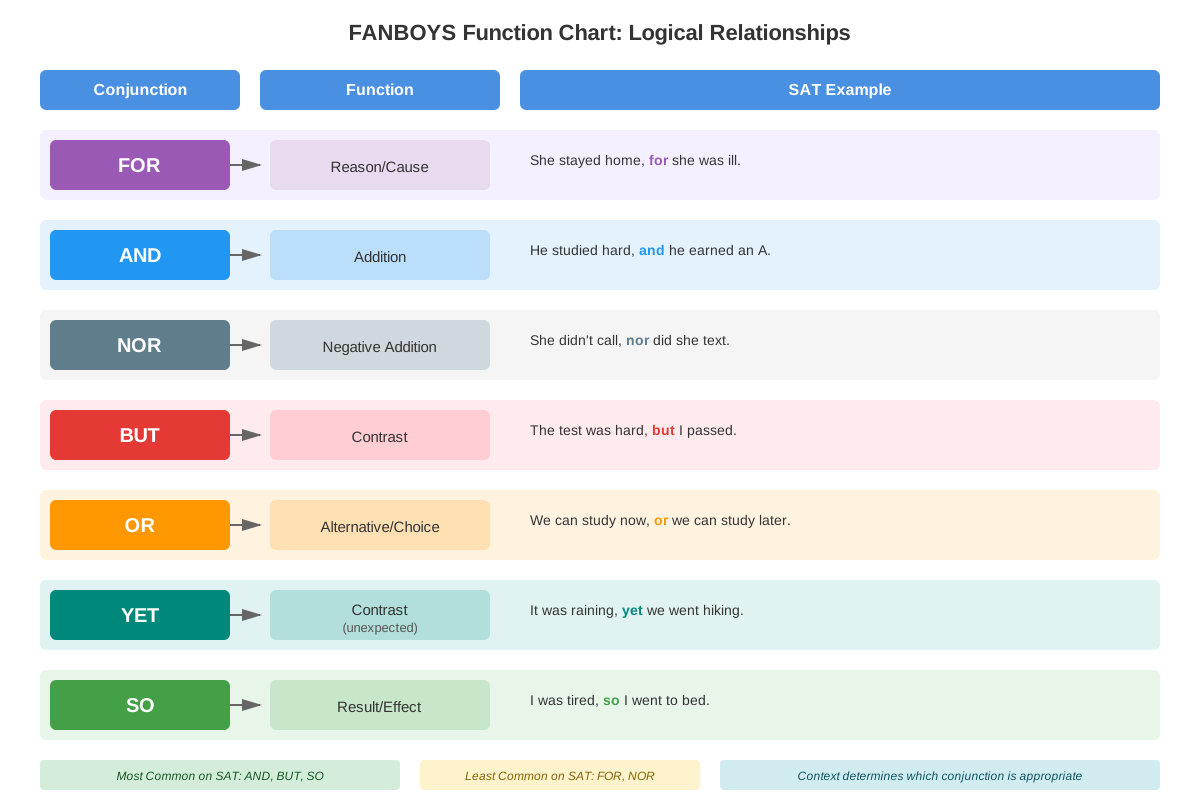
The English language contains exactly seven coordinating conjunctions: for, and, nor, but, or, yet, and so. These words are easily remembered using the acronym FANBOYS (For, And, Nor, But, Or, Yet, So). Each coordinating conjunction serves a specific purpose in connecting ideas:
- For: indicates causation or reason (similar to "because")
- And: adds information or shows continuation
- Nor: presents a negative alternative
- But: shows contrast or exception
- Or: presents alternatives or choices
- Yet: shows contrast (similar to "but" but often implies surprise)
- So: indicates result or consequence
Understanding the semantic function of each conjunction helps determine which one creates the most logical relationship between clauses in context-based SAT questions.
Coordinating Conjunctions with Independent Clauses
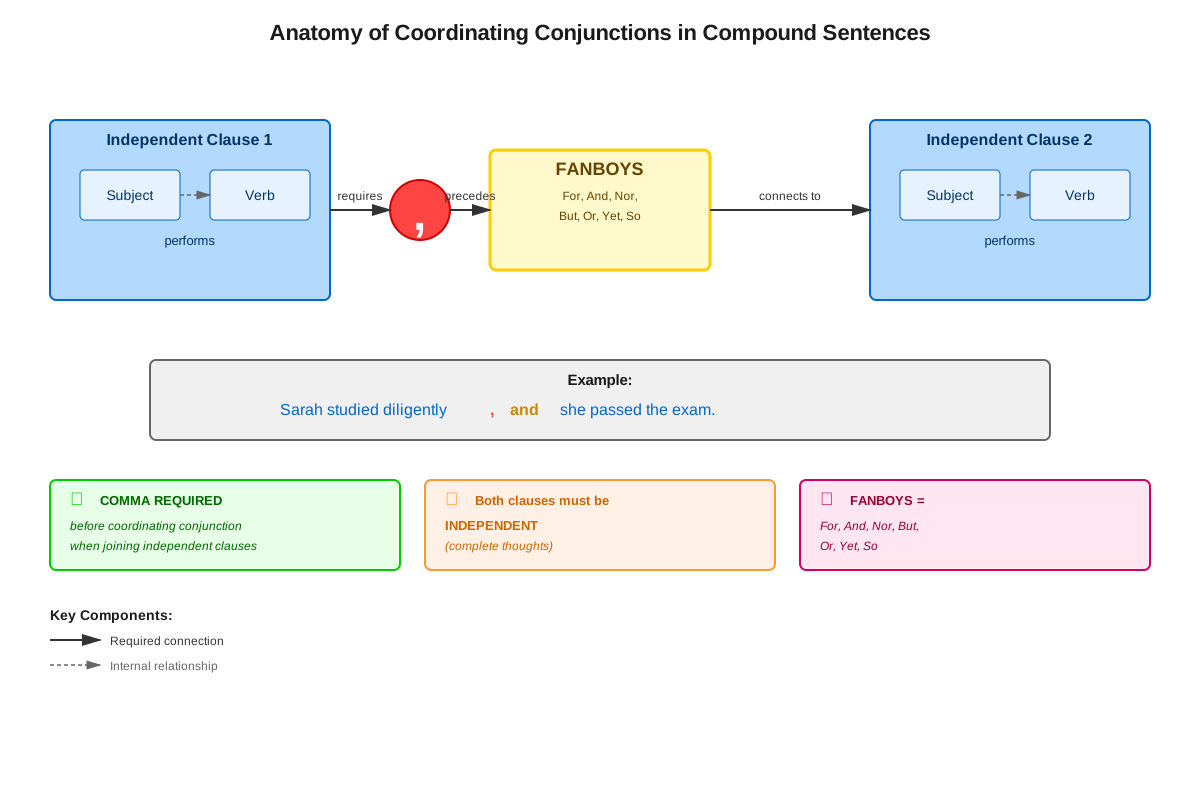
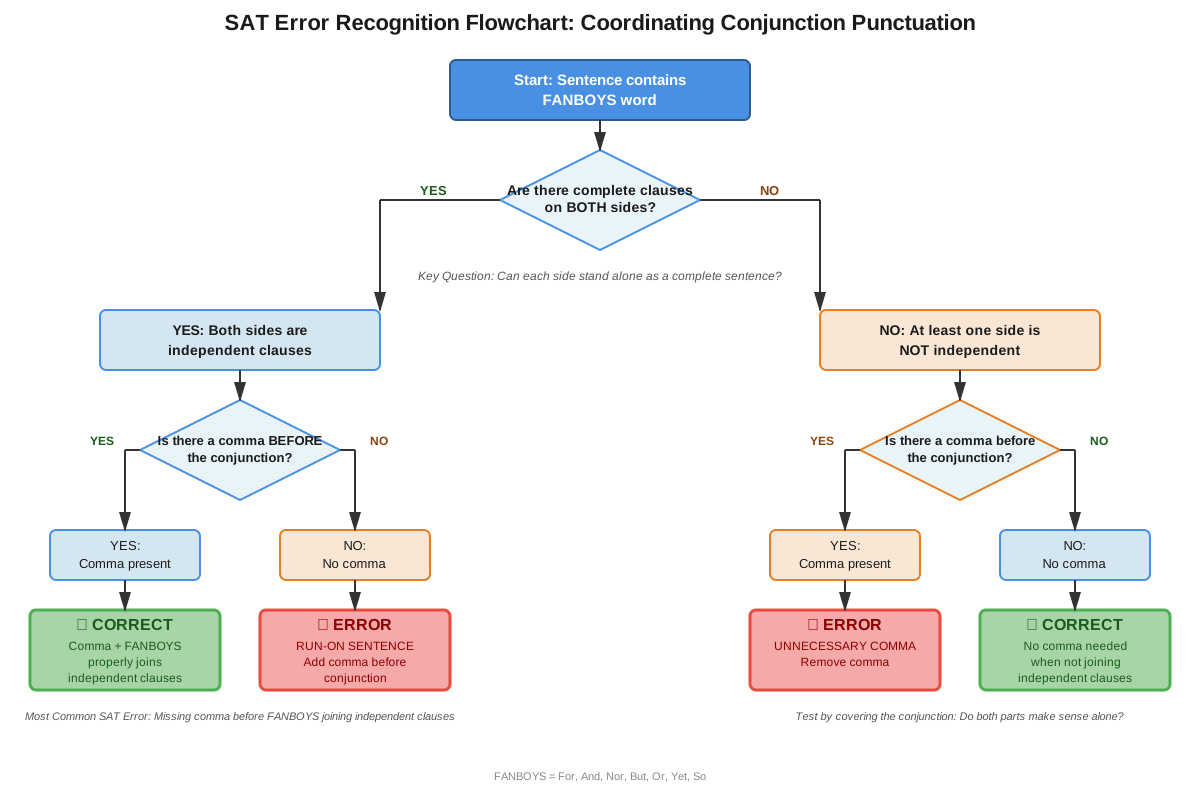
The primary rule governing coordinating conjunctions on the SAT involves their use with independent clauses. An independent clause contains a subject and a verb and expresses a complete thought. When a coordinating conjunction joins two independent clauses, a comma must precede the conjunction:
Independent Clause + , + Coordinating Conjunction + Independent Clause
Example: "The scientist completed her research, and she published her findings in a prestigious journal."
Both "The scientist completed her research" and "she published her findings in a prestigious journal" can stand alone as complete sentences. Therefore, the comma before "and" is required. This construction creates a compound sentence.
The comma serves a critical function: it signals to readers that a new independent clause is beginning. Without the comma, readers might initially misinterpret the sentence structure, leading to confusion. The SAT frequently tests whether students can identify when this comma is necessary versus when it is incorrectly used.
Coordinating Conjunctions with Compound Elements
A crucial distinction that appears frequently on the SAT involves coordinating conjunctions joining elements other than independent clauses. When a coordinating conjunction connects compound subjects, compound verbs, compound objects, or other parallel elements within a single clause, no comma is used:
Element + Coordinating Conjunction + Element (no comma)
Examples:
- Compound subject: "The professor and her assistant conducted the experiment." (no comma before "and")
- Compound verb: "The students studied for hours and achieved excellent results." (no comma before "and")
- Compound object: "The museum displays paintings and sculptures." (no comma before "and")
The key test is whether the second element after the conjunction contains its own subject-verb combination that could stand alone. If it cannot stand alone as an independent clause, no comma should precede the coordinating conjunction.
Common Errors: Run-ons and Comma Splices
Understanding coordinating conjunctions helps identify two major sentence boundary errors:
Run-on sentence: Two independent clauses joined without proper punctuation or conjunction.
- Incorrect: "The experiment failed the researchers tried again."
- Correct: "The experiment failed, so the researchers tried again."
Comma splice: Two independent clauses joined with only a comma (missing the coordinating conjunction).
- Incorrect: "The experiment failed, the researchers tried again."
- Correct: "The experiment failed, and the researchers tried again."
The SAT frequently presents these errors in answer choices, testing whether students recognize that both a comma AND a coordinating conjunction are required to join independent clauses properly.
Logical Relationships and Context
Beyond mechanical correctness, the SAT sometimes tests whether the chosen coordinating conjunction creates a logical relationship between ideas. Consider these examples:
- "The weather was terrible, but the game continued." (contrast—logical)
- "The weather was terrible, so the game continued." (cause-effect—illogical)
When answering these questions, students must read both clauses carefully and determine which conjunction best expresses the relationship the author intends. This requires understanding both the meaning of each conjunction and the context of the passage.
Comparison Table
| Situation | Punctuation Rule | Example |
|---|---|---|
| Two independent clauses | Comma + coordinating conjunction | "She studied hard, and she passed the test." |
| Compound verb (same subject) | No comma | "She studied hard and passed the test." |
| Compound subject | No comma | "The teacher and the students celebrated." |
| Three or more items in a series | Commas between items, conjunction before last | "They studied math, science, and history." |
| Short, closely related clauses | Comma + coordinating conjunction (still required) | "I came, I saw, I conquered." (Note: This famous phrase actually uses comma splices for rhetorical effect, but SAT requires proper punctuation) |
Concept Relationships
Coordinating conjunctions function as a central hub connecting multiple grammar concepts. The relationship flows as follows:
Clause Recognition → enables → Identifying Independent Clauses → determines → Coordinating Conjunction Punctuation → prevents → Run-ons and Comma Splices
Understanding independent versus dependent clauses is the foundational skill that makes all coordinating conjunction rules comprehensible. Once students can reliably identify whether a clause can stand alone, they can apply the punctuation rules with confidence.
Coordinating conjunctions also connect to parallel structure concepts. When a coordinating conjunction joins two elements, those elements must be grammatically parallel (both nouns, both verb phrases, both independent clauses, etc.). This relationship appears in more advanced SAT questions that test multiple concepts simultaneously.
Additionally, coordinating conjunctions relate to transition words and phrases. While coordinating conjunctions can join independent clauses with just a comma, conjunctive adverbs (however, therefore, moreover) require stronger punctuation (semicolon or period). Understanding this distinction prevents confusion when students encounter similar-seeming connectors that follow different rules.
The relationship to sentence variety is also significant. Overusing coordinating conjunctions creates choppy, unsophisticated writing, while strategic use creates smooth, varied prose. The SAT occasionally tests whether students can recognize when subordination or other sentence structures would be more effective than coordination.
High-Yield Facts
⭐ Exactly seven coordinating conjunctions exist: for, and, nor, but, or, yet, so (FANBOYS)
⭐ When joining two independent clauses, a comma must precede the coordinating conjunction
⭐ When joining compound elements within a single clause (compound verbs, subjects, objects), no comma precedes the coordinating conjunction
⭐ A comma alone cannot join two independent clauses—this creates a comma splice error
⭐ Two independent clauses joined without any punctuation or conjunction create a run-on sentence
- The coordinating conjunction "for" meaning "because" is relatively formal and appears less frequently in modern writing
- "Nor" requires subject-verb inversion in the second clause: "She didn't study, nor did she attend class"
- Short independent clauses still require a comma before the coordinating conjunction, even if they seem closely related
- The coordinating conjunction must create a logical relationship between the ideas it connects
- Coordinating conjunctions differ from subordinating conjunctions (because, although, since) which create dependent clauses and follow different punctuation rules
Quick check — test yourself on Coordinating conjunctions so far.
Try Flashcards →Common Misconceptions
Misconception: A comma is always needed before coordinating conjunctions like "and" or "but."
Correction: A comma is only required when the coordinating conjunction joins two independent clauses. When joining compound elements within a single clause (like compound verbs or objects), no comma should be used.
Misconception: Short sentences don't need a comma before the coordinating conjunction.
Correction: Length is irrelevant. If two independent clauses are joined by a coordinating conjunction, a comma is required regardless of how short the clauses are. "I ran, and she walked" requires the comma even though both clauses are brief.
Misconception: A comma can join two independent clauses by itself.
Correction: A comma alone creates a comma splice error. Two independent clauses require either (1) a comma plus a coordinating conjunction, (2) a semicolon, or (3) a period to separate them into two sentences.
Misconception: All FANBOYS words are always coordinating conjunctions.
Correction: Context matters. "For" can be a preposition ("for the team"), "so" can be an adverb ("so happy"), and "yet" can be an adverb ("not yet"). They only function as coordinating conjunctions when joining clauses or parallel elements.
Misconception: "However" and "therefore" are coordinating conjunctions.
Correction: These are conjunctive adverbs, not coordinating conjunctions. They require stronger punctuation (semicolon or period) before them and typically a comma after them. They cannot be used with just a comma to join independent clauses.
Misconception: The coordinating conjunction must match the relationship between ideas perfectly.
Correction: While logical relationships matter, sometimes multiple coordinating conjunctions could work. The SAT typically makes illogical choices obviously wrong, but in borderline cases, students should choose the most precise option that matches the author's intended meaning.
Worked Examples
Example 1: Identifying Proper Comma Usage
Question: Which choice correctly punctuates the sentence?
The research team collected extensive data [blank] the results contradicted their initial hypothesis.
A) data, the results
B) data the results
C) data, but the results
D) data but the results
Solution:
Step 1: Identify the clauses on both sides of the blank.
- First clause: "The research team collected extensive data" (has subject "team" and verb "collected"—independent clause)
- Second clause: "the results contradicted their initial hypothesis" (has subject "results" and verb "contradicted"—independent clause)
Step 2: Determine the relationship between the clauses.
The second clause presents information that contrasts with what might be expected, suggesting a contrast relationship. "But" is the appropriate coordinating conjunction for contrast.
Step 3: Apply the punctuation rule.
Since we're joining two independent clauses with a coordinating conjunction, we need: comma + coordinating conjunction.
Step 4: Evaluate the choices.
- A) Creates a comma splice (comma without conjunction)—incorrect
- B) Creates a run-on sentence (no punctuation or conjunction)—incorrect
- C) Correctly uses comma + coordinating conjunction "but"—correct
- D) Missing the required comma before the coordinating conjunction—incorrect
Answer: C
This question addresses Learning Objective 3 (applying coordinating conjunctions to SAT questions) and demonstrates the most common question type involving coordinating conjunctions.
Example 2: Distinguishing Compound Elements from Compound Sentences
Question: Which choice correctly punctuates the sentence?
The archaeologist carefully excavated the site [blank] documented each artifact's precise location.
A) site, and documented
B) site and documented
C) site, documented
D) site; and documented
Solution:
Step 1: Identify what comes after the blank.
"documented each artifact's precise location" contains a verb ("documented") but no subject. This is not an independent clause—it's a compound verb sharing the subject "archaeologist" from the first part of the sentence.
Step 2: Determine the sentence structure.
The sentence has one subject ("archaeologist") performing two actions: "excavated" and "documented." This is a compound verb construction, not two independent clauses.
Step 3: Apply the appropriate rule.
When a coordinating conjunction joins compound verbs (or other compound elements within a single clause), no comma is used.
Step 4: Evaluate the choices.
- A) Incorrectly adds a comma before the coordinating conjunction—incorrect
- B) Correctly uses the coordinating conjunction without a comma—correct
- C) Creates a comma splice (no conjunction)—incorrect
- D) Incorrectly uses a semicolon (too strong for compound verbs)—incorrect
Answer: B
This question tests the crucial distinction between joining independent clauses and joining compound elements, addressing Learning Objective 4 (distinguishing proper and improper comma use with coordinating conjunctions).
Exam Strategy
When approaching coordinating conjunction questions on the SAT, follow this systematic process:
Step 1: Identify the clauses
Before looking at punctuation, determine what comes before and after the coordinating conjunction (or potential conjunction). Ask: "Does each part have its own subject and verb? Could each part stand alone as a complete sentence?"
Step 2: Apply the appropriate rule
- If both parts are independent clauses → comma + coordinating conjunction required
- If joining compound elements within one clause → coordinating conjunction only (no comma)
Step 3: Check for logical relationships
If the question offers different coordinating conjunctions as options, read carefully to determine which conjunction creates the most logical relationship between the ideas. Look for clue words in the surrounding context that suggest contrast (but, yet), addition (and), cause-effect (so), or other relationships.
Trigger words and phrases to watch for:
- Answer choices that differ only in punctuation around "and," "but," or "so"
- Sentences with two verb phrases that might or might not share a subject
- Options including comma splices (comma without conjunction)
- Options including run-ons (no punctuation or conjunction)
Process-of-elimination tips:
- Immediately eliminate comma splices (comma alone between independent clauses)
- Eliminate run-ons (no punctuation between independent clauses)
- If you've identified two independent clauses, eliminate any option without both a comma AND a coordinating conjunction
- If you've identified compound elements (not independent clauses), eliminate options with commas before the conjunction
Time allocation:
These questions should take 20-30 seconds once you've mastered the concepts. Spend 10 seconds identifying clause structure, 5 seconds applying the rule, and 5-10 seconds confirming your answer. If a question takes longer, make your best guess and move on—coordinating conjunction questions are typically straightforward once you know the rules.
Exam Tip: If you're unsure whether the second part is an independent clause, try reading it alone. If it makes complete sense by itself, it's independent and requires a comma before the coordinating conjunction. If it sounds incomplete, it's probably a compound element and doesn't need a comma.
Memory Techniques
FANBOYS Acronym: The classic mnemonic for remembering all seven coordinating conjunctions:
- For
- And
- Nor
- But
- Or
- Yet
- So
The "Stand Alone" Test: To remember when to use a comma, visualize the sentence split at the coordinating conjunction. If both parts could "stand alone" as complete sentences, they need a comma to "hold hands" (the comma) while the conjunction connects them.
The "Two Captains" Rule: Think of independent clauses as two ship captains—each commands their own vessel (complete thought). When two captains meet, they need formal protocol (comma + conjunction). But when one captain has two ships (compound elements), no special protocol is needed.
Comma = Pause for Breath: When reading aloud, a comma before a coordinating conjunction signals a natural pause before introducing a new complete thought. No comma means the thought continues without interruption.
The "Subject Search" Strategy: When you see a coordinating conjunction, immediately look for subjects. If there's a new subject after the conjunction performing a new action, you likely need a comma. If the same subject continues with a new verb, no comma is needed.
Summary
Coordinating conjunctions are seven specific words (for, and, nor, but, or, yet, so) that connect independent clauses or parallel elements within sentences. The fundamental rule governing their use on the SAT is straightforward: when joining two independent clauses, a comma must precede the coordinating conjunction; when joining compound elements within a single clause, no comma should be used. This distinction accounts for the majority of coordinating conjunction questions on the exam. Students must be able to identify independent clauses by recognizing complete subject-verb combinations that express complete thoughts. Common errors tested include comma splices (using only a comma without a conjunction), run-on sentences (using neither comma nor conjunction), and incorrect comma placement before coordinating conjunctions joining compound elements. Additionally, some questions test whether the chosen coordinating conjunction creates a logical relationship between ideas in context. Mastering these concepts requires understanding clause structure, applying punctuation rules systematically, and recognizing the semantic function of each coordinating conjunction.
Key Takeaways
- Seven coordinating conjunctions exist (FANBOYS: for, and, nor, but, or, yet, so), and they join independent clauses or parallel elements
- When joining two independent clauses, always use comma + coordinating conjunction
- When joining compound elements within one clause (compound verbs, subjects, objects), use the coordinating conjunction without a comma
- A comma alone cannot join independent clauses—this creates a comma splice error
- Both the mechanical correctness and logical relationship of coordinating conjunctions may be tested on the SAT
- The key to answering these questions correctly is identifying whether both parts are independent clauses
- Coordinating conjunction questions appear frequently on the SAT and represent high-yield opportunities for score improvement
Related Topics
Semicolons and Independent Clauses: Semicolons provide an alternative method for joining independent clauses without coordinating conjunctions. Understanding when to use semicolons versus comma + coordinating conjunction expands sentence structure options and appears in related SAT questions.
Subordinating Conjunctions and Dependent Clauses: While coordinating conjunctions join equal elements, subordinating conjunctions (because, although, when, if) create dependent clauses. Mastering the distinction between these conjunction types prevents confusion about punctuation rules.
Conjunctive Adverbs: Words like "however," "therefore," and "moreover" seem similar to coordinating conjunctions but require different punctuation (semicolon or period before them). Understanding this distinction prevents common errors.
Parallel Structure: Coordinating conjunctions must join grammatically parallel elements. Advanced questions may test both coordinating conjunction usage and parallel structure simultaneously.
Sentence Combining and Variety: Understanding coordinating conjunctions enables more sophisticated sentence combining, which relates to rhetorical skills questions about improving sentence flow and variety in passages.
Practice CTA
Now that you've mastered the core concepts of coordinating conjunctions, it's time to reinforce your learning through active practice. Attempt the practice questions designed specifically for this topic—they'll challenge you to apply these rules in realistic SAT contexts and help you identify any remaining areas of uncertainty. Use the flashcards to drill the seven coordinating conjunctions and their functions until recognition becomes automatic. Remember, coordinating conjunction questions are among the most predictable and high-yield on the SAT; investing time in practice now will translate directly into points on test day. You've built a strong foundation—now strengthen it through deliberate practice!
Sign up free to keep reading
Create a free AnvayaPrep account to finish this SAT guide on Coordinating conjunctions — plus flashcards and practice questions.