Overview
Sentence separation is one of the most frequently tested concepts in the SAT Reading and Writing (RW) section, appearing in questions that assess a student's ability to recognize and correct errors in how independent clauses are joined or separated. This topic falls under the broader category of sentence boundaries and punctuation, requiring students to distinguish between complete sentences, fragments, and run-ons, then apply the appropriate punctuation or conjunctions to fix structural problems.
Mastering sat sentence separation is essential because these questions appear consistently across multiple test forms, often accounting for 10-15% of the Standard English Conventions questions in the rw section. Students who understand sentence separation principles can quickly identify comma splices, fused sentences, and improperly connected clauses—errors that frequently appear in SAT passages about science, history, literature, and social studies. The ability to recognize sentence boundaries directly impacts a student's capacity to edit text for clarity and grammatical correctness, skills that extend beyond the exam into college-level writing.
Sentence separation connects intimately with other grammar concepts tested on the SAT, including coordination and subordination, punctuation rules, and clause structure. Understanding how independent clauses function and how they can be properly joined or separated provides the foundation for recognizing more complex sentence structures. This knowledge also supports comprehension skills, as students who can identify sentence boundaries more accurately parse complex passages and understand authorial intent.
Learning Objectives
- [ ] Identify key features of sentence separation
- [ ] Explain how sentence separation appears on the SAT
- [ ] Apply sentence separation to answer SAT-style questions
- [ ] Distinguish between independent and dependent clauses in context
- [ ] Recognize and correct comma splices, run-on sentences, and fused sentences
- [ ] Evaluate multiple punctuation options to determine the most appropriate sentence boundary marker
- [ ] Analyze sentence structure to determine when separation or connection is grammatically necessary
Prerequisites
- Independent clause identification: Recognizing complete thoughts with both a subject and predicate is essential for determining where sentences can be separated or must be joined.
- Dependent clause recognition: Understanding subordinate clauses helps distinguish when separation creates a fragment versus when it creates two complete sentences.
- Basic punctuation rules: Familiarity with periods, commas, semicolons, and colons provides the toolkit for implementing proper sentence separation.
- Coordinating and subordinating conjunctions: Knowing how FANBOYS (for, and, nor, but, or, yet, so) and subordinators function enables proper clause connection.
Why This Topic Matters
Sentence separation questions appear in approximately 3-5 questions per SAT Reading and Writing section, making them among the most predictable and high-yield grammar topics to master. These questions test a fundamental writing skill that colleges expect entering students to possess: the ability to construct grammatically correct sentences that clearly communicate ideas without creating run-ons or fragments.
In real-world applications, proper sentence separation ensures clarity in academic writing, professional communication, and any context where precise expression matters. Writers who master sentence boundaries can control pacing, emphasize ideas through strategic separation, and avoid the confusion that comma splices and run-ons create for readers. The SAT tests this skill because it directly correlates with college readiness—students who cannot properly separate sentences struggle with the writing demands of higher education.
On the exam, sentence separation questions typically appear as Standard English Conventions items where students must choose between four punctuation or conjunction options to correctly join or separate clauses. These questions often embed the tested sentence within a passage about science research, historical events, or literary analysis, requiring students to focus on grammatical structure rather than content. The passages may contain complex vocabulary or sophisticated ideas, but the sentence separation question itself tests only the mechanical skill of properly handling sentence boundaries.
Core Concepts
Independent Clauses and Complete Sentences
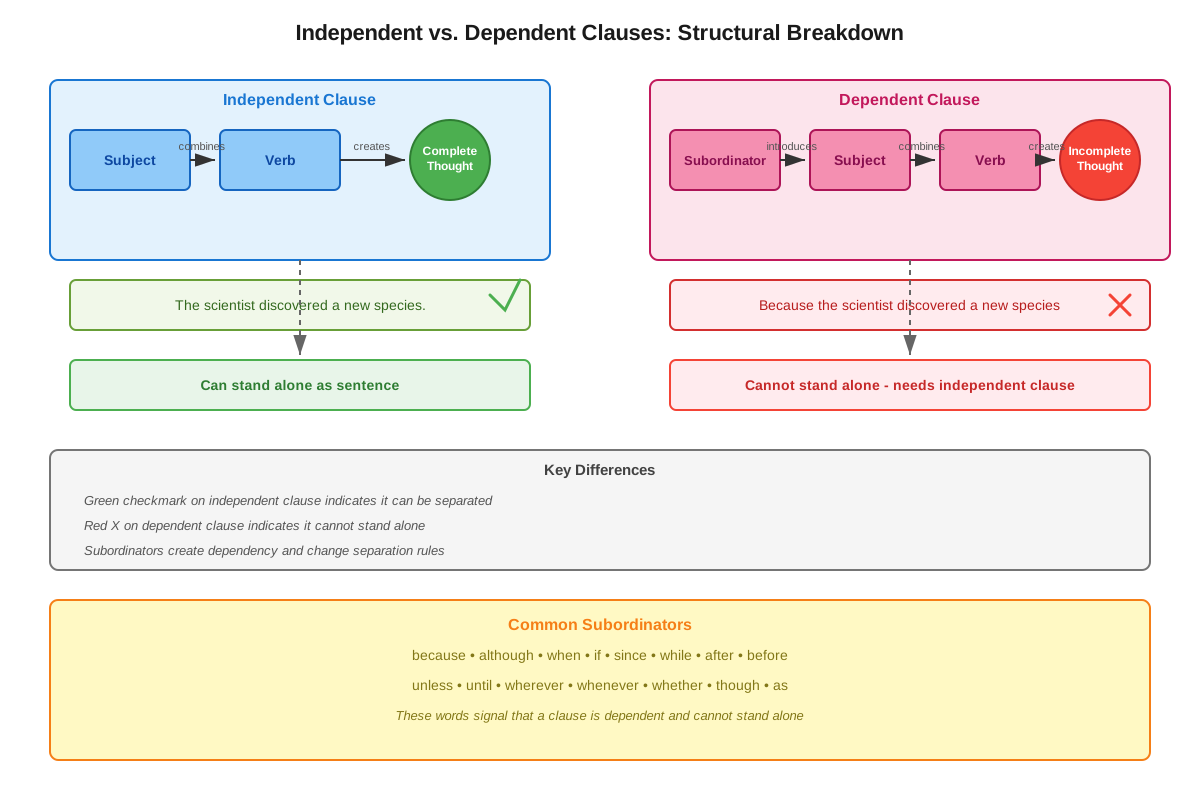
An independent clause contains a subject and a predicate and expresses a complete thought that can stand alone as a sentence. Understanding independent clauses is the foundation of sentence separation because the rules for separating sentences apply specifically to how independent clauses relate to each other. For example, "The researcher conducted the experiment" is an independent clause—it has a subject (researcher), a verb (conducted), and expresses a complete idea.
When two independent clauses appear adjacent to each other, they cannot simply be placed side-by-side without proper punctuation or conjunction. This creates what grammarians call a fused sentence or run-on sentence. The SAT frequently tests whether students can recognize when two independent clauses require separation or proper connection.
The Four Methods of Proper Sentence Separation
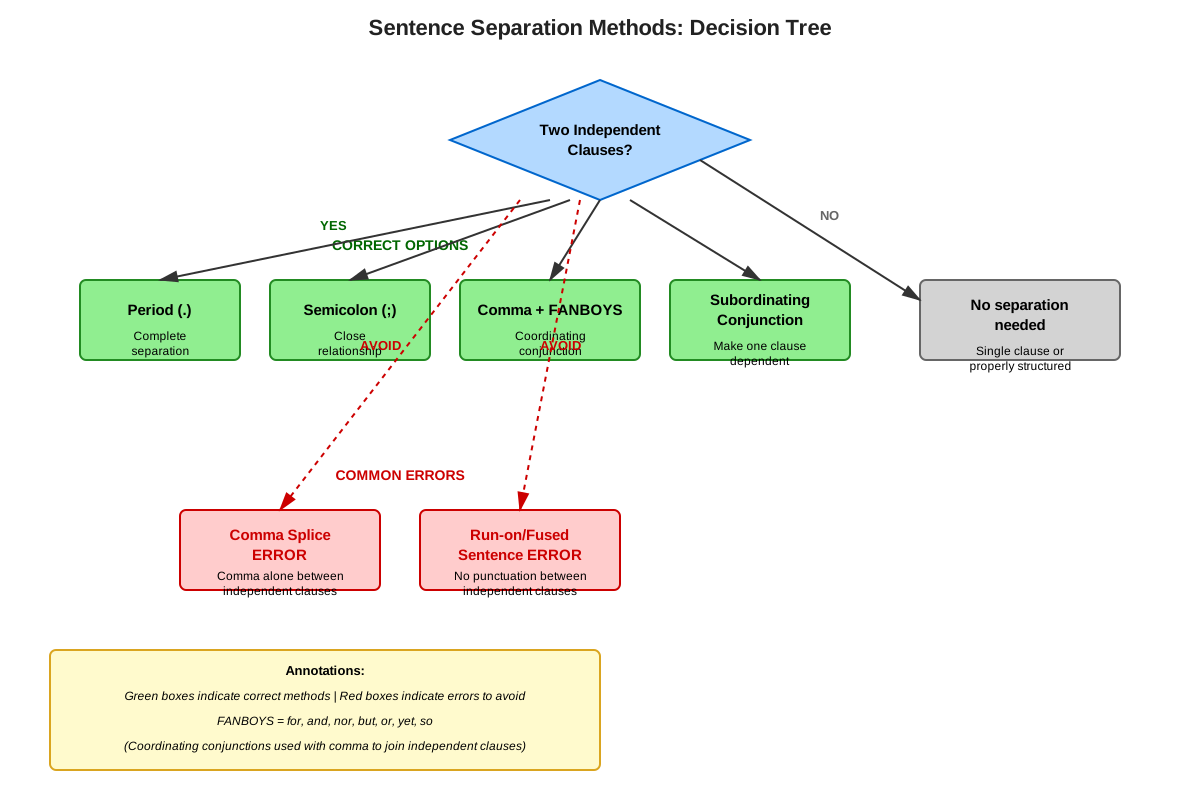
There are exactly four grammatically correct ways to handle two independent clauses that appear together:
- Period separation: Place a period between the clauses and capitalize the first word of the second clause, creating two separate sentences.
- Example: "The experiment succeeded. The researchers published their findings."
- Semicolon connection: Use a semicolon to join closely related independent clauses without a coordinating conjunction.
- Example: "The experiment succeeded; the researchers published their findings."
- Comma + coordinating conjunction: Use a comma followed by one of the FANBOYS coordinating conjunctions (for, and, nor, but, or, yet, so).
- Example: "The experiment succeeded, and the researchers published their findings."
- Subordination: Convert one independent clause into a dependent clause by adding a subordinating conjunction (although, because, since, when, while, if, etc.).
- Example: "Because the experiment succeeded, the researchers published their findings."
Comma Splices: The Most Common Error
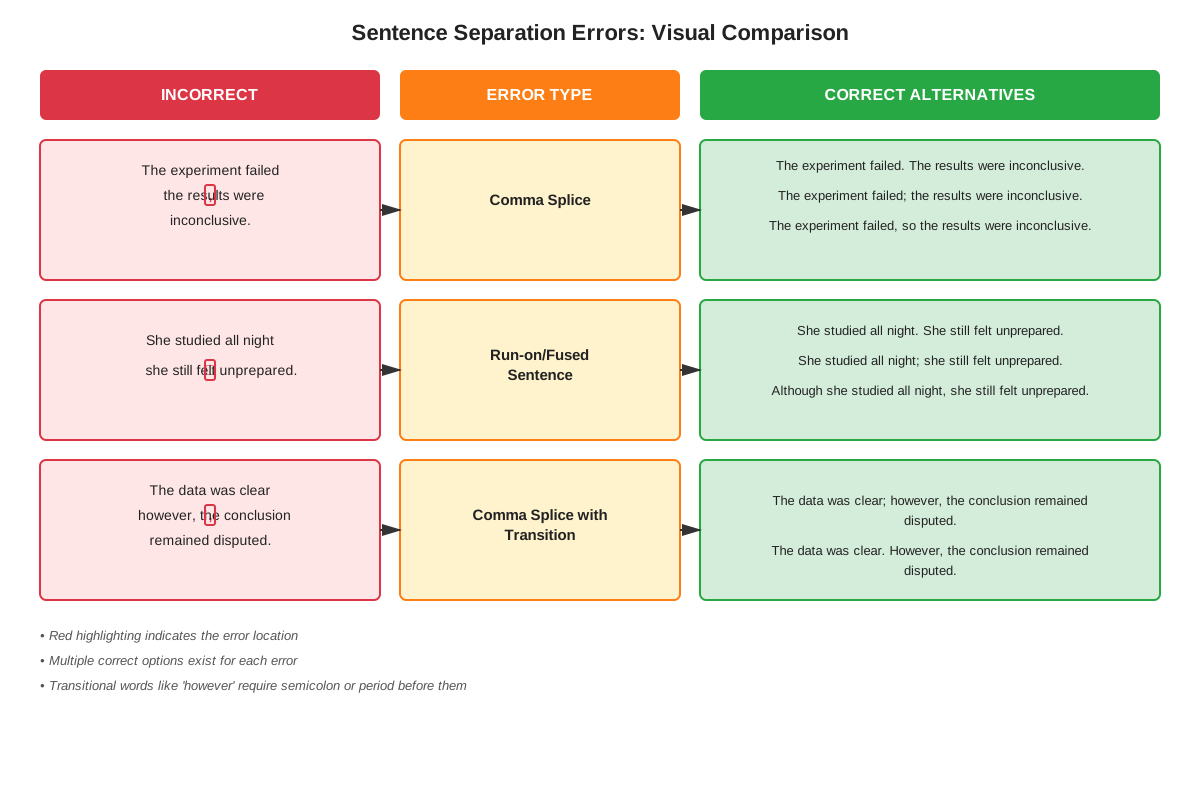
A comma splice occurs when two independent clauses are joined with only a comma, without a coordinating conjunction. This is the most frequently tested sentence separation error on the SAT. Students must recognize that a comma alone is insufficient to separate or join independent clauses.
Incorrect: "The data was compelling, the team requested additional funding."
Correct options:
- "The data was compelling. The team requested additional funding." (period)
- "The data was compelling; the team requested additional funding." (semicolon)
- "The data was compelling, so the team requested additional funding." (comma + conjunction)
- "Because the data was compelling, the team requested additional funding." (subordination)
Semicolons and Their Specific Function
The semicolon serves as a middle ground between a period and a comma—it's stronger than a comma but weaker than a period. Semicolons can only join independent clauses that are closely related in meaning. The SAT tests whether students understand that semicolons cannot join an independent clause to a dependent clause or fragment.
Correct: "The hypothesis was bold; few researchers had explored this territory."
Incorrect: "The hypothesis was bold; which few researchers had explored." (The second clause is dependent, not independent)
Conjunctive Adverbs and Transition Words
Words like "however," "therefore," "moreover," "nevertheless," and "consequently" are conjunctive adverbs, not coordinating conjunctions. This distinction is crucial for the SAT. Conjunctive adverbs cannot join two independent clauses with only a comma—they require a semicolon before them or a period before them (with the adverb starting a new sentence).
Incorrect: "The results were unexpected, however, they were reproducible."
Correct: "The results were unexpected; however, they were reproducible."
Also correct: "The results were unexpected. However, they were reproducible."
Recognizing Sentence Boundaries in Context
| Punctuation Mark | Can Join Two Independent Clauses? | Requirements |
|---|---|---|
| Period | No (separates them) | Creates two sentences |
| Comma alone | No | Creates comma splice error |
| Comma + FANBOYS | Yes | Must use coordinating conjunction |
| Semicolon | Yes | Clauses must be closely related |
| Colon | Sometimes | First clause must introduce/explain second |
| Dash | Sometimes | Used for emphasis or explanation |
Concept Relationships
Sentence separation connects directly to clause identification because students must first recognize whether clauses are independent or dependent before determining how to separate them. This identification skill leads to punctuation selection, where students choose the appropriate mark based on the relationship between clauses.
The concept flows as follows: Clause Analysis → Independence Determination → Relationship Assessment → Punctuation/Conjunction Selection. Each step depends on the previous one—students cannot select proper punctuation without first determining whether they're working with independent or dependent clauses.
Sentence separation also relates to coordination and subordination, as these are two of the four methods for handling adjacent independent clauses. Understanding when to coordinate (join clauses of equal importance) versus subordinate (make one clause dependent on another) helps students choose not just grammatically correct options but also rhetorically effective ones.
The topic connects to comma usage more broadly, as comma splice errors represent a specific misapplication of comma rules. Students who master sentence separation develop a more sophisticated understanding of when commas can and cannot be used, which supports their performance on other punctuation questions.
Quick check — test yourself on Sentence separation so far.
Try Flashcards →High-Yield Facts
⭐ A comma alone cannot join two independent clauses—this creates a comma splice, one of the most common errors tested on the SAT.
⭐ Semicolons can only join two independent clauses—they cannot connect an independent clause to a fragment or dependent clause.
⭐ Conjunctive adverbs (however, therefore, moreover) are not coordinating conjunctions—they require a semicolon or period before them when joining independent clauses.
⭐ The FANBOYS coordinating conjunctions (for, and, nor, but, or, yet, so) require a comma before them when joining two independent clauses.
⭐ An independent clause must have both a subject and a predicate and express a complete thought that can stand alone.
- A period and capital letter is always a grammatically acceptable way to separate two independent clauses, though it may not always be the most stylistically effective choice.
- Subordinating conjunctions (because, although, since, when, while, if) convert independent clauses into dependent clauses, changing the sentence structure fundamentally.
- Colons can join independent clauses when the second clause explains, illustrates, or elaborates on the first clause.
- Run-on sentences and fused sentences refer to the same error: two independent clauses joined without proper punctuation or conjunction.
- The SAT typically presents sentence separation questions with four answer choices that include different punctuation marks or conjunctions, requiring students to identify the grammatically correct option.
Common Misconceptions
Misconception: Any two sentences can be joined with a semicolon as long as they appear in the same paragraph.
→ Correction: Semicolons should only join independent clauses that are closely related in meaning and topic. The clauses must have a logical connection that justifies joining them rather than separating them with a period.
Misconception: "However" is a coordinating conjunction like "but," so it can be used with just a comma to join independent clauses.
→ Correction: "However" is a conjunctive adverb, not a coordinating conjunction. It requires a semicolon before it (or a period, making it start a new sentence) when joining independent clauses. Only the FANBOYS words are coordinating conjunctions.
Misconception: A long sentence with multiple commas must be a run-on sentence.
→ Correction: Sentence length doesn't determine whether a sentence is a run-on. A run-on occurs specifically when two independent clauses are improperly joined. A long sentence with one independent clause and multiple dependent clauses or phrases is grammatically correct.
Misconception: If two clauses are short, they can be joined with just a comma.
→ Correction: The length of clauses is irrelevant to punctuation rules. Even very short independent clauses like "I ran, she walked" require proper punctuation—this is still a comma splice. The correct version would be "I ran, and she walked" or "I ran; she walked."
Misconception: Starting a sentence with a coordinating conjunction (and, but, so) is always grammatically incorrect.
→ Correction: While some style guides discourage this practice, it is grammatically acceptable and sometimes appears in SAT passages. The key is that what follows the conjunction must be an independent clause to form a complete sentence.
Worked Examples
Example 1: Identifying and Correcting a Comma Splice
Original sentence: "The archaeologists discovered ancient pottery at the site, they dated the fragments to approximately 3000 BCE."
Step 1 - Identify the clauses:
- First clause: "The archaeologists discovered ancient pottery at the site" (independent—has subject "archaeologists" and predicate "discovered")
- Second clause: "they dated the fragments to approximately 3000 BCE" (independent—has subject "they" and predicate "dated")
Step 2 - Identify the error:
The two independent clauses are joined with only a comma, creating a comma splice.
Step 3 - Evaluate correction options:
A) "site, they dated" (original—comma splice, incorrect)
B) "site they dated" (no punctuation—fused sentence, incorrect)
C) "site; they dated" (semicolon joining two related independent clauses, correct)
D) "site, and they dated" (comma + coordinating conjunction, correct)
Step 4 - Select the best answer:
Both C and D are grammatically correct. On the SAT, if both appear as options, consider the relationship between clauses. Here, the clauses describe sequential actions in the same research project, so either works. If only one appears among the choices, select it.
Learning objective addressed: This example demonstrates how to identify independent clauses, recognize comma splice errors, and apply proper sentence separation methods.
Example 2: Distinguishing Between Conjunctive Adverbs and Coordinating Conjunctions
Original sentence: "The initial hypothesis was disproven, nevertheless the research provided valuable insights into cellular behavior."
Step 1 - Identify the word joining the clauses:
"Nevertheless" is a conjunctive adverb, not a coordinating conjunction.
Step 2 - Recognize the error:
Conjunctive adverbs cannot join independent clauses with only a comma. This is a comma splice.
Step 3 - Evaluate correction options:
A) "disproven, nevertheless the research" (comma splice, incorrect)
B) "disproven; nevertheless, the research" (semicolon before conjunctive adverb, comma after—correct)
C) "disproven nevertheless, the research" (no punctuation before conjunctive adverb—fused sentence, incorrect)
D) "disproven, but nevertheless the research" (redundant—"but" and "nevertheless" serve the same function, stylistically poor)
Step 4 - Select the answer:
Option B is correct. The semicolon properly separates the independent clauses, and the comma after "nevertheless" follows the convention for conjunctive adverbs (though this comma is sometimes optional).
Learning objective addressed: This example shows how sentence separation appears on the SAT, specifically testing the distinction between conjunctive adverbs and coordinating conjunctions—a high-yield concept that frequently appears on the exam.
Exam Strategy
When approaching sentence separation questions on the SAT, follow this systematic process:
Step 1 - Identify clause boundaries: Read the sentence and locate the main verbs. Determine whether you have one independent clause or multiple independent clauses. Look for subjects and predicates to confirm independence.
Step 2 - Check for improper joining: If two independent clauses exist, examine what currently connects them. Look specifically for comma splices (comma alone) or fused sentences (no punctuation).
Step 3 - Eliminate obviously incorrect answers: Remove any choice that creates a comma splice or fused sentence. Also eliminate options that create sentence fragments by improperly subordinating a clause that should remain independent.
Step 4 - Evaluate remaining options for correctness and style: Among grammatically correct choices, consider which best maintains the relationship between ideas. The SAT occasionally tests whether students can choose the most effective option, not just a correct one.
Trigger words to watch for: "however," "therefore," "moreover," "nevertheless," "consequently," "furthermore"—these conjunctive adverbs signal potential comma splice errors if preceded only by a comma.
Time allocation: Sentence separation questions should take 20-30 seconds each. If you can quickly identify the independent clauses, the answer becomes clear. Don't overthink these questions—they test mechanical rules, not subtle stylistic choices.
Process of elimination tip: On the SAT, if you see a semicolon in an answer choice, immediately check whether both clauses on either side are independent. If one is dependent or a fragment, eliminate that choice. Semicolons have one job: joining independent clauses.
Memory Techniques
FANBOYS mnemonic: Remember the coordinating conjunctions with "FANBOYS"—For, And, Nor, But, Or, Yet, So. These are the only words that can join independent clauses with just a comma before them.
The Semicolon Rule of Thumb: Visualize a semicolon as a "weak period"—it can only go where a period could also go (between two independent clauses). If a period wouldn't work in that spot, neither will a semicolon.
The "However" Test: When you see "however," "therefore," or similar transition words, mentally replace them with "but" or "so." If the sentence would need a semicolon or period before "but," it needs one before "however" too. This helps you remember that these aren't coordinating conjunctions.
The Independence Check: Create a mental habit of asking "Can this stand alone?" for each clause. If both clauses can stand alone (both are independent), you need one of the four proper separation methods. If one cannot stand alone (it's dependent), you can use a comma or no punctuation.
Acronym for correction methods: Remember "PSCS"—Period, Semicolon, Comma+conjunction, Subordination. These are your four tools for handling two independent clauses.
Summary
Sentence separation is a high-yield SAT Reading and Writing topic that tests students' ability to properly join or separate independent clauses using correct punctuation and conjunctions. The core principle is straightforward: two independent clauses cannot be joined with only a comma (comma splice) or with no punctuation (fused sentence). Students must recognize independent clauses—those with both a subject and predicate that express complete thoughts—and apply one of four correction methods: period separation, semicolon connection, comma plus coordinating conjunction, or subordination. The SAT frequently tests comma splices involving conjunctive adverbs like "however" and "therefore," which require semicolons rather than commas. Mastering sentence separation requires understanding the distinction between coordinating conjunctions (FANBOYS) and conjunctive adverbs, recognizing when semicolons can and cannot be used, and identifying sentence boundaries in context. These questions appear consistently on every SAT administration and represent some of the most predictable points students can earn through systematic application of grammatical rules.
Key Takeaways
- Two independent clauses cannot be joined with only a comma—this creates a comma splice, one of the most tested errors on the SAT
- The four proper methods for handling adjacent independent clauses are: period, semicolon, comma + FANBOYS conjunction, or subordination
- Semicolons can only join two independent clauses; they cannot connect an independent clause to a fragment or dependent clause
- Conjunctive adverbs (however, therefore, moreover) require a semicolon or period before them, not just a comma
- Sentence separation questions appear 3-5 times per SAT Reading and Writing section, making them high-yield for score improvement
- Identifying whether clauses are independent or dependent is the essential first step in determining proper punctuation
- The SAT tests mechanical rules for sentence separation, not stylistic preferences—there is always a clearly correct answer based on grammar rules
Related Topics
Coordination and Subordination: Understanding how to join clauses of equal importance (coordination) versus making one clause dependent on another (subordination) extends sentence separation skills to more complex sentence construction and style questions.
Comma Usage: Mastering sentence separation provides the foundation for understanding broader comma rules, including how commas function with introductory elements, nonessential clauses, and items in a series.
Sentence Fragments: The flip side of run-on sentences, fragments occur when incomplete thoughts are punctuated as sentences. Understanding sentence separation helps students recognize when clauses are complete versus incomplete.
Punctuation for Effect: After mastering the mechanical rules of sentence separation, students can explore how different punctuation choices (semicolons versus periods, for example) create different rhetorical effects and pacing in writing.
Practice CTA
Now that you understand the principles of sentence separation, it's time to reinforce your learning through practice. Attempt the practice questions and flashcards for this topic to test your ability to identify comma splices, apply proper punctuation, and distinguish between coordinating conjunctions and conjunctive adverbs. These questions mirror actual SAT items and will help you build the automatic recognition skills needed to answer sentence separation questions quickly and accurately on test day. Remember: sentence separation questions are among the most predictable on the SAT—consistent practice will translate directly into points on your exam!
Sign up free to keep reading
Create a free AnvayaPrep account to finish this SAT guide on Sentence separation — plus flashcards and practice questions.